EXPERIMENTAL STUDY ON SELF COMPACTING CONCRETRE BY
PARTIAL REPLACEMENT OFCEMENT WITH PALM OIL FUEL ASH
Ms. R. Subashini
1, Mrs. J. Umanambi
21
PG scholar, Department of Civil Engineering, Paavai Engineering College, Namakkal, India
2
Head of the department, Department of Civil Engineering, Paavai Engineering College, Namakkal India
---***---Abstract Self compacting concrete(SCC) is a concrete which can be placed and compacted under its self-weight with little or no vibration effort, and is at the same time, cohesive enough to be handled without segregation or bleeding. SCC is a flowing concrete with high workability. To achieve flowing concrete low volume of coarse aggregate is used, but the reduction in volume of coarse aggregate require high volume of paste. Increased volume of cement and addition of super-plasticizer leads to higher cost. The cost of cement can be reduced by using supplementary cementitious materials. One of he potential recycle materials from palm oil industry is palm oil fuel ash(POFA). In this study laboratory tests conducted for fresh and hardened properties of SCC incorporating POFA. This study determines the feasibility of replacing cement in SCC with POFA in percentage of 0%, 10%, 20%, 30% and 50% by weight of cement, with water/binder ratio of 0.40. the fresh properties of SCC were tested for filling ability, passing ability. The hardened properties like compressive strength , split tensile strength, flexural strength were determined. Test specimens comprising of cube, cylinder and beams were prepared and tested at 7, 28days of curing.I. INTRODUCTION
Concrete is without any doubt a fascinating building material. In one way, it is very simple and anyone can mix water, cement and aggregates, cast it in moulds of almost any shape and finally obtain an artificial stone with strength. In other way, it is an extremely difficult material: no one completely understands its complex behavior both when fresh and when hardened. This ambiguity makes concrete both the most used building material in the world and a material which creates many problems, when not properly designed or placed.
Self-compacting concrete (SCC) is a fluid mixture, which is suitable for placing difficult conditions and also in congested reinforcement, without vibration. In principle, a self- compacting must have a fluidity that allows self-compaction without external energy; remain homogeneous in a form during and after the placing process and flow easily through reinforcement. Self-compacting concrete has recently been used in the pre-cast industry and in some commercial applications
The effects of POFA on the filling ability, passing ability and segregation resistance of SCC were examined. It was found that POFA can be used to produce SCC possessing the aforementioned fresh properties within the acceptable ranges. In another study concrete was produced using a particular level of POFA replacement and same or more strength was achieved as
Self-compacting concrete is a flowing concrete with high workability. To achieve flowing concrete low volume of coarse aggregates is used, but the reduction in volume of coarse aggregates require high volume of paste, i.e. cement and fine aggregates, and use of super-plasticizers. Increased volume of cement and addition of super-plasticizer leads to higher cost. The cost of cement can be reduced by using supplementary cementitious materials. Fly ash, silica fumes and Ground blast- furnace slag has been used in SCC. Malaysia has a high production rate of POFA, and previous studies have been conducted using low volume of POFA as supplementary cementitious material in SCC. This study intends to provide fresh and hardened properties of SCC using high volume of POFA, and determining its practicality.
The advantages of SCC are already recognized by the concrete industry. Design and construction specifications are urgently needed to give designers another option in meeting the demands of high performance concrete in construction. The use of POFA as cement replacement material in SCC will fully utilize the natural resource instead of becoming an industrial waste material. The replacement can reduce the cost of concrete, since the increase in the cost of cement. SCC using POFA has a good potential for greater acceptance and wider applications in civil infrastructure works in various parts of the world.
determined in terms of compressive strength, flexural strength, split tensile strength test.
To determine the fresh properties of self-compacting concrete incorporating palm oil fuel ash.
II. LITERATURE REVIEW
A. Hardik Upadhyay et al., (2011) has investigated the Testing and Mix Design Method of Self- Compacting Concrete. This paper deals with the history of SCC development and its basic principle, different testing methods to test high-flow ability, resistance against segregation, and passing ability. Finally, the mixed design as proposed is, Coarse aggregate content is fixed at 50% of the solid volume, Fine aggregate content is fixed at 40% of the mortar volume, Water-powder ratio in volume is assumed as 0.9 to 1.0 depending on the properties of the powder and Super plasticizer dosage and the final water-powder ratio are determined so as to ensure the self – compact ability.
B. Prajapati Krishnapal et al., (2013) has studied the rheological properties of Self-Compacting concrete containing fly ash. In this paper the properties of Self-Compacting concrete with different percentages of fly ash (0%, 10%, 20%, 30%) as partial replacement of cement was studied. The workability characteristics like filling ability, passing ability have been assessed using slump flow and T50 time, V Funnel time, L-Box blocking ratio, as per EFNARC Guidelines
C. Tay (1990) used unground POFA to partially replace ordinary Portland cement (OPC) and showed that it had a low pozzolanic property, and therefore recommended that POFA should not be used with a content higher than 10% of cement by weight. Later many researchers showed that ground POFA can be successfully used as aupplementary cementing material in concrete due to its good pozzolanic property (Chindaprasirt et al. 2007; Hussin and Awal 1997; Sukantapree et al. 2002; Tangchirapatet al. 2003). Tonnayopas et al. (2006) used 5– 30% ground POFA by weight of OPC and found that the incorporation of POFA in concrete decreased the strength at early ages (3 to 21 days) but the strength achieved at and after 28 days for the concretes with 5– 15% POFA met the ASTM C618 requirement (ASTM C618-08a 2008).
D. SumadiandHussin (1995), POFA can be used up to 20% cement replacement level without any adverse effect on the strength characteristics and with a durability factor at least comparable to that of OPC concrete. POFA has also shown a good potential in suppressing the expansion due to sulfate attack (Awal and Hussin 1997b; Jaturapitakkul et al. 2007) and alkali-silica reaction (Awal and Hussin 1997a).
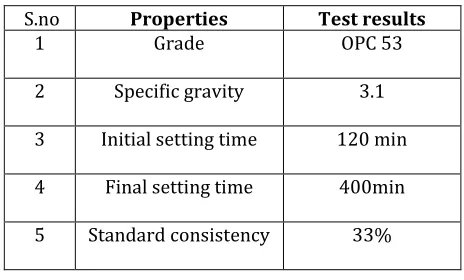
S.no Properties Test results
1 Grade OPC 53
2 Specific gravity 3.1
3 Initial setting time 120 min
4 Final setting time 400min
[image:2.596.182.414.459.599.2]5 Standard consistency 33%
Table 1 Properties of cement
Fig 1 Cement
A.
AggregateTable 2 Properties of coarse Aggregate
B.
Fine aggregate [image:3.596.199.398.296.427.2]Those fractions from 4.75mm to 150 microns are termed as fine aggregate. The river sand and crushed sand is used in combination as fine aggregate conforming to the requirements of IS:383. The river sand is washed and screened, to eliminate deleterious materials and oversize particles used.
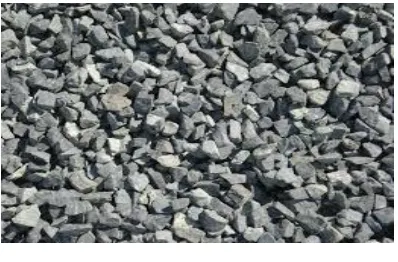
Fig 2 Coarse Aggregate
Fig 3 Fine Aggregate
Table 3 Property of Fine Aggregate
Water used for this experimental study was potable water. Water plays a major role in concrete as it actively contributes in the chemical reaction with cement. It should be free from organic matter and the pH value ranges from 6 to 7.
PROPERTIES OF WATER
The pH value shall not be less than 6.
Role of Water in Cement Concrete
Need of water used in concrete
The allowable limits for solids in water
Inorganic compounds 3000 mg/lit
Suspended matter 2000 mg/lit Water/Cement Ratio and Strength.D.
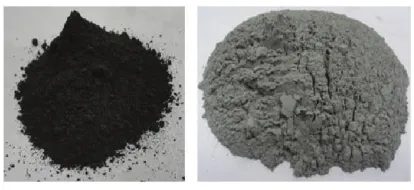
PALM OIL FUEL ASH [image:4.596.195.402.382.477.2]Palm oil fuel ash is a agro waste generated in palm oil industry. It is obtained from the combustion of Palm fruit residues of oil palm tree. Palm kernel shell and fiber husk wastes are burned in boilers as fuels the generation of energy. Temperature maintained in the boiler is above 4500c which generates about 0.5 MWt/day. Fiber husk when subjected to high temperature loses its weight and try to escape from the burning chamber. In order to collect the very fine particles of ash water is sprinkled over the chimney to increase the weight of particles such that it gets settled down at the bottom storage shaft. This collected ash from storage shaft was further pulverized, oven dried and passed through 90micron sieve and used for cement replacement
FIG 3 Palm oil fuel ash
E. MINERAL ADMIXTURES
Mineral admixtures and chemical admixtures are the extra ingredients other than water, cement, aggregates and fibers. These are added to the concrete batch plant during batch mixing or at the start when other quantities are added. Admixtures offer very favorable effects to the properties of fresh or hardened concrete only if proper use of admixtures is made possible
Mineral admixtures are the fine ground solid materials i.e., Fly ash, slag and micro silica. It is added to the concrete generally in larger amount than any other type. Because mineral admixtures have an ability to enhance workability as well as finish-ability of freshly laid concrete
F. CHEMICAL ADMIXT
Chemical Admixtures efficiency must be evaluated by comparing strengths of trial batches. Also, compatibility between cement and supplementary cementing materials, as well as water reducers, must be investigated by trial batches. From these, It will be possible to determine the workability, setting time, bleeding and amount of water reduction for given admixture and times of addition. Due to the fact that this research dealt only with super plasticizers and viscosity modifiers, papers found in the literature about these types of chemical admixtures would be presented in the following
Properties of CONPLASTSP– 337
set time or increasing air entrainment. Conplast-SP337 disperses the cement particles effectively in the concrete mix and hence exposes a larger surface area to the hydration process..
Properties of ConplastS337
Appearance Brown liquid
Specific gravity 1.18 to 1.20 at 270C
III. TEST RESULTS
A.
Compression and split tensile test result
CONCLUSION
Demand of construction materials are increased now a days. In order to bring down this problem, we are searching for new alternate materials. In the present study, POFA , and Gypsum (SCC) has been used as an admixture to cement in concrete manufacturing and its collection and properties has been studied in phase I. An experimental study will be done to check the strength and workability parameters of POFA concrete used in our project. For normal concrete, mix design is done based on In Standard (IS) method and taking this as reference design, mix design will be carried out for replacement
of POFA concrete. The test results derived from SCC concrete will be cross checked with normal concrete and end report
will be furnished in phase II.
Days FaL-G Concrete 28 DAYS 7 DAYS 14 DAYS 0 CC COMPRESSION STRENGTH
TEST - BAR CHART
40 20 Days FaL-G Concrete 28 DAYS 7 DAYS 14 DAYS
CC
SPLIT TENSILE STRENGTH TEST - BAR CHART C o mpr essi o n S tr en g th i n N /mm 2 S.NO NAME OF THE TEST SPECI
MEN DAYS
DATE OF TESTING
LOAD IN (kN) STRENGTH IN (N/mm2)
CC Concrete FaL-G CC Concrete FaL-G
1 COMPRE
SSION CUBE
7 18/02/2019 750 1040 13.5 49.0
14 25/02/2019 790 1200 31.4 54.3
28 11/03/2019 760 1450 31,7 41.7
2 SPLIT
TENSILE CYLIN
DER
7 18/02/2019 790 1500 45.6
14 25/02/2019 91.0 1200 31.6 43.6
REFERENCES
1. Okamur, H..ozawa, and M.ouchi. self compacting concrete, structure concreter, 2000,1, p 3-17
2. Karim, m, strength of concrete as influenced by palm oil fuel ash
3. Safinuddin m, development os self compacting hing perfor-mance concrete rice husk ash 2008, University opf waterloo
4. Shehub,. Duraabiolty and thermal gravimetic analysis of High volume palm oil fule ash ,2014 ,university malaysia
5. W. Gudissa and A. Dinku studied on the usage of limestone power in concrete as an alternative cement replacement material.
6. Fareed Ahmed Memon et al (2010) in this study concrete cubes were made with OPC (Ordinary Portland Cement) and with different ratios of fly-ash by replacing cement and fine aggregate in concrete.