© 2019, IRJET | Impact Factor value: 7.211 | ISO 9001:2008 Certified Journal | Page 4726
Estimation of Parameters of Kinetic Study and Arrhenius Equation for
the Reaction between Ethyl Acetate with Sodium Hydroxide
Harsh Shah
1, Setukumar Vavadiya
2, Akshay Dholariya
3, Bhaumik Patel
4, Kasim Vohra
5#1234
UG Scholars, Chemical Engineering Department, Veerayatan Institute of Engineering, Gujarat, India.
5#
Asst. Professor & Guide, Chemical Engineering Department, Veerayatan Institute of Engineering, Gujarat, India.
---***---Abstract -
Hydrolysis reaction of ethyl acetate and sodiumhydroxide was carried at different temperature and calculate the conversion of NaOH and also find out the reaction order and activation energy of particular reaction. The maximum conversion of NaOH was 96% at 36oC temperature and the
order of reaction for present reaction was best fitted for 2nd
order reaction with respect to sodium hydroxide. The activation energy of reaction was calculated by Arrhenius equation, E= 16.20 kcal/mol and frequency factor was ko =
1.85 * 1012. The enthalpy and Gibbs free energy of present
reaction was also calculated by theoretical method at different reaction temperature.
Key Words: Ethyl Acetate, Sodium Hydroxide, Kinetic Study, Activation Energy, Thermodynamic Analysis.
1. INTRODUCTION
All chemical processes features reactions as the essential step. Understanding of these reactions plays the vital role in decision making regarding the choice of reactor, the size of the reactor, magnitude of operating parameters; etc. An operational as well as theoretical insight of any reaction resides in the kinetic study of those particular reactions. This study yields certain guiding parameters; namely, rate of reaction, activation energy, rate constant. These parameters allows for the design of scaled up reactor. It also makes it possible to incorporate some modification within reactor unit.
This project work aims to carry out the kinetic study of hydrolysis reaction involving Ester acetate. Reaction is also known as saponification reaction as it produces sodium salt after completion.
In this reaction, Alkali breaks the ester bonds to release the fatty acid. This is one of the most useful reactions in many chemical industries; pharmaceuticals, food industries, and others. [1] In this experimental study, ethyl acetate is used as the main reactant. In Chemical and food industry it is used as solvent. [2]
The product Sodium Acetate is also used in clearing purpose. The special characteristic of sodium Acetate is “Hot ice”.it is crystalline form of sodium Acetate. In making hot ice we are using sodium tri sulphite in place of sodium Acetate to generate Super Saturated salutation. Sodium acetate used as salty vinegar test in chips and also as a sealing agent in concrete. [3]
This work revolves around three key words; reaction, hydrolysis and kinetic study. The following paragraph expands on these three terms:
A process in which Raw Material are converted in to the product that Reaction is called Chemical Reaction. And Study of the parameter such as reaction-order, reaction constant and the effect of temperature, concentration, temperature and agitation on these parameters.
Now second fundamental term is the Difference between “Hydration Process” And “Hydrolysis process” .When the process is carried by Addition of water molecular is called “Hydration Process” while the compound is broken by water molecule is called “hydrolysis process”. [4]
© 2019, IRJET | Impact Factor value: 7.211 | ISO 9001:2008 Certified Journal | Page 4727
Chemical reaction takes place when a detectable number ofmolecules of one or more species have lost their identity and assumed a new form by a change in the kind or number of atoms in the compound and by a change in structure or configuration of these atoms. In this classical approach to chemical change, it is assumed that the total mass is neither created nor destroyed when a chemical reaction occurs.
Chemical kinetics is the part of physical chemistry that studies reaction rates. The reaction rate for a reactant or product in a particular reaction is intuitively defined as how fast a reaction takes place. For example, oxidation of iron under the atmosphere is a slow reaction which can take years, but the combustion of butane in a fire is a reaction that takes place in seconds.
2. EXPERIMENTAL SECTION
2.1 Method
First of all we prepare 500 ml of the 0.3 N Ethyl Acetate, 0.2 N Sodium hydroxide and 0.2 N Hydrochloric Acid was the first step of experimental work. Thereafter; 150 ml of 0.3 N Ethyl Acetate was taken in the reaction beaker and this solution was heated up to desired temperature (300 oC for first run) in the water bath. Sodium hydroxide, heated up to same temperature as ethyl acetate, was poured into reaction beaker containing ethyl acetate. 10 ml of solution was drawn out from the reaction mixture for titration after every two minutes for the titration--against 0.2 N Hydrochloric Acid. Similarly, the experiments were carried out to record the consumption of sodium hydroxide in this hydrolysis reaction occurring at different temperature; 30, 32, 36 degree Celsius.
The same procedure was carried out to analyze the effect of stirring. During that particular run, reaction was allowed to carry out under stirring effect, imparted by magnetic stirrer.
2.2 Calculations
The consumption of sodium hydroxide was tracked by mean of volumetric titration. The amount of acid went in to titration was substituted into the following equation to determine the amount of sodium hydroxide present at particular time.
Where, = Normality of NaOH = Volume of mixture = normality of HCL
= Volume of HCl used For titration
Then for % conversion of Ethyl Acetate= 1- × 100, [5]
Where, Ca = Concentration of reactant at different reaction time
Cao = Initial Concentration of reactant
3. RESULTS AND DISCUSSIONS
3.1 Effect of reaction temperature
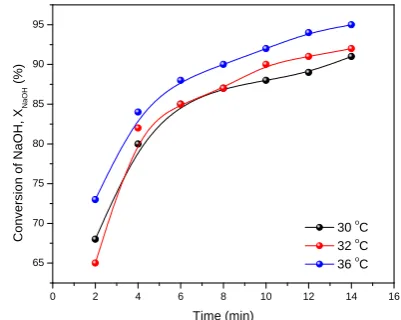
The reaction was studied at different reaction temperature and calculate the conversion of NaOH with time. The maximum conversion was 95% at 14 minutes time. Conversion of NaOH at different temperature with respect to time are showed in figure 1.
0 2 4 6 8 10 12 14 16
65 70 75 80 85 90 95
C
o
n
ve
rsi
o
n
o
f
N
a
O
H
,
XNaOH
(%
)
Time (min)
30 oC 32 oC 36 o
[image:2.595.330.531.298.458.2]C
Fig -1: Plot of conversion of NaOH vs time at different temperatures.
3.2 Kinetic studies
Kinetics of hydrolysis of ethyl acetate with sodium hydroxide has been extensively studied. The kinetic profile of given reaction showed the continuous decrease in concentration of sodium hydroxide with time as show in figure 2.
The rate of reaction is defined as the change in the number of molecules of reacting species per unit volume per unit time. It is also defined to be proportional to the concentration of reacting species raised to a certain power called the order of reaction. It is usually taken as the rate at which the reactant disappear or the rate at which the product is formed.
© 2019, IRJET | Impact Factor value: 7.211 | ISO 9001:2008 Certified Journal | Page 4728
2 4 6 8 10 12 14
0.01 0.02 0.03 0.04 0.05 0.06 0.07
C
o
n
ce
n
tra
ti
o
n
o
f
N
a
O
H
,
CNaOH
(mo
l/
lit
)
Time (min)
[image:3.595.69.265.101.265.2]30 o C
Fig -2: Plot of concentration of NaOH vs time. Rate constant: Rate constant, K quantifies the speed of a chemical reaction. For a chemical reaction where substance A and B are reacting to produce C, the reaction rate has the form
A + B C R = k [A]m[B]n
Where, k is the rate constant that depends on temperature. A is the concentration of substance A in moles per volume of solution assuming the reaction is taking place throughout the volume of the solution.
Rate constant is the rate of reaction when the concentration of each reaction is taken as unity. That is why it is also known as specific reaction rate. It is a measure of the rate of reaction, so the greater the value of the rate constant, the faster the reaction. Each reaction has a definite value of the rate constant at a particular temperature and the value of the rate constant for the same reaction changes with temperature and the values do not depend upon the concentration of reaction but depend upon order of reaction.
The hydrolysis of ethyl acetate illustrates a bimolecular reaction that gives sodium acetate and ethanol as the product from which second order rate constant can be calculated:
EA + NaOH SA + Eth
As the reaction proceeds, each hydroxide ion removed in the formation of ethanol removes one molecule of ethyl acetate, being the number of moles of either OH- or ethyl acetate so removed, the concentration of the reactants decreases. If we start with equal concentrations of the reactants, the concentration of NaOH can be conveniently followed at different time intervals by withdrawing an aliquot from the reaction mixture and determining the NaOH present in it direct or indirect titration with a standard solution of an acid. The fact that it is a second order reaction can be established by the consistency of the values of k determined by substituting the titration results at different time intervals in the second order rate equation.
In order to quantify the reaction order, rate constant and activation energy, sets of lab-scale experiments were carried out. In these experiments, two reactants; ethyl acetate and sodium hydroxide were made to react at different temperature; 30, 32, 36 degrees Celsius etc. The progress of reaction was tracked by finding the consumption of reactants with respect to time by mean of acid-base titration.
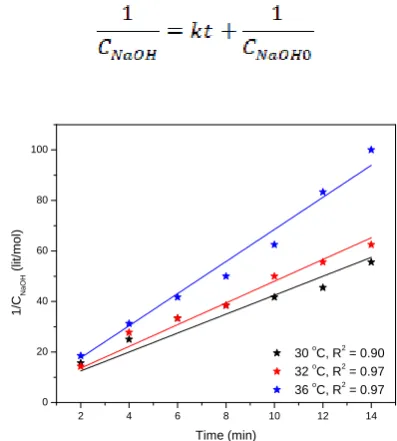
The second order rate constant with respect to consumption of NaOH was also calculated at different temperatures by plotting 1/CNaOH with time using following equations, [5] which gives best fit for second order kinetic as shows in figure 3:
2 4 6 8 10 12 14
0 20 40 60 80 100
1
/C
NaOH
(l
it
/mo
l)
Time (min) 30 o
C, R2 = 0.90 32 o
C, R2 = 0.97 36 oC, R2 = 0.97
Fig -3: Second order rate constant plot of 1/CNaOH vs time.
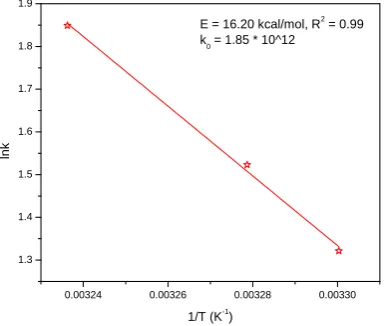
Obtained value of rate constant “k” allows for the determination of Arrhenius parameters like; activation energy and frequency factor. Plot of logarithm of k against the temperature yields the straight line. The slop of the straight –line equals the factor E/R; while the intercept represent the frequency factor.
The Arrhenius equation was fitted to the rate constant values at various temperatures. The equation is, [5]
lnk=
[image:3.595.338.537.267.488.2]© 2019, IRJET | Impact Factor value: 7.211 | ISO 9001:2008 Certified Journal | Page 4729
good fitness of lnk versus 1/T in figure 4. The activationenergy was found to be E=16.20 kcal/mol with frequency factor 1.85×10¹²
for the given reaction.
0.00324 0.00326 0.00328 0.00330 1.3
1.4 1.5 1.6 1.7 1.8 1.9
ln
k
1/T (K-1 )
[image:4.595.64.257.153.316.2]E = 16.20 kcal/mol, R2 = 0.99 k0 = 1.85 * 10^12
Fig -4: Arrhenius plot for activation energy.
The final expression for the rate constant can be written as,
3.2 Thermodynamic analysis
Thermodynamic analysis can lead to a better understanding of the overall performance of any chemical reaction. The thermodynamic properties of given reaction were also studied.
Over all reaction is,
EA + NaOH SA + Eth
We calculate the enthalpy of formation of reaction at standard state. For this we need enthalpy of formation of substrates and products at T= 298 K.
= -445 kJ mol-1 [6]
= -427 kJ mol-1 [7]
= -709.32 kJ mol-1 [8]
= -235.3 kJ mol-1 [9]
/mol (Reaction is Exothermic)
By using following equation, we calculate theoretically Gibbs free energy for this reaction at standard condition (T=298 K),
= -251.12 kJ mol-1 [10]
= -380.7 kJ mol-1 [7]
= -607.7 kJ mol-1 [8]
= -170.86 kJ mol-1 [11]
-1 (Spontaneous reaction in
forward direction)
Now,
As the reaction approaches equilibrium, becomes less negative and finally reaches zero. At equilibrium [12]
and Qc = Keq , so we can write
K eq= exp ( )
At 298 K,
Keq = 5.27 * 1025
After that,
ln = -
© 2019, IRJET | Impact Factor value: 7.211 | ISO 9001:2008 Certified Journal | Page 4730
302 303 304 305 306 307 308 309 310-35.75 -35.70 -35.65 -35.60 -35.55 -35.50 -35.45 -35.40 -35.35
G
ib
b
s
fre
e
e
n
e
rg
y
o
f
re
a
ct
io
n
(kca
l/
mo
l)
[image:5.595.62.264.99.261.2]Temp (K)
Fig -5: Plot of Gibbs free energy of reaction vs Temperature.
302 303 304 305 306 307 308 309 310 1.80E+025
2.00E+025 2.20E+025 2.40E+025 2.60E+025 2.80E+025 3.00E+025 3.20E+025 3.40E+025
Eq
u
ili
b
ri
u
m
C
o
n
st
a
n
t
Temp (K)
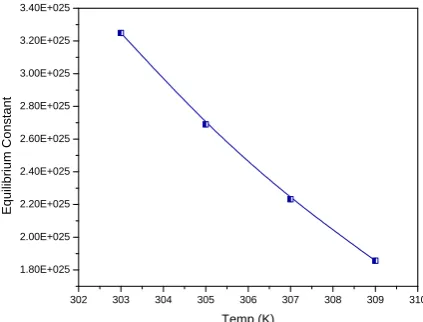
Fig -6: Plot of equilibrium constant vs Temperature.
4. CONCLUSIONS
Findings of the experiments reveal that the hydrolysis reaction involving sodium hydroxide and ethyl acetate follows second order kinetics. The value of reaction constant, k, increases with temperature up to 36oC. It leads to the conclusion that the temperature ranging from 30-34 is critical for efficient conversion. Besides, this study has also demonstrated the adverse effect of stirring on overall reaction yield, which means that the reaction rate cannot be enhanced by stirring; However, lower value of activation energy for this particular reaction lend itself to the enhancement by the use of appropriate catalyst. Higher value of equilibrium constant and lower value of Gibbs free energy also corroborate the fact to get maximum conversion of NaOH, 95 % in very less time around 14 minutes at 36oC for the given reaction.
ACKNOWLEDGEMENT
This work was carried out at Veerayatan Institute of Engineering, Gujarat, India. The authors are thankful to Mr. Sagar Jani, HOD of Chemical Engineering Department and
other faculty members Mr. Vijay Patel, Mr. Milind Matang
& Ms. Megha Chhatbar for sharing their pearl of wisdom during the course of this research work. Authors are also special thankful to Mr. Milind Matang for helping in editing the research paper.
ABBREVIATIONS
EA - Ethyl acetate SA - Sodium acetate Eth - Ethanol
NOTATIONS
- Enthalpy of formation of ethyl acetate at standard state
- Enthalpy of formation of sodium hydroxide at standard state
- Enthalpy of formation of sodium acetate at standard state
- Enthalpy of formation of ethanol at standard state
- Enthalpy of reaction at 298 K
- Gibbs free energy of ethyl acetate at standard state - Gibbs free energy of sodium hydroxide at standard state
- Gibbs free energy of sodium acetate at standard state - Gibbs free energy of ethanol at standard state
- Gibbs free energy of reaction at 298 K Keq - Equilibrium constant
REFERENCES
1) Ahmad Mukhtar, Umar Shafiq, Ali Feroz Khan, Hafiz Abdul Qadir and Masooma Qizilbash, Estimation of Parameters of Arrhenius Equation for Ethyl Acetate Saponification Reaction, Research Journal of Chemical Sciences, Vol. 5(11), 46-50, November (2015)
2) Obi Chidi* and Okoye Ifedi Peter, Kinetics and Mechanism of Ethyl Acetate Production Using Eco-Benign Solid Catalyst, DOI: 10.4172/2161-0398.1000219, J Phys Chem Biophys 2016
3) https://www.amazingrust.com/Experiments/how_to/H ot-Ice.html
[image:5.595.54.266.294.455.2]© 2019, IRJET | Impact Factor value: 7.211 | ISO 9001:2008 Certified Journal | Page 4731
5) Octave Levenspiel, Chemical Reaction Engineering, 3rd edition, Willey India Pvt. Ltd, 13, August (1998)
6) https://en.wikipedia.org/wiki/Ethyl_acetate_(data_page ), 19th March, 2019
7) https://en.wikipedia.org/wiki/Sodium_hydroxide, 19th March, 2019
8) https://en.wikipedia.org/wiki/Sodium_acetate, 19th March, 2019
9) https://en.wikipedia.org/wiki/Ethanol_(data_page), 19th March, 2019
10) https://www.chemeo.com/cid/57-231-2/Ethyl%20acetate
11)https://www.chemeo.com/cid/35-653-8/Ethanol
12)Smith, J. M., & Van, N. H. C. (1959). Introduction to chemical engineering thermodynamics. New York: McGraw-Hill.
BIOGRAPHIES
Mr. Harsh Shah is a 4th year student of B.E. in chemical engineering branch at Veerayatan Institute of Engineering, Gujarat, India
Mr. Setukumar Vavadiya is a 4th year student of B.E. in chemical engineering branch at Veerayatan Institute of Engineering, Gujarat, India
Mr. Akshay Dholariya is a 4th year student of B.E. in chemical engineering branch at Veerayatan Institute of Engineering, Gujarat, India
Mr. Bhaumik Patel is a 4th year student of B.E. in chemical engineering branch at Veerayatan Institute of Engineering, Gujarat, India