Automatically Developing a Fine-grained Arabic Named Entity Corpus
and Gazetteer by utilizing Wikipedia
Fahd Alotaibi
School of Computer Science
University of Birmingham, UK
[email protected]
Mark Lee
School of Computer Science
University of Birmingham, UK
[email protected]
Abstract
This paper presents a methodology to ex-ploit the potential of Arabic Wikipedia to as-sist in the automatic development of a large Fine-grained Named Entity (NE) corpus and gazetteer. The corner stone of this approach is efficient classification of Wikipedia articles to target NE classes. The resources developed were thoroughly evaluated to ensure reliability and a high quality. Results show the developed gazetteer boosts the performance of the NE classifier on a news-wire domain by at least 2 points F-measure. Moreover, by combining a learning NE classifier with the developed cor-pus the score achieved is a high F-measure of 85.18%. The developed resources overcome the limitations of traditional Arabic NE tasks by more fine-grained analysis and providing a beneficial route for further studies.
1
Introduction
Previous efforts that have been made to develop an Ara-bic NER either focused on traditional NE classes (Be-najiba et al., 2010) or sought to expand only one class at a time (Shaalan and Raza, 2007). Applications such as Question Answering (QA) receive more benefits when a fine-grained NER is developed. This is true when we consider that, the majority of factoid questions are about named entities (Noguera et al., 2005). Having a finer NER, results in the possibility of extracting more semantic knowledge from the context. For example, if we consider the following sentence:
(
ﻞﺋﺎﺳﻭ ﺕﺎﻛﺮﺷ ﺮﺒﻛﺃ ﻲﻫ ﻲﻧﺰﻳد ﺖﻟﺍﻭ ﺔﻛﺮﺷ
ﻢﻟﺎﻌﻟﺍ ﻲﻓ ﻪﻴﻓﺮﺘﻟﺍﻭ ﻡﻼﻋﻹﺍ
/ˇsrk~wAlt dyzny hy Okbr ˇsrkAt wsAˆyl AlIςlAm wAltrfyh fy AlςAlm/ ‘Walt Dis-ney is the largest media company in the entertainment world’)1We would have more semantic information if we could tag (
ﻲﻧﺰﻳد ﺖﻟﺍﻭ
/wAlt dyzny/ ‘Walt Disney’)1Throughout this paper, Arabic words are represented in
three variants: (Arabic word /HSB transliteration scheme (Habash et al., 2007) / “English translation”)
as [ORG-ENTERTAINMENT] rather than just [ORG]. This deeper semantics is very helpful when answering factoid question like “What is the largest entertainment company?”
Supervised machine learning technologies have been successfully adopted for several natural language tasks, including NER. These technologies require a reason-able portion of data to be accessible in the training phase, containing a number of positive and negative examples to learn from and to circumvent the problem of data sparseness. Traditional methods for compiling such data involve recruiting individuals to annotate a certain corpus manually. This is tedious work, as well as costly and time consuming. Moreover, manually an-notating a large portion of a relatively open domain cor-pus beyond a news-wire and across various genres is not easy for an individual to achieve.
Therefore, when developing a reasonable fine-grained NE corpus two questions should be answered. First, what proper fine-grained semantic classes should be established? Second, how to develop a reasonable sized fine-grained NE corpus at minimum cost? This work answers those questions.
To these ends the methodology we devised was de-signed to utilise the availability and growth of Ara-bic Wikipedia to develop a large and extendable fine-grained named entity corpus and gazetteer with min-imum human intervention. The contributions of this paper are:
1. It introduces a two-level tagset for Wikipedia NEs;
2. It develops a large fine-grained automatic NE cor-pus using minimum human intervention;
3. It develops a large fine-grained gazetteer; and
4. It thoroughly evaluates the resulting corpus and gazetteer.
2
Arabic Wikipedia and Named Entity
Wikipedia is an extensive collaborative project on the web in which articles are published and reviewed by volunteers from around the world. Wikipedia includes
271 different languages, with the Arabic version ranked 27th with more than 210,000 articles. The annual in-crease in the number of articles is 30% (Wikipedia, 2013). The actual relationship between the Named Entity and Wikipedia is that a large percentage of Wikipedia articles are about named entities (Alotaibi and Lee, 2012). This provided the motivation to utilise Wikipedia’s underlying structure to produce the target resources.
To this end, it is beneficial to provide an overview of the critical aspects of the Wikipedia structure:
• Articles: These can be one of the following:
1. Normal article: Each article has a unique title and contains authentic content; i.e. textual data, images, tables, items and links, related to the con-cept represented in the title. These are in the ma-jority.
2. Redirected article: These contain a specific tag to redirect the enquirer to a normal article. For ex-ample: for the redirected article titled (
ﺎﻴﻧﺎﻄﻳﺮﺑ
ﻰﻤﻈﻌﻟﺍ
/bryTAnyA AlςDm´y/ ‘Great Britain’),ˇ there is a redirected tag to (ﺓﺪﺤﺘﻤﻟﺍ ﺔﻜﻠﻤﻤﻟﺍ
/Almmlk~ AlmtHd~/ ‘United Kingdom’). This tag is written thus #REDIRECTED[[ﺔﻜﻠﻤﻤﻟﺍ
ﺓﺪﺤﺘﻤﻟﺍ
]].3. Disambiguation article: These are used to list all the article titles that share ambiguities.
• Links types: There are two types of links in
Wikipedia and they are described below:
1. Non-piped links: this type of links denotes that the display phrase of the link and the article’s title are the same. For example: [[London]].
2. Piped links: this type of link allows for the text that appears in the contextual data to be different from the actual article it refers to. For example: [[UK|United Kingdom]], where “UK” appears in the display text, while “United Kingdom” refers to the titles of the article.
Throughout this paper, the terms “link” and “link phrase” are used interchangeably to refer to the same thing.
• Connectivity: Used links, of any type, in the
textual data of any normal article, provide con-nectivity and thereby an underlying structure for Wikipedia; we are seeking to utilise to achieve our goal.
3
Transforming Arabic Wikipedia into a
Fine-grained NE corpus and Gazetteer
In this section we present in detail the approach advised to automatically develop a tagged fine-grained named entity corpus and gazetteer based on Arabic Wikipedia.
3.1 The Conciseness of the Approach
Our assumption regarding this work is as follows: If we are able to classify Wikipedia articles into NE classes, we will then be able to map the resultant la-belling back into contextualised linked phrases. This involves the following steps:
1. Defining a fine-grained taxonomy suitable to Wikipedia;
2. Classifying Arabic Wikipedia articles into a pre-defined set of fine-grained NE classes;
3. Mapping the results of the classification back to the linked phrases in the text;
4. Detecting successive mentions of NE that have not been associated with links, while taking into ac-count the Arabic morphological variation of the NE phrase; and
5. Selecting sentences to be included in the final cor-pus.
3.2 Defining Fine-grained Semantic NE Classes
Sekine et al. (2002) proposed a hierarchical named en-tity taxonomy that is very fine, with 150 subclasses. The methodology they used to construct semantic classes relies on analysing the named entities in a newswire corpus, in addition to analysing the answer type for a set of questions used in a Text Retrieval Con-ference TREC-QA task. WordNet noun hierarchy is also used to shape the classes further. Two years later, Sekine and Nobat (2004) added an extra 50 classes and decomposed some classes, such as “disease” and nu-meric expression respectively. Although the spectrum of classes is very wide, the specific descriptions and definitions for each class strives to avoid overlap and ambiguity, making it difficult to define. This taxonomy has been applied to both English and Japanese.
Some NLP applications, such as QA have designed their own named entity classes, based on the criteria they believe to be the most valuable. Harabagiu et al. (2003) developed a named entity recognition com-ponent in which one level consists of 20 defined fine grained classes. Knowing that factoid type questions require named entities, Li and Roth (2006) defined a fine grained taxonomy to answer certain types of ques-tions. Although, their two layer taxonomy covered 50 fine grain classes of different types, some types were unrelated to named entities such as definition, descrip-tion, manner and reason. Based on the same trend, Brunstein (2002) presented a two-level taxonomy in which 29 answer types are subdivided into 105 sub-types. Other researchers have adopted and used their taxonomy for named entity taxonomy (Nothman et al., 2008).
in the sense that it organises granularity into two lay-ers, i.e. coarse and fine grained. In the evaluation of ACE (2008), the number of fine grain classes is 45. This taxonomy is designed in two levels of gran-ularities and frequently used in the news-wire domain. Moreover, two-level taxonomy allows us to map a tagset into different traditional schemes easily, such as CoNLL or MUC.
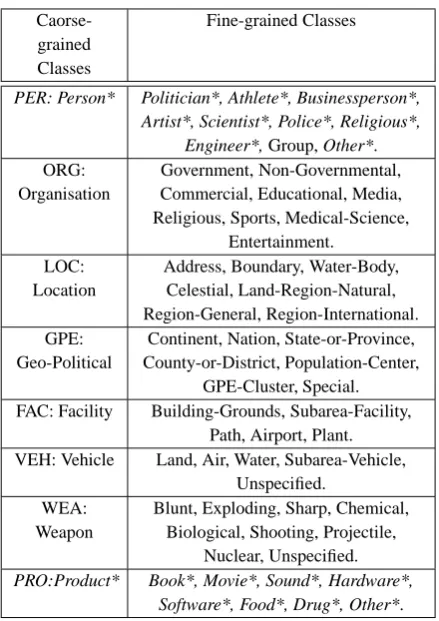
Thus, ACE (2008) taxonomy was selected and be-cause it is designed for a news-wire domain we applied some amendments to tailor it for use in a relatively open domain corpus, such as Wikipedia. For example, there are many articles in Wikipedia about people in different subclasses, such as scientists, athletes, artists, politicians, etc. These fine classes are not included in ACE, as it only involves three sub-classes: the individ-ual, group and indeterminate. Another modification is performed; a new class called “Product” is added. This modified taxonomy is presented in Table 1.
Caorse-grained Classes
Fine-grained Classes
PER: Person* Politician*, Athlete*, Businessperson*, Artist*, Scientist*, Police*, Religious*,
Engineer*, Group, Other*. ORG:
Organisation
Government, Non-Governmental, Commercial, Educational, Media, Religious, Sports, Medical-Science,
Entertainment. LOC:
Location
Address, Boundary, Water-Body, Celestial, Land-Region-Natural, Region-General, Region-International. GPE:
Geo-Political
Continent, Nation, State-or-Province, County-or-District, Population-Center,
GPE-Cluster, Special. FAC: Facility Building-Grounds, Subarea-Facility,
Path, Airport, Plant. VEH: Vehicle Land, Air, Water, Subarea-Vehicle,
Unspecified. WEA:
Weapon
Blunt, Exploding, Sharp, Chemical, Biological, Shooting, Projectile,
Nuclear, Unspecified. PRO:Product* Book*, Movie*, Sound*, Hardware*,
Software*, Food*, Drug*, Other*.
Table 1: ACE (2008) modified taxonomy. The mod-ified or added classes are represented with italics and asterisks
3.3 Wikipedia Document Classification
The aim of classifying Wikipedia articles is to produce a list of two tuples, like<article’s title, fine-grained NE tag>. The following sub sections describe the steps taken to achieve this goal.
3.3.1 Fine-grained Document Annotation and Quality Evaluation
In order to classify Arabic Wikipedia articles into named entity classes, we manually annotated 4000 ar-ticles into two levels of granularity, i.e. coarse and fine grained, using the modified taxonomy shown in Table 1. Two Arabic natives were involved in the annotation process and the inter-annotator agreement between the annotators was calculated using Kappa Statistic (Car-letta, 1996). Table 2 shows that the inter-annotator agreement was calculated for different sizes of docu-ments, i.e. 500, 2000 and 4000. This revealed diffi-culties that might be encountered during the annotation process.
Level Kappa:
n=500
Kappa:
n=2000
Kappa:
n=4000
Coarse-grained 92 98 99
[image:3.595.72.292.313.624.2]Fine-grained 80 95 97
Table 2: Inter-annotator agreement in coarse and fine grained levels
3.3.2 Features Engineering and Representation
We developed our classification model relying on the set of features proposed by Alotaibi and Lee (2012) as these score 90% on the F-measure for coarse grained level. The features were:
1. Simple Features (SF): which represent the raw dataset as a simple bag of words without further processing.
2. Filtered Features (FF): involving removing the punctuation and symbols, filtering stop words and normalising digits.
3. Language-dependent Features (LF): represent the tokens in their stem form.
4. Enhanced Language-dependent Features (ELF): involving tokenising the sentence and
assigning parts of speech for each token. This allows filtering of the dataset by involving only nouns (for instance) in the classifier.
In addition, we extended this set of features by extract-ing two more features:
1. First paragraph: Instead of just relying on the first sentence as in (Alotaibi and Lee, 2012), we identified useful features spread across the first paragraph.
2. Bigram: By using this feature, we aim to examine the effects of the collocation of tokens. Here we added the representation of a bigram while still preserving the unigram.
3.3.3 Fine-grained Document Classification Results
The annotated dataset was divided into training and test at 80% and 20% respectively. We chose the Support Vector Machine (SVM) and Stochastic Gradient De-cent (SGD) as a probabilistic model for the classifier. In each round of the classification, we tested one set of features and selected the one that performed best.
Table 3 shows the overall results for the fine-grained classification. There are three main findings. First, both classifiers tend to perform in a very similar way; there-fore, in practice, use of either classifier to perform the final classification for the whole Wikipedia dataset will be expected to deliver very similar results. The sec-ond finding is that, the bigram features have little effect when different features are set. Finally, the best result for both classifiers was achieved using theELFU ni fea-ture.
Features set SVM SGD
P R F P R F
[image:4.595.75.289.289.421.2]SFU ni 0.78 0.79 0.78 0.78 0.79 0.78 SFU ni+Bigram 0.80 0.81 0.80 0.80 0.81 0.79 FFU ni 0.80 0.81 0.80 0.81 0.82 0.80 FFU ni+Bigram 0.81 0.82 0.81 0.81 0.82 0.81 LFU ni 0.77 0.78 0.77 0.78 0.79 0.78 LFU ni+Bigram 0.79 0.80 0.79 0.79 0.80 0.79 ELFU ni 0.82 0.83 0.82 0.82 0.83 0.82 ELFU ni+Bigram 0.81 0.82 0.81 0.82 0.82 0.81
Table 3: The average fine-grained classification results when using SGD and SVM over different features sets where (tf-idf) is applied
3.4 Compiling the Corpus
Compilation of the final corpus was achieved according to the pipeline steps as follows:
1. Prepare and extract the features for all Arabic Wikipedia datasets, according to the method pre-sented in Section 3.3.2;
2. Train an SVM classifier using the training dataset (4000 articles);
3. For each Wikipedia article, classify the article into the target fine-grained NE class;
4. Prepare final list of all articles’ titles and their tags; and
5. Detect successive mentions of the named entity that have not been associated with the link:
As a convention, a linking phrase in the text of any Wikipedia article should only be assigned the first time it appears in context; successive mentions of the phrase appear with no link. Therefore, not all NE phrases are linked every time. Detecting suc-cessive mentions works by finding and matching
possible NE phrases in the text that share simi-larity, to a certain extent, with each phrase in the list of linked NE phrases. The main goal of this step is to augment the plain text with NE tags and to address some of the lexical and morpho-logical variations that arise when a named tity is contextualised. For example, a named en-tity of (
ﻞﺼﻴﻔﻟﺍ دﻮﻌﺳ
/sςwd AlfySl/ ‘SaudAl-faisal’) is expected to be repeated in context with either the first name (
دﻮﻌﺳ
/sςwd/ ‘Saud’) or the last name (ﻞﺼﻴﻔﻟﺍ
/AlfySl/ ‘Alfaisal’) or both to-gether. This can also be difficult when prefixes are used. For example (دﻮﻌﺴﻟﻭ
/wlsςwd/ ‘and for Saud’). Therefore, we prepare for and match all the variations of prefixes that can be attached to the NE.6. Produce the NE annotated corpus by selecting sentences to be included in the final corpus.
3.4.1 To Which Extent to Select Sentences to be Involved in the Final Corpus?
We decided to compile two versions of the developed corpus. The first version is called “WikiFANEW hole”,
which means that we retrieved all the sentences from the articles. On the other hand, the second version, i.e. WikiFANESelective, is compiled by selecting only the
sentences, which have at least one named entity phrase. This creates a Wikipedia corpus that has as high a den-sity of tags as possible.
In this paper and for evaluation purposes, we com-piled the corpus for more than 2 million tokens as shown in Table 4. Meanwhile, this methodology al-lows all of Arabic Wikipedia to become a tagged fine-grained NE corpus. Moreover, both versions of this dataset were freely distributed to the research commu-nity2.
Corpus # of sentences # of tokens
WikiFANEW hole 76821 2,023,496
WikiFANESelective 57126 2,021,177
Table 4: The total number of sentences and tokens for the compiled corpora
4
Introducing a Fine-grained Arabic NE
Gazetteer
The process of classifying Wikipedia articles into NE classes provides the benefit of compiling a large Ara-bic NE Gazetteer at two levels of granularity. Based on our best knowledge, the only Arabic NE gazetteer currently available is that produced by Benajiba et al. (2007) covering only three traditional NE classes, i.e. PER, ORG and LOC. The size of this gazetteer
2The fine-grained Arabic NE corpora, i.e.
[image:4.595.315.517.518.559.2]is 4132 entities. Table 5 compares the distribution be-tween ANERgazet and WikiFANEGazet. Due to the
space limitation, we only present the coarse level dis-tribution of WikiFANEGazet. It is clearly shown that,
WikiFANEGazet has superiority in the sense of type
and coverage. The gazetteer produced is freely avail-able to the research community to use and extend3.
Class ANERgazet WikiFANEGazet
PER 1920 30821
ORG 262 6664
LOC 1950 1424
GPE NA 20785
FAC NA 2182
VEH NA 518
WEA NA 274
PRO NA 5624
[image:5.595.319.512.62.103.2]Total 4132 68355
Table 5: The distribution of named entities for different gazetteers across coarse-grained NE classes
5
Evaluation and Results
To evaluate the fine-grained NE corpus and gazetteer produced, we conducted a set of thorough experiments. The aims of the evaluation were to answer the follow-ing questions:
• What is the quality of the corpus produced and the gazetteer in terms of annotation?
• How efficient is the NE classifier when used with WikiFANEW hole and WikiFANESelective
and tested over cross-domain and within-domain datasets?
5.1 Evaluating the Annotation Quality
The performance of document classification across all Wikipedia articles is crucial to avoid error propagation from the document classification stage when compil-ing the final version of the annotated corpus. There-fore, the first evaluation focused on this aspect. Af-ter classifying all articles to the target NE classes, we drew another 4000 articles, to be represented as a sam-ple for all Wikipedia articles, and manually annotated them. The selection of the articles was made by select-ing the first 4000 articles with identical glyphs to those used most frequently in other Wikipedia articles. This criteria ensured that the most frequent NE were classi-fied properly with a minimum error rate. After this, we calculated the inter-annotation agreement between the manually annotated, gold-standard documents, and that classified based on step 3 in Section 3.4. Table 6 shows the result for both levels of granularity. The overall Kappa for the fine-grained level is 82.6% and this is
3The fine-grained Arabic NE
gazeet-ter WikiFANEGazet is freely available at http://www.cs.bham.ac.uk/˜fsa081/resources.html
Level Accuracy Overall Kappa
Coarse-grained 85.8 84.02
[image:5.595.324.509.147.349.2]Fine-grained 82.9 82.6
Table 6: Inter-annotation agreement between the clas-sified articles and the gold-standard
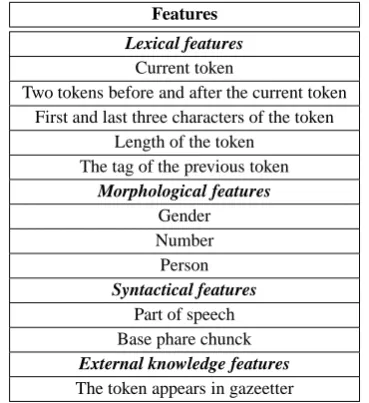
Features
Lexical features
Current token
Two tokens before and after the current token First and last three characters of the token
Length of the token The tag of the previous token
Morphological features
Gender Number
Person
Syntactical features
Part of speech Base phare chunck
External knowledge features
The token appears in gazeetter
Table 7: The set of language dependent and indepen-dent features extracted to be used by the classifier
consistent with the results shown in Section 3.3.3. This gives the impression that, the error rate is at a mini-mum, even when performing the classification across all Wikipedia articles with small amounts of training data.
5.2 Evaluating the Corpus Developed by Learning NE Classifier
This evaluation was designed to evaluate the corpus de-veloped by using it as training data to test it over cross-domain and within-cross-domain datasets. Moreover, this assists evaluation of the efficiency of using gazetteer as external knowledge resource. We parsed the differ-ent datasets and tokenised the sdiffer-entences using AMIRA (Diab, 2009) relying on the scheme (Conjunction + Preposition + Prefix). The concept behind using this to-kenisation scheme is that, the notable sparseness issues regarding Arabic NE are caused by agglutination of the prefixes. In this scheme, we guaranteed that the named entities like (
ﺪﻟﺎﺧ
/xAld/ ‘Khalid’) in the training data also refer to (ﺪﻟﺎﺨﻟﻭ
/wlxAld/ ‘and for Khalid’) in the test data. This happens by tokenising the words and splitting the prefixes, so the result will be three differ-ent tokens (ﻭ
/w/ ‘and’), (ﻝ
/l/ ‘for’) and (ﺪﻟﺎﺧ
/xAld/ ‘Khalid’). [image:5.595.97.270.157.288.2]The following set of experiments was conducted re-lying on the Conditional Random Field (CRF) proba-bilistic model to perform the sequence labelling. In all the experiments, we divided the datasets into training and test at 80% and 20% respectively. We used the three metrics, precision, recall and F-measure, to eval-uate the results.
5.2.1 Tags Distribution for the Gold-standard Newswire-based NE Corpora and WikiFANE
Different corpora have been used by researchers to de-velop NER. The first one is ANERcorp, which devel-oped by Benajiba et al. (2007) and is freely accessi-ble. It is a 150K news-wire based corpus tagged with CoNLL traditional coarse classes, i.e. PER, ORG, LOC and MISC. ACE produced two datasets named ACE 20044 and ACE 20055 which are subject to a costly licence. This prevents us using those corpora in the evaluation. However, ACE also produced a multi-lingual small corpus called REFLEX Entity Translation Training/DevTest (REFLEX for short), which consists of about 60K of tokens with two levels of classes. This is divided according to its origin into news-wire (NW), treebank (TB) and web blogs (WL). We used both the ANERcorp and the Arabic portion of REFLEX as gold-standard corpora to conduct the evaluation.
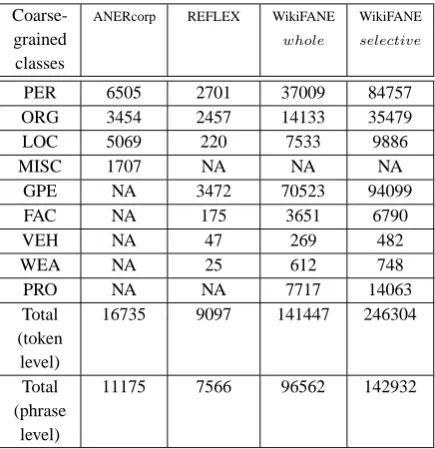
Table 8 shows the tag distribution for each corpus per class and the total per token and phrase. We use (NA) as an indication of no availability in the dataset. It is clearly shown that WikiFANESelective has wider
distributed tags compared with WikiFANEW hole.
5.2.2 Gazetteer Evaluation
Using gazetteer as an external knowledge source in NER helps to boost the performance of NER (Car-reras et al., 2002). To evaluate the gazetteer produced, we learned the classifier by news-wire dataset one at a time. Each time, we evaluated the presence and ab-sence of WikiFANEGazet. Due to ANERcorp dataset
being coarse-grain level, we decided to map the RE-FLEX dataset to the same scheme used by ANER-corp. In addition, we eliminated the MISC class used by ANERcorp because there is no direct equivalent in REFLEX. Three main points arose from this ex-periment. First, the F-measure increased by at least 2 points for all datasets, showing the overall positive effect of the developed gazetteer. Second, the recall metric clearly boosted the classifier enabling retrieval of more NE phrases than would be possible without WikiFANEGazet. Third, the TB sub-dataset of
RE-FLEX showed dramatic improvement in comparison with other datasets, because that TB dataset had com-paratively less noise.
4
http://www.ldc.upenn.edu/Catalog/catalogEntry.jsp? catalogId=LDC2005T09
5http://www.ldc.upenn.edu/Catalog/catalogEntry.jsp?
catalogId=LDC2006T06
Coarse-grained classes
ANERcorp REFLEX WikiFANE
whole
WikiFANE
selective
PER 6505 2701 37009 84757
ORG 3454 2457 14133 35479
LOC 5069 220 7533 9886
MISC 1707 NA NA NA
GPE NA 3472 70523 94099
FAC NA 175 3651 6790
VEH NA 47 269 482
WEA NA 25 612 748
PRO NA NA 7717 14063
Total (token
level)
16735 9097 141447 246304
Total (phrase
level)
[image:6.595.308.526.61.286.2]11175 7566 96562 142932
Table 8: The distribution of the coarse-grained NE tags across different corpora
No Gazetteer WikiFANEGazet
Corpus P R F P R F
ANERcorp 87.13 69.27 77.18 87.86 72.34 79.35
REFLEX
NW 88.51 69.37 77.78 88.21 72.79 79.76 TB 79.09 70.16 74.36 89.20 76.61 82.43 WL 83.78 62.23 71.41 84.69 66.61 74.57
Table 9: The comparison for using WikiFANEGazetas
external knowledge over news-wire dataset
5.2.3 Cross-domain Evaluation
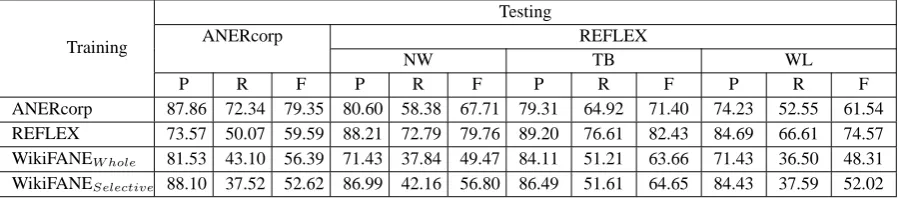
The purpose of cross-domain evaluation is to train the classifier on a certain domain and then test this over dif-ferent datasets with difdif-ferent domains or genres. The aim behind this experiment is to evaluate the effect when using WikiFANEW hole and WikiFANESelective
as training data versus news-wire domain datasets. This experiment helps to clarify the suitability of using WikiFANE as a relatively open domain corpus. It is evident from Table 10 that, self-training of ANERcorp and REFLEX produces the best performance. Mean-while, there are some interesting findings. Even though REFLEX is a news-wire based corpus, its performance is dramatically lower when it is used as training dataset and tested over ANERcorp. This is also the case when training ANERcorp and testing it over REFLEX. This implies that, even within the same domain, news-wire, there is less generalisability for the current news-wire dataset across different datasets. Another interesting finding is that, the version of WikiFANESelective
per-forms better than WikiFANEW hole on different test
sets, except for with ANERcorp. This might be be-cause WikiFANESelectivehas a greater tag density than
WikiFANEW hole, which leads to more positive
[image:6.595.306.537.339.414.2]Training
Testing
ANERcorp REFLEX
NW TB WL
P R F P R F P R F P R F
[image:7.595.76.526.63.162.2]ANERcorp 87.86 72.34 79.35 80.60 58.38 67.71 79.31 64.92 71.40 74.23 52.55 61.54 REFLEX 73.57 50.07 59.59 88.21 72.79 79.76 89.20 76.61 82.43 84.69 66.61 74.57 WikiFANEW hole 81.53 43.10 56.39 71.43 37.84 49.47 84.11 51.21 63.66 71.43 36.50 48.31 WikiFANESelective 88.10 37.52 52.62 86.99 42.16 56.80 86.49 51.61 64.65 84.43 37.59 52.02
Table 10: The result of cross-domain evaluation
Corpus P R F
ANERcorp + WikiFANESelective
90.40 58.21 70.81
REFLEX + WikiFANESelective
[image:7.595.76.287.200.273.2]NW 90.55 62.16 73.72 TB 86.52 62.10 72.30 WL 86.01 52.74 65.38
Table 11: The result of combining WikiFANESelective
with news-wire corpora
To elaborate more on cross-domain evaluation we evaluated the merging of WikiFANESelective, since it
performed best in the previous experiment, with both ANERcorp and REFLEX. The idea behind this exper-iment was to understand how the classifier performs when different domains and genera are combined to-gether. The most notable findings, as shown in Table 11 are that, the recall metric shows a sharp drop in all datasets. However, the precision shows high scores, suggesting the Wikipedia corpus is strong in difference when compared with the news-wire domain.
5.2.4 Within-domain Evaluation
The traditional practice of learning NE classifier is to draw the training and test datasets from single do-main. Therefore, we divided WikiFANEW hole and
WikiFANESelective into training and test for 80%
and 20% respectively and then training the CRF classifier on WikiFANEW hole and WikiFANESelective
separately with and without the injection of the WikiFANEGazet as an external knowledge source.
Table 12 shows that, the use of WikiFANEGazet
creates a notable improvement across datasets by at least 3 points on the F-measure. In addition, WikiFANESelective has a slightly superiority over
WikiFANEW hole advising that both datasets are
per-forming at a promising level of accuracy.
6
Related Work
A promising trend in the research is towards auto-matically developing an annotated NE corpus that ex-tends beyond both traditional classes and the domain of newswire, in order to create novel resources. One of the earliest of these approaches was presented by An et al. (2003) in which the web was used to build a target corpus, using bootstrapping to build an
anno-tated NE corpus. A further approach utilises parallel corpora to build an NE corpus automatically. This re-lies on the suggestion that once one corpus is annotated then other parallel corpora can be easily annotated us-ing projection. Ehrmann et al. (2011) developed multi-lingual NE corpora for English, French, Spanish, Ger-man and Czech. Similarly, Fu et al. (2011) developed a Chinese annotated NE corpus exploiting an English aligned corpus. The difference here is that the align-ment is conducted between both corpora at the word-level.
Beyond the newswire-based corpora, Wikipedia be-comes more attractive for different NLP tasks. Some researchers have exploited the unrestricted accessibil-ity of Wikipedia to establish an automatic fully an-notated NE corpus with different granularity; mean-while others are merely focusing on partially utilising Wikipedia to achieve specific goals, such as develop-ing a NE gazetteer (Attia et al., 2010) or classifydevelop-ing Wikipedia articles into NE semantic classes (Saleh et al., 2010).
Tkatchenko et al. (2011) expanded the classification into an 18 fine-grain taxonomy extracted from (BNN). To prepare training data for use in the classification stage, a small set of seeds is constructed, as undertaken by Nadeau et al. (2006), in which a semi-supervised bootstrapping approach was used to construct long lists of entities in different fine-grain NE classes from the web. After the list is constructed, the entities are then intersected with Wikipedia articles so as to classify each article according to its target class. Therefore, a set of 40 articles per fine-grain class was produced for use in training with the Na¨ıve Bayes and Support Vec-tor Machine (SVM). Several similar features have been selected (e.g. (Saleh et al., 2010; Dakka and Cucerzan, 2008)).
Instead of relying on machine learning, Richman and Schon Richman and Schon (2008) defined a set of heuristics involving using assigned category links to classify articles. Phrasal patterns for each semantic NE class were specified when a matching article was clas-sified; alternatively the procedure searched the upper level of categories to find candidates. These articles are still classified according to traditional coarse grain classes.
in-Corpus PER ORG LOC Overall
P R F P R F P R F P R F
WikiFANEW hole (no gaz)
93.15 85.41 89.11 93.69 89.34 91.46 83.39 66.81 74.19 88.51 76.18 81.88
WikiFANESelective (no gaz)
92.82 85.80 89.17 93.41 88.83 91.06 81.76 72.24 76.70 86.92 78.62 82.56
[image:8.595.76.524.63.161.2]WikiFANEW hole 97.35 88.61 92.78 97.74 93.10 95.36 84.58 70.37 76.83 91.10 79.62 84.98 WikiFANESelective 96.37 88.75 92.40 96.12 91.73 93.87 82.55 75.73 78.99 88.77 81.86 85.18
Table 12: The result for within-domain evaluation
tervention. The first attempt to transform Wikipedia into an annotated NE corpus was made by Nothman et al. (2008); they assumed that many NEs are asso-ciated with Wikipedia inter-links, i.e. the hyperlinks associated with a phrase in contexts pointing to another article. Therefore, the procedure first identified NEs using heuristics to exploit capitalisation, and then the target articles were classified into NE semantic classes. A bootstrapping approach is then used to extract seeds from a set of 1300 articles. Two distinguishing fea-tures were extracted per article; i.e. the head noun for the category links and the head noun for the definitional sentence. The corpus produced covered 60 fine-grained classes in two layers. An alternative approach to the same data set is presented by Tardif et al. (2009), in which the classification relies on supervised machine learning. Like Dakka and Cucerzan (2008), both Na¨ıve Bayes and the Support Vector Machine (SVM) have been used as statistical interfaces for the purpose of classification. A total of 2311 articles have been manu-ally annotated and a combination of structured and un-structured features extracted.
The corpus produced by Nothman et al. (2008) has been thoroughly experimented with to evaluate the im-pact of its performance. Three different gold-standard corpora, i.e. MUC, CoNLL and BNN, were used for comparative purposes and separate models built for each corpus. The experiment showed that, when in conjunction with other gold-standard corpora the Wikipedia-based corpus could raise their performance; it also performs well for non-Wikipedia texts (Nothman et al., 2009).
7
Conclusion
We presented a methodology to develop a large size fine-grained named entity corpus and gazetteer using an automatic approach. This involved recruiting docu-ment classifications. Using this methodology, we pro-duced constantly evolving NE resources that will ex-ploit the yearly growth rate of Arabic Wikipedia.
The freely fine-grained NE corpus and gazetteer pro-duced when used on their own are of a very promising quality and extend the scope of research beyond tradi-tional NE tasks.
References
ACE. 2008. Ace (automatic content extraction) en-glish annotation guidelines for entities, 06. [ac-cessed 10 April 2013].
Fahd Alotaibi and Mark Lee. 2012. Mapping Ara-bic Wikipedia into the named entities taxonomy. In Proceedings of COLING 2012: Posters, pages 43– 52, Mumbai, India, December. The COLING 2012 Organizing Committee.
Joohui An, Seungwoo Lee, and Gary Geunbae Lee. 2003. Automatic acquisition of named entity tagged corpus from world wide web. In Proceedings of the 41st Annual Meeting on Association for Computa-tional Linguistics, pages 165–168. Association for Computational Linguistics.
Mohammed Attia, Antonio Toral, Lamia Tounsi, Mon-ica Monachini, and Josef van Genabith. 2010. An automatically built named entity lexicon for ara-bic. In Proceedings of the Seventh conference on International Language Resources and Evaluation (LREC10), Valletta, Malta. European Language Re-sources Association (ELRA).
Yassine Benajiba, Paolo Rosso, and Jos´e Miguel Bened´ıruiz. 2007. Anersys: An arabic named entity recognition system based on maximum entropy. In Alexander Gelbukh, editor, Computational Linguis-tics and Intelligent Text Processing, volume 4394 of Lecture Notes in Computer Science, pages 143–153. Springer Berlin / Heidelberg.
Y. Benajiba, I. Zitouni, M. Diab, and P. Rosso. 2010. Arabic named entity recognition: Using features ex-tracted from noisy data. In Proceedings of the ACL 2010 Conference Short Papers, pages 281–285, Up-psala, Sweden. Association for Computational Lin-guistics.
Ada Brunstein. 2002. Annotation guidelines for an-swer types. LDC2005T33 [accessed 02 January 2012].
Jean Carletta. 1996. Assessing agreement on classifi-cation tasks: the kappa statistic. Comput. Linguist., 22(2):249–254, June.
Wisam Dakka and Silviu Cucerzan. 2008. Augment-ing wikipedia with named entity tags. In Proceed-ings of the 3rd International Joint Conference on Natural Language Processing, pages 545–552, Hy-derabad, India. Asian Federation of Natural Lan-guage Processing.
Mona Diab. 2009. Second generation amira tools for arabic processing: Fast and robust tokenization, pos tagging, and base phrase chunking. In 2nd Inter-national Conference on Arabic Language Resources and Tools.
Maud Ehrmann, Marco Turchi, and Ralf Steinberger. 2011. Building a multilingual named entity-annotated corpus using annotation projection. In Proceedings of Recent Advances in Natural Lan-guage Processing (RANLP), pages 118–124, Hissar, Bulgaria.
Ruiji Fu, Bing Qin, and Ting Liu. 2011. Generat-ing chinese named entity data from a parallel cor-pus. In Proceedings of the 5th International Joint Conference on Natural Language Processing, pages 264–272, Chiang Mai, Thailand. Asian Federation of Natural Language Processing (AFNLP).
Nizar Habash, Abdelhadi Soudi, and Tim Buckwalter. 2007. On arabic transliteration. In Arabic Com-putational Morphology, volume 38 of Text, Speech and Language Technology, pages 15–22. Springer Netherlands.
Sanda Harabagiu, Dan Moldovan, Christine Clark, Mitchell Bowden, John Williams, and Jeremy Bens-ley. 2003. Answer mining by combining extraction techniques with abductive reasoning. In Proceed-ings of 12th Text Retrieval Conference, volume 2003, pages 375–382. NIST.
Xin Li and Dan Roth. 2006. Learning question clas-sifiers: the role of semantic information. Natural Language Engineering, 12(03):229–249.
David Nadeau, Peter D. Turney, and Stan Matwin. 2006. Unsupervised named-entity recognition: Gen-erating gazetteers and resolving ambiguity. Ad-vances in Artificial Intelligence, pages 266–277.
Elisa Noguera, Antonio Toral, Fernando Llopis, and Rafael Mu ´noz. 2005. Reducing question answering input data using named entity recognition. In Text, Speech and Dialogue, pages 428–434. Springer.
Joel Nothman, James Curran, and Tara Murphy. 2008. Transforming wikipedia into named entity training data. In Proceedings of the Australian Language Technology Association Workshop, pages 124–132, Hobart, Australia. ALTA.
Joel Nothman, Tara Murphy, and James Curran. 2009. Analysing wikipedia and gold-standard corpora for ner training. In Proceedings of the 12th Confer-ence of the European Chapter of the Association for Computational Linguistics, pages 612–620, Athens, Greece. Association for Computational Linguistics.
Alexander Richman and Patrick Schon. 2008. Mining wiki resources for multilingual named entity recog-nition. In Proceedings of the 46th Annual Meeting of the Association for Computational Linguistics: Hu-man Language Technologies, pages 1–9, Columbus, Ohio, USA. Association for Computational Linguis-tics.
Iman Saleh, Kareem Darwish, and Aly Fahmy. 2010. Classifying wikipedia articles into ne’s using svm’s with threshold adjustment. In Proceedings of the 2010 Named Entities Workshop, pages 85–92, Up-psala, Sweden. Association for Computational Lin-guistics.
Satoshi Sekine and Chikashi Nobat. 2004. Definition, dictionaries and tagger for extended named entity hierarchy. In Proceedings of the 4th International Conference on Language Resources And Evaluation, pages 1977–1980, Lisbon, Portugal. ELRA.
Satoshi Sekine, Kiyoshi Sudo, and Chikashi Nobata. 2002. Extended named entity hierarchy. In Proceed-ings of the third International Conference on Lan-guage Resources and Evaluation, volume 2, Las Pal-mas, Spain. ELRA.
Khaled Shaalan and Hafsa Raza. 2007. Person name entity recognition for arabic. In Proceedings of the 2007 Workshop on Computational Approaches to Semitic Languages: Common Issues and Resources, pages 17–24, Prague, Czech Republic. Association for Computational Linguistics.
Sam Tardif, James Curran, and Tara Murphy. 2009. Improved text categorisation for wikipedia named entities. In Australasian Language Technology As-sociation Workshop 2009, pages 104–108, Sydney, Australia.
Maksim Tkatchenko, Alexander Ulanov, and Andrey Simanovsky. 2011. Classifying wikipedia enti-ties into fine-grained classes. In Data Engineering Workshops (ICDEW), 2011 IEEE 27th International Conference on, pages 212–217. IEEE.