warwick.ac.uk/lib-publications
Original citation:Cohen-Addad, Vincent, Hebdige, Michael, Králʼ, Daniel, Li, Zhentao and Salgado, Esteban. (2016) Steinberg’s conjecture is false. Journal of Combinatorial Theory, Series B.
Permanent WRAP URL:
http://wrap.warwick.ac.uk/80306
Copyright and reuse:
The Warwick Research Archive Portal (WRAP) makes this work by researchers of the University of Warwick available open access under the following conditions. Copyright © and all moral rights to the version of the paper presented here belong to the individual author(s) and/or other copyright owners. To the extent reasonable and practicable the material made available in WRAP has been checked for eligibility before being made available.
Copies of full items can be used for personal research or study, educational, or not-for-profit purposes without prior permission or charge. Provided that the authors, title and full bibliographic details are credited, a hyperlink and/or URL is given for the original metadata page and the content is not changed in any way.
Publisher’s statement:
© 2016, Elsevier. Licensed under the Creative Commons Attribution-NonCommercial-NoDerivatives 4.0 International http://creativecommons.org/licenses/by-nc-nd/4.0/
A note on versions:
The version presented here may differ from the published version or, version of record, if you wish to cite this item you are advised to consult the publisher’s version. Please see the ‘permanent WRAP URL’ above for details on accessing the published version and note that access may require a subscription.
Steinberg’s Conjecture is false
Vincent Cohen-Addad
∗Michael Hebdige
† ¶Daniel Kr´al’
‡ ¶Zhentao Li
∗Esteban Salgado
§ ¶Abstract
Steinberg conjectured in 1976 that every planar graph with no cycles of length four or five is 3-colorable. We disprove this conjecture.
1
Introduction
One of major open problems on colorings of planar graphs is Steinberg’s Conjec-ture from 1976. The conjecConjec-ture asserts that every planar graph with no cycles of length four or five is 3-colorable. This problem has been attracting a substantial amount of attention among graph theorists, see [4, Section 7]. It is also one of the six graph theory problems ranked with the 4-star (highest) importance in the Open Problem Garden [1]. As a possible approach towards proving the conjec-ture, Erd˝os in 1991 (see [12]) suggested to determine the smallest k such that every planar graph with no cycles of length 4, . . . , k is 3-colorable. Borodin et al. [8], improving up on [2, 11], showed that k ≤7, i.e., every planar graph with no cycles of length four, five, six or seven is 3-colorable. Many other relaxations of the conjecture have been established, e.g. [3, 6, 9, 14]. On the other hand, the conjecture is known to be false in the list coloring setting [13]. We refer the reader for further results on the conjecture and other problems related to colorings of planar graphs to [4, 10].
∗D´epartement d’Informatique, UMR CNRS 8548, ´Ecole Normale Sup´erieure, Paris, France.
E-mail: {vcohen,zhentao}@di.ens.fr.
†Department of Computer Science, University of Warwick, Coventry CV4 7AL, UK. E-mail:
[email protected]. The work of this author was supported by the Leverhulme Trust
2014 Philip Leverhulme Prize of the third author.
‡Mathematics Institute, DIMAP and Department of Computer Science, University of
War-wick, Coventry CV4 7AL, UK. E-mail: [email protected]. The work of this author was supported by the Leverhulme Trust 2014 Philip Leverhulme Prize.
§Ecole Polytechnique, Paris, France, and Pontificia Universidad Cat´´ olica de Chile, Santiago,
Chile. E-mail: [email protected].
¶This research was done during the stay of the second, third and fifth of the authors at ´Ecole
a
b d c
e
f g
h
i j
k l
m
[image:3.595.195.387.104.273.2]n o
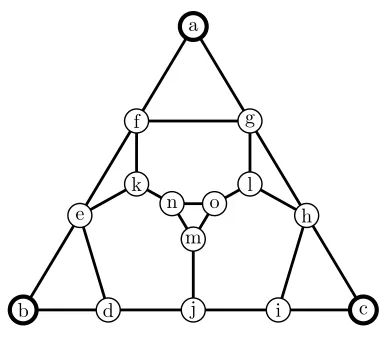
Figure 1: The graph G1 analyzed in Lemma 1.
We disprove Steinberg’s Conjecture by constructing a planar graph with no cycles of length four or five that is not 3-colorable. This also disproves Strong Bordeaux Conjecture from [9] and Novosibirsk 3-Color Conjecture from [5].
Conjecture 1 (Strong Bordeaux Conjecture). Every planar graph with no pair
of cycles of length three sharing an edge and with no cycle of length five is 3-colorable.
Conjecture 2 (Novosibirsk 3-Color Conjecture). Every planar graph without a
cycle of length three sharing an edge with a cycle of length three or five is 3-colorable.
We would like to remark that we have not tried to minimize the number of vertices in our construction; we are actually aware of the existence of smaller counterexamples (the smallest one with 85 vertices) but we decided to present the one that is the simplest to analyze among those that we have found.
2
Counterexample
Our construction has three steps. In each of these steps, we construct a partic-ular planar graph with no cycles of length four or five that has some additional properties. The next two lemmas present the first two steps of the construction.
Lemma 1. The graph G1 that is depicted in Figure 1 has no cycles of length four
or five and there is no3-coloring that would assign the same color to all the three
vertices a, b and c. In addition, the distance between a and b is three, between a
a
b c
d
e f
a
b c
d
e f
G1
[image:4.595.96.489.103.278.2]G1 G1
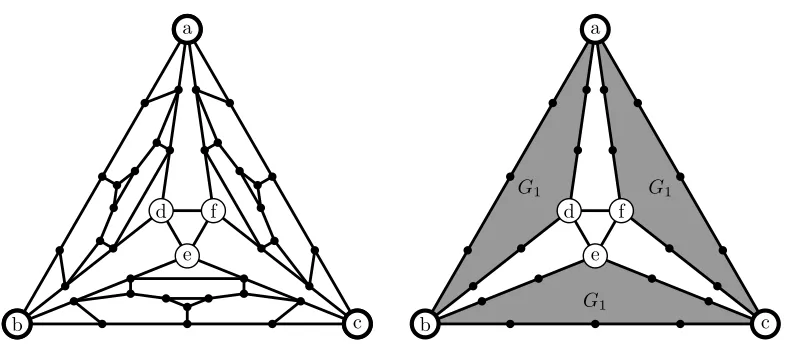
Figure 2: The graphG2 analyzed in Lemma 2. The actual graph is drawn on the left; its abstract structure using the graph G1 is given on the right. The three contact vertices a, b and c are drawn with bold circles.
Proof. It is easy to check that G1 contains no cycle of length four or five, the
distance betweena and b is three, between a and cis three, and between b and c
is four. Suppose thatG1 has a 3-coloring such that all the three vertices a,b and
chave the same color, sayγ. The other two colors must be used in an alternating way to color the vertices d, e, f, g, h and i. This implies that the vertices j, k
and l have the color γ. Hence, the two colors different from γ must be used to color the vertices m, n and o, which is impossible since these three vertices form a triangle.
Lemma 2. The graph G2 that is depicted in Figure 2 has no cycles of length four
or five and there is no3-coloring that would assign the same color to all the three
vertices a, b and c. In addition, the distance between any pairs of the vertices a,
b and c is four.
Proof. Note that the graph G2 consists of three copies of the graph G1 pasted
together as depicted in Figure 2. We start by checking that the distance between the vertices a and b is four (the cases of the other two pairs are symmetric). Since a and b are joined by a path of length four, their distance is at most four. Lemma 1 implies that there is no path of length less than four inside the copy of G1 containing a and b. On the other hand, any path passing through more than one copy of G1 must have length at least three inside each traversed copy of G1, so its total length cannot be less than six. We conclude that the distance betweena and b is four.
a
b
c
d e f
c’ d’
e’ f’
G2 G2
[image:5.595.201.386.106.262.2]G2 G2
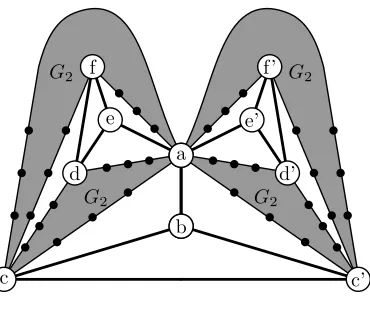
Figure 3: The graph G constructed in the proof of Theorem 3. The gray areas represent the graph from Figure 2.
between any two of the contact vertices of the copies ofG1 (the vertices used to glue the copies together) is at least three by Lemma 1, the length of any cycle passing through two or three of the copies is at least six. The only cycle that does not contain an edge inside a copy of G1 is the cycle def and its length is three. Therefore, G2 has no cycle of length four or five.
It remains to check that G2 has no 3-coloring such that the vertices a,b and
cget the same color. Suppose that G2 has a 3-coloring such that the verticesa,b
andcreceive the same color, sayγ. By Lemma 1, the color of any of the vertices
d, e and f is different fromγ. However, this is impossible since the vertices d, e
and f form a triangle and there are only three colors in total. Hence, G2 has no 3-coloring such that the vertices a, b and c would get the same color.
We are now ready to provide the counterexample construction.
Theorem 3. There exists a planar graph with no cycles of length four or five
that is not 3-colorable.
Proof. Consider the graph Gobtained by taking four copies of the graphG2 from
Lemma 2 and pasting them together with additional vertices b, e and e′ in the way depicted in Figure 3. We first argue that G has no cycle of length four or five. By Lemma 2, there is no cycle of length four or five inside a single copy of
G2. Any cycle containing an edge inside a copy of G2 that is not fully contained inside the copy must contain at least four edges inside the considered copy of
three cycles not containing an edge inside any copy ofG2 and these are triangles
bcc′, def and d′e′f′. Therefore, G has no cycle of length four or five.
Suppose thatG has a 3-coloring and letγ be the color assigned to the vertex
a. Since the vertices of the trianglebcc′ must be assigned all three colors and the color of b is not γ, eitherc or c′ is colored with γ. By symmetry, we can assume that the color of c is γ. Since the vertices a, c and d are contact vertices of a copy of G2, the color of d is not γ by Lemma 2. Similarly, since the vertices a,
cand f are contact vertices of a copy of G2, the color of f is also not γ. Hence, none of the vertices d, e and f (note the vertex e is adjacent toa) has the color
γ, which is impossible since the vertices d,e and f form a triangle. We conclude that the graph Ghas no 3-coloring.
Acknowledgement
The authors would like to thank Zdenˇek Dvoˇr´ak for his comments and insights on a computer-assisted approach towards a possible solution of Steinberg’s Con-jecture.
References
[1] Open Problem Garden, http://www.openproblemgarden.org/.
[2] H. L. Abbott, B. Zhou: On small faces in 4-critical graphs, Ars Combin. 32 (1991), 203-207.
[3] O. V. Borodin: Structural properties of plane graphs without adjacent trian-gles and an application to 3-colorings, J. Graph Theory 21 (1996), 183–186.
[4] O. V. Borodin: Colorings of plane graphs: A survey, Discrete Math. 313 (2013), 517–539.
[5] O. V. Borodin, A. N. Glebov, T. R. Jensen, and A. Raspaud: Planar graphs without triangles adjacent to cycles of length from 3 to 9 are 3-colorable, Sib. Elektron. Mat. Izv. 3 (2006), 428–440.
[6] O. V. Borodin, A. N. Glebov, M. Montassier, and A. Raspaud: Planar graphs without 5- and 7-cycles and without adjacent triangles are 3-colorable, J. Combin. Theory Ser. B 99 (2009), 668–673.
[8] O. V. Borodin, A. N. Glebov, A. Raspaud, and M. R. Salavatipour: Planar graphs without cycles of length from 4 to 7 are 3-colorable, J. Combin. The-ory Ser. B 93 (2005), 303–331.
[9] O. V. Borodin and A. Raspaud: A sufficient condition for planar graphs to be 3-colorable, J. Combin. Theory Ser. B 88 (2003), 17–27.
[10] T. R. Jensen, B. Toft: Graph coloring problems, John Wiley & Sons, 1995.
[11] D. P. Sanders, Y. Zhao: A note on the three color problem, Graphs Com-bin. 11 (1995), 91–94.
[12] R. Steinberg: The state of the three color problem, quo vadis, graph theory?, Ann. Discrete Math. 55 (1993), 211-248.
[13] M. Voigt: A non-3-choosable planar graph without cycles of length 4 and 5, Discrete Math. 307 (2007), 1013–1015.