warwick.ac.uk/lib-publications Manuscript version: Author’s Accepted Manuscript
The version presented in WRAP is the author’s accepted manuscript and may differ from the published version or Version of Record.
Persistent WRAP URL:
http://wrap.warwick.ac.uk/117424
How to cite:
Please refer to published version for the most recent bibliographic citation information. If a published version is known of, the repository item page linked to above, will contain details on accessing it.
Copyright and reuse:
The Warwick Research Archive Portal (WRAP) makes this work by researchers of the University of Warwick available open access under the following conditions.
Copyright © and all moral rights to the version of the paper presented here belong to the individual author(s) and/or other copyright owners. To the extent reasonable and
practicable the material made available in WRAP has been checked for eligibility before being made available.
Copies of full items can be used for personal research or study, educational, or not-for-profit purposes without prior permission or charge. Provided that the authors, title and full
bibliographic details are credited, a hyperlink and/or URL is given for the original metadata page and the content is not changed in any way.
Publisher’s statement:
Please refer to the repository item page, publisher’s statement section, for further information.
A Framework for Improving the Sharing of Teaching Practices Through Web 2.0
Technology for Academic Instructors
Nouf Almujally1,2, Mike Joy1
1Computer Science Department, University of Warwick, Coventry, UK, {n.almujally; [email protected]} 2Department of Computer Science, Princess Nourah bint Abdulrahman University, Riyadh, Saudi Arabia
e-mail: [email protected]
Abstract— Knowledge management (KM) has become significant for gaining a competitive advantage in many organizations, specifically higher education institutions (HEIs) which are knowledge-intensive environments. Instructors generate a considerable amount of valuable teaching-related knowledge that has accumulated through years of teaching, and needs to be gathered and shared among communities of instructors. Identifying and sharing teaching experiences means enhancing successes by helping instructors to learn from each other and deliver better quality teaching. Many universities still struggle in documenting, sharing and reusing the knowledge gained by instructors due to the absence of a collaborative platform where novices and experts can interact and collaborate. In this paper, we propose a knowledge management framework that aims to enhance the process of acquiring, sharing and reusing teaching practices. Meta-requirements are explored by conducting an investigative study with instructors who work in Saudi universities and then translating these requirements into design principles for efficient and effective knowledge management system development in the higher education context.
Information Systems; Knowledge Management System; knowledge sharing; Teaching Practices; Community of Instructors; Computer Science Education.
I. INTRODUCTION
The knowledge-based theory of the firm [1] considers knowledge as the most significant determinant of competitive advantage and organizational goal achievement. In today’s knowledge-based economy, Knowledge Management (KM) plays a vital role in any organization by facilitating the capture, storage, sharing and dissemination of knowledge [2]. While KM has been implemented in a large number of organizations [3], universities are yet to take full advantage of the capabilities offered by KM. In the last decade, a number of researchers have sought to highlight the potentials of implementing KM systems in universities [4], [5], and Rowley [6] believes that HEIs are part of the knowledge business since they are involved in knowledge creation, dissemination and learning. Teaching activities result in creating remarkable amounts of expertise that must be translated into course-related resources to produce learning activities that will satisfy students’ needs [7], [8]. Therefore, teachers must boost their knowledge and teaching skills to achieve effective and successful teaching. They must also adapt to inevitable challenges in the new changing world such as the rise in students’ expectations,
the demand for ongoing teacher professional development, and the rapid development in technologies [9].
This research considers the application of KM in Saudi Arabian universities. Yaghi and Zamzami [10] stressed the importance of and the need for KM in Saudi HEIs due to many challenges facing the Saudi higher education system. Education in HEIs has been going through a process of change which requires instructors to keep updated with developments in the field. Due to curriculum change, novice teachers are facing a critical challenge in teaching and delivering subject knowledge. Traditionally, knowledge sharing among teachers occurs through the face-to-face interaction, meetings, seminars and modules or other printed materials. However, most Saudi universities are not geographically co-located as they have remote campuses in both rural and urban areas, and that could require expert academics to travel between these campuses to share their teaching experiences with others. Furthermore, Saudi Arabia is a religious country, and the religion of Islam reflects the practice of education and the structure of universities, in which male and female academics are segregated in separate campuses. It is required to transfer knowledge between instructors in different departments (male and female) and among different campuses.
University teachers have many responsibilities and are involved in many tasks that prevent them from finding enough time for their continuing education and sharing their accumulated teaching-related knowledge and experience with other instructors via face-to-face communication. Consequently, the face-to-face mechanism is less suitable for sharing knowledge because this mechanism can reach only a limited number of people at limited places and times.
Additionally, every year some expert teachers leave the teaching profession. Their retirement not only means the loss of human capital, but many years of valuable teaching experience could be lost due to academic retirement without being recorded in a proper KM system. It will be beneficial if the knowledge and experience are captured and stored so that they can be shared and used by other teachers, especially novices.
to spend extra time and effort in recreating new teaching materials instead of spending more time on research and professional development [11].
Due to the noticeable recognition of the importance of KM in HEIs as an enabler of an interactive environment, together with the challenges identified above that Saudi universities face, this research considers the application of KM amongst academics in universities in Saudi Arabia.
Therefore, our overall research aims to answer the question of how instructors more effectively manage their teaching expertise using web technologies. The research starts with an empirical analysis of the problem space, captured by our first research question (RQ):RQ1: What are academics’ perspectives regarding managing teaching experiences using web-based technology?
Building on these empirical findings, we developed a framework which is the focus of the second RQ: RQ2: What framework is required to build an effective teaching practices management system (TPMS) for instructors?
Effective use of knowledge capital in educational institutes can lead to better decision-making capabilities, enhance the teaching quality, and reduce costs and consequently the education output.
This paper is organised as follows. In the literature review section, we review previous research relating to KM in HEIs, and we address the gaps in the literature. The method section describes the analysis and discussion of the qualitative method used in this research. Section IV presents the proposed framework, and he final section concludes.
II. LITERATURE REVIEW
The accumulation of teaching experiences gained through years of practice shapes teachers’ expertise and includes both know-what and know-how knowledge about teaching a specific subject. “Know-what” knowledge represents the content knowledge about the actual subject matter that must be transferred to students to be learned and mastered. It can be expressed in words and sentences and is easily articulated and recorded. On the other hand, “know-how” is not transferred to learners but includes the methods and skills for delivering know-what knowledge such as pedagogical approaches, cognitive skills, best teaching practices, problem-solving ability, and use of educational technologies. Faculty produce tremendous amounts of know-what and know-how knowledge as a result of teaching activities. Although content knowledge is organized by individual faculty members, they are usually preserved by them and not shared efficiently among other colleagues who teach the same courses despite the massive development of technology-enhanced learning initiatives that have focused on documentingand encoding know-what knowledge.
Additionally, in terms of know-how knowledge of instructors’ expertise, far too little attention has been paid to this component which is not easily expressed or communicated via the visual or verbal form. It is subjective, context-specific, and difficult to capture. This type of knowledge is a valuable resource and asset and uncodified it
can affect academics’ teaching performance and may result in lower levels of achievement [12].
To effectively ensure the development and delivery of learning in HEIs, and to overcome the cost and time for obtaining knowledge, knowledge sources need to rely on technology-enhanced learning tools [7]. Technology-enhanced learning tools, such as learning management systems and social networking tools, play an essential role as knowledge enabling tools which can support course content sharing for learners [13], [14]. However, the available technologies do not support the transmission of instructors’ teaching methods and expertise. Thus, there is a need to design a new system which can enhance communication among geographically dispersed instructors, taking into account respect for culture and religion.
After exploring the literature on managing instructors’ experiences in universities, many research gaps have been identified. First, to the best of the researchers’ knowledge, there is a lack of studies that have proposed a single, clear framework that system designers and policymakers can adapt to design a teaching practices management system for instructors. Second, most existing studies have explored KM in HEIs from an expert’s point of view – only a few studies have investigated instructors as end users of KM resources. Third, few studies are being carried out in Saudi HEIs concerning knowledge creation and sharing, and specifically knowledge reuse which seems to be often omitted by researchers. Fourth, previous studies only focus on general KM practice. No research has so far explored context-specific KM in HEIs, i.e., teaching experiences related to instructors. Finally, little research has focused on the know-how component of instructors’ expertise and the design of a solution for managing this type of knowledge in HEIs.
III. METHOD
Our research aims to develop a framework for supporting the creation, sharing and reusing of teaching experiences among academics who work in Saudi Arabian universities. Therefore, in order to create awareness of the problem, an investigative study was conducted to identify relevant problems.
This study used semi-structured interviews to gather preliminary information during the exploratory stage of the research. The interviews aimed to explore current knowledge sharing activities including the difficulties academics face. In addition, the exploration aimed to understand academics’ perceptions of using Web 2.0 technologies and academics’ needs for a new knowledge sharing tool. Interview questions were developed based on the review of literature where gaps were identified. The exploratory study was conducted with 22 academics (five heads of the departments, five assistant professors, eight lecturers, four teacher assistants) reflecting the distribution of roles in the entire department. The academics were recruited by sending them an email in person requesting their voluntary participation in the study.
whereas one of the researchers was not involved in any other aspects of the research. After transcribing the interview recordings, the researchers read the text files carefully. In the next phase, specific text segments related to the research objective were identified. All these segments were labeled with codes using MaxQDA-a software application primarily intended for qualitative data analysis.
IV. RESULTS
Two key themes emerged from discussions: the importance of sharing academics’ knowledge, and current knowledge sharing practices among academics.
A. The Importance of Sharing Academics’ Knowledge
The analysis of the quantitative data shows that all the academics in the study expressed beliefs about the potential benefits of sharing knowledge, specifically teaching experiences, and most of them viewed sharing as a way of learning and helping others learn. For example, academic C indicated through his comments within the interviews: “If I discovered a method that works well in my class and
captures a student’s attention, then I want to share it”.
Sharing was seen as a way of improving classroom practices and academics’ performance, which is supported by [17, 18]. Additionally, the respondents stressed the importance of sharing teaching experiences, such as the methods for teaching a specific subject and subject resources. Academics would benefit from sharing effective pedagogical approaches that support their students and enhance quality teaching. They also considered each other as primary sources of useful ideas and knowledge. Academics also agreed that “transferring knowledge will help other academics, who are involved in designing course syllabi, in avoiding error occurrences that that might affect the quality
of teaching outcomes” (Academic B).
Furthermore, the result shows that the majority of the respondents (n=21) strongly agreed that novice academics struggle without experts’ teaching experiences due to a range of different challenges they face when teaching new subjects. Firstly, academics were concerned about the depth of their subject (content) knowledge. Content knowledge is one of the crucial areas in order to support teachers in feeling confident about their subject knowledge. Academics gave the reason that they struggled to find information about new subjects when knowledge was not being shared. Academics expressed the worry that they had spent hours of their own time trying to demonstrate the subject: “...I daily spend more than four hours of my own time on building my knowledge skill by doing self-professional development to
learn programming language and skills” (Academic R).
Another concern is that academics need to develop pedagogical approaches that support their students, such as encouraging problem-solving techniques amongst the students they teach. One of the academics expressed their worry about “…finding ways to encourage students to think logically while solving the lab sheet instead of asking for
the tutors’ assistance” (Academic T).
Other academics pointed out that some topics were difficult to teach and deliver to students because they were uninteresting. Science academics confirmed that they have not received any formal training or have any industry experience, and consequently delivering science topics is difficult to practice for teachers who have just learned a topic as “…some of the computer science theory is rather dry so finding strategies to bring it to life for students is a
challenge” (Academic K).
Finally, academics expressed their worry regarding how they should assess and prepare students for assessment tasks. Novices struggled to find appropriate activities and resources for exams due to lack of resources: “As a new lecturer, I have a limited experience of teaching that will
prepare my students for an exam” (Academic S).
Therefore, it can be concluded that academics perceived sharing teaching experiences as a crucial activity that can help them enhance their quality teaching and overcome the previous challenges.
B. Current Knowledge Sharing Practices
After analyzing the qualitative data, it seems that academic departments do not currently have a standardized, formal method for sharing teaching skills and knowledge related to best teaching practices. The majority of academics still use direct face-to-face conversations for sharing teaching experiences, despite the vast advancement in technology and systems, and the availability of Internet connections and private computers for each academic.
“…It is really on a person-by-person basis … many lecturers often come to me and ask me how I should teach a particular topic or what new educational approaches are
there or what theories are happening.” (Academic C).
The results also showed that both novice and expert academics recorded and stored the knowledge obtained from different sources on personal hard drives. They confirmed that pedagogical knowledge is typically stored at the end of each academic term in Word documents and made accessible only by the Quality Assurance Department.
The results also showed that academics search for knowledge by asking experts directly; or if it is not possible to find required knowledge internally, academics tend to use external resources, such as commercial search engines. Once they discover the knowledge, academics noted that they “… apply it directly in the classroom without
recording it for later use” (Academic N).
Academics highlighted two obstacles that prevent them from sharing their teaching practices: lack of access to experts and expertise, and lack of motivation.
1) Lack of access to experts and expertise: The results
indicate that face-to-face interaction is not an appropriate way for accessing experts due to experts’ lack of time for social interaction. academics stressed that time constraint is a challenging issue for knowledge sharing “… it is hard to arrange meetings with experts to share knowledge with them
as they are always busy” (Academic L). This finding is
due to time limitation. A female academic reported that “… as a female lecturer, the only ways to communicate with expert academics in the male department is through sending
emails only due to gender segregation” (Academic C). The
results also reflect the influence of Islam on the practice of education and the structure of universities, in which male and female academics are segregated by gender in separate campuses, who even might teach the same curriculum or be interested in the same research areas [20]. The segregation approach causes a lack of teaching experience sharing between both genders.
Not recording knowledge might lead academics to duplicate and repeat knowledge over time through different communication channels, which could result in a corrupted version and inconsistent format of knowledge. One academic stated that “…. as an academic advisor all my time is devoted to answering redundant questions to the same
people” (Academic F). “While exchanging knowledge
through face-to-face conversations, academics might
eliminate a valuable part of it” (Academic D). Therefore, it
can be concluded that correctness, clarity, and consistency are significant features of the shared content, and are highly appreciated by academics [21].
With regard to the use of specific KM tools employed within the university, none was identified. Interviewees reported that the university relies heavily on e-mail for exchanging documents. Subsequently, there is no specific system in place for the storage, identification and retrieval of explicit knowledge of academics.
2) Lack of Extrinsic Motivation: The results also reveal
that one of the pressing issues that academics were complaining about was the lack of motivation to share their teaching expertise with others. They complained that they never received acknowledgement in return for sharing of knowledge through face-to-face communication. For example, Academic M specified how receiving recognition from another for sharing his knowledge is important to him. He explained that “… the same time you wish that people would appreciate your work being appreciated by other
people”. Faculty members are more likely to be motivated
by the sense of pride they feel when their knowledge is shared. This result supports previous studies’ findings which suggested that one of the most common barriers to sharing knowledge amongst academics is the absence of extrinsic motivation [22], [23].
This may indicate that academic institutes should develop a technique to reward and symbolically recognize the faculty members’ efforts for participating in knowledge sharing [19], [24]
In summary, it can be argued that when any of the obstacles mentioned above exists, knowledge sharing is unlikely to take place. At the very least, it occurs in an ineffective or inefficient way.
V. TEACHING PRACTICES MANAGEMENT FRAMEWORK Based on the findings of the investigative study which concluded that no formal process exists for the sharing of teaching-related knowledge, a novel conceptual framework is proposed to illustrate a new method for enhancing knowledge sharing and collaboration amongst instructors through the deployment of a web-based knowledge management system using Web 2.0 tools. The proposed framework is constructed based upon the understanding and mapping of the knowledge creation theory [25] and the good practices cycle model adopted [26].
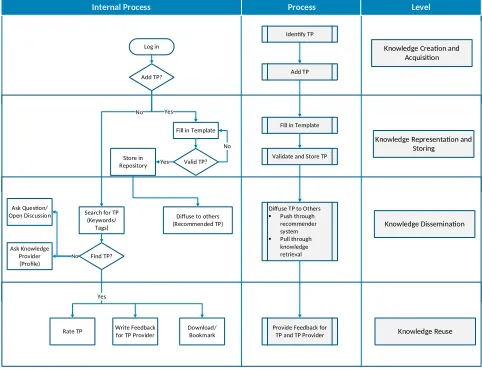
The main challenges are to persuade academics to record their own teaching practices, to share their teaching expereinces with their peers. The resulting framework motivates instructors to articulate and share their expertise in teaching by supporting feedback and rating mechanism. The authors have developed a framework consisting of four levels as shown in Figure 1.
A. Knowledge Creation and Acquisition
The first level consists of acquiring and creating knowledge related to teaching practices. Knowledge acquisition is the mechanism through which knowledge is gathered from the members of the institutions [27]. It consists of acquiring explicit knowledge, and transforming tacit knowledge in the form of explicit knowledge. The acquired knowledge includes faculty teaching experiences, resources, and solutions to problems. This step allows users to recognize teaching practices that enhance the learning process, and other users can reuse it by providing a set of guidelines that help users identify the good teaching practices that worth adding to the system.
Knowledge Creation and Acquisition
Knowledge Representation and Storing
Knowledge Dissemination
Knowledge Reuse
Identify TP
Add TP
Fill in Template
Validate and Store TP
Diffuse TP to Others
Push through recommender system
Pull through knowledge retrieval
Provide Feedback for TP and TP Provider Log in
Add TP?
Yes
Fill in Template
Valid TP? No
Yes Store in Repository
Diffuse to others (Recommended TP) No
Search for TP (Keywords/ Tags)
Find TP? Ask Question/ Open Discussion
Yes
Rate TP Write Feedback for TP Provider
Internal Process Process Level
Ask Knowledge Provider (Profile)
No
Download/ Bookmark
Figure 1. Teaching Practices Management Framework (TPMF)
B. Knowledge Representation and Storing
[image:5.612.315.556.433.618.2]stored in a central repository and represented in a structured format to be easily read and shared by academics. This will ensure the availability of the required knowledge quickly and efficiently at the same place.
C. Knowledge Dissemination
As discussed in the interview results, the standard methods for sharing knowledge amongst academics are face-to-face meetings and emails. Academics claim that these methods are not effective anymore due to time and location constraints. Therefore, knowledge dissemination is an essential component of the framework which refers to the transfer and deployment of knowledge to the users. Dissemination of knowledge can be pull-based where the user can search for the required knowledge, or push-based as the knowledge that seems relevant to the user’s profile can be offered [28].
D. Knowledge Reuse
Academics pointed out the importance of applying experts’ teaching practices in their classrooms. The main objective of knowledge reuse is to allow the knowledge consumer to access and apply teaching practices. To support the reuse of knowledge, academics can search, download and print teaching practices. The framework implements an extrinsic motivator for scoring teaching practices. Author earns reputation points when contributing knowledge while feedback represents the degree of satisfaction of other users who have shared teaching practices. Earning reputation points and feedback can encourage an individual to become more involved in knowledge sharing practices when they recognize this acknowledgment by others.
The teaching practices management framework (TPMF) is essential for the higher education sector that intends to implement the KM system in their organization. It will become a guideline for designing a system in order to avoid the errors and gain other benefits in terms of time and effort as well as cost involvement.
VI. CONCLUSIONSAND FURTHER WORK
The main aim of this study is to understand the need for improving the management process of teaching practices and construct a framework for both academic departments as well as developers to use as a guideline to apply or develop tools to support the creation, storing, sharing and reusing of teaching practices. From the analyzed results, the study confirms that Saudi universities do not currently have any formalized method for sharing an instructor’s knowledge. Some tools and procedures exist to facilitate knowledge exchange, but lack a standardized process for the creation, storing, sharing and reusing of good teaching practices. This study also indicates that academics are expected to seek out knowledge from identifiable colleagues. This is frequently completed on an oral face-to-face basis. However, it may be concluded that the universities are failing to embrace social technologies to facilitate academics collaboration and enhance knowledge sharing. Utilising the findings of the investigative study, it has been possible to develop a conceptual framework for the
improvement of sharing teaching practices among instructors. The framework has been developed to address specific issues highlighted during the investigation, but further work is recommended to identify how Web 2.0-based technologies may be employed to enhance teaching practice sharing among academics in universities.
ACKNOWLEDGEMENT
The authors thank the Saudi Ministry of Education for funding Nouf Almujally to undertake this research at the University of Warwick.
REFERENCES
[1] R. M. Grant, “Toward a knowledge-based theory of the firm,”
Strategic Management Journal, vol. 17, no. S2, pp. 109–122, 1996. [2] N. K. Agarwal, D. C. C. Poo, and J. M. Goh, “Managing Quality of
Information Retrieval for Effective Knowledge Management,” In Proceedings of the 3rd World Conference for Software Quality (3WCSQ), pp. 205–214, 2005.
[3] C. O’Dell and C. Hubert, The New Edge in Knowledge: How
Knowledge Management Is Changing the Way We Do Business. Wiley, 2011.
[4] A. L. I. A. Ahmadi, “Interdisciplinary Journal of Contemporary Research In Business Knowledge Management In Iranian University (Case Study Shushtar University),” pp. 653–667, 2012.
[5] F. Gao, T. Luo, and K. Zhang, “Tweeting for learning: A critical analysis on microblogging in education published in 2008 – 2011,”
Visual communication and Technology Education Faculty Publications, p. 20, 2012.
[6] J. Rowley, “Is higher education ready for knowledge management?,”
International Journal of Educational Management, vol. 14, no. 7, pp. 325–333, 2000.
[7] S. Kim and B. Ju, “An analysis of faculty perceptions: Attitudes toward knowledge sharing and collaboration in an academic institution,” Library & Information Science Research, vol. 30, no. 4, pp. 282–290, 2008.
[8] L. A. Mills, G. Knezek, and F. Khaddage, “Information Seeking, Information Sharing, and going mobile: Three bridges to informal learning,” Computers in Human Behavior, vol. 32, pp. 324–334, 2014.
[9] Kinshuk, N. S. Chen, I. L. Cheng, and S. W. Chew, “Evolution Are not enough: Revolutionizing Current Learning Environments to Smart Learning Environments,” International Journal of Artificial Intelligence in Education, vol. 26, no. 2, pp. 561–581, 2016. [10] K. Yaghi and O. A. Zamzami, “Obstacles of Implementing
Knowledge Management in the High Education Institutes - Saudi Arabia (Analytical study),” International Multilingual Academic Journal, vol. 1, no. 1, 2014.
[11] E. Tsui, A. Aurelie Bechina Arntzen, L. Worasinchai, and V. M. Ribière, “An insight into knowledge management practices at Bangkok University,” Journal of Knowledge Management, vol. 13, no. 2, pp. 127–144, 2009.
[12] L. A. Petrides and S. Z. Guiney, “Knowledge management for school leaders: An ecological framework for thinking schools,” Teachers College Record, vol. 104, no. 8, pp. 1702–1717, 2002.
[13] S. Panahi, J. Watson, and H. Partridge, “Towards tacit knowledge sharing over social web tools,” Journal of Knowledge Management, vol. 17, no. 3, pp. 379–397, 2013.
[15] M. D. Myers and M. Newman, “The qualitative interview in IS research: Examining the craft,” Information and Organization, vol. 17, no. 1, pp. 2–26, 2007.
[16] G. Rolfe, “Validity, trustworthiness and rigour: quality and the idea of qualitative research,” Journal of Advanced Nursing, vol. 53, no. 3, pp. 304–310, 2006.
[17] V. Venkatesh and S. A. Brown, “Research article bridging the qualitative-quantitative divide : guidelines for conducting mixed methods,” vol. 37, no. 1, pp. 21–54, 2013.
[18] V. Collinson, “Learning to share, sharing to learn: fostering organizational learning through teachers’ dissemination of knowledge,” Journal of Educational Administration, vol.42, no.3, pp.312-332, 2004.
[19] K. K. Jain, M. S. Sandhu, and G. K. Sidhu, “Knowledge sharing among academic staff: A case study of business schools in Klang Valley, Malaysia,” UCSI Centre for Research Excellence, 2007. [20] O. Alharbi and V. Lally, “Adoption of E-Learning in Saudi Arabian
University Education: Three Factors Affecting Educators,” European Journal of Open Education and E-learning Studies, vol. 2, no. 2, pp. 63–85, 2017.
[21] Choi, Lee, and Yoo, “The Impact of Information Technology and Transactive Memory Systems on Knowledge Sharing, Application, and Team Performance: A Field Study,” MIS Quarterly, vol. 34, no. 4, p. 855, 2010.
[22] K. S. N. Kumaraswamy and C. M. Chitale, “Collaborative knowledge sharing strategy to enhance organizational learning,” Journal of Management Development, vol. 31, no. 3, pp. 308–322, 2012. [23] T. Menkhoff, Y. W. Chay, M. L. Bengtsson, C. J. Woodard, and B.
Gan, “Incorporating microblogging (‘tweeting’) in higher education: Lessons learnt in a knowledge management course,” Computers in Human Behavior, vol. 51, pp. 1295–1302, 2015.
[24] D. Bevan, C. Kipka, K. Sita Nirmala Kumaraswamy, and C. M. Chitale, “Collaborative knowledge sharing strategy to enhance organizational learning,” Journal of Management Development, vol. 31, no. 3, pp. 308–322, 2012.
[25] I. Nonaka and H. Takeuchi, The Knowledge-Creating Company. New York: Oxford University Press, 1995.
[26] M. Evans and N. Ali, “Bridging knowledge management life cycle theory and practice,” in International Conference on Intellectual Capital, Knowledge Management and Organisational Learning ICICKM, 2013, pp. 156–165.
[27] T. Schwartz, D.G., Divitini, M. and Brashethvik, Internet-based Organizational Memory and Knowledge Management. Hershey: Idea Group Publishing, 2000.