warwick.ac.uk/lib-publications Manuscript version: Author’s Accepted Manuscript
The version presented in WRAP is the author’s accepted manuscript and may differ from the published version or Version of Record.
Persistent WRAP URL:
http://wrap.warwick.ac.uk/113317
How to cite:
Please refer to published version for the most recent bibliographic citation information. If a published version is known of, the repository item page linked to above, will contain details on accessing it.
Copyright and reuse:
The Warwick Research Archive Portal (WRAP) makes this work by researchers of the University of Warwick available open access under the following conditions.
Licensed under the Creative Commons Attribution-NonCommercial- 4.0 International
https://creativecommons.org/licenses/by-nc/4.0/
Publisher’s statement:
Please refer to the repository item page, publisher’s statement section, for further information.
FRANCIS BLOCH⇤, BHASKAR DUTTA†, AND MIHAI MANEA‡
Abstract. We analyze the formation of partnerships in social networks. Players need favors at random times and ask their neighbors in the network to form exclusive long-term partnerships that guarantee reciprocal favor exchange. Refusing to provide a favor results in the automatic removal of the underlying link. Players agree to provide the first favor in a partnership only if they otherwise face the risk of eventual isolation. In equilibrium, players essential for realizing every maximum matching can avoid this risk and enjoy higher payoffs than inessential players. Although the search for partners is decentralized and reflects local partnership opportunities, the strength of essential players drives efficient partnership formation in every network. Equilibrium behavior is determined by the classification of nodes in the Gallai-Edmonds decomposition of the underlying network.
JEL Classification Numbers: D85, C78.
Keywords: networks, efficiency, decentralized markets, partnerships, favor exchange, maximum matchings, Gallai-Edmonds decomposition, under-demanded.
1. Introduction
The idea that the power of an individual depends on his or her position in a certain social or economic network is well-established in a variety of contexts cutting across disciplines. For instance, social network analysis suggests that an individual’s power cannot be explained by the individual’s characteristics alone but must be combined with the structure of his or her relationships with others. Power arises from occupying advantageous positions in the relevant network and leveraging outside options. In particular, network exchange theory focuses on studying the relative bargaining power of individuals in bilateral exchanges with neighbors in social networks (see Willer (1999) for an overview). More recent research in economics develops game theoretical models aimed at understanding how an individual’s position determines his or her bargaining power and selection of trading partners in markets
⇤Université Paris 1 and Paris School of Economics; [email protected]
†University of Warwick and Ashoka University; [email protected] ‡Stony Brook University; [email protected]
Date: January 28, 2019.
with a network structure (Jackson (2008; Ch. 10), Easley and Kleinberg (2010; Ch. 11), and Manea (2016) survey this literature).
In this paper, we study the impact of the social and economic network structure on the relative strength of different positions in the network, the pattern of bilateral partnerships that emerge, and market efficiency. In our model, players form exclusive partnerships to exchange favors with one another. Favors could be small—e.g., advice on a particular issue, a small loan, and help on a school project—or large—e.g., sharing one’s life with another person and forming a long-term business relationship. Every player needs favors at random points in time and can receive them from neighbors in the network. All players benefit equally from receiving favors and incur the same cost for providing them. The benefit exceeds the cost, so it is socially desirable to exchange favors. If a player agrees to provide a favor to another, the two players form an exclusive partnership which requires that they leave the network together and do each other favors whenever needs arise in the future. A player who needs a favor and has not yet formed a partnership approaches his remaining neighbors in the network in random order to request the favor. Each neighbor asked for the favor decides whether to provide it and enter the partnership or refuse to do so and irreversibly lose his link with the player requesting it.
Our modeling of the search for partners is admittedly specific but captures important features of applications such as marriage and joint business ventures. We implicitly assume that the payoffs received by the favor seeker and favor giver are asymmetric. In the context of courtship for example, the intensity of preferences of the two partners is often asymmetric, and one partner is more eager than the other to form the partnership. In our model, players are symmetric, but the favor seeker is always more eager to form the partnership than the favor giver. This introduces an incentive for one of the two parties to delay the formation of the partnership. However, this incentive is modulated by the evolution of the network and the decline in partnership opportunities over time. Turning down favor requests results in the loss of potential future partners both because links leading to rejections are deleted from the network and because other neighbors form exclusive partnerships and leave the network. Hence, players face a trade-offbetween the cost of accepting a partner and the risk of not finding one in the future. Returning to the example of dating, players prefer not to commit to a relationship until they start worrying that they will grow old alone. We find that precisely this feature of the search process leads to efficient matching outcomes.
result in partnerships when activated. Keeping track of which partnerships are efficient in our dynamic game is challenging because the structure of maximum matchings and the efficiency of links evolves as partnerships form and favor requests are turned down.
Given the global considerations involved in identifying maximum matchings in a general network and the local decentralized nature of the search for partners as favor needs arise in our game, one might not expect a strong link between equilibrium outcomes and efficiency in the game. Nevertheless, our main result proves that when players are sufficiently patient, the game admits a unique subgame perfect equilibrium and that the equilibrium pattern of partnerships is efficient for every network structure. This result is surprising in the context of existing research on matching and trade in networks. Indeed, in a survey of the literature on bilateral trade in networks, Manea (2016) argues that the disconnect between global efficiency and local incentives explains why decentralized trade often generates inefficient market outcomes. Abreu and Manea (2012a, b) and Elliott and Nava (2016) reach this conclusion for Markov perfect equilibria in two natural models of bargaining in networks.1
By contrast, the seminal work in this area of Kranton and Minehart (2001), Corominas-Bosch (2004), and Polanski (2007) showed that centralized matching is conducive to efficient trade.
Somewhat paradoxically, the absence of prices or direct transfers in our model drives the efficiency result and the divergence from the conclusions of Abreu and Manea (2012a, b) and Elliott and Nava (2016). Players can experience only three types of outcomes in our model: remain single; commit to a partnership by granting a favor; and enter a partner-ship by way of receiving a favor. A player has an incentive to provide the first favor in a partnership only if refusing to do so puts him at risk of eventually becoming single. We find that a key structural property of nodes determines whether a player ever faces the risk of becoming single in equilibrium. Specifically, a node is said to be essential if it belongs to all maximum matchings of the network and under-demanded otherwise. A further parti-tion of essential nodes into over-demanded nodes—neighbors of under-demanded nodes—and perfectly matched nodes—the remaining ones—is central to the Gallai-Edmonds decomposi-tion, which characterizes the structure of maximum matchings.2 These concepts also play a
prominent role in the equilibrium analyses of Corominas-Bosch (2004), Polanski (2007), and Abreu and Manea (2012a). We prove that in the equilibrium of our game, essential players always find partners, while under-demanded players remain single with positive probability. Hence, essential players obtain higher payoffs than under-demanded players.
1However, Abreu and Manea (2012b) construct a complex system of punishments and rewards with a
non-Markovian structure that implements an efficient subgame perfect equilibrium.
2The intuitive economic terminology for the Gallai-Edmonds partition of nodes has been introduced by
The conclusion that under-demanded players are relatively weaker than essential ones is common across the bargaining models discussed above.3 However, our model highlights a
new channel leading to this conclusion. In previous models, the weakness of under-demanded players is caused by their vulnerability to isolation following some sequences of efficient trades. Thus, the fact that under-demanded nodes are left out by some maximum matchings, which is their defining property, is directly involved in the argument. In the present model, the analysis relies on a latent property of under-demanded nodes: if an under-demanded node is removed from the network, all its neighbors become essential in the remaining network. Backward induction then implies that when an under-demanded player needs a favor, his neighbors have incentives to turn him down in sequence and ultimately reach desirable essential positions. Hence, every under-demanded player who requests a favor remains single. Our characterization of the subgame perfect equilibrium relies on the intuition that under-demanded players are weak, and players commit to partnerships via doing favors in order to avoid occupying under-demanded positions in the network formed by surviving links. We prove that when an over-demanded player needs a favor, the first under-demanded neighbor he approaches has to provide it. When a perfectly matched player requests a favor, the last neighbor in the order with whom he shares an efficient link—another perfectly matched player—agrees to provide the favor. Refusing to enter this last possible efficient partnership and removing the corresponding link would result in both players switching from essential to under-demanded positions, with the player who requested the favor ending up single and the other player preserving his under-demanded status in the ensuing network.
Our proof additionally shows that a player does not have an incentive to grant a favor to a neighbor if refusing to do so and losing the link with the neighbor leaves him in an essential position. However, under-demanded players turn down favor requests from other under-demanded neighbors and remain temporarily under-demanded anticipating that no player will agree to provide the favor and they will become essential after the chain of rejections and link removals. Therefore, our favor exchange game reveals a deep connection between decentralized incentives for efficient partnership formation and the Gallai-Edmonds structure.
We investigate the robustness of our theoretical conclusions with respect to several mod-eling assumptions. One important ingredient for our analysis is the assumption that links generating rejections are permanently severed.4 We show that this assumption is crucial
3Polanski (2016) emphasizes this point in a range of bargaining environments, including the cooperative
game of Kleinberg and Tardos (2008) and the stationary market of Manea (2011) in addition to the models already mentioned.
4This assumption appears in other models of favor exchange. For instance, Jackson et al. (2012) motivate
for our conclusions—in a version of the model in which links are never removed from the network, multiple equilibria may exist and equilibria are not necessarily efficient. However, our equilibrium characterization continues to apply if the game is perturbed so that links generating rejections are maintained with small probability.
We find that our results are not sensitive to other modeling assumptions. In particular, the efficiency result does not change if we assume that the order in which a player asks neigh-bors for favors is selected strategically or specified exogenously instead of being generated randomly as in the benchmark model. We extend our results to a setting with reduced-form payoffs in which, in the spirit of standard matching and bargaining models, all gains from a partnership are realized at its creation (or equivalently each player requires a single favor at a random time), and the player initiating a partnership enjoys a first-mover advantage. We also discuss extensions of the model with payoffheterogeneity and continuous time.
Bloch et al. (2018) test the predictions of the model in a laboratory experiment. They find that a large fraction of subjects play according to the subgame perfect equilibrium, but a subject’s ability to select the equilibrium action depends on the complexity of the network as well as on his or her position in the network. Deviations from equilibrium behavior primarily involve subjects agreeing to grant favors when equilibrium play prescribes declining the request.
Besides the literature on bilateral trade in networks discussed above, our model contributes to research on favor exchange. Möbius and Rozenblat (2016) survey existing research in the latter area. Many models in this literature—in particular, Bramoullé and Kranton (2007), Bloch et al. (2008), Karlan et al. (2009), Jackson et al. (2012), and Ambrus et al. (2014)— share the basic structure of our model: players request favors or transfers at different points in time and cooperation is enforced through reciprocation in the future. The model of Jackson et al. (2012) is closest to ours. However, in that model favor needs are link-specific and pairs of players meet too infrequently to sustain bilateral exchange in isolation. Jackson et al. show that clustered social quilts support cooperation via the social threat of losing links with multiple neighbors following deviations from cooperative behavior.
2. Model
We study a partnership formation game played by a finite setN ={1,2, . . . , n}of players
who constitute the nodes in an undirected network G. Since the network of potential
part-nerships evolves over time and the collection of existing partpart-nerships forms a matching, it is useful to provide general definitions for networks and matchings. An undirected network G
linking the set of nodesN is a subset ofN⇥N such that(i, i)2/ Gand(i, j)2G,(j, i)2G
for all i, j 2 N. The condition (i, j) 2 G is interpreted as the existence of a link between
nodes i and j in the network G; in this case, we say that i is linked to j, or that i is a neighbor ofj inG. We use the shorthandij for the pair (i, j) and identify the links ij and ji. A node is isolated inGif it has no neighbors in G. For any network G, let G\ij, kh, . . .
denote the network obtained by removing links ij, kh, . . . from G, and G\ i, j, . . . denote
the network in which all links of nodesi, j, . . . inG are removed (but nodesi, j, . . . remain,
isolated, in the network). Amatchingis a network in which every node has at most one link. A matching of the network Gis a matching that is a subset of G. We say that a matching covers a node if the node has one link in the matching (and that a matching covers a set of nodes if it covers every node in that set).
The partnership formation game proceeds in discrete time at datest= 0,1, . . .. At every
date t, there is a set of partnerships that have already formed represented by a matching Mt and a prevailing network of potential future partnerships Gt. At date t, one player i
randomly selected—each with probability1/n—from the set N needs a favor. Partnerships
are assumed to be permanent and guarantee reciprocal favor exchange, so if player i has
a partner j under Mt, then j automatically provides the favor to i. Otherwise, player i
randomly chooses one of his neighbors j0 in the network Gt0 := Gt and asks him for the
favor. Player j0 decides whether to provide the favor or not. If player j0 declines to do the favor fori, then the linkij0is permanently removed from the network, and playericontinues searching for a partner in the networkGt1 :=Gt0\ij0. In general, after k rejections, player
irandomly chooses one of his neighbors jk in the remaining network Gtk := Gt(k 1)\ijk 1 to ask for the favor. If player jk agrees to provide the favor to player i at date t, player i
receives a payoffv > 0 and player jk incurs a cost c2 (0, v). In this case, iand jk form a
long-term partnership, so that the set of ongoing partnerships becomesMt+1 =Mt[ijk, and
the game proceeds to datet+ 1 on the networkGt+1 =Gt\i, jk. If none ofi’s neighbors in
Gt agrees to provide the favor toi, theniremains isolated and the game continues to period
t+ 1on the network Gt+1 =Gt\i. All players discount future payoffs by a factor of per
period.
1 2 3 4
1 2
3 4
Figure 1. The line and complete networks with four nodes
LetV denote the expected discounted payoffobtained by a player who is matched with a
partner with whom he reciprocates favors,
V = v c n(1 ).
Since providing the first favor in a partnership costs c and leads to a continuation payoff
of V, a necessary condition for a player to rationally agree to provide the first favor in
equilibrium is that V c, which is equivalent to
:= n
r+n
where
r:= v c c
represents thereturn to favors. Hence, if < , then all favor requests are turned down and
every player receives zero payoffin equilibrium.
As customary, the normalized payoff of a player is defined by his expected payoffin the game multiplied by1 . Thus, the normalized payoffaccruing to a player who is matched
with a partner with whom he reciprocates favors is (v c)/n.
Two types of networks that will be useful for illustrations. Thelinenetwork withnplayers
consists of the links(1,2), . . . ,(n 1, n). A network iscomplete if it links every pair of nodes.
3. Examples
In this section, we analyze the partnership formation game in the two examples shown in Figure 1: the line and the complete networks with four players. Assume that , so that at least one partnership forms in any equilibrium in either network.
Consider first the four-player line network. Suppose that player 1 needs a favor in the first period of the game. In this case, only player 2 can provide the favor to 1. If 2 agrees to provide the favor, he obtains an expected payoffof c+ V. If2turns 1 down, then the
link(1,2)is removed from the network. In the remaining network, if player 2 or 4 requests
the next favor, then player 3 has no incentive to provide it. Indeed, declining such a request leaves player 3 in a network with a single link, which generates an expected continuation payoffof V for player 3, while accepting such a request results in the lower expected payoff
approaches each of players 2 and 4 with probability 1/2, and under the assumption that
, either player accepts the request because he would otherwise remain isolated.
It follows that the expected continuation payoffof player 2 following the rejection of 1’s favor request is WL, whereWL solves the equation
WL = 1 4
✓
WL+1
2( c+ V) + V ◆
.
In this equation, the term WL represents the continuation payoff of player 2 in the event
that player 1 requires the second-period favor as well. Player 2 receives payoff0 if he needs the second-period favor (as player 3 refuses to provide it) and payoff V if 4 needs the favor
(and 3 turns him down). The expected payoffof player 2 in the event that player 3 needs a favor in the second period is( c+ V)/2, reflecting the fact that 3 asks 2 for the favor with
probability1/2. The solution to the equation is
WL = 3 V c
2(4 ).
Player 2 then has an incentive to grant the favor in the first period to player 1 only if
c+ V WL, which is equivalent to
V(8 5 ) c(8 3 ).
Using the formula V = (v c)/(4(1 )), the inequality above can be rewritten as
r= v c c
4(1 )(8 3 )
(8 5 ) .
For 2[0,1), this inequality is equivalent to
⇤L := 2(11 + 2r
p
25 + 4r+ 4r2)
12 + 5r .
For instance, forr = 1, which means thatv= 2c, we have that ⇤L
⇡0.854.
When player 2 needs the first favor, player 3 does not have an incentive to provide it because he can count on always receiving favors from 4. However, for , player 1 has an incentive to do the favor to 2 because refusing to do so would leave him isolated. Symmetric arguments apply to the situations in which players 3 and 4 require the first favor.
Therefore, the structure of equilibria in this network is as follows:
• For < , no favors are ever granted in equilibrium.
• For 2 ( , ⇤L), if player 1 (or 4) needs the first favor, then player 2 (3) turns him
• For 2( ⇤L,1), every player who needs a favor receives it and the partnerships(1,2)
and(3,4)form (players 2 and 3 reject each other’s favor requests on the equilibrium
path).
For any , welfare maximization requires that the partnerships(1,2)and (3,4)form, so the
equilibrium is efficient only for > ⇤L.
Consider next the complete network with four players. If player 1 needs the first favor and is rejected by all his neighbors, then the other three players are left in a complete network. In this case, an argument similar to the one above shows that when one of the remaining three players requires a favor, the other two turn him down. Thus, if all players refuse to do player 1 the favor, each player i2{2,3,4} enjoys a continuation payoff WC, where
WC = 1 4( W
C+ 2 V).
This payoff equation is analogous to the one defining WL. In particular, the term 2 V
captures the events in which one of two players different from 1 and ineeds the next favor
and remains single, effectively leaving i in a bilateral partnership with the fourth player
starting in the third period. Solving the equation, we obtain
WC = 2 V
4 .
The last neighbor approached by player 1 has an incentive to provide the first-period favor to 1 only if c+ V WC, which is equivalent to
r 4(1 )(4 )
(4 3 ) .
The last inequality reduces to
⇤C := 2(5 +r
p
9 2r+r2)
4 + 3r .
Forr = 1, we obtain ⇤C
⇡0.906.
To summarize, the structure of equilibria in the complete network is as follows:
• For < , no favors are granted in equilibrium.
• For 2( , ⇤C), the player who needs the first favor is refused by all other players.
The next player requiring a favor is also turned down by his remaining neighbors. The third player who needs a favor receives it from his only remaining neighbor, and a single partnership forms.
• For 2( ⇤C,1), the first player who needs a favor receives it from the last player he
approaches, and two partnerships form.
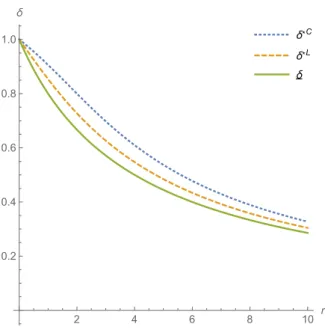
δ*C δ*L δ
2 4 6 8 10 r
0.2 0.4 0.6 0.8 1.0
δ
Figure 2. Thresholds , ⇤L, and ⇤C as a function ofr
Figure 2 depicts the thresholds , ⇤L, and ⇤C as a function of the return to favors r.
Note that < ⇤L < ⇤C for all values of r > 0. The inequality ⇤L < ⇤C reflects the fact
that player 2’s continuation payoff in the event that player 1 requires the first favor and his neighbors turn him down is smaller in the line network than in the complete network,
WL < WC. Hence, it is easier to provide an incentive for player 2 to form an efficient
partnership with player 1 in the line than in the complete network. The two examples demonstrate that adding links to a network does not always facilitate the efficient formation of partnerships. Enlarging the set of links increases the number of potential matchings but may also increase the continuation values of players after links are severed, making it more difficult to sustain efficient partnerships.
We will prove that the conclusions regarding the uniqueness and efficiency of equilibria for high in the examples of this section extend to all networks. We will also show that the equilibrium decisions to form partnerships for high are directly determined by the classification of the corresponding pairs of nodes in the Gallai-Edmonds decomposition, which we introduce next.
4. Efficient Partnerships and Maximum Matchings
The previous section reveals a close relationship between efficient partnership formation and maximum matchings. We say that a matchingM is a maximum matchingofG if there
exists no matching of G that contains a greater number of links than M. For any network G, let µ(G) denote the size of the maximum matching of G, i.e., the number of links in a
1 2 3 4 5
1
2 3
Figure 3. The line with five nodes and the complete network with three nodes
Any strategy profile along with the random moves by nature—the list of players needing favors and the sequence of neighbors they approach at every date—induce a probability distribution over outcomes at every date. We view(Mt)t 0 and(Gt)t 0 as random variables in this space. Clearly, we have Mt ✓ Mt+1 and Gt+1 ✓ Gt for all t 0. Let M¯ and G¯
denote the limits as t ! 1 of the variables (Mt)t 0 and (Gt)t 0 defined by M¯ = [t 0Mt
andG¯ =\t 0Gt. We call the random variableM¯ thelong-run matching induced by . This
motivates the following definition.
Definition 1. A strategy profile is long-run efficient if the long-run matching it induces is a maximum matching of G with probability 1.
In the Appendix, we confirm the intuition that a strategy profile maximizes the limit of the sum of normalized expected payoffs of all players as !1 only if it is long-run efficient.
The welfare analysis of equilibria in our partnership formation game thus naturally leads us to examine the structure of maximum matchings. Gallai (1964) and Edmonds (1965) developed a characterization of maximum matchings that not only proves useful in analyzing welfare properties of equilibria but captures the structure of incentives in our game in a precise way. Gallai and Edmonds’ result relies on the following partition of the set of nodes in a network G. A node is under-demanded in G if it is not covered by some maximum
matching of G. A node is over-demanded in G if it is not under-demanded but has an
under-demanded neighbor inG. A node isperfectly matched inGif it is neither under- nor
over-demanded in G. For example, in both the line and the complete networks with four
players from Figure 1, all nodes are perfectly matched. In the line with five nodes shown in the left panel of Figure 3, nodes 1, 3, and 5 are under-demanded, while nodes 2 and 4 are over-demanded. In the complete network with three nodes from the right panel of Figure 3, all nodes are under-demanded.
Theorem GE (Gallai-Edmonds Decomposition [19]). Every maximum matching of a net-work links each perfectly matched node to another perfectly matched node and each
over-demanded node to an under-over-demanded node.5
5The original theorem provides a comprehensive description of the structure of maximum matchings. We
The following result, whose proof appears in the Appendix, describes the evolution of the Gallai-Edmonds partition as partnerships form or as links are removed following declined favor requests. We say that iis an efficient partner of j inG or that ij is an efficient link
if the linkij belongs to a maximum matching ofG and that a node isessential inG if it is
either over-demanded or perfectly matched inG.
Lemma 1. For every network G and any linkij 2G, the following statements hold: (1) If iis under-demanded in G, then iis under-demanded in the network G\ij, andj
is essential in the networkG\i.
(2) Suppose that i is perfectly matched in G and that j is not the only efficient partner of iin G. Then, the sets of perfectly matched, over-demanded, and under-demanded nodes coincide inG andG\ij. Moreover, the set of efficient partners of iin G\ij consists of all efficient partners ofiin Gexcept forj (in case ij is an efficient link). (3) Ifiis perfectly matched inG, and j isi’s only efficient partner inG, then bothiand
j are under-demanded in the network G\ij, andj is under-demanded in G\i. (4) If i is over-demanded and j is under-demanded in G, then ij is an efficient link in
G, and iis an essential node in G\ij.
(5) If both iandj are perfectly matched, andij is an efficient link in G, then the sets of under-demanded nodes different from i andj in G\i, j and Gcoincide.
5. Equilibrium Partnerships and Efficiency
We provide a complete characterization of subgame perfect equilibria in the partnership formation game for high that relies on the classification of nodes in the Gallai-Edmonds decomposition in the prevailing network. From this characterization, we infer that equilibria are long-run efficient and that all essential players find partners when players are patient. The characterization also implies that for !1, all essential players receive limit normalized
payoffs of(v c)/n, while under-demanded players obtain limit normalized payoffs of at most (n 1)/n⇥(v c)/n. Therefore, as players become patient, essential players fare better
than under-demanded players.
Theorem 1. Fix a networkG withn players. The following statements hold for sufficiently high .
• Equilibrium Uniqueness: The partnership formation game played on the network
Ghas a unique subgame perfect equilibrium, which is in pure strategies.
• Outcomes: In the equilibrium, each essential player in G receives favors any time
he needs them and enjoys a limit normalized expected payoff of (v c)/n, while each under-demanded player inG remains single with probability at least1/n and obtains a limit normalized expected payoff of at most (n 1)/n⇥(v c)/n.
• Behavior and Partnerships: When playerirequests a favor in the initial network
– ifiis under-demanded in G, all neighbors denyi’s request andiremains single;
– if i is perfectly matched in G, all neighbors turn i down until there is only one remaining neighbor among i’s efficient partners in G; this neighbor agrees to provide the favor toi;
– ifiis over-demanded in G, all neighbors turni down untiliapproaches his first under-demanded neighbor inG, who grants the favor.
• Efficiency: In equilibrium, µ(G) partnerships form with probability 1. The
equilib-rium is long-run efficient.
As discussed in the introduction, existing research (e.g., Abreu and Manea (2012a, b) and Elliott and Nava (2016)) reveals a tension between decentralized trade in networks and efficient market outcomes. A combination of new modeling assumptions delivers efficiency in our decentralized setting: direct transfers are not possible within partnerships, so every player can experience only a discrete set of outcomes; a player who needs a favor gets the opportunity to propose partnerships sequentially to all his neighbors; and links leading to rejections are irreversibly removed from the network. Corominas-Bosch (2004), Polanski (2007), and Abreu and Manea (2012a) also reach the conclusion that under-demanded play-ers are weaker than essential ones. Their results rely on the vulnerability of under-demanded players to isolation as neighbors form partnerships and exit the network. This vulnerability stems from the fact that, by definition, under-demanded players are excluded by some max-imum matchings. Our analysis points to a conceptually distinct quality of under-demanded players in the structure of maximum matchings: removing an under-demanded player from the network makes all his neighbors essential. For this reason, when an under-demanded player requests a favor, his neighbors anticipate that his other potential partners will refuse the request in order to reach attractive essential positions. Hence, under-demanded players are marginalized in the original network via immediate link deletions triggered by rejections rather than being exposed to the standard gradual decline in partnership opportunities.
We present the proof of Theorem 1 in the Appendix. To develop some intuition for this result, note that every player i can experience three types of outcomes in the partnership
formation game in the networkG: (1) remaining single; (2) entering a partnership by way of
providing a favor to a neighbor who requires one; (3) initiating a partnership via having the first favor he needs granted. The expected payoffs of playeriwhen these situations arise are
given by0, c+ V, andv+ V, respectively. For > , we have that0< c+ V < v+ V.
In scenarios (2) and (3), playerialways receives the benefitvwhen he needs a favor and has
to pay the costc any time his partner requires a favor. However, scenario (3) saves playeri
some early costs c of providing favors before he needs one, so i does not have an incentive
scenario (3) most and would like to delay accepting a partnership of type (2) for as long as this does not make him vulnerable to remaining single as in scenario (1).
The proof shows by induction on the number of links in network G that in equilibrium,
essential players always form partnerships and end up in scenario (2) or (3), while under-demanded players reach scenario (1) with probability at least1/nfor close to 1. It is then
optimal for a player to provide a favor when asked only if he becomes under-demanded in the network in which his link with the player needing the favor is severed. Lemma 1.1 implies that if an under-demanded player i needs a favor and all his neighbors turn him down,
theni’s neighbors become essential in the remaining network. The induction hypothesis and
backward induction then imply that every neighbor ofiis guaranteed an outcome classified
as scenario (2) or (3) above and thus does not have an incentive to doithe favor. Hence, in
any subgame, every player who is under-demanded in the remaining network faces scenario (1) in the event he needs the next favor, which happens with probability1/n.
When a perfectly matched playerirequires a favor, we argue that his last efficient partner j whom he asks should provide the favor to i. Otherwise, the linkij is removed from the
network, and the first part of Lemma 1.3 shows that both i and j are under-demanded in
the resulting network G\ij. The induction hypothesis for G\ij implies that no neighbor
whomiapproaches afterjgrants him the favor. Then, the second part of Lemma 1.3 shows
thatj becomes under-demanded in the ensuing network G\i. By Lemma 1.2, every player
whomiasks for the favor before reaching his last efficient partner is essential and maintains
his role in the Gallai-Edmonds decomposition following his refusal to doithe favor. Hence,
these players do not have incentives to partner withi.
When an over-demanded playerirequires a favor, Theorem GE implies that no essential
neighbor changes status in the Gallai-Edmonds decomposition by refusing to provide the favor and losing the link withi. Then, no such neighbor has an incentive to doi the favor.
However, if the over-demanded player i asks an under-demanded neighbor j for the favor,
player j has an incentive to do it. This requires a more delicate analysis of the evolution of
the positions of iand j in the Gallai-Edmonds decomposition in the subgame in which the
linkij is removed andiapproaches other neighbors with the request. Lemma 1.4 shows that iremains essential inG\ij, and the induction hypothesis implies thatiwill eventually reach
a neighbork who is willing to partner with him. However, it is possible that the partnership
between iand his specific neighbor k improves j’s position from being under-demanded in G(as well as G\ij according to Lemma 1.1) to becoming essential in G\i, k.
This situation is illustrated in the network from Figure 4. Suppose that in this network, the over-demanded playeriasks his under-demanded neighborj for a favor, andj turns him
down. If irequests the favor fromh next, thenh accepts to provide the favor anticipating
that he would otherwise remain under-demanded. Following the formation of the partnership
(i, h), playerj becomes perfectly matched in the remaining network and eventually partners
g i
j h k
Figure 4. A key step in the proof of Theorem 1
payoff V c derived from providing the favor to i. However, if i asks player k instead
of h for the favor after j’s rejection, k agrees to provide the favor, in which case j is left
under-demanded and exposed to a probability 1/2 of remaining single, which for high is
significantly less desirable than the expected payoff V c guaranteed by the partnership
withi. This is where the assumption that playeriasks his neighbors for the favor in random
order is crucial for the argument—after being rejected by j, playeriis equally likely to ask
the favor from h and k; while j is slightly better off not providing the favor to i in case i
partners with h, he is considerably worse off in case i partners with k. Then, for high ,
playerj prefers to provide the favor toiif asked first. The proof shows that a player acting
like k—willing to form a partnership with iin equilibrium that leavesj under-demanded—
always exists in a general network in which i is over-demanded and j is under-demanded.
Lemma 1.4 is used to conclude that the set of partnerships that emerge in equilibrium form a maximum matching.
In Section 6.1, we discuss how the conclusions of Theorem 1 adjust if we alternatively assume that the order in which a player asks neighbors for favors is selected strategically or specified exogenously. Only the prediction of exactly which under-demanded player provides the favor to an over-demanded player change in these alternative specifications of the model.
6. Alternative Models
In this section, we test the robustness of our predictions with respect to several modeling variations. We show that the assumption that players who need favors ask neighbors in random order is not essential for our main findings. We also develop a version of the model with reduced-form payoffs in which all benefits from a partnership accrue at the time of its creation and there is some advantage for the player initiating the partnership. The results extend to such settings. We then discuss extensions of the model with payoffasymmetries and continuous time. Finally, we show that inefficient equilibria emerge if we assume that links leading to rejections are not removed from the network, but efficiency is preserved in a perturbation of the game whereby links generating rejections are maintained with small probability.
neighbors for favors. The example from Figure 4 shows that the fact that the player who needs a favor approaches neighbors in random order without revealing the order at the begin-ning of the period and instead picking neighbors sequentially is essential for the partnership outcomes described by Theorem 1. Indeed, if playeriin the network from Figure 4 chose the
order in which he approaches neighbors for the favor randomly and announced that it would be(j, h, k), then playerj would anticipate thatiwill form a partnership with h and would
optimally decide to turn down i’s request knowing that he will always have the option to
partner withgat a later stage. The same conclusion would carry over to a specification of the
model in which players who need favors approach neighbors in an exogenous deterministic order.
Furthermore, the equilibrium uniqueness established by Theorem 1 does not extend to a version of the model in which unmatched players who need favors choose the order in which they ask neighbors strategically. To fix ideas, assume that the player who needs a favor does not broadcast the order at the beginning of the period but rather decides whom to approach next following every rejection. Consider, for instance, the line network with three players. In the model with endogenous orders, for every p2[0,1], there exists an equilibrium in which
when player 2 needs the first favor, he approaches player 1 first with probabilityp. The limit
normalized payoffs of player 1 range from(v c)/9to2(v c)/9between the extreme cases p= 0 andp= 1.
While the characterization of partnerships formed by over-demanded players from Theo-rem 1 does not extend to models with alternative assumptions regarding the order in which players needing favors approach neighbors, we show that in any of these model specifica-tions, every over-demanded player who needs a favor receives it from some under-demanded neighbor. All remaining properties of the structure of equilibria uncovered by Theorem 1 extend to the alternative model specifications. The proof is provided in the Appendix. Theorem 2. Subgame perfect equilibria of the version of the partnership formation game with strategic or exogenous orderings for sufficiently high satisfy all the properties outlined in Theorem 1 with the following exceptions. The equilibrium is not unique in the case with en-dogenous orderings. When an over-demanded player requests a favor, some under-demanded neighbor provides the favor (possibly after rejections by other under-demanded neighbors).
Theorems 1 and 2 extend to a setting in which, similarly to the models of bargaining in networks [1, 2, 8, 11, 17, 18, 20, 23, 24], each player consumes all benefits of a partnership immediately and receives a payoffonly at the time the partnership is created. An alternative interpretation of this modeling assumption is that each player requires a single favor at a random time. If the player is unable to find a partner willing to provide the favor at that time, he vanishes from the network along with all his links. This interpretation of the model opens the door to applications with a “ticking clock” such as fertility in mating, deadlines for collaborative projects, and emergencies that require immediate support from a friend.
In this specification of the model, the need for a favor represents an opportunity for a player to propose a partnership. When playeriproposes a partnership to neighborj, andjaccepts
the proposal, players i and j receive one-time payoffs v1 and v2, respectively, and exit the game permanently. To match the premise of the benchmark model that each player prefers receiving the first favor in a partnership, we assume that the proposer enjoys a first-mover advantage, i.e., v1 > v2 >0. Similarly, to capture the idea that entering any partnership is more desirable than running the risk of remaining single, we require thatv2>(n 1)/n v1. We maintain the assumptions of a common discount factor and of a constant arrival rate of 1/n per period of opportunities for proposing partnerships for players who have not yet
entered partnerships.
The statements regarding equilibrium uniqueness or existence, the structure of equilib-rium partnerships, and efficiency of equilibequilib-rium outcomes from Theorems 1 and 2 carry over to this setting. For Theorem 1, we need to impose the stronger hypothesis that
v2 >(1 1/((n 1)n))v1. This condition is needed for the more detailed characterization of equilibrium partnerships from Theorem 1 establishing that an over-demanded proposer reaches an agreement with the first under-demanded player he encounters and is involved in checking incentives for the step of the proof illustrated in Figure 4. Intuitively, the conditions
v1> v2 >(n 1)/n v1 andv1> v2>(1 1/((n 1)n))v1require that the risk of not finding a partner outweighs the first-mover advantage in a partnership, so the first-mover advantage should not be too large.
The proofs of the results for this setting rely on exactly the same structural properties of nodes invoked by the analogous steps in the proofs of Theorems 1 and 2 and minor modifi-cations in payoffbound computations. In particular, the optimality of accepting a proposal whose rejection would leave a player vulnerable to isolation is driven by the assumptions thatv2>(1 1/((n 1)n))v1 andv2 >(n 1)/n v1, respectively. Similarly, the inequality
6.3. Player Heterogeneity and Continuous Time. The conclusions of Theorems 1 and 2 extend to a setting in which time is continuous and players require favors at random times that have independent and identical Poisson distributions. The structure of equilibria does not change and maximum matchings always emerge in equilibrium if the benefit of receiving favors and the cost of providing favors are player specific.6 It should be noted that the
connection between efficiency and maximum matchings breaks down for this generalization. Indeed, if the benefit from receiving favors and the cost of providing favors for player iare vi and ci (with vi > ci), respectively, then long-run efficiency requires that the long-run
matchingM¯ describing the structure of partnerships satisfies ¯
M 2arg max matchingsMofG
X
icovered byM
(vi ci).
There is no general relationship between maximizers of the expression above and maximum matchings. Nevertheless, for small levels of variation invi ci overi2N, the value achieved
by maximum matchings is close to the optimal solution, so we can conclude that equilibria of our partnership formation game are approximately efficient.
6.4. No Link Removal. Our results rely critically on the assumption that refusing to provide a favor over a link results in its removal from the network. Let us now consider a version of the model in which if a player refuses to provide a favor to a neighbor, the underlying link is not removed from the network and can be used for exchanging favors in the future (but cannot be reactivated to request the same favor in the current period). As in the benchmark model, the player who needs a favor asks neighbors in random order and partnerships are permanent once formed. The main conclusions of Theorem 1—uniqueness of the subgame perfect equilibrium and its asymptotic efficiency—do not extend to this model. To illustrate equilibrium multiplicity, consider a network with two players, 1 and 2, linked with each other. For high discount factors , we can identify the following subgame perfect equilibria. In one equilibrium, player 1 always refuses to provide the first favor, while player 2 always agrees to provide the first favor. Under these strategies, it is optimal for player 1 to refuse to provide favors as long as a partnership is not in place because player 2 will grant favors to player 1 whenever player 1 requires them. The optimality of player 2’s strategy can be checked using the single-deviation principle. The described strategies require that if player 1 needs the first favor at datet, player 2 should provide it. This behavior generates
an expected payoff of c+ V >0 for player 2. If player 2 deviates from the date taction
by turning player 1 down and then play confirms to the prescribed strategies, player 2 will enter a partnership the next time player 1 requires a favor. If this happens t0 > 0 periods
later, player 2’s conditional expected payoffis t0
( c+ V), which is smaller than c+ V
6However, the analysis becomes intractable if benefits and costs are link specific. The homogeneity
1
2
3 4
Figure 5. Long-run inefficient equilibria without link removals
for all t0. This clearly constitutes the best equilibrium outcome for player 1 and the worst
equilibrium outcome for player 2.
To obtain another stationary equilibrium, we can simply switch the behavior of players 1 and 2 in the strategies constructed above. Non-stationary equilibria can be built relying on these two equilibria. For instance, another equilibrium prescribes that the player who asks for the first favor receives it, and a partnership forms in the first period. This equilibrium relies on the threat that if a player turns down the first favor request, then play reverts to the equilibrium in which the opponent never provides the first favor. Note that this equilibrium generates expected payoffs of V for each player and is welfare optimal.7
Every subgame perfect equilibrium in the two-player network is long-run efficient. To see this, note that for close to 1, if an equilibrium involves only a small probability of agreement after a certain date, then either player would have an incentive to deviate and provide the favor at that date.
We next present an example in which long-run inefficient subgame perfect equilibria exist. Consider the 4-player network from Figure 5, which is also used to illustrate inefficient equilibria in Abreu and Manea (2012a). In the Appendix, we verify that the following strategies constitute a subgame prefect equilibrium for high . Before any partnership forms, players 1, 3, and 4 always provide favors to any neighbor who asks for one regardless of the set of players who previously refused to do the same favor, while player 2 never agrees to provide a favor. In a subgame in which partnership(1,2)or(3,4)formed, play between the
remaining pair of (linked) players proceeds according to certain equilibrium strategies for the two-player setting discussed above.8 In subgames in which the partnership(3,4)formed, the 7In another equilibrium, the first-period favor request is turned down, and then play proceeds according
to the welfare optimal equilibrium. These strategies constitute an equilibrium because providing the first favor generates an expected payoffof c+ V, while refusing to do so results in a continuation payoff of
V > c+ V. There exists also a symmetric stationary equilibrium in mixed strategies, in which conditional
on not having entered the partnership, both players agree to provide the next favor with equal probability.
8Note that the payoffs induced by these strategies are not the same as in the two-player setting because
in these subgames each player requires favors with probability1/4rather than 1/2, but the verification of
strategies specify that the best equilibrium for player 2 is played in the relationship between players 1 and 2. In subgames in which player 2 requires a favor and is first refused by both players 3 and 4 (in either order) and then ends up partnering with player 1, the strategies prescribe that the worst equilibrium for the second player who turned 2 down is played in the relationship between players 3 and 4. In other subgames with two linked players remaining, equilibrium play can be specified arbitrarily.
Under these strategies, each of the inefficient partnerships (2,3) and (2,4) forms with
probability 1/4⇥1/3 = 1/12 in the first period of any subgame in which no partnership
has formed (in the event player 2 requests a favor from player 3 or 4, respectively), with probability1/4⇥1/12in the second period (in the event player 1 requested the first-period
favor and got turned down, then 2 requested the second-period favor), and so on.
Long-run efficient equilibria also exist in this example. Such an equilibrium can be con-structed as follows. Player 2 never agrees to provide the first favor to a neighbor in any subgame. Player 1 provides a favor when asked by player 2 in every subgame. As long as no partnership has formed, there are two regimes depending on whether 3 and 4 ever refused a favor request from each other. Play starts in the “cooperative” regime, in which players 3 and 4 agree to provide favors to each other whenever one asks the other. If the pair (3,4)
ever deviates from this norm, play switches to a “non-cooperative” regime, in which players follow the inefficient equilibrium strategies constructed above. In subgames in which the partnership (1,2) has formed, players 3 and 4 play according to the welfare optimal
equi-librium strategies for the two-player game whereby they exchange favors on the equiequi-librium path in every period.
Given these strategies, it is not optimal for players 3 and 4 to ever provide favors to 2 as long as they have not deviated from the norm of the cooperative regime because they know that they can always count on each other to exchange favors when needed. By refusing to partner with 2, each of the players 3 and 4 receive the benefit v of favors when needed, but
postpone paying the cost c. Players 3 and 4 have incentives to provide favors to each other
in the cooperative regime because failing to do so results in player 2 also refusing the favor request (if asked second in the order by either 3 or 4), and the ensuing inefficient continuation play in the non-cooperative regime leaves each of them isolated with probability greater than
1/12. Incentives in other interactions involving players 1 and 2 can be checked as in the case
of the inefficient equilibrium.9
9There also exists a mixed-strategy efficient equilibrium that generates identical payoffs for all players similar
6.5. Small Probability of Link Preservation. The weakness of each under-demanded player i driving our main result stems from the incentives of i’s neighbors to decline his
favor request in order to achieve essential positions following the removal of all of i’s links.
When rejections do not always trigger link removals, i’s neighbors are not guaranteed to
land essential positions following their rejections ofi. If links are preserved with significant
probability following rejections, then some of i’s neighbors would prefer to grant the favor
and enter a partnership with i instead of running the risk of remaining under-demanded
and eventually being left single. Hence, equilibrium dynamics and bargaining power depend crucially on the probability with which rejection-generating links are preserved. However, we will argue that our main result is robust with respect to small probabilities of link preservation following rejections.
Consider a perturbation of the partnership formation game in which rejections do not necessarily lead to link removals. Instead, assume that a player whose favor request has been declined by all his neighbors maintains each of his links independently with some small probability ✏ 0.10 We refer to this version of the partnership formation game as the ✏-perturbed game.
The proof of Theorem 1 shows that incentives in the subgame perfect equilibrium of the unperturbed game are strict in every subgame for sufficiently high discount factors. A stan-dard continuity argument implies that the subgame perfect equilibrium of the unperturbed game (described by✏= 0) also constitutes a subgame perfect equilibrium of the✏-perturbed
game for✏close to 0. The proof of Theorem 1 can be straighforwardly adjusted to establish
that this is the only equilibrium of the ✏-perturbed game.
The conclusion that a maximum matching emerges in equilibrium in the long-run extends to a version of the perturbed game in which links leading to rejections are immediately re-moved with high probability and players subsequently asked for favors observe which prior rejections generated link removals. However, short-run dynamics are sensitive to the real-izations of perturbed paths under this model specification. It is no longer the case that perfectly matched players find a partner as soon as they need a favor. Indeed, when a per-fectly matched player iwho has multiple efficient partners needs a favor and some of these
partners turn him down without losing their links with i, then all neighbors subsequently
approached by i must turn him down since i is not their unique efficient partner in the
remaining network. Nevertheless, with probability 1, repeated rejections eventually leave i
with a single efficient partner, who should agree to form a partnership withiin equilibrium.
The prospects of under-demanded players who require favors are also affected by perturba-tions. When an under-demanded player i is rejected by a neighbor but maintains the link
with that neighbor, another neighbor may risk remaining under-demanded if he turnsidown
10The argument holds for any specification whereby non-empty subsets of rejection-generating links are
and loses his link with i. This neighbor should then partner with iin equilibrium, and the
ensuing partnership is efficient (since all links of under-demanded players are efficient).
7. Conclusion
This paper studies the formation of bilateral partnerships that guarantee reciprocal ex-change of favors in social and economic networks. We find that the structure of equilibrium partnerships, the strengths of players, and market efficiency are driven by the configuration of nodes that are essential for achieving all maximum matchings. In particular, essential players always find partners, while inessential players remain single with positive probability in equilibrium. This implies that essential players obtain higher equilibrium payoffs than inessential players. Even though the search for partners is decentralized and incentives for entering partnerships depend on local network conditions, we prove that the possibility that each inessential player might be unable to find a partner implies that partnerships form efficiently in every network. This result is striking in the context of existing research, which has found that local incentives for forming partnerships are not usually aligned with global welfare maximization in markets with decentralized matching.
More generally, we show exactly how each player’s equilibrium decisions are determined by his (evolving) position in the Gallai-Edmonds decomposition. Prior research on trade in networks has established similar but less detailed connections between equilibrium outcomes and the Gallai-Edmonds decomposition (mainly in markets with centralized matching). How-ever, there is a conceptual novelty in the mechanism underlying our result. In our setting, the weakness of inessential players is inflicted by neighbors actively marginalizing them via severing links with them when they request favors in the original network, while in previous models, it is indirectly precipitated by the possibility of remaining isolated in the network as neighbors forge agreements with other players.
The contribution of this research lies at the intersection of game theory and graph theory. Our analysis delivers a precise relationship between the classic Gallai-Edmonds structure of maximum matchings and incentives driving the efficient formation of partnerships in a natural favor exchange game with decentralized matching.
Appendix: Proofs
Long-run efficiency and total welfare. To understand the connection between long-run effi-ciency and total welfare in our model, fix a strategy profile . LetPdenote the probability
measure over outcomes induced by . Let T denote the lowest t such that Mt = ¯M and
Gt = ¯G. For t T, we have that Mt = ¯M and only players who are matched under M¯
are granted favors at datet. Hence, players collectively receive the net benefit ofv c from
favor exchange at date t T with probability 2µ( ¯M)/n. Starting at any date t < T, there
is a sequence of nor fewer draws by nature of unmatched players asking for favors for the
and Gt+n = ¯G. The probability of such a sequence being drawn by nature conditional on (Gt, Mt) is at least 1/nn. Therefore,P(T > t+n|T > t)1 1/nn, so
P(T > t+n) =P(T > t)P(T > t+n|T > t)P(T > t)(1 1/nn).
It follows thatP(T > kn)(1 1/nn)k for allk 0. Given this exponential bound on the
tail of the distribution ofT and the fact that the total expected payoffs of all players under
average to2µ( ¯M)/n(v c)at datest T, the limit of the total normalized expected payoffs
of all players under as !1does not exceed2µ(G)/n(v c) and achieves the maximum
of 2µ(G)/n(v c) only if M¯ is a maximum matching ofGwith probability 1. We conclude
that maximizes the limit of the sum of normalized expected payoffs of all players as !1
only if it is long-run efficient. ⇤
Proof of Lemma 1. Fix the networkG and the linkij 2G.
(1) Suppose thatiis under-demanded inG, and letM be a maximum matching ofGthat
does not cover i. Since µ(G\ij) µ(G) and M is a matching of G\ij, it must be that µ(G\ij) = µ(G) and M is also a maximum matching of G\ij. As M does not cover i, it
follows thatiis under-demanded inG\ij. Similarly,µ(G\i)µ(G)combined with the fact
thatM constitutes a matching forG\iimplies thatµ(G\i) =µ(G). Ifj is not essential in G\i, then there exists a maximum matching M0 ofG\ithat does not cover j. Adding the
link ij to M0 generates a matching of G with µ(G\i) + 1 = µ(G) + 1 links, contradicting
the definition ofµ(G).
(2) Suppose that i is perfectly matched in G and that j is not the only efficient partner
ofi. Ifj is over-demanded inG, then Theorem GE implies thatij is not an efficient link in G, soGandG\ij have the same set of maximum matchings and the same Gallai-Edmonds
decomposition. Moreover, the set of efficient partners of i in G does not contain j and is
identical to the set of efficient partners ofiinG\ij.
Suppose next thatjis perfectly matched inG. Sincejis not the only efficient partner ofi,
we have thatµ(G\ij) =µ(G)and every maximum matching ofG\ijis a maximum matching
ofG. In particular, every player who is under-demanded inG\ij is also under-demanded in G, and all efficient partners ofiinG\ij are his efficient partners inGas well. Consider now
a player k who is under-demanded in G. Then, there exists a maximum matchingM of G
that does not coverk. Since j is not the only efficient partner ofi, there exists a maximum
matchingM0 ofG that does not contain the linkij. By Theorem GE, both M andM0 link
perfectly matched players with one another. Construct a third matching M00 that consists
of the links ofM among under- and over-demanded players inGand the links ofM0 among
perfectly matched players inG. Then,M00 is a maximum matching ofG\ij which does not
cover k. Thus, k is under-demanded in G\ij. The arguments above show that the sets of
inGand G\ij are also identical. This implies that the sets of over-demanded players inG
andG\ij are the same. It follows that the sets of perfectly matched players inGandG\ij
also coincide. To prove that every efficient partnerk 6=j ofiinGis also an efficient partner
of i inG\ij, it is sufficient to note that every maximum matching of G that contains the
linkik continues to be a maximum matching of G\ij.
(3) Suppose that i is perfectly matched in G and that j is i’s only efficient partner in G. We know that µ(G) 1 µ(G\ij) µ(G). If µ(G\ij) = µ(G), then there exists a
maximum matching ofGthat does not contain the linkij, contradicting the assumption that iis perfectly matched inGandjisi’s only efficient partner inG. Hence,µ(G\ij) =µ(G) 1.
LetM be a maximum matching ofG. Asiis perfectly matched inGandjisi’s only efficient
partner in G, the link ij is necessarily contained in M. Removing ij from M produces a
matching inG\ij withµ(G) 1 =µ(G\ij) links. This constitutes a maximum matching
for G\ij, which does not cover ior j. It follows that both iand j are under-demanded in
the networkG\ij.
Sinceiis perfectly matched in G, we have thatµ(G\i) =µ(G) 1. Then, removing the
linkij from any maximum matching ofGgenerates a maximum matching forG\ithat does
not coverj. It follows thatj is under-demanded in G\i.
(4) Suppose thatiis over-demanded and j is under-demanded inG. Then, there exists a
maximum matching M of Gthat does not cover node j and hence excludes the linkij. As iis over-demanded inG,M must coveri. If we replacei’s link underM withij, we obtain
another maximum matching of Gthat contains the link ij. Therefore, ij is an efficient link
inG. Sinceµ(G\ij)µ(G)andMis a matching ofG\ij, it must be thatµ(G\ij) =µ(G),
so any maximum matching ofG\ij is also a maximum matching of G. As any maximum
matching of Gcoversi, it must be that every maximum matching of G\ij also coversi, so iis essential inG\ij.
(5) Suppose that bothiandj are perfectly matched andij is an efficient link inG. Then,
we have thatµ(G\i, j) =µ(G) 1and every maximum matching ofG\i, jcan be completed
to a maximum matching of Gby adding the link ij. Hence, every under-demanded player
in G\i, j different fromi and j is under-demanded in G. Conversely, reasoning similar to
the proof of part (2) shows that any maximum matching of G that does not cover a given
node can be transformed into a maximum matching of G\i, j with the same property by
rewiring the links among perfectly matched players in G using a maximum matching of G
that contains the linkij. It follows that every under-demanded node inGis under-demanded
inG\i, j. ⇤
Proof of Theorem 1. Fix a set of n nodes and consider a network G linking them. The
(I1) When playeriasks player j for a favor inG, player j refuses to provide the favor if j is essential inG\ij.
(I2) When a player i who is under-demanded in G first asks a neighbor for a favor, the
neighbor turns him down. In equilibrium, no neighbor of i grants the favor and i
remains single.
(I3) When a player i who is perfectly matched in G first asks a neighbor j for a favor, j does the favor for i if and only if j is the only efficient partner of i in G.11 In
equilibrium, the last efficient partner of iin G whomi approaches grants the favor
toi.
(I4) When an over-demanded playeriinGasks his first neighbor for a favor, the neighbor
agrees to provide the favor if and only if he is under-demanded inG. In equilibrium,
the first under-demanded player j in G whom iapproaches provides the favor to i;
the resulting partnership betweeniand j is efficient in G.
(I5) In a subgame in which an essential player in G happens to need a favor at the
beginning of a period (before asking any neighbor), each under-demanded player in
Gremains single with probability at least1/((n 1)n)and receives a limit normalized
expected payoffof at most(1 1/((n 1)n))⇥(v c)/n.
(I6) In every subgame perfect equilibrium for the networkG, each essential player in G
receives favors any time he needs them and enjoys a limit normalized expected payoff of (v c)/n, while each under-demanded player in G is left single with probability
at least1/nand obtains a limit normalized expected payoff of at most(n 1)/n⇥ (v c)/n.
(I7) There exists a unique subgame perfect equilibrium for the networkG. In equilibrium,
exactlyµ(G) partnerships form with probability 1. The equilibrium is long-run
effi-cient.
We prove claims (I1)-(I7) simultaneously and in this sequence by induction on the number of links in G. The induction base case for a network G with a single link can be verified
without difficulty. We need to establish the claims for a networkG assuming they are true
for any network with fewer links. The proof of the inductive step relies on the existence and uniqueness of the subgame perfect equilibrium for subnetworks ofGdifferent fromG, which
follows from the induction hypothesis (I7). For brevity, we do not explicitly state this fact at every instance it is needed.
Let V = v/((1 )n) denote the expected value of favors provided to a player in a
partnership and C¯ = (1 + /((1 )n)c the maximum expected cost a player pays upon
committing to a partnership via providing a favor in the current period.
To prove the inductive step for claim (I1), suppose that player ifirst asks player j for a
favor inGand that jis essential in G\ij. Ifj decides to grant the favor, then his expected
11Ifiis perfectly matched inG, the condition that jis the only efficient partner ofiinGis equivalent to
payoff is V C¯. If j refuses to provide the favor, then i continues to ask for favors in G\ij. By the induction hypothesis (I6) applied to networkG\ij, playerj is guaranteed to
receive favors whenever he needs them in the future. Hence,jenjoys the same favor benefits,
with an expected discounted value of V, regardless of whether he agrees to partner with i. However, the cost C¯ of partnering with i is greater than the expected cost of entering
another partnership at any later date, which is at most C¯, so j has a strict incentive to
refuse i’s request in any subgame perfect equilibrium for G.
To establish claim (I2), suppose that an under-demanded player i in G first asks his
neighborj for a favor. Playerj obtains an expected payoffof V C¯ if he grants the favor
to i. If j refuses to provide the favor, then Lemma 1.1 implies that player i continues to
be under-demanded in the resulting network G\ij. By the induction hypothesis for the
second part of (I2) applied to the network G\ij, all ofi’s other neighbors refuse to partner
with him afterj turns him down. Then, playerj is left in G\ifollowing his rejection ofi’s
request. Since j is linked to the under-demanded player iin G, Lemma 1.1 implies that j
is essential inG\i. By the induction hypothesis (I6) for the networkG\i, player j always
finds a partner when he needs a favor. Playerj’s payofffollowing his rejection ofi’s request
is thus at least V C¯, which is greater than V C¯. Hence, j has a strict incentive to
turni down as asserted. In a subgame perfect equilibrium, playerj must turn i down, and
then as argued above, all other neighbors of iin Gshould also turn him down in sequence
leaving him ultimately isolated.
To prove the first part of claim (I3), suppose that a playeriwho is perfectly matched inG
first asks his neighbor j for a favor. Since there are no links between under-demanded and
perfectly matched nodes in G, is must be that j is an essential player in G. If j is not the
only efficient partner of iin G, then Lemma 1.2 implies that j continues to be essential in G\ij. Then, (I1) implies thatjshould refusei’s request in any subgame perfect equilibrium.
Suppose instead thatj is the only efficient partner ofi inG. Then, by Lemma 1.3, both iand j are under-demanded in G\ij. Assume that j refusesi’s request. Since i is
under-demanded inG\ij, the induction hypothesis (I2) for networkG\ijimplies that no neighbor
whomiapproaches afterj grants the favor toi. Hence, playerj ends up in the networkG\i
following his refusal to partner withi. By Lemma 1.3, player j is under-demanded inG\i.
Then, the induction hypothesis (I6) for networkG\iimplies that playerj’s limit normalized
expected payofffollowing the rejection ofi’s request does not exceed (n 1)/n⇥(v c)/n.
Sincejcan attain a limit normalized expected payoffof(v c)/nby partnering withi, player j has a strict incentive to accept i’s request for high .
To prove the inductive step for the second part of claim (I3), note that repeated use of Lemma 1.2 implies that the sets of perfectly matched, over-demanded, and under-demanded nodes do not change as we removei’s links following rejections from neighbors until we reach
his last efficient partner in G, while his set of efficient partners in the remaining network