GW170817: Implications for the Stochastic Gravitational-Wave Background
from Compact Binary Coalescences
The LIGO Scientific Collaboration and The Virgo Collaboration (Dated: January 17, 2018)
The LIGO Scientific and Virgo Collaborations have announced the event GW170817, the first detection of gravitational waves from the coalescence of two neutron stars. The merger rate of binary neutron stars estimated from this event suggests that distant, unresolvable binary neutron stars create a significant astrophysical stochastic gravitational-wave background. The binary neutron star component will add to the contribution from binary black holes, increasing the amplitude of the total astrophysical background relative to previous expectations. In the Advanced LIGO-Virgo frequency band most sensitive to stochastic backgrounds (near 25 Hz), we predict a total astrophysical background with amplitude ΩGW(f= 25 Hz) = 1.8+2−1..73×10
−9
with 90% confidence, compared with ΩGW(f = 25 Hz) = 1.1+1−0..27×10
−9
from binary black holes alone. Assuming the most probable rate for compact binary mergers, we find that the total background may be detectable with a signal-to-noise-ratio of 3 after 40 months of total observation time, based on the expected timeline for Advanced LIGO and Virgo to reach their design sensitivity.
Introduction — On 17 August 2017, the Laser Inter-ferometer Gravitational-Wave Observatory (LIGO) [1] Scientific and Virgo [2] Collaborations detected a new gravitational-wave source: the coalescence of two neu-tron stars [3]. This event, GW170817, comes almost two years after GW150914, the first direct detection of grav-itational waves from the merger of two black holes [4]. In total, five high confidence detections and one sub-threshold candidate from binary black hole merger events have been reported: GW150914 [4], GW151226 [5], LVT151012 [6], GW170104 [7], GW170608 [8], and GW170814 [9]. The last of these events was reported as a three-detector observation by the two Advanced LIGO detectors located in Hanford, WA and Livingston, LA in the United States and the Advanced Virgo detector, located in Cascina, Italy.
In addition to loud and nearby events that are de-tectable as individual sources, there is also a population of unresolved events at greater distances. The superpo-sition of these sources will contribute an astrophysical stochastic background, which is discernible from detec-tor noise by cross-correlating the data streams from two or more detectors [10, 11]. For a survey of the expected signature of astrophysical backgrounds, see [12–18]. See also [19] for a recent review of data analysis tools for stochastic backgrounds.
Following the first detection of gravitational waves from GW150914, the LIGO and Virgo Collaborations calculated the expected stochastic background from a bi-nary black hole (BBH) population with similar masses to the components of GW150914 [20]. These calcula-tions were updated at the end of the first Advanced LIGO observing run (O1) [21] to take into account the two other black hole merger events observed during the run: GW151226, a high-confidence detection; and LVT151012, an event of lower significance. The results indicated that the background from black hole mergers would likely be detectable by Advanced LIGO and
Ad-vanced Virgo after a few years of their operation at de-sign sensitivity. In the most optimistic case, a detection is possible even before instrumental design sensitivity is reached.
In this paper, we calculate the contribution to the background from a binary neutron star (BNS) popula-tion using the measured BNS merger rate derived from GW170817 [3]. We also update the previous predictions of the stochastic background from BBH mergers tak-ing into account the most recent published statements about the rate of events [7]. We find the contributions to the background from BBH and BNS mergers to be of similar magnitude. As a consequence, an astrophys-ical background (including contributions from BNS and BBH mergers) may be detected earlier than previously anticipated.
Background from compact binary mergers — The energy-density spectrum of a gravitational wave back-ground can be described by the dimensionless quantity
ΩGW(f) =
f ρc
dρGW
df , (1)
which represents the fractional contribution of gravita-tional waves to the critical energy density of the Universe [10]. HeredρGW is the energy density in the frequency intervalf tof+df,ρc= 3H02c2/(8πG) is the critical en-ergy density of the Universe, and the Hubble parameter
H0= 67.9±0.55 km s−1Mpc−1is taken from Planck [22].
In order to model the background from all the binary mergers in the Universe, we follow a similar approach to [20]. A population of binary merger events may be characterized by a set of average source parameters θ
sources is given by (see, e.g. [12, 20])
ΩGW(f, θ) =
f ρcH0
Z zmax
0
dzRm(z;θ)dEGW(fs;θ)/dfs
(1 +z)E(ΩM,ΩΛ, z)
.
(2) Here dEGW(fs, θ)/dfs is the energy spectrum emitted by a single source evaluated in terms of the source fre-quency fs = (1 +z)f. The function E(ΩM,ΩΛ, z) =
p
ΩM(1 +z)3+ ΩΛ accounts for the dependence of co-moving volume on redshift assuming the best-fit cosmol-ogy from Planck [22], where ΩM = 1−ΩΛ= 0.3065. We choose to cut off the redshift integral atzmax= 10. Red-shifts larger thanz = 5 contribute little to the integral because of the [(1 +z)E(z)]−1factor in Eq. 2, as well as the small number of stars formed at such high redshift, see for example [12–18, 23].
The energy spectrum dEGW/dfs is determined from the strain waveform of the binary system. The domi-nant contribution to the background comes from the in-spiral phase of the binary merger, for which dE/dfs ∝
M5/3c f−1/3, whereMc= (m1m2)3/5/(m1+m2)1/5is the chirp mass for a binary system with component masses
m1 and m2. In the BNS case we only consider the in-spiral phase, since neutron stars merge at∼2 kHz, well above the sensitive band of stochastic searches. We intro-duce a frequency cutoff at the innermost stable circular orbit. For BBH events, we include the merger and ring-down phases using the waveforms from [13, 24] with the modifications from [25].
The merger rateRm(z;θ) is given by
Rm(z;θ) =
Z tmax
tmin
Rf(zf;θ)p(td;θ)dtd, (3)
wheretdis the time delay between formation and merger of a binary, p(td;θ) is the time delay distribution given parameters θ, zf is the redshift at the formation time
tf = t(z)−td, and t(z) is the age of the Universe at merger. We assume that the binary formation rate
Rf(zf;θ) scales with the star formation rate. For the BNS background, we make similar assumptions to those used in [20], which are outlined in what follows below. We adopt the star formation model of [26], which pro-duces very similar results as compared to the model de-scribed by [27]. We assume a time delay distribution
p(td) ∝ 1/td, for tmin < td < tmax. Here tmin is the minimum delay time between the binary formation and merger. We assumetmin= 20 Myr [28]. The maximum time delay tmax is set to the Hubble time [29–37]. We also need to consider the distribution of the component masses to calculate ΩGW. We assume that each mass is drawn from uniform distribution ranging from 1 to 2
M. The value of Rm at z = 0 is normalized to the median BNS merger rate implied by GW170817, which is 1540+3200−1220 Gpc−3 yr−1 [3]. This rate is slightly higher than the realistic BNS merger rate predictions of [38],
and those adopted in previous studies (e.g. [12, 14]), but is consistent with optimistic predictions.
The calculation of the BBH background is similar, with the following differences. We assumetmin= 50 Myr for the minimum time delay [20, 37]. Massive black holes are formed preferentially in low-metallicity environments. For binary systems with at lease one black hole more massive than 30M, we therefore re-weight the star for-mation rate Rf(z) by the fraction of stars with metal-licities Z ≤ Z/2. Following [20], we adopt the mean metallicity-redshift relation of [27], with appropriate scal-ings to account for local observations [26, 39]. For a consistent computation, a mass distribution needs to be specified. We use a power-law distribution of the primary (i.e., larger mass) componentp(m1)∝m−12.35and a uni-form distribution of the secondary [6, 7]. In addition, we require that the component masses take values in the range 5−95M withm1+m2<100M andm2< m1, in agreement with the observations of BBHs to date [7]. For the rate of BBH mergers, we use the most recent published result associated with the power-law mass dis-tribution 103+110−63 Gpc−3yr−1 [7, 40]. As shown in [21], using a flat-log mass distribution instead of the power-law only affects ΩGW(f) at frequencies above 100 Hz, which has very little impact on the detectability of the stochastic background with LIGO and Virgo. Frequen-cies below 100 Hz contribute to more than 99% of the sensitivity of the stochastic search [21].
The choices affecting the mass distribution have a min-imal effect on the background energy density ΩGW in the low frequency part of the spectrum. We estimate the magnitude of the effect on the rateR using the ap-proximate scaling relationshipR∼ hV Ti−1∼ hM5/2
c i−1, whereV Tis the sensitive spacetime volume of the instru-ment [41, 42]. In the BBH case for example, imposing a mass cutoff of m1, m2 <50 M to the power-law mass distribution reduces the estimate by less than 15%. Simi-larly, using the same scaling law, we estimate that replac-ing a uniform mass distribution for BNS with a Gaussian mass distribution centered around 1.4Mleads to an in-crease of approximately 10%. Both adjustments are well within the dominant statistical Poisson uncertainty.
Predictions and detectability — A stochastic back-ground of gravitational-waves introduces a correlated sig-nal in networks of terrestrial detectors. This sigsig-nal, ex-pected to be much weaker than the detector noise, can be distinguished from noise by cross-correlating the strain data from two or more detectors. For a network of n
detectors, assuming an isotropic, unpolarized, Gaussian, and stationary background, the optimal signal-to-noise ratio (SNR) of a cross-correlation search is given by
SNR = 3H 2 0 10π2
√ 2T Z ∞ 0 df n X i=1 X j>i γ2
ij(f)Ω2GW(f)
f6P
i(f)Pj(f)
1/2
,
3
TABLE I. Estimates of the background energy density ΩGW(f) at 25 Hz for each of the BNS, BBH and total
background contributions, along with the 90% Poisson error bounds. We also show the average timeτ between events as seen by a detector in the frequency band above 10 Hz, and the number of overlapping sources at a given time λ. We quote the number given the median rate and associated Poisson er-ror bounds.
ΩGW(25 Hz) τ [s] λ
BNS 0.7+1.5 −0.6×10
−9
13+49
−9 15+30−12
BBH 1.1+1−0..27×10 −9
223+352−115 0.06 +0.06 −0.04
Total 1.8+2−1..73×10 −9
1244−8 15+31−12
in which i, j run over detector pairs, Pi(f) and Pj(f) are the one-sided strain noise power spectral densities of the two detectors, andγij(f) is the normalized isotropic overlap reduction function between the pair [10, 20]. While the cross correlation search is not optimal for non-Gaussian backgrounds, Eq. 4 gives the correct expression for the cross-correlation signal-to-noise ratio irrespective of the Gaussianity of the background [28, 43].
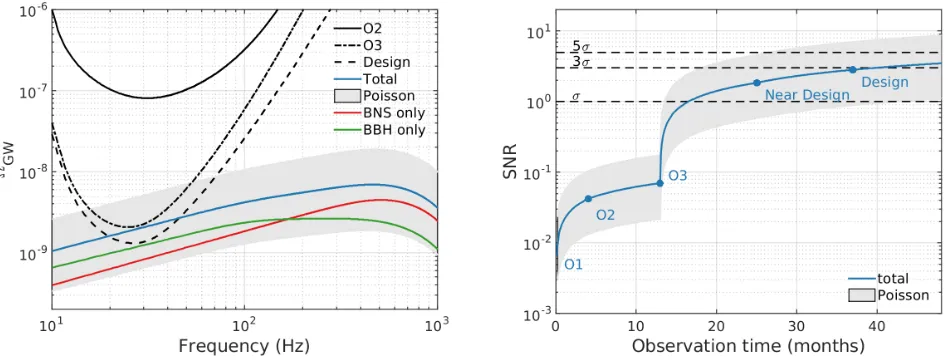
On the left hand panel of Fig. 1, we show the estimates on the background energy density ΩGW(f) for the BNS and BBH merger populations described in the previous section (red and green curves, respectively). The total (combined) background from BBH and BNS mergers is also plotted (solid blue curve) along with the 90% cred-ible Poisson uncertainties in the local rate (indicated by the grey shaded region). Considering this uncertainty, we predict Ωtot
GW(f = 25 Hz) = 1.8 +2.7
−1.3×10⁻⁹.
The spectrum is well approximated by a power law ΩGW(f) ∝f2/3 at low frequencies where the contribu-tion from the inspiral phase is dominant. The power law remains a good approximation forf .100 Hz. Indeed, previous work suggests that the deviation from power-law behaviour is probably inaccessible by advanced de-tectors [23]. The frequency region between 10 Hz and 100 Hz accounts for more than 99% of the accumu-lated SNR for the Advanced LIGO-Virgo network [21]. The median value of the background from BBH merg-ers [ΩBBHGW(f = 25 Hz) = 1.1+1.2−0.7×10⁻⁹] is comparable with our previous predictions [20] but the statistical un-certainty has decreased by a factor of 32% due to an increase in the number of observed BBH mergers. The median contribution from BNS systems is of the same order [ΩGWBNS(f = 25 Hz) = 0.7+1.5−0.6×10⁻⁹]. The sta-tistical uncertainty of the BNS background is larger than that of the BBH background, since we have only one BNS detection. These results are summarized in Table I.
The estimates on the background energy density shown in Fig. 1 are compared with power-law integrated (PI) curves [44] at various observing sensitivities (O2, O3 and Design). The PI curves represent the expected 1σ sensi-tivity of the standard cross-correlation search to power-law gravitational-wave backgrounds [44], for example the ΩGW(f) ∝ f2/3 spectrum expected from the inspiral
phase of binary mergers. Hence, if a power-law spec-trum intersects a PI curve, then it has SNR≥1 for the corresponding observing run.
Although the stochastic background is dominated by unresolvable sources, the energy-density spectra in Fig. 1 include contributions from the loudest, individually de-tectable events. Simulations of the astrophysical back-ground given the inferred rate and mass distribution in-dicate that removing sources that are individually de-tectable by the LIGO-Virgo network with a combined SNR>12 has a very small impact on the results. The detectable sources have an even smaller effect than shown by the analysis in [20], which considered only the popula-tion of loud, high mass sources. This highlights the fact that the spectrum is dominated by low-mass systems, which are less likely to be detected individually.
Different assumptions are possible on the various dis-tributions that enter the calculation of ΩGW (Eq. 2), such as star formation rate, metallicity evolution and de-lay times. However, we have verified that variations on our assumptions are contained within the Poisson band shown in Fig. 1, consistent with the detailed study in [20]. Additionally, if some of the observed BBH systems were of primordial (rather than stellar) origin, with a different redshift distribution, their contribution to the stochastic background spectrum could be weaker [45–47]. The right hand panel of Fig. 1 shows the expected ac-cumulated SNR as a function of total observation time, updated from [20]. For O1, which lasted approximately 4 months, we use the actual instrumental sensitivities of the two LIGO detectors (Virgo was not yet operating at that time)[21]. The second observing run (O2) was re-cently completed and ran for approximately 9 months. For this run we use typical sensitivities of 100 Mpc for Livingston and 60 Mpc for Hanford, assuming a duty cycle of 50%. We do not include Virgo as it does not contribute significantly to the sensitivity of stochastic searches in O2 due to the lower range and one month in-tegration time. For the next planned observing run (O3), and the following stages of sensitivity improvements, we include Virgo and assume a 50% duty cycle for each de-tector. Following [48], we assume O3 will be 12 months long (2017 – 2018). We define the “Near Design” phase (2019+) to be a 12 month run where Hanford and Liv-ingston operate at design sensitivity and Virgo at late sensitivity. Lastly, we assume that the “Design” phase (2022+) will be 24 months and will have Hanford, Liv-ingston, and Virgo operating at design sensitivity. These assumptions are broadly consistent with [48], though we make specific assumptions about the duration of each ob-serving run for concreteness.
total background could be identified after 18 months or as early as O3. The most pessimistic case considered here is out of reach of the advanced detector network but is in the scope of third generation detectors [49].
Although the BNS and BBH backgrounds have similar energy-densities, they have extremely different statisti-cal properties. To illustrate this, we plot a simulated strain time-series in Fig. 2 and show an example BNS (red) and BBH (green) background. The BNS events create an approximately continuous background consist-ing of a superposition of overlappconsist-ing sources, since the duration of the waveform (190 s on average in the fre-quency band above 10 Hz) is long compared to the aver-age time interval between two successive events (13+49−9 s on average). Considering the uncertainty on the rate, the average number of overlapping sources can vary between 3 and 45. In Fig. 2, 14 sources overlap on average.
The BBH background is different in nature even though the resulting energy density spectrum is simi-lar. BBH events create a highly stationary and non-Gaussian background (sometimes referred to as a pop-corn background in the literature), i.e. individual events are well separated in time, on top of the continuous back-ground from contributed BNS inspirals. The duration of the waveform is much smaller for these massive sources (14 s on average in the band above 10 Hz, considering both the power law mass distribution and the distribu-tion in redshift [49]) and much less than the time interval between events (223+352−115 s on average) resulting in rare overlaps.
Table I shows the estimated energy density at 25 Hz for each of the BNS, BBH and Total backgrounds. We also show the average time between events τ for each of these backgrounds as well as the average number of overlapping sources at any time λ, and the associated Poisson error bounds. The inverse ofτ gives the rate of events in the Universe in s−1.
Conclusion— The first gravitational wave detection of a binary neutron star system implies a significant contri-bution to the stochastic gravitational wave background from BNS mergers. Assuming the median merger rates, the background may be detected with SNR = 3 after 40 months of accumulated observation time, during the De-sign phase (2022+)[48]. In the most optimistic case, an astrophysical background may be observed at a level of 3σ after only 18 months of observation, during O3, the next observing run.
There are additional factors which may lead to an even earlier detection. First, the presence of additional sources, for example black hole-neutron star (BHNS) sys-tems, will further add to the total background. Even small contributions to the background can decrease the time to detection. Previous estimates in the literature, for example [50, 51], suggest that the BHNS will con-tribute roughly a few percent to the total background, although the uncertainty is large. Second, the
analy-sis we have presented here assumes the standard cross-correlation search. Specialized non-Gaussian searches may be more sensitive, particularly to the BBH back-ground [52–54]. Unlike a standard matched filter search, non-Gaussian pipelines do not attempt to find individual events, but rather to measure the rate of sub-threshold events independently of their distribution.
A detection of the astrophysical background allows for a rich set of follow-up studies to fully understand its com-position. The difference in the time-domain structure of the BBH and BNS signals may allow the BNS and BBH backgrounds to be measured independently. After de-tecting the background, stochastic analyses can address whether the background is isotropic [55–57], unpolar-ized [58], and consistent with general relativity [59]. Fi-nally, understanding the astrophysical background is cru-cial to subtract it and enable searches for a background of cosmological origin [49].
5
FIG. 1. The left panel shows the predicted median background for the BNS (red) and BBH (green) models described in the text, the total combined background (blue), and the Poisson error bars (grey shaded region) for the total background. We also show expected PI curves for observing runs O2, O3, and design sensitivity (see the main text for details about the assumptions made for these observing runs). Virgo is included in O3 and beyond. The PI curves for O3 and beyond cross the Poisson error region, indicating the possibility of detecting this background or placing interesting upper limits on the evolution of the binary merger rates with redshift. In the right panel, we plot the signal-to-noise ratio as a function of cumulative observing time for the median total background (blue curve) and associated uncertainty (shaded region). The median of the predicted total background can be detected with SNR = 3 after 40 months of observation time, with LIGO-Virgo reaching design sensitivity (2022 – 2024). The markers indicate the transition between observing runs. We only show 12 months of the Design phase for clarity, however this phase is 24 months long for the calculation of the PI curves (see [48]).
Hungary (NKFI), the National Research Foundation of Korea, Industry Canada and the Province of Ontario through the Ministry of Economic Development and In-novation, the Natural Science and Engineering Research Council Canada, the Canadian Institute for Advanced Research, the Brazilian Ministry of Science, Technol-ogy, Innovations, and Communications, the International Center for Theoretical Physics South American Insti-tute for Fundamental Research (ICTP-SAIFR), the Re-search Grants Council of Hong Kong, the National Natu-ral Science Foundation of China (NSFC), the Leverhulme Trust, the Research Corporation, the Ministry of Science and Technology (MOST), Taiwan and the Kavli Foun-dation. The authors gratefully acknowledge the support of the NSF, STFC, MPS, INFN, CNRS and the State of Niedersachsen/Germany for provision of computational resources.
This article has been assigned the document number LIGO-P1700272.
[1] J. Aasi et al. (LIGO Scientific Collaboration), Classical and Quantum Gravity32, 074001 (2015).
[2] F. Acerneseet al., Classical and Quantum Gravity 32, 024001 (2015).
[3] B. P. Abbott et al. (LIGO Scientific Collaboration and Virgo Collaboration), Physical Review Letters119, 161101 (2017), arXiv:1710.05832 [gr-qc].
[4] B. P. Abbott et al. (LIGO Scientific Collaboration and Virgo Collaboration), Phys. Rev. Lett. 116, 061102 (2016).
[5] B. P. Abbott et al. (LIGO Scientific Collaboration and Virgo Collaboration), Phys. Rev. Lett. 116, 241103 (2016).
[6] B. P. Abbott et al. (LIGO Scientific Collaboration and Virgo Collaboration), Phys. Rev. X6, 041015 (2016). [7] B. P. Abbott et al. (LIGO Scientific Collaboration and
Virgo Collaboration), Phys. Rev. Lett. 118, 221101 (2017).
[8] B. P. Abbott et al. (LIGO Scientific Collabora-tion and Virgo CollaboraCollabora-tion), ApJ 851, L35 (2017), arXiv:1711.05578 [astro-ph.HE].
[9] B. P. Abbott et al. (LIGO Scientific Collaboration and Virgo Collaboration), Physical Review Letters119, 141101 (2017), arXiv:1709.09660 [gr-qc].
[10] B. Allen and J. D. Romano, Phys. Rev. D 59, 102001 (1999).
[11] N. Christensen, Phys. Rev. D46, 5250 (1992). [12] T. Regimbau, Res. Astron. Astrophys.11, 369 (2011). [13] X.-J. Zhu, E. Howell, T. Regimbau, D. Blair, and Z.-H.
Zhu, ApJ739, 86 (2011).
[14] P. A. Rosado, Phys. Rev. D84, 084004 (2011).
[15] S. Marassi, R. Schneider, G. Corvino, V. Ferrari, and S. Portegies Zwart, Phys. Rev. D84, 124037 (2011). [16] C. Wu, V. Mandic, and T. Regimbau, Phys. Rev. D85,
104024 (2012).
[17] X.-J. Zhu, E. J. Howell, D. G. Blair, and Z.-H. Zhu, MNRAS431, 882 (2013).
FIG. 2. We present a simulated time series of duration 104 seconds illustrating the character of the BBH and BNS signals in the time domain. In red we show a simulated BNS back-ground corresponding to the median rate as shown in Figure 1, and in green we display the median BBH background. We do not show any detector noise, and do not remove some loud and close events that would be detected individually. The re-gion in the black box, from 1800 – 2600 seconds, is shown in greater detail in the inset. The BNS time series is continuous as it consists of a superposition of overlapping signals. On the other hand the BBH background (in green) is popcorn-like, and the signals do not overlap. Remarkably, even though the backgrounds have very different structure in the time domain, the energy in both backgrounds are comparable below 100 Hz, as seen in Figure 1.
(2017), arXiv:1608.06889 [gr-qc].
[20] B. P. Abbott et al.(LIGO Scientific Collaboration and Virgo Collaboration), Phys. Rev. Lett. 116, 131102 (2016).
[21] B. P. Abbott et al.(LIGO Scientific Collaboration and Virgo Collaboration), Phys. Rev. Lett. 118, 121101 (2017).
[22] P. A. R. Adeet al., A&A594, A13 (2016).
[23] T. Callister, L. Sammut, S. Qiu, I. Mandel, and E. Thrane, Physical Review X 6, 031018 (2016). [24] P. Ajithet al., Phys. Rev. D77, 104017 (2008). [25] P. Ajithet al., Phys. Rev. Lett.106, 241101 (2011). [26] E. Vangioniet al., MNRAS447, 2575 (2015). [27] P. Madau and M. Dickinson, ARA&A52, 415 (2014). [28] D. Meacher, M. Coughlin, S. Morris, T. Regimbau,
N. Christensen, S. Kandhasamy, V. Mandic, J. D. Ro-mano, and E. Thrane, Phys. Rev. D92, 063002 (2015), arXiv:1506.06744 [astro-ph.HE].
[29] K. Belczynski, V. Kalogera, and T. Bulik, ApJ572, 407 (2002).
[30] S. Ando, J. Cosmology Astropart. Phys.6, 007 (2004). [31] K. Belczynski, R. Perna, T. Bulik, V. Kalogera,
N. Ivanova, and D. Q. Lamb, ApJ648, 1110 (2006). [32] J. A. de Freitas Pacheco, T. Regimbau, S. Vincent, and
A. Spallicci, Int. J. Mod. Phys. D15, 235 (2006). [33] E. Bergeret al., ApJ664, 1000 (2007).
[34] E. Nakar, Phys. Rep.442, 166 (2007).
[35] R. O’Shaughnessy, K. Belczynski, and V. Kalogera, ApJ 675, 566 (2008).
[36] M. Dominiket al., ApJ759, 52 (2012). [37] M. Dominiket al., ApJ779, 72 (2013).
[38] J. Abadie et al., Classical and Quantum Gravity 27, 173001 (2010), arXiv:1003.2480 [astro-ph.HE].
[39] K. Belczynski, D. E. Holz, T. Bulik, and R. O’Shaughnessy, Nature534, 512 (2016).
[40] An analysis using all events in O2 will be done in a follow-up paper. However, as noted in [21], the power-law mass distribution considered here is dominated by events with low masses, and so the inclusion of GW170814 would not change the rate estimate significantly.
[41] M. Fishbach and D. E. Holz, ApJ 851, L25 (2017), arXiv:1709.08584 [astro-ph.HE].
[42] In fact this scaling relationship is approximate, but leads to a conservative estimate.
[43] D. Meacher, E. Thrane, and T. Regimbau, Phys. Rev. D 89, 084063 (2014).
[44] E. Thrane and J. D. Romano, Phys. Rev. D88, 124032 (2013).
[45] S. Bird, I. Cholis, J. B. Mu˜noz, Y. Ali-Ha¨ımoud, M. Kamionkowski, E. D. Kovetz, A. Raccanelli, and A. G. Riess, Phys. Rev. Lett.116, 201301 (2016). [46] M. Sasaki, T. Suyama, T. Tanaka, and S. Yokoyama,
Phys. Rev. Lett.117, 061101 (2016).
[47] V. Mandic, S. Bird, and I. Cholis, Phys. Rev. Lett.117, 201102 (2016).
[48] B. P. Abbottet al., (2013), arXiv:1304.0670.
[49] T. Regimbau, M. Evans, N. Christensen, E. Katsavouni-dis, B. Sathyaprakash, and S. Vitale, Phys. Rev. Lett. 118, 151105 (2017).
[50] B. P. Abbott et al. (LIGO Scientific Collabora-tion and Virgo CollaboraCollabora-tion), ApJ 832, L21 (2016), arXiv:1607.07456 [astro-ph.HE].
[51] I. Kowalska-Leszczynska, T. Regimbau, T. Bulik, M. Do-minik, and K. Belczynski, Astron. Astrophys.574, A58 (2015), arXiv:1205.4621 [astro-ph.CO].
[52] E. Thrane, Phys. Rev. D87, 043009 (2013).
[53] L. Martellini and T. Regimbau, Phys. Rev. D89, 124009 (2014).
[54] R. Smith and E. Thrane, ArXiv e-prints (2017), arXiv:1712.00688 [gr-qc].
[55] E. Thrane, S. Ballmer, J. D. Romano, S. Mitra, D. Talukder, S. Bose, and V. Mandic, Phys. Rev. D 80, 122002 (2009).
[56] S. W. Ballmer, Class. Quantum Gravity23, S179 (2006). [57] S. Mitra, S. Dhurandhar, T. Souradeep, A. Lazzarini, V. Mandic, S. Bose, and S. Ballmer, Phys. Rev. D77, 042002 (2008).
[58] S. G. Crowder, R. Namba, V. Mandic, S. Mukohyama, and M. Peloso, Physics Letters B 726, 66 (2013), arXiv:1212.4165.
The LIGO Scientific Collaboration and Virgo Collaboration
B. P. Abbott,1 R. Abbott,1 T. D. Abbott,2 F. Acernese,3,4K. Ackley,5,6 C. Adams,7 T. Adams,8 P. Addesso,9 R. X. Adhikari,1 V. B. Adya,10 C. Affeldt,10 M. Afrough,11 B. Agarwal,12 M. Agathos,13 K. Agatsuma,14 N. Aggarwal,15 O. D. Aguiar,16 L. Aiello,17,18 A. Ain,19 P. Ajith,20B. Allen,10,21,22 G. Allen,12 A. Allocca,23,24
P. A. Altin,25 A. Amato,26 A. Ananyeva,1 S. B. Anderson,1 W. G. Anderson,21 S. V. Angelova,27 S. Antier,28 S. Appert,1 K. Arai,1 M. C. Araya,1 J. S. Areeda,29N. Arnaud,28,30 K. G. Arun,31 S. Ascenzi,32,33 G. Ashton,10 M. Ast,34S. M. Aston,7 P. Astone,35 D. V. Atallah,36 P. Aufmuth,22 C. Aulbert,10 K. AultONeal,37 C. Austin,2
A. Avila-Alvarez,29 S. Babak,38 P. Bacon,39 M. K. M. Bader,14 S. Bae,40 P. T. Baker,41 F. Baldaccini,42,43 G. Ballardin,30S. W. Ballmer,44 S. Banagiri,45J. C. Barayoga,1 S. E. Barclay,46 B. C. Barish,1 D. Barker,47
K. Barkett,48 F. Barone,3,4 B. Barr,46 L. Barsotti,15 M. Barsuglia,39 D. Barta,49 J. Bartlett,47 I. Bartos,50,5 R. Bassiri,51 A. Basti,23,24 J. C. Batch,47 M. Bawaj,52,43 J. C. Bayley,46 M. Bazzan,53,54 B. B´ecsy,55 C. Beer,10
M. Bejger,56 I. Belahcene,28 A. S. Bell,46 B. K. Berger,1 G. Bergmann,10 J. J. Bero,57 C. P. L. Berry,58 D. Bersanetti,59 A. Bertolini,14 J. Betzwieser,7 S. Bhagwat,44 R. Bhandare,60 I. A. Bilenko,61 G. Billingsley,1 C. R. Billman,5 J. Birch,7R. Birney,62 O. Birnholtz,10S. Biscans,1,15S. Biscoveanu,63,6 A. Bisht,22 M. Bitossi,30,24
C. Biwer,44 M. A. Bizouard,28 J. K. Blackburn,1 J. Blackman,48 C. D. Blair,1,64 D. G. Blair,64 R. M. Blair,47 S. Bloemen,65 O. Bock,10 N. Bode,10 M. Boer,66G. Bogaert,66A. Bohe,38 F. Bondu,67E. Bonilla,51 R. Bonnand,8
B. A. Boom,14 R. Bork,1 V. Boschi,30,24S. Bose,68,19 K. Bossie,7 Y. Bouffanais,39 A. Bozzi,30 C. Bradaschia,24 P. R. Brady,21 M. Branchesi,17,18 J. E. Brau,69 T. Briant,70 A. Brillet,66 M. Brinkmann,10 V. Brisson,28 P. Brockill,21 J. E. Broida,71 A. F. Brooks,1 D. A. Brown,44 D. D. Brown,72 S. Brunett,1C. C. Buchanan,2 A. Buikema,15 T. Bulik,73H. J. Bulten,74,14 A. Buonanno,38,75 D. Buskulic,8 C. Buy,39R. L. Byer,51M. Cabero,10 L. Cadonati,76 G. Cagnoli,26,77 C. Cahillane,1 J. Calder´on Bustillo,76 T. A. Callister,1 E. Calloni,78,4 J. B. Camp,79
M. Canepa,80,59 P. Canizares,65 K. C. Cannon,81 H. Cao,72 J. Cao,82 C. D. Capano,10 E. Capocasa,39 F. Carbognani,30S. Caride,83M. F. Carney,84J. Casanueva Diaz,28C. Casentini,32,33 S. Caudill,21,14M. Cavagli`a,11
F. Cavalier,28 R. Cavalieri,30 G. Cella,24C. B. Cepeda,1 P. Cerd´a-Dur´an,85 G. Cerretani,23,24 E. Cesarini,86,33 S. J. Chamberlin,63 M. Chan,46 S. Chao,87P. Charlton,88 E. Chase,89 E. Chassande-Mottin,39 D. Chatterjee,21 B. D. Cheeseboro,41 H. Y. Chen,90X. Chen,64 Y. Chen,48 H.-P. Cheng,5 H. Chia,5A. Chincarini,59 A. Chiummo,30
T. Chmiel,84 H. S. Cho,91 M. Cho,75 J. H. Chow,25 N. Christensen,71,66 Q. Chu,64 A. J. K. Chua,13 S. Chua,70 A. K. W. Chung,92 S. Chung,64 G. Ciani,5,53,54 R. Ciolfi,93,94 C. E. Cirelli,51 A. Cirone,80,59 F. Clara,47 J. A. Clark,76 P. Clearwater,95 F. Cleva,66 C. Cocchieri,11 E. Coccia,17,18 P.-F. Cohadon,70 D. Cohen,28 A. Colla,96,35C. G. Collette,97 L. R. Cominsky,98 M. Constancio Jr.,16 L. Conti,54S. J. Cooper,58P. Corban,7
T. R. Corbitt,2 I. Cordero-Carri´on,99 K. R. Corley,50 N. Cornish,100A. Corsi,83 S. Cortese,30 C. A. Costa,16 M. W. Coughlin,71,1 S. B. Coughlin,89 J.-P. Coulon,66 S. T. Countryman,50 P. Couvares,1 P. B. Covas,101 E. E. Cowan,76D. M. Coward,64M. J. Cowart,7D. C. Coyne,1R. Coyne,83J. D. E. Creighton,21 T. D. Creighton,102
J. Cripe,2 S. G. Crowder,103 T. J. Cullen,29,2 A. Cumming,46L. Cunningham,46 E. Cuoco,30T. Dal Canton,79 G. D´alya,55 S. L. Danilishin,22,10 S. D’Antonio,33 K. Danzmann,22,10 A. Dasgupta,104 C. F. Da Silva Costa,5 V. Dattilo,30 I. Dave,60 M. Davier,28 D. Davis,44 E. J. Daw,105 B. Day,76 S. De,44 D. DeBra,51 J. Degallaix,26 M. De Laurentis,17,4 S. Del´eglise,70W. Del Pozzo,58,23,24 N. Demos,15 T. Denker,10 T. Dent,10 R. De Pietri,106,107
V. Dergachev,38R. De Rosa,78,4 R. T. DeRosa,7 C. De Rossi,26,30 R. DeSalvo,108 O. de Varona,10 J. Devenson,27 S. Dhurandhar,19M. C. D´ıaz,102L. Di Fiore,4 M. Di Giovanni,109,94 T. Di Girolamo,50,78,4 A. Di Lieto,23,24 S. Di Pace,96,35 I. Di Palma,96,35 F. Di Renzo,23,24 Z. Doctor,90 V. Dolique,26 F. Donovan,15 K. L. Dooley,11 S. Doravari,10I. Dorrington,36 R. Douglas,46 M. Dovale ´Alvarez,58T. P. Downes,21M. Drago,10 C. Dreissigacker,10
J. C. Driggers,47 Z. Du,82 M. Ducrot,8 P. Dupej,46 S. E. Dwyer,47 T. B. Edo,105 M. C. Edwards,71 A. Effler,7 H.-B. Eggenstein,38,10P. Ehrens,1J. Eichholz,1 S. S. Eikenberry,5 R. A. Eisenstein,15 R. C. Essick,15D. Estevez,8 Z. B. Etienne,41T. Etzel,1 M. Evans,15 T. M. Evans,7M. Factourovich,50V. Fafone,32,33,17 H. Fair,44S. Fairhurst,36
X. Fan,82 S. Farinon,59 B. Farr,90 W. M. Farr,58 E. J. Fauchon-Jones,36M. Favata,110 M. Fays,36 C. Fee,84 H. Fehrmann,10 J. Feicht,1 M. M. Fejer,51 A. Fernandez-Galiana,15I. Ferrante,23,24 E. C. Ferreira,16F. Ferrini,30
F. Fidecaro,23,24 D. Finstad,44 I. Fiori,30 D. Fiorucci,39 M. Fishbach,90 R. P. Fisher,44 M. Fitz-Axen,45 R. Flaminio,26,111M. Fletcher,46H. Fong,112J. A. Font,85,113P. W. F. Forsyth,25S. S. Forsyth,76 J.-D. Fournier,66
V. Gayathri,116 N. Gehrels†,79 G. Gemme,59 E. Genin,30A. Gennai,24 D. George,12 J. George,60 L. Gergely,117 V. Germain,8 S. Ghonge,76 Abhirup Ghosh,20 Archisman Ghosh,20,14 S. Ghosh,65,14,21 J. A. Giaime,2,7 K. D. Giardina,7 A. Giazotto,24 K. Gill,37 L. Glover,108 E. Goetz,118 R. Goetz,5 S. Gomes,36 B. Goncharov,6 G. Gonz´alez,2J. M. Gonzalez Castro,23,24 A. Gopakumar,119M. L. Gorodetsky,61 S. E. Gossan,1 M. Gosselin,30
R. Gouaty,8 A. Grado,120,4 C. Graef,46 M. Granata,26 A. Grant,46 S. Gras,15 C. Gray,47 G. Greco,121,122 A. C. Green,58 E. M. Gretarsson,37 P. Groot,65 H. Grote,10 S. Grunewald,38 P. Gruning,28 G. M. Guidi,121,122
X. Guo,82 A. Gupta,63 M. K. Gupta,104 K. E. Gushwa,1 E. K. Gustafson,1 R. Gustafson,118 O. Halim,18,17 B. R. Hall,68 E. D. Hall,15 E. Z. Hamilton,36 G. Hammond,46 M. Haney,123 M. M. Hanke,10 J. Hanks,47 C. Hanna,63 M. D. Hannam,36 O. A. Hannuksela,92 J. Hanson,7 T. Hardwick,2 J. Harms,17,18 G. M. Harry,124
I. W. Harry,38 M. J. Hart,46 C.-J. Haster,112 K. Haughian,46 J. Healy,57 A. Heidmann,70 M. C. Heintze,7 H. Heitmann,66 P. Hello,28 G. Hemming,30 M. Hendry,46 I. S. Heng,46 J. Hennig,46 A. W. Heptonstall,1 M. Heurs,10,22 S. Hild,46 T. Hinderer,65 D. Hoak,30 D. Hofman,26 K. Holt,7 D. E. Holz,90 P. Hopkins,36 C. Horst,21 J. Hough,46E. A. Houston,46 E. J. Howell,64 A. Hreibi,66 Y. M. Hu,10 E. A. Huerta,12D. Huet,28
B. Hughey,37 S. Husa,101S. H. Huttner,46 T. Huynh-Dinh,7 N. Indik,10 R. Inta,83 G. Intini,96,35 H. N. Isa,46 J.-M. Isac,70 M. Isi,1 B. R. Iyer,20 K. Izumi,47 T. Jacqmin,70 K. Jani,76 P. Jaranowski,125 S. Jawahar,62 F. Jim´enez-Forteza,101W. W. Johnson,2 D. I. Jones,126 R. Jones,46 R. J. G. Jonker,14 L. Ju,64 J. Junker,10 C. V. Kalaghatgi,36 V. Kalogera,89B. Kamai,1 S. Kandhasamy,7 G. Kang,40 J. B. Kanner,1 S. J. Kapadia,21
S. Karki,69 K. S. Karvinen,10 M. Kasprzack,2 M. Katolik,12 E. Katsavounidis,15 W. Katzman,7 S. Kaufer,22 K. Kawabe,47 F. K´ef´elian,66D. Keitel,46 A. J. Kemball,12R. Kennedy,105 C. Kent,36 J. S. Key,127 F. Y. Khalili,61
I. Khan,17,33 S. Khan,10 Z. Khan,104 E. A. Khazanov,128 N. Kijbunchoo,25Chunglee Kim,129 J. C. Kim,130 K. Kim,92W. Kim,72W. S. Kim,131Y.-M. Kim,91S. J. Kimbrell,76E. J. King,72 P. J. King,47M. Kinley-Hanlon,124
R. Kirchhoff,10J. S. Kissel,47L. Kleybolte,34 S. Klimenko,5 T. D. Knowles,41 P. Koch,10 S. M. Koehlenbeck,10 S. Koley,14 V. Kondrashov,1A. Kontos,15 M. Korobko,34 W. Z. Korth,1 I. Kowalska,73 D. B. Kozak,1C. Kr¨amer,10
V. Kringel,10 B. Krishnan,10 A. Kr´olak,132,133G. Kuehn,10 P. Kumar,112R. Kumar,104S. Kumar,20 L. Kuo,87 A. Kutynia,132 S. Kwang,21 B. D. Lackey,38 K. H. Lai,92 M. Landry,47 R. N. Lang,134 J. Lange,57 B. Lantz,51
R. K. Lanza,15 A. Lartaux-Vollard,28 P. D. Lasky,6 M. Laxen,7 A. Lazzarini,1 C. Lazzaro,54 P. Leaci,96,35 S. Leavey,46 C. H. Lee,91 H. K. Lee,135 H. M. Lee,136H. W. Lee,130 K. Lee,46 J. Lehmann,10 A. Lenon,41 M. Leonardi,109,94 N. Leroy,28 N. Letendre,8Y. Levin,6 T. G. F. Li,92 S. D. Linker,108T. B. Littenberg,137J. Liu,64
R. K. L. Lo,92 N. A. Lockerbie,62L. T. London,36 J. E. Lord,44M. Lorenzini,17,18 V. Loriette,138 M. Lormand,7 G. Losurdo,24 J. D. Lough,10 C. O. Lousto,57 G. Lovelace,29 H. L¨uck,22,10 D. Lumaca,32,33 A. P. Lundgren,10
R. Lynch,15 Y. Ma,48 R. Macas,36 S. Macfoy,27 B. Machenschalk,10 M. MacInnis,15 D. M. Macleod,36 I. Maga˜na Hernandez,21 F. Maga˜na-Sandoval,44 L. Maga˜na Zertuche,44 R. M. Magee,63 E. Majorana,35 I. Maksimovic,138 N. Man,66 V. Mandic,45 V. Mangano,46 G. L. Mansell,25 M. Manske,21,25 M. Mantovani,30
F. Marchesoni,52,43 F. Marion,8 S. M´arka,50 Z. M´arka,50C. Markakis,12 A. S. Markosyan,51 A. Markowitz,1 E. Maros,1 A. Marquina,99 F. Martelli,121,122L. Martellini,66 I. W. Martin,46R. M. Martin,110 D. V. Martynov,15 K. Mason,15 E. Massera,105 A. Masserot,8 T. J. Massinger,1 M. Masso-Reid,46S. Mastrogiovanni,96,35A. Matas,45
F. Matichard,1,15 L. Matone,50 N. Mavalvala,15 N. Mazumder,68 R. McCarthy,47 D. E. McClelland,25 S. McCormick,7 L. McCuller,15 S. C. McGuire,139 G. McIntyre,1 J. McIver,1 D. J. McManus,25 L. McNeill,6 T. McRae,25S. T. McWilliams,41 D. Meacher,63 G. D. Meadors,38,10 M. Mehmet,10 J. Meidam,14E. Mejuto-Villa,9
A. Melatos,95 G. Mendell,47 R. A. Mercer,21 E. L. Merilh,47 M. Merzougui,66 S. Meshkov,1 C. Messenger,46 C. Messick,63 R. Metzdorff,70 P. M. Meyers,45H. Miao,58 C. Michel,26 H. Middleton,58 E. E. Mikhailov,140
L. Milano,78,4 A. L. Miller,5,96,35 B. B. Miller,89 J. Miller,15 M. Millhouse,100 M. C. Milovich-Goff,108 O. Minazzoli,66,141Y. Minenkov,33J. Ming,38 C. Mishra,142S. Mitra,19 V. P. Mitrofanov,61 G. Mitselmakher,5 R. Mittleman,15 D. Moffa,84 A. Moggi,24 K. Mogushi,11 M. Mohan,30 S. R. P. Mohapatra,15 M. Montani,121,122
C. J. Moore,13D. Moraru,47 G. Moreno,47 S. R. Morriss,102 B. Mours,8 C. M. Mow-Lowry,58 G. Mueller,5 A. W. Muir,36 Arunava Mukherjee,10D. Mukherjee,21S. Mukherjee,102N. Mukund,19A. Mullavey,7 J. Munch,72 E. A. Mu˜niz,44 M. Muratore,37 P. G. Murray,46 K. Napier,76 I. Nardecchia,32,33L. Naticchioni,96,35 R. K. Nayak,143
J. Neilson,108 G. Nelemans,65,14 T. J. N. Nelson,7 M. Nery,10 A. Neunzert,118 L. Nevin,1 J. M. Newport,124 G. Newton‡,46 K. K. Y. Ng,92 T. T. Nguyen,25 D. Nichols,65 A. B. Nielsen,10 S. Nissanke,65,14 A. Nitz,10 A. Noack,10 F. Nocera,30 D. Nolting,7 C. North,36L. K. Nuttall,36 J. Oberling,47 G. D. O’Dea,108 G. H. Ogin,144
9
B. O’Reilly,7 R. Ormiston,45L. F. Ortega,5 R. O’Shaughnessy,57S. Ossokine,38 D. J. Ottaway,72 H. Overmier,7 B. J. Owen,83 A. E. Pace,63 J. Page,137 M. A. Page,64A. Pai,116,145 S. A. Pai,60 J. R. Palamos,69O. Palashov,128
C. Palomba,35 A. Pal-Singh,34 Howard Pan,87 Huang-Wei Pan,87 B. Pang,48 P. T. H. Pang,92 C. Pankow,89 F. Pannarale,36 B. C. Pant,60 F. Paoletti,24 A. Paoli,30 M. A. Papa,38,21,10 A. Parida,19 W. Parker,7D. Pascucci,46 A. Pasqualetti,30R. Passaquieti,23,24D. Passuello,24 M. Patil,133B. Patricelli,146,24B. L. Pearlstone,46 M. Pedraza,1
R. Pedurand,26,147 L. Pekowsky,44 A. Pele,7 S. Penn,148 C. J. Perez,47 A. Perreca,1,109,94 L. M. Perri,89 H. P. Pfeiffer,112,38M. Phelps,46 O. J. Piccinni,96,35M. Pichot,66F. Piergiovanni,121,122V. Pierro,9 G. Pillant,30
L. Pinard,26I. M. Pinto,9 M. Pirello,47 M. Pitkin,46 M. Poe,21 R. Poggiani,23,24 P. Popolizio,30 E. K. Porter,39 A. Post,10 J. Powell,46,149 J. Prasad,19 J. W. W. Pratt,37 G. Pratten,101 V. Predoi,36 T. Prestegard,21 M. Prijatelj,10 M. Principe,9 S. Privitera,38G. A. Prodi,109,94 L. G. Prokhorov,61 O. Puncken,10 M. Punturo,43
P. Puppo,35 M. P¨urrer,38 H. Qi,21 V. Quetschke,102 E. A. Quintero,1 R. Quitzow-James,69 F. J. Raab,47 D. S. Rabeling,25 H. Radkins,47 P. Raffai,55 S. Raja,60 C. Rajan,60 B. Rajbhandari,83 M. Rakhmanov,102 K. E. Ramirez,102 A. Ramos-Buades,101 P. Rapagnani,96,35 V. Raymond,38 M. Razzano,23,24 J. Read,29 T. Regimbau,66 L. Rei,59 S. Reid,62 D. H. Reitze,1,5 W. Ren,12 S. D. Reyes,44 F. Ricci,96,35 P. M. Ricker,12 S. Rieger,10 K. Riles,118 M. Rizzo,57 N. A. Robertson,1,46 R. Robie,46 F. Robinet,28 A. Rocchi,33 L. Rolland,8 J. G. Rollins,1 V. J. Roma,69 J. D. Romano,102 R. Romano,3,4 C. L. Romel,47 J. H. Romie,7 D. Rosi´nska,150,56
M. P. Ross,151 S. Rowan,46 A. R¨udiger,10 P. Ruggi,30 G. Rutins,27 K. Ryan,47 S. Sachdev,1 T. Sadecki,47 L. Sadeghian,21 M. Sakellariadou,152 L. Salconi,30 M. Saleem,116 F. Salemi,10A. Samajdar,143 L. Sammut,6 L. M. Sampson,89E. J. Sanchez,1L. E. Sanchez,1 N. Sanchis-Gual,85V. Sandberg,47J. R. Sanders,44 B. Sassolas,26
B. S. Sathyaprakash,63,36 P. R. Saulson,44O. Sauter,118R. L. Savage,47 A. Sawadsky,34P. Schale,69 M. Scheel,48 J. Scheuer,89 J. Schmidt,10P. Schmidt,1,65 R. Schnabel,34 R. M. S. Schofield,69A. Sch¨onbeck,34 E. Schreiber,10
D. Schuette,10,22B. W. Schulte,10 B. F. Schutz,36,10 S. G. Schwalbe,37 J. Scott,46 S. M. Scott,25 E. Seidel,12 D. Sellers,7 A. S. Sengupta,153 D. Sentenac,30 V. Sequino,32,33,17A. Sergeev,128 D. A. Shaddock,25 T. J. Shaffer,47
A. A. Shah,137 M. S. Shahriar,89 M. B. Shaner,108 L. Shao,38 B. Shapiro,51 P. Shawhan,75 A. Sheperd,21 D. H. Shoemaker,15D. M. Shoemaker,76 K. Siellez,76 X. Siemens,21 M. Sieniawska,56 D. Sigg,47 A. D. Silva,16 L. P. Singer,79 A. Singh,38,10,22 A. Singhal,17,35 A. M. Sintes,101 B. J. J. Slagmolen,25 B. Smith,7 J. R. Smith,29 R. J. E. Smith,1,6 S. Somala,154 E. J. Son,131J. A. Sonnenberg,21B. Sorazu,46 F. Sorrentino,59 T. Souradeep,19 A. P. Spencer,46A. K. Srivastava,104K. Staats,37 A. Staley,50 M. Steinke,10J. Steinlechner,34,46 S. Steinlechner,34
D. Steinmeyer,10 S. P. Stevenson,58,149 R. Stone,102 D. J. Stops,58 K. A. Strain,46 G. Stratta,121,122 S. E. Strigin,61 A. Strunk,47 R. Sturani,155 A. L. Stuver,7 T. Z. Summerscales,156 L. Sun,95 S. Sunil,104 J. Suresh,19 P. J. Sutton,36 B. L. Swinkels,30 M. J. Szczepa´nczyk,37 M. Tacca,14 S. C. Tait,46 C. Talbot,6
D. Talukder,69 D. B. Tanner,5 M. T´apai,117 A. Taracchini,38 J. D. Tasson,71 J. A. Taylor,137 R. Taylor,1 S. V. Tewari,148 T. Theeg,10 F. Thies,10 E. G. Thomas,58 M. Thomas,7 P. Thomas,47 K. A. Thorne,7 E. Thrane,6 S. Tiwari,17,94 V. Tiwari,36 K. V. Tokmakov,62 K. Toland,46 M. Tonelli,23,24 Z. Tornasi,46 A. Torres-Forn´e,85 C. I. Torrie,1 D. T¨oyr¨a,58 F. Travasso,30,43G. Traylor,7J. Trinastic,5 M. C. Tringali,109,94 L. Trozzo,157,24 K. W. Tsang,14 M. Tse,15 R. Tso,1 L. Tsukada,81 D. Tsuna,81D. Tuyenbayev,102K. Ueno,21 D. Ugolini,158 C. S. Unnikrishnan,119A. L. Urban,1 S. A. Usman,36H. Vahlbruch,22 G. Vajente,1 G. Valdes,2 N. van Bakel,14 M. van Beuzekom,14 J. F. J. van den Brand,74,14C. Van Den Broeck,14,159 D. C. Vander-Hyde,44
L. van der Schaaf,14 J. V. van Heijningen,14 A. A. van Veggel,46 M. Vardaro,53,54 V. Varma,48 S. Vass,1 M. Vas´uth,49 A. Vecchio,58 G. Vedovato,54 J. Veitch,46 P. J. Veitch,72 K. Venkateswara,151 G. Venugopalan,1 D. Verkindt,8 F. Vetrano,121,122 A. Vicer´e,121,122 A. D. Viets,21 S. Vinciguerra,58 D. J. Vine,27 J.-Y. Vinet,66 S. Vitale,15 T. Vo,44 H. Vocca,42,43C. Vorvick,47 S. P. Vyatchanin,61 A. R. Wade,1 L. E. Wade,84 M. Wade,84 R. Walet,14 M. Walker,29L. Wallace,1S. Walsh,38,10,21 G. Wang,17,122H. Wang,58 J. Z. Wang,63W. H. Wang,102
Y. F. Wang,92 R. L. Ward,25 J. Warner,47M. Was,8 J. Watchi,97 B. Weaver,47 L.-W. Wei,10,22M. Weinert,10 A. J. Weinstein,1R. Weiss,15 L. Wen,64 E. K. Wessel,12 P. Weßels,10 J. Westerweck,10 T. Westphal,10K. Wette,25
J. T. Whelan,57 B. F. Whiting,5 C. Whittle,6 D. Wilken,10 D. Williams,46 R. D. Williams,1 A. R. Williamson,65 J. L. Willis,1,160 B. Willke,22,10 M. H. Wimmer,10 W. Winkler,10 C. C. Wipf,1 H. Wittel,10,22 G. Woan,46 J. Woehler,10 J. Wofford,57K. W. K. Wong,92 J. Worden,47 J. L. Wright,46D. S. Wu,10D. M. Wysocki,57 S. Xiao,1
(LIGO Scientific Collaboration and Virgo Collaboration)
†Deceased, February 2017. ‡Deceased, December 2016.
1
LIGO, California Institute of Technology, Pasadena, CA 91125, USA
2
Louisiana State University, Baton Rouge, LA 70803, USA
3
Universit`a di Salerno, Fisciano, I-84084 Salerno, Italy
4
INFN, Sezione di Napoli, Complesso Universitario di Monte S.Angelo, I-80126 Napoli, Italy
5
University of Florida, Gainesville, FL 32611, USA
6OzGrav, School of Physics & Astronomy, Monash University, Clayton 3800, Victoria, Australia 7LIGO Livingston Observatory, Livingston, LA 70754, USA
8Laboratoire d’Annecy-le-Vieux de Physique des Particules (LAPP),
Universit´e Savoie Mont Blanc, CNRS/IN2P3, F-74941 Annecy, France
9
University of Sannio at Benevento, I-82100 Benevento, Italy and INFN, Sezione di Napoli, I-80100 Napoli, Italy
10
Max Planck Institute for Gravitational Physics (Albert Einstein Institute), D-30167 Hannover, Germany
11
The University of Mississippi, University, MS 38677, USA
12NCSA, University of Illinois at Urbana-Champaign, Urbana, IL 61801, USA 13University of Cambridge, Cambridge CB2 1TN, United Kingdom
14Nikhef, Science Park, 1098 XG Amsterdam, The Netherlands 15LIGO, Massachusetts Institute of Technology, Cambridge, MA 02139, USA
16Instituto Nacional de Pesquisas Espaciais, 12227-010 S˜ao Jos´e dos Campos, S˜ao Paulo, Brazil 17Gran Sasso Science Institute (GSSI), I-67100 L’Aquila, Italy
18
INFN, Laboratori Nazionali del Gran Sasso, I-67100 Assergi, Italy
19
Inter-University Centre for Astronomy and Astrophysics, Pune 411007, India
20
International Centre for Theoretical Sciences, Tata Institute of Fundamental Research, Bengaluru 560089, India
21
University of Wisconsin-Milwaukee, Milwaukee, WI 53201, USA
22
Leibniz Universit¨at Hannover, D-30167 Hannover, Germany
23
Universit`a di Pisa, I-56127 Pisa, Italy
24
INFN, Sezione di Pisa, I-56127 Pisa, Italy
25
OzGrav, Australian National University, Canberra, Australian Capital Territory 0200, Australia
26
Laboratoire des Mat´eriaux Avanc´es (LMA), CNRS/IN2P3, F-69622 Villeurbanne, France
27SUPA, University of the West of Scotland, Paisley PA1 2BE, United Kingdom 28LAL, Univ. Paris-Sud, CNRS/IN2P3, Universit´e Paris-Saclay, F-91898 Orsay, France
29California State University Fullerton, Fullerton, CA 92831, USA 30European Gravitational Observatory (EGO), I-56021 Cascina, Pisa, Italy
31Chennai Mathematical Institute, Chennai 603103, India 32Universit`a di Roma Tor Vergata, I-00133 Roma, Italy 33INFN, Sezione di Roma Tor Vergata, I-00133 Roma, Italy
34
Universit¨at Hamburg, D-22761 Hamburg, Germany
35
INFN, Sezione di Roma, I-00185 Roma, Italy
36
Cardiff University, Cardiff CF24 3AA, United Kingdom
37
Embry-Riddle Aeronautical University, Prescott, AZ 86301, USA
38
Max Planck Institute for Gravitational Physics (Albert Einstein Institute), D-14476 Potsdam-Golm, Germany
39
APC, AstroParticule et Cosmologie, Universit´e Paris Diderot, CNRS/IN2P3, CEA/Irfu, Observatoire de Paris, Sorbonne Paris Cit´e, F-75205 Paris Cedex 13, France
40
Korea Institute of Science and Technology Information, Daejeon 34141, Korea
41
West Virginia University, Morgantown, WV 26506, USA
42
Universit`a di Perugia, I-06123 Perugia, Italy
43
INFN, Sezione di Perugia, I-06123 Perugia, Italy
44
Syracuse University, Syracuse, NY 13244, USA
45
University of Minnesota, Minneapolis, MN 55455, USA
46
SUPA, University of Glasgow, Glasgow G12 8QQ, United Kingdom
47
LIGO Hanford Observatory, Richland, WA 99352, USA
48
Caltech CaRT, Pasadena, CA 91125, USA
49Wigner RCP, RMKI, H-1121 Budapest, Konkoly Thege Mikl´os ´ut 29-33, Hungary 50Columbia University, New York, NY 10027, USA
51Stanford University, Stanford, CA 94305, USA
52Universit`a di Camerino, Dipartimento di Fisica, I-62032 Camerino, Italy 53Universit`a di Padova, Dipartimento di Fisica e Astronomia, I-35131 Padova, Italy
54INFN, Sezione di Padova, I-35131 Padova, Italy 55
Institute of Physics, E¨otv¨os University, P´azm´any P. s. 1/A, Budapest 1117, Hungary
56
11
57
Rochester Institute of Technology, Rochester, NY 14623, USA
58
University of Birmingham, Birmingham B15 2TT, United Kingdom
59
INFN, Sezione di Genova, I-16146 Genova, Italy
60
RRCAT, Indore MP 452013, India
61
Faculty of Physics, Lomonosov Moscow State University, Moscow 119991, Russia
62
SUPA, University of Strathclyde, Glasgow G1 1XQ, United Kingdom
63
The Pennsylvania State University, University Park, PA 16802, USA
64
OzGrav, University of Western Australia, Crawley, Western Australia 6009, Australia
65
Department of Astrophysics/IMAPP, Radboud University Nijmegen, P.O. Box 9010, 6500 GL Nijmegen, The Netherlands
66Artemis, Universit´e Cˆote d’Azur, Observatoire Cˆote d’Azur,
CNRS, CS 34229, F-06304 Nice Cedex 4, France
67
Institut FOTON, CNRS, Universit´e de Rennes 1, F-35042 Rennes, France
68
Washington State University, Pullman, WA 99164, USA
69
University of Oregon, Eugene, OR 97403, USA
70
Laboratoire Kastler Brossel, UPMC-Sorbonne Universit´es, CNRS, ENS-PSL Research University, Coll`ege de France, F-75005 Paris, France
71
Carleton College, Northfield, MN 55057, USA
72OzGrav, University of Adelaide, Adelaide, South Australia 5005, Australia 73Astronomical Observatory Warsaw University, 00-478 Warsaw, Poland
74VU University Amsterdam, 1081 HV Amsterdam, The Netherlands 75University of Maryland, College Park, MD 20742, USA
76Center for Relativistic Astrophysics, Georgia Institute of Technology, Atlanta, GA 30332, USA 77Universit´e Claude Bernard Lyon 1, F-69622 Villeurbanne, France
78Universit`a di Napoli ‘Federico II,’ Complesso Universitario di Monte S.Angelo, I-80126 Napoli, Italy 79NASA Goddard Space Flight Center, Greenbelt, MD 20771, USA
80Dipartimento di Fisica, Universit`a degli Studi di Genova, I-16146 Genova, Italy 81RESCEU, University of Tokyo, Tokyo, 113-0033, Japan.
82Tsinghua University, Beijing 100084, China 83Texas Tech University, Lubbock, TX 79409, USA
84Kenyon College, Gambier, OH 43022, USA
85Departamento de Astronom´ıa y Astrof´ısica, Universitat de Val`encia, E-46100 Burjassot, Val`encia, Spain 86Museo Storico della Fisica e Centro Studi e Ricerche Enrico Fermi, I-00184 Roma, Italy
87National Tsing Hua University, Hsinchu City, 30013 Taiwan, Republic of China 88Charles Sturt University, Wagga Wagga, New South Wales 2678, Australia 89Center for Interdisciplinary Exploration & Research in Astrophysics (CIERA),
Northwestern University, Evanston, IL 60208, USA
90
University of Chicago, Chicago, IL 60637, USA
91
Pusan National University, Busan 46241, Korea
92
The Chinese University of Hong Kong, Shatin, NT, Hong Kong
93
INAF, Osservatorio Astronomico di Padova, I-35122 Padova, Italy
94
INFN, Trento Institute for Fundamental Physics and Applications, I-38123 Povo, Trento, Italy
95
OzGrav, University of Melbourne, Parkville, Victoria 3010, Australia
96
Universit`a di Roma ‘La Sapienza,’ I-00185 Roma, Italy
97
Universit´e Libre de Bruxelles, Brussels 1050, Belgium
98
Sonoma State University, Rohnert Park, CA 94928, USA
99
Departamento de Matem´aticas, Universitat de Val`encia, E-46100 Burjassot, Val`encia, Spain
100
Montana State University, Bozeman, MT 59717, USA
101
Universitat de les Illes Balears, IAC3—IEEC, E-07122 Palma de Mallorca, Spain
102
The University of Texas Rio Grande Valley, Brownsville, TX 78520, USA
103
Bellevue College, Bellevue, WA 98007, USA
104
Institute for Plasma Research, Bhat, Gandhinagar 382428, India
105
The University of Sheffield, Sheffield S10 2TN, United Kingdom
106Dipartimento di Scienze Matematiche, Fisiche e Informatiche, Universit`a di Parma, I-43124 Parma, Italy 107INFN, Sezione di Milano Bicocca, Gruppo Collegato di Parma, I-43124 Parma, Italy
108California State University, Los Angeles, 5151 State University Dr, Los Angeles, CA 90032, USA 109Universit`a di Trento, Dipartimento di Fisica, I-38123 Povo, Trento, Italy
110Montclair State University, Montclair, NJ 07043, USA
111National Astronomical Observatory of Japan, 2-21-1 Osawa, Mitaka, Tokyo 181-8588, Japan 112Canadian Institute for Theoretical Astrophysics,
University of Toronto, Toronto, Ontario M5S 3H8, Canada
113
Observatori Astron`omic, Universitat de Val`encia, E-46980 Paterna, Val`encia, Spain
114
115
University and Institute of Advanced Research, Koba Institutional Area, Gandhinagar Gujarat 382007, India
116IISER-TVM, CET Campus, Trivandrum Kerala 695016, India 117
University of Szeged, D´om t´er 9, Szeged 6720, Hungary
118University of Michigan, Ann Arbor, MI 48109, USA 119Tata Institute of Fundamental Research, Mumbai 400005, India 120
INAF, Osservatorio Astronomico di Capodimonte, I-80131, Napoli, Italy
121
Universit`a degli Studi di Urbino ‘Carlo Bo,’ I-61029 Urbino, Italy
122INFN, Sezione di Firenze, I-50019 Sesto Fiorentino, Firenze, Italy 123
Physik-Institut, University of Zurich, Winterthurerstrasse 190, 8057 Zurich, Switzerland
124
American University, Washington, D.C. 20016, USA
125University of Bia lystok, 15-424 Bia lystok, Poland 126
University of Southampton, Southampton SO17 1BJ, United Kingdom
127
University of Washington Bothell, 18115 Campus Way NE, Bothell, WA 98011, USA
128Institute of Applied Physics, Nizhny Novgorod, 603950, Russia 129
Korea Astronomy and Space Science Institute, Daejeon 34055, Korea
130
Inje University Gimhae, South Gyeongsang 50834, Korea
131National Institute for Mathematical Sciences, Daejeon 34047, Korea 132NCBJ, 05-400 ´Swierk-Otwock, Poland
133
Institute of Mathematics, Polish Academy of Sciences, 00656 Warsaw, Poland
134
Hillsdale College, Hillsdale, MI 49242, USA
135Hanyang University, Seoul 04763, Korea 136
Seoul National University, Seoul 08826, Korea
137
NASA Marshall Space Flight Center, Huntsville, AL 35811, USA
138ESPCI, CNRS, F-75005 Paris, France 139
Southern University and A&M College, Baton Rouge, LA 70813, USA
140
College of William and Mary, Williamsburg, VA 23187, USA
141Centre Scientifique de Monaco, 8 quai Antoine Ier, MC-98000, Monaco 142
Indian Institute of Technology Madras, Chennai 600036, India
143
IISER-Kolkata, Mohanpur, West Bengal 741252, India
144Whitman College, 345 Boyer Avenue, Walla Walla, WA 99362 USA 145Indian Institute of Technology Bombay, Powai, Mumbai, Maharashtra 400076, India
146
Scuola Normale Superiore, Piazza dei Cavalieri 7, I-56126 Pisa, Italy
147
Universit´e de Lyon, F-69361 Lyon, France
148Hobart and William Smith Colleges, Geneva, NY 14456, USA 149
OzGrav, Swinburne University of Technology, Hawthorn VIC 3122, Australia
150
Janusz Gil Institute of Astronomy, University of Zielona G´ora, 65-265 Zielona G´ora, Poland
151University of Washington, Seattle, WA 98195, USA 152
King’s College London, University of London, London WC2R 2LS, United Kingdom
153
Indian Institute of Technology, Gandhinagar Ahmedabad Gujarat 382424, India
154Indian Institute of Technology Hyderabad, Sangareddy, Khandi, Telangana 502285, India 155
International Institute of Physics, Universidade Federal do Rio Grande do Norte, Natal RN 59078-970, Brazil
156
Andrews University, Berrien Springs, MI 49104, USA
157Universit`a di Siena, I-53100 Siena, Italy 158Trinity University, San Antonio, TX 78212, USA 159
Van Swinderen Institute for Particle Physics and Gravity,
University of Groningen, Nijenborgh 4, 9747 AG Groningen, The Netherlands
160Abilene Christian University, Abilene, TX 79699, USA 161