1 DEVELOPING INCLUSIVE PRACTICES WITH TECHNOLOGIES FOR ONLINE
TEACHING AND LEARNING: A THEORETICAL PERSPECTIVE
DESARROLLO DE PRÁCTICAS INCLUSIVAS CON TECNOLOGÍAS PARA LA ENSEÑANZA Y EL APRENDIZAJE ONLINE: UNA PERSPECTIVA TEÓRICA
Abstract: INTRODUCTION: The purpose of this paper is to explore ways that online learning might support the full spectrum of learners (those with specific social and emotional difficulties or mobility or physical disabilities, for example). METHODOLOGY: The paper draws out theoretical conceptions of inclusive practices for teaching and learning when activities deploy online technologies, using evidence from current literature. The scope of the paper is limited in two ways: to online learning and inclusive practices for the adult age group (those in higher, further, vocational education and training); and to practices concerned with subject and topic learning (rather than interventions addressing specific educational needs). Some existing taxonomies are used to explore initial dimensions and features, and a new theoretical framework is drawn through an inductive process of analysis. RESULTS: The theoretical framework defines key factors for online tutors to consider: possible spatial and physical barriers – access to learning, spatially within work or home environments; implications of tutor or learning focus – accommodating the demands of learning activities adopted; social focus - accommodating the social concerns and engagement of others; emotional focus - accommodating the demands and engagement of others; and cognitive focus - accommodating specific cognitive needs. DISCUSSION: The theoretical framework factors are related to specific individual characteristics that might be presented within a wide inclusive group online. These highlight key concerns that online tutors should consider in these cases. Although new tools are being developed that could allow us to monitor social and emotional shifts in individuals and groups working online, allowing for more timely tutor
intervention, taking cognisance of findings from previous studies, as in the theoretical framework offered here, can nevertheless provide us with ways to at least ensure we consider the challenges already recognised when we support wide inclusive participation
Key words: Web based instruction, academic engagement, educational strategies, tutoring, individual instruction, group discussion.
2 y emocionales específicas o movilidad o discapacidades físicas, por ejemplo). METODOLOGÍA El documento presenta una serie de concepciones teóricas de prácticas inclusivas para la enseñanza y el aprendizaje a través de actividades implementadas mediante
el uso de las tecnologías en línea, evidenciadas estas por la literatura actual. El alcance del trabajo se centra en dos puntos: el aprendizaje en línea y las prácticas inclusivas para el grupo de edad adulta (aquellos que se encuentran en la enseñanza superior y la formación profesional); Ya las prácticas relacionadas con el aprendizaje de sujetos y temas (en lugar de intervenciones que aborden necesidades educativas específicas). Se han utilizado algunas taxonomías existentes para explorar las dimensiones iniciales y las características, lo que ha permitido generar un nuevo marco teórico a través de un proceso inductivo. RESULTADOS El marco teórico define los factores clave para que los tutores en línea consideren: posibles barreras espaciales y físicas , el acceso al aprendizaje, espacialmente dentro de los ambientes de trabajo o el hogar; Implicaciones del tutor o enfoque del aprendizaje – acondicionar las demandas de las actividades de aprendizaje adoptadas; Enfoque social y emocional determinar las preocupaciones sociales y los compromisos de otros; Y el enfoque cognitivo -señalar las necesidades cognitivas específicas. DISCUSIÓN Los factores del marco teórico están relacionados con características individuales específicas que podrían presentarse dentro de un amplio grupo inclusivo en línea. Estos destacan las preocupaciones clave que los tutores en línea deben considerar en estos casos. Aunque se están desarrollando nuevas herramientas que nos permitan monitorizar los cambios sociales y emocionales en los individuos y los grupos que trabajan en línea, permitiendo una intervención más oportuna del tutor, teniendo en cuenta los hallazgos alcanzados en estudios previos, como el ofrecido en este trabajo. Con el fin de, al menos, asegurar y apoyar ampliamente los desafíos considerados y reconocidos de la participación inclusiva
Palabras clave: introducción basada en la Web, participación académica, estrategias
educativas, tutoría, formación individual, grupo de discusión.
INTRODUCTION
3 access courses and modules, while the Centre Nationale d’Éducation Distance in France provided courses for those not able to attend educational institutions. Online learning is now used to deliver entire learning courses or modules in educational institutions worldwide, or
integrated into some courses or modules, blending face-to-face with virtual activities. Positive outcomes across three domains have been identified: cognitive (gaining awards, certificates and degrees, for example), social (interacting and discussing with others) and emotional (interacting empathetically with others not necessarily face-to-face).
While online learning has been seen to offer benefits (identified through a meta-analysis as early as 2001 by Coomey and Stephenson, for example), and while the importance of social presence and engagement in interaction has been highlighted (what Coomey and Stephenson called ‘dialogue, involvement, support and control’), ways that online learning might support the full spectrum of learners (those with specific social and emotional difficulties or mobility or physical disabilities, for example) so they might be involved in inclusive opportunities has not been deeply explored. The purpose of this paper is to explore this possibility more, to identify theoretical conceptions of inclusive practices for teaching and learning when programmes, courses or modules deploy online technologies.
The paper explores evidence from current literature, reporting on aspects of inclusive practices with online learning. The paper’s scope is limited in two ways: it looks at online learning and inclusive practices for adult age groups (in higher, further, vocational education and training); and practices are concerned with subject and topic learning (rather than interventions addressing specific educational needs). Within this scope, evidence is highlighted in two main areas: what is known about inclusive practices when using a range of online technologies; and what is known about inclusive practices that relate to specific characteristics of individuals who might engage in inclusive learning practices. Some existing taxonomies are used to explore initial dimensions and features, and a new theoretical
framework is developed from an inductive process of analysis.
ONLINE LEARNING AND TECHNOLOGIES
4 writing tools such as blogs and wikis; reporting of technical faults; access to support and training resources; spaces to share profiles and successes; task setting and tracking tools; mobile compatibility; and synchronisation.Apart from this range of facilities, learners might
encounter additional specific technologies, integrated into or through the VLE, or running separately. The latter might be video-based (running online video or providing video access), games-based activities, simulations and modelling software, word processors, spreadsheets, data bases, links to revision banks, or the contemporary use of social networks, such as Twitter or Facebook.
Study results vary when different specific technologies are investigated, however. In the latter context, Yu, Tian, Vogel and Kwok (2010) found online social networking helps students “attain social acceptance from others and adapt to university culture, both of which play prominent roles in improving their learning outcomes” (p.1494). This study suggests that social networking might well support inclusive practices more widely. However, Gamage, Tretiakov and Crump (2011), in their study on multi-user virtual environments, found that both non-experienced and early adopters of this technology “had an overall positive view on how student co-presence in multi-user virtual environment is likely to affect learning... [but non-experienced and early adopter] educators differed in their perceptions of the possibility of teachers emotionally connecting with students in multi-user virtual environment” (p.2412). These results highlight how different technologies may be perceived and while they might lead to positive outcomes, online tutors need to be well aware of the technologies to handle cognitive, social and emotional connections with learners online.
Considering an inclusive group of learners who may face physical, social or emotional challenges, the very abilities to engage with and use technologies themselves might be a key potential limitation. As Burgstahler (2015) said, “Some online learning practices erect barriers to individuals with disabilities” (p.70). She highlighted uncaptioned videos not
5 A THEORETICAL FRAMEWORK FOR THE ONLINE LEARNING AND INCLUSIVE PARTICIPATION ARENA
Student choice for online learning has been compared to that for face-to-face learning, and
Daymont, Blau and Campbell (2011), from their study of undergraduate students on a management course, stated that “many students choose the online format because it offers greater flexibility even though it requires greater self-discipline, and will compensate by, for example, putting more effort into time-management” (p.156). Their study showed that those preferring flexibility tended to choose an online format, those preferring structure tended not to choose an online format, those with work, home, or outside activity constraints tended to choose an online format, believing online courses provided greater flexibility. While these results highlight features suggesting potential wider participation, applicability to inclusive groups of students needs to be considered quite carefully, and how this matches to needs for greater self-discipline, perhaps compensated for by more effort with time-management.
Forms of learning that can be adopted when tutors design and undertake online learning activities are themselves, however, potential determinants of ways that individuals might engage or not. To begin to problematise this issue, online learning needs to be considered from a pluralistic learning approach perspective. Some learning approaches that might be deployed online are: problem-based learning (described by Barrows, 1996, as student-centred, in small groups, guided by facilitators, with problems forming the basis of learning, with new information arising through self-directed learning); authentic learning (described by Donovan, Bransford and Pellegrino, 1999, as student-centred, with students discussing and constructing meaningful concepts and relationships, in real-world contexts, of relevance to the learner); dialogic learning (described by Alexander, 2008, as student- and teacher-centred, exploiting talk to develop and shape thinking, to engage the learner, leading to understanding); situated learning (described by Lave and Wenger, 1991, as student- and
6 ways of working that have different implications when considered from cognitive, social and emotional perspectives. While all of these learning approaches have a focus on cognitive outcomes (subject knowledge, concepts or ideas, for example), specific learning approaches
demand a different balance of focus on social, on emotional intentions and outcomes, or on both. Problem-based learning and technology enhanced learning clearly rely upon high levels of social interaction (individuals engaging with others, either in group work practices, or in modelling or simulation activities, for example), but they rely much less on affective or emotional links of learners within that context. However, authentic learning and situated learning rely much more upon emotional links (individuals empathising and relating to real situations and actions), but relying less upon social involvement (interactions focus more on content and contexts than on social engagement). Where all three are involved, in dialogic learning, networked learning, and computer supported collaborative learning, tutors running these activities clearly need to know how to manage all of these factors, how students might manage them, and whether there are implications for individuals with specific cognitive, social and emotional needs and characteristics.
Yet, even before engaging with online environments themselves, students may well encounter preparatory needs. As Topol (2016) found in her study of how mobility impaired individuals coped with technologies used to support their everyday work, a number of important elements had to be addressed, connected to concerns about flexibility and time management: spatial arrangements, enabling interactions and integration with surroundings and the physical environment to connect to ways of working; physical barriers not necessarily initially recognised; spaces and the placement of objects for access and use; how inter-related technologies might enable links to wider communities of practice; addressing barriers requiring possible bespoke solutions developed through metacognitive thinking approaches; and creating solutions to ‘do things differently, do things better, or do different things’.
7 However, details from recent studies are relevant when considering how to manage inclusive practices in online learning.
From a social perspective, researchers have explored a range of social components involved
in and arising from online interactions. Xie, Miller and Allison (2013) found that “social conflict within the learning community evolved through five general phases including cultural initiation, social harmonization cycle, escalation of conflict, intervention and stabilization, and adjourning” (p.404), while El Seoud, Anguera-Iglesias, Franco-Casamitjana, Garcia-Ruiz and Block (2007) provided “a space for individuals to master the skills necessary to minimize the negative consequences that can result when the sources of conflicts are not quickly identified, confronted and resolved” (p.66). Lu, Yang and Yu (2013) investigated another component, social capital, finding that online learning “facilitates social capital formation mostly in terms of the dimensions of community, trust, collective action and cooperation, communication, and sociability and inclusion, depending on the media-based human interaction forms of online learning employed” (p.517). They found that both asynchronous and synchronous facilities in a VLE were used together to facilitate social capital development, email asynchronously and chat synchronously; these communications fostered both trust and collective action among students, while private email and VLE online meetings developed “a sense of community and communication flow between the instructor and learners” (p.517). This study clearly shows that different technologies and their blending can affect social uses and outcomes. On the other hand, Rienties, Giesbers, Tempelaar, Lygo-Baker, Segers and Gijselaers (2012) found that learner characteristics can also have an effect, concluding that “getting the balance between guidance and support right to facilitate both autonomous and control-oriented learners is a delicate complex issue” (p.893). In terms of using social networks, a specific form of technology studied, Cho, Gay, Davidson and Ingraffea (2007) found that “communication styles and a pre-existing friendship network”
(p.309) affected the way learners developed collaborative learning through social networks. Those learners with a high desire to communicate and those positioned at the outset on the network periphery were found to be more likely to look to expand their network links.
8 this , Mazer (2013) found that “teacher immediacy more strongly predicted student emotional interest than cognitive interest, whereas teacher clarity was a stronger predictor of student cognitive interest” (p.253). Results indicated strong interaction effects between teacher
immediacy and clarity with student cognitive interest, and between student emotional and cognitive interest with engagement. In terms of student emotional engagement, Robinson (2013) found that some students engaged in online group work “occasionally use emoticons to signal an emotion or intent” (p.306), but argued that they needed to “provide other group members with a much more detailed textual description in order to fully simulate the communicative richness of a face-to-face encounter” (p.306). The importance of communicating emotions more in order to gain deeper understanding and trust is supported by Reilly, Gallagher-Lepak and Killion (2012), who, exploring perceptions of nursing students on their sense of community in online learning, identified five major concerns: “aloneness... lack of connection to others online;... anonymity... degree of sharing identity or personal factors;... non-verbal communication... absence of face-to-face communication cues;... trepidations... fear of making mistakes; ...and unknowns... unclear or unknown course expectations” (p.102). However, whilst online tutors need to consider how to manage such issues, they also need to be aware that some individuals may very well welcome features such as anonymity, this being a prime reason for their involvement in an online rather than a face-to-face environment (a point picked up later in the paper).
In terms of how online tutors manage the environment, Biasutti (2011), studying how primary school trainee teachers responded to a distance learning module on music education, found positive aspects reported were “teamwork, cognitive, operating, organizing, and emotive/ethic aspects” (p.1865). They also indicated, however, that aspects for improvement were “teamwork, operating, organizing, and emotive/ethic” (p.1865), indicating needs for more collaboration, more co-ordination and organisation, having workload managed more,
and addressing some technical problems.
In summary, taking the previous study findings in this section into account, it is clear that online tutors, when working with inclusive groups, need to carefully consider a number of factors. The theoretical framework factors elicited are:
• Possible spatial and physical barriers – can learners access their learning, spatially
9 • Implications of tutor or learning focus – can learners accommodate the demands of
the learning approaches and activities adopted, and the implications for social engagement, emotional accommodation, and cognitive need?
• Social focus - can learners engage with others online, using text or audio or video, and
how will they accommodate the social concerns and engagement of others?
• Emotional focus - can learners emotionally accommodate the demands and
engagement of others, as well as forms of activities needing to be undertaken?
• Cognitive focus - can learners accommodate the specific cognitive needs of online
interactions?
CONCERNING INCLUSIVE USES
From a learner perspective, traditionally, as Burgstahler (2015) implied, the approach taken to consider applicability of online programmes, modules and courses has been to focus on cognitive appropriateness. From the theoretical framework proposed and highlighted above, however, it seems that a rethinking of factors concerning applicability and appropriateness is needed; we should consider: possible spatial and physical barriers; implications of tutor or learning focus; social focus; emotional focus; and cognitive focus. Considering these factors, this section will explore how they relate to a wide inclusive online group, looking at specific individual characteristics that might be presented.
Research studies have explored how groups of learners with specific characteristics have responded to online learning environments. A useful overview is provided by Redecker
10 with cognitive disabilities in general, and dyslexia specifically” (p.703). They go on to point out that text-based synchronous activities “can marginalise, demotivate and disappoint students with dyslexia with difficulties in reading, spelling, word order and argumentation”
(p.703). In a similar way, Drigas, Vrettaros, Argiri and Bardis (2013) stated that for hearing impaired individuals wikis, blogs and hypermedia do not necessarily support learning to any great extent, “while lip-reading and video-sign language seem to be very fruitful ways of communication and exchange of information” (p.138).
In contrast, in terms of developing critical thinking and literacy, Yang, Gamble, Hung and Lin (2014), exploring uses of a ‘critical thinking-infused adaptive English literacy instruction resource’ accessed through Moodle, found that it improved students’ critical thinking skills at the same time as improving English literacy, with discussions leading to “higher levels of interaction” (p.723). While this study looked at undergraduate uses in a university, Starcic and Niskala (2010) investigated how vocational students with severe learning difficulties used a bespoke e-learning environment , and found that for those with reading, writing and perceptive skill difficulties, they developed a graphic interface with “large and clear fonts, colours, symbols, pictures, photos and speech” (p.E155). The authors reported “higher motivation, learning skills and enriched achievements by students; improvement of planning, organisation and the learning process generally with more intensive interaction to assist teachers and students, fostering the development of digital literacy” (p.E1 59).
In terms of those on the autistic spectrum, McDowell (2015) reported in a study of undergraduates on a computing programme that online facilities offered an Asperger’s Syndrome-diagnosed learner more opportunity to participate in group work. The author reported that this learner “demonstrated higher levels of collective-inclusive versus individual-exclusive phraseology than neuro-typical peers, thereby challenging assumptions around participation in collaborative learning activities and assimilation of peer-feedback”
(p.7).
For those learners who have offended and in custodial institutions, Steele, Bozick, and Davis (2016) reviewed “18 eligible studies of educational interventions implemented within juvenile correctional facilities... [and found] positive and statistically significant effects for computer-assisted instruction in raising reading comprehension, and for personalized learning in improving diploma completion and post-release employment” (p.65).
11 disorder, or bipolar disorder” (p.1). They found that peer support helped reduce the sense of isolation, offering hope, sharing ways to cope with day-to-day challenges they met, and the experience of others with medication and approaching mental health care. They noted that
students were content with “lack of anonymity and associated risks of being identified as an individual with severe mental illness on YouTube” (p.1). This study suggests that some individuals might be better supported if there are online environments specifically enabling peer support, running in parallel to the environment providing direct learning support.
In terms of maintaining engagement, Cochran, Campbell, Baker and Leeds (2014) found “the strongest factor in determining the potential of withdrawal from an online class is academic experience... the withdrawal rate is highest for freshmen and decreases steadily for sophomores, juniors and seniors” (p.42). Additionally they found that students who had previously withdrawn were more likely to withdraw as were students with lower average grades. However, they found differences across age, and across subject group; there is a clear need for local contextual concern when considering engagement.
In terms of underprivileged students, Kim and Lee (2011) found that “teacher assistance seems to be mandatory for the online learning of underprivileged students” (p.2403). They went on to say that learning support had the largest impact on students, followed by level of motivation inculcated by teachers, entertainment quality, and interest in the subject. In conclusion they stated that “a supply of differentiated contents tailored to their level and thematic contents for different learning themes is required to raise the online learning satisfaction” (p.2404). With marginalised individuals, however, Caffrey and Carew (2012) found that: “Due to their prior experiences, this population is mindful of protecting themselves and at the same time are placed in a position of vulnerability” (p.169). They argue that online learning environments should provide marginalised communities with access to emancipate themselves, that engagement should not be forced, or else passivity and
disenfranchisement might arise. Instead, they recommend open, timely user-led dialogue, inviting participant feedback, with sufficient time given to accommodate “hesitancy and vulnerability” (pp.169-170). Lockyer, Johnson and Dyer (2009), however, by contrast, argued that “European marginalised youth have the potential to be future net contributors to the economy. Providing these disaffected individuals with the skills and competences may act as catalyst for integration… functional literacy, numeracy and ICT skills in order to improve their personal employability” (p.361).
12 informal, unstructured approaches” (p.310). In terms of inclusive practice where learners come from different cultural, ethic or language backgrounds, however, Jung-Ivannikova (2016) found that “while frameworks such as Salmon’s support the effective development of
online communication and collaboration between students, they are not sufficient to address intercultural issues” (p.239). The author found that both native and non-native English-speaking students experience challenges expressing themselves, feeling “obliged to write in an unfamiliar way because of the asynchronous mode of communication, the presence of the tutor and the design of the VLE” (p.239).
Although studies above indicate positive outcomes, it should be recognised that online learning environments do not always lead to anticipated success. For example, Owens, Sharkey, Smithson, Hewis, Emmens, Ford and Jones (2015) explored how young people with experience of self-harm could work with “recently/nearly qualified professionals in relevant health-care disciplines [in] three separate Internet discussion forums” (p.81). While the young people shared their experience of self-harm and how it was managed with health professionals, the latter group did not actively participate, but the young people developed an online community, “supported by site moderators” (p.81).
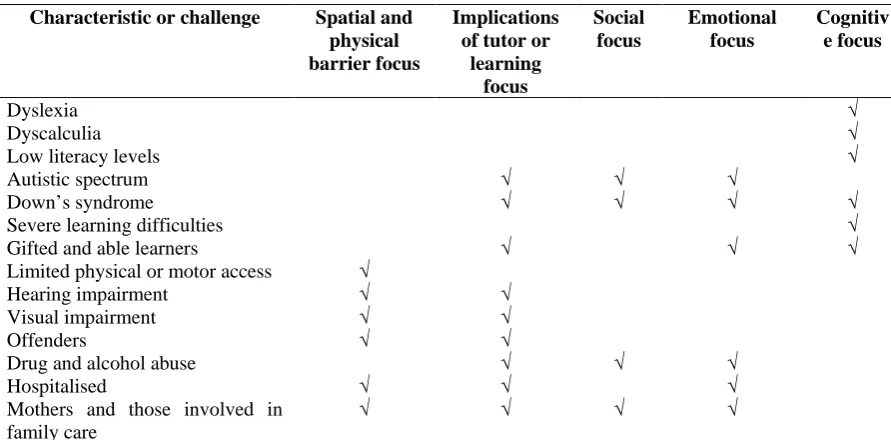
[image:12.595.74.520.546.766.2]The different groups above are related to a taxonomy of learner characteristics offered by Passey (2010). The original taxonomy, focused on the school-aged sector, is adapted here to highlight the theoretical framework factors that should be considered in each case (spatial and physical barriers, implications of tutor or learning approach, social, emotional, and cognitive focus), drawn from details in the previous text (see Table 1).
Table 1. Categories of learners with specific characteristics and major factors to consider for online learning
Characteristic or challenge Spatial and physical barrier focus
Implications of tutor or
learning focus Social focus Emotional focus Cognitiv e focus
Dyslexia √
Dyscalculia √
Low literacy levels √
Autistic spectrum √ √ √
Down’s syndrome √ √ √ √
Severe learning difficulties √
Gifted and able learners √ √ √
Limited physical or motor access √
Hearing impairment √ √
Visual impairment √ √
Offenders √ √
Drug and alcohol abuse √ √ √
Hospitalised √ √ √
Mothers and those involved in family care
13 Characteristic or challenge Spatial and
physical barrier focus
Implications of tutor or
learning focus Social focus Emotional focus Cognitiv e focus
Homeless √ √ √ √
Anxiety and shyness √ √ √
Withdrawal √ √ √
Emotional distraction √
Elective or selective mute √ √ √
Reluctant communicators √ √ √
Mental illness √ √ √
Disengagement and disaffection √ √ √
Dissatisfaction and disenfranchisement
√ √ √
Disruptive and anti-social behaviour
√ √ √
Social deprivation √ √
Marginalised √ √
Ethnic, cultural and language barriers
√ √ √ √
Geographical isolation and rural locations
√
It is important to note that researchers are increasingly identifying the need for tutors and students to engage in discussions about appropriateness and accommodation of online learning environments (discussed by Lockyer, Johnson and Dyer [2009], for example). From a study of how modern language teachers considered developing their pedagogical practices to accommodate specific learning difficulties more through online environments, Gallardo, Heiser and Arias Mclaughlin (2015) stated that outcomes depended on “individuals mastering the technology but also on their positive attitudes and willingness to communicate in a distinctive space” (p.10). They emphasised the need to re-negotiate roles, accommodate differences and establish connections through dialogue and understanding. Indeed, the need
14 and carer involvement can enhance student learning and personal development during social work education and training” (p.1021).
CONCLUSIONS
Overall, the review that developed the theoretical framework presented in this paper indicates that online learner support appears to be more developed and researched with ‘general’ higher and adult education groups than it is with groups involving inclusive participation for those with specific learning challenges. Limited research has been undertaken to identify how online tutors support the range of individuals with characteristics considered in this paper. From a theoretical perspective, a range of key factors for online tutors to consider are (in potential order of importance according to findings in this analysis):
• Spatial and physical barriers in the user environment;
• Implications of tutor or learning focus for user engagement with activities;
• Social focus (managing group work involving learners and tutors and appropriate
interactions);
• Emotional focus (and tutors and learners recognising that specific elements of concern
such as anonymity may not be accepted in the same way by all learners); • Cognitive focus;
• Choices of technologies, and using possible parallel online environments (to
accommodate needs for social or emotional interactions).
On the horizon, new tools are emerging that might enable specific features of online interactions to be monitored for learners and tutors, making it possible to respond in more timely fashion to situations arising. Some tools are becoming available that allow us to explore characteristics of individuals when they are interacting in online environments. For example, Schmidt, Laffey, Schmidt, Wang and Stichter (2012) introduced a system in a 3-dimensional interactive environment that allowed them to identify different behaviours, finding that: “Initiation was the least dominant interaction model behaviour” (p.410). Their system identified the most dominant form of inappropriate behaviour as interruption, the dominant mode of interaction as verbalisation, followed by movement, gesture and action, with text the least dominant interaction mode. Hou and Cheng (2012) studied patters of “latent emotional changes” (p.E113). They argue that teachers who can monitor this change
15 to determine the timing of encouragement and mediation and to design optimal guidance strategies” (p.E115). In a study that looked at analysing personal traits, Sumner, Byers, Boochever and Park (2012) focused on “anti-social traits of narcissism, Machiavellianism
and psychopathy, commonly referred to as the Dark Triad”. Their study was able to identify prediction rates for these traits, but could not identify accurately an individual’s traits (from Twitter activity). They believe their system, applied to large groups, allows anti-social traits that are increasing or decreasing to be recognised.
At this time, however, we must still largely rely upon our own personal ways of analysis to identify social and emotional concerns and issues as they arise, as well as build on the successes and positive outcomes that are generated in online environments. Taking cognisance of findings from previous studies, as in the theoretical framework offered here, however, can provide us with ways to at least ensure we consider the challenges already recognised when we support wide inclusive participation.
REFERENCES
Alexander, R.J. (2008). Towards Dialogic Teaching: rethinking classroom talk (4th edition). Cambridge: Dialogos.
Barrows, H.S. (1996). Problem-based learning in medicine and beyond: A brief overview. New Directions for Teaching and Learning, 68, 3-12.
Biasutti, M. (2011). The student experience of a collaborative e-learning university module. Computers & Education, 57(3), 1865-1875. doi: 10.1016/j.compedu.2011.04.006.
Burgstahler, S. (2015). Opening doors or slamming them shut? Online learning practices and students with disabilities. Social Inclusion, 3(6), 69-79.
Caffrey, B.M., & Carew, P.J. (2012). A Limited Engagement: A Case Study in Using Contextualised Online Learning Environments to Engage With Marginalised Communities. IFAC Proceedings, 45(10), 165-170.
Cho, H., Gay, G., Davidson, B., & Ingraffea, A. (2007). Social networks, communication styles, and learning performance in a CSCL community. Computers & Education, 49(2), 309-329.
Cleveland-Innes, M., & Campbell, P. (2012). Emotional presence, learning, and the online learning environment. International Review of Research in Open and Distance Learning, 13(4), 269-292.
16 Coomey, M., & Stephenson, J. (2001). Online Learning: it is all about dialogue, involvement, support and control-according to the research. In J. Stephenson (Ed.), Teaching and Learning Online: Pedagogies for New Technologies. London: Kogan Page.
Daymont, T., Blau, G., & Campbell, D. (2011).Deciding Between Traditional and Online Formats: Exploring the Role of Learning Advantages, Flexibility, and Compensatory Adaptation. Journal of Behavioral and Applied Management, 12(2), 156-175.
Dirckinck-Holmfeld, L., Jones, C., & Lindström, B. (2009). Analysing Networked Learning Practices in Higher Education and Continuing Professional Development. Rotterdam.
The Netherlands: Sense Publishers, BV.
Donovan, M.S., Bransford, J.D., & Pellegrino, J.W. (1999). How People Learn: Bridging Research and Practice. Washington, DC: National Academy of Sciences.
Drigas, A.S., Vrettaros, J., Argiri, K., & Bardis, N. (2013). Web 2.0 Learning Strategies for Disabled Students. Journal of Applied Mathematics & Bioinformatics, 3(4), 125-140. El Seoud, S.A., Anguera-Iglesias, C., Franco-Casamitjana, M., Garcia-Ruiz, M.A., & Block,
A.E. (2007). Employing Collaborative Learning Strategies in Online Conflict Resolution. International Journal of Emerging Technologies in Learning, 2(4), 66-69. Gallardo, M., Heiser, S., & Arias Mclaughlin, X. (2015). Developing Pedagogical Expertise
in Modern Language Learning and Specific Learning Difficulties Through Collaborative and Open Educational Practices. The Language Learning Journal, 20, 1-15.
Gamage, V., Tretiakov, A., & Crump, B. (2011). Teacher perceptions of learning affordances of multi-user virtual environments. Computers & Education, 57, 2406–2413. doi:10.1016/j.compedu.2011.06.015.
Hockly, N. (2015). Developments in online language learning. ELT Journal, 69(3), 308-313. Hou, H-T., & Cheng, K-H. (2012). Analyzing the Latent Emotional Transfer Pattern (LETP)
of a Learning Community in an Online Peer-Assessment Activity. British Journal of Educational Technology, 43(4), E113-E116. doi:10.1111/j.1467-8535.2012.01301.x
Jung-Ivannikova, L. (2016). Communication challenges learners face online: Why addressing CMC and language proficiency will not solve learners' problems. British Journal Of Educational Technology, 47(2), 239-247.
17 Kirkwood, A., & Price, L. (2014). Technology-enhanced learning and teaching in higher
education: what is ‘enhanced’ and how do we know? A critical literature review. Learning, Media and Technology, 39 (1), 6–36. doi:10.1080/17439884.2013.770404
Laurillard, D. (2001). Rethinking University Teaching: A Framework for the Effective Use of Educational Technology (2nd ed.). London: Routledge.
Lave, J., & Wenger, E. (1991). Communities of Practice: Creating Learning Environments for Educators. Cambridge: Cambridge University Press.
Lidström, H., Granlund, M., & Hemmingsson, H. (2012). Use of ICT in school: a comparison between students with and without physical disabilities. European Journal of Special Needs Education, 27(1), 21–34.
Lockyer, B., Johnson, J., & Dyer, J. (2009). Conceptual Content Requirements for a Mobile Online Learning Community for Marginalised Youth. Proceeding International Multiconference on Computer Science and Information Technology, 4, 361-366.
Lu, J., Yang, J., & Yu, C-S. (2013). Is social capital effective for inline learning? Information & Management, 50(7), 507-522.
Malinverni, L., Mora-Guiard, J., Padillo, V., Valero, L., Hervás, A., & Pares, N. (2016). An inclusive design approach for developing video games for children with Autism Spectrum Disorder. Computers in Human Behavior, In press. doi: 10.1016/j.chb.2016.01.018.
Mazer, J. (2013). Student Emotional and Cognitive Interest as Mediators of Teacher Communication Behaviors and Student Engagement: An Examination of Direct and Interaction Effects. Communication Education, 62(3), 253-277. doi: 10.1080/03634523.2013.777752.
McDowell, J. (2015). A black swan in a sea of white noise: Using technology-enhanced learning to afford educational inclusivity for learners with Asperger’s Syndrome. Social
Inclusion, 3(6), 7-15.
Naslund, J.A., Grande, S.W., Aschbrenner, K.A., & Elwyn, G. (2014). Naturally occurring peer support through social media: the experiences of individuals with severe mental illness using YouTube. PloS ONE, 9(10), 1-9.
18 Passey, D. (2010). Identifying young people at risk of learning exclusion: evidence from the educational system in England. In J. Engelen, J. Dekelver &W. Van den Bosch (Eds.),
Social Media for Social Inclusion of Youth at Risk: Proceedings of the INCLUSO 2010
Conference. Leuven, Belgium: K.U. Leuven.
Quinney, L., & Fowler, P. (2013). Facilitating Shared Online Group Learning between Carers, Service Users and Social Work Students. Social Work Education, 32(8), 1021-1031.
Redecker, C. (2009). Review of Learning 2.0 Practices: Study on the Impact of Web 2.0 Innovations on Education and Training in Europe. Luxembourg: Office for Official
Publications of the European Communities.
Reilly, J., Gallagher-Lepak, S., & Killion, C. (2012). “Me and My Computer”: Emotional Factors in Online Learning. Nursing Education Perspectives, 33(2), 100-105.
Rienties, B., Giesbers, B., Tempelaar, D., Lygo-Baker, S., Segers, M., & Gijselaers, W. (2012). The role of scaffolding and motivation in CSCL. Computers & Education, 59, 893–906. doi:10.1016/j.compedu.2012.04.010.
Robinson, K. (2013). The interrelationship of emotion and cognition when students undertake collaborative group work online: An interdisciplinary approach. Computers & Education, 62, 298-307. doi: 10.1016/j.compedu.2012.04.010.
Salmon, G. (2000). E-moderating: The Key to Teaching and Learning Online. London: Kogan Page.
Schmidt, M., Laffey, J., Schmidt, C.T., Wang, X., & Stichter, J. (2012). Developing methods for understanding social behavior in a 3D virtual larning environment. Computers In Human Behavior, 28(2), 405-413. doi: 10.1016/j.chb.2011.10.011.
Stahl, G., Koschmann, T., & Suthers, D. (2006). Computer-supported collaborative learning: An historical perspective. In R.K. Sawyer (Ed.), Cambridge handbook of the learning
sciences, Cambridge: Cambridge University Press.
Starcic, A.I., & Niskala, M. (2010). Vocational students with severe learning difficulties learning on the Internet. British Journal of Educational Technology, 41(6), E155-E159. doi: 10.1111/j.1467-8535.2010.01128.x.
19 . Sumner, C., Byers, A., Boochever, R., & Park, G. J. (2012). Predicting Dark Triad
Personality Traits from Twitter Usage and a Linguistic Analysis of Tweets. 11th
International Conference on Machine Learning and Applications, 2, 386-393.
Topol, R. (2016). Manipulating affordances in practice: A hermeneutic phenomenological study of mobility impairment and uses of digital technologies in work. Unpublished PhD thesis. Lancaster University, UK.
Woodfine, B.P., Nunes, M. B., & Wright, D.J. (2008). Text-based synchronous e-learning and dyslexia: Not necessarily the perfect match! Computers & Education, 50(3), 703-717. doi: 10.1016/j.compedu.2006.08.010.
Xie, K., Miller, N., & Allison, J. (2013). Toward a social conflict evolution model: Examining the adverse power of conflictual social interaction in online learning. Computers & Education, 63, 404–415. doi: 10.1016/j.compedu.2013.01.003.
Yang, Y-T.C., Gamble, J.H., Hung, Y‐W., & Lin, T‐Y. (2014). An online adaptive learning environment for critical‐thinking‐infused English literacy instruction. British Journal of Educational Technology, 45(4), 723-747. doi: 10.1111/bjet.12080.