Developing a Multi-Layer Strategy for Securing Control
Systems of Oil Refineries
Musaria K. Mahmood1, Fawzi M. Al-Naima2
1Department of Electrical Engineering, College of Engineering, Tikrit University, Tikrit, Iraq 2Department of Computer Engineering, College of Engineering, Nahrain University, Baghdad, Iraq
E-mail: [email protected], [email protected] Received May 12, 2010; revised May 21, 2010; accepted May 27,2010
Abstract
The energy industry and in particular the Oil Refineries are extremely important elements in Iraq’s infra-structure. A terrorist attack on one oil refinery will have a catastrophic impact on oil production and the whole economy. It can also cause serious damage to the environment and even losses of human lives. The security of information systems and industrial control systems such as Supervisory Control and Data Acqui-sition (SCADA) systems and Distributed Control System (DCS) used in the oil industry is a major part of infrastructure protection strategy. This paper describes an attempt to use several security procedures to de-sign a secure, robust system for the SCADA and DCS systems currently in use in the North Oil Refinery in the city of Baiji located in northern Iraq.
Keywords:DCS, SCADA, Security, Encryption, Internet, Public Key, DMZ, Data Security
1. Introduction
The increased use of computer network in control sys-tems and the use of internet as communication backbone have brought benefits in communication and for the pro- cess control in general. The ability to share information, making decision concerning production stoking and dis-tribution has been greatly improved [1]. New informa-tion technologies have recently been introduced for con-trol system based on open standards like Visual Basic, Java, Open Database Connectivity (ODBC), Ethernet communication and finally the use of internet based con-trol system. Internet or web based concon-trol system uses some internet protocols in the application layer to moni-tor and control plants at a distance. Older control systems were based on closed protocols implemented by vendors of SCADA, DCS, and Programmable Logic Controller (PLC) systems. However, the new common technology and the use of internet introduced many challenges in the area of security, such as cyber threats [2].
The North Oil Refinery in Baiji is a large industrial complex located on various sites scattered around the city of Baiji, north of Baghdad. This complex comprises four basic big refineries: 1) Salah Aldine-1, 2) Salah Al-dine-2, 3) North, and 4) Chemical Products. All these refineries are functioning under the same direction and are technically sported by unified sections. Each ref- inery unit has many DCS systems controlling several
chemical processes. These processes are independent of each other and are situated at different geographical lo-cations. Each DCS acts as standalone control system with its private communication network and local control room (LCR).
DCS systems in operation are based on new informa-tion technology (IT) with open standards such as TCP/IP protocols using fiber optic Ethernet for data transmission between field and LCR. The refineries direction begins a new project to connect all DCS systems to a Central Control Room (CCR) via intranet. Local server of each DCS will be connected to system server located at the CCR. System server will be connected to the Internet as part of web based control system of the refineries.
Multi-layered security system is suggested for Baiji Oil Refineries. This strategy of security will be based on the “ring of defense” around each local network of each DCS and also around the overall corporate intranet (which will be similar to SCADA system) [2].
The suggested security system can also be used for other SCADA systems in general like those used in Ele- ctrical Power Plants, Water Purification and many other Oil Industries.
2. Networking DCS’s
521 DCS system as a node or “station” of a global SCADA
system in the perspective of grouping all LCR of all DCS's of the North Refineries in the CCR. CCR will be the central control of the overall SCADA system. Each DCS will keep its local server, local database, and local LCR, and will be connected to the CCR via appropriate communication links.
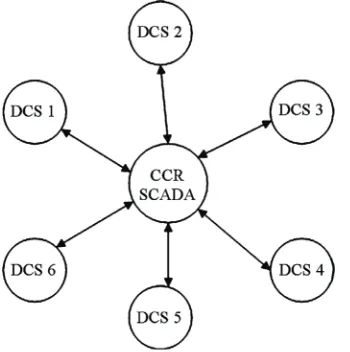
The connection of local servers to the system server (or web server) of SCADA system located at the CCR is made via corporate intranet as depicted in Figure 1. Communication links between LCR sites and CCR can be accomplished by fiber optics, coaxial cable or wire-less links regarding several factors related to topology, geography, and required bandwidth. Reliability, avail-ability and redundancy are major factors for the design of network topology. System database and all local data-bases use the same standard SQL database. The system database is located near the system server at the interface zone between corporate intranet and the internet. This location is chosen at the border of the system to mini-mize the risk of unauthorized intruder. The topology definition and the reliability of the communication net-work are not a part of this net-work.
3. Security Strategy
[image:2.595.321.520.178.500.2]The similarity of the new SCADA system and the ordi-nary IT system leads to the adoption of the same security approach used in computer communication network. The principal of networks separation into “rusted network” and “non-trusted network” fit perfectly for securing SCADA systems [3]. The ring of defense (multi-layer security system) will be implemented using various techniques, which are cited as the principal countermea-sure for securing SCADA [4]. The goal of such model will be the repetition of countermeasures to enhance the global system security as shown in Figure 2.
Figure 1. Networking DCS’s.
Each layer will acts against one or more of possible security challenges. There exist many cyber threats fac-ing control systems as cited in Table 1 [5]. Each security layer will be part of the defense on depth against threats.
The possible attack will be considered from the exter-nal non trusted network (the Internet) in the direction of the internal trusted network (the corporate intranet).
The Internet Non-trusted net.
Medium trust
DCS network Trusted net.
Refinery intranet
(1) Enerypted authentication
(2) Data eneryption
(3) Security policles
(4) Demilitarized zone (DMZ)
(5) Proxy server
(6) Applications
(7) DCS DMZ
(8) Data eneryption intern to DCS
A
track
d
ir
ec
ti
[image:2.595.88.263.529.705.2]on
[image:2.595.310.537.542.723.2]Figure 2. Ring of defense.
Table 1. Correlation of security threats and properties.
Properties Cyber threats Importance
Eavesdropping Low Message
confidentiality Traffic analysis Low
Message modification High Message
integrity False message injection High
Message
freshness Message replay High
Denial-of-service Middle Availability
Malicious codes Middle
Masquerade High Source
The compatibility of countermeasures like encryption standards, firewall, antivirus, intrusion detection techni- ques will be accomplished by the use of standardized techniques. Each DCS system can be isolated immedi-ately from the SCADA network and then be controlled locally if needed. The connection or the disabling of connection of one DCS can be made locally or from the CCR by some fixed authorization protocol. The connec-tion of DCS system to the CCR server and then to the internet will be subject to several layers of security de-fense rings as illustrated in Figure 3. Between each DCS system and the corporate intranet network a demilitarized zone (DMZ) is used where the local server and database of DCS reside. The global SCADA system is connected to the internet via another DMZ. To login from browser to the SCADA intranet an original process of encrypted authentication and digital signature is implemented.
3.1. Encrypted Authentication
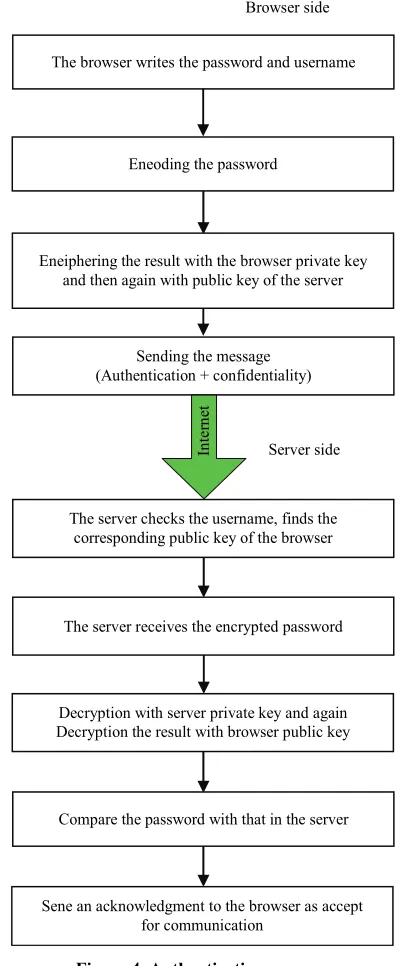
It is the first security stage for an external client. An origi- nal authentication process is developed based on asym-metric key encryption algorithm as shown in Figure 4. The RSA algorithm is used to encrypt the password two times for the implementation of authentication and the secrecy of password [3,6].
Local darabase
DCS
Inner firewall DCS
DCS
server Outer firewall DCS
router
To Internet
router
Outer firewall SCADA
Inner firewall SCADA System server
[image:3.595.322.520.80.563.2]System database
Figure 3. Security layers from DCS to internet.
Browser side
Eneoding the password
The browser writes the password and username
Eneiphering the result with the browser private key and then again with public key of the server
Sending the message (Authentication + confidentiality)
The server checks the username, finds the corresponding public key of the browser
Server side
In
te
rn
et
The server receives the encrypted password
Decryption with server private key and again Decryption the result with browser public key
Compare the password with that in the server
Sene an acknowledgment to the browser as accept for communication
Figure 4. Authentication process.
The implementation of public key algorithm was made with two key groups (e1,d1), and (e2,d2), where e1 is the public key of the first key group, d1 is the private of browser (personal private key), e2 is the second public key, and d2 is the private key of server.
The method of defining these keys, and the encryption algorithm is as follows:
[image:3.595.59.283.395.702.2]523 Choose an integer number e, (e < n) relatively prime
to β(n). Find second integer (d) such that {e × d mod β(n) = 1}
Then, the Public Key = (e, n) The Private Key = (d, n)
The encryption function of RSA for a plain text (M) is (C) such that:
C = M d mod n (2) Then, the recovered plain text (M) is:
M = C e mod n (3) If (e) is used instead of (d) for the encryption of equa-tion (2), then (d) will be used for the decryption in Equa-tion (3).
The password will be encoded using ASCII code or other encoding system. Each byte will be encrypted two times: the first with (d1) and the second with (e2) This will ensure both secrecy and authentication of the pass-word. At the server side, the reverse process is executed. The received cipher password will be first decrypted using (d2) and then (e1) in order to get the original plain text password.
The result will be compared to usernames table in the server. If matching is achieved then the server will open a communication channel and begin responding to brow- ser requests.
3.2. Data Encryption
To protect SCADA system already connected to the in-ternet and its data from unauthorized accesses many al-gorithms for data protection exist. In this work two en-cryption algorithms are used to encrypt data.
1) Encryption-1(security layer 2): This encryption al-gorithm used to encrypt data over the Internet. We pro-pose to use the Secure And Fast Encryption Routine (SAFER+), which is one of the known symmetric key algorithms that accomplishes requirements for real time data encryption. The SAFER+ was designed by James Messey for Cylink Corporation in 1998 as the new algo-rithm of SAFER family (safer-64, safer-128...) [7]. It was one of the candidates of the Advanced Encryption Stan-dard (AES) chosen for its good hardware-software tra-deoff orientation, simplicity, high throughput compared to other algorithms, and low memory requirement [8], [9]. Also, this algorithm brought attention recently by the use in as security measure in Bluetooth and wireless communication [10,11].
A detailed analysis of maximum bit rate for one DCS proves that SAFER+ fits well for the encryption of data over Internet to get the required real data transmission. SAFER+ is published with three options, 128 bits, 192, bits and, 256 bits key lengths. All three options are used to encrypt 16-byte plaintext. The plaintext block then passes through R rounds of encryption where R is
deter-mined by the key length chosen for encryption in the following manner:
● If key length = 128 bits then R = 8 rounds.
● If key length = 192 bits then R = 12 rounds.
● If key length = 256 bits then R = 16 rounds.
Our choice was the adoption of SAFER+ with 128 bits key length as other key lengths were found with certain key weaknesses [12]. Also, by increasing key length more computation time is needed related to rounds num-ber which will affect the assumption of real data trans-mission in control system.
This algorithm will be implemented as hardware in the server side and portable software in the client side. If there is wireless link between two sites interior to the corporate intranet, SAFER+ must be used with hardware encryption decryption processes. SAFER+ algorithm is divided into three blocks: the key scheduling, encryption process, and decryption process. Programming is accom-plished using Turbo Pascal.
2) Encryption-2 (security layer 8): This algorithm is used to encrypt data over the network of one DCS. This algorithm is not a part of this work but we can use the American Gas Association (AGA) standard which is proven to be a good choice for data over DCS network when dealing with protocols such as MODBUS or DNP3 [13]. In this work we found that securing data over the DCS network has no significant impact to enhance the security of overall system because all DCS system are well physically protected in isolated areas and we take care about data security when data circulate outside DCS network by other countermeasures. This encryption pro-cedure is mentioned here merely for other case studies with other compromises and challenges related to other situations.
3.3. SAFER+ Encryption/Decryption
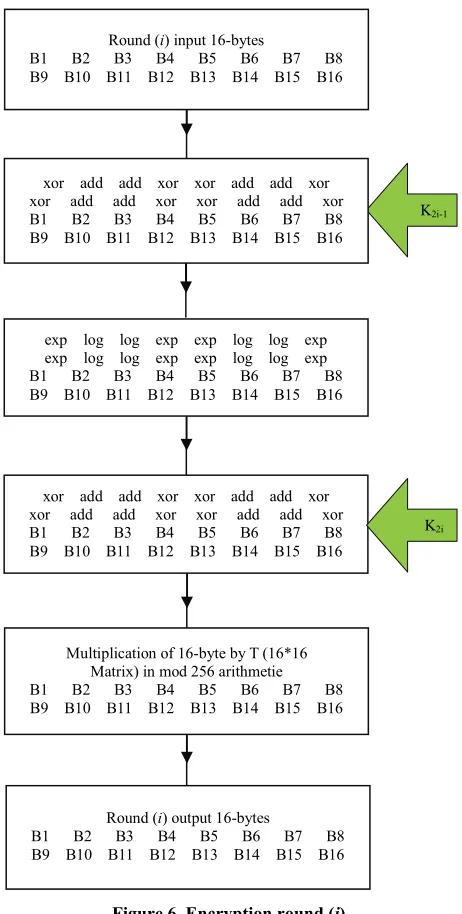
Giving the 16-byte key (128 bits), SAFER+ begin by calculating a set of 17 keys each with same length 16 bytes. The calculation uses sample arithmetic and logic functions like bit rotation, bit-by-bit exclusive-or of bytes, modulo 256 addition of bytes, and selection byte process.
key K2i-1 to the input 16-byte of the round Figure 6. The 16-bytes result are then fed to a layer of nonlinear func-tion. The value x of byte j is converted to 45x mod 257 for j = 1, 4, 5, 8, 9, 12, 13, and 16 (with the convention that when x = 128, then 45128 mod 257 = 256 is repre-sented by a 0). The value x of byte j is converted to log45(x) for j = 2, 3, 6, 7, 10, 11, 14, and 15 (with con-vention that when x = 0, then log450 = 128). The output of the nonlinear layer is then subject to same addition and Xor operation similar to the first block with key K2i. At the end of round (i), a block of matrix multiplication is used. The 16 bytes are multiplied by matrix T in mod 256 arithmetic. T is a 16 × 16 predefined matrix.
The operations in the decryption round are simply conducted in reverse order to the operations from the encryption round.
The first operation in the decryption round (i), is to post multiply the 16-byte round input by matrix T–1, which is the modulo 256 inverse of T to give the 16-byte result (S). The first round sub key K16-2i+2, is then “sub-tracted” from (S) in the manner that the round sub key bytes 1, 4, 5, 8, 9, 12, 13, and 16 are subtracted modulo 256 from the corresponding bytes of (S), while round sub key bytes 2, 3, 6, 7, 10, 11, 14, and 15 are added bit-by-bit modulo 2 to the corresponding bytes of (S). The 16-byte result is then processed nonlinearly in the manner that the value x of byte j is converted to log45(x) for bytes j = 1, 4, 5, 8, 9, 12, 13, and 16 (with the con-vention that when x = 0, log450 = 128). For j = 2, 3, 6, 7, 10, 11, 14, and 15, the value x is converted to 45x mod
16-Byte input plain text
SAFER+ single round
Round (i)
Output transformation Mixed xor/byte addition
16-Byte output cipher text K2i-1 and K2i
K17
Key
Ke
y
she
du
li
[image:5.595.308.539.75.532.2]ng
Figure 5. SAFER+ encryption process.
Round (i) input 16-bytes
B1 B2 B3 B4 B5 B6 B7 B8 B9 B10 B11 B12 B13 B14 B15 B16
K2i-1 xor add add xor xor add add xor
xor add add xor xor add add xor B1 B2 B3 B4 B5 B6 B7 B8 B9 B10 B11 B12 B13 B14 B15 B16
exp log log exp exp log log exp exp log log exp exp log log exp B1 B2 B3 B4 B5 B6 B7 B8 B9 B10 B11 B12 B13 B14 B15 B16
xor add add xor xor add add xor xor add add xor xor add add xor B1 B2 B3 B4 B5 B6 B7 B8 B9 B10 B11 B12 B13 B14 B15 B16
Multiplication of 16-byte by T (16*16 Matrix) in mod 256 arithmetie B1 B2 B3 B4 B5 B6 B7 B8 B9 B10 B11 B12 B13 B14 B15 B16
Round (i) output 16-bytes
B1 B2 B3 B4 B5 B6 B7 B8 B9 B10 B11 B12 B13 B14 B15 B16
K2i
Figure 6. Encryption round (i).
257 (with the convention that when x = 128, 45128 mod 257 = 256 round sub key K16-2i+1, is then “subtracted” from the 16-byte result in the manner that the round sub key bytes 1, 4, 5, 8, 9, 12, 13, and 16 are added bit-by-bit modulo 2 to the corresponding input bytes. Sub key bytes 2, 3, 6, 7, 10, 11, 14, and 15 are subtracted modulo 256 from the corresponding input bytes to produce the 16-byte output of the round.
3.4. Demilitarized Zone (DMZ)
[image:5.595.62.279.432.702.2]525 another network with less level of trust [1,3]. In the
DMZ the server and database reside in safe place, see Figure 3. Proxy server and application action like anti-virus are also deployed in the DMZ. In this work a dou-ble protection is found by the use of two DMZs. The first is as a security interface between SCADA system and the external non-trusted Internet (security layer 4), while the second is between the DCS trusted network and the less trusted corporate intranet for SCADA (security layer 7). DMZ is a zone between an inner firewall and an outer firewall. This firewall, properly configured, can protect passwords, IP addresses, and files. Firewall acts as a fil-ter that permits the data to enfil-ter from certain ports and blocks others. At the DMZ output a router is used as border router to route information to correct destination.
3.5. Security Policies
Security policies must be fixed by the security committee of the enterprise. Correct procedure of effective policies can reduce violation of security rules. Training personnel at the vocation of security can increase the defense in depth strategy. Developing documentation and well de-fining the access authorization will be a very active point. The choice of password must be as random as possible with at least ten characters, including symbols and num-bers.
In this work all the required information of the group of DCS in the North Oil Refinery will be available in the system server in the master DMZ (between corporate network and the internet).
4. Simulation Results
RSA and SAFER+ encryption algorithms are implemen- ted in Turbo Pascal language. As example to show how the encrypted authentication will be calculated. Let the password be chosen as the random word ‘playmyaudio’. Encoding this password with simple code from 01 for (a) to 26 for (z), will give:
M = 16, 12, 1, 25, 13, 25, 1, 21, 4, 9, 15.
C will be composed by the same number of 11 bytes. Consider for our example the following values for the keys are taken:
e1 = 13, d1 = 53, e2 = 37, d2 = 17, n = 77 Using equation (2) twice with browser private key d1 and then with server public key e2 the cipher text will be:
(1653 mod 77)37 mod 77 = 60 (1253 mod 77)37 mod 77 = 45 For the same for other bytes, we have:
C = 60, 45, 1, 58, 13, 58, 1, 21, 37, 53, 15. At the server, the received cipher text will be
con-verted back to the original password using Equation (3) twice:
(6013 mod 77)17 mod 77 = 16 (4513 mod 77)17 mod 77 = 12
So on for other bytes to get the original password: M = 16, 12, 1, 25, 13, 25, 1, 21, 4, 9, 15.
The use of double RSA encryption procedure will gives both authentication and secrecy.
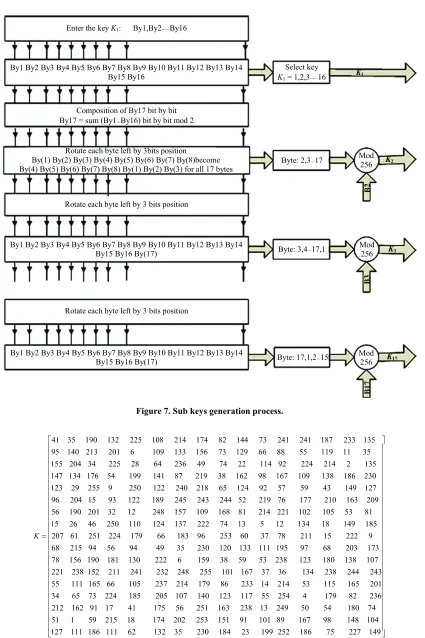
SAFER+ algorithm uses matrix to represent the 17- sub keys (17 × 16 matrix).given the secrete key (K1) as series of 16 bytes, the 16 other keys, each of 16 bytes will be generated. The calculation of each round is made using iterative process and many preprogrammed proce-dure (for Xor, Exp, log..).
As an example for the encryption/decryption process, let the 16 byte user selected input key (secrete key) be: 41, 35, 190, 132, 225, 108, 214, 174, 82, 144, 73, 241, 241, 187, 233, 235.
After the execution of key schedule procedure of Fig-ure 7, for 128 bit key we have the (17 × 16) matrix which represents the 17 sub keys each of length 16 bytes (128 bits). Each key is represented by a row, where row (1) represents K1 (the secrete key), to row (17) which represents K17, this will give the matrix (K) shown in Figure 8. The resulting 17 sub keys and the plain text are used to generate the cipher text as presented in Figure 5.
The plain text block input (16 byte plain text) = 179, 166, 219, 60, 135, 12, 62, 153, 36, 94, 13, 28, 6, 183, 71, 222.
The resulting cipher text will be = 224, 31, 182, 10, 12, 255, 84, 70, 127, 13, 89, 249, 9, 57, 165, 220.
The predefined bias matrix (B) is given as (16 × 16) matrix as input to generate sub key matrix [7]. This pro-cedure will be used to encrypt input data by block of 16 bytes at a time. The schedule procedure will be executed next time when the secrete key is changed to find the new matrix (K).
5. Conclusions
Enter the key K1: By1,By2……By16
By1 By2 By3 By4 By5 By6 By7 By8 By9 By10 By11 By12 By13 By14 By15 By16
Composition of By17 bit by bit By17 = sum (By1…By16) bit by bit mod 2
Rotate each byte left by 3bits position
By(1) By(2) By(3) By(4) By(5) By(6) By(7) By(8)become By(4) By(5) By(6) By(7) By(8) By(1) By(2) By(3) for all 17 bytes
Rotate each byte left by 3 bits position
By1 By2 By3 By4 By5 By6 By7 By8 By9 By10 By11 By12 By13 By14 By15 By16 By(17)
Rotate each byte left by 3 bits position
By1 By2 By3 By4 By5 By6 By7 By8 By9 By10 By11 By12 By13 By14 By15 By16 By(17)
Select key
K1 = 1,2,3……16
Byte: 2,3…17
Byte: 3,4…17,1
Byte: 17,1,2…15
K1
K2
K3
K17
Mod 256
Mod 256
Mod 256
B2
B3
B1
[image:7.595.88.513.66.704.2]7
Figure 7. Sub keys generation process.
41 35 190 132 225 108 214 174 82 144 73 241 241 187 233 135 95 140 213 201 6 109 133 156 73 129 66
K
88 55 119 11 35 155 204 34 225 28 64 236 49 74 22 114 92 224 214 2 135 147 134 176 54 199 141
87 219 38 162 98 167 109 138 186 230
123 29 255 9 250 122 240 218 65 124 92 57 59 43 149 127 96
204 15 93 122 189 245 243 244 52 219 76 177 210 163 209 56 190 201 32 12 248 157 109 168 81 214 221
102 105 53 81 15 26 46 250 110 124 137 222 74 13 5 12 134 18 149 185 207 61 251 224 179 66
183 96 253 60 37 78 211 15 222 9
68 215 94 56 94 49 35 230 120 133 111 195 97 68 203 173 78
156 190 181 130 222 6 159 38 59 53 238 123 180 138 107 221 238 152 211 241 232 248 255 101 167 37 36
134 238 244 243
55 111 165 66 105 237 214 179 86 233 14 214 53 115 165 201 34 65 73 224 185 205
107 140 123 117 55 254 4 179 82 236
212 162 91 17 41 175 56 251 163 238 13 249 50 54 180 74 51
1 59 215 18 174 202 253 151 91 101 89 167 98 148 104 127 111 186 111 62 132 35 230 184 23
199 252 186 75 227 149
527 The use of computer network protection can be very
useful in SCADA like DMZ, and network segmentation from the trust point of view. Layered strategy is a good method to secure SCADA, DCS and control systems in general. The use of different layered actions against cy-ber threats makes the defense in depth active. Authenti-cation is one of most used and active countermeasure for security in control systems. The use of RSA public key algorithm for encrypt password will ensure security and authenticity.
6. References
[1] R. L. Krutz, “Securing SCADA Systems,” Wesley Pub-lishing, Inc., Indianapolis, 2006.
[2] J. Pollet, “Developing a Solid SCADA Security Strat-egy,” Proceedings of the Second ISA/IEEE Sensors for Industry Conference, Houston, November 2002, pp. 148- 156.
[3] M. Bishop, “Introduction to Computer Security,” Addi-son-Wesley, Boston, 2005.
[4] J. Nordlander, “What is Special about SCADA System Cyber Security,” Master Dissertation, Royal Institute of Technology, Sweden, 2009.
[5] H. Lim, S. Hong, M. S. Choi, S. J. Lee, T. W. Kim, S. W. Lee and B. N. Ha, “Security Protocols Against Cyber At-tacks in the Distribution Automation System,” IEEE Transactions on Power Delivery, Vol. 25, No. 1, 2010, pp. 448-455.
[6] T. Davis, “RSA Encryption,” October 2003. http://www. geometer.org/mathcircles
[7] J. Messy, H. Kh and K. Kuregian, “Nomination of SA-FER+ as a Candidate Algorithm for the AES,” 1998. http://csrc.nist.gov/archive/aes/round1
[8] A. Schubert and W. Anheier, “Efficient VLSI Implemen-tation of Modern Symmetric Block Ciphers,” 6th IEEE International Conference on Electronics, Circuit and Sys-tems, Pafos, Vol. 2, September 1999, pp. 757-760. [9] S. Mukherjee, D. Ganguly and S. Naskar, “A New
Gen-eration Cryptographic Technique,” International Journal of Computer Theory and Engineering, Vol. 1, No. 3, Au-gust 2009, pp. 284-287.
[10] I. S. Ashour, “Online Data and Voice Encryption System Based on FPGA,” 24th National Radio Science Confer-ence, Cairo, National Republican Senatorial Committee, 2007, pp. 1-7.
[11] D. Sharmila and R. Neelaveni, “Performance Analysis of SAFER+ and Triple DES Security Algorithms for Blue-tooth Security System,” International Journal of Com-puter Science and Network Security, Vol. 9, No. 2, 2009, pp. 74-87.
[12] J. Kelsey, B. Schneier and D. Wagner, “Key Schedule Weaknesses in SAFER+,” Second Advanced Encryption Standard Candidate Conference, Rome, 1999, pp. 155- 167.