APPLICATION OF LEARNING MODEL SCIENCE TECHNOLOGY SOCIETY (STS) IN IMPROVING
MASTERY OF CHEMISTRY LEARNING OF COLLOID
Chemistry Education Program, Universitas Halu Oleo, Kendari
ARTICLE INFO ABSTRACT
This research aimed to improve student mastery of chemistry learning of integrating Science Technology Society (STS). A pretest
which involved three year XI secondary school classes. The students engaged with different issues using STS principles. They used diffe
Colloid concept. A concept map was used as the research instrument along with multiple
items. The results show that (1) there are three fundamental concepts in the Colloidal Systems in the curricula consisting of 12,50% abstract concepts with concrete examples, 4,17% of concepts that state the nature of properties, and 70,83% concepts that describe the process; (2) the comparison of the highest mean of posttest score of 93,89 for the exper
meanwhile, for the control class with a score of 82 in Colloid concept. The lowest score for the experimental class was 68,89 in the Liofil Sol concept while in the control class it was 24,58 in the Gel Conce
by the experimental class students was higher than for the control class with an average score of N Gain 0,78> 0,53 which entered the high category for the experime
the category of being; (4) The model of science learning technology communityimproved students' mastery of the concept for high ability groups with th 63> 2,91, the ability of being with th 37,15> 1,72, low ability to
of different test t 'intergroup ability of students showed no difference, with t' high ability and being t'h 0,259<1,753,high and low ability t'h0,270 <6,313 and the low
response of students qualify as well to the application of science learning model community technology with a percentage of 77,9% while the response of students qualify as sufficient to direct learning model with a percent
Copyright © 2019, Rafiuddin and Maisara. This is an open use, distribution, and reproduction in any medium, provided
INTRODUCTION
Curriculum, as a description of students’ learning, should empowered students. The curriculum should seek both meaningful learning experiences and empowering
outcomes for students within a range of societal demands and government policies. Therefore, the curriculum is
of economic, political, social and cultural questions about the aims, purposes, content and processes of education (UNESCO, 2016). In the context of science education, students should be helped to develop the understanding and habits of thinking needed to solve life’s problems Mundilarto, 2002 in Atika, 2018). Chemistry, as part of science, should help students to develop their knowledge and skills to make chemistry more relevant to their lives and society.
*Corresponding author: Rafiuddin and Maisara,
Chemistry Education Program, Universitas Halu Oleo, Kendari
ISSN: 0975-833X
Article History:
Received 29th October, 2018
Received in revised form 16th November, 2018
Accepted 27th December, 2018
Published online 31st January, 2019
Citation:Rafiuddin and Maisara.2019. “Appication of learning model science technology society (sts) in improving mastery of chemistry learning of colloid system concepts in secondary school”,International
Key Words:
Science society technology, Mastery of concepts, Colloidal Systems.
RESEARCH ARTICLE
APPLICATION OF LEARNING MODEL SCIENCE TECHNOLOGY SOCIETY (STS) IN IMPROVING
MASTERY OF CHEMISTRY LEARNING OF COLLOID SYSTEM CONCEPTS IN
SECONDARY SCHOOL
*Rafiuddin and Maisara
Chemistry Education Program, Universitas Halu Oleo, Kendari
ABSTRACT
This research aimed to improve student mastery of chemistry learning of
integrating Science Technology Society (STS). A pretest-posttest control group design was used which involved three year XI secondary school classes. The students engaged with different issues using STS principles. They used different sources from the environment which linked with the Colloid concept. A concept map was used as the research instrument along with multiple
items. The results show that (1) there are three fundamental concepts in the Colloidal Systems in the curricula consisting of 12,50% abstract concepts with concrete examples, 4,17% of concepts that state the nature of properties, and 70,83% concepts that describe the process; (2) the comparison of the highest mean of posttest score of 93,89 for the experimental class with the Tyndall effect concept, meanwhile, for the control class with a score of 82 in Colloid concept. The lowest score for the experimental class was 68,89 in the Liofil Sol concept while in the control class it was 24,58 in the Gel Concept; (3) the comparison of the average score of N-gain for increasing mastery of the concept by the experimental class students was higher than for the control class with an average score of N Gain 0,78> 0,53 which entered the high category for the experime
the category of being; (4) The model of science learning technology communityimproved students' mastery of the concept for high ability groups with th 63> 2,91, the ability of being with th 37,15> 1,72, low ability to th 9,8> 6,3 on the subject of Colloid Systems, which was reinforced by the results of different test t 'intergroup ability of students showed no difference, with t' high ability and being t'h 0,259<1,753,high and low ability t'h0,270 <6,313 and the low-ski
response of students qualify as well to the application of science learning model community technology with a percentage of 77,9% while the response of students qualify as sufficient to direct learning model with a percentage of 36,84%.
open access article distributed under the Creative Commons Attribution provided the original work is properly cited.
Curriculum, as a description of students’ learning, should empowered students. The curriculum should seek both meaningful learning experiences and empowering learning outcomes for students within a range of societal demands and re, the curriculum is a key driver of economic, political, social and cultural questions about the aims, purposes, content and processes of education (UNESCO, students should be helped to develop the understanding and habits of thinking needed to solve life’s problems Mundilarto, 2002 in Atika, 2018). Chemistry, as part of science, should help students to r knowledge and skills to make chemistry more
Rafiuddin and Maisara,
Chemistry Education Program, Universitas Halu Oleo, Kendari
The chemistry subject involves three representations of macroscopic, microscopic and symbolic representation (Treagust, 2015), therefore, chemistry learning is required to convey the concept of contextualization or the phenomenon of everyday life (Westbroek, 2005; King, 2012)
learning more meaningful. The research conducted by experts, including Wiseman (1981), Nakhleh (1992), Kirkwood and Symington (1996) as cited by Rusmansyah and Yudha Irhasyuarna (2001) suggests that many students can easily learn other subjects, but have difficulty in unders
concepts and principles of chemistry. Chemistry learning is considered difficult for students, especially the material colloidal system, therefore the process for learning chemistry should involve innovative teaching approaches.
topic is relevant to students’ daily lives, therefore, to understand the colloidal material, student mastery of concepts need to be improved (Pudjiadi, 2005). One teaching model that can be used to learn the colloidal topic is the Science International Journal of Current Research
Vol. 11, Issue, 01, pp.421-426, January, 2019
DOI: https://doi.org/10.24941/ijcr.34008.01.2019
Appication of learning model science technology society (sts) in improving mastery of chemistry learning of
International Journal of Current Research, 11, (01), 421-426.
APPLICATION OF LEARNING MODEL SCIENCE TECHNOLOGY SOCIETY (STS) IN IMPROVING
SYSTEM CONCEPTS IN
Chemistry Education Program, Universitas Halu Oleo, Kendari
This research aimed to improve student mastery of chemistry learning of the colloidal system by posttest control group design was used which involved three year XI secondary school classes. The students engaged with different issues rent sources from the environment which linked with the Colloid concept. A concept map was used as the research instrument along with multiple-choice test items. The results show that (1) there are three fundamental concepts in the Colloidal Systems in the curricula consisting of 12,50% abstract concepts with concrete examples, 4,17% of concepts that state the nature of properties, and 70,83% concepts that describe the process; (2) the comparison of the imental class with the Tyndall effect concept, meanwhile, for the control class with a score of 82 in Colloid concept. The lowest score for the experimental class was 68,89 in the Liofil Sol concept while in the control class it was 24,58 in the gain for increasing mastery of the concept by the experimental class students was higher than for the control class with an average score of N-Gain 0,78> 0,53 which entered the high category for the experimental class while the control class in the category of being; (4) The model of science learning technology communityimproved students' mastery of the concept for high ability groups with th 63> 2,91, the ability of being with th 37,15> th 9,8> 6,3 on the subject of Colloid Systems, which was reinforced by the results of different test t 'intergroup ability of students showed no difference, with t' high ability and being t'h skilled and t'h0,342 <6,313; (5) the response of students qualify as well to the application of science learning model community technology with a percentage of 77,9% while the response of students qualify as sufficient to direct
ribution License, which permits unrestricted
The chemistry subject involves three representations of macroscopic, microscopic and symbolic representation (Treagust, 2015), therefore, chemistry learning is required to convey the concept of contextualization or the phenomenon of everyday life (Westbroek, 2005; King, 2012)in order to make The research conducted by experts, including Wiseman (1981), Nakhleh (1992), Kirkwood and Symington (1996) as cited by Rusmansyah and Yudha Irhasyuarna (2001) suggests that many students can easily learn other subjects, but have difficulty in understanding the concepts and principles of chemistry. Chemistry learning is considered difficult for students, especially the material colloidal system, therefore the process for learning chemistry should involve innovative teaching approaches. The colloidal opic is relevant to students’ daily lives, therefore, to understand the colloidal material, student mastery of concepts need to be improved (Pudjiadi, 2005). One teaching model that can be used to learn the colloidal topic is the Science INTERNATIONAL JOURNAL
OF CURRENT RESEARCH
Technology Society (STS) which uses resources from the environment. Relevant research from Eady (2013) states that teachers can connect the concepts of science that have been delivered in the classroom with problems that occur in society and in the student’s daily life. In addition Diana (2012) states that there is a strong relationship between education and technology. Tools and technologies, in their broadest sense, are important drivers of education, though their development is rarely driven by education. Writing, one of the most important tools in the development of human civilization, was not invented for education but for commerce. Pasnik and Hupert (2016) state that that technology can model approaches to learning, ways of interacting with peers, adults or children, and most importantly, it can use visual and audio information, enabling adults and children to engage in meaningful discourse about science and the world around them.This approach is reinforced by Yager (2009) regarding the "comparison of students in learning STS along with guided learning inquiry in class. Research into STS shows that students develop 1) understanding of basic concepts, 2) science process skills, 3) creativity, and 4) positive attitudes about their knowledge by learning through STS. In support, Sirhan (2007)states that students prefer problems that challenge real-world contexts that have clear relevance to everyday life. If the problem is interesting, meaningful, challenging, and involves students in the learning process they will be more motivated to learn.
Vygotsky’s and Bandura’s theories, as reportedby Eady (2013), provide teachers with guidance on how to use technology in teaching and learning. Learning occurs within a social environment – we learn by modelling and interacting with others. Technology can be used to facilitate social interaction and communication among learners in class, within a school, between schools and around the world. For this reason, the researcher applied the community technology science learning model, because the STS model can link between the material in the classroom and those in the environment, so that with this the students can improve their mastery of the concept. In the context of this research, the teacher still tends to use teaching to develop students' concept mastery. The data shows that the average score for chemistry in year XI is below the minimum passing grade (Kriteria Ketuntasan Minimal-KKM), therefore, the researcher looked at the influence of the application of the STS model on the learning of the Colloidal System. The research was not only to help achieve the KKM, but to explore different teaching approaches since students in a traditional classroom are less active because of the teaching methods such as memorizing and recording material provided by the teacher. The STS uses environmental issues so that students can develop mastery of the concepts. By learning through everyday life expereinces. Thompson, et all, (2001) states that the STS research has to serve society and engage students in the issues of real life situations. Therefore, this study will explore the effect of this model on student learning.
RESEARCH METHODS
The research focused on "how can the application of STS improve the mastery of concepts of the colloidal system for year XI students in secondary school?". In particular, the following research questions were stated:
1.What are the characteristics of the concept of the colloidal system?
2. How does mastery of the concept by students in the control class using a direct teaching model compare with the STS model cohort?
3. What is the difference between the effectiveness of increasing the mastery concept of students using the STS model compared with the control class using the direct teaching model?
The participants in the study consisted of three parallel year XI chemistry students at a secondary school enrolled in the 2016/2017 academic year. A random sampling technique
(Creswell, 2012) was used which determined class XI IPA1 as
the experimental class and class XI IPA3 as the control class.
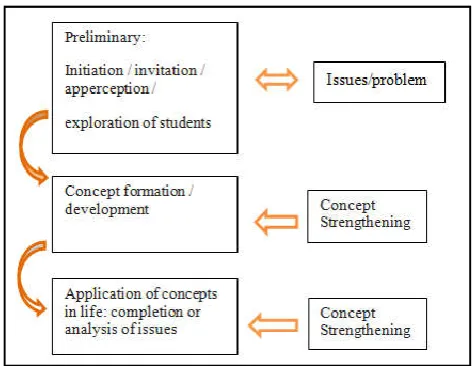
[image:2.595.314.551.247.430.2]The experimental class was taught by STS while the control class was taught using a direct teaching model.
Figure 1. STS learning flow (Poedjiadi, 2005)
The posttest was given to assess student mastery of the concepts. Data analysis was performed using statistical techniques of descriptive statistics and inferential statistics.
RESULTS AND DISCUSSION
A. Characteristics of Colloid System Concepts
A curricula analysis was conducted to understand the characteristics of Colloid concept.
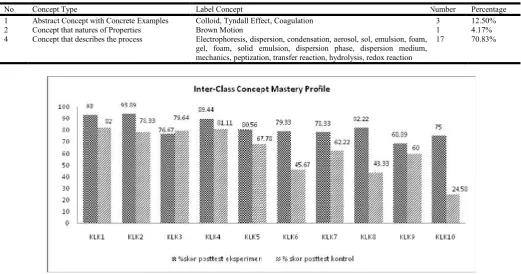
Based on Table 1 above, the concept characteristics of the subject matter of the colloidal system is more dominant in the concept that states the process with a percentage of 70.83%, thus the colloidal system material is suitable for use with the practicum method or the STS model. Fry, et all. (2008)states that arousing the interest of students is important to reassure them and to help them see that the material to be covered will be useful in solving problems that exist in the surrounding environment.
Concept Mastery Profile
Based on the mean score and the mean percentage of posttest
Based on Figure 2 of the results of the percentage of concept mastery profiles from the average score posttest between the experimental class and control class on the concept label each question can be concluded that the experimental class is higher than the control class because it can be seen from the highest percentage of Label Concept Group (KLK) in the experimental class, which is 93.89% in KLK2 (Tyndall effect), high percentage KLK2 (Tyndall Effect) that is 93.89%, because students are more likely to master the concept of Colloidal System material which is related to the sub-material of colloidal properties, especially the material of Tyndall Effect, while the highest percentage of control class is 82% in KLK1 (Colloid), the high percentage of KLK1 (Colloid) is 82% due to the sub-material understanding of colloid, the material still tends to be easy so the students can immediately understand even though the teacher uses the direct learning model while the lowest percentage of the averagescore in posttest the experimental class is 68.89% found in KLK9 (sol liofil), the low percentage of KLK9 (sol liofil) is 68.89% because in the liofil sol material it tends to be difficult so students still find it difficult to understand the material, while in the percentage control class that is 24.58% found in KLK10 (Gel), the low percentage of KLK10 (Gel) is 24.58% because the students' control class is not using practicum methods so students tend to find it difficult to understand gel material.
The percentage profile of KLK3 concept mastery (Colloid Type) in the control class was higher than in the experimental class due to the material being explained so that the students could understand it, therefore, the STS learning model did not significantly influence the colloid type material. The percentage of the mastery profile of the KLK4 (Gel) concept showed a significant difference between the experimental class and the control class due to the instructional methodology used.
The experimental class used a practicum method where students experienced the learning process directly while the control class used a direct, lecture style learning model where students did not understand the material. The use of active methodologies (Kirkwood et al. 2016), reflective exercises and writings (Burr et al. 2016; Constable 2010), seem to support mastery by focusing on learning from experience in conjunction with reflective practice, discussion with others and dialogue with the trainer. In this way learners are encouraged, through reflection and comparison with the contexts of their professional practice, to question the sense of ‘self in practice’, and to develop their own professional identity (Bruno and Bracco 2016).
Index Data N-Gain
[image:3.595.37.559.77.351.2]Profile mastery of concepts in KLK3 (Colloid Type), based on the scores N-Gainin were higher in the control class compared to the experimental class, because in this sub-subject the control class students were better understood than the experimental class students, by the STS learning model is not very influential on the sub-material, it does not affect the STS model because this material can be used without practicum methods. The concept mastery profile in KLK10 (Gel) showed a significant difference between the experimental class and the control class. In the experimental class pre-test students did not know what the Gel was, nor did the control class. But after the application of each associated learning model, the experimental class found it easier to understand because it saw and experienced direct learning while the control class only heard from a teacher explanation, therefore, for the post-testthe experimental class better understood the sub-material compared to the control class. As Hulu (in Maimunah, 2017) opinioned, the process and the frequency of enjoyable learning can increase motivation for students so that the quality learning Table 1. Characteristics of Concepts in Colloidal System Material
No Concept Type Label Concept NNumber Percentage
1 Abstract Concept with Concrete Examples Colloid, Tyndall Effect, Coagulation 3 12.50%
2 Concept that natures of Properties Brown Motion 1 4.17%
4 Concept that describes the process Electrophoresis, dispersion, condensation, aerosol, sol, emulsion, foam, gel, foam, solid emulsion, dispersion phase, dispersion medium, mechanics, peptization, transfer reaction, hydrolysis, redox reaction
17 70.83%
KLK= Kelompok Label Konsep (Label Concept Group)
outcomes improves. Salila, and Musrin (2014) claimed that when the experimental class is given a learning treatment with SETS learning model in which there are discussion, demonstration, and practicum activities, and control class with conventional learning model in which there is also practicum activities.
Effectiveness of STS Model on Mastery of Students Concept
Hypothesis test analysis was carried out using a t-test analysis technique, before hypothesis testing with a t-test analysis prerequisite test. Prerequisite tests include a normality test to determine data distribution, and the variance homogeneity test. These prerequisite tests include:
Normality
Test Data distribution normality was carried out on the data of the experimental group and control group learning outcomes. Table 4.1 below shows the results of the analysis of the normality test of two variables. Parts that need attention and
Asymp. Sig. (2-tailed). If the value of Asymp. Sig. (2-tailed) is
more than or equal to 0.05, the data is normally distributed, if
Asymp. Sig. (2-tailed) is less than 0.05, the data is not normally
distributed. The normality test was carried out on the control class and Experimental Class as follows:
A normality test was conducted to find out whether the data obtained were from a normal distribution or not. The results of the normality test can be briefly seen in Table 2 From table 2 can be concluded that the data has a normal distribution of normality.
Homogeneity Test: Homogeneity was tested by the One Way
Anova with significance level was 0.05. The calculation of
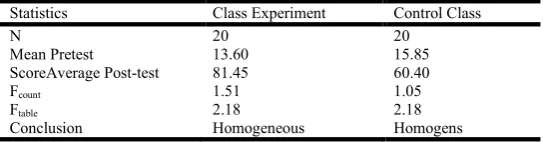
homogeneity test results can be seen in Table 3. From Table 4.3 shows that Fcounts <Ftable both experimental and control
classes because it can be seen from the value of 1.51 <2.18 for the experimental class, while for the control class value is 1.05 <2.18, it can be concluded that the experimental class data as well as the homogeneous control class.
Different test: After prerequisite data analysis, the data from the research sample shows a normal and homogeneous distribution, therefore, testing the data was continued by hypothesis testing.
In this study, hypothesis testing was done using the "t" test with the testing criteria: p value> alpha 5%, so Ho is accepted, H1 is rejected and vice versa. In this study hypotheses were
tested based on the level of student ability between the experimental class and the control class. Based on data N-gain
from both classes, the t test was carried out. The results of the calculation of the t test were carried out using the SPSS application. The differences in the increase in mastery of concepts for each group of students' abilities between the experimental class and the control class can be seen in Table 4.4 below. In accordance with the criteria for testing the hypothesis where if tcount> ttable or p value <α 5% then H0 is
rejected and vice versa then by Table 4.4, the data from samples taken with a significant level of 5% can be seen that tp
= 5.72> 1.68 or p value = 0.000 <0.05 so that it can be said H0 is rejected and H1 is accepted, with the acceptance of H1 there is
a difference in students' concept mastery based on the index N-gain because the difference in the scores pretest to posttest in the experimental class is higher than the increase in scores from pretest to posttest in the control class, the increase in
pretest to posttest. experimental class because the experimental
class uses the STS model with the practicum method by which students experience the learning process directly while the control class uses the direct learning model using the lecture method so that students tend to be less active in the learning process, so the increase in scores pre-test to post-test does not increase. The difference in the increase in the adoption of this concept is also strengthened by research conducted by Iskandar (1997) which shows that the application of the STS approach is considered suitable for integrating dominant concepts, skills, processes, creativity, attitudes, values, applications and interrelations among the fields of study in learning and the scientific approach. In addition, Mandra (2012) also reported that there is a difference in understanding the concept of chemistry towards the application of the community technology science learning model (STS) for the better.
[image:4.595.77.525.81.135.2]The difference in the increase in the adoption of this concept is strengthened also by the research, (Mandra, 2012) that in this study there were differences in understanding the concept of chemistry on the application of the community technology science learning model (STS). Bennett J, Hogarth S, Lubben F (2003) also show that the in-depth review to the five studies were included in the in-depth review has shown the following: first, there is some evidence to support the claim that context-based approaches motivate pupils in their science lessons. Second, is there is evidence to support the claim that such approaches also foster more positive attitudes to science Tabel 2. Normality Test Result
Statistics N-Gain
Experiment
N-Gain Control
Pre-test Experiment
Post-test Experiment
Pre-test Control
Post-test Controls
Average 0.785 0.535 13.60 81.45 15.85 60.40
0.063 0.185 5.394 5,689 6,738 17,282
[image:4.595.162.434.167.238.2]Asymp. Sig. (2-tailed) 0.972 0.570 0.656 0.356 0.656 0.767
Table 3. Homogeneity Test Results
Statistics Class Experiment Control Class
N 20 20
Mean Pretest 13.60 15.85
ScoreAverage Post-test 81.45 60.40
Fcount 1.51 1.05
Ftable 2.18 2.18
generally, and third, there is evidence to support the claim that context-based approaches do not adversely affect pupils’ understanding of scientific ideas.
Conclusion
Based on the results of the study and previous discussion, it can be concluded that the characteristics of the subject of colloid can be divided into three types of concepts including 12.50% of abstract concepts with concrete examples, 4.17% of concepts which state the nature of properties, and 70.83% of concepts that state process. The results are consistent with what has been previously reported (Akcay, 2015). The results of the study show that an ICPD program integrated with STS instruction helps students to understand the nature of science concepts and engenders and more positive attitude towards science, science class and science teachers than traditional textbook-oriented classrooms. The results are consistent with what has been reported previously (Yager, 1996; Liu, 1992; Rubba & Wiesenmayer, 1990; Lochhead & Yager, 1996 in Akcay, 2015). However, the results of this study are quite different from the Mackinnu study (Mackinnu, 1991 in Akcay, 2015) where it was reported that no statistically significant differences occurred in either pre-test or post-test scores on student understanding of the nature of science. Profile mastery of concepts from the application of community technology science learning models to students of class XI in the topic of the colloidal system has an average comparison of the scores
posttest highest and lowest for the experimental class and
control class, the comparison for the score posttest highest in the experimental class is 93.89 on the Tyndall Effect concept label while the control class is 82 on the label of the concept of colloid. while the score comparison posttest lowest in the experimental class was 68.89 on the liofil sol concept label while the control class was 24.58 on the gel concept label. Mastery of the concept of class XI studentsincreased after instruction using the community technology science learning model and the direct learning model with the average N-Gain
experimental class being 0.78 in the high category, while the average N-Gain for thecontrol class was 0.53 in the medium category. The community technology science learning model effectively increased the mastery of the concept of high-ability group students with th 63> 2.91, moderate ability with th
37.15> 1.72, low ability with th 9.8> 6.3 on the subject of
colloid systems. This is reinforced by the results of different test t 'between groups of students ability showed no difference, with t' high ability and being t'h 0.259 <1.753, high capability
and low t'h 0,270 <6.313 and the ability of low- and t'h 0.342
<6.313. In other words, the three groups have a significant increase in ability, an outcome supported by Yörük, Nuray (2010) that shows teaching science subjects through STSE links enable sstudents to understand that the topics they learn are not independent from real life and could lead them to learn about occupations related to real world fields.
REFERENCES
Akcay, B. & Akcay H. 2015. Effectiveness of science-technology-society (STS) instruction on student understanding of the nature of science and attitudes toward science. International Journal of Education in
Mathematics, Science and Technology, 3(1), 37-45.
Atika, et al. 2018. Improving Deaf and Hard of Hearing Students’ Achievements Using STS Approach: A
Literature Review. Japan: International Journal of
Pedagogy and Teacher Education (IJPTE), Vol-2.
Bennett J, Hogarth S, Lubben F (2003) A systematic review of the effects of context-based and Science-Technology-Society (STS) approaches in the teaching of secondary science: Review summary. University of York, UK. Bruno, A., and F. Bracco. 2016. Promoting Safety through
Well-being: An Experience in Healthcare. Frontiers in Psychology 7: 1208.
Burr, V., E. Blyth, J. Sutcliffe, and N. King. 2016.
“Encouraging Self-reflection in Social Work Students: Using Personal Construct Methods British.” Journal of
Social Work 46 (7): 1997–2015.
Constable, G. 2010. Reflection as a Catalyst in the Development of Personal and Professional Effectiveness. In Reflective Practice in Social Work, edited by Christine Knott and Terry Scragg, 48–64. 2nd ed. London: Sage. Creswell, John W. 2012. Educational research: planning,
conducting, and evaluating quantitative and qualitative research / John W. Creswell. — 4th ed.
Eady, M. J. & Lockyer, L. 2013, 'Tools for learning: technology and teaching strategies', Learning to Teach in the Primary School, Queensland University of Technology, Australia. pp. 71
Ghassan Sirhan. 2007. Learning difficulties in chemistry: An overview. Journal of Turkish science education.
Heather Fry et al. 2008. A handbook for teaching and learning in higher education: enhancing academic practice. Taylor and Francis Group –3rd ed
Hulu, F. L. W. 2009. Usage Confrontative Practicum for Facilitate Improvement Mastery of Concepts and Attitudes Scientific Class VII students on Organizational Subjects Life. Thesis. University Indonesian Education, Bandung. Indarti, et al. 2011. Application of Community Science and
Technology Approaches to Improve Science Learning Outcomes. Surakarta: UNS.
King. 2012. New perspective on context-based chemistry education: using a dialectical sociocultural approach to view teaching and learning. Journal of Studies in Scinece
Education.
Kirkwood, S., B. Jennings, E. Laurier, V. Cree, & B. Whyte. 2016. “Towards an Interactional Approach to Reflective Practice in Social Work.” European Journal of Social Work 19 (3–4): 484–499.
Klein Thompson, et al. 2001. Joint Problem Solving among Science, Technology and Society. Berlin : Springer
Laurillad Diana. 2012. Building Pedagogical Patterns for Learning and Technology. UK and London: Tailor and Francis.
Mandra, I, M. 2012. The Influence of Science Technology Community Learning Model (STS) on Understanding Chemical Concepts and Scientific Attitudes of Class X Students of SMAN 1 Kediri. Natural Sciences Education Study Program at the University of Ganesha Education Postgraduate Program. Bali.
Pasnik, S., & Hupert, N. 2016. Early STEM Learning and the Roles of Technologies. Waltham, MA: Education.
Pudjiadi, A. 2005. Community Science Technology. Bandung: Teenagers Rosdakarya.
Rusmansyah and Yudha Irhasyuarna. 2003. Implementation of the STS approach in chemistry learning in the Banjarmasin City High School. Journal of Education and Culture
Salila, Musrin. 2014. Effectivity Of Pbl Learning Sets Vision Assisted Acebook Colloid System Man Model Gorontalo. Semarang: Univeristy of Semarang.
Treagust, DF, et.al. (2015). The role of sub microscopic and symbolic representations in chemical explanation.
International Journal of Science Education, 25 (11),
1353-1368.
Tritiyatma, Rahmawati, Ridwan A. 2017. Developing 21st century skills in chemistry classrooms: Opportunities and challenge of STEAM integration. American Institute Of Physic.
United Nations Educational, Scientific and Cultural Organization (UNESCO). 2016.What Makes a Quality Curriculum? Retrived from: http://unesdoc.unesco.org/ images/0024/002439/243975e.pdf
Vygotsky, L. S. 1978. Mind in society: The development of higher psychological processes. Massachusetts: Harvard University Press.
Westbroek, et al. 2005. Research and the Quality of Science Education, International Journal of Springer, (67—76.). Printed in the Netherlands.
Yager, R, E., et al. 2009. A Comparison of Student Learning in STS vs. Those in Directed Inquiry Classes. Electronic
Journal of Science Education, 13 (2), 186-208.
Yörük, N, Morgil, İ. And Seçken, N. 2010. The effect of Science, Technology, Society, Environment (STSE) interaction on teaching chemistry. Natural Science, 2(12), 1417- 1424.