PERSPECTIVES ON INFLUENCE OF INDUCTION ON NEWLY QUALIFIED SECONDARY
SCHOOL TEACHERS’ PERFORMANCE IN CURRICULAR ACTIVITIES IN KENYA: A CASE
STUDY OF AWENDO SUB
1
Sr. Symprose M. Atieno Ogege
1
Department of Educational Management and Foundations, Maseno University
2Department of Education Policy and Management, Tom Mboya University College,
A Constituen
3
Department of Educational Management and Foundations, Maseno University
ARTICLE INFO ABSTRACT
Induction of Newly Qualified Teachers (NQT) is a requirement by the Teachers Service Commission. Its intent
teachers who are inducted adjust very fast and perform their duties as required. In Awendo Sub County, it has been observed that despite induction, quite a number of NQTs ha
perform below par in curricular and co
three (39%) of the NQTs were found to be wanting in schemes of work preparation, 93(39%) in lesson planning, 86(36%) in preparation of tea
games and sports, 88(37%) in music, 88(37%) in athletics, and 104(44%) in drama compared with 62(26%), 56(24%), 78(33%), 82(35%), 95(40%), 86(36%), 76(32%) and 79(33%) respectively in Uriri Sub county
69(29%), 44(19%), 63(27%), 73(31%) and 54(23%) respectively. The objective of the study was to determine the perception of stakeholders on influence of induction on NQTs’ perf
curricular activities in public secondary schools in Awendo Sub
showing the relationship between induction and performance of NQTs was adopted. The study established that induction had a high influence (M=3.87) on
activities. This study is useful to policy makers and school administrators in providing the way forward on induction of Newly Qualified Teachers.
Copyright © 2018, Sr. Symprose M. Atieno Ogege et al.
unrestricted use, distribution, and reproduction in any medium,
INTRODUCTION
The initial years of teaching are some of the most important periods in a teacher’s life. This is because for the first time, novice teachers are fully responsible for blending the insights learnt from their own educational experiences and the pedagogical theory gleaned from teacher education programs with the reality of inspiring and managing the learning of their students on a day-to-day basis (Nemser, 2000).
years are also important in that early experiences serve to set the professional norms, attitudes and standards that will guide practice over the course of their career.
*Corresponding author: Enose M.W. Simatwa
Department of Education Policy and Management, Tom Mboya University College, A Constituent College of Maseno University
DOI:https://doi.org/10.24941/ijcr.31181.06.2018
ISSN: 0975-833X
Article History:
Received 19th March, 2018 Received in revised form 26th April, 2018 Accepted 19th May, 2018 Published online 30th June, 2018
Citation: Sr. Symprose M. Atieno Ogege, Enose M.W. Simatwa secondary school teachers’ performance in curricular activities in 10, (06), 70790-70809.
Key Words:
Perspectives, Influence, Induction, Newly Qualified Secondary School Teachers’ Performance, Curricular Activities, Kenya: Awendo Sub-County.
RESEARCH ARTICLE
PERSPECTIVES ON INFLUENCE OF INDUCTION ON NEWLY QUALIFIED SECONDARY
SCHOOL TEACHERS’ PERFORMANCE IN CURRICULAR ACTIVITIES IN KENYA: A CASE
STUDY OF AWENDO SUB-COUNTY
no Ogege,
2,*Enose M.W. Simatwa and
3Olive T. Baraza
Department of Educational Management and Foundations, Maseno University
Department of Education Policy and Management, Tom Mboya University College,
A Constituent College of Maseno University
Educational Management and Foundations, Maseno University
ABSTRACT
Induction of Newly Qualified Teachers (NQT) is a requirement by the Teachers Service Commission. Its intent is to enhance NQTs professional competencies. Worldwide studies have revealed that teachers who are inducted adjust very fast and perform their duties as required. In Awendo Sub County, it has been observed that despite induction, quite a number of NQTs ha
perform below par in curricular and co-curricular activities. For instance, from 2012 to 2014, ninety three (39%) of the NQTs were found to be wanting in schemes of work preparation, 93(39%) in lesson planning, 86(36%) in preparation of teaching aids, 91(38%) in lesson presentation, 98(41%) in games and sports, 88(37%) in music, 88(37%) in athletics, and 104(44%) in drama compared with 62(26%), 56(24%), 78(33%), 82(35%), 95(40%), 86(36%), 76(32%) and 79(33%) respectively in Uriri Sub county while in Rongo Sub county, the cases were as follows: 82(35%), 88(37%), 68(39%), 69(29%), 44(19%), 63(27%), 73(31%) and 54(23%) respectively. The objective of the study was to determine the perception of stakeholders on influence of induction on NQTs’ perf
curricular activities in public secondary schools in Awendo Sub
showing the relationship between induction and performance of NQTs was adopted. The study established that induction had a high influence (M=3.87) on
activities. This study is useful to policy makers and school administrators in providing the way forward on induction of Newly Qualified Teachers.
et al. This is an open access article distributed under the Creative Commons medium, provided the original work is properly cited.
The initial years of teaching are some of the most important periods in a teacher’s life. This is because for the first time, blending the insights learnt from their own educational experiences and the pedagogical theory gleaned from teacher education programs with the reality of inspiring and managing the learning of their day basis (Nemser, 2000). These initial years are also important in that early experiences serve to set the professional norms, attitudes and standards that will guide
Management, Tom Mboya University College, A Constituent College of Maseno University
.06.2018
Additionally, a growing body of research is beginning to substantiate the crucial link between student achievement and the quality of teacher’s instruction. Yet,
difficult one for new teachers who often find themselves unprepared to the realities of the workplace (Menon, 2012; Labaree, 2000; Johnston, 1994). Menon (2012) observes that this is when the discrepancy between theories learnt during the initial teacher training and the realities in the field dawn on the teachers. This inevitably puts a lot of pressure on newly qualified teachers and may consequently lead to poor attitude towards the profession and unsatisfactory work performance. This difference between expectation and reality has even been linked to several teaching related problems and outcomes such as low morale and job dissatisfaction, high levels of stress and ultimately high rates of teacher turnover. According to Tyson and York (1996), many people leave organizations shortly after joining them for greener pastures and Newly Qualified
International Journal of Current Research
Vol. 10, Issue, 06, pp.70790-70809, June, 2018
eno Ogege, Enose M.W. Simatwa and Olive T. Baraza. 2018. “Perspectives on influence of induction on newly qualified
secondary school teachers’ performance in curricular activities in Kenya: A case study of awendo sub-county.”, International Journal of Current Research
PERSPECTIVES ON INFLUENCE OF INDUCTION ON NEWLY QUALIFIED SECONDARY
SCHOOL TEACHERS’ PERFORMANCE IN CURRICULAR ACTIVITIES IN KENYA: A CASE
Olive T. Baraza
Department of Educational Management and Foundations, Maseno University
Department of Education Policy and Management, Tom Mboya University College,
Educational Management and Foundations, Maseno University
Induction of Newly Qualified Teachers (NQT) is a requirement by the Teachers Service Commission. is to enhance NQTs professional competencies. Worldwide studies have revealed that teachers who are inducted adjust very fast and perform their duties as required. In Awendo Sub County, it has been observed that despite induction, quite a number of NQTs have continued to curricular activities. For instance, from 2012 to 2014, ninety three (39%) of the NQTs were found to be wanting in schemes of work preparation, 93(39%) in ching aids, 91(38%) in lesson presentation, 98(41%) in games and sports, 88(37%) in music, 88(37%) in athletics, and 104(44%) in drama compared with 62(26%), 56(24%), 78(33%), 82(35%), 95(40%), 86(36%), 76(32%) and 79(33%) respectively in while in Rongo Sub county, the cases were as follows: 82(35%), 88(37%), 68(39%), 69(29%), 44(19%), 63(27%), 73(31%) and 54(23%) respectively. The objective of the study was to determine the perception of stakeholders on influence of induction on NQTs’ performance in curricular activities in public secondary schools in Awendo Sub-county. A conceptual framework showing the relationship between induction and performance of NQTs was adopted. The study established that induction had a high influence (M=3.87) on NQTs performance in curricular activities. This study is useful to policy makers and school administrators in providing the way
Commons Attribution License, which permits
Additionally, a growing body of research is beginning to substantiate the crucial link between student achievement and the quality of teacher’s instruction. Yet, this period is a difficult one for new teachers who often find themselves unprepared to the realities of the workplace (Menon, 2012; Labaree, 2000; Johnston, 1994). Menon (2012) observes that this is when the discrepancy between theories learnt during the initial teacher training and the realities in the field dawn on the teachers. This inevitably puts a lot of pressure on newly qualified teachers and may consequently lead to poor attitude towards the profession and unsatisfactory work performance. fference between expectation and reality has even been linked to several teaching related problems and outcomes such as low morale and job dissatisfaction, high levels of stress and ultimately high rates of teacher turnover. According to Tyson 96), many people leave organizations shortly after joining them for greener pastures and Newly Qualified
INTERNATIONAL JOURNAL OF CURRENT RESEARCH
Perspectives on influence of induction on newly qualified
Teachers are not exceptional; yet the public does not expect them to commit any error as they perform their tasks. Their situation is worsened by the fact that unlike other professionals such as doctors and lawyers, teachers do not often get the benefit of serving as interns under experienced teachers in order to understand their practice; though this is a crucial service that deals with human beings on a daily basis (Menon, 2012). Even though the teaching practice that student teachers undergo is supposed to enhance teacher practice by linking what has been learnt to field practice, it is often more concerned with assessing their content mastery and their pedagogical skills at the expense of other roles that teachers play outside the classrooms. Moreover, these trainee teachers are more answerable to their assessors, who only visit them on few occasions during their practice; than to the school authority. Induction that is aimed at providing support in work performance and attitude is thus not given much priority during this time. Even though there is induction going on to the NQTs as noted by (Felmer and Nemser, 2000; Ajowi, Simatwa and Ayodo, 2011) the NQTs still underperform in the professional responsibilities hence the process of induction should be looked into. While the researchers emphasized on the induction methods being used, this study would like to emphasize the influence of induction on NQTs performance of duty on curricular activities.
Research objective: The research objective was to establish perspectives on influence of induction on newly qualified secondary school teachers’ performance in curricular activities in Awendo Sub-county.
Synthesis of literature on influence of induction on newly qualified teachers’ performance in curricular activities
Concept of induction of newly qualified teachers: Induction
of newly appointed teachers is an important administrative and supervisory function of the school administrators; how a new teacher is introduced to his/her assignment can greatly influence the contributions that teacher will eventually make to the system (Tanner and Tanner, 1987). Globally, induction programs to assist new teachers in adjusting to the rigours of teaching have been considered important and have been developed in a number of countries and schools. These programs recognize the special developmental needs of first year teachers by providing both specialized training and emotional support (Duke, 1990). There has not been a uniform practice in induction of NQTs but it varies from region to region. In Texas for example, the induction programs are developed to bring to their first year teachers, veteran teachers, school administrators and university resource people. The focus of these programs is the issues that most concerns new teachers such as beginning the school year, classroom management, organizing instruction methods, grading, and evaluating students. In the Pacific regions (Australia, Japan, and New Zealand), induction is considered very important for new teachers and all professionals do take active roles in new teachers acclimatization. They do this through mentoring, modeling good teacher practice orientations and in service training. Studies in Africa reveal that there is need for well-organized and comprehensive Induction Methods and Attitude programs in schools just as is the case in other parts of the world. For example, Mazimbuko (1998) in his study, which focused on understanding the experiences of beginning secondary school teachers, and which was done in South
Africa, revealed that new teachers are overwhelmingly isolated in schools and that there is little interaction between the new teachers and experienced teachers. Paradoxically, these new teachers are sometimes given the same responsibilities as the experienced teachers. The author further reveals that it is rare for novice teachers to join a lively and supportive community, where they are guided through the difficult periods they face. Similarly, a study by Kamwengo (1995) on in-service training for educational managers in Lusaka, Zambia reveals that school managers do not organize Induction Methods and Attitude programs for new teachers. Singelejika (1994) states that the performance of principals is unsatisfactory to the staff members as they lack knowledge and skills and most of them were appointed to their positions through political influence. Going by the reviewed studies, principals in Africa do not have organized and systematic Induction Methods and Attitude programmes for the Newly Qualified Teachers in their schools. Nonetheless, efforts are being made at some levels in one way or the other to offer induction to NQTs with little impact at times. There are, however, important considerations that should be made in creating an effective induction programme. According to Broachi (2003), induction is a complex activity whereby diverse approaches may be used by varied organizations. It happens whether it is programmed or not and so it is important for educational leaders to emotionally design a way to clearly articulate professional norms and expectations. Some of the factors determining the kind of induction programme to be used may be organizational financial resources, availability, willingness and competence of personnel. One common thing in induction is mentoring, in which an experienced teacher provides support to the beginning teacher.
European Commission Staff Working Document (2010) suggests an induction programme design for a coherent and system-wide induction programme. The researcher supports this programme for an elaborate and effective induction strategy. In this design, induction is conducted in three dimensions; namely personal support, social support and professional support. According to the author, personal support is aimed at identifying one’s identity as a teacher. This entails support from mentors and peers, creating a safe environment where problems and feelings can easily be discussed and assigning those on induction less workload. In the social support, there is collaborative work with teachers and support from a mentor to enable the NQTs to fit in the school culture and professional community.
Induction methods and practices in Kenya: Studies on induction practices in Kenya reveal that there is no uniform structured induction programmes. For example, Simatwa (2010) noted that head teachers relied on themselves, deputy head teachers, senior teachers, experienced teachers, class teachers and guidance and counseling teachers to mentor the NQTs. The author further explains that seminars, workshops, in-service training, classroom observation, informal guidance, appraisal and discovery methods were prevalent induction processes but notes that the induction process has not been well established and that nobody is directly responsible for mentoring NQTs. On his part, Indoshi (2003), discovered that teachers on probation were assisted by senior teachers, school inspectors and teachers advisory centres. The Teachers Service Commission, which is the employer of teachers in public schools, has also put in place some induction programmes. Currently, the Teachers Service Commission is issuing NQTs with Teachers Service Commission charter (2009), which is an induction guide, to help familiarize themselves with the mission, vision and core values of Teachers Service Commission such as professionalism, customer focus, integrity, innovativeness and team spirit. There is also the Teachers Service Commission Code of Regulations for Teachers (2005) that is supposed to be provided in schools for teachers. This document contains detailed aspects of teachers’ professional conduct and development. The Teachers Service Commission also periodically publishes the Teachers’ Image magazine which covers various issues on teachers’ growth and development, including changes in teacher management. Other useful induction documents include The Basic Education Act (2013) and the Teachers Service Commission Circular N. 3/2010 on Protection of Pupils/Students from Sexual Abuse. Others include the Teachers Service Commission Act (2012), Kenya Gazette supplement and The Ministry of Education, Science and Technology Sessional papers. These documents are supposed to be read by NQTs as part of their induction. There is also weekly makers of paper on Education which deals with teachers issues nationally. However, many NQTs seem not to pay much attention to these policies and regulations and therefore act contrary to their directives.
Induction and performance in curricular activities: There is
the Secondary School Mathematics and Science Education programme induction for Science and Mathematics teachers that focuses on strengthening the teaching of Mathematics and Sciences. The Secondary School Mathematics and Science Education programme started in 2004 and it has initiated innovative pedagogical strategies to simplify the teaching of these subjects hence strengthen their teaching. However, these programmes only focus on selected subjects, meaning that not all teachers benefit from this programme. Besides, many teachers are yet to embrace it and make an impact through it. It is the apparent failure of NQTs teachers to practice what the induction processes require of them that has prompted this research. Induction workshops and seminars are also conducted in other subjects of the curriculum from time to time. However, these programmes are always irregular, at times even one-shot with no follow up on the benefits to teachers. At school level, the NQTs are often left at the mercy of the subject teachers, who may choose to induct them or not. Some research studies have also been done on induction of NQTs in Kenya (Ajowi, 2011; Simatwa 2010 and Indoshi, 2003). Simatwa (2010) examined the effects of induction to newly qualified teachers in Bungoma district. The study done by Simatwa (2010) on induction noted that the head teachers
relied on themselves deputy head teachers, senior teachers, experienced teachers, class teachers and guidance and counseling teachers to mentor their NQTs. This study basically highlights those who were involved in the induction of NQTs. It does not however talk about the influence of induction on NQTs on their performance in curricular and co-curricular activities. This study also contextually differs from Simatwa (2010) study in that it will be conducted in Awendo Sub-county while Simatwa (2010) research was done in Kisumu District (now Kisumu Sub-county). Ajowi, Ayodo and Simatwa (2011) research on induction of NQTs done in Kisumu East and North districts, focused on the assessment of management practices of induction for the newly appointed teachers in secondary schools in Kenya. This study did not, however, talk of the influence of induction on NQTs performance in both curricular and co-curricular activities. Similarly, Indoshi (2003) studied teachers’ experiences of the probation period of teaching, leaving out the area of the influence of induction in their performance in curricular and co-curricular activities. This study also contextually differs from the above studies in the sense that it will be carried out in Awendo Sub-County, Migori County. Literature searches on similar study in Migori County did not yield any results. There have also been studies on challenges facing newly qualified teachers (Menon, 2012; Simatwa, 2010; Ajowi et al 2011 and Wilson, 2010) that used newly qualified teachers as their respondents. This study differs from the above because apart from the newly-qualified teachers, principals, deputy principals, one Teachers Service Commission, County Director and one Quality Assurance and Standards Officer are also respondents. Other studies examined the importance of induction to teachers (Coolaham, 2002; Malcolm, 2004 and Tanner, 1997). This study will differ from these in the sense that it will examine the outcomes of induction to newly-qualified teachers in the performance of duties in curricular and co-curricular activities rather than the importance of induction to them.
teachers had lessons observed and discussed by mentors, the higher they rated their induction programmes.
Benefits of induction process to newly qualified teachers:
Induction of NQTs is an important administrative and supervisory function of the school administrators as it helps new teachers to adjust to the rigours of teaching. It therefore directly influences their performance, since as Tanner and Tanner (1997) observe how a new teacher is introduced to his/her assignment can greatly influence the contributions that the teacher will eventually make to the school system. However, in the past years, much attention has been given to the quality of teacher education and continuous professional programmes at the expense of effective induction programmes (European Commission Staff Working Document, 2010). This is despite the fact that the first few years of teaching require socialization into the profession and the school environment. Another area of concern is that the general teaching methods that teachers learn in college are not adapted to the specific needs of the school setting where the NQTs serve. Even if the NQTs get into friendly and supportive departments, induction into the school system and history is still necessary. Sergiovanni (1995) concurs with this observation in his argument that whereas new teachers join faculties with friendships and social groups already formed, the cultural norms and shared history of the school are unknown to them. In the midst of these challenges, the administration, parents and students expect great performance from them just as they expect from veteran teachers. All these challenges and expectations put a lot of pressure on the NQTs, and in the absence of appropriate induction programme for them, they may develop negative attitudes towards their work, and in some cases, even quit their jobs. Attrition, though an issue at every stage from the first year of teaching experience well into their career (Conell, 2004), from the researcher’s experience, it is usually more pronounced at the initial stage of teachers’ careers. This calls for an elaborate and structured induction. Malcom (2004) observes that attrition rates could be reduced through more personal career guidance in training, comprehensive and supportive induction and systematic career mapping and counseling within the initial years of teaching. The strong emphasis in schooling on children's intellectual capabilities and their future employability is crucial for both personal development and to meet the wider needs of society. Equally, the social and emotional needs of children must be a prime focus of schooling often in some jeopardy due to changing patterns of family and community life, to wider trends in contemporary society and to critical global issues, these needs can only be adequately addressed at school when
well educated, sensitive teachers display depth of
understanding and skills in human relations. Through their initial preparation as teachers and their continuing professional development, and in their daily work teachers need to give no less attention to the social and emotional dimensions of education than to the intellectual and vocational (Coolahan, 2002). In the Kenyan context, studies on induction of NQTS have shown remarkable benefits it has to the teachers and the school system. For example, Ajowi, Simatwa and Ayodo (2011), in their study on induction for newly qualified teachers in Kisumu East and North Districts established that principals of various schools identified the following benefits of induction to schools and newly employed teachers. These include helping to retain competent teachers in the profession, improving teacher performance, building a foundation for continued professional growth through structured contact with
heads of departments, principals and other veteran teachers; transmitting the culture of the school and teaching profession, improving personal and professional well-being and increasing understanding of the community and the culture. The study also revealed, through its respondents, that induction helps the NQTS to settle quickly in their new environment and exposes them to the rigors of teaching. Further, it was revealed that it also helps them to familiarize with the school environment, hence enhancing their performance. Zimpher and Howey (1990), observe that the induction period involves teachers going through developmental stages of concern, starting from survival concerns, moving to strategies of coping with challenges and finally to learner outcomes, while it's a learning process the nature of its content, mode of organization, delivery and evaluation is crucial to its effectiveness. Therefore the NQT is largely helped to grow and mature in the profession and this helps retain them in the profession. This can best be done through induction programmes that trains, supports and retains them (Wong and Freiberg, 2002). Studies suggest that certain aspects of induction in particular mentoring, may enable beginner educators to become effective educators, reducing negative influence on student learning, alleviating educator's stress, improving the outcomes of both educators and learners and enhance majority self-motivation towards the profession (Tanner, 1994; Dowding, 1998; Harrison, 2000; Whitaker, 2000; Heaney, 2001). Tanner (1997), Coolahem (2002) and Malcoln (2004) have also examined the importance of induction of teachers; this study differs from the above reviewed studies since it examines the induction process and outcome on Newly Qualified Teachers.
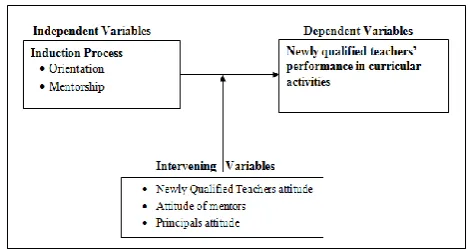
Conceptual framework: The conceptual framework
[image:4.595.316.554.492.617.2]postulates induction as a process that enables Newly Qualified Teacher to acquaint with and adapt to a new position and organizational environment. The induction process is participatory and a collective responsibility of the Principal, teacher mentors and mentees as shown in Figure 1.
Figure 1. A Conceptual Framework showing the influence of Induction on Newly Qualified Teachers performance in
Curricular Activities
However, if the attitude is negative the influence on NQTs performance declines. This is because there is no motivation.
MATERIALS AND METHODS
The study also adopted a descriptive survey research design. The study population consisted of 25 principals, 27 deputy principals, 25 senior teachers, 1 Sub-county Quality Assurance and Standards Officer, 1 Teacher Service Commission County Director and 60 NQTs posted by Teachers Service Commission. Saturated sampling technique was used to select 20 principals, 18 deputy principals, 15 senior teachers and 50
NQTs. Instruments of data collection used were
questionnaires, interview schedules and document analysis guide. Face and content validity of the instruments was determined by experts in Educational administration whose input was included. Pilot study was conducted in 5(20%) which were excluded from the main study. The reliability was tested using test-retest method and a Pearson’s r of 0.87 for NQTs, 0.75 for Principals and 0.87 for Deputy Principals’ questionnaires obtained, therefore reliable. Quantitative data was analyzed using mean, standard deviation and ANOVA while qualitative data was transcribed and organized in themes and sub themes.
RESULTS
The research question responded to was: What is the influence of induction on performance of newly qualified secondary school teacher in curricular activities? The response to this research question by newly qualified secondary school teachers is presented in Tables 1 - 4 which gives the mean ratings, standard deviation and one-way Analysis of variance. Table 1 shows that induction of newly qualified teachers in the department of Languages on the scheme of work precision highly influenced performance since the NQTs mean rating was 3.82. The principals mean rating was 4.20 and the deputy principals rating was 4.25. The means on testing differences using one-way ANOVA (F (2, 16) =0.540, p=0.593) showed no statistically significant difference. Equally, Table 1 showed that induction on newly qualified teachers in science department on precision of scheme of work highly influenced the performance to teach as indicated by the NQTs mean rating of 3.58.
The mean rating by the principals and deputy principals in the department were 3.40 and 3.40 respectively. These means showed no statistically significant difference amongst the categories of respondent as determined by one-way ANOVA (F (2, 36) =0.333, p=0.719). Similarly, in the department of humanities, the study on the newly qualified teachers, principals and deputy principals on the precision of scheme of work gave mean ratings of 4.07, 4.33 and 4.14 respectively in the humanities department as represented in the Table 1.The means were found not to be significant as demonstrated by the one-way ANOVA (F (2, 27) =0.289, p=0.751). The study finding in the departments signified the principals, the deputy principals and NQTs were in agreement that preparing a precise scheme of work highly influenced the NQTs performance to teach. In the Department of Languages, the induction of the newly qualified teachers on self-evaluation highly influenced the teaching of NQTs performance with a mean rating of 4.00. The principals and deputy principals mean ratings were 3.80 and 3.75. These rating were not statistically significantly different as illustrated by the one-way ANOVA
(F (2, 16) =0.049, p=0.952). In addition, the newly qualified teachers in science department indicate that self-evaluation before actual teaching highly influenced their performance during teaching as demonstrated by the mean rating of 3.62. The principals mean rating on self-evaluation was 3.50 while the deputy principals’ rating was 3.80. The means showed no significant difference as determined by one-way ANOVA (F (2, 36) =0.385, p=0.683). In addition, the newly qualified teachers in science department also indicate that self-evaluation before actual teaching highly influenced their performance during teaching as demonstrated by the mean rating of 3.62. The principals mean rating on self-evaluation was 3.50 while the deputy principals’ rating was 3.80. The means showed no significant difference as determined by one-way ANOVA (F (2, 36) =0.385, p=0.683). This implied that the principals, the deputy principals and the newly qualified teachers in the departments agreed that self-evaluation highly influenced NQTs performance to prepare teaching.
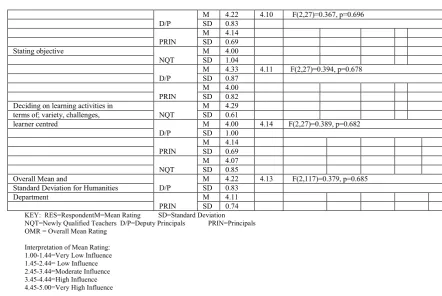
Table 1 indicates that induction highly influenced NQTs on stating clear objectives to be achieved in Languages Department with a mean rating of 3.90. The principals and deputy principals in the department rated the performance at 3.80 and 3.50. The one-way ANOVA (F (2, 16) =0.166, p=0.849) output inferred no significant difference. In the department of Science, induction of newly qualified teachers on stating objectives highly influenced the NQTs performance with mean rating of 3.77. The principals and deputy principals rated the NQTs performance on stating objectives at 3.88 and 4.20 respectively. The one-way ANOVA (F (2, 36) =0.413, p=0.665) showed no statistically significant difference in the mean rating. This was further confirmed by the NQTs in the Humanities department who also agreed that induction highly influenced NQTs abilities on stating clear objectives at a mean rating of 4.00. The principals and deputy principals in the department rated the performance of NQTs at 4.00 and 4.33, and the one-way ANOVA result (F (2, 27) =0.394, p=0.678) showed no significant difference. This meant that the newly qualified teachers, principals and deputy principals’ were in agreement that induction highly influenced NQTs on stating objectives.
Furthermore, the Table 1 shows that induction had highly influenced the NQTs decisions on learning activities with a mean rating of 3.50 in the Languages department. The principals and deputy principals in the department had a mean rating of 3.40 and 3.25 respectively. These ratings on one-way ANOVA (F (2, 16) =0.101, p=0.905) showed no statistically significant difference amongst the categories of teachers. Equally, induction highly influenced the performance of NQTs in the Department of Science, on identifying learning activities based on variety, challenges and learner-centeredness with a mean rating of 3.69. The principals and deputy principals’ mean ratings were 3.88 and 3.60 respectively. The one-way ANOVA result showed that the mean ratings for the categories were not significantly different (F (2, 36) =0.185, p=0.832). Similarly, induction highly influenced newly qualified teachers on deciding learning activities based on variety, challenges and learner centredness, in the Humanities Department, with a mean rating of 4.29. The principals and deputy principals mean rating were 4.14 and 4.00. The one-way ANOVA (F (2, 27) =0.389, p=0.682) signified that there was no significant difference in the ratings. Thus, the principals, the deputy principals and NQTs had the same view that induction highly
teaching/learning based on variety, challenges and learner centredness. In general, Table 1 shows that the overall mean rating in the Languages department were; NQTs =3.78, principals =3.80 and deputy principals =3.69. The one-way ANOVA (F (2, 73) =0.100, p= 0.905) indicated no statistically significant difference amongst the mean ratings. Similarly, the overall mean ratings of the elements of preparing to teach were; newly qualified teachers =3.66, principals =3.75 and deputy principals =3.75 in the Science department. The one-way ANOVA (F (2, 153) =0.201, p=0.818) showed that induction highly influenced the NQTs preparation to teach since the ANOVA result were not statistically significantly different. Equally, in the Humanities department, the overall mean rating for the stated elements of preparing to teach were; NQTs =4.07, principals =4.11 and deputy principals =4.22. The one-way ANOVA result (F (2, 117) =0.379, p=0.685) infer no significant difference.
Table 2 responds to the question on the influence of induction on performance of NQTs lesson presentation in curricular activities and gives the mean, standard deviation and ANOVA results for the Languages, Sciences and Humanities Departments.
Table 2 shows that induction of newly qualified secondary school teachers in the department of Languages on the use of learners’ experiences highly influenced the NQTs teaching performance with a mean rating of 3.90. The principals and deputy principals mean ratings were 4.20 and 4.25 respectively. The means on analyzing differences using one-way ANOVA (F (2, 16) =0.320, p=0.731) showed no statistically significant difference. Also, Table 2 indicate that induction of newly qualified teachers in the department of science on the use of learners’ experience highly influenced the NQTs performance to teach with a mean of 3.92 while the principals and deputy principals rating were 4.25 and 4.20 respectively. The one-way ANOVA (F (2, 36) =0.464, p=0.633) result showed no statistically significant difference. Equally, in the department of humanities, the use of learners’ experience was observed to highly influence the performance of newly qualified secondary school teachers with a mean of 3.86. The principals and deputy principals rated the use of learners’ experience at 3.71 and 3.89 respectively. The one-way ANOVA (F (2, 27) =0.101, p=0.904) revealed no significant difference. The results implied principals, deputy principals and NQTs were in agreement that induction of newly qualified teachers on the use of learners experience highly influenced the performance of NQTs on lesson presentation.
In the department of Languages, the induction of newly qualified teachers on logical presentation of lessons highly influenced the teaching performance of NQTs with a mean rating of 4.10. The principals and deputy principals rated the influence of logical presentation of lesson at 4.20 and 4.25 respectively. The one-way ANOVA output (F (2, 16) =0.049, p=0.952) was not statistically significantly difference. In addition, the newly qualified teachers in science department indicate that logical presentation of lesson highly influenced their teaching performance with a rating of 3.45. The principals and deputy principals rated at 3.88 and 3.60 respectively. The means showed no significant difference as illustrated by the one-way ANOVA (F (2, 36) =0.446, p=0.644). Equally, in the humanities department, induction on logical presentation highly influenced NQTs performance with a rating of 3.79.
The rating for the principals was 3.71 while that for the deputy principals was 3.78. These means ratings showed no significant difference on one-way ANOVA (F (2, 27) =0.018, p=0.982). This signified that the principals, deputy principals and NQTs agreed that logical presentation of lesson highly influenced the understanding of learners hence their performance in curricular activities. Table 2 indicates that induction of newly qualified teachers of secondary schools on the relevance of content to lesson time highly influenced the performance of NQTs in Languages department with a mean rating of 3.70. The principals and deputy principals in the department rated the level of influence at 3.60 and 3.50. The one-way ANOVA (F (2, 16) =0.068, p=0.935) inferred no significant difference. In the department of science, induction on relevance of content to lesson time highly influenced the focus of the NQTs classroom presentation with a rating of 3.92. The principals rated the influence of induction on relevance of content to lesson time at 3.88 while the deputy principals rated at 4.00. The analysis using one-way ANOVA (F (2, 36) =0.025, p=0.975) revealed no significant difference amongst the categories of respondents in the department of Science. The newly qualified teachers in the humanities department also confirmed that induction on the relevance of content to lesson time highly influenced their performance on classroom lesson presentation with mean rating of 4.00. The principals rated at 4.29 and deputy principals at 4.11. The analysis of the differences among the mean rating using one-way ANOVA (F (2, 27) =0.361, p=0.700) showed no statistically significant difference. This meant that the NQTs, principals and deputy principals’ concurred that induction on relevance of content to lesson time highly influenced the learners’ attention and reflection on the study.
Table 2 shows that induction highly influenced the newly qualified secondary teachers on the importance of adequacy of content to lesson time with a rating of 4.00. The principals and deputy principals rated the level of influence of induction on adequacy of content to lesson time at 4.20 and 4.00 respectively. One-way ANOVA (F (2, 16) =0.134, p=0.876) signified no difference. Also, Table 2 indicates that induction of newly qualified teachers on adequacy of content to lesson time highly influenced performance on lesson presentation at 4.12. On the other hand, the principals and deputy principals in science department rated the influence at 4.38 and 4.40. The one-way ANOVA (F (2, 36) =0.409, p=0.667) showed no significant difference. In the humanities department, the mean rating for the influence of induction on adequacy of content to lesson time were; NQTs=3.64, principals=3.86 and deputy principals=3.78. The one-way ANOVA output (F (2, 27) =0.237, p=0.790) inferred no statistically significant difference. These findings meant that the principals and deputy principals had the same opinion that induction of newly qualified secondary school teachers on the adequacy of content to lesson time had high influence on the NQTs performance. Furthermore, induction of newly qualified teachers in the department of Languages on choosing strategies and methods appropriate to content highly influenced performance NQTs with a mean rating of 3.50. The principals mean rating was 3.80 and the deputy principals rating was 3.75. The differences on the mean ratings using one-way ANOVA (F (2, 16) =0.246, p=0.785) showed no statistically significant difference. Also, Table 8 showed that induction on newly qualified teachers in
science department on the strategies and methods
Table 1. Perspectives on influence of Induction on Newly Qualified Teachers Performance on preparation to Teach
Aspects of Preparing
to teach RES M & SD OMR ANOVA OUTPUT
LANGUAGES
Scheme of work precision
NQT
M 4.00 SD 0.00
D/P
M 4.25 4.15 F(2,16)=0.540, p=0.593 SD 0.50
PRIN
M 4.20 SD 0.84 Self-evaluation
NQT
M 3.90 SD 0.74
D/P
M 3.75 3.82 F(2,16)=0.049, p=0.952 SD 0.96
PRIN
M 3.80 SD 1.10 Stating objective
NQT
M 3.70 SD 0.48
D/P
M 3.50 3.67 F(2,16)=0.166, p=0.849 SD 1.29
PRIN
M 3.80 SD 0.84 Deciding on learning activities in
NQT
M 3.50
terms of; variety, challenges, SD 0.54
learner centred
D/P
M 3.25 3.38 F(2,16)=0.101, p=0.905 SD 1.50
PRIN
M 3.40 SD 1.14
NQT
M 3.78 SD 0.53 Overall Mean and
D/P
M 3.69 3.76 F(2,73)=0.100, p=0.905
Standard Deviation for Languages SD 1.08
PRIN
M 3.80
SD 0.95
SCIENCES
Scheme of work precision
NQT
M 3.58 SD 0.58
D/P
M 3.40 3.46 F(2,36)=0.333, p=0.719 SD 0.89
PRIN
M 3.40 SD 0.89 Self-evaluation
NQT
M 3.62 SD 0.50
D/P
M 3.80 3.64 F(2,36)=0.385, p=0.683 SD 0.45
PRIN
M 3.50 SD 0.93 Stating objective
NQT
M 3.77 SD 1.03
D/P
M 4.20 3.95 F(2,36)=0.413, p=0.665 SD 0.84
PRIN
M 3.88 SD 0.84 Deciding on learning activities in
NQT
M 3.69
terms of; variety, challenges, SD 0.97
learner centred
D/P
M 3.60 3.72 F(2,36)=0.185, p=0.832 SD 0.55
PRIN
M 3.88 SD 0.64
NQT
M 3.66 SD 0.80 Overall Mean and
D/P
M 3.75 3.72 F(2,153)=0.201, p=0.818
Standard Deviation for Sciences SD 0.72
PRIN
M 3.75
SD 0.88
HUMANITIES
Scheme of work precision
NQT
M 4.07
SD 0.83
D/P
M 4.33 4.18 F(2,27)=0.289, p=0.751
SD 0.71
PRIN
M 4.14
SD 0.90
Self evaluation
NQT
M 3.93
SD 0.92
D/P
M 4.22 4.10 F(2,27)=0.367, p=0.696
SD 0.83
PRIN
M 4.14
SD 0.69
Stating objective
NQT
M 4.00
SD 1.04
D/P
M 4.33 4.11 F(2,27)=0.394, p=0.678
SD 0.87
PRIN
M 4.00
SD 0.82
Deciding on learning activities in
NQT
M 4.29
terms of; variety, challenges, SD 0.61
learner centred
D/P
M 4.00 4.14 F(2,27)=0.389, p=0.682
SD 1.00
PRIN
M 4.14
SD 0.69
NQT
M 4.07
SD 0.85
Overall Mean and
D/P
M 4.22 4.13 F(2,117)=0.379, p=0.685
Standard Deviation for Humanities SD 0.83
Department
PRIN
M 4.11
SD 0.74
KEY: RES=RespondentM=Mean Rating SD=Standard Deviation NQT=Newly Qualified Teachers D/P=Deputy Principals PRIN=Principals OMR = Overall Mean Rating
Interpretation of Mean Rating:
1.00-1.44=Very Low Influence 1.45-2.44= Low Influence
[image:8.595.70.513.45.341.2]2.45-3.44=Moderate Influence 3.45-4.44=High Influence 4.45-5.00=Very High Influence
Table 2. Perspectives on influence of Induction on Newly Qualified Teachers Performance on Lesson Presentation
Aspects of
Presentation RES M&SD OMR ANOVA OUTPUT
LANGUAGES
NQT
M 3.90
SD 0.88
Use learners experience
D/P
M 4.25 4.12 F(2,16)=0.320, p=0.0.731
SD 0.96
PRIN
M 4.20
SD 0.84
Logical presentation
NQT
M 4.10
SD 0.88
D/P
M 4.25 4.18 F(2,16)=0.049, p=0.952
SD 0.96
PRIN
M 4.20
SD 0.84
NQT
M 3.70
SD 0.95
Relevance of content
D/P
M 3.50 3.60 F(2,16)=0.068, p=0.935
to lesson time SD 1.29
PRIN
M 3.60
SD 0.55
NQT
M 4.00
SD 0.82
Adequacy of content
D/P
M 4.00 4.70 F(2,16)=0.134, p=0.876
to lesson time SD 0.82
PRIN
M 4.20
SD 0.45
NQT
M 3.50
Strategies and methods SD 0.97
appropriateness to content
D/P
M 3.75 3.68 F(2,16)=0.246, p=0.785
SD 0.50
PRIN
M 3.80
SD 0.86
NQT
M 3.80
Use of teaching skills in terms SD 0.63
of motivation, reinforcement,
D/P
M 3.75 3.78 F(2,16)=0.007, p=0.993
questioning and stimulus SD 0.96
Variation
PRIN
M 3.80
SD 0.84
NQT
M 4.10
SD 0.74
Mastery of content
D/P
M 4.25 4.18 F(2,16)=0.095, p=0.910
SD 0.50
PRIN
M 4.20
SD 0.45
NQT
M 4.50
SD 0.53 Verbal in terms of; fluency,
D/P
M 4.75 4.62 F(2,16)=0.326, p=0.726
voice projection SD 0.50
PRIN
M 4.60
SD 0.55
NQT
M 4.00
SD 0.00 Non verbal in terms of;
D/P
M 4.25 4.02 F(2,16)=0.477, p=0.629
gestures, eye contact, body SD 1.50
Movement
PRIN
M 3.80
SD 0.45
NQT
M 4.20
SD 0.63 Use of chalkboard in terms of;
D/P
M 4.25 4.28 F(2,16)=0.079, p=0.924
layout, innovativeness and SD 1.50
Creativity
PRIN
M 4.40
SD 0.89
NQT
M 4.00
SD 0.94 Class control and management
D/P
M 4.50 4.23 F(2,16)=0.492, p=0.602 in terms of; knowledge, learner SD 1.00
participation, group work etc
PRIN
M 4.20
SD 0.45
NQT
M 3.98
SD 0.78 Overall Mean and
D/P
M 4.14 4.07 F(2,206)=0.732, p=0.482
Standard Deviation SD 0.96
PRIN
M 4.09
SD 0.67
SCIENCES
NQT
M 3.92
SD 0.98
Use learners experience
D/P
M 4.20 4.12 F(2,36)=0.464, p=0.633
SD 0.84
PRIN
M 4.25
SD 0.89
NQT
M 3.46
SD 1.07
Logical presentation
D/P
M 3.60 3.65 F(2,36)=0.446, p=0.644
SD 0.89
PRIN
M 3.88
SD 1.25
NQT
M 3.92
SD 0.98
Relevance of content
D/P
M 4.00 3.93 F(2,36)=0.025, p=0.0.975
to lesson time SD 0.71
PRIN
M 3.88
SD 1.13
NQT
M 4.12
SD 0.95
Adequacy of content
D/P
M 4.40 4.30 F(2,36)=0.409, p=0.667
to lesson time SD 0.55
PRIN
M 4.38
SD 0.74
NQT
M 3.92
Strategies and methods SD 1.13
appropriateness to content
D/P
M 3.60 3.76 F(2,36)=0.236, p=0.791
SD 0.55
PRIN M 3.75
SD 1.04
NQTs
M 3.92
Use of teaching skills in terms SD 0.94
of motivation, reinforcement,
D/P
M 3.80 3.91 F(2,36)=0.077, p=0.926
questioning and stimulus SD 0.84
Variation
PRINC
M 4.00
SD 0.76
NQT
M 3.69
SD 1.01
Mastery of content
D/P
M 4.00 3.81 F(2,36)=0.166, p=0.848
SD 1.73
PRIN
M 3.75
SD 0.89
NQT
M 3.50
SD 0.65
Verbal in terms of; fluency,
D/P
M 3.20 3.36 F(2,36)=0.353, p=0.705
voice projection SD 1.30
PRIN
M 3.38
SD 0.74
NQT
M 4.08
SD 1.06
Non verbal in terms of;
D/P
M 4.20 4.14 F(2,36)=0.037, p=0.964
gestures, eye contact, body SD 0.45
Movement
PRIN
M 4.13
SD 0.84
NQT
M 3.96
SD 0.66
Use of chalkboard in terms of;
D/P
M 4.00 4.03 F(2,36)=0.123, p=0.884
layout, innovativeness and SD 1.41
Creativity
PRIN
M 4.13
SD 0.84
NQT
M 3.42
SD 0.86
Class control and management
D/P
M 3.60 3.42 F(2,36)=0.259, p=0.773
in terms of; knowledge, learner SD 0.55
participation, group work
PRIN
M 3.25
SD 1.04
NQTs
M 3.81
SD 0.96
Overall Mean and
D/P
M 3.87 3.86 F(2,426)=0.260, p=0.771
Standard Deviation SD 0.94
PRIN
M 3.89
SD 0.94
HUMANITIES
NQT
M 3.86
SD 0.86
Use learners experience
D/P
M 3.89 3.82 F(2,27)=0.101, p=0.904
SD 0.93
PRIN
M 3.71
SD 0.49
NQT
M 3.79
SD 0.80
Logical presentation
D/P
M 3.78 3.76 F(2,27)=0.018, p=0.982
SD 0.97
PRIN
M 3.71
SD 0.76
NQT
M 4.00
SD 0.68
Relevance of content
D/P
M 4.11 4.13 F(2,27)=0.361, p=0.700
to lesson time SD 0.93
PRIN
M 4.29
SD 0.49
NQT
M 3.64
SD 0.63
Adequacy of content
D/P
M 3.78 3.76 F(2,27)=0.237, p=0.790
to lesson time SD 0.83
PRIN
M 3.86
SD 0.69
NQT
M 4.07
Strategies and methods SD 0.92
appropriateness to content
D/P
M 4.33 4.23 F(2,27)=0.326, p=0.725
SD 0.71
PRIN
M 4.29
SD 0.76
NQT
M 3.79
Use of teaching skills in terms SD 0.69
The mean rating by the principals and deputy principals in the department were 3.75 and 3.60 respectively. These means showed no statistically significant difference amongst the categories of respondent as determined by one-way ANOVA (F (2, 36) =0.236, p=0.791). Similarly, the study on the newly qualified teachers, principals and deputy principals on the choice of strategies and methods appropriate to content of the lesson gave mean ratings of 4.07, 4.29 and 4.33 respectively in the humanities department as represented in the Table 9.The means were found not to be significantly difference as demonstrated by the one-way ANOVA (F (2, 27) =0.326, p=0.725). Consequently, the study findings in the departments signified that the principals, the deputy principals and NQTs were in agreement that appropriate choice of strategies and methods to content highly influenced the performance to teach. Moreover, in the department of Languages, the induction of the newly qualified teachers on the use of teaching skills in terms of motivation, reinforcement, questioning and stimulus variation highly influenced their ability to teach with a mean rating of 3.80.
The principals and deputy principals mean ratings were 3.80 and 3.75. These rating were not statistically significantly difference as illustrated by the one-way ANOVA (F (2, 16) =0.007, p=0.993). In addition, the newly qualified teachers in science department indicate that use of teaching skills in terms of motivation, reinforcement and stimulus variation highly influenced the performance of NQTs during teaching as demonstrated by the mean rating of 3.92. The principals mean rating on use of teaching skills was 4.00 while the deputy principals’ rating was 3.80. The means showed no significant difference as determined by one-way ANOVA (F (2, 36) =0.077, p=0.926). Equally, in the humanities department, the mean rating were; newly qualified teachers =3.79, principals =4.00 and deputy principals =3.78. The one-way ANOVA (F (2, 27) =0.191, p=0.827) indicate that there was no significant difference. This implied that the principals and the deputy principals concurred with newly qualified teachers in the departments that use of teaching skills in terms of motivation, reinforcement, questioning and stimulus variation highly influenced performance during teaching.
of motivation, reinforcement,
D/P
M 3.78 3.86 F(2,27)=0.191, p=0.827
questioning and stimulus SD 0.83
Variation
PRIN
M 4.00
SD 1.00
NQT
M 4.14
SD 0.36
Mastery of content
D/P
M 4.11 4.18 F(2,27)=0.227, p=0.799
SD 0.78
PRIN
M 4.29
SD 0.49
NQT
M 3.93
SD 0.73
Verbal in terms of; fluency,
D/P
M 4.00 3.88 F(2,27)=0.322, p=0.727
voice projection SD 0.71
PRIN
M 3.71
SD 0.76
NQT
M 3.79
SD 0.96
Non verbal in terms of;
D/P
M 4.00 3.98 F(2,27)=0.415, p=0.664
gestures, eye contact, body SD 0.87
Movement
PRIN
M 4.14
SD 0.69
NQT
M 4.00
SD 0.78
Use of chalkboard in terms of;
D/P
M 4.00 4.10 F(2,27)=0.252, p=0.779
layout, innovativeness and SD 1.12
Creativity
PRIN
M 4.29
SD 0.95
NQT
M 3.86
SD 0.77
Class control and management
D/P
M 3.89 3.92 F(2,27)=0.058, p=0.944 in terms of; knowledge, learner SD 1.17
participation, group work etc
PRIN
M 4.00
SD 0.82
NQT
M 3.90
SD 0.75
Overall Mean and
D/P
M 3.97 3.97 F(2,327)=0.755, p=0.471
Standard Deviation SD 0.87
PRIN
M 4.03
SD 0.73
KEY: RES=Respondent M=Mean Rating SD=Standard Deviation NQT=Newly Qualified Teachers D/P=Deputy Principals PRIN=Principals OMR = Overall Mean Rating Interpretation of Mean Rating:
1.00-1.44=Very Low Influence 1.45-2.44=Low Influence
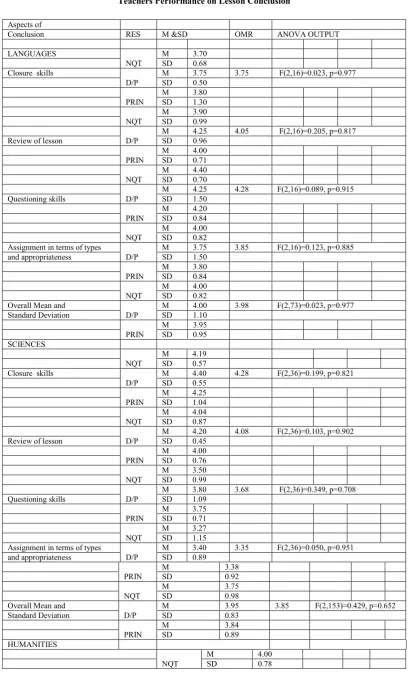
Table 3. Perspectives on influence of Induction on Newly Qualified Teachers Performance on Lesson Conclusion
Aspects of
Conclusion RES M &SD OMR ANOVA OUTPUT
LANGUAGES
NQT
M 3.70 SD 0.68 Closure skills
D/P
M 3.75 3.75 F(2,16)=0.023, p=0.977 SD 0.50
PRIN
M 3.80 SD 1.30
NQT
M 3.90 SD 0.99
D/P
M 4.25 4.05 F(2,16)=0.205, p=0.817
Review of lesson SD 0.96
PRIN
M 4.00 SD 0.71
NQT
M 4.40 SD 0.70
D/P
M 4.25 4.28 F(2,16)=0.089, p=0.915
Questioning skills SD 1.50
PRIN
M 4.20 SD 0.84
NQT
M 4.00 SD 0.82 Assignment in terms of types
D/P
M 3.75 3.85 F(2,16)=0.123, p=0.885
and appropriateness SD 1.50
PRIN
M 3.80 SD 0.84
NQT
M 4.00 SD 0.82 Overall Mean and
D/P
M 4.00 3.98 F(2,73)=0.023, p=0.977
Standard Deviation SD 1.10
PRIN
M 3.95 SD 0.95 SCIENCES
NQT
M 4.19 SD 0.57 Closure skills
D/P
M 4.40 4.28 F(2,36)=0.199, p=0.821 SD 0.55
PRIN
M 4.25 SD 1.04
NQT
M 4.04 SD 0.87
D/P
M 4.20 4.08 F(2,36)=0.103, p=0.902
Review of lesson SD 0.45
PRIN
M 4.00 SD 0.76
NQT
M 3.50 SD 0.99
D/P
M 3.80 3.68 F(2,36)=0.349, p=0.708
Questioning skills SD 1.09
PRIN
M 3.75 SD 0.71
NQT
M 3.27 SD 1.15 Assignment in terms of types
D/P
M 3.40 3.35 F(2,36)=0.050, p=0.951
and appropriateness SD 0.89
PRIN
M 3.38
SD 0.92
NQT
M 3.75
SD 0.98
Overall Mean and
D/P
M 3.95 3.85 F(2,153)=0.429, p=0.652
Standard Deviation SD 0.83
PRIN
M 3.84
SD 0.89
HUMANITIES
NQT
M 4.00
SD 0.78
Closure skills
D/P
M 4.22 4.07 F(2,27)=0.239, p=0.789
SD 0.83
PRIN
M 4.00
SD 0.82
NQT
M 3.71
SD 0.47
D/P
M 3.78 3.83 F(2,27)=0.502, p=0.611
Review of lesson SD 0.83
PRIN
M 4.00
SD 0.58
NQT
M 4.07
SD 0.48
D/P
M 4.22 4.14 F(2,27)=0.149, p=0.862
Questioning skills SD 0.83
PRIN
M 4.14
SD 0.69
NQT
M 3.79
SD 1.05
Assignment in terms of types
D/P
M 3.67 3.72 F(2,27)=0.037, p=0.964
and appropriateness SD 1.23
PRIN
M 3.71
SD 0.76
NQT
M 3.89
SD 0.73
Overall Mean and
D/P
M 3.97 3.94 F(2,117)=0.138, p=0.871
Standard Deviation SD 0.94
PRIN
M 3.96
SD 0.69
KEY: RES=Respondent Category M=Mean Rating
SD=Standard Deviation
NQT=Newly Qualified Teachers D/P=Deputy Principals
PRIN=Principals OMR = Overall Mean Rating
Interpretation of Mean Rating:
1.00-1.44=Very Low Influence 1.45-2.44=Low Influence
[image:13.595.49.533.57.333.2]2.45-3.44=Moderate Influence 3.45-4.44=High Influence 4.45-5.00=Very High Influence
Table 4. Perspectives on influence of Induction on Newly Qualified Teachers Performance on Personality and Organization
Teacher Personality
and Organization RES M & SD OMR ANOVA output
LANGUAGES
NQT
M 4.70
SD 0.48
Confidence
D/P
M 4.50 4.60 F(2,16)=0.154, p=0.859
SD 1.00
PRIN
M 4.60
SD 0.55
NQT
M 3.70
SD 0.68
Dress code
D/P
M 3.75 3.68 F(2,16)=0.044, p=0.957
SD 0.50
PRIN
M 3.60
SD 1.14
NQT
M 4.20
SD 0.63
D/P
M 4.25 4.15 F(2,16)=0.169, p=0.846
Mannerism SD 0.96
PRIN
M 4.00
SD 0.71
NQT
M 4.20
SD 0.42
Maintenance of records
D/P
M 4.00 4.13 F(2,16)=0.158, p=0.855
SD 1.16
PRIN
M 4.20
SD 0.45
NQT
M 3.30
SD 0.48
Handling of challenges
D/P
M 3.25 3.32 F(2,16)=0.073, p=0.930
SD 0.96
PRIN
M 3.40
SD 0.55
NQT
M 4.02
SD 0.72
Overall Mean and
D/P
M 3.95 3.98 F(2,92)=0.080, p=0.923
Standard Deviation SD 0.95
PRIN
M 3.96
SD 0.79
SCIENCES
NQT
M 3.77
SD 0.43
Confidence
D/P
M 3.80 3.73 F(2,36)=0.123, p=0.885
SD 0.84
PRIN
M 3.63
SD 1.41
NQT
M 3.27
SD 0.72
Dress code
D/P
M 3.40 3.31 F(2,36)=0.068, p=0.0.935
SD 1.14
PRIN
M 3.25
SD 0.71
NQT
M 2.92
SD 1.06
D/P
M 3.20 3.12 F(2,36)=0.354, p=0.704
Mannerism SD 1.30
PRIN
M 3.25
SD 1.04
NQT
M 3.08
SD 1.16
Maintenance of records D/P
M 3.40 3.16 F(2,36)=0.178, p=0.838
SD 1.82
PRIN
M 3.00
SD 1.07
NQT
M 3.92
SD 0.94
Handling of challenges
D/P
M 4.20 4.12 F(2,36)=0.530, p=0.593
SD 0.84
PRIN
M 4.25
SD 0.71
NQTs
M 3.39
SD 0.97
Overall Mean and
D/P
M 3.60 3.49 F(2,192)=0.474, p=0.624
Standard Deviation SD 1.19
PRIN
M 3.48
SD 1.06
HUMANITIES
NQT
M 3.29
SD 0.73
Confidence
D/P
M 3.33 3.25 F(2,27)=0.116, p=0.891
SD 1.00
PRIN
M 3.14
SD 0.69
NQT
M 3.93
SD 0.73
Dress code
D/P
M 4.11 4.06 F(2,27)=0.236, p=0.791
SD 0.78
PRIN
M 4.14
SD 0.90
NQT
M 3.29
SD 0.99
D/P
M 3.33 3.25 F(2,27)=0.080, p=0.923
Mannerism SD 1.00
PRIN
M 3.14
SD 0.90
SD 0.86
Maintenance of records D/P
M 4.11 3.99 F(2,27)=0.264, p=0.770
SD 0.78
PRIN
M 4.00
SD 0.82
NQT
M 4.00
SD 0.96
Handling of challenges
D/P
M 4.11 4.08 F(2,27)=0.069, p=0.934
SD 0.93
PRIN
M 4.14
SD 0.90
NQT
M 3.67
SD 0.89
Overall Mean and
D/P
M 3.80 3.73 F(2,147)=0.270, p=0.764
Standard Deviation SD 0.94
PRIN
M 3.71
SD 0.93
KEY: RES=Respondent Category M=Mean Rating
SD=Standard Deviation
NQTs =Newly Qualified Teachers
D/P=Deputy Principals PRIN=Principals
OMR = Overall Mean Rating
Interpretation of Mean Rating:
Induction of NQTs on mastery of content highly influenced the performance of the teachers in Languages department with the rating of 4.10. The principals and deputy principals in the department rated at 4.20 and 4.25. The one-way ANOVA (F (2, 16) =0.095, p=0.910) output inferred no significant difference. In the department of Science, induction of newly qualified teachers on mastery of content highly influenced the teaching performance with mean rating of 3.69. The principals and deputy principals rated mastery of content at 3.75 and 4.00 respectively. The one-way ANOVA (F (2, 36) =0.0.166, p=0.848) showed no statistically significant difference in the mean rating. This was further confirmed by the NQTs in the Humanities department who also agreed that induction on the mastery of content highly influenced the ability to deliver in teachings at a mean rating of 4.14. The principals and deputy principals in the department rated the element at 4.29 and 4.11, and the one-way ANOVA result (F (2, 27) =0.227, p=0.799) showed no significant difference. This meant that the newly qualified teachers, principals and deputy principals’ were in agreement that mastery of content highly influenced teaching in the classroom.
In addition, Table 2 shows that induction has highly influenced the NQTs on verbal presentation in terms of fluency and voice projection with a mean rating of 4.50 in the Languages Department. The principals and deputy principals in the department gave a mean rating of 4.60 and 4.75. These ratings on one-way ANOVA (F (2, 16) =0.326, p=0.726) revealed that there was no statistically significant difference amongst the categories of teachers. Equally, the induction of newly qualified secondary school teachers in the department of science on fluency and voice projection highly influenced their performance to teach as indicated by the mean rating of 3.50. The principals and deputy principals’ mean rating were 3.38 and 3.20 respectively. The one-way ANOVA result showed that the mean ratings for the categories were not significantly different (F (2, 36) =0.353, p=0.705). Similarly induction of newly qualified teachers on fluency and voice projection highly influenced the performance in the Humanities with mean rating of 3.79. The principals and deputy principals mean rating were 3.71 and 4.00. The one-way ANOVA (F (2, 27) =0.322, p=0.727) signified that there was no significant difference in the ratings. Thus the principals and the deputy principals had the same view as the NQTs that induction of newly qualified teachers on fluency and voice projection highly influenced the performance to teach.
In the department of Languages, the induction of the newly qualified teachers on non- verbal cues highly influenced the NQTs performance with a mean rating of 4.00. The principals and deputy principals mean ratings were 3.80 and 4.25. These rating were not statistically significantly difference as illustrated by the one-way ANOVA (F (2, 16) =0.477, p=0.629). In addition, the newly qualified teachers in science department indicate that non-verbal cues such as gestures, eye contact and body movement highly influenced the performance during teaching as demonstrated by the mean rating of 4.08. The principals mean rating on non-verbal cues was 4.13 while the deputy principals’ rating was 4.20. The means showed no significant difference as determined by one-way ANOVA (F (2, 36) =0.037, p=0.964). Equally, in the humanities department, the mean rating were as follows; newly qualified teachers =3.79, principals =4.14 and deputy principals =4.00. The one-way ANOVA (F (2, 27) =0.415, p=0.664) indicate that there was no significant difference. This implied that the
principals and the deputy principals concurred with newly qualified teachers in the departments that use of non-verbal cues highly influenced performance during teaching.
Table 2 indicates that induction of NQTs on use of chalkboard in terms of layout, innovativeness and creativity highly influenced the performance of the teachers in Languages department with the rating of 4.20. The principals and deputy principals in the department rated at 4.40 and 4.25. The one-way ANOVA (F (2, 16) =0.079, p=0.924) output inferred no significant difference. In the department of Science, induction of newly qualified teachers on the use of chalkboard highly influenced the teaching performance with mean rating of 3.96. The principals and deputy principals rated the influence on the element at 4.13 and 4.00 respectively. The one-way ANOVA (F (2, 36) =0.123, p=0.884) showed no statistically significant difference in the mean rating. This was further confirmed by the NQTs in the Humanities department who also agreed that induction on the use of chalkboard layout, innovativeness and creativity highly influenced the understanding of learners at a mean rating of 4.00. The principals and deputy principals in the department rated the element at 4.29 and 4.00 respectively. The one-way ANOVA result (F (2, 27) =0.252, p=0.779) showed no significant difference. This meant that the newly qualified teachers, principals and deputy principals’ were in agreement that good use of chalkboard highly influenced teaching in the classroom.