Master Thesis (10 EC)
“It is profoundly positive to be grateful every day, it gives me the feeling of being worthwhile to others.”
Exploring the Social Component in Reports on
Gratitude Exercises
September 2018
Hannah Jung
Department of Positive Psychology and Technology (PPT)
Supervisors Nadine Köhle, Dr.
Marileen Kouijzer, MSc.
Faculty of Behavioral,
Management and Social Sciences
Abstract
Background. Gratitude exercises are found not only to enhance well-being, but also seem to contain a social component which may be conceptualised as prosociality. To supplement existing research, the current study investigated areas of life that gratitude can be directed at and subjectively perceived influences of gratitude exercises. Additionally, it explored the role of the proposed social component within gratitude exercises by investigating prosocial
remarks in reflections on these exercises. Since well-being, gratitude and prosociality seem to be connected, the relationships of these concepts was studied as well.
Methods. A content analysis was conducted on data from online diaries of 32 participants of the general Dutch population. These online diaries contained reflections on six different weekly gratitude exercises and gratitude lists of aspects and events participants reported gratitude for. Additionally, a correlational analysis was executed on the gratitude reports and measures of well-being and prosociality.
Results. Participants directed their gratitude most frequently at interpersonal areas of life, such as social activities, while also indicating gratitude for non-social areas. Additionally, they mainly ascribed positive influences to the gratitude exercises, including uplifted feelings and positive intrapersonal changes, such as increasing gratitude. Of the three discovered prosocial remarks, positive relational appraisals were reported most frequently, while indications of a prosocial attitude and of direct expression of gratitude were reported less frequent. Whereas prosociality did not increase during the intervention, increased well-being was related to reports on general mindfulness, but not to other reports on gratitude exercises.
Discussion. The current study emphasised the value of a social component within gratitude exercises, reflected by reported interpersonal areas of gratitude and prosocial remarks. However, the frequency of prosocial remarks remained relatively low compared to the intrapersonal perceived influences of gratitude exercises, which were also strikingly positive. Limitations and recommendations for future research regard under more the finding that well-being was unrelated to most gratitude reports, the relatively low report rate of prosocial remarks and the measurement of prosociality. This study highlights the special potential of interpersonal relations to create grateful experiences and suggests that future research continues to explore the role of prosociality as social component within gratitude exercises.
Introduction Well-being
The notion that mental health involves both, the absence of psychopathology as well as the presence of well-being (World Health Organization [WHO], 2004) has been widely accepted. In fact, the World Health Organization describes mental health as “a state of well-being in which the individual realizes his or her own abilities, can cope with the normal stresses of life, can work productively and fruitfully, and is able to make a contribution to his or her community“ (WHO, 2004, p. 59). Well-being can be subdivided into three components, which are emotional, psychological and social well-being (WHO, 2004; Keyes, 2005).
Emotional well-being is determined by a person’s individual balance between positive and negative affect and expresses the person’s overall life satisfaction (Lambert, Passmore, & Holder, 2015). Psychological well-being includes six dimensions (autonomy, environmental mastery, personal growth, positive relationships, purpose in life and self-affection) which involve an aspect of functioning relating to the private life, while social well-being refers to a person’s functioning in social life (Lambert, et al., 2015). The latter therefore includes the quality of relationships with others and the connectedness with the community and holds five dimensions (acceptation, actualization, coherence, contribution, integration; Lambert, et al., 2015). Profound manifestation of all three components of well-being indicate that an
individual is in a state of high well-being and optimal functioning (Keyes, 2002). In this state, individuals experience personal growth and meaning in life, can manage challenging and stressful life situations and are highly productive (Keyes, 2002). Thereby, high well-being can function as a buffer against the development of psychopathology (Fredrickson & Losada, 2005; Lamers, 2012). This evidence indicates that it is desirable for society to ensure a high level of well-being. However, it is found that within the Dutch population merely 36.5% of people experiences such high well-being (Schotanus-Dijkstra, et al., 2016). Since the absence of psychopathology does not necessarily predicted the presence of well-being (Keyes, 2005), the question arises how the percentage of people with a high level of well-being can be increased. This question lies at the core of positive psychology, a research field that is subject of discussion in the following section.
Positive Psychology
component of mental health. This constitutes a balancing counterpart to the clinical focus on reducing or eliminating psychopathology and negative qualities (Bohlmeijer, et al., 2013; Seligman & Csikszentmihalyi, 2000). In promoting high levels of well-being, positive psychology is of value not only to individuals with an indication for psychopathology but for all people with low to moderate levels of well-being (Bohlmeijer, et al., 2013).
By enhancing well-being, interventions within the field of positive psychology facilitate mental health and functioning. They not only hold a curative function for people suffering from psychopathology, but also a preventive function for those who are at risk for developing psychopathologies (Bolier, et al., 2013; Lamers, 2012). Positive psychology interventions appear in diverse forms and focus on various components of well-being. In the past years, one intervention type, which has been studied and proven effective in enhancing well-being, is based on gratitude exercises (Emmons & McCollough, 2003). Such exercises focus on enhancing well-being through the promotion of gratitude. Before discussing these exercises, the next section firstly provides an account on the concept of gratitude.
Gratitude
During the past two decades a growing body of research on gratitude has emerged. In the current study Wood, Froh, and Geraghty’s (2010) definition on gratitude as “a life orientation towards noticing and appreciating the positive in the world” (p. 902) is used. In line with previous research (e.g. Watkins, Woodward, Stone, & Kolts, 2003), the present study may also use the term gratefulness to refer to this definition. An attitude of gratitude is found to be highly valued across different countries and cultures (Seligman, Steen, Park, & Peterson, 2005) as well as by the main world religions (Emmons & Crumpler, 2000). Besides possessing a more general attitude of gratefulness, gratitude may also be felt instantly, as an emotional reaction to an experience such as receiving a benefit (Emmons & McCullough, 2003).
Existing literature discovered areas of life that gratitude can be directed at. These include the beauty of nature, success and simple pleasures that are enjoyed, but also loss, when seeing the positive in an adversity (Adler & Fagley, 2005). Gratitude can further be directed at tangible or intangible assets when focusing on available materialistic resources (Adler & Fagley, 2005; Watkins, et al., 2003), at a higher (divine) entity which may fulfil spiritual needs (Rusk, Vella-Brodrick, & Waters, 2016) or at life itself, by appreciating one’s existence (Emmons & Crumpler, 2000). Additionally, people may direct their gratitude at other people in their life (Adler & Fagley, 2005; Watkins et al., 2003).
suggests that crucial cognitive processes are responsible. These may include being aware of other people’s contributions to one’s well-being (Adler & Fagley, 2005; Watkins, et al., 2003), realising that that one’s life is well when comparing it to others or drawing one’s attention to the present instant (Adler & Fagley, 2005). Since these processes are personal, individuals may feel different levels of gratitude for the same benefit or experience
(McCullough, Emmons, & Tsang, 2002). An example may illustrate this notion: While one person is highly grateful that her husband brings the children to school, the other person may take it for granted without being aware of her husband’s contribution to her well-being. In this scenario, the first person would experience more gratitude than the latter.
Returning to the relationship between gratitude and well-being, it is found that gratitude is strongly positively associated with measures of well-being, while it is negatively associated with measures of negative affect and psychopathology (Watkins, et al., 2003; Wood, et al., 2010). Various researchers have tested the interventional effect of gratitude exercises on well-being. Whereas Watkins, et al. (2003) speculated that gratitude promotes happiness and vice versa in a sort “upward spiral” resulting in both increased happiness and gratitude, more recently it is suggested that well-being may increase as a consequence of enhanced gratitude (e.g. Wood, et al, 2010). However, it remains unclear through which mechanisms gratitude exercises work to increase well-being (Harbaugh & Vasey, 2014).
A commonality between all these three intervention types is that they seem to include a social component. This is most obvious for the behavioural expression intervention (3) in which appreciating a benefactor is an essential condition. Subsequently, the question arises which role this social component plays within gratitude. In the light of this question, several researchers, have considered the concept of prosociality. The following section will focus on this concept and its relation to gratitude.
Prosociality
Prosociality can be defined as “a broad range of behaviours, efforts or intentions designed to benefit, promote or protect the well-being of another individual, group,
organization or society” (Ma, Tunney, & Ferguson, 2017, p. 602). McCullough et al. (2002) found that gratitude was positively linked to several prosocial traits or attitudes, including the willingness to forgive, to provide help, being empathically concerned and taking other
people’s perspective. Moreover, it was linked to an increased wish to spend time with
benefactors (Algoe & Haidt, 2009) and to concrete prosocial behaviours, including the direct expression of gratefulness and the provision of favours and of tangible and emotional support (Algoe, Gable, & Maisel, 2010; Algoe & Haidt, 2009; Emmons & McCullough, 2003;
McCullough, et al., 2002). These findings indicate a close connection between gratitude and prosociality.
First insights into this relationship between gratitude and prosociality led researchers to conclude that gratitude may function as a means to enhance social exchange (Bartlett & DeSteno, 2006). Thereby, gratitude would be based on providing and returning benefits in response to considerate calculations of values, costs and repayments (Bartlett & DeSteno, 2006). Such exchange relationships would mainly serve to build trust between people who are relatively strange to each other, thereby making gratitude particularly important for
economical relationships (Clark & Mills, 2011). Another approach stems from Algoe, Haidt, and Gable (2008) who argued that in close relationships gratitude goes beyond the repayment of favours. In the light of prosociality, they found that gratitude is predicted by positive relational appraisals, such as liking a provided benefit and perceiving the benefactor as thoughtful. Therefore, in the researchers line of argumentation gratitude is rather about establishing relationships than about social exchange. A further support for this claim stems from a study by Algoe and Haidt (2009), in which participants wished to connect with their benefactors, for example by spending time with them. The researchers concluded that
build, maintain and strengthen close and intimate relationships (Algoe, 2012; Algoe & Haidt, 2009). That is, a grateful person tends to seek and appreciate beneficial relationships, while also having a prosocial attitude marked by the wish to give back to others (Algoe, 2012). Additionally, the social value of gratitude is emphasised by the finding that the expression of gratitude can improve relationship satisfaction and -quality for a benefactor (Algoe,
Fredrickson, & Gable, 2013). Furthermore, when explicitly being thanked, benefactors show motivation to extend their prosocial behaviour outside the beneficial relationship. In such cases, expressed gratitude may elicit feelings of being socially valued, which in turn may motivate an individual to act even more prosocial (Grant & Gino, 2010).
This account on the importance of prosociality and gratitude in the maintenance of intimate relationships holds implications for the well-being domain, since these relationships are crucial not only for health in general, but also for well-being (Algoe, 2012; Emmons & McCullough, 2003). Ma, et al. (2017) also found strong effect of gratitude on emotional well-being as well as on prosociality. Overall, this evidence illustrates how closely connected the three concepts gratitude, well-being and prosociality are and leads to wonder what the role of prosociality is in gratitude exercises that pursue to enhance well-being.
Present Research
The present research is part of a larger study which investigated the effects of two short positive psychology interventions (Acts of Kindness and Gratitude Exercises) on the well-being of a group of participants representing the general Dutch population. The goal of this larger study is to evaluate interventions designed to enhance well-being, positive relations and gratitude. The current study focused on the intervention Gratitude Exercises. This
intervention was based on six different weekly gratitude exercises and online diaries. In these, participants reflected on their experiences with the weekly exercises and created gratitude lists of aspects and events (further also referred to as areas of life) they felt grateful for during the past week.
As the previous discussion illustrated, various studies provide insight into areas of life people can be grateful for. However, there is lack of research that provides a complete
perceived relation to well-being. Subsequently, a second research question of this study is: (2) Which influences do participants ascribe to the weekly gratitude exercises? To explore the role of prosociality within reports on gratitude exercises, a third research question that will be investigated is: (3) Which remarks do participants make on their prosociality when reflecting on the weekly exercises? In order to analyse the connectedness between gratitude, prosociality and well-being, a fourth research question relates the findings of the first three research questions to participants’ measured prosociality and well-being, by asking: (4) How are the reports on gratitude exercises related to participants’ prosociality and well-being? This research question is based on three hypotheses: 1) Gratitude-related areas of life are positively related to increased well-being and increased prosociality. 2) Reports on positive influences with the gratitude exercises are positively related to increased well-being and increased prosociality. 3) Remarks on prosociality are positively related to increased well-being and increased prosociality.
Methods
Design
The research at hand performs two analyses on data from a gratitude intervention group that was part of a longitudinal randomized control study design (RCT). At first, a content analysis is performed to investigate gratitude-related areas of life, perceived
influences stemming from the gratitude exercises and remarks on prosociality. Secondly, in a correlational analysis the relationship between reports on gratitude exercises and measures of well-being, respectively measures of prosociality is explored.
Setting
As measurements of the intervention-effects participants filled in nine questionnaires. These measured 1) mental well-being, 2) symptoms of depression, 3) symptoms of anxiety, 4) positive and negative emotions, 5) gratitude, 6) positive relations with others, 7) interest in the self and in the other, 8) optimism and 9) symptoms of stress. The questionnaires were filled in on five occasions: Before the start of the intervention as a pre-measure (T0), within the
intervention as in-between measures at two weeks (T1) and at four four weeks (T2) to identify mediation effects, after the intervention as post-measure (T3) and as follow-up measures, at six weeks (T4) and at six months (T5) after the end of the intervention. Filling in the
questionnaires required a time-investment of less than 90 minutes. It was expected that the interventions would lead to an increase in well-being, gratitude and positive relations.
The Ethical Committee University of Twente approved the research design.
Participants were recruited via advertisement in Dutch newspapers, in the online newsletter of the Psychology Magazine and in Facebook. The advertisement was formulated positively and informed potential participants that by participating in the study they would receive happiness exercises which facilitate a happy, meaningful and involved life. For registration, potential participants were referred to a special website, which contained information on the study, an automated informed consent and the registration process. The potential participants were able to download the information, the informed consent and a governmental information brochure on participating in medical scientific research. In order to register, potential participants were required to fill in a contact- and the consent form of which they needed to approve every line to not be discharged from the study. Participants were free to stop the intervention at any time without providing a reason. For possible questions about the study procedure, they were able to contact an independent expert.
After registration, potential participants were required to fill in a screening questionnaire. The following five criteria for inclusion in the RCT were the set: 1) A minimum age of 18 years, 2) Low to moderate well-being, 3) Sufficient connection to the internet and the possession of an email address, 4) Having knowledge of the Dutch language in a way that allows the participant to execute the weekly exercises and to fill in the online diaries and questionnaires, 5) The provision of informed consent for participation. Criteria for exclusion were serious symptoms of depression (more than 34 points on the depression scale at screening) or anxiety (more than 15 points on the anxiety scale at screening). After
participants were assigned to the Gratitude Exercises intervention.
Participants
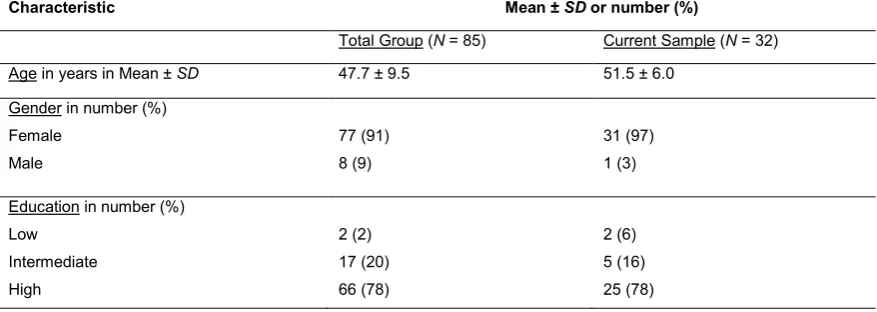
For the current study,32 of the 85 participants were selected on the basis of observable conscientiousness. Criteria indicating this conscientiousness were 1) Complete online diaries which include six weekly gratitude lists and reflections; 2) Completion of the pre-measure (T0) and the post-measure (T3) of both the scale for mental well-being, Mental Health Continuum-Short Form (MHC-SF) and the subscale for positive relations, Positive Relations with Others (translated from the Dutch scale: Positieve Relations met Anderen). Of the selected participants the majority was female (97%) and had a higher professional
[image:10.595.72.511.370.526.2]education (78%). Participants’ age ranged from 38 to 64 years, with a mean age of 52 years. Table 1 displays the demographic characteristics of the current sample and the total group and their correlation.
Table 1
Demographic characteristics of the total group (N = 85) and the current sample (N = 32)
Characteristic Mean ± SD or number (%)
Total Group (N = 85) Current Sample (N = 32)
Age in years in Mean ± SD 47.7 ± 9.5 51.5 ± 6.0
Gender in number (%) Female
Male
77 (91) 8 (9)
31 (97) 1 (3)
Education in number (%) Low
Intermediate High
2 (2) 17 (20) 66 (78)
2 (6) 5 (16) 25 (78)
Note.SD = Standard Deviation.
Intervention
The intervention was executed in Dutch and took six weeks. It consisted of two parts, an online diary that was filled in each weekend and the execution of six weekly gratitude exercises. Since the weekly exercises were different for each of the six weeks, participants were informed about the content of such an exercise via email in the beginning of each week. Besides an instruction for execution, the email also contained information about the
participants were asked to write every day about an aspect of their life, while imagining that it would not exist. To express gratefulness by writing letters of gratitude to benefactors was the third exercise. The fourth focused on positive memories, by asking participants to write about people or aspects of their life they were grateful for. Writing about difficult experiences or hardships in life, while focusing on what good they have brought, was the fifth exercise. The sixth and last weekly exercise was about establishing a grateful life-attitude. Each Saturday, participants were requested to keep an online diary, which marked the other part of the intervention. For this, they were asked to write a reflection on their experiences with the execution of the weekly exercise and to execute the gratitude list exercise. This exercise requested participants to list five aspects or events of their life (areas of life) they were grateful for during the past week. The data used for analysis in the current study consisted of both the gratitude lists and the reflections on the weekly exercises (together referred to as reports on gratitude exercises).
Qualitative Data Analysis
For each participant a data set was established, consisting of six gratitude lists and six reflections. The data sets were uploaded per participant into the coding program Atlas.ti. On these data sets a content analysis was conducted. Several steps were taken to establish three coding schemes, each regarding one of the first three research questions.
The first version of these coding schemes was created during two steps. In the first step, codes were deducted from existing research on gratitude and prosociality. The second step was an inductive process during which twenty data sets were scanned for meaningful text units that did not fit the pre-established codes. Reoccurring themes relating to the
corresponding research questions were formed into codes supplementing the coding schemes. This version was discussed with supervisors and adjusted. Thereafter, in collaboration with a fellow student, the coding schemes were adapted during four rounds. For each round
respectively, five data sets were coded separately by the researcher and the fellow student. Thereby, codes and sub-codes were applied to text units (further referred to as statements). Such statements consisted of full, partial or several sentences. Subsequently, the coded data sets were discussed in order to reduce disagreements and refine the coding schemes.
each of the (sub-) codes. In calculating Cohen’s kappa (k), these frequencies were placed into the following formula, with N being the total frequency of the (sub-) codes:
𝑘 = 𝑜𝑏𝑠. 𝑓𝑟𝑒𝑞. − 𝑒𝑥𝑝. 𝑓𝑟𝑒𝑞. 𝑁 − 𝑒𝑥𝑝. 𝑓𝑟𝑒𝑞.
In the current study it was agreed with the supervisors that a value of k ≥ .70 would be considered as acceptable agreement for the (sub-) codes and coding schemes. This threshold value was chosen because it is considered to indicate substantial agreement (Landis & Koch, 1977). A value below this threshold may indicate a need to revise the (sub-) codes or the coding scheme(s) in order to improve the inter-rater reliability. Agreement was satisfying for all codes, besides Aspiration. However, since this was the only code and laid just below the threshold, it was decided to accept this code with no further revision. The kappa-values are displayed in the final coding schemes.
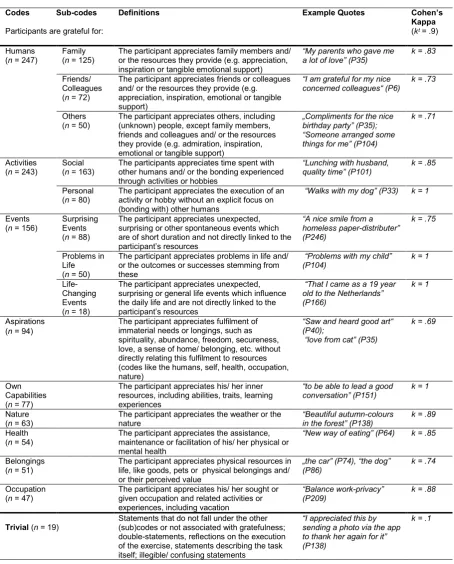
The coding scheme to the first research question (What do participants, who execute daily gratitude exercises, report to be grateful for during the day?) regards the data from the gratitude lists and reveals the aspects and events of daily life participants reported to be grateful for. The coding scheme is labelled Gratitude-related Areas of Life and consists of ten codes and eight sub-codes (see Table 2 in the Results).
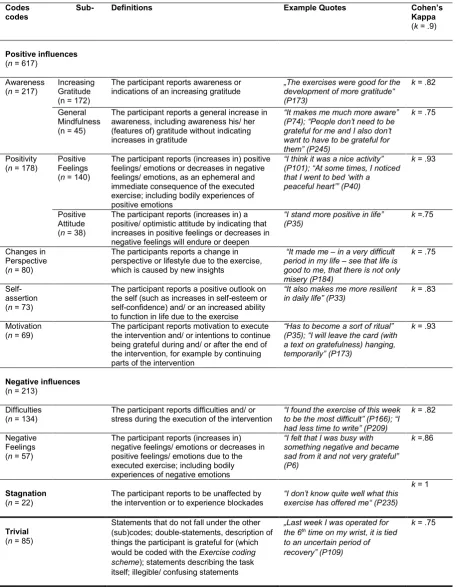
The coding scheme to the second research question (Which influences do participants ascribe to the weekly gratitude exercises?) regards the data from the reflections and provides and overview on the perceived influences of the weekly gratitude exercises reported by the participants. It is labelled Perceived Influences of the Weekly Gratitude Exercises and includes nine codes and four sub-codes (see Table 3 in the Results).
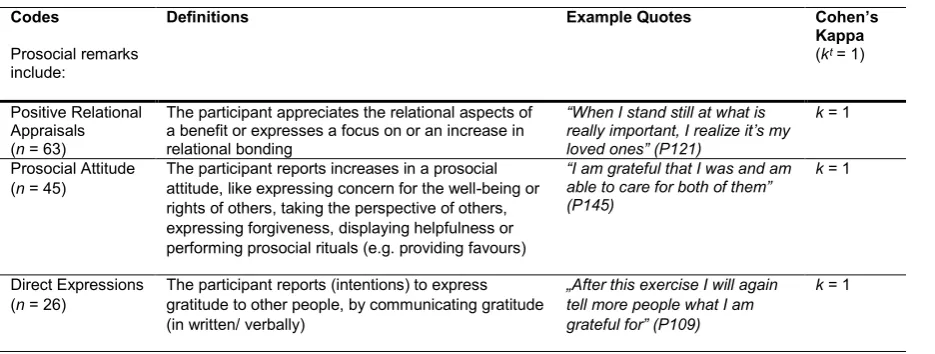
The coding scheme to the third research question (Which remarks do participants make on their prosociality when reflecting on the weekly exercises?) also regards the data from the reflections and displays prosocial remarks participants made when reflecting on the weekly gratitude exercises. It is labelled Prosocial Remarks and consists of three codes (see Table 4 in the Results).
Quantitative Data
Measurements. In order to investigate the fourth research question (How are the reports on gratitude exercises related to participants’ prosociality and well-being?), the Dutch version of the mental well-being questionnaire Mental Health Continuum Short-Form (MHC-SF) and the Dutch version of the subscale Positive Relations with Others (PRwO), one of the six Ryff’s Scales of Psychological Well-Being (SPWB) were used within this study.
The MHC-SF is a validated self-report questionnaire consisting of 14 items and developed by Keyes, et al., (2008). For the current study, the validated Dutch version, by Lamers, Westerhof, Bohlmeijer, ten Klooster, and Keyes (2011), was used. The MHC-SF measures positive mental health and the three components of well-being (emotional-,
psychological- and social well-being) by asking participants to rate the frequency with which feelings occurred during the past four weeks on a 6-point Likert Scale ranging from (0) = “never” to (5) = “every day”. Examples of items are: “During the past month, how often did you have the feeling…” 1) “…that you were interested in life” (emotional well-being, three items), 2)“…that you understand how our society functions?” (social well-being, five items) and 3) “…that you liked most aspects of your personality?” (psychological well-being, six items). The internal consistency for the Dutch version is good (Cronbach’s α = .89; Lamers, et al., 2011). To measure overall positive mental health, the mean score of all items (one to 14) is calculated. The general norm-score [M = 2.98; SD = .85] can be used as an orientation for well-being of the general population. A state of high mental well-being is reached when a score of “every day“ (5) or “almost every day“ (4) is given to at least one of the items of emotional well-being and if a score of “every day“ (5) or “almost every day“ (4) is given to at least six of the items on subjective and psychological well-being (Keyes, 2002).
The subscale Positive Relations with Others, developed by Ryff (1989), measures positive relations by asking participants to indicate their agreement with statements on a 6-point Likert Scale ranging from (1) “totally disagree” to (6) “totally agree” (van Dierendonck, 2004). For this study, the nine-item version of the subscale is used as a measure of
participant’s prosociality. Example items are: “I don’t have many people who want to listen when I need to talk“ and “Maintaining close relationships has been difficult and frustrating for me“ (Springer & Hauser, 2006). The internal consistency for this nine-item scale is acceptable (Cronbach’s α = .77; van Dierendonck, 2004). Norm-scores are not available for this version. However, the norm-scores of the six-item version [M = 4.67; SD = .77] can be used as orientation for the general populations’ positive relations with others (van
satisfying relationships, can be intimate with other, affectionate and empathetic, shows
concern about other people’s well-being and understands that relationships involve reciprocity (Ryff, 1989).
Data Analysis. In providing answer to the fourth research question, firstly, the frequencies of the reported codes were calculated for each participant with the software Atlas.ti. Subsequently, these frequencies were inserted into the statistical software SPSS, which was used for following calculations. As the next step, the difference scores between the pre-measure (T0) and the post-measure (T3) of both, the MHC-SF and PRwO, were calculated for each participant by subtracting their scores on T0 from their scores on T3. Following, the normality of the distribution was checked for each code by executing the Kolmogorow-Smirnow-Test. If codes were normally distributed, Pearson’s correlation was used as analysis and if they were not normally distributed Spearman’s correlation was selected. Correlational analyses were executed between each of the (sub-) codes from the content analysis and all participants’ difference scores on the MHC-SF, respectively the PRwO. Correlations were significant at the p = .05 level (Cowles & Davis; 1992). Additionally, as background information for a profound interpretation of the results, two one-sample t-tests were
conducted to analyse whether 1) well-being and 2) prosociality increased significantly from T0 to T3, at the significance level of p = .05.
Results
Gratitude-related Areas of Life
In the following, areas of life participants reported to be grateful for are discussed in decreasing order, starting with the most frequently reported area. An overview on these areas is given in Table 2. The nine main categories were Humans, Activities, Events, Aspirations, Own Capabilities, Nature, Health, Belongings and Occupation.
colleagues, as the quote “I received help from a woman” (P201), illustrates. Such others were under more, acquaintances, neighbours or professionals and seemed to be appreciated most frequently for direct or professional support, as illustrated by a participant who was grateful for “the support of [her] lawyer regarding the difficulties at [her] work” (P171).
Another frequently reported area was Activities, which includes all activities, hobbies and ventures participants were grateful for. On a frequent basis, participants expressed gratitude for Social activities which involved spending their time with another person, like “having lunch with a friend” (P114). Additionally, gratitude was reported for Personal activities, which participants executed for themselves. These seemed oriented at relishing in passions, like “painting” (P184) or at self-care, as illustrated by a participant who noted that “riding [her] bike in the nature enables [her] to gain new energy” (P145). It was striking that while participants expressed gratitude for executing social activities, to a remarkable extent, they tended to appreciate executing activities for personal purposes distinctly less frequent.
Moreover, participants frequently reported to be grateful for Events which rather happened to them and seemed to lay out of their control. Of these, most frequently, participants were grateful for Surprising Events, which include unexpected or surprising events that are positively perceived and of short duration. It was noticeable that the vast majority of these events seemed to elicit pleasant feelings, such as relief when hearing “the first sign of a sick uncle who laid on the integrated circuit” (P209). On a surprisingly regular basis, participants expressed gratefulness for having experienced Problems in life, like hardships, struggles or severe stress. Sometimes participants also indicated gratitude for mastery of such struggles, like a participant with a difficult “relationship with [her] brother, [who] talked out disagreements.” (P91). However, gratitude for Life-Changing Events was reported strikingly seldom. Such positive changes related to events that changed how
participants experience their daily life. For example, participants reported gratitude for events that altered their responsibilities or lifestyle, when for example “[becoming] a mother” (P121).
The area Aspirations, comprises participants’ gratefulness for the fulfilment of own longings and needs. These included under more “living quietly”(P239), being born in a country, like “The Netherlands” (P173), having a “roof over [the] head”(P183) or receiving “God’s mercy”(P101). The great majority of participants expressed gratefulness for at least one aspiration, but as the examples illustrate, the nature of named aspirations was remarkably diverse.
which included skills, abilities and traits. While some participants appreciated their ability to be kind towards themselves, others were grateful for being kind towards other people or for being resilient, by for example “[finding] the strength to end [a] relationship” (P155).
Participants also expressed gratitude for the Nature, including landscapes, the own garden, certain plants or animals and the weather. It stuck out that frequently participants expressed an indirect feeling of awe and relish when appreciating nature’s beauty, by for example enjoying “the gorgeous sunny weather” (P213).
A further area, participants were grateful for, was Health, which comprises all health-related issues, such as health supporting facilities, therapies, and other health-aids, like glasses. Some participants expressed to be grateful for their current well-being in mental or physical areas, by stating that “[being] still so healthy, that is a daily celebration” (P235).
Additionally, participants reported gratitude for Belongings, including physical possessions such as property, vehicles, pets and other tangible assets. Some participants indicated an underlying value of a possession, like “hiking boots to go hiking with them” (P121).
Some participants also expressed gratefulness for their current Occupation, including new work opportunities or special work experiences, like “nice team work” (P116).
Surprisingly, only few of these participants reported to be grateful for not having to work, by either having time off or being in pension.
Table 2
Coding Scheme: Gratitude-related Areas of Life (N = 1051) Codes Sub-codes
Participants are grateful for:
Definitions Example Quotes Cohen’s
Kappa
(kᵗ = .9)
Humans (n = 247)
Family (n = 125)
The participant appreciates family members and/ or the resources they provide (e.g. appreciation, inspiration or tangible emotional support)
“My parents who gave me a lot of love” (P35)
k = .83
Friends/ Colleagues (n = 72)
The participant appreciates friends or colleagues and/ or the resources they provide (e.g. appreciation, inspiration, emotional or tangible support)
“I am grateful for my nice concerned colleagues“ (P6)
k = .73
Others (n = 50)
The participant appreciates others, including (unknown) people, except family members, friends and colleagues and/ or the resources they provide (e.g. admiration, inspiration, emotional or tangible support)
„Compliments for the nice birthday party” (P35); “Someone arranged some things for me” (P104)
k = .71
Activities (n = 243)
Social (n = 163)
The participants appreciates time spent with other humans and/ or the bonding experienced through activities or hobbies
“Lunching with husband, quality time” (P101)
k = .85
Personal (n = 80)
The participant appreciates the execution of an activity or hobby without an explicit focus on (bonding with) other humans
“Walks with my dog” (P33) k = 1
Events (n = 156)
Surprising Events (n = 88)
The participant appreciates unexpected, surprising or other spontaneous events which are of short duration and not directly linked to the participant’s resources
“A nice smile from a homeless paper-distributer” (P246)
k = .75
Problems in Life (n = 50)
The participant appreciates problems in life and/ or the outcomes or successes stemming from these
“Problems with my child” (P104)
k = 1
Life-Changing Events (n = 18)
The participant appreciates unexpected, surprising or general life events which influence the daily life and are not directly linked to the participant’s resources
“That I came as a 19 year old to the Netherlands” (P166)
k = 1
Aspirations (n = 94)
The participant appreciates fulfilment of immaterial needs or longings, such as spirituality, abundance, freedom, secureness, love, a sense of home/ belonging, etc. without directly relating this fulfilment to resources (codes like the humans, self, health, occupation, nature)
“Saw and heard good art“ (P40);
“love from cat” (P35)
k = .69
Own Capabilities (n = 77)
The participant appreciates his/ her inner resources, including abilities, traits, learning experiences
“to be able to lead a good conversation” (P151)
k = 1
Nature (n = 63)
The participant appreciates the weather or the nature
“Beautiful autumn-colours in the forest” (P138)
k = .89
Health (n = 54)
The participant appreciates the assistance, maintenance or facilitation of his/ her physical or mental health
“New way of eating” (P64) k = .85
Belongings (n = 51)
The participant appreciates physical resources in life, like goods, pets or physical belongings and/ or their perceived value
„the car” (P74), “the dog” (P86)
k = .74
Occupation
(n = 47) The participant appreciates his/ her sought or given occupation and related activities or experiences, including vacation
“Balance work-privacy”
(P209) k = .88
Trivial (n = 19)
Statements that do not fall under the other (sub)codes or not associated with gratefulness; double-statements, reflections on the execution of the exercise, statements describing the task itself; illegible/ confusing statements
“I appreciated this by sending a photo via the app to thank her again for it” (P138)
k = .1
Note.N = total frequency of coded statements. n = frequency of coded statements. Statements can include partial-, full- or
Perceived Influences of the Weekly Gratitude Exercises
In the following, participant’s reported influences of the gratitude exercises, as displayed in Table 3, are discussed in decreasing order, starting with the most frequently reported influence. At first the positive influences are discussed, followed by negative influences and after that stagnation. A remarkable finding is that positive influences with the gratitude exercises, including Awareness, Positivity, Changes in Perspective, Self-assertion and Motivation were reported three times more often than negative influences, which included Difficulties and Negative Feelings. Experienced Stagnation was reported strikingly seldom.
Most frequently, participants reported a greater Awareness due to the exercises. They indicated to be more consciously aware of themselves or their environment either during or after execution of the exercises. Participants indicated strikingly often to experience
Increasing Gratitude as a consequence of engaging in the exercises. Frequently, they stated that gratitude has received a greater priority in life, as indicated by a participant who reported that “as the week went on, the moments of gratitude came by themselves” (P114). Less frequently, participants also reported a general increase in mindfulness by consciously engaging with their own gratitude. Strikingly, General Mindfulness was mainly reported through neutral descriptions, like: “I can see and mention [worries and sadness] from a broader view and therefore with more distance” (P239), which were not emotionally loaded.
For the great majority of participants the gratitude exercises seemed to have led to increases in Positivity, and especially in Positive Feelings. Frequently, positive feelings, such as liking an exercise or “feel[ing] happier” (P201) after its execution, were experienced as direct consequences of an exercise. Less frequently, participants indicated that the
intervention led to a greater Positive Attitude, such as increased optimism or hope “that what is needed will come [their] way” (P104).
Changes in Perspective, which seemed to be based on new insights, were also reported frequently as consequences of the exercises. It is noticeable that challenges, like hardships in life, were strikingly often reported as inducements for such new insights. These seemed to draw participants’ focus to the bright side or to value what is provided in life by realizing “that not everything is so for granted” (P114).
Several participants also noted that the exercises seemed to have led to a greater Motivation to increase their gratitude either during or after the intervention. Some participants even reported motivation to overcome existing difficulties which hinder experiences of
gratitude, like “want[ing to] persevere” (P145) despite inner “resistance to think positive” (P145).
Besides the discussed positive influences, participants also reported negative influences of the exercises. The most frequently reported negative influences were
experiences with Difficulties. These difficulties mainly regarded the execution of the exercise. As reasons for such difficulties, participants often reported personal circumstances, such as stress, illness or lacks in motivation or energy. However, some participants explained to have struggled with the exercises because they experienced “resistance” (P239) or felt mentally “unstable [or] whiny” (P239).
A less frequently reported negative influence was the triggering of Negative Feelings, such as dislike, which participants ascribed to the content or execution of the exercises. A striking notion is that a few participants also expressed negative feelings toward themselves. One participant, for example, realised that the exercise led her to be “very busy with [her]self [which] feels egoistic” (P91). However, it is noteworthy that negative feelings with the exercise were reported three times less than positive feelings.
Rather infrequently, participants reported to feel Stagnation, which involves non-change or non-progress. Some participants “experience[d] the exercise […] as a repetition [because they were]grateful for the same every week” (P213), while others noted that they cannot feel true gratitude but rather “write with reason” (P145).
Table 3
Coding Scheme: Perceived Influences of the Weekly Gratitude Exercises (N = 915)
Codes
Sub-codes Definitions Example Quotes Cohen’s Kappa
(k = .9)
Positive influences
(n = 617)
Awareness
(n = 217) Increasing Gratitude (n = 172)
The participant reports awareness or
indications of an increasing gratitude „The exercises were good for the development of more gratitude“ (P173)
k = .82
General Mindfulness (n = 45)
The participant reports a general increase in awareness, including awareness his/ her (features of) gratitude without indicating increases in gratitude
“It makes me much more aware” (P74); “People don’t need to be grateful for me and I also don’t want to have to be grateful for them” (P245)
k = .75
Positivity (n = 178)
Positive Feelings (n = 140)
The participant reports (increases in) positive feelings/ emotions or decreases in negative feelings/ emotions, as an ephemeral and immediate consequence of the executed exercise; including bodily experiences of positive emotions
“I think it was a nice activity” (P101); “At some times, I noticed that I went to bed ‘with a peaceful heart’” (P40)
k = .93
Positive Attitude (n = 38)
The participant reports (increases in) a positive/ optimistic attitude by indicating that increases in positive feelings or decreases in negative feelings will endure or deepen
“I stand more positive in life” (P35)
k =.75
Changes in Perspective (n = 80)
The participants reports a change in perspective or lifestyle due to the exercise, which is caused by new insights
“It made me – in a very difficult period in my life – see that life is good to me, that there is not only misery (P184)
k = .75
Self-assertion (n = 73)
The participant reports a positive outlook on the self (such as increases in self-esteem or self-confidence) and/ or an increased ability to function in life due to the exercise
“It also makes me more resilient in daily life” (P33)
k = .83
Motivation (n = 69)
The participant reports motivation to execute the intervention and/ or intentions to continue being grateful during and/ or after the end of the intervention, for example by continuing parts of the intervention
“Has to become a sort of ritual” (P35); “I will leave the card (with a text on gratefulness) hanging, temporarily” (P173)
k = .93
Negative influences
(n = 213)
Difficulties (n = 134)
The participant reports difficulties and/ or stress during the execution of the intervention
“I found the exercise of this week to be the most difficult” (P166); “I had less time to write” (P209)
k = .82
Negative Feelings (n = 57)
The participant reports (increases in) negative feelings/ emotions or decreases in positive feelings/ emotions due to the executed exercise; including bodily experiences of negative emotions
“I felt that I was busy with something negative and became sad from it and not very grateful” (P6)
k =.86
Stagnation
(n = 22) The participant reports to be unaffected by the intervention or to experience blockades “I don’t know quite well what this exercise has offered me“ (P235) k = 1
Trivial (n = 85)
Statements that do not fall under the other (sub)codes; double-statements, description of things the participant is grateful for (which
would be coded with the Exercise coding
scheme); statements describing the task
itself; illegible/ confusing statements
„Last week I was operated for the 6th time on my wrist, it is tied
to an uncertain period of recovery” (P109)
k = .75
Note.N = total frequency of coded statements. n = frequency of coded statements. Statements can include partial-, full- or
Prosocial Remarks
In the following, participant’s prosocial remarks are discussed in decreasing order, starting with the most frequently reported remark. View Table 4 for an overview on the prosocial remarks, which include Positive Relational Appraisals, Prosocial Attitude and Directly Expressions.
A first notion regards the surprising finding that although the vast majority of participants (91%) made at least one prosocial remark, only half of the participants included more than one type of prosocial remark and merely six participants included all three types. The most frequently reported prosocial remarks were Positive Relational Appraisals. In the vast majority of these appraisals participants reported to appreciate close or intimate relationships with family, friends or close colleagues. At times, however, participants more generally appreciated the fact that they are socially connected, through for example “the realization that [one is] part of a number of good functioning social groups” (P187).
Several participants reported to have a Prosocial Attitude, indicated by a concern for the well-being of others. While some participants expressed worry for dear ones, others stated the wish to be supportive or kind to others. Surprisingly, a few participants also showed concern for the well-being of acquaintances or strangers and one participant even expressed concern for a broader distribution of prosociality. She hoped that “by sharing [her gratitude] the others also started sharing experiences” (P109).
Table 4
Coding Scheme: Prosocial Remarks (N = 134) Codes
Prosocial remarks include:
Definitions Example Quotes Cohen’s
Kappa
(kᵗ = 1)
Positive Relational Appraisals (n = 63)
The participant appreciates the relational aspects of a benefit or expresses a focus on or an increase in relational bonding
“When I stand still at what is really important, I realize it’s my loved ones” (P121)
k = 1
Prosocial Attitude (n = 45)
The participant reports increases in a prosocial attitude, like expressing concern for the well-being or rights of others, taking the perspective of others, expressing forgiveness, displaying helpfulness or performing prosocial rituals (e.g. providing favours)
“I am grateful that I was and am able to care for both of them” (P145)
k = 1
Direct Expressions (n = 26)
The participant reports (intentions) to express gratitude to other people, by communicating gratitude (in written/ verbally)
„After this exercise I will again tell more people what I am
grateful for”(P109)
k = 1
Note.N = total frequency of coded statements. n = frequency of coded statements. Statements can include partial-, full- or
several sentences. kᵗ = Cohen’s kappa of the total coding scheme. P[number] = Participants’ identification.
Relations between Reports on Gratitude Exercises and Well-being
Considering the difference score on the MHC-SF between T0 and T3, M = .5; SD = .5 (see the Appendix for a full overview on participants’ difference scores), it is found that participant’s well-being increased significantly from pre- to post-measure, t(31) = 6.4, p = .000. On an individual basis, 88% of the participants experienced an increase in well-being from T0 to T3, while no change was experienced by 3% and for 9% of the participants well-being decreased.
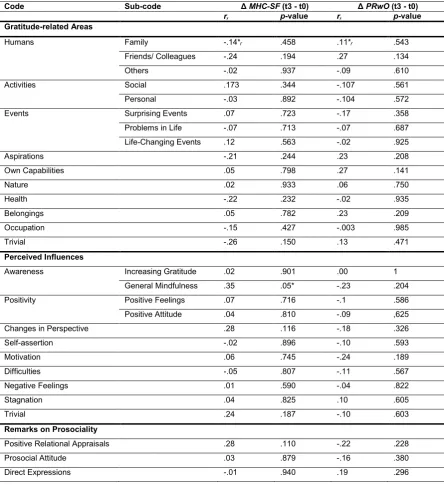
A significant correlation at the .05 level was found between participants’ well-being and General Mindfulness, rₛ = .34; p = .05. No further correlations were found between participants’ well-being and other reports on gratitude exercises (see Table 5).
Relations between Reports on Gratitude Exercises and Prosociality
On the other side, the mean difference score on the PRwO between T0 and T3, M = -.01; SD = .5 (see the Appendix for a full overview on participants’ difference scores),
showed that prosociality did not significantly increase from pre- to post-measure, t(31) = -.01, p = .901. Comparing the scores between T0 and T3 on an individual basis, it is found that prosociality increased for 56% of the participants, while it stayed unchanged for 16% and even decreased for 28% of the participants.
Table 5
Relations between Reports on Gratitude Exercises and Participants’ Well-being and Prosociality
Code Sub-code Δ MHC-SF (t3 - t0) Δ PRwO (t3 - t0)
rₛ p-value rₛ p-value
Gratitude-related Areas
Humans Family -.14*ᵣ .458 .11*ᵣ .543
Friends/ Colleagues -.24 .194 .27 .134
Others -.02 .937 -.09 .610
Activities Social .173 .344 -.107 .561
Personal -.03 .892 -.104 .572
Events Surprising Events .07 .723 -.17 .358
Problems in Life -.07 .713 -.07 .687
Life-Changing Events .12 .563 -.02 .925
Aspirations -.21 .244 .23 .208
Own Capabilities .05 .798 .27 .141
Nature .02 .933 .06 .750
Health -.22 .232 -.02 .935
Belongings .05 .782 .23 .209
Occupation -.15 .427 -.003 .985
Trivial -.26 .150 .13 .471
Perceived Influences
Awareness Increasing Gratitude .02 .901 .00 1
General Mindfulness .35 .05* -.23 .204
Positivity Positive Feelings .07 .716 -.1 .586
Positive Attitude .04 .810 -.09 ,625
Changes in Perspective .28 .116 -.18 .326
Self-assertion -.02 .896 -.10 .593
Motivation .06 .745 -.24 .189
Difficulties -.05 .807 -.11 .567
Negative Feelings .01 .590 -.04 .822
Stagnation .04 .825 .10 .605
Trivial .24 .187 -.10 .603
Remarks on Prosociality
Positive Relational Appraisals .28 .110 -.22 .228
Prosocial Attitude .03 .879 -.16 .380
Direct Expressions -.01 .940 .19 .296
Note.rₛ = Spearman’s correlation. *r =Pearson correlation. * p ≤ .05. t0 = pre-measure. t3 = post-measure.
Discussion
The current study focused on the intervention Gratitude Exercises, which is based on the execution of various gratitude exercises. Participants were requested to write reflections regarding their experiences with weekly gratitude exercises and to make gratitude lists of events or aspects of their life they were grateful for during the past week.
grateful for and of the perceived influences gratitude exercises may exert. A further aim was to investigate whether prosociality may be an integral social component of gratitude exercises. For this aim, prosocial remarks were filtered from the reflections and additionally relations between prosociality and reports on gratitude exercises were determined. Since gratitude exercises serve the purpose of increasing well-being, the relation between reports on gratitude exercises and well-being was also examined to search for potentially influencing factors.
The Interpersonal Value of Gratitude Exercises
One interesting finding of the current study stems from the gratitude lists which revealed a variety of aspects and events in life that were linked to gratitude (here referred to areas of gratitude).Surprisingly, the most frequently reported areas of gratitude, social activities and family, clearly relate to social resources. Therefore, social connections seem to be highly valued, a finding that is in line with Adler and Fagley’s (2005) research on
appreciation. The researcher’s conceptualization of appreciation carries the same meaning as gratitude does in the current study. Adler and Fagley (2005) argued that “interpersonal” (p. 81) is one of eight aspects of general appreciation and characterised by appreciating other people and their contribution to one’s life and well-being. In the current study, such contribution from other humans included under more connectedness, emotional support, tangible help and affection. Subsequently, the gratitude lists indicate the importance of a social component within gratitude. This finding is in line with previous studies, which highlighted the value of gratitude for building, maintaining and strengthening intimate relationships (e.g. Algoe, 2012).
satisfaction with the relationship (Algoe, et al., 2013). Still, the great representation of social resources in the gratitude lists leads to wonder why the reflections did not reveal prosocial remarks on a more regular and extensive basis. A possible explanation stems from the task description of the exercises. Of the six exercises, only the third exercise directly requested participants to involve other people into the execution of the exercise. Moreover, as aid for writing their reflections, participants received questions, like “How was it for you to do the exercise?” Those questions, however, directed their focus to intrapersonal instead of
interpersonal experiences and changes. Subsequently, prosociality may be underrepresented in all participants. Although it remains speculative, this might also be an explanation to the finding that none of the remarks on prosociality in the current study related to well-being.
A deep understanding for the role of prosociality within gratitude is necessary in order to exploit its potential for fostering and improving intimate relationships. These in turn, constitute an essential aspect of mental well-being (Algoe, 2012). Therefore, it is suggested that future research focuses more directly on prosociality in the task description of gratitude exercises, for example through questions, like: “How is your gratitude related to other people in your life?” Additionally, since the gratitude lists represented the interpersonal component of gratitude exercises, participants could be asked to elaborate on the on the areas of gratitude, for example by asking them: “Why are you grateful for these aspects of your life?”
Besides, the current study found that gratitude can be directed at areas independent of other humans in life and therefore be independent of their contribution, since participants were also grateful for nature, or rather personal areas, like personal activities, health or own capabilities. This finding is supported by Watkins, et al. (2003) who argued that gratitude can be directed at non-social areas.
In this study, none of the areas of gratitude related to increased well-being, although previous literature found that the gratitude lists intervention has proven effective in enhancing well-being (e.g. Wood, et al., 2010). A possible explanation to this contradictory finding is that experiencing gratitude in several areas rather than in a particular area may be associated with well-being. This would be in line with the fact that participants reported a variety of areas instead of merely a certain one.
The current study provides insights into the relationship between prosociality and gratitude, by illustrating the importance of a social component within gratitude exercises. Additionally, the majority of participants made at least some prosocial remarks, without being explicitly asked to focus on prosocial themes in their reflections. The field of positive
experiences to investigate the full potential of prosociality within gratitude exercises. If prosociality is a crucial component of gratitude, then interventions focusing on promoting prosociality should serve to increase gratitude.
Measured Prosociality and its Relation to Gratitude Exercises
Surprisingly, prosociality did not increase during the intervention-phase. Therefore, no relationship between reports on gratitude exercises and increases in prosociality was found. This finding is not in line with previous research, which found that gratitude interventions hold a potential for promoting prosociality (Ma, et al., 2017). A possible explanation is that prosociality did not increase because only one weekly gratitude exercise requested
participants to behave prosocial. Future gratitude interventions should directly encourage prosociality in participants for an extended period of time, to test whether this may lead to increased prosociality. Another explanation relates to the limitation that prosociality was measured with the subscale Positive Relations with Others (PRwO). The PRwO was chosen because it is a scale of the larger RCT this study was part of and includes an evaluation of a prosocial attitude (van Dierendonck, 2004). However, it is not a validated scale for measuring prosociality and does not evaluate prosocial behaviour. Previous studies used a range of different methods to measure prosociality, including self-ratings, (Emmons & McCollough, 2003), peer-ratings and measures of related concepts, such as empathy and perspective-taking (McCullough, et al., 2002). For these reasons, it is possible that the outcomes of the PRwO may not fully reflect participants’ prosociality. For a better understanding on the relation between prosociality and gratitude exercises, it is recommended that future research uses a validated scale on prosociality, like the Prosociality Test Battery developed by Penner, Fritzsche, Craiger, and Freifeld (1995), as a measure of this construct. An improved understanding on this relation would be of use to the field of positive psychology for extending and refining its tool of gratitude interventions.
Perceived Influences of Gratitude Exercises on Daily Life
One prominent finding regarding the reflections was that positive influences were by far more prevalent than negative influences or stagnation. This indicates that only few
gratitude exercises. Such endeavour is found to be related to the positive impact those exercises can exert (Lyubomirsky, Dickerhoof, Boehm, & Sheldon, 2011).
A surprising finding of the current study was that of all influences gratitude exercises were perceived to exert, only general mindfulness related to increases in well-being. This relationship is line with Adler and Fagley’s (2005) notion that being mindful or in “present moment” (p. 81) is essential to appreciation. However, as a whole the finding contrasts
previous research which shows support also for relations between the other perceived positive influences and well-being. This is most obvious for increasing gratitude, since increased gratitude is found to enhance well-being (O' Leary & Dockray, 2015). Taking the perceived change of having a more positive attitude in life, it is further found that optimism can exert a positive influence on well-being (Conversano, et al., 2010). Additionally, the perceived increase in self-assertion seems directly related to the self-acceptance- and autonomy aspects of psychological well-being (Ryff & Singer 1989). Furthermore, perceived changes in perspective involved comparing one’s current situation to previous ones or those of others, which according to Adler and Fagley (2005) is not only essential to the experience of appreciation, but also positively associated with subjective well-being.
The finding that well-being was unrelated to the majority of the perceived influences can have different explanations. One might argue that the actual experiences during the week with the gratitude exercises could relate to increases in well-being rather than reporting on these experiences. However, the value of the reflection task of the online diaries is supported by previous literature, which found that expressive writing on gratitude can enhance well-being over time (Booker & Dunsmore, 2017). At the same time, this leads to wonder whether the amount of involvement with weekly gratitude exercises may be related to increased well-being. A range of perceived influences reported might relate to increases in well-being, while merely reporting on of these influences does not. Another possibility is that the whole
research design, including the execution of exercises and writing reflections on these, may be responsible for increased well-being. With a deeper insight into the mechanisms between gratitude exercises and increases in well-being, the field of positive psychology can refine gratitude interventions and orientate them towards their target. Therefore, it is recommended that future research investigates whether the amount of involvement with gratitude exercises is associated with well-being. This may be realized by comparing participants who report a wide range of influences with those who report few influences and by asking participants directly how conscientious they executed the weekly exercise.
exercises need to be viewed with caution because a great number of participants dropped out of the intervention or did not fill in their online diaries every week and were subsequently excluded from this study. Since the reasons for drop-out are unknown, it is possible that the reported influences are biased and therefore unreliable, if a majority based their drop-out on negative experiences with the exercises (Groeneveld, Proper, van der Breek, Hildebrandt, & van Mechelen, 2009). Therefore, it is recommended that future research investigates the reasons for this drop-out and takes measures to prevent it. For ethical issues it is not possible to ask participants for reasons of their drop-out. However, more information on these reasons may be gathered via log-file analysis on the online diaries, which can help to identify
moments of drop-out. Subsequently, these moments can be analysed for critical factors (van Germert-Pijnen, 2013). Additionally, participants could be asked for critical feedback and difficulties with the intervention every time they fill in the online diary. Such feedback could serve as guideline for tailoring preventative measures. If indicated, persuasive technology may be implied in the research design to increase motivation and adherence (van Germert-Pijnen, 2013).
Although it remains unknown why, besides for general mindfulness, no other reports on the exercises related to increased well-being, the high prevalence of perceived positive influences provides reason to continue using these exercises in order to promote gratitude.
Strengths and Limitations
A more general strength of the current study lies in the provision of three complete and coherent coding schemes, one providing an overview on areas of life in which people may feel gratitude, another on perceived influences which gratitude exercises can exert and a third on prosocial remarks that can occur in reports on gratitude exercises.
Besides the limitations discussed in the previous sections, a further limitation regards the possibility that the demographics of the current sample, including age, gender and education may not fully represent the total group. However, females and a high education were over-represented in both, the current sample and the total group, and the mean age of both groups did not differ much. Therefore, if the sample bias had consequences on the findings of the current study, it is expected that the same would apply to total group.
Conclusion
positive attitude and new perspectives. Moreover, one of these influences, general
mindfulness, seems to be positively related to well-being. Additionally, gratitude is found to be directed at different areas of people’s life, especially at areas laying on the interpersonal level. This illustrates the importance of a social component in gratitude, which is further emphasized by prosocial remarks that are made in reflections on gratitude exercises. However, due to the low report rate of prosocial remarks and the fact that no increase in prosociality during the intervention was found, it cannot be concluded at this point that prosociality constitutes the social component of gratitude. In essence, the current study reveals the potential of interpersonal experiences within gratitude exercises and recommends that the role of prosociality as social component within these exercises will be further
References
Adler, M. G., & Fagley, N. S. (2005). Appreciation: Individual differences in finding value and meaning as a unique predictor of subjective well-being. Journal of Personality, 73(1), 79–114. doi: https://doi.org/10.1111/j.1467-6494.2004.00305.x Algoe, S. B. (2012). Find, Remind, and Bind: The Functions of Gratitude in Everyday
Relationships. Social and Personality Psychology Compass, 6(6), 455-469. doi:10.1111/j.1751-9004.2012.00439.x
Algoe, S. B., Gable, S. L., & Maisel, N. C. (2010). It’s the little things: Everyday gratitude as a booster for romantic relationships. Personal Relationships, 17(2), 217–233.
doi:10.1111/j.1475-6811.2010.01273.x
Algoe, S. B., Fredrickson, B. L., & Gable, S. L. (2013). Brief Report: The Social Functions of the Emotion of Gratitude via Expression. Emotion, 13(4), 605-609.
doi:10.1037/a0032701
Algoe, S. B., & Haidt, J. (2009). Witnessing excellence in action: the ‘other-praising’
emotions of elevation, gratitude, and admiration. The Journal of Positive Psychology, 4(2), 105-127. doi:10.1080/17439760802650519
Algoe, S. B., Haidt, J., & Gable, S. L. (2008). Beyond reciprocity: Gratitude and relationships in everyday life. Emotion, 8(3), 425-429. doi:10.1037/1528-3542.8.3.425
Algoe, S. B., & Zhaoyang, R. (2016). Positive psychology in context: Effects of expressing gratitude in ongoing relationships depend on perceptions of enactor
responsiveness. The Journal of Positive Psychology, 11(4), 399-415. doi:10.1080/17439760.2015.1117131
Bartlett, M. Y., & DeSteno, D. (2006). Gratitude and Prosocial Behavior. Psychological Science,17(4), 319-325. doi:10.1111/j.1467-9280.2006.01705.x
Bohlmeijer, E., Westerhof, G., Bolier, L., Steeneveld, M., Geurts, M., & Walburg, J. (2013). Welbevinden: Van Bijzaak naar Hoofdzaak [Well-being: From Side Issue to Main Issue]. De Psycholoog, 48-59.Retrieved from
http://www.positievepsychologie.nu/upload/PSY1311_W2_corr.pdf
Bolier, L., Haverman, M., Westerhof, G. J., Riper, H., Smit, F., & Bohlmeijer, E. (2013). Positive psychology interventions: a meta-analysis of randomized controlled studies. BMC public health, 13(119), 1-20. doi:10.1186/1471-2458-13-119
Booker, J. A., & Dunsmore, J. C. (2017). Expressive writing and well-being during the