Original citation:
Clarke, C. T. and Nudd, G. R. (1994) Three dimensional CORDIC with reduced iterations. University of Warwick. Department of Computer Science. (Department of Computer Science Research Report). (Unpublished) CS-RR-264
Permanent WRAP url:
http://wrap.warwick.ac.uk/60943
Copyright and reuse:
The Warwick Research Archive Portal (WRAP) makes this work by researchers of the University of Warwick available open access under the following conditions. Copyright © and all moral rights to the version of the paper presented here belong to the individual author(s) and/or other copyright owners. To the extent reasonable and practicable the material made available in WRAP has been checked for eligibility before being made available.
Copies of full items can be used for personal research or study, educational, or not-for-profit purposes without prior permission or charge. Provided that the authors, title and full bibliographic details are credited, a hyperlink and/or URL is given for the original metadata page and the content is not changed in any way.
A note on versions:
The version presented in WRAP is the published version or, version of record, and may be cited as it appears here.For more information, please contact the WRAP Team at:
Three Dimensional CORDIC with
reduced iterations
C.T. Clarke and G.R. Nudd
Department of Computer Science University of Warwick
Coventry CV4 7AL United Kingdom
Abstract
This paper describes a modification to the three dimensional CORDIC algorithm
using an approximation of the Taylor series. The modification has the potential to reduce
the number of iterations required for a three dimensional CORDIC operation by at least
25%. The approach used is based upon a modification of the two dimensional CORDIC
algorithm originally suggested by H.M Ahmed[1].
Introduction
The COordinate Rotation DIgital Computer or CORDIC was first suggested in
1959 by J. E. Volder [2]. The motivation was a need for accurate calculations for on
board an aircraft navigation. The system was capable of rapidly computing vector
rotations, and performing Cartesian to circular co-ordinate conversions. The same
hardware was also able to multiply, divide, and convert between binary and mixed-radix
number systems. The CORDIC algorithm is now widely used for trigonometric
evaluation [3, 4].
The basic CORDIC iteration can be described as a rotation and extension of a
vector. Ignoring the vector extension, the relationship between the two vectors is:
Xi+1 =Xi ±2
−i Yi
and
Yi+1=Yim2
The ± indicates the fact that the rotation can be in either direction. As the vector is
rotated, it is extended by a small amount. The scaling effect is removed by pre or
post-scaling of X, and Y. A third register (conventionally Z)is used to accumulate prestored
angle values to give the current remaining rotation required.
In 1982 Ahmed suggested a combination of CORDIC, and the Taylor series for
vector rotation [1]. The first term of the Taylor series for sine Z is simply Z, and it is
possible to perform the last of our CORDIC iterations using this approximation, rather
than 2−i. Hence after the last CORDIC iteration, a final iteration, as follows is performed:
Xm+1= Xm −ZmYm
Ym+1=Ym+ZmXm
It has been shown by Ahmed that only m = n+1
2
(where n is the number of bits
of accuracy required in the output) iterations of the CORDIC algorithm are needed
followed by the final iteration as given above. Timmermann et al. extended this work to
include vectoring mode [5]. The advantage of these techniques is that they speed up the
calculation of the function, but multiplication and division are now required in the final
iteration.
The three dimensional CORDIC algorithm
Clarke et. al. [6], and Delosme [7] have shown that the CORDIC algorithm can
be extended to three dimensions. This paper considers only the three dimensional
algorithm suggested by Clarke et. al. A vector in three dimensional has Cartesian
coordinates
(
Xi,Yi,Zi)
and spherical coordinates(
Ri,θi,φi)
. Note that Z is no longerthe angle register. The vector can be rotated by an angle αi around the z-axis and by an
Xi+1,Yi+1,Zi+1
(
)
and spherical coordinates(
Ri,θi +αi,φi +βi)
. The variables Ui, Viand Wi defined below must be used to complete the set of iteration equations.
Ui =Ri cosθi cosφi
Vi =Ri sinθi cosφi
Wi =Risinφi
The iteration equations are:
Ui+1= 1
ki2(Ui −Xibi2
−i −
Viai2−i+Yiaibi2−2i)
Vi+1= 1
ki2(Vi −Yibi2
−i +
Uiai2−i−Xiaibi2−2i)
Wi+1= 1
ki (Wi +Zibi2
−i
)
Xi+1 = 1
ki2(Xi +Uibi2
−i −
Yiai2−i −Viaibi2−2i)
Yi+1= 1
ki2(Yi +Vibi2
−i +
Xiai2−i +Uiaibi2−2i)
Zi+1 = 1
ki (Zi −Wibi2
−i
)
It should be noted that the scale factor for Zi+1 and Wi+1 is different to that of
Ui+1, Vi+1, Xi+1 and Yi+1. Clarke et. al. [6] have shown that no repeated iterations are
Use of the Taylor series
The work of Timmermann et. al. and Ahmed [5, 4] that reduces the number of
iterations required for a given accuracy can be extended to three dimensions. The
technique relies on the first term of the Taylor series to remove the need for further
iterations. The approximations used are:
cosδ ≈1 and sinδ ≈ δ
A final iteration is to be added to the algorithm in rotation mode that uses these
approximations. Clearly, if only
(
x,y,z)
needs to be evaluated, then it is only necessaryto do the final iteration for those equations. The equations for u, v andw, are not given
because it will not normally be necessary to store these variables. If they are required, it
would be a simple matter to calculate the equations for them.
Xn = Xn−1−Yn−1rθ +Un−1rφ −Vn−1rθrφ
Yn =Yn−1+Xn−1rθ +Vn−1rφ +Un−1rθrφ
Zn =Zn−1−Wn−1rφ
The variables rθ and rφ are the remaining angles to be rotated through. They are
the remainder stored in the angle registers. To get an overall accuracy of m bits, it is
necessary to use the standard CORDIC algorithm to obtain m bit variables to an accuracy
of n bits and then one iteration as described above. The relationship between m and n is
n= m−1
2
This result is found directly from the second term of the Taylor series (the others
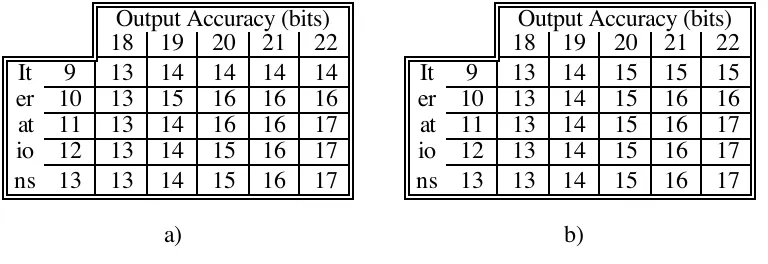
do not need to be taken into account). Bit level simulation accuracy results are shown in
the number of bits to which the angles are stored will be the same as the coordinates, the
bits that can be anything other than zero will only be in the lower half of the word. It is
therefore possible to use a fairly small multiplier (in the region of m bits by m
2 bits) for
the most of the multiplications. With a pipelined Booths multiplier this will take m
4 steps.
The combination of the reduced CORDIC iterations, and the Taylor series expansion is
roughly 25% fewer iterations than a full three dimensional CORDIC operation.
Output Accuracy (bits) Output Accuracy (bits)
18 19 20 21 22 18 19 20 21 22
It 9 13 14 14 14 14 It 9 13 14 15 15 15 er 10 13 15 16 16 16 er 10 13 14 15 16 16 at 11 13 14 16 16 17 at 11 13 14 15 16 17 io 12 13 14 15 16 17 io 12 13 14 15 16 17 ns 13 13 14 15 16 17 ns 13 13 14 15 16 17
[image:6.595.134.518.236.368.2]a) b)
Table 1. The accuracy of a 3D Hybrid CORDIC for a) conventional,
and b) redundant arithmetic. Numbers of iterations are CORDIC iterations.
Conclusions
This paper has described a modification to the three dimensional CORDIC
algorithm of Clarke et. al. [6]. The modification reduces the number of iterations required
for a given output accuracy. The final iteration is more complex than in the standard
algorithm, but this is more than outweighed by the reduction in the overall iteration count.
References
[1] "Signal Processing Algorithms and Architectures", H.M. Ahmed, PhD thesis,
Stanford University, June 1982.
[3] "A unified algorithm for elementary functions", J.S. Walther, Spring Joint
Computer Conf., 1971, pp. 379-385.
[4] "INTEL's Floating-Point Processors", A.K. Yuen, Proceedings of Electro/88,
1988, pp. 48/5/1-6.
[5] "Modified CORDIC Algorithm with Reduced Iterations", D. Timmermann, H.
Hahn, B. Hostika, Electronics Letters, Vol. 25, No. 15, July 1989, pp. 950-951.
[6] "A Redundant Arithmetic CORDIC System With A Unit Scale Factor", C.T.
Clarke, Research Report RR234, University of Warwick Dept of Computer
Science, December 1992.
[7] "CORDIC algorithms: Theory and Extensions" J.M. Delosme, SPIE Vol. 1152
Advanced Algorithms and Architectures for Signal Processing IV, 1989, pp.