Master’s Thesis by
Judith Graef
Committee: dr. ir. J. de Leede dr. A.C. Bos-Nehles
H.J. Poppe M.Sc.
De scriptie die voor u ligt vormt de afsluiting van mijn studententijd aan de Universiteit Twente. Na met veel plezier gestudeerd te hebben is dit het resultaat van mijn master Business Ad-ministration met als specialisatie HRM. Ik ben erg dankbaar voor de leuke maanden die ik bij Nedap heb mogen doorbrengen. In het begin was het even zoeken hoe ik het onderzoek moest aanpakken: toewerken naar een advies over het bereiken van een sterke feedbackcultuur. Een feedbackcultuur. Tja, wat is feedback eigenlijk precies? Wanneer weet je of je een cultuuromslag hebt bereikt? Welke factoren spelen er allemaal mee? Maar al snel begon het vorm te krijgen en kreeg ik door welke kant het op moest gaan. Ik heb erg veel geleerd, van hoe het er in een organisatie aan toe kan gaan tot hoe je de juiste informatie uit interviews kan halen. Daarnaast ben ik mezelf erg tegen gekomen. Ik heb veel stressmomenten gehad, het ene moment was dit wat duidelijker dan het andere moment, maar altijd kwam het weer goed.
Ik wil heel graag iedereen bedanken die mij heeft geholpen. Om te beginnen natuurlijk mijn begeleiders, waarvan eerst Irene Poppe. Ik ben je heel dankbaar voor je inzet om mij te helpen, of het nou om het onderzoek ging of om mijzelf. Ik heb van je geleerd dat mijn perfectionisme een goede eigenschap kan zijn, maar dat ik er niet in moet doorschieten. Ik heb ook geleerd dat het goed is om het beste eruit te willen halen, maar dat ik niet harder moet werken dan eigenlijk goed voor een mens is.
Ook Jan de Leede was een fijne begeleider. Je kon kritisch zijn maar was altijd positief en je nam altijd ruim de tijd voor onze besprekingen. Ook gaf je me af en toe een duw in de organisatierichting wanneer ik me dankzij mijn bachelor onderwijskunde me wat te veel mee liet slepen in de gedragswetenschappen. Ook wil ik Anna Nehles bedanken voor de frisse blik die je hebt gegeven als tweede begeleider. Direct was je ge¨ınteresseerd in mijn opdracht en hielp je mijn scriptie naar een nog hoger niveau te tillen.
Daarnaast wil ik mijn dankbaarheid uiten aan Hubert. Van begin tot eind heb je voor me klaar gestaan. Ik heb steeds met je kunnen praten over wat me bezig hield, wat goed ging en wat spannend was. En altijd kon je me helpen te relativeren en de rust weer te vinden. Je liet me zien dat af een toe een stap terug nemen en korte pauzes wonderen kunnen doen, wat een belangrijke les voor me is geweest.
Tot slot wil ik mijn ouders, mijn vriendinnen en alle collega’s die ik heb leren kennen bedanken. Ik vind het bijzonder hoe betrokken iedereen was, jullie zijn een grote steun voor me geweest!
Ik heb met veel plezier mijn afstudeertijd bij Nedap doorgebracht. Ik hoop dat ik mijn steentje heb kunnen bijdragen en dat mijn onderzoek een mooie basis vormt voor hun traject naar een sterke feedbackcultuur.
Organisations challenge their employees to become lifelong learners, in order to have relevant and up-to-date knowledge and skills. Feedback is considered to be essential to this process, which is why feedback becomes a central subject to organisations. Nedap recognizes the importance of feedback and wants to transform itself into an organisation with a strong feedback culture. Since it is unknown how organisations can manage this process, this research will answer the following research question: How can an organisation implement a strong feedback culture?
A literature study revealed that four different feedback approaches exist: (1) feedback sign: positive and negative feedback; (2) feedback formality: formal and informal feedback; (3) feed-back level: feedfeed-back about the task, process, self-regulation, and self; and (4) feedfeed-back subject: feedback about hard and soft skills. When constructive feedback is given with a balance in all these levels, it can be stated that the organisation has a strong feedback culture.
Literature explains what variables can be used to stimulate the feedback culture in an or-ganisation, which are designated to three levels. On the employee level, five variables have an influence: (1) clear need, (2) psychological safety, (3) openness of the receiver, (4) feedback-seeking behaviour and (5) clear goals. On the organisational level, four long-term variables have an influence: (1) centralisation, (2) formalisation, (3) power distance, and (4) progressiveness. On the organisational level also four short-term variables have an influence: (1) vision commu-nication, (2) importance emphasizing, (3) support providing, and (4) role models.
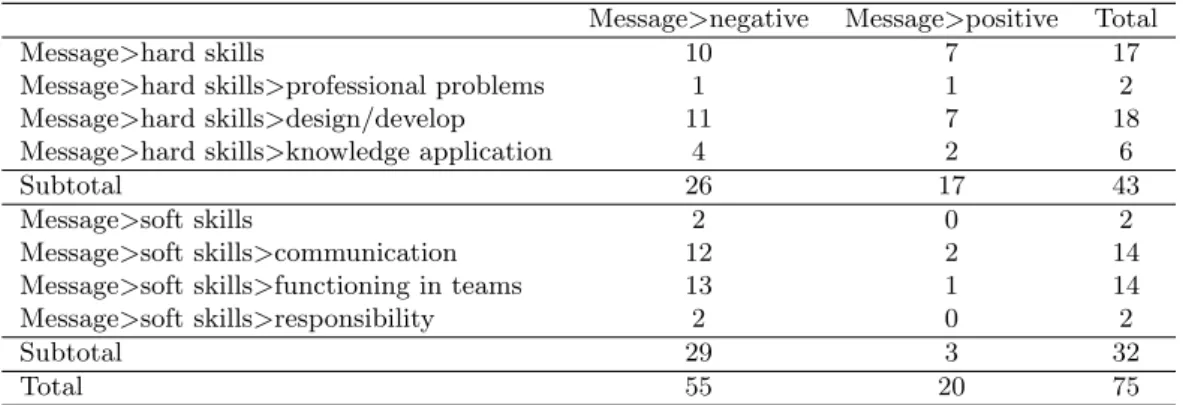
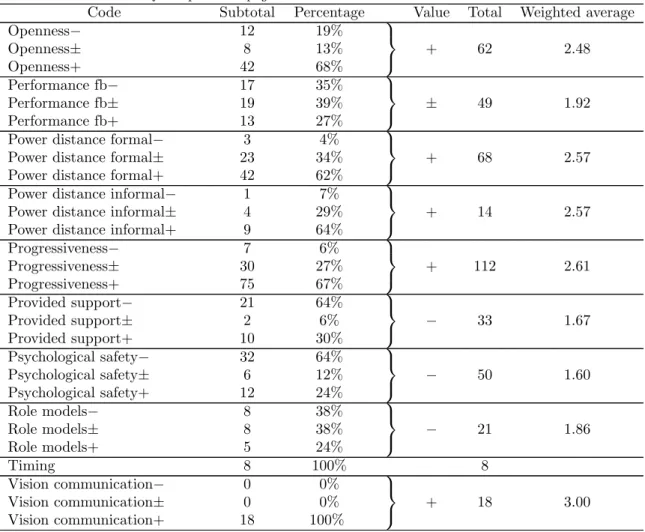
Qualitative research was used to determine the current situation in the organisation. During ten interviews with employees in two departments of the organisation, 64 per cent of the feedback messages that were mentioned was negative and only 36 per cent was positive. Additionally respondents explained they were more familiar with feedback on hard skills than with feedback on soft skills. The respondents also revealed that only little performance feedback is given. Therefore it is concluded that the current situation is a weak feedback culture.
The interviews revealed that six influencing variables are absent: (1) psychological safety, (2) clear goals, (3) centralisation, (4) importance emphasizing, (5) support providing, and (6) role models. These variables therefore need most work to implement a strong feedback culture. Also six variables are present: (1) openness of the receiver, (2) feedback-seeking behaviour, (3) formalisation, (4) power distance, (5) organisational culture, and (6) vision communication. Two variables are moderately present: (1) clear need and (2) openness of the other. Finally, the respondents gave suggestions for possible difficulties that might arise during the implementation and they gave several ideas that might facilitate the implementation process.
Based on the results and suggestions from literature, guidelines are provided to implement a strong feedback culture. First, the organisation needs to focus on the absent variables. Then the moderately present variables can be stimulated further and finally the variables which are already present can be strengthened.
The first suggested measure for implementation is to agree that all employees in a managerial position, including top management, will function as a role model, since role models can be used
to stimulate psychological safety, openness, recognizing a clear need, feedback-seeking behaviour and emphasizing feedback importance. Agreements must be made on which behaviour they will show and how frequently. Additionally, they can be provided with a training to learn how to give constructive feedback. Preferably all employees are provided with a training. Additionally, they can be provided with a document in which guidelines are given on how to give feedback.
The second suggested measure is to enhance the team spirit by stimulating teams to define their vision, to share this vision, and to share successes and failures with each other. The team spirit creates a safe environment for employees to give and receive feedback.
Third, formalisation can be used to get employees to define performance goals with their supervisor and to reflect on these goals during meetings for performance feedback. It can also be formalised that these meetings need to take place on a certain frequency. Additionally formali-sation can be used to make feedback part of a daily routine, like making feedback a fixed part of the daily stand-up in scrum, and partly use the retrospective of scrum as a feedback moment with the team.
Fourth and final, the organisation needs to focus on their formal and informal communication methods. Vision communication is positive, while importance emphasizing is negative and they need to be congruent. Role models can be used to informally communicate with employees about feedback. When agreements on the subjects are made, these moments can be used to enhance all variables that influence the feedback process.
Preface (Dutch) iii
Abstract v
1 Introduction 1
1.1 Nedap . . . 1
1.2 Problem statement . . . 2
1.3 Scientific and social relevance . . . 3
1.4 Research design . . . 3
1.5 Structure of this thesis . . . 3
2 Theoretical framework 5 2.1 Feedback approaches . . . 5
2.2 Feedback advantages . . . 7
2.2.1 Advantages for organisations . . . 7
2.2.2 Feedback disadvantages . . . 8
2.3 Feedback quality . . . 9
2.3.1 Feedback content . . . 9
2.3.2 Feedback delivery . . . 10
2.3.3 Feedback context . . . 10
2.4 Feedback process . . . 11
2.4.1 Employee level . . . 12
2.4.2 Organisational level . . . 13
2.4.3 Conceptual model . . . 18
3 Methodology 21 3.1 Research group . . . 21
3.2 Data collection . . . 23
3.2.1 Observations . . . 24
3.2.2 Interviews . . . 24
3.3 Data analysis . . . 25
3.3.1 Observations . . . 25
3.3.2 Interviews . . . 25
4 Results 27 4.1 Observations . . . 27
4.1.1 Market group 1 . . . 27
4.1.2 Market group 2 . . . 27
4.1.3 Comparison market groups . . . 28
4.2 Interviews . . . 28
4.2.1 General results . . . 32
4.2.2 Differences between market groups . . . 36
4.2.3 Points of attention . . . 37
5 Implementation guidelines 43 5.1 Employee level . . . 43
5.2 Organisational level: long-term . . . 45
5.3 Organisational level: short term . . . 47
5.4 Priority of guidelines . . . 48
6 Conclusions 49 6.1 What defines a strong feedback culture? . . . 49
6.2 What variables influence a feedback culture? . . . 49
6.3 How can the influencing variables be stimulated? . . . 50
6.4 What is the current situation? . . . 51
6.5 How can the desired situation be achieved? . . . 54
7 Discussion 55 7.1 Methodology . . . 55
7.2 New variables . . . 56
7.3 Surprising results . . . 56
8 Recommendations 59 8.1 Nedap . . . 59
8.2 Suggestions for further research . . . 60
8.2.1 Generalisation of results . . . 60
8.2.2 Quantitative research . . . 60
Bibliography 63
A Operationalization 67
B Interview Questions 71
C Translated Quotations 73
D Results per variable 77
List of Figures 79
CHAPTER
1
Introduction
At an increasing rate employees and managers in organisations are challenged to become lifelong learners, in order to remain relevant to the organisation because of their up-to-date knowledge and skills (Mulder & Ellinger, 2013). Relevant knowledge and skills of employees are important to organisations, since talented employees are argued to be the most valuable asset of the organ-isation and key to organorgan-isational success (Mulder & Ellinger, 2013). Feedback is considered to be essential to learning and performance, which is why feedback becomes a more central subject to organisations (Linderbaum & Levy, 2010; Mulder & Ellinger, 2013). In its broadest sense feedback is a communication process in which information is given to someone about himself (Il-gen, Fisher, & Taylor, 1979). The information can regard to the other individuals performance (Hattie & Timperley, 2007; Kluger & DeNisi, 1996), although Ilgen et al. (1979) state that the feedback message comprises information about the recipient in general. In this paper feedback is conceptualised as a message provided by one individual to another individual about that other individual.
1.1
Nedap
Nederlandsche Apparatenfabriek Nedap (hereafter referred to as Nedap) is an organisation that acknowledges the importance of feedback. Nedap is an organisation in the business-to-business market that develops technological solutions for themes that are considered to be relevant. Dif-ferent business units, which are called market groups, are responsible for their own research and development, marketing and sales. Their products are focused on one of the themes:
1. Energy Systems. This market group focuses on becoming independent of energy companies and saving money by using self-generated (solar) energy.
2. Healthcare. This market group focuses on increasing available time for care by automating administrative tasks.
3. Identification Systems. This market group focuses on solutions for long range identification of both vehicles and people.
4. Library Solutions. This market group focuses on supporting libraries to remain important in this era of information.
5. Light Controls. This market group focuses on energy saving light solutions.
6. Livestock Management. This market group focuses on simplifying the management of cows and pigs in husbandry.
7. PEP. This market group focuses on simplifying time registration in the temporary agency sector.
8. Retail. This market group focuses on optimising processes for retailers.
9. Security Management. This market group focuses on simplifying security management. Nedap is an organisation with more than 700 employees and is therefore a large-sized organisa-tion according to the Chamber of Commerce. Despite of the amount of employees, only three hierarchical layers are present: employees, market group leaders and the managing board. Nedap thus has a horizontal organisation structure.
1.2
Problem statement
Nedap developed a strategy to transform itself into an excelling organisation with excellent em-ployees, called People Excellence. A part of this strategy is the shift from a weak to a strong feedback culture. As emerges from this shift, Nedap considers itself to have a weak feedback culture where most employees are not giving or receiving feedback. Nedap however beliefs that feedback is necessary for employees to keep developing themselves to improve employee perfor-mance and the perforperfor-mance of Nedap. These arguments are confirmed by multiple researches (e.g., Linderbaum & Levy, 2010). That is why Nedap wants to integrate both positive and neg-ative feedback on both hard and soft skills in the work processes of all employees and managers in the organisation, on a daily and on a performance basis. An integration of feedback on a daily basis implies that everybody is going to provide each other with feedback and use the feedback they receive. Integrating feedback on a performance basis implies that every employee will re-ceive feedback about their performance in the organisation. It is unclear however how can be assured employees and managers actually are going to give and use feedback. Further research into this subject is therefore necessary.
Research into how a strong feedback culture can be implemented in an organisation will provide insights into how organisations can improve their performance by stimulating their em-ployees to communicate with each other more thoroughly. Research therefore contributes to knowledge about organisational performance. This research is specifically focused on Nedap. For that reason, the following research question will be central to this paper: “How can a large-sized organisation with a horizontal structure implement a strong feedback culture?” With the aim of answering the research question, five sub questions need to be answered:
1. What defines a strong feedback culture? 2. What variables influence a feedback culture?
3. How can the influencing variables be stimulated by an organisation?
1.3
Scientific and social relevance
Since feedback is considered to become an essential part for human capital as an organisational asset (Mulder & Ellinger, 2013), organisations need to have insights into how the feedback process can be stimulated throughout the organisation. Currently however to organisations it is unclear how they can change from an organisation where no feedback is given at all to an organisation where constructive feedback is given on multiple levels. Therefore, insights into which variables influence feedback processes in organisations and why is desirable information. Literature however gives staggered results. On the one hand, implications for organisational change are provided (e.g., Kotter, 2012); these are however not specified for the implementation of a feedback culture. On the other hand literature on feedback give information about specified topics of feedback like feedback-seeking behaviour (e.g., Krasman, 2010). No overarching research has been performed about introducing feedback as a type of organisational change, where business and social sciences meet. Research therefore contributes to scientific knowledge into how a strong feedback culture can be implemented in organisations by combining organisational and social research.
Aside from the scientific relevance research into implementing a strong feedback culture in organisations is social relevant as well. Organisations that are dealing with the same question as Nedap can use the results of this study and apply them to themselves. Insights into how a strong feedback culture can be implemented and be maintained over time can support organisations in enhancing the value of their employees and as a result the organisational performance and success.
1.4
Research design
To answer the research question a gap analysis will be performed. First a literature study will be done in order to identify variables that according to scientific research are contributing factors in the implementation process of a strong feedback culture and how these variables can be stimulated. The literature study therefore will be used to answer sub questions 1, 2 and 3.
After the literature study a qualitative research will follow, which consists of two parts. First, to get a first impression of the current situation, observations will be performed during the presentations of the CEO where the subject feedback culture will be introduced. Second, interviews will be done to identify which variables are already present in the organisation and to get opinions from employees on what measures will and will not work in Nedap. The data analysis will thus be used to answer sub question 2, 3 and 4. The combination of answers of sub questions 1, 2, 3 and 4 will lead to the answer of sub question 5. As a result, the overall research question will be answered.
The research is partly descriptive, since the current situation in the organisation is analysed through the observations and interviews. In the end the research is a gap analysis, since literature and information of the interviews is used to determine how the gap between a weak and a strong feedback culture in Nedap can be closed.
1.5
Structure of this thesis
CHAPTER
2
Theoretical framework
To answer the research question a literature study has been performed. Literature will answer sub question 1 and partly sub questions 2 and 3. In this chapter, first different approaches to feedback will be discussed that contribute to a strong feedback culture. Second, the advantages and disadvantages of feedback will be given. Third, an explanation will be given on when the quality of feedback is high. Fourth, the process of feedback will be discussed, where is deliberated which variables are an influence to the steps of the process. The feedback process with the influencing variables leads to a conceptual model, which forms the base of this research.
2.1
Feedback approaches
It can be stated that feedback is a broad concept, as five different approaches emerge from literature. To start, the feedback sign refers to the distinction between positive and negative feedback (e.g., Hattie & Timperley, 2007; London & Smither, 2002; Ilgen et al., 1979; Harms & Roebuck, 2010). Positive feedback refers to giving someone a positive comment. Negative feedback refers to giving someone a critical comment (e.g., Harms & Roebuck, 2010; Morran, Stockton, Cline, & Teed, 1998). Usually negative feedback is given with the intention to help the other to improve his performance and/or behaviour. Negative feedback is thus about correction, which is why it is also called corrective feedback (Latting, 1992).
Either positive or negative, feedback about someones performance and/or behaviour in an organisation can be given by different people. The second approach is therefore about who the provider of feedback is. In literature the difference is made between formal and informal feedback (Gielen, Peeters, Dochy, Onghena, & Struyven, 2010; Van der Rijt, Van den Bossche, & Segers, 2013). In this case, formal feedback is provided by someone in a higher hierarchical position in the organisation (Gielen, Peeters, et al., 2010; Gielen, Tops, Dochy, Onghena, & Smeets, 2010; Van der Rijt et al., 2013) and informal feedback is provided by an employee on the same hierarchical level. Often this is a direct colleague, but it can also be an employee from a different department (Van der Rijt, Van den Bossche, Segers, & Gijselaers, 2012). Informal feedback is therefore also called peer feedback (Gielen, Peeters, et al., 2010; Van der Rijt, Van de Wiel, Van den Bossche, Segers, & Gijselaers, 2012). The formality of the feedback however can also refer to the setting of the feedback. When the distinction is based on the setting, formal feedback refers to feedback that is given in a meeting while informal feedback is given on the work-floor (Mulder & Ellinger, 2013).
Regardless of who the feedback provider is or whether the feedback is positive or negative, feedback can be given on different levels, which is the third approach in feedback literature. Gabelica, Van den Bossche, Segers, and Gijselaers (2012) distinguish two feedback levels: (1) performance and (2) process. Performance feedback refers to the results of a task that is executed by an individual or a team (Gabelica et al., 2012; Linderbaum & Levy, 2010). Hattie and Timperley (2007) state that performance feedback is feedback on the task level. Feedback on task level can be related to correctness, neatness, behaviour, or some other criterion related to the accomplishment of tasks (Hattie & Timperley, 2007). Process feedback on the other hand is about the way an individual or a team of individuals performs a task (Gabelica et al., 2012; Linderbaum & Levy, 2010). According to Hattie and Timperley (2007) process feedback is related to the processes that underlie or are related to the tasks. An example of such a process is a strategy that an individual or a team uses to accomplish a task. Hattie and Timperley (2007) argue that there are another two other levels of feedback: (1) self-regulation and (2) self. Feedback on the self-regulation level is concerned with commitment, control, and confidence of the individual. It is thus related to the attitude and self-image of the individual that influence the achievement of his work-related goals. The final level is feedback about the self as a person. Hattie and Timperley (2007) give the example of “good girl” which is a phrase that is usually used in a classroom setting. Such feedback however is minimally task-related since it is about the individual as a person and not about what he has achieved and how he achieved it. That is why it is argued that feedback on this level is less useful for the individual, although it can increase his self-confidence. Kluger and DeNisi (1996) however state that compliments on this level are appreciated by students, therefore possibly by employees as well. Feedback on the self-level therefore might be less relevant in terms of performance, but more relevant in terms of confidence. Hattie and Timperley (2007) do not give further insights about which feedback level is most important. To conclude, four levels of feedback can be distinguished: (1) performance, (2) process, (3) self-regulation, and (4) self.
Feedback can be given about different subjects, leading to the fourth approach in literature. Shuman, Besterfield-Sacre, and McGourty (2005) argue that a distinction can be made between hard skills and professional skills. Hard skills refer to the knowledge and skills regarding to a professional content, such as an ability to apply knowledge of mathematics, science and engineer-ing, an ability to design and conduct experiments, and an ability to analyse and interpret data (Shuman et al., 2005). Professional skills on the other hand refer to the knowledge and skills re-garding to a personal, emotional, social or intellectual content, such as communicating effectively, having an understanding of professional and ethical responsibility, and an ability to function in teams (Shuman et al., 2005). Although Shuman et al. (2005) argue the contradistinction of hard skills versus professional skills, haziness may arise since hard skills refer to a professional content. Additionally, the skills Shuman et al. (2005) refer to as professional skills are in many other studies referred to as soft skills (Robles, 2012). Therefore a better contradistinction would be hard skills versus soft skills, which will be used further in this research.
1995; Leung, Su, & Morris, 2001). In contrast destructive feedback is less accepted due to its negative nature (London, 1995; Leung et al., 2001).
To conclude, there are five different approaches in literature that are used to conceptualise feedback:
1. Feedback sign 2. Feedback formality 3. Feedback level 4. Feedback subject 5. Constructiveness
When the first four approaches are all in balance in an organisation and when all provided feedback is constructive, it can be stated that the organisation has a strong feedback culture. When the approaches are not in balance and/or the feedback is destructive, it can be stated that the organisation has a weak feedback culture. Literature does not state how the feedback culture of an organisation should be defined where some feedback approaches are in balance while others are not, which is therefore debatable. A logic statement would be however that such a feedback culture is a mediocre feedback culture. Finally, it must be noted that in the vernacular formal feedback, feedback in a formal setting with someone higher in the hierarchy, is called performance feedback. Therefore, hereafter formal feedback will be referred to as performance feedback, and performance feedback will be referred to as task level feedback.
2.2
Feedback advantages
Constructive feedback in organisations can have a lot of advantages. To start, feedback is essential to an individuals learning process (Gielen, Tops, et al., 2010; Butler, Karpicke, & Roediger, 2008). Feedback makes the receiver reflect on his own behaviour (Gielen, Peeters, et al., 2010), gives the receiver insights into how his behaviour affects others (Rothke, 1986), and stimulates the use of this knowledge to change (Gielen, Peeters, et al., 2010). Feedback thus stimulates the personal development of the receiver and the motivation to personal development (Davies & Jacobs, 1985). Additionally, Butler et al. (2008) found that feedback can correct memory and metacognitive errors. Memory corrections are being made when an individual makes a mistake, is made aware of the mistake and will not make the same mistake again. A metacognitive error occurs when an individual is insecure about his performance while his performance is quite high. Positive feedback corrects the error and increases his self-confidence (Butler et al., 2008). Butler et al. (2008) also suggest when an individual is confident about the results of a task while the results are actually not good enough, feedback can correct the high-confidence error and raise awareness to the individual in following tasks. Feedback thus can also function as a mechanism to increase the self-confidence of the receiver when he is insecure and to raise cautiousness when the receiver is too confident (Butler et al., 2008). It must be noted however that the study of Butler et al. (2008) was performed with only college students as the research group. The results might have been different for employees in organisations. Still however the research gives an indication of advantages feedback might have in general.
2.2.1
Advantages for organisations
When the receiver uses the feedback, with the precondition that the feedback is of high quality, he can improve his behaviour and performance (Gielen, Peeters, et al., 2010; Salas, Rosen, & DiazGranados, 2010; Kluger & DeNisi, 1996; Van der Rijt, Van den Bossche, Segers, & Gijselaers, 2012). Second, feedback providers also seem to improve their performance (Gielen, Peeters, et al., 2010; Salas et al., 2010). Gielen, Peeters, et al. (2010) make a guess that people who provide feedback become more reflective themselves, more critical to their own actions and therefore more effective in their work. When both the provider and receiver become better executers of their work, the organisation also profits from the feedback process. Therefore, an organisation that embraces an open feedback environment improves its performance (e.g., Becker & Klimoski, 1989; Rosen, Levy, & Hall, 2006; Hattie & Timperley, 2007; Linderbaum & Levy, 2010; Kluger & DeNisi, 1996; London, 1995; Van der Rijt, Van de Wiel, et al., 2012).
Another advantage of feedback is that it increases pressure to perform well (Gielen, Peeters, et al., 2010), which results in a higher effort and commitment of employees in their work (Gielen, Tops, et al., 2010; Rosen et al., 2006; Norris-Watts & Levy, 2003). Feedback can also increase the job satisfaction of employees in the organisation. When a manager gives feedback to an employee with honesty and openness for discussion, the employee decreases his perception of presence of politics in the organisation (Rosen et al., 2006). As a result the employee has a higher job satisfaction, again resulting in more effort and commitment towards the organisation (Rosen et al., 2006; Morran et al., 1998; Coch´e, Dies, & Gottelman, 1991). It needs to be considered however that a decreasing perception of presence of politics can only occur when this perception is present among employees. When employees already argue the absence of politics, the advantage of a decreasing negative perception on politics does not occur.
Taken all together, feedback can have positive influences on the learning process and personal development of both the receiver and the provider, it can increase the performance of both the receiver and provider, and it increases effort and commitment towards the organisation. A precondition however is that the feedback is given according to several guidelines (Norris-Watts & Levy, 2003; Nowack & Mashihi, 2012; Smither, London, & Reilly, 2005; London & Smither, 2002).
2.2.2
Feedback disadvantages
Feedback can also have disadvantages. Belschak and Den Hartog (2009) found that especially negative feedback can have six different negative influences on emotions and behaviour of the receiver of the feedback. The negative emotions included in the research are disappointment, frustration, shame, guilt, embarrassment, fear and anger.
1. Negative emotions are significantly higher when receiving negative feedback than when receiving positive feedback.
2. Negative emotional experiences are significantly higher when receiving feedback in public than when receiving the same feedback in private.
3. Intentions to show counterproductive work behaviours will be higher when receiving neg-ative feedback, especially in front of colleagues.
4. Turnover intentions will be higher when negative feedback is received.
5. Organisational Citizenship Behaviour intentions will be higher when receiving positive performance feedback than when receiving negative performance feedback.
Relationships between positive feedback and negative emotions or behaviour have not been found by Belschak and Den Hartog (2009). Van Dijk and Kluger (2011) researched the relationship between feedback and motivation and between feedback and performance. They found that pos-itive feedback can have negative influences on motivation and performance when the feedback is about a task that requires vigilance, such as error detection. Motivation and performance in such prevention tasks however increase when negative feedback is provided. Positive feedback has a positive influence on motivation and performance when the feedback is about a task that requires creativity. Negative feedback in this case negatively influences motivation and perfor-mance. Literature thus shows that feedback may have a lot of advantages, but disadvantages might arise depending on the type of tasks (Van Dijk & Kluger, 2011) and the emotions of the receiver (Belschak & Den Hartog, 2009).
2.3
Feedback quality
Feedback is not always effective (e.g., Leung et al., 2001). That is why a lot of research has been done about feedback effectiveness, which has resulted in guidelines that should be followed. The guidelines can be divided into three main categories: (1) the content of the feedback: what to say, (2) the delivery of the feedback: how to say it, and (3) the context of the feedback.
2.3.1
Feedback content
Before giving feedback, the feedback provider should decide what he exactly wants to say (Lat-ting, 1992; Harms & Roebuck, 2010). Researches have given guidelines to make this decision. First of all, feedback should be focused on the behaviour of the other individual (Brinko, 1993; Hewson & Little, 1998). Behaviour is concrete and specific and therefore it is easier for the re-ceiver to use the feedback compared to when it is focused on the individual as a person (Brinko, 1993; Hewson & Little, 1998). Personality is more difficult to change and negative feedback about personality has the risk of decreasing self-confidence of the feedback receiver (Hattie & Timperley, 2007). A focus on behaviour assures that the feedback is related to experiences, making it more tangible for the receiver of feedback to understand (Morran et al., 1998).
When the feedback has a corrective nature (i.e. negative feedback), the provider should give suggestions for improvement because this makes the feedback more understandable for the receiver (Brinko, 1993; Harms & Roebuck, 2010; Hewson & Little, 1998). Suggestions for improvement also provide some guidance for the receiver to use the feedback (Harms & Roebuck, 2010).
Even when the feedback is corrective, it is most effective when combined with positive feed-back when it is provided to the receiver (e.g., Brinko, 1993; Norris-Watts & Levy, 2003). When the feedback is negative receivers have more difficulty in accepting the feedback. Combining the negative feedback with positive feedback reduces the negativity of the conversation (e.g., Brinko, 1993; Morran et al., 1998). In contrast, positive feedback can be given without negative feedback. Finally, feedback needs to answer three questions: (1) Where am I going? (2) How am I going? (3) Where to next? (Hattie & Timperley, 2007). The first question is focused on the goals of the receiver. The second question is focused on how the receiver is performing. The third question is focused on the future goals of the receiver. According to Hattie and Timperley (2007), when all three questions are answered on the four different levels as previously discussed (task, process, self-regulation and self), all possible feedback is given to the receiver.
2. Give suggestions for improvement 3. Combine negative with positive feedback
4. Consider the level of the feedback and feedback questions
2.3.2
Feedback delivery
After the provider has decided the content of the feedback, he should consider how he is going to give the feedback (Latting, 1992). In this decision, four factors should be considered. First, the feedback needs to be constructive (e.g., Gielen, Peeters, et al., 2010; Van der Rijt, Van den Bossche, Segers, & Gijselaers, 2012; London et al., 1999; London, 1995). When feedback is constructive it is more accepted than when it is destructive (London, 1995; London et al., 1999). Destructive feedback decreases peoples self-esteem, which in turn negatively affects productivity and the atmosphere on the work floor (London, 1995).
Although feedback acceptance is a precondition for the receiver to even consider using the feedback, in order to be able to use the feedback it must be concrete, specific, and focused (e.g., London, 1995; Raemdonck & Strijbos, 2012). When an employee receives general feedback it makes him aware of other peoples thoughts about him, but it does not give further clarification of why. Concrete and specific feedback gives the receiver clarity about what is positive or negative about his behaviour and about how the feedback can be used for self-development (e.g., London, 1995; Raemdonck & Strijbos, 2012). Feedback thus should be descriptive, where is explained what exactly is positive or negative, instead of only evaluative, where only is stated if ones behaviour in general is positive or negative (Brinko, 1993).
When the feedback provider has described what behaviour is positive or negative, he should elaborate on why he is positive or negative about the specific behaviour (Shute, 2008; Raemdonck & Strijbos, 2012). An explanation of the feedback provider makes it easier for the receiver to understand why the provider gives the feedback and why it is valuable to use (Shute, 2008). As a result, the feedback is more effective (Shute, Hansen, & Almond, 2007).
After the feedback has been provided there should be room for response and interaction for the receiver, since the provider wants the feedback to be effective and the receiver needs to understand the feedback and the explanation. The receiver should be able to ask questions and discuss the feedback with the provider in order to fully understand the feedback and to have a chance to give counterarguments (London, 1995; Brinko, 1993).
Summarised, the guidelines addressed by literature about the delivery of the feedback are: 1. Be constructive
2. Be concrete, specific, and focused 3. Give an explanation
4. Give the receiver space for questions and response
2.3.3
Feedback context
While it is more effective to give feedback soon after the occurrence of the implied behaviour, feedback privacy needs to be taken into account. According to Leung et al. (2001) the chance of feedback acceptance by the receiver increases when individual feedback is given in privacy. Especially when feedback is corrective or formal, the privacy of the receiver needs to be respected. When the feedback provider takes into account the receivers privacy, the receivers perceived control over the situation increases, which contributes to feedback acceptance (Leung et al., 2001). Feedback thus should be given quickly. Nevertheless, time should be taken to move away from other individuals. An exception however is being made by Linderbaum and Levy (2010) who argue that only when feedback refers to a whole group in general, the feedback can also be given in the presence of the whole group.
A final consideration that needs to be made is although feedback is used to help someone to improve his performance and/or his behaviour, it is not a “one-time quick fix” (Brinko, 1993, p. 581), because usually repeated instances of feedback are necessary to change someones behaviour. Lack of immediate improvement therefore does not imply ineffectiveness of feedback. Instead, feedback needs to be considered as a process, implying that feedback about the specific behaviour of the individual should be given frequently (Ilgen et al., 1979). Frequent feedback is however only useful when the feedback is of high quality. When the precondition of high quality feedback is met it is more effective to frequently give feedback (Ilgen et al., 1979). It does however require motivation of the feedback provider to continue to give feedback multiple times about the same behaviour.
Summarised, the guidelines addressed by literature about the context of the feedback are: 1. Give the feedback soon after the occurrence of the behaviour
2. Consider the privacy of the receiver 3. Consider feedback as a process
To conclude, eleven guidelines need to be followed according to literature in order for the feedback to be successful. These guidelines are summarised in Table 1.
Table 1
Guidelines for feedback delivery
Category Guideline
Feedback content Focus on behaviour
Give suggestions for improvement Combine negative with positive feedback
Consider the level of the feedback and feedback questions
Feedback delivery Be constructive
Be concrete, specific, and focused Give an explanation
Give the receiver room for questions and response
Feedback context Give feedback soon after occurrence of the behaviour
Consider privacy of the receiver Consider feedback as a process
2.4
Feedback process
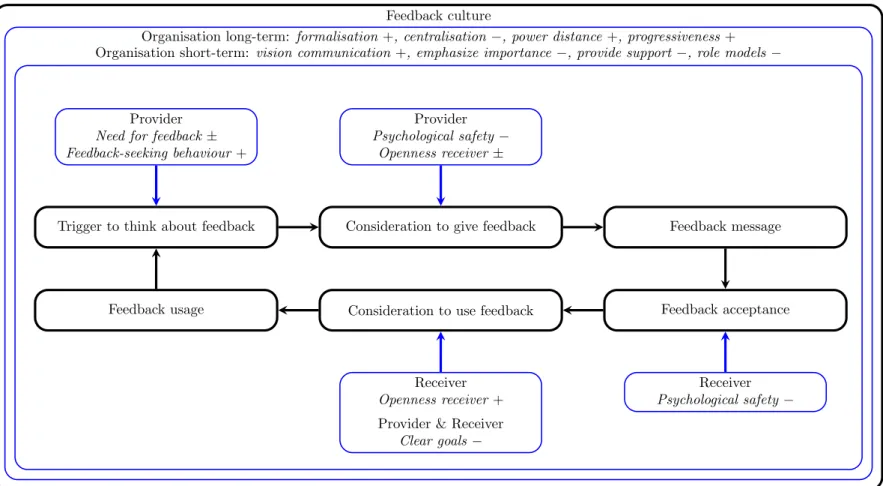
trigger, a formal feedback setting or an occurrence on daily basis that alerts the provider, makes the provider consider whether or not to provide feedback. When decided to give feedback, the provider gives the message to the receiver. Based on the quality of the message, the receiver does or does not accept the feedback. When the receiver accepts the feedback, he considers whether or not he is going to use the feedback. If the receiver decides to use the feedback there is finally the feedback usage.
Several variables have been shown in research to have an effect on the feedback process which can be used by an organisation to implement a feedback culture. Advice on how to succeed will be given for every variable. Research does not much differentiate between variables that differ in their influence for different feedback approaches. Only three variables specifically apply for performance feedback, as will be indicated at the discussion of these variables. Aside from these variables, no distinction will be made between variables that influence different feedback approaches.
The variables can be designated to two levels: (1) employees and (2) the organisation. The employee level refers to variables that are related to thoughts and the behaviour of employees and interactions between them as feedback providers and feedback receivers. The organisational level refers to variables related to the organisation itself. The feedback process and its influencing variables as discussed in this section will lead to the conceptual model on which further research is based.
2.4.1
Employee level
Five variables on the employee level influence the feedback process. The variable that is relevant first in the feedback process is a clear need. When an individual notices a situation where he is convinced feedback is necessary, he will sooner be inclined to provide feedback compared to a situation where the individual is not convinced of the necessity of feedback (Hoffman et al., 2005; Morran et al., 1998). Hoffman et al. (2005) give the example of behaviour that according to the provider interferes with the development of the receiver. When the provider is convinced that the noticed behaviour harms the development of the receiver, he will easily be inclined to give feedback (Hoffman et al., 2005). A clear need therefore stimulates the provider to consider feedback giving, which is the first phase of the feedback process. Hoffman et al. (2005) suggest that trainings could be offered by the organisation to learn to recognize when feedback can be necessary and appropriate. It can also be argued however that the organisation can stimulate the employees and managers to give feedback every time they think it can be given, although this approach might be less effective than a training.
After an individual is triggered to think about feedback, he will consider whether or not he is going to provide the feedback. This consideration is influenced by the psychological safety of the provider, which implies that individuals need to feel safe to provide and to use feedback (Van der Rijt, Van de Wiel, et al., 2012; Edmondson, 2008). Psychological safety is present when an employee feels free to give critical feedback to others, and to use feedback without the need to be afraid of negative consequences for his self-image, status, or career (Van der Rijt, Van den Bossche, Segers, & Gijselaers, 2012). Edmondson (2008) states that “psychological safety makes it possible to give tough feedback (...) without the need to tiptoe around the truth” (p. 6). Lacking psychological safety causes the employee to fear loss of self-image or status as a result of making mistakes. As a consequence the employee will not give or use feedback. Therefore, psychological safety of both the provider and receiver is a precondition to implement a strong feedback culture in an organisation. According to Edmondson (2008) organisations can stimulate psychological safety. He argues that role models need to demonstrate openness, humility and curiosity to show that feedback does not need to have negative consequences. When individuals experience that feedback is not necessarily negative, they experience a safe environment to give and use feedback. As a result, psychological safety is stimulated.
The consideration to give feedback is also affected by openness to feedback of the receiver. When an employee is open to feedback, he is willing to listen to and use feedback in order to develop himself (Hoffman et al., 2005). Hoffman et al. (2005) suggest that when a receiver is open to feedback he will be more motivated to use feedback. They also suggest that when the individual is open to feedback the feedback provider will more quickly decide to provide feedback than when the other is not open to feedback. Suggestions for stimulating openness to feedback are not made by literature. It can be argued however that since psychological safety is stimulated by role models and psychological safety is also about the state of mind, openness can be stimulated by role models as well.
After the feedback has been accepted by the receiver, the receiver will consider whether or not he will use the feedback. The variable that influences this phase of the feedback process is the presence of clear goals of the receiver. In case of performance feedback, clear goals need to be present in order to use the feedback (Smither, Brett, & Atwater, 2008; Ilgen et al., 1979; Hewson & Little, 1998). Goals are clear when they are measurable. Measurability assures that close to no disagreement can arise in the evaluation about the achievement of the goals (Shute, 2008). Ilgen et al. (1979) argue that it is difficult to evaluate performance without goals and that feedback will be difficult to interpret and apply. Specific feedback without goals leads to knowledge of the receiver about what has been done in the task, but his performance remains uncertain. When the feedback is general as well it has no value, since the receiver has not gotten suggestions for improvement and it remains unclear how well he has performed. Clear goals are thus a precondition to use performance feedback and should be established by both the feedback provider and receiver. Literature does not however discuss the relationship between clear goals and feedback levels other than the performance level.
To conclude, five variables on the employee level influence the feedback process. These variables are summarised in Table 2.
2.4.2
Organisational level
Table 2
Employee variables that influence the feedback process
Variable Influenced employee Influenced feedback phase
Clear need Provider Trigger to think about feedback
Feedback-seeking behaviour Provider Trigger to think about feedback
Psychological safety Provider Consideration to give feedback
Receiver Consideration to use feedback
Openness receiver Provider Consideration to give feedback
Receiver Consideration to use feedback
Clear goals Provider & Receiver Consideration to use feedback
Long-term organisational variables
On the long term, four variables have an influence on the feedback process. First, formalisation has been found to influence the amount of formal feedback employees receive in the organisation (Medcof & Song, 2013; Katsikea, Theodosiou, Perdikis, & Kehagias, 2011). Formalisation is by Katsikea et al. (2011) defined as “the extent to which work activities are defined formally by administrative rules, policies and procedures” (p. 224). They found that since formalisation results in a uniform and structured process of information exchange between employees and their managers, formalisation is positively related to performance feedback. Formalisation of rules, policies and procedures can thus be used to implement meetings for performance feedback in an organisation. It must be noted however that the relationship between formalisation and feedback is only about formal feedback. No research has yet been done about formalisation and informal feedback.
Related to the formalisation of processes in the organisation, centralisation is shown to be related to formal feedback as well. Katsikea et al. (2011) define centralisation as “the inverse of the amount of delegation of decision-making authority throughout an organization, and the extent of participation by organizational members in decision-making” (p. 224), which is the second long-term organisational variable to influence the feedback process. Their research revealed that in a highly centralised organisation, the top management feels an increasing pressure to achieve the objectives of the organisation, while it simultaneously understands that organisational successes depend on outcomes of the employees. The top management therefore feels the need to monitor the activities and performance of the employees. Katsikea et al. (2011) however also found that organisational size moderates the positive relationship between centralisation and formal feedback. The relationship is stronger for small sized organisations than for large sized organisations, although the relationship remains significant (Katsikea et al., 2011). As with formalisation, centralisation is related to formal feedback. A relationship between centralisation and informal feedback has not been researched yet.
determine the behaviour of S and the extent to which S can determine the behaviour of B” (p. 83). Power distance is thus determined by the hierarchical layer of both parties involved with the feedback.
It is argued that the higher the provider in the hierarchy compared to the receiver and thus the greater the power distance, the more the receiver will be inclined to use the feedback (e.g., Zagenczyk, Gibney, Murrell, & Boss, 2008; Brutus et al., 2006; Khatri, 2009; Madlock, 2012; Hoogervorst, Van den Flier, & Koopman, 2004). When the feedback provider is higher in the hierarchy, he will thus have less difficulty in persuading the receiver to use the feedback. On the contrary, when the provider is lower in the hierarchy, he will have more difficulty to persuade the receiver to use the feedback. Brutus et al. (2006) discovered that feedback receivers expe-rienced difficulties in accepting feedback from non-supervisory sources. The research of Brutus et al. (2006) was performed in different countries with different cultures, but the phenomenon of difficulties regarding to the power distance was consistent. A solution proposed by Brutus et al. (2006) is that the top of the organisation needs to communicate the importance of providing and using feedback to all employees and managers, so awareness will be raised and more careful considerations will be made to use feedback (Brutus et al., 2006).
Power distance can be informal as well. Diefenbach and Sillince (2011) explain informal hi-erarchy as “unofficial stratification among members of a social system because of conscious or unconscious social processes” (p. 1516). Informal power distance thus refers to a difference be-tween two individuals based on social processes within for example an organisation. To conclude, power distance is the third long-term organisational variable that influences the feedback culture of the organisation. A difficulty that arises however is when the organisation wants everybody to give feedback to everybody, feedback will also be given and received between colleagues on the same hierarchical level. As will be explained in the next section however, communication can be used to overcome this barrier.
The final long-term variable on organisational level that influences the feedback process is by Hoogervorst et al. (2004) referred to as the organisational culture. Organisational culture is about collective convictions and refers to basic values and beliefs that are shared among the employees (Hofstede, 2001; Hoogervorst et al., 2004). Hoogervorst et al. (2004) discovered that three dimensions of organisational culture affect the behaviour of employees: (1) excellence, (2) encouragement and (3) adaptability. Excellence represents convictions about excellent work per-formance. In an organisational culture with a focus on excellence, the employees and managers have a desire for excellent performance. Encouragement represents convictions about putting ideas into action and the openness to try out new ideas. In an organisational culture with a focus on encouragement, the employees and managers are open to change. Adaptability rep-resents convictions about the necessity to change and to adapt to external conditions. In an organisational culture with a focus on adaptability, the employees and managers are motivated to adapt their work if required by external factors. These cultural dimensions have been shown to have a positive relationship with openness of individuals in such a way that a change in the organisational culture corresponds to a change in openness (Hoogervorst et al., 2004), which is as previously discussed a variable that influences the feedback process. As a consequence, organ-isational culture is an influencing variable as well. It must be noted however that organorgan-isational culture is a broader concept than Hoogervorst et al. (2004) use. For example, the feedback culture of an organisation can be defined as part of the organisational culture. It is therefore wise to use a different variable name, which is why the final long-term organisational variable in this research will be defined as progressiveness, which relates more specifically to the three dimensions that influence the feedback culture of an organisation.
therefore stimulate the overall implementation of a strong feedback culture. Table 3
Long-term organisational variables that influence the whole feedback process
Variable Influenced employee Influenced feedback phase
Formalisation Provider & Receiver All phases
Centralisation Provider & Receiver All phases
Power distance Provider & Receiver All phases
Progressiveness Provider & Receiver All phases
Short-term organisational variables
On the short-term, organisations can take four steps that have an influence on the feedback process. These steps are not order sensitive, but they are actions the organisations can take to create a feedback culture. The first step is for the top management to develop a vision and to communicate this vision to the employees and managers of the organisation (Kotter, 2012; Brutus et al., 2006). The vision needs to be feasible, easy to communicate, emotionally appealing and strategically smart (Kotter, 2012). A feasible and communicable vision is clear when all employees and managers understand what needs to be done when the vision is shared with them. An emotionally appealing vision implies that it can become an internal motivation for individuals and therefore needs to have a positive nature. A strategically smart vision implies that it contributes to the competitive advantage of the organisation (Kotter, 2012).
The vision needs to be formally communicated to the employees and managers of the or-ganisation in order to become a vision of the whole oror-ganisation (Kotter, 2012). Brutus et al. (2006) have determined that communication of the vision is an important action from the top management in order to implement a feedback strategy as a result from the established vision. Without formal communication, haziness arises among employees and managers and difficulties in feedback acceptance might outweigh the motivation to provide and use feedback (Brutus et al., 2006). Vision communication is thus a variable that stimulates a feedback culture in the organisation.
With the presence of vision communication, the vision about feedback is formally commu-nicated to the employees of the organisation. The importance of this vision however can also be emphasized informally, which is the second step the organisation can take to implement a feedback culture. Emphasizing importance is not a formal communication tool, but it lies in the implicit communication to make employees and managers intrinsically belief in the importance of feedback. Hoogervorst et al. (2004) state that congruence between the formal and informal communication is a precondition in order to successfully change behaviour of employees and managers. As a result, to implement a feedback culture, the formal and informal communication need to be congruent. When through formal communication employees are asked to give and use feedback while this is neglected on the work floor, employees will take the request for a feedback culture less seriously. Consequently, the implementation of a strong feedback culture will be less successful.
of their own experience. Both actions are examples of ways to match the formal and informal communication, which stimulates the feedback process.
When the organisation communicates its vision in a formal and informal way, the next step is to provide support to the employees to give and use feedback. When employees and managers get the tools to give and use feedback, individuals are likely to become positively oriented to-wards feedback (London & Smither, 2002). Such a positive orientation is necessary in order to implement a strong feedback culture, because individuals are more likely to give, accept and use feedback if they are positively oriented (London & Smither, 2002).
The support of the organisation can be providing a training to learn how to give useful and constructive feedback and to learn how to receive feedback. Organisational support can also be providing opportunities to discuss the concept of feedback (Morran et al., 1998), or the feedback employees and managers received in order to clarify the feedback and create understanding (London & Smither, 2002). Organisational support thus is about creating opportunities for employees and managers that make it easier for them to provide, accept and use feedback. As a result the process of implementing a strong feedback culture is facilitated.
When organisational support is present, the organisation can encourage the employees and managers to give, use, and ask for feedback by making an agreement with managers and a se-lection of employees to function as role models. A role model can be defined as an individual in the organisation regardless of his position in the hierarchy who works in line with the communi-cated vision (Arrata, Despierre, & Kumra, 2007; Kotter, 2012; Morran et al., 1998). When the organisation has the vision of a strong feedback culture, the role models will give feedback to colleagues and accept and use the feedback they receive themselves, regardless of the hierarchical position of the other.
Morran et al. (1998) state that “one of the most powerful tools for encouraging member-to-member feedback is for the leader to regularly model the giving of feedback (...)” (p. 263). When a manager functions as a role model the organisation shows that the people in the organisation who communicate the vision also follow their own conviction, instead of not executing their own vision and creating scepticism among the employees (Oxtoby, McGuiness, & Morgan, 2002). London and Smither (2002) argue that role models in the organisation have two positive effects on the feedback culture. First, since everybody frequently witnesses providing and using feedback, feedback becomes more normal and natural to them. The perception of feedback being normal to give and to use stimulates individuals to give and use feedback themselves, resulting in a strong feedback culture. Second, role modelling contributes to a positive orientation towards feedback since they frequently witness the effects of giving and using feedback. As previously discussed, such a positive orientation is necessary in order to implement a strong feedback culture, because individuals are more likely to give, accept and use feedback if they are positively oriented (London & Smither, 2002). A precondition is that role models should give feedback according to the guidelines as previously explained, otherwise the feedback will not be accepted by the receiver.
To conclude, there are four short-term organisational variables that influence the feedback process. These variables are summarised in Table 4.
Table 4
Short-term organisational variables that influence the whole feedback process
Variable Influenced employee Influenced feedback phase
Vision communication Provider & Receiver All phases
Importance emphasizing Provider & Receiver All phases
Support providing Provider & Receiver All phases
2.4.3
Conceptual model
Literature has shown thirteen variables to have an influence on the feedback process which make it possible to implement a strong feedback culture in an organisation. The variables on organi-sational level influence the whole feedback process. They influence the triggers, considerations, acceptance and use of feedback. The openness of the receiver towards feedback influences both the consideration to give and to use feedback. Psychological safety influences the consideration to give feedback and the feedback acceptance. The other variables influence one of the phases in the feedback process. In Table 5 the feedback process and the variables by which it is influenced is summarised.
FEEDBA
CK
PR
OCESS
19
Variables influencing the feedback process
Phase Variable Definition Function
Feedback process as a whole Centralisation* The inverse of the amount of delegation of decision-making authority
through-out an organisation, and the extent of participation by organisational members in decision-making
Stimulation
Formalisation* The extent to which work activities are defined formally by administrative
rules, policies and procedures
Stimulation
Power distance The distance between the feedback provider and the feedback user determined
by the hierarchical layer of both
Stimulation
Progressiveness Collective convictions about basic values and beliefs that are shared among
employees in terms of excellence, encouragement and adaptability
Stimulation
Vision communication The degree to which the management of the organisation formally
communi-cates with employees about feedback
Stimulation
Importance emphasizing The degree to which the management of the organisation informally
commu-nicates with employees about feedback
Stimulation
Support providing Support from the organisation to provide and use feedback to and from each
other
Stimulation
Role models Presence of employees/managers who provide colleagues with (high quality)
feedback and use the feedback they get themselves as an exemplary role
Precondition
Trigger to think about feedback Clear need The felt need of the provider to give feedback to the receiver with the intention
to help the receiver to develop himself
Stimulation
Feedback-seeking behaviour The seeking of feedback from a colleague by a colleague Stimulation
Consideration to give feedback Psychological safety of the provider Provider’s feelings of freedom to give (critical) feedback to
col-leagues/managers without the need to be afraid of negative consequences for his self-image, status, or career
Precondition
Openness receiver The degree to which an employee is willing to listen to and use feedback in
order to improve himself
Stimulation
Feedback acceptance Psychological safety receiver Receiver’s feelings of freedom to give (critical) feedback to colleagues/managers
without the need to be afraid of negative consequences for his self-image, status, or career
Precondition
Consideration to use feedback Openness receiver The degree to which an employee is willing to listen to and use feedback in
order to improve himself
Stimulation
Clear goals* Measurable goals, agreed by supervisor and employee, about the development
and ’successful’ executing his work, so the provider can use these goals in the providence of normative feedback
Precondition
CHAPTER
2.
THEORETICAL
FRAMEW
ORK
Feedback culture
Organisation long-term: formalisation*, centralisation*, power distance, progressiveness
Organisation short-term: vision communication, emphasize importance, provide support, role models
Trigger to think about feedback Consideration to give feedback Feedback message
Feedback acceptance Consideration to use feedback
Feedback usage Provider
Need for feedback Feedback-seeking behaviour
Provider
Psychological safety Openness receiver
Receiver
Openness receiver
Provider & Receiver
Clear goals*
Receiver
Psychological safety
CHAPTER
3
Methodology
This research is aimed to overcome the gap from a weak to a strong feedback culture in the organisation. Literature has clarified variables that need to be present in an organisation in order to implement a strong feedback culture. Sequential, this research needs to reveal to which degree these variables are already present in the organisation and on which variables the organisation needs to focus most in order to implement a strong feedback culture.
This research is executed as an empirical qualitative survey research. Qualitative research can provide insights into why the needed variables are existent in the organisation or not. Survey research provides a cross-sectional view of the organisation, enabling to research a larger group while qualitative data is used (Baarda, de Goede, & Teunissen, 2009).
3.1
Research group
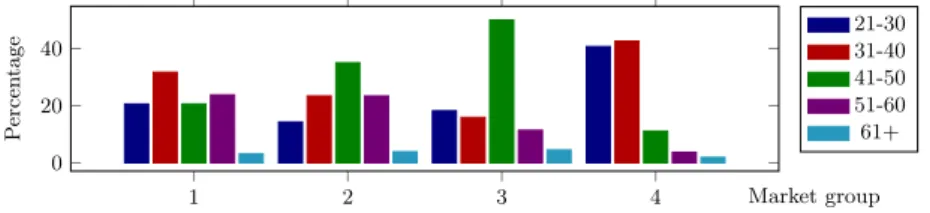
Nedap consists of nine different market groups. Two of these market groups will be researched. To select two of these groups a selection was based on which groups are eligible to research. Three groups were excluded because of their small size compared to others and two groups were excluded because of a recent change of the market group leader, which could give noise to the research. Four market groups therefore formed the first selection. All groups were open to participate in the research; therefore the choice of two groups was based on comparability in age and years of service at Nedap.
1 2 3 4
0 20 40
Market group
P
ercen
tage
21-30 31-40 41-50 51-60 61+
Figure 2. Comparison of age between market groups
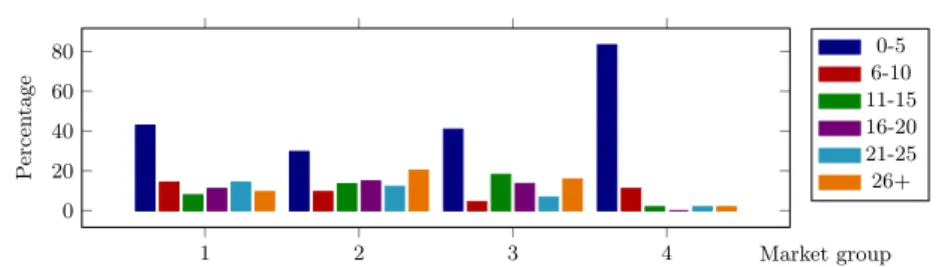
As can be seen in Figure 2 and 3, group 1 and group 2 are most similar to each other based on age and years of service of the employees. Therefore, group 1 and 2 will form the research group.
1 2 3 4 0 20 40 60 80 Market group P ercen tage 0-5 6-10 11-15 16-20 21-25 26+
Figure 3. Comparison of years of service between market groups
Of both market groups, three teams will be researched. The choice is based on the comparability of the three teams of both market groups in team function, age of employees and years of service at Nedap. To start, as can be seen in Figure 4 and 5, team 1 of market group 1 and team 1 of market group 2 are similar in age. As can be seen in Figure 6 and Figure 7, the same teams are also similar in years of service of the employees. Therefore, these two teams will be researched. Second, it can be seen that team 5 of market group 1 and team 7 of market group 2 have a similar pattern in age of the employees. Both teams have relatively more elder employees compared to the number of younger employees. Since these teams are also comparable in their function, both will be researched. Third and final, it can be seen that team 7 of market group 1 and team 6 of market group 2 are comparable in age and years of service. They are also comparable in their team function. Therefore, these teams will be researched as well.
1 2 3 4 5 6 7
0 2 4 Team Num b er of emplo y ees 21-30 31-40 41-50 51-60 61+
Figure 4. Age of employees of teams market group 1
1 2 3 4 5 6 7 8 0 2 4 Team Num b er of emplo y ees 21-30 31-40 41-50 51-60 61+
Figure 5. Age of employees of teams market group 2
1 2 3 4 5 6 7 0 2 4 6 Team Num b er of emplo y ees 0-10 11-20 21-30 31-40
Figure 6. Years of service of employees of teams market group 1
1 2 3 4 5 6 7 8 0 2 4 Team Num b er of emplo y ees 0-10 11-20 21-30 31-40
Figure 7. Years of service of employees of teams market group 2
Within both market groups three teams will be researched. Every team has a team captain. The team captain does not function in a different hierarchical layer than the other team members, but the team captain is appointed to give a direction to the team and to make final decisions. Therefore the team captain may also have different views and experiences than other employees, which is why of every team the team captain participates in the research (n= 6). Finally, of every team two other employees next to the team captain will be researched since they also might have different views and experiences (n = 12). Due to a limited time for the research not every team member can participate in the research. However, since the team members are chosen such that for every team a younger, an average in age and an older employee participate in the research, these team members are representative for the whole team. Representativeness is more important than large numbers of respondents (Baarda et al., 2009). Therefore it is not considered a problem to use only part of the teams in the research.
To summarise, the research group consists of two market group leaders, six team captains and twelve other employees within the six teams (n= 20). The average age of the whole respondent group is 39. The median of 37 is slightly lower. The average tenure of the respondent group is 8. The median however is 5, indicating that some respondents have been working at Nedap relatively long compared to the other respondents.
3.2
Data collection
1. Message: feedback sign 2. Message: feedback formality 3. Message: feedback subject
Researching these added variables helps to determine to what extent these types of feedback are already given according to the respondents, why, and what employees and managers of Nedap think that needs to happen in order to start giving feedback about both subjects. Finally, the variable “openness of the other” has been added to the operationalization. Openness occurs twice in the conceptual model. The first time it influences the provider in his decision to give feedback. The second time it influences the receiver in his decision to use feedback. These occurrences count for different points of views (the view of the provider towards the receiver and the view of the receiver himself). Since the first view is about the way the provider perceives the openness of the receiver, the variable openness of the other is introduced.
In total there are seventeen variables in the operationalization. Each variable has been defined and based on these definitions and explanations in literature, dimensions have been assigned to every variable. Finally, characteristics of every dimension were defined in order to have indicators for the variables in the data analysis. For example, power distance is defined as the distance in power between the feedback provider and the feedback receiver. The power distance can be formal and informal, which are two dimensions. Formal power distance is based on hierarchy, which is why employees, line managers and top management are its indicators. The full operationalization can be found in Appendix A.
3.2.1
Observations
Once a year the CEO of Nedap gives a presentation to each market group about the state of affairs of the organisation. This year, the announcement that a strong feedback culture will be implemented in the organisation is included. The presentations for both market groups are observed. The observations are focused on both the message of the CEO and on the reactions of the employees on that message. The goal of the observations is to get a first impression of the current situation of both market groups and to observe the first reactions of the employees on the subject.
An observation form was made based on the variables that resulted from the theoretical framework. All variables are listed and comments that are made and behaviour that is shown will be quoted in the cell of the matching variable.