Name: Anouk Hölzken Student number: s1677225
Faculty: Behavioural, Management, and Social Sciences Master Educational Science and Technology University: University of Twente
Supervisors: T. Hirschler MSc and Dr. S. van Aalderen Organisation: Gelre Ziekenhuizen
Date: 22nd of December, 2016
EXPERIENCED FEEDBACK AND MINDSET OF NURSES
A research on the obstructing and stimulating aspects of the feedback process in
Abstract
Due to several changes within healthcare, continuous learning becomes more important for nurses. One way to continue one’s development, is the use of informal feedback, also known as the provision of feedback between equal colleagues. However, literature showed to be ambiguous regarding aspects that can influence the feedback process between nurses. To add, whether such experiences regarding the feedback environment could be dependent of the underlying implicit factor that is known as a mindset, was still unknown. An online questionnaire gathered qualitative and quantitative data among nurses within a Dutch hospital to answer these two questions. The qualitative results showed several obstructing and stimulating aspects that influence the feedback process, such as the openness, safe environment, relationship, and personal situation of the nurses. Furthermore, whether feedback is favourable or unfavourable has a high impact on the experiences, and thus nurses emotions, as well. More research is needed to determine the order of influence these aspects have on the feedback environment and therefore the eventual learning effect. To add, the quantitative results showed some significant relationships between the mindsets of the nurses and scales of the feedback environment. The mindset seems to influence whether the nurses find the feedback valuable and whether they trust their colleagues who provide feedback. This study did not show other significant relationships. It is expected that other possible relationships did not occur, as many other aspects showed to have an influence on the experienced feedback environment. Future research is needed to study this assumption.
Acknowledgements
This thesis is the final project of my Master Educational Science and Technology at the University of Twente.
When finishing high school I knew two things; I wanted to learn something about ‘management’, and I wanted to work with people. I started with the first by registering for my Bachelor in Facility Management at Saxion. During these years of studying I realised I missed my second goal, working with people. As the thought of continuing to be a student for a couple more years also sounded pretty attractive to me, I started looking for a suitable Masters education. I then found EST, which immediately sounded like the perfect study as it made the combination between business administration, human resource development, and a little bit of psychology. During the last two years I had the chance to not only extend my student days, but to develop myself into the subject of how people can develop themselves within organisations (ironic isn’t it?). When graduation came closer, I got the wonderful opportunity to apply my gathered knowledge in practice with an internship at Gelre Ziekenhuizen. During this period I had the chance to work on several projects, with different responsibilities. I experienced some bigger projects from the sidelines, but also got assigned some projects on my own, both valuable learning opportunities. Moreover, I could perform my own research within this hospital. The advantage of graduating is that you can pick a subject that suits you. As I have always been interested in psychology and the behaviour of people, I chose feedback. A concept that is either loved or hated. To make it even more interesting, my lovely colleague Sandy from ‘het Leerhuis’ suggested to add mindset to the mix, making it the perfect subject for me. After my subject was chosen and my internship was started, a turbulent year followed, with a lot of ups and downs in both my personal and professional life. Looking back, I am grateful for all the people who helped me through this year and my thesis. To start, I would like to thank my first supervisor from the University, Tim, who supported me with the process of writing, structuring, and this ambiguous thing that is called ‘statistics’. I would also like to thank my second supervisor, Sandra, who entered my graduation process last-minute but still managed to help me through the last weeks with her extensive knowledge regarding the implicit theories. Furthermore, I want to give a special thanks to Jettie, who was not only my mentor and coach, but always provided a listening ear when necessary as well. Thank you for your encouraging words, critical questions, and our lively discussions. I would also like to thank my friends, family, and boyfriend, who supported me throughout the entire year by providing encouraging advice, some necessary hugs here and there, and even their homes. All these important people in my life provided me the confidence I needed to successfully finish my thesis.
Thank you.
Anouk Hölzken
Table of Contents
Introduction 5
Literature Review 7
Method 15
Results 21
Discussion 30
References 36
Appendix A 41
Appendix B 44
Appendix C 46
Introduction
The perception of health has greatly changed over the years. In 1948 the World Health Care Organization (WHO) defined health as “a state of complete physical, mental and social well-being”. However, this definition is currently being reviewed after criticism as it does not fit today’s society anymore. The definition proposed by Huber et al. (2011), where health is described as “the ability to adapt and implement one’s own control, in light of the physical, emotional and social challenges of life” (p. 3), shows that the focus is changed. More attention goes towards dealing appropriately with health issues with more expected autonomy from the patients. This shift influences the job of nurses, as patients are expected to take more control regarding their own care. Furthermore, the complexity of the provided care will increase, while the length patients stay in the hospital will decrease. These changes make it necessary for nurses to continuously learn so they are able to adjust to these changes (Berings, 2006).
The importance of continuous learning is also included in the report of V&V2020. This report, commissioned by the Dutch department of health, discusses the new perspective on health and how healthcare should look like in the year 2020. This report influences the policy of Dutch hospitals. According to V&V2020, one tool that can be used to improve learning is informal feedback, also known as feedback among colleagues (V&VN, 2016). Such informal feedback can be considered a crucial factor in any learning process (Van der Rijt et al., 2012). More specifically, Van de Ridder, Stokking, McGaghie and Ten Cate (2008) added that informal feedback is a crucial element in clinical learning situations. Overall, informal feedback can be considered a valuable learning tool and when used optimally it can result in an increase of informal learning, a better collaboration, more competent employees and better patient care (van de Ridder, McGaghie, Stokking & ten Cate, 2015). These results are all in line with the healthcare vision for the year 2020 (V&VN, 2016).
Furthermore, it is known that the feedback effect, and therefore the desired learning effect, is also influenced by the way the feedback is interpreted by the feedback receiver (Van de Ridder et al., 2015). Literature shows that the interpretation towards challenges, setbacks and learning moments can be influenced by a person’s mindset (Dweck, 2000). Dweck (2012) describes two different types of mindsets, a fixed mindset and a growth mindset. These mindsets are also known as implicit theories of intelligence. When people hold a fixed mindset, they believe that their core qualities are built-in and fixed by nature (entity theory). Hence, they believe that their abilities cannot be improved. Therefore, they have the tendency to perceive setbacks as an affirmation that they cannot do something. People holding a growth mindset believe that their qualities can be developed through nurture and their own persistent efforts (incremental theory). They are more open to challenges and learning opportunities (Dweck, 2012). To add, research also showed that the mindset of a person is malleable. By using the right interventions it is possible to influence a person’s mindset more towards a growth mindset, which is valuable information as this also changes the way people perceive setbacks (Blackwell, Trzesniewski & Dweck, 2007). This study therefore suggests that nurses can either experience informal feedback as a learning opportunity where nurses can improve their abilities, or as a setback and confirmation of inability. Consequently, the second part of this study will focus on investigating the relationship between the experienced informal feedback environment of the nurses with their mindset.
To sum up, as a learning effect is eventually desired, a better insight into the experienced informal feedback environment of nurses is necessary to determine what aspects can positively or negatively influence this feedback effect. Therefore, obstructing and stimulating aspects that influence the feedback process will be explored. In addition, this study will investigate whether a nurses’ mindset influences the way they experience such an informal feedback environment. When a significant positive relationship is shown, this information could help to change nurses’ mindsets and maybe positively change their experiences towards feedback with it.
Outline Report
Literature Review
This study focusses on two concepts, namely the informal feedback environment and implicit theories of intelligence, also known as the mindset. Both will be discussed in this literature review.
Informal Feedback Process
This current study will focus on the informal feedback process between nurses as equal colleagues. Formal feedback practices, such as 360-degree appraisals with supervisors, will therefore be omitted. Informal feedback happens promptly during day-to-day interactions between colleagues and is “a dynamic communication process occurring between two individuals that convey information regarding the receiver’s performance in the accomplishment of work related tasks” (Baker et al., 2013, p. 260). As there is a wish of hospitals to have nurses as lifelong learners, it is not surprising that informal feedback is considered to be an important aspect according to the report of V&V2020 (V&VN, 2016). Berings (2006) stated that “professionals all agree that nurses need to learn continuously and that on-the-job learning is significant if this is to be achieved” (p. 88). As nurses work closely with each other on a day to day basis, on-the-job learning can easily occur as colleague nurses can be a big influence on each other’s development (V&VN, 2016). Eraut (2006) adds that nurses who work closely alongside each other, are able to continuously learn from each other by asking questions and learn from provided feedback regarding shared activities. He also states that the ongoing monitoring of colleagues influences nurses’ tacit knowledge (Eraut, 2006). The influence of informal feedback on the learning process has long been recognized by Ericsson, Krampe and Tesch- Römer (1993) who stated that “in the absence of adequate feedback, efficient learning is impossible and improvement only minimal even for highly motivated subjects” (p. 367). This influence is also recognized in more current studies which emphasize that informal feedback is considered to be of high importance in any learning process (Van de Ridder et al., 2015; Baker et al., 2013; Van der Rijt et al., 2012).
Practical aspects. The communication message from the feedback provider towards the feedback receiver and the interpretation of this feedback message can firstly be influenced by five practical aspects (Rummler & Brache, 1995). First of all, the feedback message must be relevant. Each feedback receiver has a goal, the feedback should be related to this goal, or the receiver is not going to change towards the desired behaviour (Baker, 2010). Secondly, the feedback message should be accurate, meaning that the receiver recognizes the feedback. Inaccurate feedback has adverse effects such as distraction of the desired behaviour or losing trust (Baker, 2010). Thirdly, it is best when feedback is given within a suitable time frame so that the receiver is willing to change any undesired behaviour as quickly as possible (Baker, 2010; Baker et al., 2013). Fourthly, the provider should make sure they give specific feedback, which has a higher impact than generalized statements (Baker, 2010). Lastly, it is of high importance that the feedback is also understandable for the receiver or no feedback effect will be reached (Baker, 2010; Rummler & Brache, 1995). The above discussed components are mostly practical guidelines for the feedback provider to abide. According to Baker (2010), informal feedback that is missing one or more of these five aspects can have a short-term ineffective effect on the feedback process. However, consistent misuse or missing of these components, can even have a long term ineffective effect on the total feedback environment (Baker, 2010).
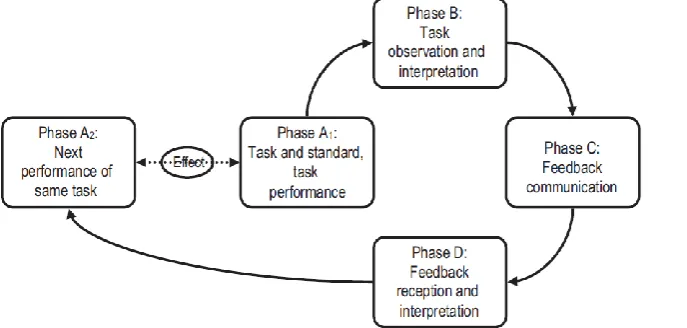
Figure 1: Representation of feedback process phases A1, B, C and D, and the feedback effect, which becomes apparent when two performances are compared (∆A2–A1) (Van de Ridder et al., 2015).
The feedback environment “refers to the contextual aspects of day-to-day … co-worker-coworker feedback processes” (Steelman et al., 2004, p. 166). Instead of determining how one single loop of the feedback process is experienced, as with the above mentioned components, the feedback environment focusses on the experienced feedback in general. There are seven aspects that determine the feedback environment. Firstly, the source credibility shows the provider’s expertise. This means if the feedback provider is aware of the receiver’s job responsibilities and performance. This aspect shows the trustworthiness of the provider during the provision, which can ultimately cause the receiver to trust the feedback he or she receives (Steelman et al., 2004). Secondly, the feedback quality should be of acceptable standards to the receiver. This means that the feedback message should be consistent and useful. Therefore, the feedback may not be influenced by
How the receiver assesses the informational value of the informal feedback eventually determines if the receiver is going to apply such feedback (Ilgen, Fisher & Taylor, 1979). Thirdly, the feedback delivery also influences the reaction of the feedback receiver. Very simply stated; “the more considerate the feedback source is when providing feedback, the more likely an individual is to accept and respond to the feedback” (Steelman et al., 2004, p. 167). Fourth and fifth, feedback can be favourable as in compliments, or unfavourable as in expressions of dissatisfaction. The way these types of feedback are interpreted are not necessarily dependent “whether the recipient likes the feedback” (Steelman et al., 2004, p. 168), but more whether, after reflection, the feedback is considered to be accurate (Steelman et al., 2004). Sixth, source availability shows the ease in which feedback can be obtained, making this aspect more of a prerequisite of the complete feedback process. The seventh and last construct shows if the organisation promotes feedback seeking. This means whether the environment supports or does not support the seeking of feedback and whether employees feel comfortable enough asking for feedback (Steelman et al., 2004). These seven aspects can be quantitatively measured, which helps to determine the experienced (informal) feedback environment within a team. The way these practical aspects are used by the feedback provider and experienced by the feedback receiver, can determine whether the feedback helps “to increase performer ability” (Baker, 2010, p. 481), or causes to have “a negative effect on future performance” (Baker, 2010, p. 481). However, according to Young (2000), the way feedback is experienced is not always related to students’ abilities, to the received assessments, or to the positive or negative nature of the feedback, it is however largely related to their self-esteem (Young, 2000). The following part of this review therefore focusses on social aspects.
Feedback effects. The above discussed aspects do not only affect phase C and D of the feedback process, but eventually affect the difference between A1 and A2. Several studies have shown that a lack of effect, where received feedback is simply not applied, is not the biggest risk of the feedback effect (e.g. Archer, 2010). For example, feedback receivers might find the received comments tedious, unusable, judgemental or too controlling (Archer, 2010). Even more important; “negative feedback can evoke negative feelings and interfere with its acceptance” (Sargeant et al., 2008, p. 275). This is explained by Trope, Ferguson and Raghunathan (2001), who state that, especially negative, feedback has the ability to discourage people with all kinds of emotional costs. It can lead to lower self-esteem, feelings such as shame and unhappiness, and disappointment in one’s self ability. It is therefore pivotal for organisations to limit such negative emotional responses, as this can disrupt learning (Mangels et al., 2012).
Such negative thoughts regarding feedback were also shown to be present in a Dutch hospital (Jochems, 2016). Nurses seemed to have difficulties with providing feedback as a negative reaction from the receiver was expected. This study also emphasized that further research was necessary to determine the reason behind these difficulties with feedback responses (Jochems, 2016). Furthermore, as other literature concerning Dutch healthcare showed that feedback has the ability to decrease nurses’ well-being, it is of high importance to know what type of aspects have the ability to cause such negative feedback effects (Giesbers, Schouteten, Poutsma, Van der Heijden & Van Achterberg, 2015). The first part of this current study will therefore investigate whether the practical and social aspects that influence phase C and D known from literature are important for nurses as well. This will be done by exploring obstructing and stimulating aspects that can influence the experienced informal feedback environment.
Mindset
A mindset, otherwise known as ‘implicit theories of intelligence’, can be ‘fixed’ (entity theory) or ‘growth’ (incremental theory). These implicit theories show a person’s belief regarding their abilities, independent from their actual abilities. People holding a fixed mindset believe that “you have a certain amount of intelligence or talent and that’s that. You can learn new things, but you can’t change your ability” (Dweck, 2007, p. 1). On the other hand, people holding a growth mindset believe that “their abilities are things they can cultivate and develop throughout their lives. They believe that through effort and learning, they can become smarter or more talented” (Dweck, 2007, p. 1). However, it is important to emphasize that incremental theorists understand the influence of born ability such as talent and intelligence, but the belief that they can develop their abilities over time, differentiates them from entity theorists (Van Aalderen-Smeets & Walma van der Molen, 2016; Dweck, 2007). This theory can also be divided into a mindset regarding intelligence, or mindset regarding talent. From the intelligence point of view, people with a fixed mindset believe their intelligence is stable and fixed. They base their abilities on the amount of intelligence they are born with (Dweck, 2000). This means that such entity theorists are less motivated for learning, as they do not believe that it will improve their intelligence (Ommundsen, 2003). On the other hand, people with a growth mindset believe their intelligence is malleable and believe it has the potential to change or develop (Yeager & Dweck, 2012). Dweck (2015) states that such incremental theorists have a higher motivation for learning and self-development. From the talent point of view, people with a fixed mindset believe their talent is an innate trait (Chełkowska, Hyla & Baran, 2015). This means that such entity theorists base their abilities on their natural born talent (Ommundsen, 2003). They believe natural talent is “necessary in order to achieve a high level of proficiency” (Mercer & Ryan, 2010, p. 440). On the other hand, people with a growth mindset believe their abilities are a result of passion, discipline, training and practice (Dweck, 2007; Howe, Davidson & Sloboda, 1998). Such incremental theorists have more confidence in the power of hard work and effort (Mercer & Ryan, 2010).
It is important to indicate that “people can hold different implicit theories in different domains” (Dweck, 2000, p. 50). Meaning that, for example, people can believe that their foreign language learning talent is fixed, but their mathematical intelligence can grow (Dweck, 2007). However, the theory above also shows that the only difference between the talent mindset and intelligent mindset is whether people believe one or both of these traits is fixed or malleable. The behavior and effects of these implicit theories is basically the same. This literature review will therefore continue with ‘abilities’ as subject of a person’s mindset.
(Burnette, O’Boyle, VanEpps, ollack & Finkel, 2013, p. 660). Rather than doubting their own abilities, incremental theorists are able to turn such setbacks into learning moments (Dweck & Leggett, 1988). However, entity theorists perceive setbacks as a lack of ability and they feel personally measured by their setbacks and failure (Dweck, 2007). They do not like challenges and have the tendency to avoid these as they are afraid to look foolish or feeling inadequate (Dweck, 2006; Dweck, 2015). The reason behind this fear is that these individuals with a fixed mindset are more focused on displaying their abilities and performances to others, or comparing their abilities with others (Mercer & Ryan, 2010). However, this behavior makes them “easily loose self-confidence in case of failure” (Van Aalderen-Smeets & Walma van der Molen, 2016, p.4). Mercer and Ryan (2010) suggest that entity theorists “would be likely to set lower goals and not even attempt to strive for such perfection” (p. 440). Consequently, rather than learning from setbacks, they usually feel discouraged, can become defensive (Dweck, 2012), and can experience negative emotions such as anxiety (Van Aalderen-Smeets & Walma van der Molen, 2016; Burnette et al., 2013).
Furthermore, it seems that setbacks can also play a moderating role between entity beliefs and esteem. Literature shows that the mindset does not have a direct influence on a person’s self-esteem. However, Robins and Pals (2002) suggest that experiencing challenges or setbacks deteriorates the self-esteem of individuals with a fixed mindset relative to those with a growth mindset. In other words, when individuals with a fixed mindset experience a setback, their self-esteem decreases. However, when individuals with a growth mindset experience a setback, they tend to blame their failure to a lack of effort, which retains their self-esteem. This was shown by a study on students in college, a period with many challenges, where the gap of self-esteem between the two types of mindset widened significantly over a period of four years (Robins & Pals, 2002). To add, Niiya, Crocker and Bartmess (2004) showed that entity theorists’ self-esteem was lower after failure than after success, whereas such failure or success had no significant effect on incremental theorists.
Relationship between feedback and mindset
One other important and interesting aspect of this implicit theories, is that research shows the mindset to be changeable with the help of large-scale interventions (Blackwell et al.,2007), or small-scale interventions (Paunesku et al., 2015). Even though most studies regarding the implicit theories were performed with teachers and students in a school setting (e.g. Dommett, Devonshire, Sewter & Greenfield, 2013; Schroder, Moran, Donnellan & Moser, 2014), the results all show that changing a persons’ mindset by using the appropriate intervention is possible.
Research Questions
Following the information provided during the literature review, two research questions are formulated for this study:
Research question 1: What are the stimulating and obstructing aspects that influence the informal feedback process between nurses?
Research question 2: What is the relationship between the mindsets of nurses and their experience regarding the informal feedback environment?
Research Model
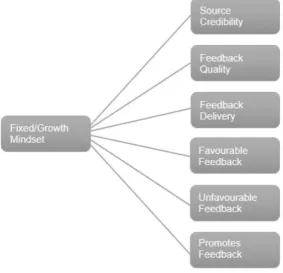
[image:14.595.81.365.362.635.2]To answer research question 2, the type of mindset will be measured together with six aspects that determine how feedback is experienced in an organisation. Figure 2 shows an overview of the research model with the theoretical concepts which were discussed during the literature review.
Method
In this chapter the research method is described. Firstly, the overall research design is explained, followed by the context of this study, the sampling procedures and the characteristics of the respondents. Subsequently, the used instruments with the proper validity and reliability checks are elaborated on. Finally, the data analysis is discussed.
Research Design
A mixed method design was chosen using an online survey that consisted of open and closed questions. Firstly, the qualitative part explored aspects that influence the informal feedback process. Secondly, for the quantitative part, a correlational study with a cross-sectional design was chosen to test the relationship between nurses’ mindsets and their experienced feedback environment. The mindset was the independent variable and the experienced feedback the dependent variable.
Context
This study is conducted in Gelre Hospitals, which has two large hospitals in the cities Apeldoorn and Zutphen of the Netherlands. The organisation has a total of 3.500 employees and around 25 nursing departments with approximately 800 nurses employed. Gelre Hospitals carry the STZ-status (‘Samenwerkende Topklinische opleidingsZiekenhuizen’), also known as Cooperating Topclinical Training Hospitals. This status shows that this organisation has a strong focus on research and education. One department within the hospital, the Learning House (‘het Leerhuis’), focusses entirely on the education of the staff. Prioritising education in such a big organisation is also formulated in the hospital’s vision on learning, where it is stated that appreciative learning is their major focus and that giving constructive feedback is considered a high priority (Gelre Ziekenhuizen, 2015). This is visible in that the hospital currently provides some tools that focus on how the employees of the hospital should give feedback to their colleagues. This is done by the use of ‘feedback-cards’ which show the practical steps to give constructive feedback. There is also a short instruction included on how to receive feedback. Furthermore, the practicalities around feedback are also a topic during the mandatory course to become a suitable mentor to guide student nurses (Gelre Ziekenhuizen, 2016).
Research Method
In this research method, the sampling procedure and general procedure is discussed.
Procedure. Before executing the data collection, a pilot was performed. With the help of 14 nurse educators and educational advisors from the Learning House, the instruments were tested before the online survey was sent to the nurses. To recruit the actual participants for this study, contact was being made with the supervisors of the departments to explain the research. A poster with information on the research and importance of the participation of the nurses was made and sent to the leaders who spread the poster throughout their departments. Afterwards, the nurses were invited by e-mail to participate in the study by filling out the online digital survey. Parantion, a program for conducting digital surveys, was used as the hospital always used this program when conducting an online survey. The survey started with a short introduction stating the reason and the goal for this research. To start the questionnaire, the respondents had to give their consent to participate in this research. It was also explained that participation was voluntary and anonymous. The Ethics approval from the Ethics Committee was obtained before starting the data collection. In total, one invite and two reminders were sent over a period of three and a half weeks (16-06-2016 till 11-07-2016).
Participant Characteristics
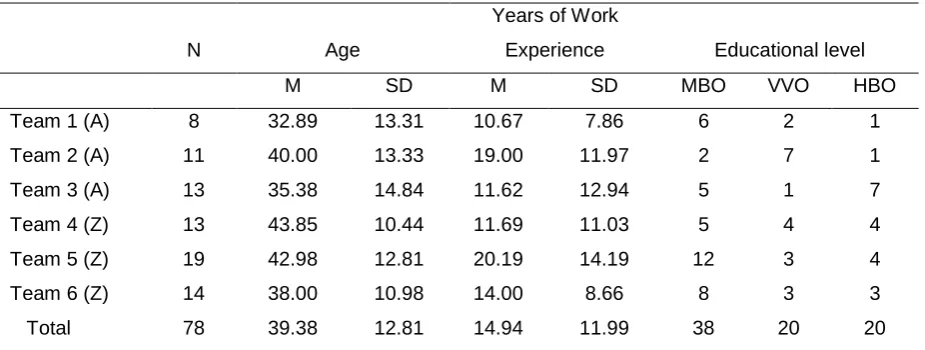
[image:16.595.66.529.504.679.2]An invite to participate in the current study was sent to 194 nurses. Eventually 78 nurses (40%) responded. The group of nurses that participated in the study consisted of 5 males and 73 females, between the ages of 18 and 65 (M = 39, SD = 12.81). A one-way ANOVA was conducted on the variables age, years of work experience, and educational level, for each team (team 1 till team 6). This test showed that there was a homogeneity of variance as assessed by Levene’s test. To add, this test showed no significant differences between teams regarding their demographic information, thus equal groups can be assumed. The demographic information per department is shown in Table 1.
Table 1.
Demographic Information Per Department
N Age
Years of Work
Experience Educational level
M SD M SD MBO VVO HBO
Team 1 (A) 8 32.89 13.31 10.67 7.86 6 2 1
Team 2 (A) 11 40.00 13.33 19.00 11.97 2 7 1
Team 3 (A) 13 35.38 14.84 11.62 12.94 5 1 7
Team 4 (Z) 13 43.85 10.44 11.69 11.03 5 4 4
Team 5 (Z) 19 42.98 12.81 20.19 14.19 12 3 4
Team 6 (Z) 14 38.00 10.98 14.00 8.66 8 3 3
Total 78 39.38 12.81 14.94 11.99 38 20 20
Measure
An online questionnaire was used with eight open questions to answer the first research question (qualitative), and 32 closed questions to answer the second research question. Firstly, the instruments are introduced, followed by several reliability and validity tests.
Instruments. Firstly, the questionnaire consisted of eight open questions. To answer the first research question, open questions such as ‘When do you find it easy to receive feedback from a colleague’ and ‘Why do you find it hard to give feedback to a colleague in this situation’ were added to the questionnaire.
Secondly, to measure the feedback environment, items from the Feedback Environment Scale (FES) developed by Steelman et al. (2004) were used. The FES officially consists of a ‘Supervisor Source’ and ‘Co-workers Source’. The ‘Supervisor Source’ entails items about feedback received from the supervisor. As this study measures the experienced feedback among equal colleagues, only the ‘Co-workers Source’ was used. This study used six of the seven subscales from the FES. Items regarding the subscale ‘Source Availability’ were removed as these items did not have any value for this study, as nurses already interact on a daily basis with their colleagues. An example item from this subscale was; ‘I have little contact with my co-workers’. The following six subscales were tested: Source Credibility, with five items such as: ‘I have confidence in the feedback my co-workers give me’, Feedback Quality with four items such as: ‘My co-workers give me useful feedback about my job performance’, Feedback Delivery with five items such as: ‘When my co-workers give me feedback, they are usually considerate of my feelings’, Favourable Feedback with three items such as: ‘I frequently receive positive feedback from my co-workers’, Unfavourable Feedback with three items such as: ‘My co-workers tell me when my work performance does not meet organisational standards’, and Promotes Feedback Seeking with four items such as: ‘I feel comfortable asking my co-workers for feedback about my work performance’. In total, 24 items were used and could be answered by the use of a 5-point Likert scale ranging from ‘totally disagree’ to ‘totally agree’.
Thirdly, to test the mindset of the nurses, four incremental items and four entity items divided over two scales from the Implicit Theories of Intelligence Scale (TOI) developed by Dweck (2000) were used. The scale Intelligence consisted of four items such as: ‘Your intelligence is something about you that you can’t change very much’. The scale Talent consisted of four items such as: ‘You can always substantially change how much talent you have’. These eight questions were also answered by the use of a 5-point Likert scale ranging from ‘totally disagree’ to ‘totally agree’.
Validity and reliability pilot. As the original versions of the FES and TOI were in English, but
Reliability open questions. To analyse the reliability of the open questions, a codebook was used. Codes were made with information from the literature review and during close contextual reading. To test the reliability, a colleague-researcher also coded a part of the open answers. The codes were then compared using the intra-class correlation (ICC). This is a method to assess the Interrater Reliability (IRR) for ordinal, interval, and ratio variables. As this codebook uses several different codes, this method was most suitable. The final ICC for this codebook was .74, making this tool reliable (Halgren, 2012).
Validity and reliability FES. To check the validity and reliability of the final FES data collected
from the nurses, the normal distribution was checked by looking at the skewness and kurtosis for values exceeding 2.0. Five items (2, 4, 5, 11 and 12) had to be removed as normality could not be assumed and they would have made the analysis results less reliable (Brown, 2011). An Exploratory Factor Analysis (EFA) was conducted on the 19 remaining items using a principal axis factor analysis with oblique rotation (direct oblimin) (Field, 2013). The Kaiser Normalization (KMO = .687) and the Bartlett’s test of Sphericity (p < .001) confirmed that the data was suitable to conduct a factor analysis. An initial analysis was run to obtain eigenvalues for each factor in the data. Four factors had eigenvalues over Kaiser’s criterion of 1 and in combination explained 51.62% of the variance. The scree plot was ambiguous, but a parallel analysis showed that retaining four factors would be most suitable (O’Connor, 2000). The following criteria were used to remove items that did not fit any of these four factors that were used: items with factor loadings less than .32, cross-loadings less than .15 difference from the item’s highest factor loadings, and items that contained absolute loadings higher than .32 on two or more factors (Worthington and Whittaker, 2006). A total of six items were removed using these criteria, leaving 13 items divided over four factors. Surprisingly, all these steps showed that, in contrast of the validation study of Steelman et al. (2004), this FES turned out to be an invalid instrument during this current study. An overview of the factor loadings can therefore be found in Table B1 of Appendix B.
The four factors with the matching items are shown in Table B2 of Appendix B. A minimum of three items per factor is necessary, otherwise the factor becomes unstable. This study reaches that minimum (Costello & Osborne, 2005). Even though the reliability of these four factors seem low, according to Kline (1999) “when dealing with psychological constructs, values below even .7 can, realistically, be expected because of the diversity of the constructs being measured” (Field, 2013, p. 709). Therefore, these Cronbach’s Alpha’s are considered acceptable. Table 2 shows the results of the factor analysis and reliability tests.
Table 2.
Final Factors Feedback Environment Scale
Eigenvalues Cumulative % explained
Variance
Cronbach’s Alpha α Factor
Eigen-value
% explained variance
Number of items 1. Appropriate-
ness
4.72 24.82 24.82 4 .63
2. Favourable Feedback
1.79 9.41 34.22 3 .76
3. Unfavourable Feedback
1.74 9.16 43.38 3 .62
4. Feeling of Trust 1.57 8.25 51.62 3 .63
Table 3.
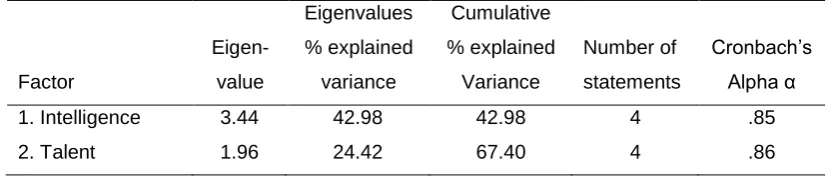
Final Factors Implicit Theories of Intelligence Scale
Eigenvalues % explained
variance
Cumulative % explained
Variance
Cronbach’s Alpha α Factor
Eigen-value
Number of statements
1. Intelligence 3.44 42.98 42.98 4 .85
2. Talent 1.96 24.42 67.40 4 .86
Data Analysis
To analyse the qualitative data, Excel was used to gather and structure all the answers. The summary of these answers is the answer to research question 1. During the quantitative data analysis, SPSS Statistics was used. To answer research question 2, a multiple linear regression analysis was used.
Results
This section presents the results of this study. Firstly, the qualitative data will be analysed, described and summarized. Subsequently, the quantitative data will be analysed, described and visualised.
Qualitative Results
The qualitative part of the questionnaire yielded approximately 600 statements on eight questions from a total of 78 nurses, which ultimately results in answering research question 1: ‘What are the stimulating and obstructing aspects that influence the informal feedback process between nurses?’
The analysis showed that the statements of the nurses could be divided into three categories, namely; conditions, behaviour, or effect. Conditions refer to conditions which the feedback has to meet in order to be successfully given or received. Behaviour refers to the communication and interpretation during the feedback process. Effect refers to the situation after the feedback is given or received. This is in line with the feedback process according to Van de Ridder et al. (2015), and the practical aspects according to Rummler and Brache (1995). However, new insights were given as well, which are all discussed in the analysis below. The analysis is structured with the help of the codebook. This chapter ends with a table that comprises the most important stimulating and obstructing factors.
Favourable and unfavourable feedback. Feedback can be divided in two types, namely favourable feedback, such as compliments, and unfavourable feedback, such as expressions of dissatisfaction. It is firstly important to report the following striking finding which came up during the analysis; when nurses answered the open feedback questions, they almost always linked their answers with unfavourable feedback. Meaning that they usually experience feedback as a process that occurs when situations are not happening as it should be, instead of a process that consists of acknowledging each other’s successful performances. This finding is a major indicator of how the feedback environment is experienced among the nurses. Apparently, the majority does not think of feedback that can be used to complement each other, but mostly to correct each other. Therefore, almost all the stimulating and obstructing factors that are discussed in this chapter, are associated with unfavourable feedback.
To continue, the deviation between favourable or unfavourable feedback showed to be a condition in receiving and providing feedback as well. For example, 12 out 78 nurses indicated that they found it easy to receive feedback when this was favourable feedback. In addition, 17 nurses indicated that they found it easy to provide feedback when it was favourable feedback. They stated that favourable feedback could be experienced as pleasant, nice, enjoyable, and as a compliment or confirmation of them doing well. According to the nurses, the effect is that it can help to make colleagues feel more confident, to better develop themselves, and can even create a safe working environment. To add, 12 out of 78 nurses indicated that they found it difficult to receive feedback when this was unfavourable feedback. In addition, 14 nurses indicated that they found it difficult to provide feedback when it was unfavourable feedback. Their answers showed that this negativity
For example, unfavourable feedback was experienced damagingly when the receiver feels they “could have done better”, when the feedback comes unexpectedly, when they “have tried their best”, or when it is provided in a very harmful and critical matter. The provider agrees by stating that these aspects make it difficult for them to provide feedback, as the effect is that the nurses feel insecure, discouraged, vulnerable, and they could feel like they failed. They also add that providing unfavourable feedback becomes more difficult when it is feedback regarding behaviour, towards more experienced or dominant colleagues, and when they are aware of possible personal issues. The behaviour of the provider is therefore dependent of the expected effects of the receiver. The nurses are afraid to hurt their colleagues, demotivate their colleagues and making their colleagues dislike them. They could also be hesitant to provide unfavourable feedback as past experiences showed that feedback did not have any effect with the receiver, making the feedback ineffective.
Credibility. Feedback should also consist of some other aspects before it can be successfully provided or received. It seems that the nurses find it an important condition that the feedback is credible, meaning that the nurses can recognize themselves in the feedback. Moreover, it should be believable and clear that both the receiver and provider have the same situation in mind that is subject for the feedback, otherwise, the receiver will not accept such feedback. Regarding the behaviour, it is important for the receiver to be able to have a dialogue with the provider, so the provider gets the opportunity to argument the feedback and base it on examples. Such examples were also considered as conditions. When these aspects of behaviour during the feedback process are absent, the effect may be that the receiver feels personally offended and eventually will not accept the feedback. Such conditions also help the provider during the feedback process. Having the knowledge that both parties have the situation “fresh in mind”, and that the provider has prepared his argumentation and examples, it is easier to give credible feedback. Furthermore, other conditions for the provider are a clear protocol to fall back on, no personal feelings that can interfere the credibility, feelings of trust, and confidence in their own feedback. These aspects can all stimulate or obstruct the credibility of feedback.
Feedback seeking. Some answers from the nurses showed that specifically asking for feedback could be considered as a condition. Eight out of 78 nurses stated that they found it easy to receive feedback when they had purposely asked for it. To add, nine nurses stated they found it easy to provide feedback when their colleague had specifically asked for it. When the nurse purposely asks for feedback, she expects this feedback and the behaviour of this receiver is automatically more open towards feedback. The nurses that intentionally ask for feedback, also indicate that they experience feedback as something useful and can turn it into a learning moment. This asking for feedback creates a positive feedback effect with miniscule chances of a negative reaction from the feedback receiver.
Openness. Openness turned out to be a subject that many nurses viewed as an important condition whether they find it easy to receive and provide feedback. 19 out of 78 nurses indicated that they found it easy to give feedback when they know their colleague has an open attitude. To add, 11 out of 78 stated that they found it difficult to provide feedback when the receiver showed a closed attitude. There are several reasons behind these statements. First of all, open behaviour from the receiver ensures the provider that they are more likely to accept or even appreciate the feedback. Secondly, an open attitude from both parties can lead to a dialogue where the receiver and provider are listening to each other. Thirdly, the receiver is more likely to experience the feedback as constructive, rather than critic, with an open attitude. Fourthly, the provider feels that the feedback is more welcome when the receiver shows openness, giving them more freedom in the provision. It can be concluded that an open attitude from the receiver lowers the barrier of providing feedback, as a defensive reaction from the receiver as effect is not expected. On the other hand, when an open attitude is missing, the work environment or relationship can be affected or the feedback may not even be used. From the receiver’s point of view, openness is considered to help the feelings of trust among the colleagues, together with an open communication and accepting attitude. However, the nurses admit that their open attitude can be dependent regarding their personal feelings and situation at a particular moment, meaning that they are not always as open towards feedback as they wished to be.
Offensive/Defensive. When there is a lack of Openness or Safe Environment, the nurses regularly experience that their colleagues can be offensive or react defensive. Both are considered to be negative aspects during the feedback process. Ten out of 78 nurses admitted that it was difficult to receive feedback when it was provided in an offensive way. To add, 19 nurses stated that they found it difficult to provide feedback when their colleague reacts defensive. These statements show that an offensive and/or defensive behaviour is a condition on whether they find it difficult to receive and provide feedback. According to the nurses, offensive or defensive behaviour can be described with an aggressive tone, very direct communication, judgmental behaviour, angry reaction, ignoring or walking away from the provider, or just “in a rude way”. When the feedback process has any of these characteristics, it is experienced as an attack, rather than as a learning moment. When such behaviour occurs, the effect is that the nurses feel misunderstood, unheard, hurt, and it makes them feel like they did something stupid. This is causing them to take the feedback, or reaction on feedback, personal. This eventually results in an unsafe environment with irritation and self-doubt among the nurses, meaning that a learning effect is absent.
Dialogue. When there are no offensive or defensive attitudes during the feedback process, a dialogue can take place. Having a dialogue turned out to be an important and desirable behaviour among the nurses. The nurses indicated that they find it a comfortable idea to immediately discuss the feedback with the provider, so the feedback doesn’t get ambiguous. This way they can check whether they understood the feedback well, or ask follow-up questions. For this situation to occur, there are a few conditions. First of all, the feedback should be given directly after the situation occurred. Secondly, it should be provided during one on one contact. Thirdly, the receiver expects openness from the provider. When the provider does not want to engage in a dialogue about the feedback, the receiver finds it difficult to receive feedback. This “does not feel good”, or it feels like the provider wants to impose their thoughts and actions on to the receiver. From the provider’s point of view, it turned out that they considered a dialogue desirable as well. During a dialogue they can argument their choices and explain the feedback properly during a calm conversation. When the conditions are met and the dialogue can take place, the nurses indicate that a learning effect can be reached as well.
Personal. The nurses’ personal wellbeing turned out to be an important condition on whether
Relation. The type of relationship the nurses have with their colleagues has a high impact on how the feedback is received or provided as well. They find it easier to receive and provide feedback with colleagues they know well, feel comfortable with and respect. This makes the relationship a condition. This way they know their colleagues can appreciate the feedback and learn from it, the desired effect. However, 16 nurses indicated that they find it difficult to receive and provide feedback with colleagues they do not know very well, they do not feel comfortable with, or more dominant and assertive colleagues with a strong personality. Receiving feedback from such colleagues makes the nurses feel uncomfortable and insecure. However, providing feedback is also an issue as they are afraid of a negative reaction. They are afraid that those colleagues think that the feedback is a result of their ‘bad’ relationship, rather than helping with each other’s improvements.
Learning effect. The learning effect is mentioned several times already, as this concept showed to be a result when certain conditions and desirable behaviours were met. This learning effect is also acknowledged by the nurses, as they gave this concept as a reason why they found feedback easy or difficult. To summarize, the nurses experience a learning effect when the receiver feels personally well, in a trusting environment, if the feedback is work-related, if it is communicated correctly, when there is an open attitude, when the feedback is positive, when a dialogue can occur, and when they agree with the feedback. However, the learning effect is missed when the feedback is incorrect, the nurses already feel insecure, when it is not communicated properly, when the receiver was already trying really hard, when their colleague is not open for feedback, when the receiver feels attacked, and if they have to provide (the same) feedback multiple times.
Research question 1
Table 8.
Stimulating and Obstructing Aspects that Influence the Feedback Process
Desired outcomes
Factors
Positive
personal
feelings Confidence
Safe
environment
Learning
effect Acceptance
Feelings of
trust Dialogue Openness Appreciation
Provision of
FB Relationship
Compliments + + + +
Critic - - - -
Open attitude + + + + + + + +
Closed attitude - - -
Positive personal situation + +
Negative personal situation - - - - -
Positive relationship + + + +
Negative relationship - - - -
Offensive message - - - - - -
Defensive reaction - - -
Psychological safety + + + + + +
Dialogue + + +
Recognizable FB + + + +
Unexpected FB -
FB on behaviour -
Argumentation by examples/protocol
+ + +
FB delivery ASAP + +
FB delivery during quiet moment
+
One on one contact +
Calm approach from FP + +
Specifically asking for FB + + + +
Quantitative Results
To continue with the second part of this current study, an overall overview will be firstly given on the answers of the closed questions. Secondly, the relationships between the factors of the FES and TOI are described, after which the multiple linear regression analysis is elaborated on. This chapter will answer research question 2: ‘What is the relationship between the mindsets of nurses and their experience regarding the informal feedback environment?’
[image:27.595.69.421.297.432.2]Feedback and mindset. To get an overview of the nurses’ answers, the Mean, Standard Deviation, Minimum and Maximum answers, divided per scale, are presented in Table 4.
Table 4.
Descriptive Statistics Per Scale Of The Dependent And Independent Variables
Variables M SD Min Max
Appropriateness 3.94 .38 3.00 5.00
Favourable Feedback 3.50 .67 1.33 5.00
Unfavourable Feedback 3.76 .52 2.33 5.00
Feeling of Trust 4.27 .44 3.33 5.00
Mindset on Intelligence 3.34 .74 1.50 4.75
Mindset on Talent 3.50 .68 2.00 4.75
Note: (N = 78)
Table 5.
Pearson correlations between the FES and TOI
TOI FES
Intelligence Talent
Appropriate-ness
Favourable Feedback
Unfavourable Feedback
Feeling of trust TOI
Intelligence 1.00 .29*
Talent .29* 1.00
FES
Appropriate- ness
.09 .24* 1.00
Favourable Feedback
-.09 .11 .29** 1.00
Unfavourable Feedback
-.01 .15 .24* .35** 1.00
Feeling of Trust
.26* .19 .30** .28* .22 1.00
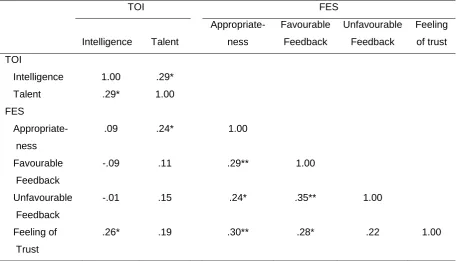
[image:27.595.66.526.497.758.2]Relationship between the FES and TOI. A Pearson correlation coefficient was computed to assess the relationships between all factors, as seen in Table 5. There were two significant relationships found between the scales of mindset and the factors of the feedback environment. Firstly, ‘Appropriateness’ and ‘Talent’ were significantly correlated, r = .24, p = .04. Secondly, ‘Feeling of trust’ and ‘Intelligence’ were also significantly correlated, r = .26, p = .02.
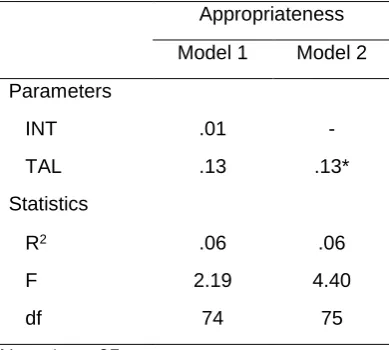
Multiple linear regression analysis. To continue, a multiple linear regression analysis was conducted to see if the mindset of the nurses could predict the experienced feedback environment. To be more specific, multiple linear regressions were run with the independent variables ‘Intelligence’ and ‘Talent’ for each dependent variable (Appropriateness, Favourable Feedback, Unfavourable Feedback, Feeling of Trust). The backward entry method was used during the analysis, meaning that both independent variables were added to the equation first before deleting one at a time, showing which does or does not contribute to the equation. This method was chosen as the correlation analysis already showed differences between the two predictor variables (“Selection Process for Multiple Regression”, 2016).
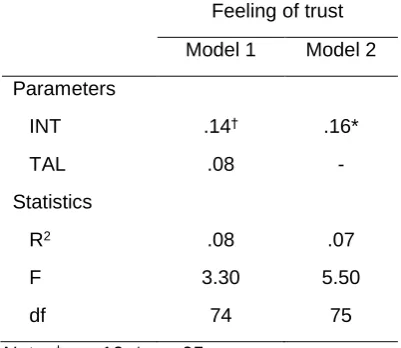
[image:28.595.72.267.510.685.2]The results for Appropriateness are displayed in Table 6. Model 2, which included only the variable Talent, was accepted as the best fitting model over Model 1, which included both independent variables. Model 2 showed a significant relationship between appropriateness and talent (F(1, 75) = 4.40, p = .04), with an R2 of .06. The results for Feeling of trust are displayed in Table 7. Model 2, which included only the variable Intelligence, was accepted as the best fitting model over Model 1, which included both independent variables. Model 2 showed a significant relationship between feeling of trust and intelligence (F(1, 75) = 5.50, p = .02), with an R2 of .07. The models tested for favourable and unfavourable feedback are not included in tables, as no significant effects were found.
Table 6.
Multiple Linear Regression on Appropriateness with Intelligence and Talent
Appropriateness Model 1 Model 2 Parameters
INT .01 -
TAL .13 .13*
Statistics
R2 .06 .06
F 2.19 4.40
df 74 75
Table 7.
Multiple Linear Regression on Feeling of trust with Intelligence and Talent
Feeling of trust Model 1 Model 2 Parameters
INT .14† .16*
TAL .08 -
Statistics
R2 .08 .07
F 3.30 5.50
df 74 75
Note. †p < .10, *p < .05.
Research question 2
Discussion
The results of this study gave new insights into the obstructing and stimulating aspects that influence the feedback process between nurses. This study also provided insights into the relationship between nurses’ mindsets and their experienced informal feedback environment. The conclusion of these insights will be discussed below, together with new questions and discussion points that occurred.
First of all, the qualitative results showed that when nurses think about feedback, they mostly think about negative feedback. Rather than thinking of situations where colleagues complimented them on a job well done, or expressed their satisfaction on performances, they mainly thought about situations where critic and expressions of dissatisfaction were shared. To add, the results show that favourable feedback made the provision and receiving of feedback easy, whether unfavourable feedback made it difficult to provide and receive feedback. The nurses’ open answers also showed the magnitude in influence compliments or critic can have on the liking or disliking of the feedback process. In other words, the presence of the aspects favourable and unfavourable feedback in phase C of the feedback process, have a high influence on how feedback is interpreted in phase D, ultimately resulting in a certain feedback effect. To sum up, it could influence social aspects such as the openness of the nurses towards feedback, it could make them feel safe or precisely the opposite, it could trigger a defensive reaction, or it could be experienced as an offensive message, it could improve or deteriorate the relationship among the nurses, it could make them feel personally good or bad, and it could induce a learning moment, but it could also prevent a learning moment. These examples show that these two aspects have a lot of impact on the eventual feedback effect. However, the answers also showed that the way favourable and unfavourable feedback was interpreted (phase D), could be influenced by other practical and social aspects as well (phase C). For example, it is dependent on the credibility of the feedback, on the way the feedback is delivered and if the receiver’s feelings are taken into account, on the openness of the nurses towards feedback, whether they feel safe during the feedback process, whether it is provided in an offensive way, or received in a defensive way, and whether a dialogue is possible. However, it is also dependent of the person’s wellbeing at that moment, dependent on the colleagues relationship with each other, and if they feel they can turn it into a learning moment. In conclusion, most practical and social aspects that were discussed during the literature review showed to be important for nurses as well. However, their personal well-being that is influenced by their private life situation, work pressure, having a “bad” day, and personal characteristics also showed to have a high impact on the way they experience feedback. To continue, the quantitative data shows that the hypothesized positive relationship between the nurses mindsets and their experienced informal feedback environment was partly fulfilled. There was a positive and significant relationship found between a person’s mindset regarding Talent and Appropriateness. This means that the more nurses believe that their abilities are based on effort, rather than natural born talent, the better their experiences are regarding the appropriateness of feedback. This also works reversed, the more nurses believe that their natural born talent
The quantitative data shows that the nurses who believe that they can continuously develop themselves by working hard, feel that the feedback that is given has an added value for them. They find received feedback more meaningful and useful, and believe that the feedback providers are supporting when giving feedback. Literature showed that people with a growth mindset on talent are usually willing to work harder, as they know effort is very important in one’s own development. They trust that passion, discipline, training and practice will help them towards higher levels of proficiency (Mercer & Ryan, 2010; Dweck, 2007; Howe et al., 1998). This makes them appreciate all the tools that help them towards that development, such as feedback, even more (Dweck, 2006; Mercer & Ryan, 2010).
There was also a positive and significant relationship found between a person’s mindset regarding Intelligence and Feeling of Trust towards feedback. This relationship shows that the more nurses believe that their abilities are based on effort, rather than their natural born intelligence, the more they have a feeling of trust towards feedback. This also works reversed, the more nurses believe that their natural born intelligence determines their abilities, the less their experiences are regarding their feelings of trust towards feedback. The quantitative data shows that the nurses who believe a person’s intelligence is malleable and can be improved over time, the more they appreciate their colleague’s feedback, believe in the credibility of the feedback, but also feel comfortable asking for feedback. Literature showed that a person with a growth mindset is more open towards challenges and is not afraid to make mistakes. In contrast to people with a fixed mindset, people with a growth mindset are less afraid to look foolish and their own learning and development is more important than the chance of failing (Dweck, 2006; Dweck, 2012). It is therefore reasonable that the more of a growth mindset nurses have, the more they appreciate the feedback, as they are always open to improve themselves. To add, in contrast to a fixed mindset, the growth mindset nurses do not immediately respond defensive when help is provided, but trust their colleagues on their credibility. Last, but not least, the more of a growth mindset, the more they feel comfortable asking their colleagues for feedback as they are less afraid to look foolish.
To continue, after the two found relationships, the question remained why these were the only relationships that were found. There were no relationships found with the dependent variables of Favourable Feedback and Unfavourable Feedback, even though the information from the literature review suggested a positive relationship. A person’s mindset determines the way they react towards challenges and setbacks. An incremental theorist can experience a setback as a learning moment, whereas an entity theorist can experience a setback as a lack of ability, or confirmation of inability (Dweck, 2000). As unfavourable feedback can be described as critic and expressions of dissatisfaction, this variable could be experienced as a setback. A positive relationship with the nurses’ mindset was therefore expected. Furthermore, a person’s mindset can also determine the goal settings of a person (Mercer & Ryan, 2010). An incremental theorist focusses more on “the longer term goal of learning and developing mastery” (Burnette et al., 2013, p. 660). However, an entity theorist focusses more on displaying their abilities and performances to others (Mercer & Ryan, 2010). As favourable feedback can be described as compliments and expressions of satisfaction, it could be experienced as an input in one’s self-development (Dweck, 2015), or it is all the information they needed to know as they succeeded in showing their abilities to others (Burnette et al., 2013). A positive relationship with the nurses’ mindset was therefore once more expected.
When answering the remaining question why no relationships were found between a nurses’ mindset and favourable or unfavourable feedback, even though it was hypothesized, it could be answered by the following: There are many more practical and social aspects influencing the way favourable and unfavourable feedback is experienced by nurses. Their mindset has an influence on other aspects of the feedback environment, as shown by the two significant relationships, but this influence does not seem to be enough to overshadow the stimulating and obstructing factors that have an influence on the way favourable and unfavourable feedback is experienced.
Limitations and Future Research
Furthermore, the questionnaire that was used to test the feedback environment turned out to be invalid. This FES has been used in multiple other studies and they all mentioned sufficient Cronbach’s Alpha’s of the complete FES (Rosen, Levy & Hall, 2006; Sparr & Sonnentag, 2007; Whitaker, Dahling & Levy, 2007; Anseel & Lievens, 2007). However, when measuring more constructs in one test, it is best to calculate the Cronbach’s Alpha for each of those constructs (Field, 2013). When calculating the Cronbach’s Alpha on the complete FES for this current study, it also showed a sufficient value of .821. However, sufficient values were not reached when calculating each subscale. To add, neither of those other studies performed a factor analysis. The validation study of Steelman et al. (2004) shows that the FES should have probably been valid for this current study as they show a sufficient reliability per scale. However, rather than performing an Exploratory Factor Analysis, which is preferable for validation studies (Izquierdo, Olea & Abad, 2014), they performed a Confirmatory Factor Analysis, which did confirm the original scales. Nevertheless, there are two differences between this current study and the other studies. The other studies presented the questions to the participants divided per scale. This current study randomized the questions in order to prevent answer tendencies. Furthermore, this study used a 5-point Likert scale, instead of a 7-point Likert-type scale such as the other studies. This choice was made as other questionnaires that are distributed among Gelre Hospitals also use a 5-point Likert scale. Furthermore, a research from Colman, Norris and Preston (1997) showed very high correlations between scores from several 5-point scales and 7-point scales studies, using empirical research. To add, Dawes (2007) showed that “5- and 7-point scales produced the same mean score as each other, once they were rescaled” (p. 61).