A Thesis Submitted for the Degree of EngD at the University of Warwick
http://go.warwick.ac.uk/wrap/36381
This thesis is made available online and is protected by original copyright. Please scroll down to view the document itself.
A Framework for the
Effective Management of Collaborative
R&D Projects
Executive Summary
A submission to the Engineering Doctorate portfolio of
Tina Angela Barnes
Abstract
There is a growing trend toward collaboration, both between companies, and between academia and industry. Studies have linked the use of external sources of information and expertise to the enhanced generation of innovation. Innovative companies, in turn, have been shown to out-perform non-innovating companies in terms of both growth and profit. Therefore, against a background of increasing international competition and rapid technological change, governments are actively encouraging collaboration as a means of improving innovation efficiency and thereby enhancing wealth creation. Collaboration provides companies with the means by which to advance technologically, at lower cost and with less inherent risk. Collaboration also provides access to a greater breadth and depth of knowledge and technologies than would normally be possible through internal development. For universities the benefits include additional public and private funding, and increasingly, licensing and patenting income, as a result of technology transfer activities.
However, these considerable potential benefits are often not realised in practice. The major reason is that collaborations between, often diverse, organisations, need considerable management effort in order to be successful. To this end, considerable research (reported in the literature) has been devoted to identifying management "success" factors, factors which where present, enhance the probability that a collaboration will be successful. This information was used by the author to develop a best practice model for collaboration management that is more comprehensive than has previously been reported in the literature. To date however, the literature provides no guidance as to how the full range of these success factors could be applied in the every day context of managing a collaboration.
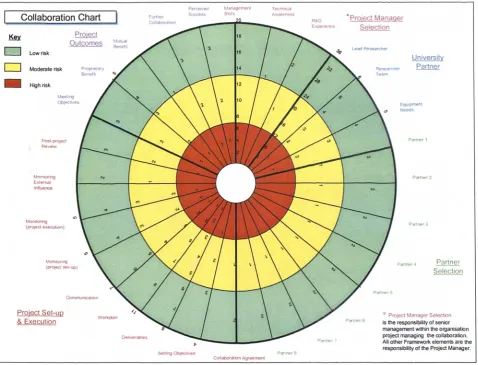
The Framework presented here provides a mechanism for achieving more effective collaboration management in the form of a simple-to-apply management tool. The Framework was developed on the basis of case study research and disparate sources of relevant published research. Essentially, it provides a means of applying the current body of knowledge in a way that does not assume prior experience of collaboration management on the part of the user. Through the provision of reference material and diagnostic features, the Framework encourages an awareness of the key issues affecting the success of collaborations and prompts the manager to take appropriate and timely action to prevent the occurrence of problems later on. The main feature of the Framework's feedback mechanism, the Collaboration Chart, enables the user to identify quickly, specific areas where problems could arise. The concept of the Framework is new to the collaboration field and as such it constitutes the main innovation to result from this research.
Furthermore, while ihe Framework was originally conceived as a specific aid to collaboration between WMG and its industrial partners, this research indicates that it is potentially much more widely applicable. The Framework is certainly shown to be applicable to other university-industry collaborations, and with some modification, could also be applied to industry-industry collaborations. In addition, the Framework would lend itself to development into an evaluation tool that funding bodies could use to assess research proposals. The potential value of the Framework therefore extends beyond industry and academia, to ensuring the efficient use of public funds.
Executive Summary page ii
Acknowledgements
The author wishes to thank Academic Mentor, Dr. Ian Pashby and Industrial Mentor, Mr. Neil Pitchford for their help and support throughout this research work. Special thanks also to Dr. Anne Gibbons for her help and support in an area of research in which I had no previous experience.
I would also like to thank the Engineering and Physical Sciences Research Council (EPSRC) and Rover Group Ltd. for sponsoring this research. I would also like to express my gratitude to all of the partner companies and members of WMG's academic and technical staff who freely gave of their time to participate in this research study. Without their participation this research would not have been possible.
Finally, thank you to my husband Stuart, without whom I could not have come this far.
Declaration
Table of Contents
Abstract i
Acknowledgements ii
Declaration ii
Table of Contents iii
List of Tables v
List of Figures vi
1. Introduction 1
1.1 The Background to Collaboration 1
1.1.1 Defining Collaboration 1
1.1.2 Incentives to Collaborate 1
1.1.3 Disincentives to Collaborate 5
1.2 Research Objectives 8
1.3 Research Approach 10
1.4 A Guide to the Portfolio Submissions 11
1.4.1 The Portfolio "Route-map" 14
2. Preliminary Research 16
2.1 Best Practice Model in Collaboration Management 16
2.2 A Framework for Effective Collaboration Management 21
3. The Case Study Research 23
3.1 Research Strategy 23
3.1.1 Measures of Collaboration Success 24
3.1.2 Comparison with Best Practice 25
3.2 Case Selection 26
3.3 Data Collection 30
3,4 Data Organisation & Analysis 31
3.5 The Main Findings 33
4. The Framework 40
4.1. The Basis for a Solution 40
4.2 The Basic Structure & Rationale 41
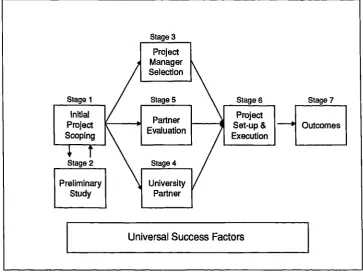
4.3 Applying the Framework 46
4.4 A Review of Relevant Management Tools 50
5. Results of Preliminary Implementation Trials 54
6. Applicability of the Framework 56
6.1 University-Industry Collaborations 57
6.2 Industry-Industry Collaborations 59
6.3 Other Potential Areas of Application 60
Executive Summary page iv
7. Recommendations for Further Work 62
7.1 Limitations of the Current Framework 62
7.2 Further Testing and Implementation of the Framework 63 7.3 Testing the Broader Applicability of the Framework 64
8. Conclusions 65
9. References 69
List of Tables
Table 1 Overview of Portfolio Submissions 12
Table 2 Summarised Results of Case Study Research (Positive Impacts) 34 Table 3 Summarised Results of Case Study Research (Negative Impacts) 35
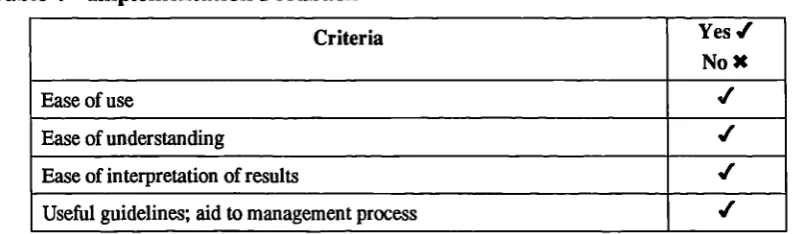
Table 4 Implementation Feedback 55
Executive Summary page vi
List of Figures
Figure 1 Portfolio "Route-map" 15
Figure 2 Best Practice Model for Effective Collaboration Management 16 Figure 3 Modified Best Practice Model Containing Factors Associated with
the University-Industry "Cultural Gap" 20 Figure 4 Degree of Commonality between Best Practice Model for
Collaboration & Factors Negatively Represented in the Case Study
Findings 37
Figure 5 Basic Model of the Framework for Effective Management of
Collaborative R&D Projects 41
Figure 6 Complete Project Management Process for Effective Management of
Collaborative R&D Projects 44
Figure 7 Framework Collaboration Chart 48
Figure 8 The Ten Factor Model of the Project Implementation Profile [42] 52 Figure 9 The Framework for Effective Management of Collaborative R&D
1. Introduction
1.1 The Background to Collaboration
1.1.1 Defining Collaboration
Collaboration is simply defined by the Centre for Exploitation of Science and Technology (CEST) [1] as "the activity of two or more partners working together to mutual benefit". However, Dodgson's [2] description differentiates collaboration from a business transaction: "Collaboration is based on the premise that through formal agreements, technology sharing between firms produces benefits that cannot be obtained by individual firms or through market transactions such as direct purchase, licensing or merger and acquisition." For the purposes of this research, the activities referred to by the term "collaboration" are more accurately described by the latter definition.
Collaboration can involve industrial partners only, i.e., industry-industry collaborations, or they can involve universities or other academic institutions, i.e. academic-industry collaborations. While this work uses relevant research findings associated with industry-industry collaborations, the focus of this research is on academic-industry collaborations, or more specifically, university-industry collaborations.
1.1.2 Incentives to Collaborate
A number of studies in recent years have found that there is an increasing trend toward collaboration between academia and industry and between firms [1, 3-5]. There are a number of reasons for this which vary according to perspective. At a national level the primary motivator is innovation. External sources of information and expertise have
Executive Summary page 2
been shown to enhance the generation of innovation. Furthermore, the work of Geroski & Machin [6] provided strong evidence to suggest that innovating firms consistently out-perform non-innovating firms in terms of growth and profit. Against a background of increasing international competition and rapid technological change,
governments are therefore actively encouraging collaboration between firms and between the public sector science base (PSSB) and industry, as a means of improving innovation efficiency and thereby enhancing wealth creation [7, 8].
From an industrial perspective, rapid changes in the competitive and technological environments of a wide range of industries have resulted in a considerable degree of uncertainty with which companies must find a way of coping [9]. Collaboration allows companies to observe new technological developments without having to undertake the expense and risk of investing in speculative research [2].
Nueno & Oosterveld's [12] study of technological affiances found that the reduction in the costs of access to a technological capability was a primary motivator behind many firm's decision to engage in collaboration. Further, one third of the cases studied revealed that the companies would not have entered the affiance if the project to be undertaken had not attracted some form of external financial support [13].
While the above benefits and incentives are equally relevant to industry-industry and university-industry collaborations, Gregory [13] concentrates on the specific benefits that can accrue from collaborations involving universities. For example, the opportunity to observe and work with graduate students on a project can provide an effective mechanism for recruitment [13-16]. From the academic perspective, this is just one of a number of motivations which are driving the increasing number of
academic-industry collaborations. Packham & Tasker [17] for example, drawing on their experiences of university-industry collaborations in the UK and the US, suggest that the advantages of industrial collaboration for a university include:
• The stimulus of different problems and different perspectives,
• Access to otherwise inaccessible research environments, e.g. industrial plant, schools, hospitals and government departments,
• Resources (including cash).
In their study of Eureka projects, Barker eta! [15] found that access to complementary technical expertise was the primary motivation of both industrial and non-industrial (universities and research institutes) partners. EPSRC (Engineering and Physical Sciences Research Council) [18] list a number of other benefits with regard to universities:
Executive Summary page 4
• The opportunity to sustain existing research programmes and initiate new programmes by widening the customer base.
• The opportunity to learn new skills, developed within companies.
• Gaining an employer's perspective on the direction and content of teaching programmes; sourcing ideas for student projects and locating placement opportunities.
• Gaining the "inside track" on possible job opportunities for graduates, post-graduates, post-doctoral researchers and academics.
The benefits listed by Gregory [13] follow a similar theme in that it is suggested that, access to "real world" problems and the opportunity to become more familiar with industrial culture and technology needs, will enable a university faculty to become more effective educators and researchers.
Greater collaboration with industry has certainly become a reality of academic life and in the UK alone, it is becoming a prominent feature in the life of universities such as Oxford [20], Cambridge [21], Cranfield [22], Edinburgh [10], Imperial College [4], Heriot-Watt [22], Queen's University, Belfast [22], Warwick [23] and Swansea [22]. Apart from the public and private funding that collaboration with industry can bring into a university, Shohet & Prevezer [4] show that universities are also increasingly benefiting from technology transfer activities in the form of licensing and patenting income.
1.1.3 Disincentives to Collaborate
The emphasis currently being placed on industry-industry and university-industry collaboration from the national, industrial and academic perspectives, is clearly being driven by the considerable potential benefits identified above. However, despite the trend toward increased collaborative activity, there is some evidence to suggest that these potential benefits are often not realised in practice.
One reason put forward for this is that the very nature of collaboration between often diverse organisations gives rise to substantial management problems. Dodgson [2] makes explicit the point that collaborations need considerable management effort to make them work. In the case of the Alvey programme in the UK, Dodgson [2] states that despite some technological successes, little commercial advantage has since been realised by the participating companies. Similarly, Barker et al [15] indicated that experiences among Alvey's participants had been mixed with almost one-quarter of participants reporting negative effects from unsuccessful partnerships.
Executive Summary page 6
Furthermore, a report on Alvey commissioned by the DTI and the Science and Engineering Research Council (now EPSRC) [24], revealed some significant difficulties relating directly to the collaborative nature of the programme. Among the points noted, there was a recognition that whilst most participants gained from the experience of collaboration, the high overhead costs of collaborating, in some cases, outweighed the associated benefits. Difficulties concerning exploitation were also identified.
Evidence in the literature indicates that collaboration in any form, can prove disappointing in terms of the expectations of collaborative partners. Spekman et al [3] suggest that the failure rate of strategic alliances is somewhere in excess of 60%. At the individual participant level, a report by CEST (Centre for Exploitation of Science and Technology) [1] draws attention to the findings of studies such as that by Harrigan [25], which found that among 895 joint ventures, only 45% were mutually agreed by their partners to be successful. However, placing this figure in context, the report [1] goes on to state that the success rate of acquisitions and mergers is even lower.
• Prohibitive costs associated with the time and effort necessary to set-up and monitor the collaboration, and where required, to harmonise the different cultural styles of the parties involved
• A reduction in control over the product development process, with the prospective threat of a partner using the knowledge gained in a non-co-operative way
• The instability of such alliances as a result of a lack of trust. A fear of leakage of information, experience and skills essential to the core competencies of a firm, affect the successful function of partnerships, since successful collaboration depends on freely disclosed information
• Conflicts can arise as a result of divergent aims and objectives
It was evident from the above that despite considerable potential benefit, managing a collaboration successfully is difficult and therefore the actual benefits realised can be limited. Furthermore, while much of the above evidence arose from studies of industry-industry collaborations, differences in the priorities, perspectives and values of academia and industry (Section 2.1) indicate that the management problems associated with collaboration and the difficulties of ensuring that all partners achieve actual benefit, are considerably amplified in university-industry collaborations. Given the considerable investment in terms of time and resources that collaborative projects can involve, it is therefore important that an effective means of managing collaborations is established so that the benefits from them can be maximised.
Executive Summary page 8
1.2 Research Objectives
The above discussion has indicated that there is a growing world-wide trend toward collaboration between firms and between academia and industry, an activity which is also being actively encouraged by governments as a means of enhancing national competitiveness and wealth creation [7, 20, 27]. Warwick Manufacturing Group (WMG) is a part of this growing trend in so much as it is involved in collaborative research to a considerable degree, and is well known for its extensive links with industry. It was therefore, important to ensure that the management of WMG's collaborative research projects conforms to best practice. However, the main objective of this research was to extend beyond a simple evaluation of performance, toward the development of a management tool (based on best practice) which would provide a systematic, effective approach to the management of WMG's collaborative research projects and therefore enhance the probability of success.
Main Objective:
• To develop a management tool (a Framework) for the effective management of collaborative R&D projects that would enhance the probability of collaborations being successful
Subsidiary Objectives:
• To evaluate collaborative research projects in which WMG was an academic partner
• To establish, through comparison with best practice, how successfully these projects were managed
• To identify (also through comparison with best practice) areas where improvements could be made to the way in which these projects were managed • To determine the extent to which WMG's projects, and any problems experienced
within them, were typical of those reported in the literature
Given the substantial investment (both public and private) currently being made in collaborative research activities, the potential value of a management tool which will help industry and academia to manage collaborations effectively, thereby maximising the benefit achieved, is considerable. Examination of the published research provided no evidence to suggest that a Framework of this kind has been developed elsewhere in the context of collaboration management. The Framework is therefore the main innovation to result from this research.
Executive Summary page 10
1.3 Research Approach
For the purposes of this research, best practice with respect to collaboration management, was established through a review of the literature and interviews with experienced collaboration practitioners. The findings were used to develop a best practice model against which WMG could be compared. Detailed information regarding the management of WMG's collaborative research projects was obtained
through case study research (described in Section 3). A comparison was then made between the best practice model and each individual project (case), in order to identify areas in which best practice was being demonstrated and areas where it was not. Analysis across the projects case studied was then used to identify patterns of similar findings and common factors.
1.4 A Guide to the Portfolio Submissions
The purpose of this section is to provide a brief overview of the individual reports submitted to this portfolio, highlighting the issues addressed in each report, the research methods employed and the major outcomes and achievements (Table 1). This section also includes a "route-map" (Figure 1) through the portfolio to serve as a guide to the reader. Both of these tools are designed to help the reader to locate items of specific interest and to underline the relative importance of each submission with respect to the achievement of academic rigour and innovation in the application of knowledge.
Submission 1, in which work conducted in the first year of registration was reported, has been included in the submission overview (Table 1) in order that the achievements of this particular piece of work can be acknowledged. The work contributed to a collaborative research project, but addresses the technological issues with which that project was concerned. Therefore, Submission 1 does not include work which is essential to the main theme of this portfolio, and it is not considered necessary for the reader to refer to it. For this reason, it will be noted that Submission 1 has been omitted from the portfolio "route-map", Figure 1.
E-4 m 0 ..m cz 0 I•4.4 .. con ... 0 ? • %.) ,..(„) E o .2 0 ... § 0
>, a. .n a) E -Eth
„,
a)
- .44 .... ....„i...
a s
..50 -s ,.ft.,0
0 t,, ••
-0.. 0 •a ,.,....,
= bo
..la o
= =
„at t3
8 ;8
Cl] L.
a) § tO
c.) V) = 0
• •-n )... P---)
..= 1:13 ..= :.-. a) .0 c.)
> 0 0 a)
.n = 00 ...
•go '0 0 0
C.) • •-• 43
CI) h. •n-n 0.) 0
,.= 0 cu 0 $4.
bi)
...., .2', •0 u
....
0 .. . c. i CZ4
a) 1-, ot
45. 2 E ''',
= ..8 cis b 0
.
.8 ,t4 ,- o o
= ...
= ,.o,fl = t) 2 --,
.§ •,- - •- ..= V) 0 c ...
I-, .--i a ''8 g t„., c> 'C.)
0 Q E--4
= a) ,.., .8 d I g c.:,
bi) o tO 4.7:
-S 01, --.134',71
0 a) bil "•-• u
it? 0 > - 1 o&...
1-E .5 ,t 4 E.' a.. a..
,--n csi cri
a) 0 0
4. g
0 E
0
E 3 o
. 4 .2 -.0
c,-.1 0
til 0 o i-,
... a'' L) al 0
...' ts .... T) LI
%) a, =0 c..) o
E ....r. ..s -a
oe --.
b)3 0 c.) 1
41
2
ct .18 00 0 R 1;:jE *- = ',-,4 ...
ti • "
0 to 4 • . - 1 v)
0 T.: 8 6
'.0 p 0-' 2 8
0 gy cn cl 0
k.. co „L.
0 I, ‘X c).Cl]
41 ''. 4 ,L,
'-c >, 78 r-.
0 °
C.) .2 Ci) 4.. al,
h. ? •W P. 0$...
A ' )4
t Mi-• 6 = 6 °
,,,tt t ,.... .= 4-4 'It
E ...t
al o a)
....
r
'5, " '-'= mcr.{. - ;is C.) .
*.m t.1 -5 a
ts a, rn 0 '&'3) r.., h,, - 4. .0 I-4
•-.8 0 a) 0
cy2
E 2 8.
`
C,3 Q. 0 0 1..,
4:, E C 1-.0 = a)
.1 2 ¢ .E, ¢ .5
....7 csi tr.;
o.,---.
al..
0 0
ii..i ... ill'
0 OS a)>
6 w tz .17,
E
'D 8 . „9 -6
a) > •Iel
" '01 ." n
.5 n . ,.,,,
IAI = 8 F ig,
ci „eD , 0. '.0 ::,',
rt, as -a. c,,?, o 0.. "al, 4 Cl] -cr.i
ctt a)c.) r..) >
a) 4)
-. C) 10 c.,, co) w 0 .18 `1 173 = 6
›, >, r4
tg .0 0 •a
-,= =
= . g % =
-8 1:2 .r) .5 •°
• ,„ I-, 1
= zi a. g
° ..-) ") o = 0 • ,-. 1-.c.) =
V
0
..-1) ,•,... " • V•••n
>, 0 g 8
-0 ,-, 0 ,.._, 0 td) c A - - . = 0 ;_, 0
on '.0 0 4g 0
a) 8 --.
cn
ct 73 ad ° as
u v) a) 1:
,-; csi cri 4 Iri
18 bn 'al
= i. 2 ..= 0
04 8 e
. 8
a-.1 = 0 on '^'.... V)
, 0 ,....
0 4-, 0 ,..cz, a) •,-J 0 ,... at a)0
-E ,.,.= .,
8 '„)
0 - „
0) t) 0 c.) 4:21 = ›, .14 ...t -''' "Cj N
,0 0 g
L''' 0 , V) 00
0) = a) ,,, •••••v) c).. E 0 . ,.3,
CI...,
C:) 0 u 0., U 0 ,... N...I 4=1
o 0 =
. 8 '''-')
tO a.)
zi = , ..z3
> ,,,,0 -c:s ,g 2
cl) 0 .0 -5 =
CI) • ••• bo 0) ? ...z; •-n -.8 0
... C? ..= •
..- ,,,.. •,-. ,.., ,., • -. ,&) = 4.-cz
a) t,3 cn .-..
N.. ts • -. 59, ..., QL, - Z 4.5 ri'
Z .''-, m 8 .8
o Qh. VI =
U p, 4.1 c4 •
,--4 csi
'S ea) 4 c.) ). a) ci] a) g •E 0
ci) , 4) p4 0 4-+o et') ;11 a) a) g a) g Cl 3 ;:i 0.) a) g 0.) E Cl 1' .,:l .0c.) g ›-• 7:7 3 c/) § c...) = 0 •-. 4-, rn a) Cl CY 4 ;... es a) ,„ a) 04 ...a = „9 ,..4 ,-, tko = o o 0 ‘w-.
•,--. .. = ccs rn
a) •,-,
0 J....) E
• ^. 1-, cz
2 fs c.tzcat 1 444 11) Cl) .... .., c..) (1)
•
i_. .,... („, 73.
r=1. -6 ra, .. 0 V) ,.=
" I-. ,-. 0)
0. 0 0 > ra. `'-' 0
,1 6 =.. TA = ..' .' "" ..C.r E °
:8 .= = E a ..= --8 p, ,..9 8 C4-.1 0
0 CO
con 1.. .2 c.) cri 0 4, 0 - ..=
••Ci) co) o
8 2
c) aat = •---. .ci) -6 - c.)
.-a> = cu=
'S --. E
t4' 'a)
a
'.= 1.., az
= a) 0
a) ..= o
;Cil ..5.1 E
g 0
cl 0 7:) '8= >
o a) b.°
2 ... 0=
ozt ad .-. '5
0 0 z >.
1.., v 9, . a)2 CZ14 0 - 0
rz, ..o = o va
ci .-, .0 0 0
g w E .o
g 1-. Z0 al
4-F, -e) t b .z 0 ci) ci) cn cl..) ,-;),"fa. CC
'0a) cll = t..., 1-1 1.., r... ...., c.)
bo Cl .5 o > 0
a) ..-n
;-. u)
`3) '. >....6 C... ,E R. eu)
v) a) (4,/
c/) ..z> g
CZ
= b
u) ,,m 0
41
0 .-.
Z 8
=
o
• .-.V)
.41 S .0 o CA 'in )... 0
,42, 5
v3 al
a) c.
o 0
Cr c.)
. • = ca,
r. .= En
= 8 s
.2 E-1 =
4 do • ,... .n11 ,G. 5,
5 .= E
.0 • '-'0 = ri) 3 "q.
0 ...
8
0 c4-, ,,
Cri 0 1-4
'-',_, e"t ...J 43 g (:.4 6' E a)
= gc) ii) > 0 ..,n t)0 '0,.., • .... ..., 03 ...., „
i2 • Cl g ti Cl]- Cl)
, ..,E
Cl 4
= cz
4 a),--. .5,
Cl al CL) 0 ,... CA 3 'S U (11
. bc. 0 0 T.:, 0 -5
e.ri ,._,0
=
.9.1 -=0
.1 cn
-a a)
Cl p4
CiD 3
I
41-. 0
0.,
4 ri4) r..T.
Cl ›, .
.° "0 •C
[II 5 v)
= 0 a)
4 Cn . C7
Cl Cl F.
0
.0
ts
0 0 *•••I
c . . 7
'. ? 0 -... ,..., -6 = t c j = 0
"0 "R.al
A .2 b.() .?:%.
E ."'a'
I) = -a' -5 0 30
= 5 Cl
0 E 0
E0
E w 0 120
0 =
e) 0 z ..=
,., 8 "8 .L4
° to E a ) I-, 6u.,
A a) '4 d
E 'Zi .0 *1=1 8 E CL) 0E,,
12,0 C..) Z '
= • . al
-= 1-• 2 .'
cl a, gn
4..1
C4. '. ,44
0 0 0 "0
4.) • •-n
8 a)0
= ,.., 0) C.)
a> 0 _= = IZ1
-c„ 6 .2 $..) g
'p 4 .4 'Ci .C4 ay
0 Z.3 X a) g X0 . ,--.E 1-) FA a) a.)
0 .5 5 74
'8 ti 1(
.18 c.>
cl 8 , 03
.:i 2 2 5
.M tj5 _ = a= z
cn 'El. 0 el) 0 n s
w a. u .5 c..) .6
,__: csi cr;
0 '.0 • V,
*.-' I.., CI 0
o) a.) $-• 1-.
E -E 2
g4) o cl t
el
b)) 2 'z' '-'-' e ..N4 c.) eup
ti 'q'" E 3 u, ca Q.) a) •Z3 = -aQ .•
C.) g .,79 Eu
„..._tu i'l" S,' CI
c'63 a ) „ , ,,,
v -t: .6
CA.) , .0 ,,, 'S. M. 40 = 45
0
u. ... >, - '
c, ,„ . rA
14..1 ? :• •-• 1-1 =0 t 'ili) z c„ 4D .z "8 cz ...9
...." .... U. TO cy k)1 --6.,, 2 .
E .--, a.cia
4:11 10.C5 CI '-' ^
i.. .. f. 0 :,,'Ll
La, """ 0 0 ›., 4.., C4 7:1,-. ?' .'-' 8
Ootl .1a4 r= .z
cu 1:4 0 - .5 0
L .0 8 =
Z ''4' e •E - "a
:t ^g . 74 8
;ZS >+ ran
IA 0 . 4 c )3 /
• c) -ea,. , tzt 55 li-)g .>_,. ,. ... 0rj R.
ti '13 cn = .... °
01 0 w = a 5.
....; (-.1
'S. 0 0 -0
o 0 - ts
o) g,. ...) g..)
... 14, ,z, o m o.) .4.)
0 "01 to E
m
•-= •-•n . cu
C.) ..e , t'"
M - )... 0
C.1 tt ez t ;..
rk. 0.
M h. E
.." ,,,,'4) .t. "" y
0 0 ..--., 4. 0 1... "Ig *. 1..) 0 S 0 04 n4 '4. ' Z : s )... 1 10 I. - - .. .S. 04 04 4 ... _cis)
•
. ta t E v,
.5 W .. 1.. ct, .1)
ts .- 0 0 0 en 0) ...., C.)e...)
m 1.. m I:0, ;) ba 0 " ,„, m n ... ,._ .:,.,%) ,... ... %)
? 0.1 C::. 0) „„ ,. 4-, .--- v .z
"ts 2., E :5 - r4
,••• Z ? .4.) t
....
%) '4 z P. Z 'E
4- el %Id 0.
2
tu)'n4t. ,.. e Z V ttl e L. ct --.. ..,
cs cz c., 4 a ct
v cz -2
.-v 2t., ,;::, t2.0
t. E Cb E VZH:= e:..= CO2 CI.
t 4 4 . cl 8 E '6'
E v -5, t ... .1:
tz ..S. bn ,0 0
1.. 0..., . 2 cz 4.4 o 01%2 Is, E
-4 <47
"g el .1: C..) ;... ea a) ,•3 CIJ fg la Cl
• cA "Ul .• >, g i „). Es' s_. U
,.,,,, a) a)
co) C.) rt'l CI ).., '1 CD ;.., 0 C.) cn ra. ,
et a)
.-1 ...
e.) .-n , 1..
e.-. A ,
0 0..
= 1:1 X ri)
0 a .1) ,..,
*.= at cu on >, 0=
•La w 5 0
"" 5 b0 Cl.) ..=
= -. a) cu .4=
.ct ;.8 .3 = cra...5 0 0 . 5 0a> os1..
--0C c4 g g rz.
a)
g CI col
1••• '. O.) • ••••$.
E-1 ;::1
0
i ..t
= 8
II) =
e 0
CD E
'-' a) °
ra,.s . 7:3'.
0 a)
c4 g Il
= 2 "ill a) = co =a>...
001
4 1.;_4.
0
En
4
6 a)
E , 0 =
E cil
0
= I.
g -,) E V
0 cl) C..) 7:)
Cl CI) il; 0 2 ;.,t°)
cl) a.?. 5
•S +ci rn
a) a. p,), .., ‘. cz 0 c..)
a> 2
,- .z r.0)
8 v 6
.a. t'll = (L) v-4 Co)
E •S 0 .8
a) c->
bo e), ,,,, ,...,
CI cl) •
g 8 VI 5
E ti 'S '-'2 • ca •-4 • ,-.•t::,4-, • -.,
R. r-, 1..
0•4 a.
-.5 , .., cz cz .0 0.) 0 a .23 ct .8 5.g
8 6 = ,_. _ ,
? UCI) 8
._, Cr) tinI = 1.4 o a..) ccs V ...
E cn 0
eel ..-n a
CI 11,... .1
E 6, •r)
eel e..) g P. .E
o , 7c1
tI) .-5 z
>.
•-0 ..= g
r: 3 E
Cl
0 • -.en tn
1
.C2 = CI) C.) 2.,.., cn 1-, CL) 0174 I:4 6:14 R .„3-' P4
.2 0
ci) 4-. •
i v, E
.., al E
Cl C.) 0 V). V)
$..,
0
a)
40 ell 4, ,,,o > 0 er.,
nE 0 .z 0 to 8 a' > 171' 0, r T i E C'ZI ^
co) 0 ^ 0) ,.1 '1/)
• - ..-, 0 bo ..-.
E >..) ..s ct co 8
az 0 g - "a'
Cl
b' c 4
JD 3 e... C.)
> .14
*.R e_)Cl
al =
41 A la') _.,) en
0 c4-4 ,,,, 1'
.. 4, 0 la, 3
' h= -' 40 t ° "> . ' z', ' ul 00 E ;.1:
fij 4, 0 cn
• ...
. g g i 'g
= g - 7:5'
= < ° 4
Executive Summary page 14
1.4.1 The Portfolio "Route-map"
The portfolio "route-map" indicates a logical path through the portfolio, as a guide for the reader, Figure 1. The route-map begins with Submission 2, a literature review which summarises the current body of knowledge in the field of collaboration management and concludes with the development of a best practice model. Submission 3 describes the research methodology used in the "experimental" stage of the work. The report describes the rationale behind the choice of case study subjects, the method of data collection, sources of evidence and analysis techniques used.
The results of the case study research are reported in a series of six Case Reports, collectively referred to as Submission 4. Each Case Report presents the findings of a single collaboration project (or case). It will be noted that the Case Study Reports (Submission 4) have been set aside from the main path through the portfolio. The research work generated a considerable volume of data as a result of the adoption of a case study research strategy, and it is acknowledged that it may not be necessary for the reader to examine the individual case study reports in detail in order to establish the efficacy of the work. Therefore, while the individual case study reports (Submission 4) have been submitted to the portfolio in order to demonstrate the depth and detail of the research conducted, the reader is advised that the Case Study Summary Report
(Submission 5) identifies and discusses the main research findings and outcomes.
Submission 6 details the development of the Framework for the effective management of collaborative R&D projects, based on best practice and the case study research findings. Submission 6 also discusses the wider applicability of the resulting Framework, beyond WMG. Finally, Submission 7 presents the Framework Handbook
and User Pack, the results of further development of the Framework into a usable
Background
Project A
Project B
Pro ect C
Submission 4
Case Reports
Submission 5
Case Summary Report
Innovation
Submission 7
Framework
Development
Project D
Protect E
Project F
Submission 6
Framework Development
Submission 2
Literature Review
Submission 3 Methodology
Research Methodology
[image:23.595.74.507.67.394.2]Results & Analysis
Figure 1 Portfolio "Route-map"
University-Industry Specific Issues Staff secondment
Leadership 1' Project Management Clearly defined objectives Clearly defined responsibilities Mutually agreed project plan Realistic aims
Adequate resources Defined project milestones Simple collaborative agreement Regular progress monitoring Effective communication Ensuring collaborators deliver Ensuring Equality Mutual benefit
Equality of power/dependency Equality of contribution
Monitoring Environmental Influences Market need
Corporate stabil Partner Attributes
Compatibility of culture/ mode of operation Mutual understanding
Complementary expertise/strengths Past collaboration partners High quality staff
Shared vision/strategic importance Complementary aims
No hidden agendas Collaborative experience
Project Manager Project management training Diplomacy
Track record & experience in collaboration Multi-functional experience —00 Outcomes Proprietary benefit Technological innovation Continued support of research programmes Papers published Patents/IPR Student projects Student recruitment
Universal Success Factors Mutual trust Continuity
Commitment Learning
Flexibility Leadership
Good personal relationships Collaboration champion
Executive Summary page 16
2. Preliminary Research
2.1 Best Practice Model in Collaboration Management
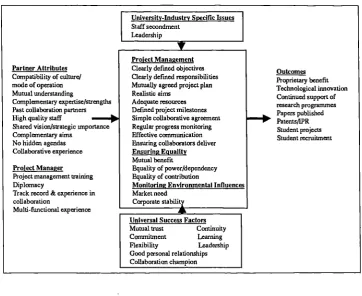
[image:24.595.105.468.404.700.2]While the literature indicates that there are no universal definitions of "success" in collaboration, it has been suggested that the key to successful collaboration by any definition, lies in the way in which they are managed [28]. To this end, many workers have concentrated on identifying management factors which, if present, increase the probability that the venture will be considered successful. Research aimed at the identification of these management "success" factors therefore became the focus of the literature reviewed in Submission 2, Section 3.2, and subsequently provided the basis for the best practice model for collaboration management developed by the author, Figure 2.
Collaborations in which WMG were involved could then be compared against the best practice model as a means of identifying possible areas for improvement in current management practices.
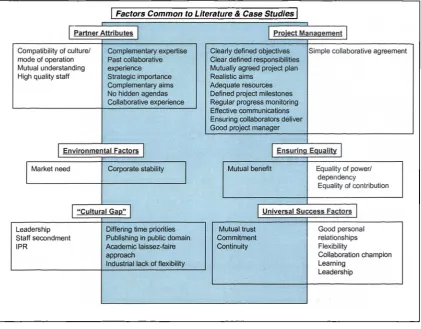
On review of published research concerning factors shown to have a positive impact on collaboration success, a pattern of similar findings emerged. First of all, it was found that there are a number of "success" factors which are essentially generic, being generally applicable across a wide range of collaborative formats, e.g. strategic alliances, joint ventures, research consortia. Evidently, these generic "success" factors also apply across industrial sectors; the literature reviewed spanned studies of technological collaborations in the biotechnology, pharmaceuticals, electronics, telecommunications, information technology, automotive engineering, aerospace, and oil-exploration. Further, the regularity with which some of these factors appear in the literature would seem to indicate that they are of key importance to the success of collaboration (Submission 2, Section 3.2).
The majority of the literature available in the field of success factors in collaboration management, examined only collaborations between companies, i.e. industry-industry collaborations. Nevertheless, on comparison with similar investigations examining university-industry collaborations, a high degree of commonality was observed with respect to the "success" factors identified (Submission 2, Section 4.2). As such therefore, the element of the best practice model referring to university-industry specific issues contained comparatively few success factors, since many of the success factors identified were already accounted for in other areas of the model, Figure 2.
Executive Summary page 18
This suggested that the generic success factors identified were applicable to both industry-industry and university-industry collaborations. Therefore, a best practice model developed on the basis of these "success" factors could potentially be applied to a wide range of types of collaboration and industrial sectors, though clearly the emphasis on certain factors may change depending on the particular circumstances of each collaboration.
However, a related area of literature suggested that with regard specifically to university-industry collaborations, there were a number of additional issues which must be taken into account. These additional factors arise as a result of distinct cultural differences between academia and industry, a phenomenon referred to as the "cultural gap". The existence of a "cultural gap" between academia and industry, and the detrimental effects it can have on university-industry collaborations has been reported by several workers [13, 17, 22, 4, 24, 29-31]. These authors provide evidence that the cultural difficulties encountered within university-industry collaborations could constitute a significant obstacle to successful collaboration. Gregory [13] summarises a number of points which immediately illustrate a significant cultural gap, i.e. conflicting interests/objectives, between industry and academia which must be bridged in order for collaboration to succeed:
• The academic culture of publishing research results in the open literature, versus a typical desire by industry to maintain data as proprietary in order to establish competitive advantage
• A perception of university researchers by industry as having a laissez-faire
approach to research
• Concern among academic researchers that collaborative research with industry will lack the flexibility to pursue unanticipated, but interesting and potentially valuable research directions
• Conflict regarding the ownership of IPR arising from a partnership
For a more detailed discussion of the issues raised specifically with respect to the "cultural gap" the reader is referred to Submission 2, Section 4.1. Clearly, consideration of such issues were important in the context of evaluating collaborations in which WMG was an academic partner. However, while these factors were taken into account in the analysis of the case study data (Submission 4 & 5) and subsequently also featured in the Framework for effective collaboration management (Submissions 6 & 7), they were not incorporated into the best practice model for collaboration management developed in Submission 2, Section 5.
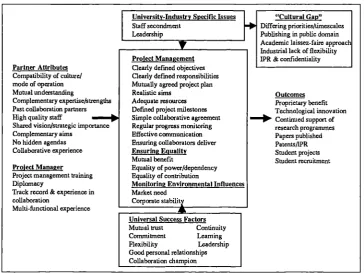
The main reason for this was that these factors were essentially "failure" factors, i.e. factors which could contribute to the failure of a collaboration. The best practice model was designed to incorporate "success" factors. Furthermore, these factors were essentially cultural issues and not management factors. Since these issues were taken into account in subsequent analyses (Submission 5 includes a discussion of the occurrence of such issues in the case study projects), their omission from the best practice model is not considered to have in any way affected the results of this research. However, in order to provide a more complete view of all of the factors considered to have either a positive or negative impact on the effectiveness of collaboration management, Figure 3 presents a modified version of the best practice
Partner Attributes Compatibility of culture/ mode of operation Mutual understanding
Complementary expertise/strengths Past collaboration partners High quality staff
Shared vision/strategic importance Complementary aims
No hidden agendas Collaborative experience Project Manager Project management training Diplomacy
Track record & experience in collaboration
Multi-functional experience
University-Industry Specific Issues Staff secondment
Leadership
Project Management Clearly defined objectives Clearly defined responsibilities Mutually agreed project plan Realistic aims
Adequate resources Defined project milestones Simple collaborative agreement Regular progress monitoring Effective communication Ensuring collaborators deliver Ensuring Equality Mutual benefit
Equality of power/dependency Equality of contribution
Monitoring Environmental Influences Market need
Corporate stabil
Universal Success Factors Mutual trust Continuity
Commitment Learning
Flexibility Leadership
Good personal relationships Collaboration champion
"Cultural Gap" Differing prioritiesitimescales Publishing in public domain Academic laissez-faire approach Industrial lack of flexibility IPR & confidentiality
Outcomes Proprietary benefit Technological innovation Continued support of research programmes Papers published PatentsffPR Student projects Student recruitment V
Executive Summary page 20
[image:28.595.99.464.223.496.2]model originally presented in Submission 2. As a result, while other workers have presented models of success factors found to be relevant to their particular study or line of research (Submission 2, Section 3.2), the inclusion of "success" and "failure" factors identified by literature covering a wide range of research studies, means that the best practice model developed by the author (Figure 3) is the most comprehensive.
Figure 3 Modified Best Practice Model Containing Factors Associated with the University-Industry "Cultural Gap"
The above best practice model for collaboration management therefore constitutes a generic model against which management practice in collaborations could be compared. Furthermore, the model shows that the success factors identified are concentrated into key areas: choice of partner, the project manager, project
management, ensuring equality, monitoring environmental influences. The model
collaboration, universal success factors, i.e. factors which are not easily categorised into a specific area of collaboration management and factors associated with university-industry collaborations and the "cultural gap".
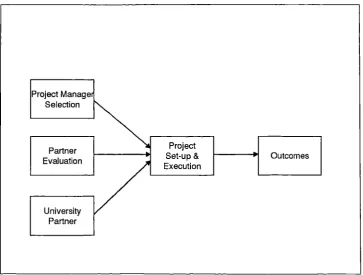
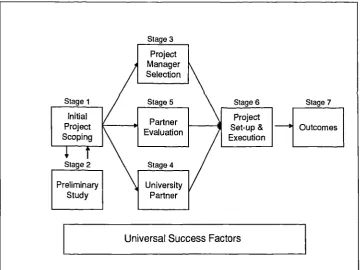
Further, the model organises these categories of success factors in such a way that it represents a total collaboration management process, beginning with the evaluation of partners and a project manager and ending with the emergence of a range of outcomes. The model therefore demonstrates the importance of managing the whole process in order to achieve success and not just individual elements of it.
2.2 A Framework for Effective Collaboration Management
The literature on which the best practice model was based indicated that research had not extended beyond the identification of a number of "success" and "failure" factors and their impacts on collaboration success. Very little work was found pertaining to how this knowledge could be applied in practice, to bring about improvements in collaboration management and thereby increase the rate of success in collaborations and the benefit obtained from them.
Furthermore, what little work had been carried out in this direction concentrated on one specific area only, e.g., partner evaluation, people management or project management. The work of Bailey et al [32] for example, presents a model for the evaluation of appropriate collaboration partners and as such provides some guidance in this respect. The work of Spekman et al [3] and also Brouthers et al [33] also present the results of their research in the form of guidelines aimed at maldng the process of partner evaluation more discriminating. Another example is the work of Porter Lynch [34] which whilst providing valuable insights into issues such as leadership and
Executive Summary page 22
interface management in the context of collaborations, again does not extend beyond this limited field.
Clearly, the importance of each individual element of the collaboration management process is such that in depth, dedicated research is not merely justifiable, but necessary. However, without some mechanism for bringing together these individual threads of research, such work is unlikely to increase the probability of collaboration success because each individual area effectively ignores the influence of factors in other elements of the collaboration process. A coherent solution is required which brings together the results of research into these individual areas and in doing so, provides the collaboration practitioner with a management tool (a Framework) which facilitates the effective management of the Whole process, from the initial planning stage through to measuring the outcomes.
3. The Case Study Research
3.1 Research Strategy
The objective of the case study research was to determine how WMG and its industrial partners compared to best practice in the management of technological collaborations. This evaluation was necessary in order to identify areas where improvements could be made to the way in which WMG's collaborative projects are managed. The findings could then be used, with reference to the current body of knowledge, to develop a Framework for the effective management of WMG's collaborative R&D projects.
The principal means by which the case study research would determine whether or not WMG and its partners were demonstrating best practice in collaboration management, was through direct comparison with the best practice model developed from the literature. However, since the best practice model consists of a large number of generic success factors, applicable across a wide range of collaboration types and industry sectors, it is probable that some factors will have a greater influence on collaboration success than others, in the specific context of this study. Furthermore, many of the factors which make up the best practice model were derived from industry-industry collaborations. Therefore, despite some evidence to suggest that they are equally applicable in the university-industry context, it was by no means clear that their influence on the success of the case study projects would be significant. This indicated that, in the first instance, the research strategy should include some means of evaluating the success of the projects, as the basis for establishing the significance of any influential factors identified.
Executive Summary page 24
3.1.1 Measures of Collaboration Success
The literature has shown that there is no universal definition of "success" in collaborative terms, or a standardised means of measuring it. For the purposes of this study, four success measures considered appropriate in this context, were therefore developed with reference to related areas of published research (Submission 3, Section 6.1). These measures were:
• Meeting Partners Objectives — a measure of the extent to which the objectives of
the project's partners had been met
• Mutual Benefit — a measure of the extent to which the project had been perceived
as mutually beneficial by all parties involved
• Overall Success — measured partner's perceptions of overall project success
• Technical innovativeness — an objective measure of success based on tangible
evidence of technological innovation resulting from the project
The literature showed that participant's perceptions are extremely important in the context of collaboration success (Submission 2) and the first three success measures therefore reflect that importance. However, perceptions are highly subjective and it is therefore inappropriate to base inferences of success or failure solely on such judgements. The fourth measure, technological innovativeness, therefore provides an objective measure of actual success as a means of validating these subjective judgements.
measures were established, the reader is referred to the Research Methodology report (Submission 3, Section 6.1).
3.1.2 Comparison with Best Practice
Comparison between the case study research findings and best practice was carried out by analysing the data collected for evidence of the management success factors incorporated in the best practice model. Establishing the presence of these success factors and any positive impacts from them, would suggest that WMG and its industrial partners were demonstrating best practice in collaboration management. Similarly however, if it could be shown that the antitheses of these success factors were having a negative impact on the collaborations studied, this would indicate that WMG and its partners were not demonstrating best practice.
For example, if it could be shown that the aims of the collaboration partners were not complementary, this would suggest that the success factor complementary aims had not been achieved and that best practice in the evaluation of appropriate collaboration partners had not been demonstrated in this respect. Furthermore, if the evidence indicates that this lack of complementary aims had a negative impact on the collaboration, it could be concluded that this success factor is an influential one in the context of collaborations involving WMG and its industrial partners and should therefore be included in the Framework.
Executive Summary page 26
However, this strategy clearly assumes that all possible management factors likely to have an influence on success have been identified and accounted for in the best practice model, i.e. there is a risk of possible threats to internal validity [35]. Therefore, it was equally important to analyse the data for evidence of other, not previously identified influential factors.
Finally, the literature (Submission 2, Section 4.1) showed that within university-industry collaborations specifically, a number of issues can arise as a result of distinct differences in the interests, priorities and values of academia and industry. Clearly, such differences in perspective and philosophy could have a negative impact on the success of a collaboration. Therefore, the data collected was also analysed for evidence of negative impacts as a result of a "cultural gap" between WMG and its industrial partners. A brief outline of the method of analysis used is given in Section 3.4.
3.2 Case Selection
[37, 38]. Therefore, another key differentiating factor in selecting the cases centred on collaborative projects which were generally perceived to be either largely successful or substantially failing. Such a strategy would ensure that the study focused on differences in management practices that might account for such substantially different results. On the basis of these criteria six case study projects were identified for investigation.
The first five projects were components of a larger research programme and as such provided a natural multiple case study. The benefit of studying projects from a common research programme was that this complied with the recommendation that cases be selected in such a way as to set boundaries around the study, thereby limiting the extent of environmental variation [37]. The circumstances and conditions within each of the projects, or cases, were broadly similar because they were set-up by the same Lead Partner and were set-up at the same time, to contribute toward a common goal. At the same time, each project incorporated different Lead Partner and WMG personnel, different partner companies, and were charged with delivering different aspects of the problem that the common research programme was set-up to address. Therefore, while the common arrangements shared by the projects limited the extent of environmental variation, there was still scope for considerably different outcomes.
Furthermore, since the research programme was essentially based in the automotive sector, these projects could be regarded as representative of WMG's research portfolio. In addition, cursory investigations suggested that whilst some of the projects within the programme were perceived as achieving some degree of success, others appeared to be failing. Collectively therefore, these projects presented the study
Executive Summary page 28
with examples of polar types. To this end, all five active projects were included in the case study research.
However, despite the many advantages of studying these projects as a natural multiple case study, it was noted that the existence of numerous strong vertical (customer-supplier) relationships within the projects was likely to influence the results of the investigation. Since in many cases the Lead Partner was a significant customer for the companies participating in the research programme, it was recognised that these companies were therefore likely to be to some extent pre-disposed to involvement in it. In fact, the involvement of the Lead Partner, an automotive manufacturer, was to a great extent used to leverage industrial support.
To this end, an additional case study project was added as a control for the inherent influence of the vertical relationships in the multiple case study. It was anticipated that if these strong vertical relationships were distorting the influence of the management success factors, the additional case study would give different results. Therefore the sixth case study project acted as a control for the vertical relationships in the first five cases, providing a means by which any influences attributable to these relationships could be identified and accounted for.
Another consideration in the selection of this additional case was the need to find a collaborative research project which had been set-up on a similar basis to that of the first five cases. This would contain the number of variables and potential extraneous influences on the results to within manageable boundaries, facilitating the study of only those influences that are of principal interest. It was noted that the sixth case (designated Project F) had the following features in common with the multiple case study (designated Projects A-E):
• Project F was funded under the same government initiative as two of the multiple case study projects (though for the Aerospace rather than the Land Transport Sector), and as such the terms of the funding, and the partners contributions to it were similar, as were the general programme objectives,
• Project F was therefore also an industry-lead project, managed by one of the industrial partners, and had the same three-year duration as Projects A-E,
• WMG were involved in Project F, though as with each of the other five cases, the individuals representing WMG on the project were different,
• Project F is a technology-based research collaboration, as were Projects A-E,
• The terms of the collaboration agreement were similar to that of Projects A-E,
• At the time that the interview data was collected, Project F had reached approximately the same stage of the collaboration, i.e. entering its final year.
One notable difference between Project F and Projects A-E (other than the difference in industry sector) was the involvement of more than one university. In Project F, WMG was partnered by two other universities, each university offering a distinctly different field of expertise. It was considered that this feature was unlikely to introduce any additional influences that have not already been accounted for, though
Executive Summary page 30
through the involvement of the two additional universities, there was the opportunity to gain additional insights into the relationships and cultural differences between academia and industry within this type of collaboration. This feature was therefore considered an additional benefit of Project F.
3.3 Data Collection
The principle source of evidence used in this study was that of interviews, a key source of case study information [35, 36]. In each of the cases studied, project participants from the collaborating companies, academic researchers, and where applicable, any technical staff having direct involvement in the projects, were asked to give an interview.
To ensure a consistent approach to each interview, i.e. to ensure that the same issues were raised in each case, the interviews were carried out in a semi-structured way [39], using a questionnaire. The use of a questionnaire meant that direct comparisons could be made with regard to respondents views on the issues raised. The design of this questionnaire is described in Submission 3, Section 5.
Since multiple sources of evidence are considered to provide more robust support to the findings of case study research, these interviews were supplemented by other sources of evidence [36, 37, 40]. The other sources of evidence available for this study included:
• Documentary evidence in the form of minutes of meetings carried out during the project, and progress reports.
• Archival records in the form of the financial reports of the companies involved in the collaborations.
Since Projects A-E and Project F had not been completed at the time that the interview evidence was being collected, it was considered important to obtain a sample of up-dated views from participants when these projects came to an end mid-1999. To this end, a follow-up questionnaire was sent to participants (this time by post) in order to capture these views. This questionnaire was designed to highlight any changes in the views of participants since the original interview and to record the final outcomes (both tangible and intangible) from each of the projects.
Finally, background information from company reports was used to further develop the contextual issues regarding each case. It was considered that such information could be important in strengthening external validity, in drawing attention to possible alternative influences which might explain certain events, decisions made, or specific problems which arose.
3.4 Data Organisation & Analysis
The study of the Projects A-F generated a large volume of interview data, particularly given the substantial use of open-ended questions in the questionnaires (Submission 3, Section 5.2). However, in order to ensure reliability in the application of the case study research methodology, it was important to develop a set procedure for the organisation and analysis of the data (Submission 3, Section 6.2) [36, 37].
The approach taken was to group responses pertaining to the same or similar issues into categories. This technique proved most effective in identifying the respondents' main concerns. Furthermore, this technique allows the researcher to identify patterns of similarities or differences, both within a case and across cases [35, 37, 40].
Executive Summary page 32
Appropriate categories were defined on the basis of the data collected and with reference to the major categories of success factors identified in the literature [37]. For clarity, the analysis concentrated on only the most frequently cited issues, which were assumed to be the most significant. The responses grouped under each category were tabulated for ease of reference and comparison with other cases. However, where an issue was only raised a small number of times, but was nonetheless considered important in the context of the study or a particular project, the issue was noted and raised for discussion in the case study report.
Aside from providing a clear impression of what the major issues were in each project, the categorising of responses in this way also facilitated discussion. The grouping together of all comments relating to a particular issue allowed for the different view points and interpretations expressed, to be compared and contrasted. Further, any additional information and relevant facts drawn from other information sources, e.g. meeting minutes, could also be brought into the discussion to verify the findings.
3.5 The Main Findings
The case study research findings, using the four success measures described in Section 3.1.1, showed that of the six projects studied three were successful, two were classed as "borderline" and one was deemed a failure. This indicates that, in at least one case, WMG and its industrial partners did not demonstrate best practice in managing collaborations. Furthermore, in all six cases there was evidence of negative impacts as a result of failing to apply best practice in certain areas. Therefore, while the negative impacts were only severe enough to cause project failure in one case, the evidence indicates that there was some scope for improvement in all six projects.
Tables 2 and 3 summarise the findings for each project, listing all factors found to have had either a positive (Table 2) or negative impact (Table 3). Table 2 shows that the positive impacts identified were associated with the presence of success factors identified in the best practice model, Figure 3. Similarly, it was found that the
antitheses of success factors (Table 3) identified in the best practice model, had a
correspondingly negative association on the projects concerned. For example, mutual
trust is identified in the best practice model as an important Universal Success Factor
which, if present, would be expected to have a positive impact on the success of the collaborative projects. In contrast however, the presence of the antithesis of trust,
mistrust in Project A, was found to have had a negative correlation with the success of
that project.
These positive and negative factors have been categorised according to the main areas of the best practice model for collaboration management, i.e., universal success factors, partner attributes, project management, ensuring equality. This was done in order to demonstrate the degree of fit with the best practice model and also to facilitate the identification of patterns of similar factors arising across cases.
...
CY
•
11
.0 6
= a ...
N
0.,.
a) CA ... a. = 8 -.§ 1 .1 i
a) c)
1
,
.E u vi, Vicp = 0 -z as at-8' '4-3
% g
CA
=
0
8
• .4
co = > 0 7:1 E
8 E 0 14 c.>
W .... a.I a, "F
4
4
to a> i == 0 a.) ..s.(
A
.1f,1:14 /...
5 4)
0 51"
u
a)CA 0 0 -1=1 8 ..
tl.) = > =
LL., =
iti 8 w..1 u
0 E 0 2 0 0 CD
v ,.... .:, rl
a
E-1 A ..., C.) CD4
cn fo i 09= 1:1
=w al. .e E & o x L.) a.)
(..) ..., u w .6
4
E '8 i 5 E ...,15, E 0 U 4 i s = 1=1 cu coE -4-5 •,-, .W..4 Ct. I:1 E 4) o Ca'x U a)
,8 8 ,.2 •;.'
cu —
1:1 4D..-4 2
Vit .--. 6 U s. P=1 ...,c., CY Ts'
4
c.) fo i. d9= b 0.) V)
E ..C.-CS
•... ....a.. e
E & o x C..) a.)
..,4 . aa .07
4
--,
„,
-ci o = 1,, g2 —
.-•C tr, V) = rki
gl, = tp 1. 0 a.) 0) .ci C.5 1-4-1, g a.'
g
•8 i e) 0 ;__, in, E o U .,a, = 0 0 ... : :,, ) zi 1=1 E & ox U co . . . .>as u M =
.6 r%) .--4 )1)
1n1 r, op^
U cu
= 0,, .
0
.0 0
i
I a ° b (:).a-) ,,, 5 .__. '0 cta3 P. ra.

![Figure 8 The Ten Factor Model of the Project Implementation Profile [42]](https://thumb-us.123doks.com/thumbv2/123dok_us/9824669.483767/60.595.106.476.332.614/figure-factor-model-project-implementation-profile.webp)