R
EQUIREMENTS
FOR EFFICIENT
ROBOTIC SURGERY
TRAINING
Thomas E. F. Witte
22TE
Enschede, 02-11-15
Faculty Behavioral Science
Psychology
Supervisors
Dr. M. Schmettow
&
1 Abstract
2 Table of contents
1 Abstract ... 2
2 Table of contents ... 3
3 Requirements for efficient robotic surgery training ... 5
3.1 Training of robot assisted surgeons ... 6
3.2 Frameworks and the development of robot assisted surgery training ... 7
3.3 Research questions ... 7
4 Method ... 8
5 Results ... 10
5.1 Search results ... 10
5.2 General overview of the field ... 12
5.3 Road to expertise ... 12
5.3.1 Surgery in terms of problem solving. ... 13
5.3.2 Knowledge. ... 14
5.3.3 Skill Development ... 16
5.3.4 Cognitive processes ... 16
5.4 Applicant selection ... 17
5.5 Training ... 19
5.5.1 A short history of surgical education. ... 19
5.5.2 Robot assisted surgery training ... 20
5.5.3 Striving for the gold standard ... 21
5.5.4 The major contenders to become the gold standard. ... 22
5.5.4.1 Fundamentals of robotic Surgery (FRS). ... 23
5.5.4.2 ERUS robotic surgery training curriculum. ... 23
5.5.4.3 Evaluation of emerging standards. ... 24
5.6 Task analysis ... 25
5.7 Robot assisted surgery in the context of open and laparoscopic surgery ... 26
5.7.1 Robot assisted surgery in comparison to laparoscopy ... 26
5.7.2 Prior surgical experience and skill transfer to robotic assisted surgery ... 28
5.7.3 Transfer of motor skills from laparoscopy to robotic assisted surgery. ... 29
5.7.4 Transfer of motor skills from open surgery to robotic assisted surgery. ... 34
5.8 Lessons learned from other domains ... 37
5.8.1 Aviation ... 37
6 Discussion ... 41
6.1.1 Requirements for efficient, effective and safe surgery training ... 42
6.1.2 A prototypical training approach. ... 43
6.1.3 The status quo in robot assisted surgery training. ... 45
6.2 Future research recommendations ... 45
6.3 Limitations ... 46
7 References ... 47
8 Appendix A ... 54
3 Requirements for efficient robotic surgery training
Robot assisted surgery has created a solid momentum in the last two decades, supported by surgeons as well as by researchers. An exponential growth in literature releases about the topic promotes this development, as shown by Schreuder and Verheijen (2009). They further show an exponential growth of performed procedures with the da Vinci robotic system. In 1998, 127 procedures were performed. In 2008, there were 132 454 procedures. The da Vinci robotic system (Intuitive Surgical, Inc) is the only commercially available system for general robotic assisted surgery, after the discontinuation of the ZEUS robotic surgical system in 2003. Schreuder and Verheijen (2009) summarize their results of a literature review they performed, with a list of advantages and disadvantages of robotic surgery. Among others, the main advantages they found are: (a) “better ergonomics for the surgeon”; higher degrees of freedom of the instruments compared to a human hand, (b) “elimination of physical hand tremor”, (c) “improved dexterity” (fine motor skills), (d) better vision, and (e) the “elimination of fulcrum effect” (p. 207). In laparoscopic surgery the fulcrum effect is the reversal of the movements of the instruments to the movements of the surgeon’s hand. Better performance and less physical and cognitive stress for the surgeon compared to laparoscopic methods are for example reported by van der Schatte Olivier, Van’t Hullenaar, Ruurda, & Broeders (2009). Nevertheless, there are some disadvantages too: (a) “high costs [for the] robotic system [and the] maintenance [of it]”; (b) “bulky size of the robotic system”; (c) “sometimes difficult access to the patient”; (d) “no tactile feedback [for the surgeon]”; (e) “chance of breakdown”; and (f) they criticize the monopoly of the da Vinci system, as the only commercially available option for robot-assisted surgery (Schreuder & Verheijen, 2009, p. 207).
technology is a well-designed and carefully integrated training program. Scientifically grounded guidelines and literature reviews are needed to support the development of such a training program. The most important reviews are shown in the following section.
3.1 Training of robot assisted surgeons
After a literature review about surgical robot assisted training programs Guzzo and Gonzalgo (2009) concluded that there is no current standardized training program and that the programs vary significantly in form and duration. A training can be as short as two days or as long as a full two years long trainee program. According to them, the most effective training is a “structured mentored training program” (p. 217). Subsequent to a systematic literature review about training and learning aspects of robotic surgery Schreuder, Wolswijk, Zweemer, Schijven, & Verheijen (2012) stated that “designing a competence-based training curriculum for robotic surgery remains a challenge …” (p. 146). Competency or proficiency based training is defined as setting a benchmark, validated by expert performance that has to be reached to gain credentialing. This is in contrast to a training model that is based on the time the trainee has spent acquiring the needed skills for surgery, i.e. volume-based training. The authors further describe the following points: assessment of skills training, learning curve and other aspects of robot assisted surgery training and they point out possible components of a structured competence based training in their guidelines. According to them most training models are divided into two categories, system training and procedural training, and their guidelines contains means to train knowledge and skills for the specific category. System training refers to knowledge and skills that are specific for the robotic system used, procedural training refers to the knowledge and skills needed to perform specific procedures with the robotic system. Last but not least they stress that with a stepwise and systematic training a safe and efficient use of the new method is possible. There are gaps in the review which can only be answered with further analysis of the literature and a broader scope, further discussed in the next section.
designer has to choose and create the content of the training program. Another important aspect for robot surgery training, which is missing in the review, is the transfer of skill from one operation modality to the other, for example from classical minimally invasive surgery to robot assisted surgery. To fill in the mentioned gaps a literature review was performed. Also issues that arose while trying to close the gaps will be discussed.
3.2 Frameworks and the development of robot assisted surgery training
One guiding theme for designing a medical training program is breaking down the experts’ knowledge and procedures into smaller parts. After that the training program designer has to decide which parts should be learned with which method. Suturing, for example, could be learned on a simulator with the help of virtual reality, in a dry lab, in a wet lab, or a combination of those methods. Guidelines and research for designing such a training need to be embedded into frameworks as mentioned in the previous sections. Without such frameworks research in a systematic way would be difficult.
Experts are not born, they become an expert by deliberate practice (Ericsson, Krampe, & Tesch-Römer, 1993). Ericsson et al. (1993) provide a framework on how to become an expert trough deliberate practice. This framework from expertise literature can be useful for creating guidelines for training development. Anderson (2004) provides another line of research on how to develop specific skills with his three stage model for skill acquisition.
Not only frameworks about how to become an expert are relevant for guidelines. Frameworks and research regarding cognitive processes on expert level are also relevant. For example, a surgeon performing on expert level has to make informed decisions in complex real world scenarios. One approach to describe decision making in complex real world scenarios is naturalistic decision making initially developed by Klein (2008). Understanding those cognitive processes can help training designers to focus on key elements that a trainee has to learn to perform on an expert level later on. For future daVinci training programs it is interesting how the mentioned frameworks about expertise can shape future training programs and also what the status quo in literature is. These frameworks and lines of research among others will be used and further discussed in the following sections.
3.3 Research questions
relevant tasks a surgeon has to perform? What are the relevant frameworks for cognitive and sensorimotor processes in being and becoming an expert in robotic assisted surgery? What are the similarities and differences between laparoscopy and robot assisted surgery? How do these differences influence the transfer of laparoscopic skills to robotic surgery ones? Are there lessons learned in other domains, which could be useful in the context of robotic surgery? To answer these questions a literature review was performed to give an overview of the relevant topics and to line out the issues that arise. After that the literature was analyzed to give recommendations for promising future research topics.
4 Method
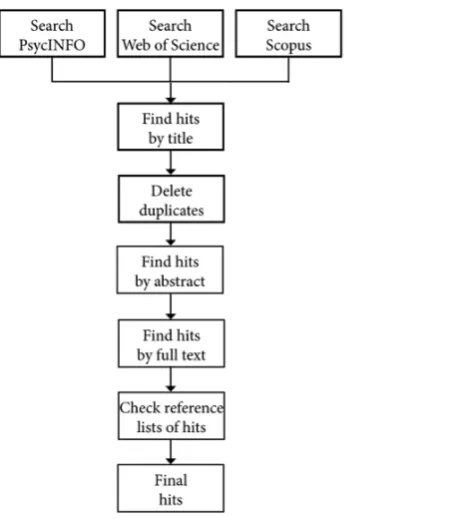
[image:8.595.213.451.420.680.2]The process of the literature review is as follows. A similar method was used for the systematic literature review as was used by Schreuder et al. (2012). In contrast to the review of Schreuder et al. (2012) different search engines were used. Also, the date of publishing was not limited. An overview of the process can be found in figure 1. Further, the stepwise guidelines provided by the library of the University of Twente were followed (Boxem, n.d.). The used databases for the search are: (a) PsycINFO, (b) Web of Science, and (c) Scopus with integrated PubMed.
The following initial search terms were used as a starting point:
Transfer of skill
→ ( laparoscop* AND robot* surg* ) AND ( skill OR task ) AND transfer )
Surgical task decomposition and acquisition
→ (surg* OR laparoscop* OR robot* surg* OR traditional surg* OR open surg*) AND (skill OR task) AND (decomposition OR deconstruction OR training OR aqui* OR proficiency)
Task analysis
→ (surg* OR laparoscop* OR robot* surg* OR traditional surg* OR open surg*) AND task AND analysis
→ (surg* OR laparoscop* OR robot* surg* OR traditional surg* OR open surge*) AND cognitive AND task AND analysis
→ (surg* OR laparoscop* OR robot* surg* OR traditional surg* OR open surg*) AND hierarchical AND task AND analysis
Cognitive, sensor, motor demands and skills
→ (cognit* OR senso* OR motor) AND (dexterity OR skill OR requirement OR demand) AND (surg* OR laparoscop* OR robot* surg* OR traditional surg* OR open surg*)
Critical incidents
→ (surg* OR laparoscop* OR robot* surg* OR traditional surg* OR open surg*) AND (critical incident*)
Aviation
→ aviat* AND skill AND surg* AND training
Sport
→ sport AND skill AND surg* AND training
systematic literature review the category transfer and comparison was processed until the step hits by full abstract. In the other categories an emphasis was placed on selecting literature reviews and literature that fill the gaps in those reviews as mentioned in the introduction. Finally, the articles were categorized and a short description of the most relevant aspects of each article for this study was summarized (see Appendix A). Until the step of finding hits by abstract and categorizing them, the literature review was performed systematically. To keep the work within the boundaries of a master thesis the literature review was further performed partly systematic. A detailed literature review protocol was created (see Appendix B).
5 Results
In the following sections the outcome of the search process is presented. This is followed by a general overview of the working field. After that the results of the literature review are shown in more detail for the different working field areas.
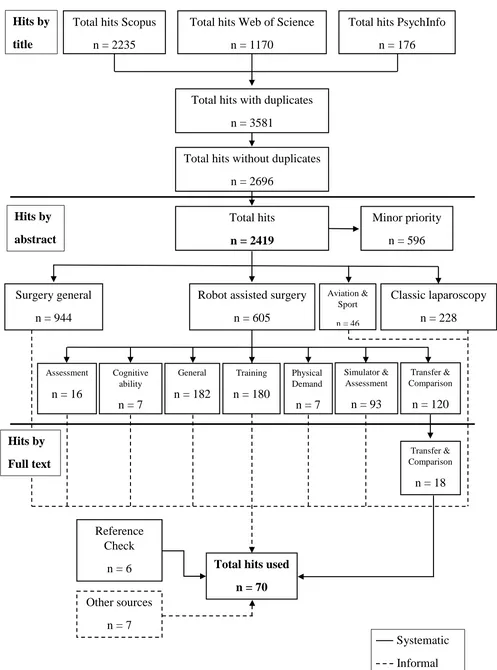
5.1 Search results
Total hits Scopus n = 2235
Total hits Web of Science n = 1170
Hits by
title
Total hits PsychInfo n = 176
Total hits with duplicates n = 3581
Total hits without duplicates n = 2696
Hits by
abstract
Total hits n = 2419
Minor priority n = 596
Surgery general n = 944
Robot assisted surgery n = 605
Classic laparoscopy n = 228
Assessment
n = 16
Cognitive ability
n = 7
General
n = 182
Physical Demand
n = 7
Simulator & Assessment
n = 93
Transfer & Comparison
n = 120
Training
n = 180
Hits by
Full text
Transfer & Comparison
n = 18
Reference Check
n = 6 Total hits used n = 70 Other sources
n = 7
[image:11.595.50.547.56.726.2]Systematic Informal
Figure 2. Overview and results of literature search.
5.2 General overview of the field
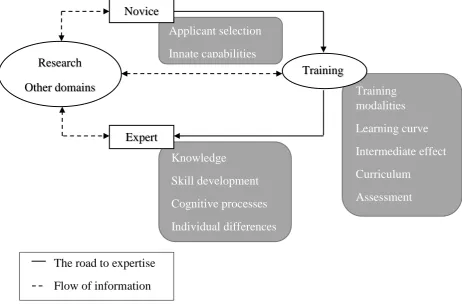
Setting up and maintaining a training program for robotic surgery is a demanding and complex task. Applicants need to be chosen, needed knowledge and procedures for becoming an expert has to be gathered. Means and modalities to train the knowledge and procedures have to be considered. Underlying cognitive, sensor and motor processes of a robotic assisted surgeon have to be broken down for structuring and content creation of the training program. Figure 3 gives a general overview of the field. The different parts of the work field and the found literature will be summarized and analyzed in the following, with the main focus on the transfer of skill, not covered by the literature review by Schreuder et al., (2012).
5.3 Road to expertise
Expertise has to be broken down into smaller pieces for a detailed discussion, because of its complexity. Robertson (2001) suggests the following dimensions to research and discuss expertise: (a) “knowledge”, (b) “skill development”, (c) “cognitive processes”, and (d) “innate capabilities and individual differences” (p.168). Those aspects are summarized in the context of robot assisted surgery in the following part.
Knowledge
Skill development
Cognitive processes
Individual differences Applicant selection
Innate capabilities
Training modalities
Learning curve
Intermediate effect
Curriculum
Assessment Novice
Expert Research
Other domains
Training
[image:12.595.67.530.262.566.2]The road to expertise Flow of information
5.3.1 Surgery in terms of problem solving. A problem can be described by its initial
state, the goal state, operators and restrictions (Robertson, 2001). For a better understanding of the problem it is important to categorize the problem. Surgery is an ill-defined, real world problem. Cao and Rogers, (2004) describe the main goal structure of a surgeon as follows:
“As most of the global decisions for surgery have been made before entering the operation room, the surgeon’s cognitive task during surgery consists of two parallel goals: 1) to execute a planned sequence of actions based on knowledge of the surgical procedure, and 2) to detect and correct deviations from the pre-planned course of action, as the operation proceeds, based on new information from the environment, as well as declarative knowledge of anatomy and case-specific details.” (p.77)
The description of the problem already has all the key elements a training has to provide to help a novice to become an expert in surgery. It has to provide enough declarative knowledge, so the surgeon can make informed decisions for the next step. Surgeons need enough
experience, so that they can execute the needed sequence of actions. Experience is building up over time resulting in declarative and especially procedural knowledge. Most prominent is anatomical knowledge as an example for declarative knowledge. Cognitive and sensorimotor processes are also listed implicitly in the description, so procedural knowledge is a key to success for becoming a surgeon. Detecting deviations from the pre-planned sequence involves attention to important aspects for each step, sensing those information and processing them, so
situational awareness is important. The recall of the different steps for a procedure also involves cognitive processes.
Table 1
Limitations of a human information processing system Limitations Limited working-memory capacity (Miller, 1956) Limited throughput of information from the senses Interference of new memories with old ones Limited ability to retrieve stored information
Limited “ability to maintain optimum levels of motivation and arousal” (p. 19)
The state action space of a problem is the description of every possible step, or problem state the problem can have. Because of the limitations and the experience of a human IPS an instantiation of the state action space, called problem space, is individually created. In concrete terms, this means that a surgeon cannot and must not consider every possible step and its consequences to reach the goal of a successful surgical operation. He pre-plans and executes the plan within his own narrowed down problem space. The notion that a surgeon pre-planned the necessary steps and made most general decisions before the surgical operation implicates that the surgeon generates an internal representation of the problem, the specific surgical operation with the case history in mind. He also chooses a method to reach the goal. Newell and Simon (1972) are defining a method as “a process that bears some rational relation to attaining a problem solution” (p88), (Robertson, 2001). The process of getting experience and developing needed skills and knowledge to become a surgeon is further described in the following sections.
5.3.2 Knowledge. Knowledge can be categorized into declarative knowledge and
and (d) “Post-operative steps for shutting down the robot, removing a robot from the operative field and transitioning the patient to a gurney.” (Smith, Patel, & Satava, 2014, p. 382). The elements taught in lecture form are most likely to become declarative knowledge.
The content for lectures, for example described above, needs to be linked to the tasks a surgeon has to perform. So to create the content, knowledge representations are required to describe the knowledge that is needed to perform surgeries. This field is called surgical process modelling (Lalys & Jannin, 2014). The knowledge representations have to be based on data and information acquired from surgeries and experts. Lalys and Jannin, (2014) conducted a literature review and give an overview of the working field. They concluded, that the data acquisition for surgical process modelling can be distinguished by four main elements: “(1) the level of granularity of the surgical information that is extracted, (2) the operator(s) on which the information is extracted, (3) the time when the acquisition is performed and (4) the recording method” (p. 499). They created two axes, one for granularity and one for formalization level. The axis for granularity ranges from low – level information, over motions, activities, steps, phases, up to procedure. It can be seen in Figure 4. It ranges from very fine grained to broad descriptions of a surgery
Low-level information
(image/video/presence) Motions Activities Steps Phases Procedure
Granularity axis
Figure 4. Levels of granularity of a surgical procedure, reproduced (Lalys & Jannin, 2014)
2D graph Lightweight ontology
Non-sequential list
Sequential list
State-transition diagram
Hierarchical decomposition
XML schema
UML diagram
Heavyweight ontology
[image:16.595.72.529.82.142.2]Formalization level axis
Figure 5. Levels of formalization of the surgery, reproduced (Lalys & Jannin, 2014) 5.3.3 Skill Development Anderson (2004) is proposing a three stage model of skill
acquisition. Those three stages are (a) the cognitive stage, (b) the associative stage, and (c) the autonomous stage. In the cognitive stage, the learned declarative knowledge is used to perform the tasks and skills, for example docking the robot to a patient. In this stage the tasks will have the highest cognitive workload compared to a task in another stage. At the associative stage, “errors are gradually detected and eliminated […] ” and “ […] the connections among the various elements required for successful performance are strengthened” (Anderson, 2004, p. 282). At this stage, the procedural knowledge builds up. For example, at this stage it is no longer required to rehearse the docking procedure before performing the task, because the declarative knowledge gradually converts to procedural knowledge. In the autonomous stage “the procedure becomes more and more automated and rapid” (Anderson, 2004, p. 282). From stage to stage the cognitive workload of the task degrades freeing up resources for other tasks, for example for team communication while docking the robot to the patient. However, even if all relevant skills for robotic surgery are developed until stage three it still needs deliberate practice to become an expert instead of only a very experienced professional (Ericsson et al., 1993).
5.3.4 Cognitive processes Frameworks could be helpful to describe cognitive and
sensorimotor processes and to model learning. The combination of surgical process modelling, skill development theories and cognitive frameworks can help to make decisions in the training design process. Cao and Rogers, (2004) are proposing to use a modified version of Wicken’s information processing and manual control model as a cognitive and sensorimotor framework to “describe the cognitive processes that underlie the decisions for motor responses in MIS” (p. 77). They further line out the usefulness of Rasmussen’s model for describing the different levels of human behavior (Rasmussen, 1983). The usefulness of this model in the domain of surgery is further mapped out by Wentink, Stassen, Alwayn, Hosman, and Stassen (2003).
can switch to slower more conscious analytical decision making. According to Crebbin et al. (2013) the surgeon varies between those extremes based upon situational cues. They provide a model for the monitoring and intraoperative decision making. This is in line with the overall goal structure mentioned above. Flin, Youngson, & Yule (2007) further map out the usefulness of integrating decision making strategies into surgical training in the tradition of naturalistic decision making. The switching between slower and faster more automated decision making could have the following consequence. For a surgeon coming from classical minimally invasive surgery the removal of the fulcrum effect and the loss of haptic feedback could lead to a high initial error rate or a longer time for completion compared to their classical minimally invasive task scores. Cues coming from haptic feedback and different visual cues could interfere with the automated processes. This example shows that a closer look at the transfer of laparoscopic skills to robotic surgery could be fruitful, so training programs can address these issues.
These examples show that models for cognitive processing can be useful for hypothesis formation in the domain of surgical training and can support decision making in designing a training program. For example, the notion that situational awareness is a key to success for the procedure, therefore other skills should be as much automated as possible so enough resources can be used and attention can be shifted to the situational awareness skill. However, the notion that skills once automated are difficult to alternate and the alternation of an automated skill is a slow learning process should also lead to careful considerations which skill should be automated to which level. This leads to the conclusion that skills automation and the resource freeing effects of it should be in balance with the risk of over automatization of skills, which can lead to devastating errors. One possible solution could be that a trainee could train skills with variation in tasks. For example, a trainee could train suturing with and without the fulcrum effect, and with and without haptic feedback on a simulator in alternating order. This could lead to longer training times, but could prevent costly errors and thus could be a cost effective training nonetheless. Spruit, Band, Hamming, and Ridderinkhof, 2013 are also suggesting task variation for motor task learning. They summarize that task variation has led to better learning outcomes than without variation. This effect “is called the contextual interference effect” (Spruit et al., 2013, p. 883)
5.4 Applicant selection
robot cost upwards of a thousand euro. They can only be used a couple of times. With such high costs admitting only high potential candidates can make a training program as cost effective as possible. Despite the need of candidate screening like in other high risk domains, it is only rarely used in the domain of surgery (Mann, Gillinder, & Szold, 2014). It is an ongoing line of research to find the underlying factors and innate differences that differentiates high potentials from other candidates.
A study compared two groups of second year students (Gupta, Lantz, Alzharani, Foell, & Lee, 2014). Participants of one group had a preference in pursuing a career in surgery the other group was interested in other medical disciplines. Baseline scores for “self- reported scores of dexterity and surgical technical skill […]” and “[…] prior surgical exposure and experience [..]” had no statistical significant differences. Also, “[…] gender, handedness, video game use, sport participation, prior open suturing exposure, prior cystoscopic exposure, prior laparoscopic exposure, prior robotic surgery exposure, mean self reported dexterity score and mean self-reported surgical skill score” showed no statistical significant differences (Gupta et al., 2014, p. 243). After a urologic skill assessment, the researcher of the study report that there were statistical significant differences between those groups. For certain skills in laparoscopy and all robotic skills tested the surgical group outperformed the non-surgical group. The authors conclude that there are innate differences between the participants of the two groups. They speculate that visual spatial perception or psychomotor learning curve could cause those differences.
In laparoscopy, the influence of cognitive aptitude on the learning curve and performance of a surgeon is a focus of ongoing research. More specifically visuo – spatial ability, spatial memory, perceptual speed, and general reasoning are considered as valuable variables (Groenier, Schraagen, Miedema, & Broeders, 2014). Groenier et al., (2014) summarize that based on their study, cognitive aptitude cannot be used for resident selection, but could be promising for creating individualized training programs.
Despite the fact that more research is needed to find the underlying factors that cause the differences of candidates, there are attempts for candidate screening. Mann et al. (2014) showed for example, that scores of participants from a simulator could predict “individual candidate’s chances of succeeding in” fundamentals of laparoscopic surgery tasks. These are tasks that American trainees have to perform to become a surgeon (Mann et al., 2014 p. 196).
5.5 Training
After the results of the literature review regarding the theoretical background were presented it is also interesting what the status quo in robot assisted training is. To give an overview a short history of surgical education is given. This is followed by a description and discussion of the training provided by Intuitive Surgical, the manufacturer of the DaVinci robot. After that the two main initiatives who develop a robot assisted training that is independent of intuitive surgical are shown.
5.5.1 A short history of surgical education. Traditionally open surgery was taught
in the operating theatre (Spruit, Band, Hamming, & Ridderinkhof, 2014). An experienced surgeon taught residents stepwise in an apprenticeship model. However, there were several shortcomings for this model. First, with the appearance of minimally invasive surgery, this model was more and more inefficient. The loss of degree of freedom, the fulcrum effect and the loss of 3D perception makes the procedures more complex compared to open surgery. The procedures are also less visible. Second, surgery is a high risk domain, so an ongoing development is overcoming as much as possible of the learning curve of a surgeon outside of the operating theatre, so patient safety is as high as possible. One of the founders of the fundamentals of laparoscopy (FLS) training is describing the situation as follows:
“(1) a huge group of surgeons required training, as did residents, in an environment where not a lot of teachers were available; and (2) surgeons were being trained through industry-funded courses that were highly variable in terms of their format. People would attend courses and then go back to the hospital and get credentials” (Brunt, 2014, p. 11)
5.5.2 Robot assisted surgery training Intuitive Surgical, Inc., at this moment in time
the only company producing a robot for general surgery, sustains an online community for training, marketing and peer to peer communication. The training pathways for the different team members, surgeon, multi-port first assist and operation room staff, are laid out. Further, they provide online training modules, detailed step by step procedure descriptions for specific surgical operations like prostatectomy and full length narrated procedure videos free of charge for now. Those step by step procedure descriptions “are developed with, reviewed and approved by independent surgeons” (Intuitive Surgical Inc., 2015, p 3). The company also has training centres all around the globe. As helpful that material may be, there are severe limitations:
” da Vinci® Surgical System training programs are not replacements for hospital policy regarding surgical credentialing. Certification, OR access and hospital privileges are the responsibility of the trainees and their institutions, not that of Intuitive Surgical. Any demonstration during Intuitive Surgical-sponsored training or instructional material on how to use the system to perform a particular technique or procedure is not the recommendation or ‘certification’ of Intuitive Surgical as to such technique or procedure, but rather is merely a sharing of information on how other surgeons may have used the system to perform a given technique or procedure“ (Intuitive Surgical Inc., 2015, p 3)
lack of certification and the patient has to cover all costs of the procedure. Because of that, only surgeons with high proficiency scores in laparoscopic surgery are performing those procedures and surgeons with lower scores who could profit from the robot in complex tasks do not even think about using the robot because of the risks involved. This suggests that laparoscopic experience and expert level transfers to robot assisted surgery. This will be further investigated in a later section.
Another reason for the need of system producer independent certified robot training programs is the upcoming competition within the market. Important patents for robot surgery are expired and companies like Titan Medical and Kymerax are expected to enter the market in the upcoming years (O’Reilly, 2014). With more systems on the market than only the daVinci system, a template with the basic requirements for robotic surgery is needed. All in all, the leading opinion in the literature is that a widely accepted, evaluated, validated, and well-structured training program for the certification of robot ready surgeons and their team is desperately needed (Schreuder et al., 2012).
for the team at an approved training center. This training can be “performed on a cadaver and/or animal model” (Ben-Or et al., 2013, p. 121). The training can last “one to two days, depending on clinical specialty” (Intuitive Surgical Inc., 2015, p. 1). The surgeon has to complete a protocol within the scheduled time and all members of the team may not leave the training early, otherwise the certificate for the off-site training completion will not be granted. Intuitive Surgical recommends that a minimum of two cases should be scheduled for the third phase, initial case series plan, as fast as possible, because “increased retention, improvement of system skill and confidence are connected to the immediate application of the skills learned in da Vinci Technology Training” (Intuitive Surgical Inc., 2015, p. 1).
Phase three and four are about post system training. In Phase three, initial case series plan, the team rehearses the procedure needed for the first case with a dry run, followed by the initial case series. It is recommended to start with level one cases, which means choosing a patient, with a good overall health, no reoperation, and a low procedural complexity. This initial case plan should be guided by an experienced proctor. “The surgeon should be proctored until s/he determines, in his/her surgical judgment, that s/he is sufficiently competent to operate independently” (Intuitive Surgical Inc., 2015, p.2). Further they recommend to perform two da Vinci technology skill development activities per week. These activities involve completion of the skills drills sessions, skills simulator sessions and the review of relevant surgery procedure videos for the cases at hand. After the initial case series, in phase four, the surgeon and the team should continue to develop the competencies so that the team gets competent enough for more complex procedures. Intuitive surgical recommends to attend to at least two courses led by a surgeon from their course catalogue, those are: (a) “surgeon lecture program”, (b) “complex da Vinci procedure observation”, (c) “complex da Vinci procedure video review”, (d) “da Vinci surgery webinar”, and (e) “Peer-to-Peer consultation via Surgical Congress” (Intuitive Surgical Inc., 2015, p.3). The lack of standardized validated proficiency levels of the team members after completion of the training and the system producer dependence of the training program disqualifies this candidate to become the gold standard for robot surgery training in general.
training curriculum” (Fisher et al., 2015, p. 120). Further they suggest to use the Fundamentals of Laparoscopic Surgery (FLS) training program as a benchmark to compare the main curricula of robotic surgery training to. After reviewing the main curricula they conclude that FRS and the ERUS initiative have the strongest offerings to become the gold standard for robot surgery, because they “[…] use a variety of models in a fellowship-style course […]” and their “ […] methods are transferable from one robot specification to another.” (Fisher et al., 2015, p. 121). An overview of the two potential candidates for the gold standard will be given and the content and development of the curricula will be used for analysis in the following sections.
5.5.4.1Fundamentals of robotic Surgery (FRS). The initiative of FRS is based on
subject matter experts of 14 international societies working on a consensus to create a validated basic skill training for the save use of robotic assisted surgery (Smith et al., 2014). These were joined by members of the certifying specialty boards and surgical education societies. The society of American Gastrointestinal and endoscopic surgeons (SAGES), who is responsible for the creation and wide acceptance of FLS, participates in the initiative and is joined by the US department of defense, just to name a few. The curriculum was gathered by multiple work groups, developing the four different modules of the program, and discussed in multiple consensus conferences. The FLS is used as the prototype for the development of the FRS. Further, a template was created with which several work groups are creating training curricula for their specific specialty. The skills training can be performed with a box trainer using the daVinci robot or virtual reality simulators. The training is supposed to train the basic knowledge and skills involved in robotic surgery.
5.5.4.2ERUS robotic surgery training curriculum. The Robotic urology section
aspirant may have different levels of proficiency in advance, for example experience in open surgery or laparoscopy, or begins without experience, so that the training program should be tailored to the trainee’s needs.
5.5.4.3Evaluation of emerging standards. The above described standards are just at
their dawn. Parts of them are still not published. Validation studies are in development or in progress. It seems that there are several years ahead until a golden standard is established. However, it is still interesting to evaluate the two above mentioned candidates that could become the gold standard. A detailed comparison with the commonalities and differences of the two curricula is provided by Fisher et al. (2015), a short summary is given in the following.
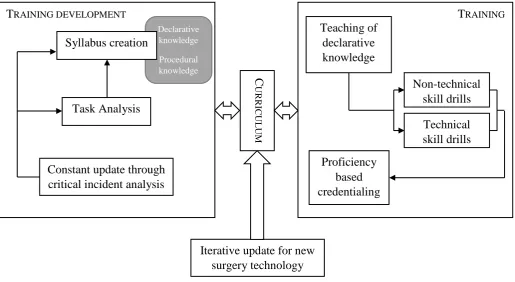
First of all, both curricula are based on simulation training. Both have modules where the trainee gains declarative knowledge. These are followed by modules where procedural knowledge is gathered via simulator skill drills. The biggest difference between the two curricula is that the FRS is a short comprehensive training. It should be seen as a starting point for “initial accreditation upon which further training is built” (Fisher et al., 2015, p. 117). The ERUS curriculum not only has simulator based training. The curriculum supports the trainee with a combination of dry lab, wet lab and structured mentorship until the trainees can perform full surgical procedures. The advantage of the FRS is that it can be integrated more easily into existing training programs. However, the ERUS training program can interconnect the modules of the program more easily once the curriculum is fully developed.
The previously described skill development stage model can be used to further clarify the difference of the two programs (Anderson, 2004). Both programs start with the cognitive stage. They provide declarative knowledge about robot assisted surgery. That is followed by the associative stage. Here the trainees train procedural skills. So part of the declarative knowledge starts to become procedural knowledge. The last stage, the autonomous stage is where the two programs differ the most. With the FRS the trainee will reach the autonomous stage barely for basic skills. The ERUS program however supports the trainee until the autonomous state for full surgical procedures. In both cases deliberate practice will still be needed to gain expert level performance.
5.6 Task analysis
[image:25.595.71.531.427.753.2]After the results of the literature review for the theoretical background and surgery training it is important to know what the actual tasks of a robot assisted surgeon are. In a study, the cognitive and procedural skills needed for robotic surgery were identified with the help of interviews of six subject matter experts for the purpose of curriculum creation (Dulan et al., 2012). The deconstruction of the tasks was further validated via 10 observational task analysis sessions. The result is a task deconstruction list of a total of 23 tasks and their descriptions. This list was used together with a further literature review, presentations and a discussion of subject matter experts at a consensus meeting to find the tasks involved in robotic surgery for the creation of the FRS (Smith et al., 2014). A list of 25 tasks ranked by importance, with the task name, description, errors, outcomes and metrics is provided in the report of the consensus meeting and an excerpt can be seen in Table 2 (Satava, Smith, & Patel, 2011). The tasks are categorized into pre-operative, intra-operative, and post-operative tasks. This is one example for how the knowledge basis for the content creation and training design can be gathered.
Table 2
Relevant tasks for robotic surgery training and their rank order gathered by subject matter experts, adapted from Satava et al., (2011).
Occurrence Task name Rank order
Pre-op
Situation awareness 1
Closed loop communication 9
Docking 10
Robotic trocars 16
Ergonomic positioning 19
System settings 20
Operating room set-up 22
Respond to robot system error 23
Intra-OR
Eye-hand instrument coordination 2
Needle driving 3
Atraumatic handling 4
Occurrence Task name Rank order
Camera 6
Clutching 7
Dissection fine & blunt 8
Knot tying 11
Instrument exchange 12
Cutting 13
Energy sources 14
Foreign body management 15
Suture handling 17
Wrist articulation 18
Multi-arm control 21
Post-op
Undocking 24
Transition to bedside assist 25
5.7 Robot assisted surgery in the context of open and laparoscopic surgery
Robot assisted surgery does not stand alone as a surgical technique. It evolved from laparoscopy. As the method evolves the surgeons have to evolve as well. Because of that it is important for training programs to know what the differences and similarities of the new surgical method are in comparison to the already established ones. Further, the impact of the differences and similarities on learning and performance of surgeons familiar with laparoscopy and open surgery is important. These issues will be addressed in the following sections.
5.7.1 Robot assisted surgery in comparison to laparoscopy It is often considered,
that results of laparoscopy can be extrapolated to robot assisted surgery, (Balkin, 2013, Cao & Rogers, 2004). After participating in surgical training activities and 400 hours of observation of robot assisted surgeries in an ethnological study, Balkin (2013) argues that the extrapolation needs to be handled with care. The detachment of the surgeon from the patient narrows the senses from the surgeon to a three-dimensional in vitro video stream.
laparoscopic surgeons but a more gradual learning experience for robot surgery. The authors also found differences in skill acquisition mainly due to lack of haptic feedback of the daVinci robot. An “increase in both quality and quantity of communication between surgeon […] and the First Assistant as compared to teams using laparoscopic technology”, (Balkin, 2013, p. 695). Difficulties were found to navigate in robot assisted surgery, because anatomy is often taught when the patient is in supine position, but different positions are sometimes needed in robot assisted surgery. Surgeons also reported that they are feeling like “working in a tunnel”, because of in vitro three dimensional view for the robot assisted surgeon, (Balkin, 2013, p. 695). Last but not least differences were found in camera use because of more extreme angles of view in robot assisted surgery. This amplifies “the difficulties with perceptual judgement” compared to laparoscopy so that beginners get “lost in the anatomy” more easily, (Balkin, 2013, p. 695). More details of the changes in skill acquisition and cognitive work are promised by the author, but not yet published.
5.7.2 Prior surgical experience and skill transfer to robotic assisted surgery The
differences and similarities between classical laparoscopic surgery and robot assisted surgery mentioned above raise the question how those skills transfer to the new method of robotic assisted surgery and vice versa. Surgeons that want to become robot assisted surgeons have open or laparoscopic experience or a combination of it. This state of the training market for robot surgery at the moment requires a closer look at implications of prior experience for robot surgery training. In general, the comparison of skill enhancement and transfer of skill for a trainee can take place on a continuum from no prior surgical experience to a fully trained experienced surgeon with thousands of performed procedures. The found literature will be discussed in the following to map out the transfer of skills.
loop communication for surgical teams. To conclude, trained surgeons who want to become robot surgeons can profit from further training in communication skills specific to robot surgery, because transfer from other surgery methods does not seem to be enough for a safe, efficient and effective robot surgery performance. Third, the sensorimotor skill level will be issued. This aspect has gotten the most attention in the literature for transfer of skill. It is discussed in the following sections.
5.7.3 Transfer of motor skills from laparoscopy to robotic assisted surgery. Three
main aspects differentiate classical laparoscopy from robotic assisted surgery. The fulcrum effect is eliminated, the degrees of freedom for the instruments regained and a three dimensional view is provided by the robotic system. The most benefit for the enhancement of surgical performance of novice trainees or trainees with minor surgical experience by the daVinci robot compared to laparoscopic surgery seems to be the combination of the vision improvement and the instrument improvements of the daVinci robot (Blavier, Gaudissart, Cadière, & Nyssen, 2007). Both factors on their own had no statistical significant effect on performance scores in the study of Blavier et al. (2007). The participants had also higher confidence and satisfaction rating for the robot assisted modality compared to classical laparoscopy. The study lays out the situation for novice trainees and trainees with a very short familiarization period of just a few trials.
In another study Blavier & Nyssen (2014) summarize and further map out that novice trainees are the most dependent on the surgery method they train with. After a switch of the surgery method low performance scores were measured “suggesting that there is no transfer of skills in novice performance” (Blavier & Nyssen, 2014, p. 516). Further they describe that experts in laparoscopic surgery can readily transfer their motor skills to robotic surgery. They showed similar performance scores laparoscopically, and with the daVinci robot in 2d and 3d view mode. However, surgeons trained with both modalities show better performance robotically. The authors conclude that even with the showed transfer of skill there is a method dependence expertise that needs to be trained to reach best results with each modality.
cues to correlate suture resistance with knot tension during conventional laparoscopic training and conveyed this skills to their robotic performance” (Öbek et al., 2005, p. 1103). This observation can be important for robot surgery training to facilitate the training by using a variation in motor skill training with and without haptic feedback as mentioned earlier.
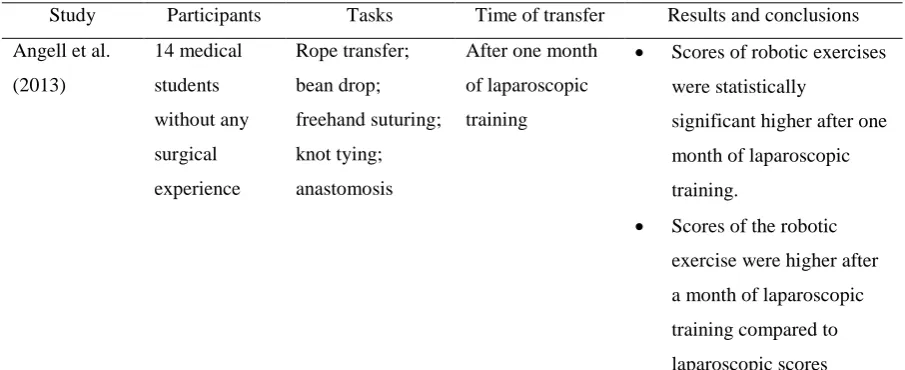
The study of Angell, Gomez, Baig, and Abaza (2013) supports the observation of enhanced performance for laparoscopically relatively inexperienced trainees. They also show that the performance after one month of laparoscopic training does not seem to negatively interfere with the switch to robotic surgery. However, those results need to be considered with care. They only showed the performance after the switch of one month of training for specific motor skills, not the switch of method after hundreds or even thousands of full surgical procedures that has to take place for some future robot surgeons. They also did not have a control group where the trainees trained the task with the daVinci robot, so the effect size of the transfer compared to only robotically trained participants cannot be estimated. The results combined with the one of Öbek et al. (2005) support the observation that with increasing laparoscopic experience for specific motor skills the switch of modalities becomes easier and is in contrast to the earlier mentioned possible outcome that negative transfer leads to significantly higher time to completion or errors. The observations are further validated in the literature. A study compared laparoscopic novices, with laparoscopic advanced participants, performing three motor tasks with and without the daVinci robot (Panait, Shetty, Shewokis, & Sanchez, 2014). All participants had no prior experience with the robot. They measured the initial scores for the tasks after familiarizing one minute with every modality. They conclude that the performance of participants with less laparoscopic experience was enhanced by the daVinci robot when the task’s difficulty was high. The more experienced subjects showed slightly lower performance scores robotically compared to the laparoscopic method for easy tasks. In the more difficult tasks they showed equal performance. These results also support the observation, that inexperienced surgeons’ performance is enhanced by the robot compared to laparoscopy. The more experienced laparoscopic surgeons’ performance seems not to be enhanced but for more difficult tasks the laparoscopic skills seem to be transferable. Kaul et al. (2006) is arguing that this could mean that for simple tasks the benefits of the robot are not needed and are more useful for complex tasks. All in all, the study shows that the level of proficiency of laparoscopic skills corresponds to different needs of the trainee for the robotic surgery training.
enhancement effect diminishes. So a novice shows overall better performance with the robot compared to laparoscopy. An experienced laparoscopic surgeon shows similar performance scores with or without the robot. These observations are also supported by several studies, (Heemskerk, van Gemert, de Vries, Greve, & Bouvy, 2007; Kim, Choi, Park, & Park, 2014; Landman et al., 2004; Nguan, Girvan, & Luke, 2008). This is in line with the observations of Balkin (2013) mentioned above for the learning curve. However, when an experienced surgeon trains with the daVinci robot further performance improvements can be gained. An overview of the studies discussed in this section can be found in Table 3.
[image:31.595.70.523.574.759.2]In summary, the findings have multiple implications for robot surgery training. Surgeons should train not only one modality. Motor skills transfer partly from one surgery method to the other. Specific robotic training should be complementary to already established trainings for open and classical laparoscopic surgery to prevent the risks of conversion of surgeries. Surgeons should also not train solely with the robot. Learned haptic feedback in other surgery methods can transfer to the robot training and facilitate it. The novice trainees’ enhanced sensorimotor skill performance through the robot has also training implications. The fast progress towards expert level scores and higher confidence and satisfaction levels compared to laparoscopy requires special attention to the credentialing process of robot surgeons. Non sensorimotor skills as for example intraoperative decision making and team communication develops at a non-robotically enhanced pace. The fast progress in sensorimotor skills could lead to overestimation of overall surgical skill performance. Therefore, mainly robotically trained surgeons should be evaluated with special attention to that aspect.
Table 3
Overview of studies regarding transfer of skills from classical laparoscopy to robotic assisted surgery
Study Participants Tasks Time of transfer Results and conclusions
Angell et al.
(2013)
14 medical
students
without any
surgical
experience
Rope transfer;
bean drop;
freehand suturing;
knot tying;
anastomosis
After one month
of laparoscopic
training
• Scores of robotic exercises
were statistically
significant higher after one
month of laparoscopic
training.
• Scores of the robotic
exercise were higher after
a month of laparoscopic
training compared to
Study Participants Tasks Time of transfer Results and conclusions
Blavier et al.
(2007) 60 medical students without surgical experience
Pick and place;
checkerboard; rings route; circular pattern cutting; suture and knot After short familiarization
phase of ten
repetitions
• Higher self-confidence and
satisfaction in the robotic
surgery group compared to
classical laparoscopic
group
• Best scores obtained
robotically compared to
classical laparoscopy
scores
• Poor performance after
switch from robot assisted
to classical laparoscopic
method without familiarization period. Blavier & Nyssen (2014) 12 medical student; 12 classical laparoscopical
ly surgeons; 4
robotically
and classically
trained
surgeons
Pick up and place;
checkerboard; Rings route; Circular pattern cutting; suture and knot 12 surgically inexperienced students; 12 surgeons with
more than 100
classical
laparoscopic
surgeries; 4
surgeons with
more than 100
surgeries
laparoscopically
and robotic
assisted
• Novice participants
benefited most from the
daVinci robot for training
skill enhancement
• “The results showed a
variable sensitivity to
perspective (2D - 3D) and
instrumental
(robot-classical laparoscopy)
aspects according to the
level of expertise but also
according to the type of
task.” (Blavier & Nyssen,
2014, p. 515)
Guru et al.
(2007) 6 faculty members; 6 fellows; 10 residents Beads; loops; knots After various degrees of laparoscopic training, 6 participants had robotic experience
• Different skills for the two
surgery methods requires a
specific training in robotic
Study Participants Tasks Time of transfer Results and conclusions Heemskerk et al. (2007) 8 medical students without experience in surgery
Pick up and drop;
Give over the
bead; cap the
needle; suturing
and knot tying
Learning curve of
cross trained
participants
without earlier
experience.
• Tasks were performed
more accurately and faster
with the daVinci robot
Tendency of initially faster
learning for robotic assisted
surgery
Kaul et al.
(2006) One open surgeon; one laparoscopic surgeon; one robotic assisted surgery trainee
Full procedure of
radical prostatectomy After various degrees of laparoscopic training
• DaVinci robot shrinks the
learning curve
• Open or laparoscopic
experience not required for
robotic training
Kim et al.
(2014) 10 medical students; 10 surgical trainees and fellows
Pick up and give
over a bead; ring
insertion onto a
cone; suturing and
tying of knots
10 laparoscopic novices; 10 laparoscopic experienced residents and fellows with formal laparoscopic
training and at
least 12 cases a
month
• Laparoscopically novices
have more benefits of
robotic system than
laparoscopic experienced
participants
• Laparoscopic experienced
participants have the same
or slightly better
performance robotically
compared to classical
laparoscopically
Landman et al.
(2004)
21 Surgeons Pipe cleaner; Ring
drill; Bead drill;
Knot drill
Novice;
intermediate;
expert surgeon
• Surgical robot enhances
performance of novice
surgeons compared to
experienced surgeon.
• Shorter learning curve for
robot assisted surgery is
suggested by the authors
Nguan et al.
(2008) 4 staff surgeons; 4 postgraduate trainees; 4 medical students Suturing; Knot tying
4 novices; 4
intermediate; 4
laparoscopic
experts
• Surgical experience can
compensate method
Study Participants Tasks Time of transfer Results and conclusions
Öbek et al.
(2005)
20 medical
students
Knot tying After training of
maximal 2 hours
• Knot tying skill was partly
transferred from classical
laparoscopy to robotic
assisted surgery and vice
versa
• Classical laparoscopically
trained participants had
higher scores robotically
than robot assisted trained
participants classical
laparoscopically
Panait et al.,
(2014) 14 medical student; 14 surgery residents all without robotic experience
Three FLS skills:
(a) peg transfer,
(b) circle cutting,
and (c) intracorporeal suturing After various degrees of laparoscopic
training, with one
minute of
familiarization
time for method
and task
• Less laparoscopy
experienced trainees’
learning enhanced by robot
• More experienced trainees
have initially robotically
assisted lower scores
compared to laparoscopy
skills for low difficulty
tasks but equal scores for
more complex ones.
Trabulsi, Zola,
Gomella, &
Lallas (2010)
One surgeon Full procedures Continuous
transition from
classical
laparoscopy to
robot assisted
surgery
• The surgeon had better
results with robot surgery
compared to his classical
laparoscopic performance
scores
5.7.4 Transfer of motor skills from open surgery to robotic assisted surgery. The
hour procedure benchmark for radical prostatectomy was reached after 110 to 120 procedures in their institution. Equal early continence outcomes were reached after 200 procedures compared to open surgery outcomes (Johnson & Wood, 2010). The very small participant numbers make a generalization of the conclusions difficult. The outcomes could be due to individual differences of the participants and therefore will be difficult to reproduce. This is also observed for literature regarding transfer of motor skill from microsurgery.
[image:35.595.68.525.594.763.2]Microsurgeries are surgeries where the surgeon needs a microscope to perform the procedure. The surgeon’s posture and the binocular view are considered to be similar to that of robot surgery. The surgeon has also no haptic feedback. If the surgeon uses forces that could give back haptic feedback trough the instruments the suturing fails because of the destruction of the suture (Perez et al., 2013). The close resemblance of work environment and viewing conditions suggests an overlap of sensorimotor skills. However no transfer of sensorimotor skill is reported (Karamanoukian, Bui, McConnell, Evans, & Karamanoukian, 2006). The authors used only 8 participants to come to the conclusion. A study with 49 surgeons as participants showed that surgeons with microsurgery experience have better performance in a dry lab compared to surgeons without that experience. The authors suggest to use cheap microsurgery training drills for robotic surgery training (Perez et al., 2013). In summary, there are the following implications for robotic surgery training. The single surgeon reports can be seen as a proof of concept. Open surgeons can become robot surgeons without the need of prior laparoscopic experience. Microsurgery training could be a cheap training module to familiarize the trainees with the work environment and to acquire sensorimotor skills. Both implications need further research for more precise recommendations for robot surgery training.
Table 4
Overview of studies regarding transfer of skills from open surgery to robotic assisted surgery
Study Participants Tasks Time of transfer Results and conclusions
Ahlering et
al. (2003)
1 Surgeon Full procedure Experienced
open surgeon
after one day
training
• Transfer of skill from open to
robot assisted surgery in 8 to
12 cases for radical
prostatectomy
• Performance outcome
comparable to outcome of
laparoscopic surgeons after
100 laparoscopic radical
Study Participants Tasks Time of transfer Results and conclusions
Doumerc et
al. (2010)
1 Surgeon Full procedure Continuous
comparison of
learning curve
with and
without robot
aid
• Different aspects of surgery
outcome and transferring skill
takes different learning times
to achieve comparable
outcomes to open surgery
outcomes Johnson & Wood (2010) Institution report
Full procedure Continuous
comparison of
learning curve
with and
without robot
aid
• After 100 procedures
operative times are similar
• No difference in complication
rate
• “The surgeons who are
beginning to incorporate
robotic surgery into their
repertoire should expect
outcomes to mirror their open
results” (p. 78)
• Learning of robot surgery is
easy for an open surgeon that
has no or minor prior
laparoscopic experience
Karamanouk
ian et al.
(2006)
3 surgeon; 5
residents Anastomosis on bovine arteries Comparison of fully trained microvascular surgeon and intermediate residents
• Results indicate “that no
transfer of training exists” (p.
664) O’Brien & Shukla (2012) Institution report
Full procedure Continuous
comparison of
learning curve
with and
without robot
aid
• Robotic surgery learning curve
is shorter from transition of an
open surgeon to robotic
surgery compared to a
transition to classical
laparoscopy
• Transition from open to
robotic surgery is possible
without first learning classical
5.8 Lessons learned from other domains
Learning precise sensorimotor procedures, acting and deciding under high psychological and physical stress, handling of high cost equipment and fatal errors counted in the loss of human lives is not unique to the domain of surgery. Pilots, and especially fighter pilots, have to act under similar circumstances (Buchholz, 2014). In top level sport, athletes also have to perform under high psychological and physical stress and have to perform highly trained sensorimotor procedures where mistakes can lead to severe injuries or even death of the athlete. Therefore, it can be fruitful to look at other domains and how the lessons learned can be used for the domain of surgery.
5.8.1 Aviation At the beginning of pilot training the situation was similar to the
beginning of surgeon training, mentioned above. A senior pilot was teaching a trainee in a master to trainee fashion in the cockpit (Buchholz, 2014). However, from thereon the situation has changed dramatically between those domains. Pilot training has legally binding international regulations, based on constantly developed and re-evaluated standardized syllabi, infused by detailed critical incident report evaluations. Every airplane producer has to provide detailed manuals for their products that meet the demands of those regulations. The training of a pilot is two parted, where the pilot first gains the basic flight license and then performs a training tailored specifically to the aircraft the pilot will operate. Every crucial skill, cognitive
Study Participants Tasks Time of transfer Results and conclusions
Perez et al.
(2013)
49 Surgeons Pick and place;
peg board; ring
and rail; camera
targeting; match
board
After experience
in microsurgery
and without
microsurgery
experience
• Surgeons with microsurgery
experience have better overall
scores in robot surgery tasks
than surgeons without that
experience.
• “Sitting position”,
“workspace”, “forearm
position”, “wrist working” and
“binocular vision system”
from microsurgery are
strongly considered to be
similar to the robotic surgery
environment (p. 355).
• Basic microsurgery training
could result in cost effective
or procedural, is described in the syllabi in detail and outcome measures are mentioned according to tasks performed. Examples are given by Buchholz, (2014). Further “all pilots must demonstrate their proficiency situations every 6 month in a check-flight (at present, mostly in a simulator) to renew their license” (Buchholz, 2014, p. 34). If the proficiency level is not sufficient to renew the license the pilot undergoes additional training. If the pilot still does not meet the requirements for the license the employment contract will be terminated. Comparing this situation to the situation the training of surgeons shows the problems and risks the healthcare system takes by not providing legally binding certification of surgeons. An analogy can be drawn. A pilot could not work on a line where two types of aircrafts are used and has only training for one of the types. Even if almost always the type of aircraft is used that was trained and the other aircraft is used for backup purposes. The chance that the pilot may have to operate the other aircraft requires the pilot to be trained for both types of aircrafts. Brunt (2014) is describing that there are procedures in surgery that are almost always performed with the minimally invasive surgery method these days but that rare complications may occur that requires a transition to open surgery. However, there are surgeons who never performed those procedures with open surgery and even state that they feel uncomfortable if such a transition is required (Brunt, 2014). These untrained scenarios, where the surgeon needs to transition from laparoscopy to open surgery, can lead to severe complications and death. A similar conclusion was drawn from critical incident analysis of the Air France flight 447 (Bhangu, Bhangu, Stevenson, & Bowley, 2013). A loss of speed indication made the autopilot useless. The pilot was not prepared to manually fly the plane at a high altitude, usually done by autopilot. Further the team was caught by surprise of a sudden problem resulting in the death of 228 passengers and crewmembers. For the context of surgery, the authors recommend that a surgeon and the surgical team should have gone through a comprehensive emergency and non-technical skill training. Further they should be trained in performing the procedures without the help of technology. In rare emergency occasions where technology fails or critical incidents requires a transition to traditional open surgery the team must be prepared.
effective and safer. Hereby not even considering the prevention of the tragically loss and traumatic experience for the relatives of the patient and the surgeon itself.
Quest (2007) a former fighter pilot with wartime experience and experienced neurosurgeon, is also pointing out key differences and similarities between the training of those two professions. The lack of emergency training, the lack of proficiency based training and not time based training like in surgery training, and the missing re-evaluation of the state of proficiency of surgeons are his main critique points and lessons that could be useful for the training of surgeons. He also points out that the simulator training of surgeons are “primitive and rudimentary” compared to flight simulators (Quest, 2007, p. 1072). The last notion is especially important for robotic surgery, because the console with the 3d view and the lack of haptic feedback is predesignated to be simulated with high fidelity to overcome parts of the learning curve outside of the operating theatre. However, with sophisticated simulators in development and in validation research, simulation training with mechanical, hybrid and virtual reality simulators are on their way to be a crucial part of save and efficient surgery training in general and for robotic surgery training especially (Cosman, Cregan, Martin, & Cartmill, 2002), (Halvorsen, Elle, & Fosse, 2005), (Patel et al., 2014).