Experience of posttraumatic growth of partners of cancer
patients who participated in an online intervention for
partners of cancer patients based on self-compassion and
Acceptance and Commitment Therapy
What doesn’t kill you only makes you
stronger?
Frauke Pelters (1186957)
30-08-2016
University of Twente
Faculty of Behavioural, Management and Social Sciences
Psychology – Master’s degree
10 European Credits (EC)
Contents
Samenvatting ... 3
Abstract ... 4
Introduction ... 5
Problem and General Background ... 5
Posttraumatic Growth (PTG) ... 6
Interventions to support partners of cancer patients ... 7
Acceptance and Commitment Therapy (ACT) ... 8
Self-compassion ... 9
Aim of this study & research question ... 10
Methods ... 12
The intervention Hold on, for each other ... 12
Target group within this study ... 14
Demographic data ... 15
Instruments ... 15
Data analysis ... 16
Procedure – development of the coding scheme & answering the research questions ... 16
Results ... 18
In which way do the domains of PTG occur? ... 21
Distribution of the domains of PTG across the exercises ... 23
Amount of PTG in the different groups of participants after the second measurement point .... 25
Conclusions and Discussion ... 27
Most important results ... 27
Strengths, limitations and recommendations ... 30
Final remark ... 31
References ... 32
Appendix A ... 39
Appendix B... 43
3
Samenvatting
Doelstelling. Het aantal nieuwe gevallen van kanker neemt steeds meer toe. Gediagnosticeerd
worden met kanker heeft grote invloed op de patiënt en de partner en kan tot psychische
problemen leiden. Echter kan het ook posttraumatische groei (PTG) teweeg brengen. Er zijn
ondersteunende interventies voor partners van kankerpatiënten. Köhle et al. hebben Houvast,
voor elkaar ontwikkeld dat gebaseerd is op zelfcompassie en Acceptance and Commitment
Therapy (ACT). Literatuur toont aan dat zelfcompassie en psychologische flexibiliteit (als
gevolg van ACT) ook groei kunnen bevorderen. Deze studie is er daarom op gericht uit te
vinden of PTG in de antwoorden van deelnemers van Houvast, voor elkaar optreedt. De
deelvragen staan stil bij de manier waarop PTG optreedt, in welke oefeningen en of er
onderscheid bestaat tussen drie verschillende groepen deelnemers (verbeterd, gelijk gebleven,
verslechtert in psychische klachten gemeten door middel van de HADS).
Methode. Data in de vorm van .pdf-files met alle antwoorden van 15 deelnemers werd
geanalyseerd. Deze deelnemers werden weer in drie groepen onderverdeeld, gebaseerd op hun
ontwikkeling op de HADS van het eerste naar het tweede meetmoment. In een iteratief proces
werd op zowel de- als inductieve manier een codeerschema ontwikkeld. De deelvragen
werden op exploratieve manier beantwoord en er werd beschrijvende statistiek gedaan door
tabellen op te stellen met de incident en verdeling van de codes. Alle data werd door een
onderzoeker geanalyseerd.
Resultaten. De domeinen waardering voor het leven, persoonlijke kracht en relaties met
anderen treden het meest op. Dit resultaat wordt ook weerspiegeld in de soorten oefeningen
waarin PTG het meest optreedt. Tenslotte hebben de deelnemers die op de HADS zijn
verbeterd ook de meeste PTG lieten zien tijdens de interventie.
Conclusie. Andere studies vonden ook dat partners van kankerpatiënten vooral de
bovenvermelde domeinen van PTG laten zien. Daarnaast bleken bepaalde oefeningen meer
PTG-gerelateerde inhoud op te leveren en dus meer geschikt te lijken om PTG te bevorderen
dan andere. Bij het aanbieden van Houvast, voor elkaar met het oog op het PTG zou daarom
overwegen moeten worden alleen de PTG-gerelateerde oefeningen aan te bieden. Dat zou
mogelijk sneller tot positieve PTG-gerelateerd uitkomsten kunnen leiden. Een sterk punt van
deze studie is het nieuw ontwikkelde codeerschema waarmee alle data gecodeerd kon worden.
Aan de ene kant is dat opvallend want de interventie was helemaal niet gericht op PTG. Aan
de andere kant is het dat niet omdat deze studie ook kon laten zien dat de constructen – ACT,
4
Abstract
Objectives. The number of new cases of cancer steadily increases. Being diagnosed with
cancer has a great impact on the patient and the partner and can lead to psychological
problems. However, it may also evoke posttraumatic growth (PTG). There are supportive
interventions for partners of cancer patients: Köhle et al. developed Hold on, for each other
which is based on self-compassion and Acceptance and Commitment Therapy (ACT).
Literature shows that self-compassion and psychological flexibility (as a consequence from
ACT) may also promote growth. Therefore, this study aims to find out if PTG occurs in the
answers of the participants of Hold on, for each other. The subquestions focus on the way in
which PTG occurs, in which exercises it occurs and if there is a difference between three
groups (improved, remained the same, deteriorated in psychological distress measured by the
HADS)..
Methods. Data in the form of .pdf-documents with all answered exercises of 15 participants
was analysed. These 15 participants were again divided into three groups, based on their
development on the HADS from the first to the second measurement point. In an iterative
process, a coding scheme was developed in both deductive and inductive way. The
subquestions were answered exploratory and there was made use of descriptive statistics.
Tables with occurrence and distributions of the codes were compiled. All data was analysed
by one researcher.
Results. The domains appreciation of life, personal strength, and relating to others occur
most often. This result is also reflected in the types of exercises in which most PTG occurs.
Lastly, participants who improved on the HADS after the intervention also expressed most
PTG during the intervention.
Conclusions. Other studies also found that partners of cancer patients mainly show the
aforementioned domains of PTG. Next to it, it turned out that certain exercises yield more
PTG-related content and therefore seem to be more helpful in promoting PTG than other
exercises do. When offering the intervention with the aim to promote PTG it should be
considered to only choose the PTG-related exercises in order to save time and resources of the
participant and to eventually enable quicker positive results regarding PTG. One strength of
this study is the novel coding scheme with which all data could be coded. On the one hand,
this is striking because the intervention was not focused on PTG at all. On the other hand, in
the end, it is not because the study also showed that the three constructs – ACT,
5
Introduction
Problem and General Background
Every year, the number of new cases of cancer increases. According to a report of the
Dutch Cancer Society, the number of new diagnosed cases of cancer for men will increase
from 45.110 in the year 2007 up to approximately 66.000 in the year 2020. For women a
similar trend is detected: For them the number of diagnosed cases of cancer will increase from
41.690 in the year 2007 up to approximately 57.000 in the year 2020 (Dutch Cancer Society,
2011). However, the Dutch Cancer Society also detects the trend of a declining mortality rate
in consequence of cancer. There are still certain forms of cancer that usually end up lethally
but meanwhile there is also good treatment for various forms of cancer. By this, the disease
does not have to be lethally anymore but becomes chronic or even acute (Dutch Cancer
Society, 2011). Due to the rising incidence and the decreasing mortality rates, the overall
prevalence of cancer sharply increases (Dutch Cancer Society, 2011).
Being diagnosed with cancer is a life-changing experience and can lead to many
psychological problems, such as emotional distress (Manne et al., 2004; Hinnen et al., 2008;
Gregurek, Braš, Đorđević, Ratković, Brajković, 2010; Hagedoorn, Sanderman, Bolks,
Tuinstra, & Coyne, 2008; Eton, Lepore, & Helgeson, 2005). This does not only apply to the
cancer patient himself but also to close family, for example partners (Köhle et al., 2015;
Sklenarova et al., 2014; Northouse, Katapodi, Schafenacker, & Weiss, 2012; Stenberg,
Ruland, & Miaskowski, 2010; Kim, Kashy, Spillers, & Evans, 2010; Friðriksdóttir et al.,
2011; Pitceathly & Maguire, 2003). According to several authors, partners of cancer patients
experience even more distress than the patients themselves (Couper et al., 2010; Janda et al.,
2008). In the existing literature, several reasons for the emergence of psychological problems
among family caregivers such as partners can be found:
Family caregivers are expected to provide complex care in the home with little
preparation or support. When the demands placed on caregivers exceed their
resources, caregivers feel overwhelmed and report high stress. (Northouse et al.,
2012, p. 237)
Furthermore, informal caregivers have to take over responsibilities and many roles, such as
providing support for the patient or attend to financial affairs (Köhle et al, 2015; Eton et al.,
2005; Goldzweig,Merims, Ganon, Peretz, & Baider, L., 2012; Stenberg et al., 2010). Besides,
uncertainties about the future (Eton et al., 2005) and changing plans regarding the future
6 Moreover, some studies state that partners of cancer patients primarily give attention
to the needs of their ill partner but do not care that much about their own needs or problems
(Sklenarova et al., 2014; Thomas, Morris & Harman, 2002; Pitceathly et al., 2003; Köhle et
al. 2015a; Northouse, Katapodi, Song, Zhang & Mood, 2010). Partners of cancer patients may
by even much ruder against themselves “than they ever would be to others they cared about [...].” (Neff, 2003, p. 87). Also, if one constantly criticizes oneself, this may also lead to stress
and symptoms of depression (Neff, 2011).
Posttraumatic Growth (PTG)
Next to the negative consequences a cancer diagnosis brings along, cancer patients and
their partners can also experience positive effects in consequence of the diagnosis and coping
with the disease (e.g. Manne et al., 2004; Thornton & Perez, 2006; Jansman, 2014). All these
effects can be resumed as posttraumatic growth (from now on abbreviated with PTG).
Tedeschi and Calhoun are most associated with this term. PTG comprises positive changes
due to fighting with life crises, such as bereavement of a loved person, illnesses such as
cancer, sexual assault or abuse and many more (Tedeschi and Calhoun, 2004). PTG can find
expression in many ways, “including an increased appreciation of life in general, more
meaningful interpersonal relationships, an increased sense of personal strength, changed
priorities, and a richer existential and spiritual life.” (Tedeschi & Calhoun, 2004, p. 1).
Overall, the major domains of posttraumatic growth are: (1) personal strength, (2) new
possibilities, (3) relating to others, (4) appreciation of life, and (5) spiritual change (Calhoun
& Tedeschi, 2006). In the following, these domains will be explained in more detail.
First, the domain personal strength entails an increased awareness of one’s own
strength. People who experience growth in this domain are able to “handle things better” (Tedeschi & Calhoun, 2004, p.6) and are aware that “bad things can and do happen” (Tedeschi & Calhoun, 2004, p.6). Moreover, awareness of one’s own strength is often also
accompanied by the somewhat paradoxically sense of being vulnerable (Tedeschi & Calhoun,
2004). People, who experience growth in the second domain (new possibilities), see new
possibilities for their life or for taking new or different paths in their life (Tedeschi &
Calhoun, 2004). They may also develop new interests and activities (Calhoun & Tedeschi,
2006). Growth in the third domain is characterized by “more intimate, and more meaningful
relationships with other people” (Tedeschi & Calhoun, 2004). People may also experience a
growing sense of connection to and compassion for other people who share the same fortune
because they also have experiences with loss and tragedy (Calhoun & Tedeschi, 2006). This
7 & Tedeschi, 2006). However, this domain has a paradoxical element, too. Next to more close
and meaningful relationships it may happen that one loses other relationships. This is
especially because people find out who their real friends are (Tedeschi & Calhoun, 2004).
People who experience growth in the fourth domain have a greater “appreciation for life in
general, and many smaller aspects of it” (Tedeschi & Calhoun, 2004, p.6). More precisely,
this can entail a “changed sense of what is important” (Tedeschi & Calhoun, 2004, p.6) and a “changed sense of priorities” (Tedeschi & Calhoun, 2004, p.6). Characteristic for this domain are regarding certain things more important than before or realizing “that life is precious”
(Calhoun & Tedeschi, 2006, p. 6). The last domain is about spirituality. More precisely,
people who experience growth in this domain, see a greater purpose and meaning in life, are
more satisfied, and may establish “clarity with the answers given to the fundamental existential questions” (Calhoun & Tedeschi, 2006, p.6). Even people who are not a priori
religious can experience growth in this domain (Tedeschi & Calhoun, 2004).
Based on the work of Tedeschi and Calhoun, Bohlmeijer & Bannink (2013)
summarize the process of PTG as follows: It starts with a traumatic event. This traumatic
event is so shocking that it causes the individual’s understanding of the world to totter or even
to be destroyed. It is also important to mention that PTG is not the direct consequence to the
trauma itself but to the intense struggle with the trauma and the effort to build new schemas
about the world and frame new goals. It is the first task to cope with the negative emotions
that are accompanied by the traumatic event. Anxiety, despair, anger or grief can be classed
among these emotions. Over time, the involved person becomes aware of the reality of the
event. Allowing and expressing negative emotions finally makes that the intensity of the
feelings and the rumination on the event decreases. Then, the person may be in state to find
new values, to solve problems and to imagine new future visions. The traumatic event is
integrated in a new life story and constitutes a turning-point in one’s life. Finally, the idea
occurs that one has grown through the confrontation with the traumatic event (Bohlmeijer &
Bannink, 2013).
If partners of cancer patients are nonetheless overpowered by psychological problems
that occur in the course of the caregiving process, a psychological intervention may be helpful
for them.
Interventions to support partners of cancer patients
There are a number of supportive interventions that aim to support partners of cancer
patients during the caregiving process and with eventually psychological problems due to
8 interventions: The majority of the evaluated interventions focuses on the well-being of the
patient but only few interventions were designed to focus on caregiver’s self-care. Also, they
are often not theory-based (Ussher, Perz, Hawkins, & Brack 2009). To overcome this
problem, Köhle et al. (2015) developed a new intervention called Hold on, for each other
[Dutch original title: Houvast, voor elkaar] that aims to support partners of cancer patients. In
the following there will be an outline about the theoretical framework of this intervention and
why it is supposed to support the well-being of partners of cancer patients..
Acceptance and Commitment Therapy (ACT)
The intervention is based on Acceptance and Commitment Therapy (from now on
abbreviated with ACT; pronounced as one word). The term already contains its core: ACT is
about accepting what is out of one’s own personal control and committing to take “action that enriches your life.” (Harris, 2009, p. 2). According to Harris (2009), the aim of ACT is to
build up a meaningful life and concurrently accepting the pain that is related to everyone’s
life. The main point of therapy is not to reduce symptoms but to change the relationship with
these symptoms. A reduction in symptoms still often appears as a positive side effect.
ACT contains a number of core processes which overlap and are interrelated with each
other: (1) contacting the present moment, (2) defusion, (3) acceptance, (4) self-as-context, (5)
values, and (6) committed actions. These processes are about consciously experiencing what
is happening in this moment and not going along with one’s thoughts and losing touch with
the environment; about regarding thoughts as “nothing more or less than words or pictures”
(Harris, 2009, p.9). Further the processes include accepting negative or dreadful feelings and
giving place to these emotions; and being “aware of whatever we’re thinking, feeling, sensing, or doing at any moment.” (Harris, 2009, p. 11). Lastly, there are two processes about
values and about the encouragement to develop larger patterns of actions that are linked to
these values. All these processes are not apart from each other. Rather, they can be seen as
facets of one whole which again can be called psychological flexibility (Harris, 2009).
Constantly more studies report the efficacy of ACT in reducing symptoms of
psychological distress (e.g. Hayes et. al, 2006; Fledderus, Bohlmeijer, Pieterse, & Schreurs,
2012; etc.) and more specific, also for cancer patients (Feros, Lane, Ciarrochi, & Blackledge,
2013; Hulbert-Williams, Storey, & Wilson, 2015). According to Köhle et al. (2015a), ACT
may help partners of cancer patients because they learn to “deal with the negative emotions caused by cancer [...] instead of avoiding these.” (p. 2). Furthermore, partners of cancer
patients could benefit from ACT because it teaches them to handle dysfunctional thoughts or
9 partners of cancer patients “to focus on what is really important to them” (p. 2) and to act
according to these values.
ACT is also related to self-compassion which is another theoretical foundation of Hold
on, for each other. In more detail, this relationship comes forth from the fourth core process
of ACT, Self-as-context. According to Harris (2009), there are two different components
when talking about the “mind”: The thinking and the observing self. The thinking self
includes producing thoughts, beliefs, plans etc. Most of the people are very familiar with this
self. The observing self is about being “aware of whatever we’re thinking, feeling, sensing, or doing at any moment.” (Harris, 2009, p. 11). Many people are not aware of this part of the
mind. According to Neff & Tirch (2013), the observing self, or the self-as-context, offers a
“non-attached and disidentified relationship to our experiences” (p. 96) and enables to view own suffering as one would view other people’s suffering and to "be touched by the pain in that experience”. This is what is also called self-compassion. According to Hayes, the roots
and emergence of self-compassion may be found in the core processes of ACT (Neff & Tirch,
2013).
Self-compassion
For a start, self-compassion is connected to the more general term compassion.
According to van den Brink and Koster (2013), compassion is the ability to feel affected by
pain and suffering. Additionally, compassion contains the wish and motivation to relieve
these pain and suffering. Self-compassion includes the understanding that pain and failures
are a common thing and that every human may experience it someday. A self-compassionate
person is able to forgive himself for these failures and is able to respect himself “as a fully
human—and therefore limited and imperfect—being.” (Neff, 2003, p. 87).
According to Neff (2003), self-compassion includes three domains: (1) self-kindness,
(2) common humanity, and (3) mindfulness. Self-kindness entails the friendly treatment of
our negative emotions and vulnerability. Common humanity grounds on the given that we are
not the only one with pain and suffering and that these are parts of every human. Mindfulness
entails open attention to our emotional pain and makes people not overidentifying with these
negative feelings.
Neff (2003) states that “there is good reason to believe that having compassion for
oneself promotes mental well-being” (p. 92). She assumes that a self-compassionate attitude
towards oneself should lead to a large number of favourable psychological outcomes, as for
instance decreased depressive symptoms, decreased anxiety, or more life satisfaction.
10 health-promoting contribution (van den Brink & Koster, 2013). Increased self-compassion is
associated with decreased depression, anxiety, ruminating or self-criticism (van den Brink &
Koster, 2013). Self-compassion also seems to be protective against throwbacks and is
associated with a healthier form of dealing with traumatic events (van den Brink & Koster,
2013).
Aim of this study & research question
Neff (2003) refers to Maslow and Rogers, who argue that among other things,
accepting own pain and failings and being more self-acceptant can lead to growth and change
(Neff, 2003). Furthermore, as mentioned earlier, self-compassion is associated with a
healthier form of dealing with traumatic events (van den Brink & Koster, 2013). As
self-compassion is linked to growth and self-self-compassion and ACT are linked to each other in
some way as mentioned earlier, it could be assumed that ACT and PTG may also be linked to
each other. Actually, there seem to be parallels between these two constructs: In its essentials,
ACT is about accepting what is out of one’s own personal control and committing to take actions that enriche one’s life. Posttraumatic growth is often consequence of events people
cannot control such as bereavement of a loved person or illnesses such as cancer and entails
increased appreciation of life, more meaningful relationships, an increased sense of personal
strength, changed priorities, and a richer existential and spiritual life. Besides, Kashdan and
Kane (2010) hypothesized in one of their studies that psychological flexibility, which is the
consequence of all core processes of ACT “would be associated with greater reports of
post-traumatic growth and meaning in life” (Kashdan & Kane, 2010, p. 85). Based on the study
results they were indeed able to approve this hypothesis. However, further literature about a
link between ACT and posttraumatic is difficult to find. Based on the preceding
argumentations about links between PTG and self-compassion respectively ACT and on the
fact that but yet there is not much literature about a possible link between ACT and PTG, it
would be interesting to investigate if partners of cancer patients were also able to experience
PTG through their participation in Hold on, for each other. If they were able to experience
posttraumatic growth while the intervention was based on ACT this could be an indication of
a link between ACT and PTG.
The assumption can be suggested that partners of cancer patients who get in the
context of Hold on, for each other the possibility to improve their self-compassion and
psychological flexibility may also be able to experience PTG.
11 Do partners of cancer patients who participate in the intervention “Hold on, for each other”
based on self-compassion and ACT, report PTG?
To investigate this question, the following subquestions are formulated:
i. In which way do the domains of PTG occur?
ii. In which exercises of the intervention do the elements of PTG occur more and in
which do they occur less?
iii. Are there differences with respect to PTG between people who scored lower, higher or
remained the same on psychological distress (HADS) after the second measurement
compared to the first measurement?
The research question and its subquestions will be answered after coding the data. For the
coding of the data, a new coding scheme will be developed. Development of this coding
12
Methods
The intervention Hold on, for each other
Hold on, for each other is a theory-based online intervention for partners of cancer
patients. There are several reasons for providing psychological interventions via the internet.
It increases the access to care and makes it available for everyone in any time or place.
Furthermore, people using online-interventions can stay anonymous. This may lower the
threshold for people who would otherwise fear stigmatization. People who have little time or
live in remote areas may also benefit from online interventions (Ossebaard & van
Gemert-Pijnen, 2013).
The intervention is based on Acceptance and Commitment Therapy and contains
exercises based on self-compassion. It contains six modules which are meant to be worked
through within six weeks. If a participant needs more time, he or she can work through the
intervention in at the longest 12 weeks. In every module, another topic comes up. The topics
range from learning recognizing, allowing and expressing emotions over managing a period
of chronic stress or focussing on negative thoughts or on values in life to the importance of
communication. There are also two additional modules from which participants can choose
the one which is important to them. The first one focuses on life after a successful cancer
treatment; the other one focuses on the final stage of cancer.
Every module opens with a brief text about the topic of the module. To these texts,
psychological exercises based on ACT are added. Beside this, each module contains a
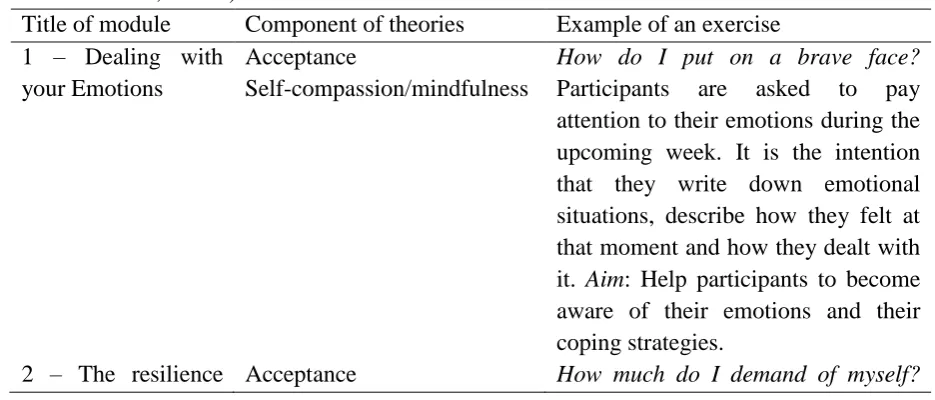
meditation task which is based on mindfulness and self-compassion. Hereinafter a table with
[image:12.595.60.528.578.778.2]an overview over which parts of which theory appear in the lessons.
Table 1. Modules, components of theories and examples of Hold on, for each other (according to Köhle et al., 2015b)
Title of module Component of theories Example of an exercise
1 – Dealing with your Emotions
Acceptance
Self-compassion/mindfulness
How do I put on a brave face? Participants are asked to pay attention to their emotions during the upcoming week. It is the intention that they write down emotional situations, describe how they felt at that moment and how they dealt with it. Aim: Help participants to become aware of their emotions and their coping strategies.
13 plan – How can you
ensure that you keep going?
Self-compassion/mindfulness Participants are asked to “write down how many hours they work, sleep, and have leisure time each week.” (Köhle et al., 2015b, p. 4). The
exercise is meant to show
participants “how much they demand of themselves and if their planning is realistic.” (Köhle et al., 2015b, p. 4) 3 – My mind works
overtime
Cognitive defusion
Self-compassion/mindfulness
The Worries-Box. Participants are asked to write their thoughts, sorrows and fears on a piece of paper. These pieces of paper are meant to be put in a box. After a while, participants can throw the box away or open it and read again what they have written down back then. The purpose of this exercise is to show participants “that worries are often not based on firm grounds.” The worries-box can help participants to see their thoughts in a new perspective.
4 – What is now really important?
Values
Self-compassion/mindfulness
Values in your relationship. Participants were asked to put down those things they consider most important within their relationship. The aim is to make participants aware of what may not be congruent with their values
5 – Very afraid, enormous tired, and moment to enjoy
Committed action
Self-compassion/mindfulness
Celebrating your relationship. Participants were asked to choose activities like writing a letter of having dinner together. This exercise was meant to show participants the preciousness of their relationship and how they could live “in accordance with their values.” (Köhle et al., 2015b, p. 4)
6 – The art of
staying in
conversation with someone
Communication about what really matters
Self-compassion/mindfulness
14 7 – Continuing life
(optional lesson)
Acceptance, cognitive
defusion, values
Self-compassion/mindfulness
Strengthen your hope. Participants were asked to “imagine the situation that their partner is cancer free for almost a year, and that he/she is feeling alright” (Köhle et al., 2015b, p. 4). They should imagine a life under these conditions. The exercise is meant to show participants that it can be helpful to look at a situation from another point of view.
8 – A good last
period (optional
lesson)
Acceptance, communication about what really matters, committed action
Self-compassion/mindfulness
Beautiful memories. Participants
were asked to think about
possibilities to create new memories
Participants can also decide to receive text-messages with inspiring texts. Furthermore,
two kinds of social support are integrated into the intervention. The first one is peer-to-peer
contact. In this context, participants can share their answers to some exercises and can have a
look at those of other participants. They can further write advices for their peers and can read
those written by other participants. Lastly, they can also make contact with peers and
communicate with them via email. The second kind of social support within this intervention
is professional support. For that matter, there are two versions of the intervention. In the first
one, participants get personal professional support. With personal support, participants weekly
get email-feedback from a counsellor on their progress in the intervention. In the second
version, participants get automated professional support. With automated support, participants
get short feedback immediately after they have completed an exercise. This feedback opens in
a separate pop-up window (Köhle et al., 2015b).
Target group within this study
In order to investigate the research question and its subquestions, the filled in exercises
of Hold on, for each other of three different groups of intervention participants were explored.
These groups were formed based on the participants’ development on the HADS, the Hospital
Anxiety and Depression Scale (HADS, Zigmond & Snaith, 1983). By this, the following
groups of participants were formed: (1) improved on the HADS, (2) remained the same on the
HADS, or (3) deteriorated on the HADS. The HADS and the precise criteria for assigning
15 Demographic data
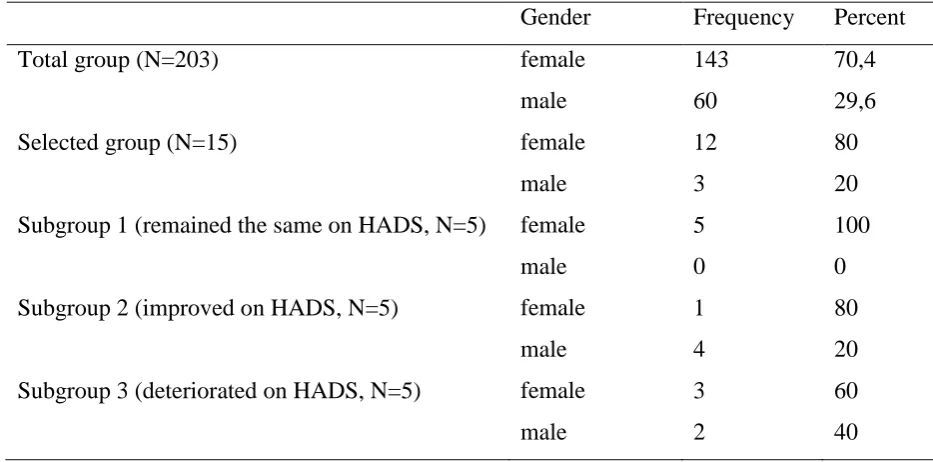
The demographic information age, gender and educational level have been ascertained
for all participants, for the selected participants in this study and for the participants in each
[image:15.595.66.532.210.400.2]subgroup and are displayed below.
Table 2. Mean age of all participants in the total group, in the selected group and in the three
subgroups in this study
Minimum age Maximum age Mean Std.Deviation
Total group (N=203) 27 82 55,89 10,72
Selected group (N=15) 34 74 54,60 11,16
Subgroup 1 (remained
the same on HADS)
42 74 59,8 12,34
Subgroup 2 (improved
on HADS)
34 58 50,2 9,86
Subgroup 3 (deteriorated
on HADS)
36 63 53,8 11,30
Table 3. Distribution of gender in the total group, in the selected group and in the three
subgroups
Gender Frequency Percent
Total group (N=203) female 143 70,4
male 60 29,6
Selected group (N=15) female 12 80
male 3 20
Subgroup 1 (remained the same on HADS, N=5) female 5 100
male 0 0
Subgroup 2 (improved on HADS, N=5) female 1 80
male 4 20
Subgroup 3 (deteriorated on HADS, N=5) female 3 60
male 2 40
Instruments
Within the scope of the randomized controlled trial by Köhle et al. (2015b),
participants in the experimental condition filled in the Hospital Anxiety and Depression Scale
[image:15.595.62.529.460.691.2]16 HADS is a self-assessment scale that aims to detect presence and severity of depression and
anxiety. It has two subscales, the depression subscale and the anxiety subscale with each
seven items. All items are four-point Likert items and their categories range from “very often”
to “not at all”. Anyway, the verbalisation of these categories is slightly different for each item. For example, the item “I still enjoy the things that I used to enjoy” which comes within the depression subscale has the following answer options: “definitely as much”, “not quite so much”, “only a little” and “hardly at all”. At the end, all points in each subscale are summed up. The scale is also useful for assessing changes “in a patient’s emotional state” (Zigmond &
Snaith, 1983, 366-367).
Within the RCT of Köhle et al. (2015b), the cronbach’s α of the HADS was as
follows: For the whole HADS, cronbach’s α was .861 at the first measurement point
respectively at the baseline measurement and .888 at the second measurement point. For the
depression subscale, cronbach’s α was .807 at the baseline measurement and .836 at the
second measurement. For the anxiety subscale, cronbach’s α was .773 at the baseline
measurement and .810 at the second measurement.
Data analysis
This study explored whether partners of cancer patients show PTG while participating
in the online intervention Hold on, for each other. This was done by means of a content
analysis: There was a pdf.-dossier of every participant. This dossier contained all exercises of
the intervention and the corresponding answers the participant typed in. The first supervisor
of this study randomly selected ten dossiers from each group of participants from which again
five dossiers were randomly selected for the content analysis. Prior to the analyses, it was
decided to analyse additional dossiers if no saturation would be reached after the first 15
dossiers. In this context, saturation means that as many dossiers are coded until no new codes
can be generated anymore. However, in the end, analysis of additional dossiers was not
necessary because saturation was reached after analysis of 15 dossiers.
Procedure – development of the coding scheme & answering the research questions
The content analysis was conducted with the aid of ATLAS.ti, a programme for
qualitative data analysis. In total, 15 dossiers have been analysed. Data analysis was an
iterative process and both deductive and inductive: The deductive part of the data analysis
proceeded as follows: Initially, based on the literature of Tedeschi and Calhoun (Calhoun &
Tedeschi, 2006; Tedeschi & Calhoun, 2004), a provisional code book with the domains of
PTG was prepared. This provisional code book contained the five overall domains of PTG as
17 dossiers have been coded with this code book. The inductive part of the analysis especially
refers to the constant revision of the code book while coding the data. For example, when
segments of data could not be coded with an already existing code, literature was consulted
again to search for additional aspects of PTG. In this manner, the code book was steadily
extended. Constant comparison also refers to withdrawing certain aspects of PTG from the
provisional code book if these aspects almost never occurred.
The size of the units of analysis within the content analysis varied. The units were not
grammatically but substantially based. For the majority of the data, the units mostly
comprised one sentence of parts of a sentence. Occasionally, whole exercises could be coded
as one unit because they could be covered by one single code. If suitable, one unit could also
be coded with more than one code.
To demonstrate what each code contains, a definition based on the literature and an
example quotation was given. Originally, the example quotations were in Dutch as the
intervention was developed in the Netherlands and the participants were also Dutch. For the
readability of this study, the quotations were translated into English.
Based on the coded data, the research questions could be answered. For this purpose,
descriptive statistics of the occurrence and the distribution of the codes were applied. More
specific, for each subquestion, a table was compiled. For the first subquestion, this was a
frequency table with the total frequencies of all codes and the number of participants who
showed a code. For the second subquestion, a table was compiled that shows the distribution
and the frequency of the codes within the individual exercises of the intervention. For the
third subquestion, at first, the three groups had to be compiled. Participants were assigned to
one of these groups, depending on the difference score on the HADS between the baseline
measurement at the beginning of the intervention and the measurement three months after
baseline measurement. Depending on the magnitude and the value of the difference score, a
participant was either assigned to the group of participants who improved on the HADS; to
the group who remained the same on the HADS or to the group who deteriorated on the
HADS. A participant “improved on the HADS” when he or she showed a difference score
between baseline and second measurement of Δ ≤ -3. A participant “remained the same on the
HADS” when he or she showed a difference score between baseline and second measurement
of -3 < Δ < 3. A participant deteriorated on the HADS when he or she showed a difference
18 quantity of codes per participant and on average was determined. Furthermore, it was
investigated how many exercises participants completed on average.
Results
In the following, the final coding scheme as it resulted from the data analysis will be
described and explained. For this purpose, a detailed description of each code and an example
quotation for each code will be given.
All code terms and code descriptions in the coding scheme are based on and can be
retrieved in the literature of Tedeschi and Calhoun (2004) & Calhoun and Tedeschi (2006), be
it as direct quotations particularly marked as such, as paraphrases or as reformulation based
on statements of the authors. The latter however only applies to the code “Paradoxical
element: happiness despite grief”. This term as such cannot be found in the literature but is an
own creation based on the authors’ deliberations (Tedeschi & Calhoun, 2004).
The final coding scheme entails the five domains of posttraumatic growth as worked
out by Tedeschi and Calhoun (2004, 2006): (1) Personal Strength, (2) New Possibilities, (3)
Relating to others, (4) Appreciation of Life, (5) Spiritual Change. Each domain again entails
different numbers of single codes.
For the domain Personal Strength there are the following codes: “Can handle things
better”, “Increased sense of personal strength”, “Knowledge that bad things can and do happen” and “Paradoxical element: sense of own vulnerability”. “Can handle things better”
means that the partner of the cancer patient has the idea that he or she is better able to cope
with things/events/situations: “Things that used to be big deals aren’t big deals anymore.”
(Tedeschi & Calhoun, 2004, p.6). This code can be applied when there are quotations such as:
“Hopefully, I can say: Time will tell. Often, I experience that things that I am faced with or
afraid of turn out better than expected afterwards. I already see now that I got used to many
things that I was faced with, e.g. the tube feeding and ground food, afterwards. Don’t worry
about tomorrow.” “Increased personal strength” is the most characteristic code of this
domain. The partner of the cancer patient recognizes that he or she possesses personal
strength in consequence of coping with the traumatic event: “This is a strength of mine I don’t
want to miss.” The code “Knowledge that bad things can and do happen” means that the
partner of the cancer patient is aware of the fact that bad things can and do happen. This code
finds expression in quotations such as: “What if the therapy is going to be stopped? Then we
19 recognizing one’s own strengths the partner may also become aware of the fact that he or she
is also vulnerable. This code can be found in quotations such as: “Often I feel as if I have to
do everything on my own, as if everything comes down on me.”
For the domain New Possibilities there are the following codes: “New activities”,
“New possibilities for taking a new and/or different path in life”. “New activities” entails that
in consequence of the trauma of the cancer diagnosis and coping with it, the partner becomes
interested and engages in new activities, be it in the context of work or in the context of
recreation etc. This code can find expression in the following way: “We arranged to go out
one day every week. I continue doing mindfulness and yoga. Furthermore I thought about
playing tennis more often.” The term of the second code in this domain, “New possibilities for taking a new and/or different path in life” already entails its core. Taking another path in
life can manifest in e.g. accepting a completely new job or exactly quitting one’s job, or
anything else not related to work: “In the end of june, I voluntarily quit my job. I already
arranged this before Harry got sick. That was lucky under the circumstances, through which I
have more time now.”
For the domain Relating to others, there are the following codes: “Relating to others in
general”, “Greater connection to people”, “More intimate and meaningful relationships”, “Increased sense of compassion for others”, “Increased sense that they are ‘part of the main who suffer’” and “Paradoxical element: changing relationships due to losing other relationships”. “Relating to others in general” means that the partner appreciates relationships
and friendships more and engages more in maintaining them than before the diagnosis: “I am
proud of being able to say that I have many friends, most of them already more than 30 years.
I consider it important and I also invest in that. I notice that I experience much support from
that in this difficult time.” The code “Greater connection to people” is given when the partner
experiences deeper relationships respectively friendships since the diagnosis. This may find
expression as follows: “Family ties became deeper, too.” The next code, “More intimate and
meaningful relationships” seems to be similar to the previous code but is somewhat more specific and targets the intimacy more than the previous code does. “More intimate and meaningful relationships” means that in consequence of coping with the trauma, the partner
experiences relationships to become more intimate and meaningful. A typical example of this
code may be: “I am going to invest more consciously in social contacts with people which I
experienced as precious during “the cancer”.” The code “Increased sense of compassion of others” is about empathising with other people who suffer – that follows on own coping with
20 general and especially with those who also have to fight against cancer or have a partner who
has to. “Letting him to cry out close next to me and telling him that he can get everything off
his chest at my place and that it is good that he comes to me to show his feelings.” The next code, “Increased sense that they are ‘part of the main who suffer’” may consequently follow
on the increased sense of compassion for other people: the partner recognizes that he or she is
not the only one bears this fate, but that there are indeed many people who suffer the same
fate: “Television programme Imagine Having it...a girl that lost many organs, colostomy, no
uterus, finally a CT scan and then it turned out that she had metastasis again after all.
Disappointment, compassion, melancholy.” The last code in this domain, “Paradoxical element: changing relationships due to losing other relationships” entails that the partner finds
out who his or her real friends are and consequently loses some friends or relationships:
“Furthermore it is also very confronting to see that our world has become very small. That we have few social contacts although we have a large circle of friends. My husband’s fatigue
and that he changed in a subtle way through the brain surgery makes that we can only make
short appointments, it is searching for how we can find our way with the changing
friendships.”
The domain Appreciation of Life contains the following codes: “Appreciation of life
(in general)”, “Changed sense of what is important”, “Major shift in how one approaches daily life”, “Smallest joys in life get a special meaning” and “Paradoxical element: Happiness despite grief”. The code “Appreciation of life” is given when it is obvious that the partner of
the cancer patient appreciates life more since the diagnosis: “Very surprised that I sufficiently
go on doing pleasant things: going for a walk, enjoying with my partner, being outside,
delicious food, sociability. In a word, being happy in the situation as it is right now.” “Changed sense of what is important” entails that the partner considers other things to be
(more) important than before since the diagnosis. A typical quote for this code may be: “More
and more, I try to figure out possibilities to create more time for myself.” “Major shift in how one approaches daily life” means that, as a result of considering other things to be important,
the partner may also change his or her approach of his or her daily life: “When talking about
work I would consider dealing with someone who has cancer as work, too.” The code “Smallest joys in life” is about valuing more small things such as smiling children, drinking a
coffee etc. in consequence of the cancer: “Enjoying doing some gardening work”. The last
code in this domain, “Paradoxical element: Happiness despite grief” is about still being able
to enjoy the pleasant sides and moments in life although the person has a difficult time and
21 half-full. Although there is almost nothing left in the glass now, I can enjoy the last nip that is
left. This is always the most delicious one!”
The domain Spiritual change only contains one code: “Spiritual change (in general)”.
The partner experiences a greater sense of meaning in life, satisfaction and may also get
answers to the fundamental questions of life. One does not have to be religious in order to
experience growth in this domain. A typical example quotation of this code may be:
“Inspiration, peace and harmony, giving meaning, ensoulment, silence, deceleration, faith, observing, reflection, meditation, consciousness, integrity, nature”
With the coding scheme, almost all answers to the exercises could be coded.
Exceptions were formed by exercises in which participants only had to tick options from a list
that apply to them. Furthermore, exercises that could be print out by the participants were not
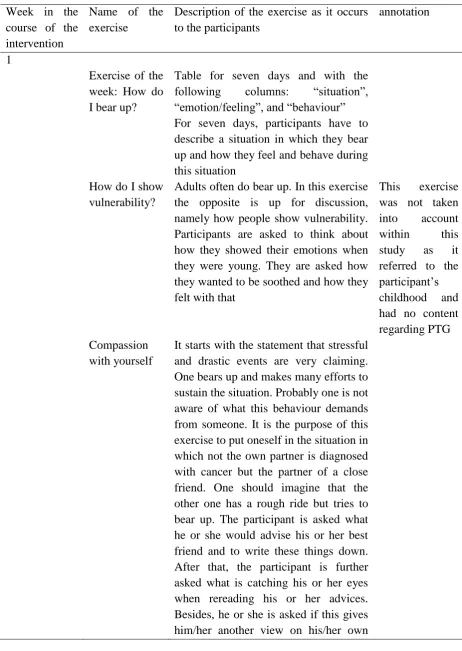
covered by the coding scheme. Lastly, the second exercise from lesson one was not covered
by the coding scheme as it referred to the participant’s childhood and delivered no content
regarding PTG. Negatively coloured answers especially appeared within the scope of the
codes “Paradoxical element: sense of own vulnerability” and “knowledge that bad things can and do happen”.
In the following, three paragraphs will have a more detailed focus on the answer of
each one of the three subquestions.
In which way do the domains of PTG occur?
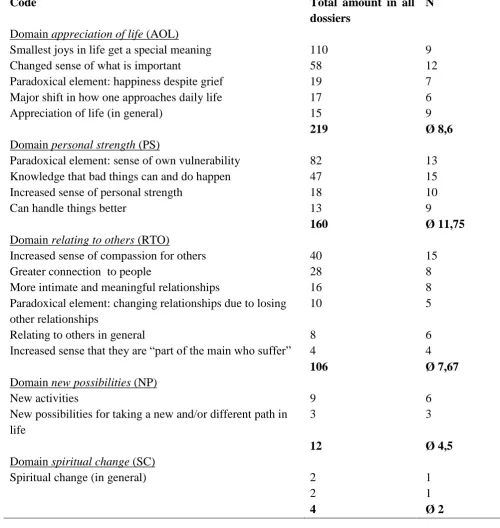
At first, the following table will give an overview over the amounts of all codes in all
dossiers. It contains all codes from the coding scheme together with the total amount of each
code in all dossiers been analysed and the number of participants who showed a particular
22 Table 4. Distribution of the domains and codes over all dossiers and participants
Code Total amount in all
dossiers
N
Domain appreciation of life (AOL)
Smallest joys in life get a special meaning 110 9
Changed sense of what is important 58 12
Paradoxical element: happiness despite grief 19 7
Major shift in how one approaches daily life 17 6
Appreciation of life (in general) 15 9
219 Ø 8,6
Domain personal strength (PS)
Paradoxical element: sense of own vulnerability 82 13
Knowledge that bad things can and do happen 47 15
Increased sense of personal strength 18 10
Can handle things better 13 9
160 Ø 11,75
Domain relating to others (RTO)
Increased sense of compassion for others 40 15
Greater connection to people 28 8
More intimate and meaningful relationships 16 8
Paradoxical element: changing relationships due to losing other relationships
10 5
Relating to others in general 8 6
Increased sense that they are “part of the main who suffer” 4 4
106 Ø 7,67
Domain new possibilities (NP)
New activities 9 6
New possibilities for taking a new and/or different path in life
3 3
12 Ø 4,5
Domain spiritual change (SC)
Spiritual change (in general) 2 1
2 1
4 Ø 2
The domain appreciation of life (AOL) occurs most often in the dossiers of the
participants of Hold on, for each other. Although this is the domain that occurs most often
with respect to its codes, it is not the one that occurs in the most dossiers. The domain that
occurs in the most dossiers is personal strength (PS). With respect to single codes, it can be
23 “Knowledge that bad things can and do happen” and “increased sense of compassion for others” are shown by most, namely by all 15 participants.
Furthermore, with respect to its codes, the domain personal strength occurs second
most commonly and the domain relating to others occurs third most commonly.
In terms of number of participants who showed a particular code, the codes “Paradoxical
element: sense of own vulnerability”, “changed sense of what is important” and “increased sense of personal strength” are shown by second, third and fourth most participants.
The domain spiritual change (SC) occurs least of all. Its only code is only shown by
one participant and also just two times in total.
Distribution of the domains of PTG across the exercises
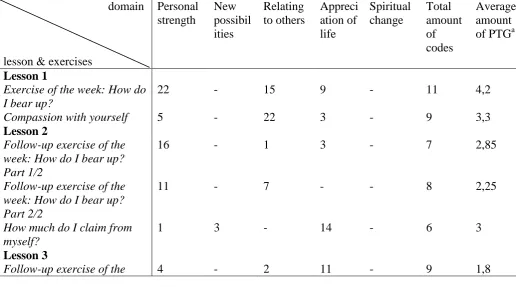
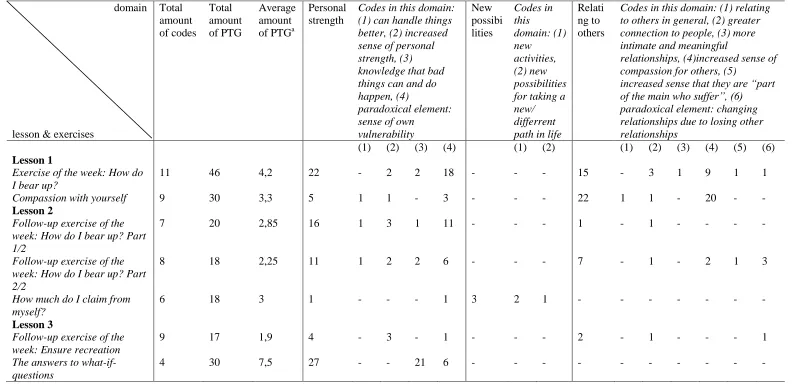
To answer the second subquestion, at first, another table was compiled. It shows for all
exercises within the intervention which domains of PTG occured in the answers of the
participants and for each exercise how often this domain occurred. Furthermore, the total
amount of different codes in every single exercise and the average amount of PTG in a
concerning exercise is displayed. This value takes the number of codes into account that was
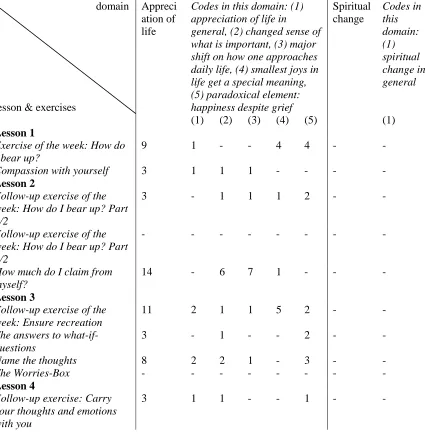
shown in a concerning exercise. Additionally, a more detailed version of this table can be
found in Appendix A. Next to the domains of PTG, it also contains the individual aspects of
[image:23.595.57.574.492.779.2]the domains respectively the codes.
Table 5. Occurrence of domains of PTG in answered individual exercises of the intervention
domain
lesson & exercises
Personal strength New possibil ities Relating to others Appreci ation of life Spiritual change Total amount of codes Average amount of PTGa
Lesson 1
Exercise of the week: How do I bear up?
22 - 15 9 - 11 4,2
Compassion with yourself 5 - 22 3 - 9 3,3
Lesson 2
Follow-up exercise of the week: How do I bear up? Part 1/2
16 - 1 3 - 7 2,85
Follow-up exercise of the week: How do I bear up? Part 2/2
11 - 7 - - 8 2,25
How much do I claim from myself?
1 3 - 14 - 6 3
Lesson 3
24 Note. For a more detailed table, see Appendix A
a
As measured by the amount of codes that occurred in the corresponding exercise
In “How do I bear up?” (lesson 1), the greatest amount of different codes occurs (11).
This is followed by several exercises in which nine or eight codes occur, for example
“Compassion with yourself” (lesson 1), “Name the thoughts (lesson 3)” or “Three good things” (lesson 5). The fewest codes occur in the exercise “Pretty memories” (lesson 8) (3).
With respect to the average amount of PTG, the exercise “Three good things” (lesson
5) is ahead (12). That means that in this exercise most PTG occurs compared to the other
exercises. At the same time, this is also the exercise with the largest total amount of PTG
(108, see extend table in Appendix A). “The answers to what-if-questions” (lesson 3) shows
the second largest average amount of PTG (7,5). The second largest total amount of PTG
occurs in the exercise “Dealing with drastic events” (lesson 6) (48, see extended table in
Appendix A).
Exercises that are mostly unrelated to PTG in terms of that few to no codes or
frequencies occur, are: “Worries-box (Zorgen-doos)” (lesson 3), “Cuddling attentively week: Ensure recreation
The answers to what-if-questions
27 - - 3 - 4 7,5
Name the thoughts 10 - - 8 - 8 2,25
The Worries-Box 5 1 - - - 3 2
Lesson 4
Follow-up exercise: Carry your thoughts and emotions with you
8 - - 3 - 6 2
Values in your relationship 4 - 8 12 - 9 2,67
Lesson 5
Three good things 1 1 16 89 1 9 12
Cuddling attentively 1 - 4 2 - 4 1,75
Lesson 6
Follow-up exercise:
Celebrating your relationship
2 1 4 8 - 8 1,88
What do you want to talk about?
7 - 7 10 - 8 3
Dealing with drastic events 24 - 8 16 - 8 6
The Love Me-method 2 - 2 1 - 3 1,67
Lesson 7
Strengthen your hope - 1 6 6 - 8 1,63
Wise counsel part 1/2 2 - - 9 - 6 1,83
Wise counsel part 2/2 5 - 1 1 - 6 1,17
What do you especially need now?
- 3 1 8 1 6 2,17
Lesson 8
25 (Knuffelen met aandacht)” (lesson 5), “Love-Me method (Love-Me methode)” (lesson 6),
“Wise counsel part 2 (Wijze raad deel 2)” (lesson 7) and “Pretty memories (Mooie
herinneringen)” (lesson 8).
Summing up, it can be said that three exercises are clearly related to PTG: “Three good things” (lesson 5), “The answers to what-if-questions” (lesson 3) and “Dealing with drastic events” (lesson 6).
Amount of PTG in the different groups of participants after the second measurement point
For the third subquestion, a table was compiled that is split with respect to the
development of psychological distress from first to second measurement. The rows therefore
show the three groups of participants: “Improved on HADS”, “remained the same on HADS” and “deteriorated on HADS”. The table further contains the number of expressions of PTG
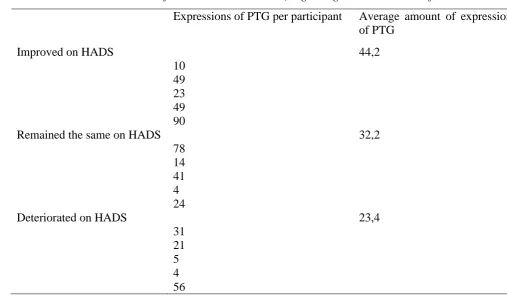
[image:25.595.54.562.395.694.2]per participant and the average number of expressions of PTG per development on the HADS.
Table 6. Differences between participants of the three groups (improved, remained the same,
or deteriorated on the HADS after second measurement) regarding the total amount of PTG
Expressions of PTG per participant Average amount of expressions of PTG
Improved on HADS 44,2
10 49 23 49 90
Remained the same on HADS 32,2
78 14 41 4 24
Deteriorated on HADS 23,4
31 21 5 4 56
The group that improved on psychological distress, measured by the HADS, showed
the greatest average amount of PTG. Simultaneously, the group of participants who remained
26 average amount of expressions of PTG. In the group of participants who deteriorated on
psychological distress after the second measurement,
In all three groups, there is each one obvious outlier: In the group that improved on
psychological distress, there is one participant who expressed PTG 90 times. In the group of
participants who remained the same on the HADS after the second measurement, one
participant showed just four expressions of PTG in total while another expressed PTG 78
times. In the group of participants who deteriorated on the HADS, one participant expressed
far more PTG than the other participants of this group (56).
For this subquestion, it was also controlled how many exercises participants
completed. As lesson 7 and 8 were optional, the number of possible exercises varied. The
participants could choose one of these lessons but did not have to. If they did, the number of
possible exercises again depended on which of the two lessons they chose. The group of
participants who improved on the HADS also completed most exercises (15 out of averagely
20,8 exercises).
Participants in the group that deteriorated on the HADS completed slightly more
exercises (12,4 out of averagely 20,4 exercsies) than participants in the group that remained
the same on the HADS (12,4 out of averagely 21,4 exercises). In this field, there are also
some outliers: In the group of participants who improved on the HADS, one participant
completed only ten exercises out of 19 while other participants in this group completed far
more exercises (19 out of 23 exercises). In the group of participants who remained the same
on the HADS after the second measurement, one participant completed just five out of 19
exercises. In the group of participants who deteriorated on the HADS, one participant
completed far more exercises than the other participants in this group (21 out of 23 exercises)
while another one in this group completed only 5 out of 19 exercises1.
27
Conclusions and Discussion
It was aim of the present study to investigate if partners of cancer patients who
participate in the theory based online intervention Hold on, for each other are able to
experience PTG. Based on the literature, there was reason to presume that partners of cancer
patients who participate in Hold on, for each other and get the possibility to improve their
self-compassion and psychological flexibility, are also able to experience PTG.
Most important results
Analysis of the data disclosed that participation in Hold on, for each other is
associated with the occurrence of PTG.
Regarding the first subquestion, especially the domains appreciation of life (AOL),
personal strength (PS) and relating to others (RTO) occur most often. More specific,
especially the codes “smallest joys in life”, “paradoxical element: sense of own vulnerability”,
“knowledge that bad things can and do happen” and “increased sense of compassion for others” occur most often. Interestingly, other studies which also focused on PTG in partners
or other family members of cancer patients, revealed similar results: Manne et al. (2004)
found out that partners of cancer patients especially grew in the domains of personal strength,
appreciation of life and relationship with others. The same applies for the study of Jansman
(2014) and a yet unpublished study by Köhle, Drossaert and Bohlmeijer (2016).
As the analysis in this study disclosed the same domains occurring most often, its
results could confirm what other studies found out earlier, namely that partners of cancer
patients especially experience PTG in the domains personal strength, appreciation of life, and
relation to others. However, the question remains whether PTG in these domains occurred
during and due to the intervention or whether it already existed before participants started
with the intervention. On the one hand, dealing with the ACT and self-compassion based
exercises could have facilitated the emergence of PTG because self-compassion may motivate
for growth and change (Neff, 2003). Furthermore, self-compassion may also support healthier
dealing with traumatic events (van den Brink & Koster, 2013). Becoming psychologically
flexible as it results from ACT is also associated with more posttraumatic growth (Kashad &
Kane, 2010). On the other hand, PTG can already occur in consequence of hearing about the
diagnosis and purely coping with the disease (Manne et al., 2004; Thornton & Perez, 2006;
Jansman, 2014). Thus, people participating in Hold on, for each other may already have
experienced PTG before due to coping with the diagnosis and the disease of the partner. In
future research, a PTG-related questionnaire, for example the Posttraumatic Growth Inventory
28 other before they start with the intervention and after the finished it to determine whether they
possibly already experienced PTG before the start and whether their levels of PTG could be
improved through the intervention.
With respect to the second subquestion, it can be concluded that most PTG occurs in
the exercises “Three good things” (lesson 5), “The answers to what-if-questions” (lesson 3) and “Dealing with drastic events” (lesson 6). Furthermore, the results from the first
subquestion appear here, too: In the abovementioned exercises, almost entirely the domains
appreciation of life and personal strength occur. As mentioned before, these domains rank
among those occurring most often in the dossiers of the participants. This is not surprising:
“Three good things” is about not focusing too much on negative experiences. It is about standing still with the things that are going well in one’s life (Mongrain &
Anselmo-Matthews, 2012). In this exercise, the construct self-compassion appears: The exercise is
about being kind to oneself and about thinking mindfully about what is positive in one’s life.
Simultaneously, the domain personal strength is about a person’s strengths, thus things that
are positive, that are going well etc. With the exercise “Three good things”, the participant
starts to think about positive experiences in his or her daily life. He or she may get another
view on what is positive. Simultaneously, the domain appreciation of life is about changing
sense of what is important in one’s life. This way, it makes sense that in Three good things,
the domains personal strength and appreciation of life occur. The appearance of PTG in this
self-compassion related exercise and the overlap between self-compassion and the occurring
codes in this exercise show that these two constructs – self-compassion and PTG – are indeed
closely related to each other.
“The answers to what-if-questions” is about that people normally try to avoid such
questions because they are about worries and doubts. However, avoiding them results in the
opposite, namely that these questions arise again and again. In this exercise, participants are
consciously standing still at these questions. By doing this exercise, they get the awareness
that some things are out of one’s own control. Becoming aware and accepting what is out of one’s own personal control is part of the core of ACT (Harris, 2009). Simultaneously, the
domain personal strength also entails an increased awareness that “bad things can and do
happen” (Tedeschi & Calhoun, 2004, p.6) in one’s life. “Dealing with drastic events” asks the
participant to evaluate how he or she and his or her partner deal with drastic events, primarily
with the cancer. By definition, PTG is the realization that one has grown after being
confronted with a traumatic event (Bohlmeijer & Bannink, 2013). Thus, this exercise affords