Multi-Objective Optimization of Pilots’ FFS Recurrent
Training Problem
Mingang Gao
Institute of Policy and Management, Chinese Academy of Sciences, Beijing, China Email: [email protected]
Received July 21, 2012; revised August 24, 2012; accepted September 3,2012
ABSTRACT
Two multi-objective programming models are built to describe Pilots’ full flight simulator (FFS) recurrent training (PFRT) problem. There are two objectives for them. One is the best matching of captains and copilots in the same air- craft type. The other is that pilots could attend his training courses at proper month. Usually the two objectives are con- flicting because there are copilots who will promote to captains or transfer to other aircraft type and new trainees will enter the company every year. The main theme in the research is to find the final non-inferior solutions of PFRT prob- lem. Graph models are built to help to analyze the problem and we convert the original problem into a longest-route problem with weighted paths. An algorithm is designed with which we can obtain all the non-inferior solutions by a graphic method. A case study is present to demonstrate the effectiveness of the algorithm as well.
Keywords: PFRT Problem; Multi-Objective Programming; Bipartite Graph; Longest-Route Problem; Graphic Method
1. Introduction
With the rapid development of the air transportation, aviation safety has become an important issue in Chinese airline companies. FFS (full flight simulator) recurrent training is an important method to ensure airmen’s flight safety. Pilots need to take FFS (full flight simulator) re- current training every half a year in order to keep the pilot qualification in Chinese airways [1]. It allows two airmen to be trained in an FFS at the same time and the two men had better be a captain and a copilot for the best training effect. Moreover, an airman’s fitting month for the training is from the fifth month to the seventh month after his last training. And the sixth month after his last training is his optimal training month because it is a re-source waste for him to be trained in the fifth month and he will not get the best training effect when the training is implemented in the seventh month. To make the plan, we should take these two objectives into account. So PFRT problem is a multi-objective problem.
Pan et al. studied the problem and present a decompo- sition algorithm [1]. However, the algorithm is not a polynomial time algorithm. Liu [2] described the prob- lem with multiple resource constraints and a Genetic Algorithm was designed to solve it. The algorithm is an approximation algorithm which cannot get the optimal results in general. PFRT problem with resource con- straints is an NP-hard problem in theory [3].
Multi-objective programming involves recognition
that the decision maker is responding to multiple objec- tives. Generally, the objectives are conflicting, so that not all objectives can simultaneously arrive at their optimal levels. An assumed utility function is used to choose ap- propriate solutions. Several fundamentally different uti- lity function form s have been used in multi-objective models. These forms may be divided into three classes: lexicographic, multi-attribute utility and unknown utility. The lexicographic utility function specification assumes that the decision maker has a strictly ordered preemptive preference system among objectives with fixed target levels. Multi-attribute utility approaches allow tradeoffs between objectives in the attainment of maximum utility. The third utility approach involves an unknown utility function assumption. Here the entire Pareto efficient (nondominated) solution set is generated so that every solution is reported wherein one of the multiple objec- tives is as satisfied as it possibly can be without making any other objective worse off [4]. Many techniques have been developed to solve the multi-objective program- ming, such as tabu search [5,6], simulated annealing [7], and foremost evolutionary algorithms [8,9]. And other important publications on metaheuristics for multi-objec- tive optimization include the work of Gandibleux et al. [10,11].
A polynomial time algorithm is developed to solve PFRT problem. In part 3, a case study is given. In last part, we summarize the work.
2. Models and Methodology
2.1. Mathematical Programming Models
The two objectives of PFRT problem are conflicting and the problem can be described as programming (a) and (b).
i: the number of the captains whose optimal training month is .
a i
i: the number of the copilots whose optimal training month is .
b i
,
i j: the number of the captains whose optimal train- ing month is i and who will attend the training in month
. a
j
,
i j: the number of the captains whose optimal train- ing month is i and who will attend the training in month
. b
j
We describe the PFRT problem as the following multi-objective mathematical programming model:
Programming (a):
1
maxf (1)
2
maxf (2)
where
6
1 1, 1, 1,
1
min ii i i i i, ii i i i i i
f a a a b b b
1,
1 6
1 6
62 , 1 , 1 , 1 , 1
1 i i i i i i i i
i
f a a b b
Subject to
, 1 , , 1, 2 5
i i i i i i i
a a a a i ; (3)
, , 1,
i i i i i
a a a i ; (4)
, 1 ,,
i i i i i
a a a i ; (5)
, 1 , , 1, 2 5
i i i i i i i
b b b b i ; (6)
, , 1,
i i i i i
b b b i ; (7)
, 1 ,,
i i i i i
b b b i ; (8)
, , 0, 0 or 7
i j i j
a b i j ; (9)
, i i
a b are positive integers and are all non-
negative integers. , ,
, i j i j a b
The first objective of the programming is to maximize the number of captains who are matched with copilots. The other objective is to minimize the number of the pilots who will not be trained in their optimal training months. The Formulas (3)-(9) assure all pilots will be trained.
The general model for the problem can be described as:
Programming (b):
1
maxf (10)
2
maxf (11) Subject to
, 1 , , 1, 2 1
i i i i i i i
a a a a i n ; (12)
, , 1,
i i i i i
a a a i 1; (13)
, 1 ,,
i i i i i
a a a i n; (14)
, 1 , , 1, 2
i i i i i i i
b b b b i n; (15)
, , 1,
i i i i i
b b b i 1; (16)
, 1 ,,
i i i i i
b b b i n; (17)
, , 0, 0 or 1
i j i j
a b i j n (18)
, i i
a b are all positive integer and are all non-
negative integer. , ,
, i j i j a b
The key work of this research is to find the non-infe- rior solutions. We will find an initial non-inferior solu- tion by two steps. Firstly, we consider the programming with a single objective as follows. Secondly we will convert get other non-inferior solution by a graphic method in part 2.2.
Programming (c):
1
maxf (19) Subject to the constraints (12)-(18).
Here let max denote the optimal value for this pro- gramming. Then we solve the following programming. P
Programming (d):
2
maxf (20) Subject to the constraints (12)-(18) and
1 max
f P (21) Let denote the optimal value for this program- ming and the optimal solutions is the initialization for the following graph models. We will give a graphic method to find all the other non-inferior solutions sequentially.
0 Q
2.2. Graph Models
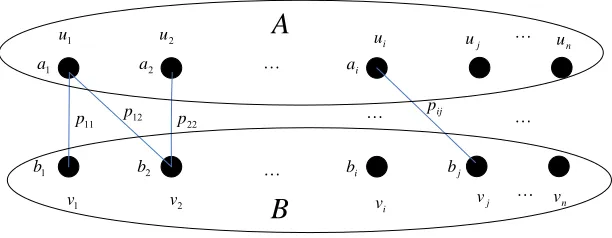
We draw a bipartite graph in Figure 1. The
vertex i
,G A B
u A denotes the captains whose optimal
training month is i. And the vertex i denotes the copilots whose optimal training month is i. Here
v B
i ui
a denotes the module of i, i.e. the number of
the captains in i and
u
u bi vi denotes the module of
i and i denotes the number of the pilots trained in their optimal training month i. There is an edge i j weighted by ij ended by i and
v q
p
u v
1
v vj
i v 2 v 1 u i u 2 u 1
a a2 ai
1
b b2 bi bj
11
p p12 p22 pij
[image:3.595.145.451.87.206.2] n u n v j u
A
B
Figure 1.Bipartite graph G.
i
u and vj.
In graph there may be an edge i j ended by i and
G u v u
j
v where i j 2. In other words, there are a
captain i k, ui and a copilot j s, vj matched where j i 2 (orj i 2). Suppose i1,kui1 (or
1, 1
i k ui
) and i1,svi1 (i1,svi1 tched
in graph G, we can change the training plan by
match-ing i k,
) are ma
to i1,s and i1,k to i2,s (or i k, to 1,
i s
and i1,k to i2,s
i
u
). T e suppose there are no u vi j ended by and
hen w j
v where i j 2 in the
part of the study. following
Let , and
, i j
i j
P
p ii
Q
q . What we will do innext parts of this study is to find the largest Q when is decreased by k where k = 1, 2, ....
max
We assume there are three possible nexus among , , and in graph G shown in Figure 2. PP
i
u
u
i
v i1 i1
We consider two types to change the nexus among i, i, i1 and in
G
as follows. One is to break apair on edge 1 in case 1 in Fiugre 3 or to break a
pair on edge i i and a pair on edge i1 i1 and
re-built a new pair between
u v
v u vi1
i i
u v
u v u v
1
i
u and i in case 2 and case 3. It is denoted by
v
1
. The other is tobreak a pair on edge i in case 2 in Figure 3 or to break a pair on edge i i and a pair on edge i1 i1
,
i vi
br u v
1
i
u
u v u v
and rebuilt a new pair between i and in case 1 and 3. It is denoted by .
u
vi11,
i i
u v br
Then we can conclude that we can find the solution of
the problem with by or
for all 1 max where . 1
PP
i k
1 kbr u v
ni,1i11
G
i 1, ibr u v
We generate another two weighted graphs and in Figure 3 from the recurrent training graph in Figure 1.
2
G G
Here vi denotes month in i Figure 3 and li1 when there exist edge u vi i1 in graph , or else,
. And when there exists edge , or
G
1 i
l li 1 ui1vi
else, l 1. Let lm and
l
Then we have the follow eorem.
Theorem 1:
Let be the graph with and
i 0 0 0 1 1 1 1 max i k i k m i n m i m i i i k n
L l
0 0 0 1 1 1 1 max i k i k m mi n m i m i i i k n
L l
. thG QQ0 PP0, we
got a non-inferior solution pi j, in graph G with the
la re 0
PP 1 when we change the
rgest Q whe
nex-us amo vertices in graph G byng :
(a) br u v
i, i1
for all i0 i k0 when
ma ,
L x L L an
(b)
d
i , i
br u1 v for all i0 i k0 when
ax L L, m
L .
Proof:
In case (a) we find that the nexus among the vertices , , is case 1 in Figure 3 when
i
u vi ui1 and vi1
i
l 1. When we change the nexus among ui, vi, ui1
and vi1 by br u v
i, i1
, pi i, 1 reduces one and theof qi d qi1
sum an increases 1, which equals to li, as sult. The nexus among ui, vi, ui1 nd vi1
an re a is
case 2 or case 3 when li 1, and when we change the nexus by br u v
i, i1
, we will get a new pair between1
i
u and vi where pi1,i1 e sum of qi nd
1
i q
and th a
is decreased by one and the sum of pi i, , pi 1, 1i and pi1,i by one as well, corresponding to
n conclusion, when ange the nexus am gui, i ui1
is reduc w ed i l. v ,
I e ch on
and vi1 by br u v
i, i1
we incre thof qi qi1
ase e sum and by li and increase Q by li in other ords. Then to find the largest Q where P P0 1
w
ap is to d the th in graph 1
G when in gr h G fin l ngest pao
L
max ,
L L . Case (b) can be prove similarly.
2.3. Al orithm
hm as follows is designed to s d
g
In this part an algorit olve
t = 0; for all 1≤ i ≤ n, a = the num-
of the copilots whose optimal training m
PFRT problem.
Step 1: Initialize: i
ber of the captains whose optimal training month is i and bi = the number
onth is i.
Step 2: Find the optimal solutions of programming (c)
and (d). Gt
A Bt, t
denotes the graph with maxt
P P and t
Q = the maximum quantity of pilots
tra
: Generate and
who will be ined in their optimal training month.
Step 3 the weighted graphs G1t
2
t
i
u
1
i
v
i
v
1
i
u ui ui1 ui ui1
1
i
v
i
v vi vi1
[image:4.595.120.475.69.357.2]1 2 3
Figure 2. Nexusamong ui, vi, ui+1 and vi+1 ingraph G.
1
v v2 v vj
i
i
l ln1
1
l
G1
1
v vj
i v
2
v
i
l ln1
1
l
2
G
Figure 3. Generated graphs of G. from the graph Find the longest path in
l . If LL, go to step 4.
Else go to step 5.
Step 4: Change the nexus among the vertice ,
y for .
S ha e nexus am e vertices
by for .
S f th -inferior so we got in the pre
s not the final solution, let t
G . the graphs
1
t
G and Gt2.
1
max m m
i n
m i m i
L l l
and0 0
0
1
1 1
i k i k i i k n
0 0
0
1 1
1 1
max
i k i k
m m
i n
m i m i i i k n
L l
i u ,
k
0v1i
1
i
u and vi1 b br u v
i, i1
0 0to step 6.
tep 5: C nge th ong th ,
i
u and v
i i i Go
i u ,
k
v1i
1 i1 i 1 i 0 0 0
to step 6.
tep 6: I e non lution -
vious step i
,
br u v i i i Go
1 t t ,
3.
ns and 313 copilots in an airline training demand is shown in Table
here
d copilots. 609 p
ing in their optimal training months. There are 18 pilots
S training demand for all pilots
1 1
tPt , go to step 3, else go to step 7.
Step 7: Output the final solution, stop.
P
A Case Study
There are 314 captai company. Their FFS1 and P0 Pmax 313 is achieved in Table 2 and Fig- ure 4 w
6
0 609
i . We paired up 313 pairs
1
i
Q q
of captains an ilots will attend FFS train-
who have to attend the training in the previous month or the succeeding month of their optimal training months.
i (Month)
ai (The number of captains need to be trained in
month i)
bi (The number of copilots need to be trained in
month i) Table 1. FF
1 51 55
2
3 48
50 49
51
4 60 56
5 55 49
6 50 53
and
i 1 2 3 4 5 6 bj
Table 2. P0 P x 313
ma
i
Q q
6 0
1 609
i .
j Pi,j
1 51 4 55
45 6 51
54
49
5
Not m
5 50 48 6 5
2 46 3 49
3
4 2 56
5 49
6 3 0 53
atched 1
[image:4.595.306.539.399.736.2]Figure 4. The initial non-inferior solution with P0 = 313 in graph G0.
Figure 5. Generated graphs of G0.
And there is one captain in month 5 who cannot be trained with copilots because the sum of captains is more than that of
We draw a as fol-
he am
n
same tim he
copilots.
couple of new graphs 1 and 0
G G02
lows.
We can find that the longest route in graph 1 0 G is
5 6
v v where L = 1 and the longest route in graph 2is
v
0 G
1
on
2 3 4 5
v v v v where L = 4. We change t nexus ong u1,
1
v, u2 and by v2 br u v
2, 1
. The p2,1 will reducee and ,
, i j
i j
P
p will reduce one as well. In thei i
q
will increase one. When we change t ong ,e
nexus am ui vi, ui1 and vi1 by br u
i1,vi
as well w 4 and rematch the pairs of un- matched ca and copilots who have the same opti- mal training th, we will get a new graph G with
here ptai m
w ere
pt pi
ing in their optimal train onths. T
rapidly in China and it
be companies to
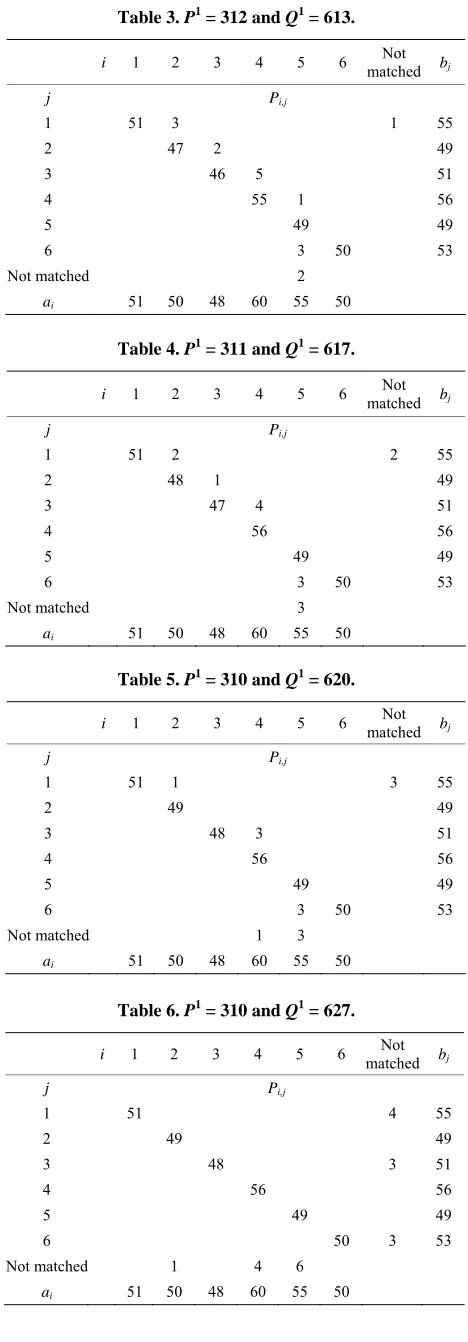
3. P1 = 312 and Q1 = 613.
ns on
1i
1 0
the largest QQ1 h 1 , , i j
i j
P
Pand Q1613. Then we get a new non-inferior solution
described in Table 3.
ired u s of ca ains and co lots 1 312
p
Now we pa p 312 pair .
613 pilots will attend FFS train - ing m here are 14 pilots who have to attend the training in the previous month or the succeeding month of their optimal training months. And there are 3 pilots in month 5 and month 1 who cannot be matched with other pilots.
Repeating above steps, we will get the following so- lutions shown in Tables 4-6.
Now we get all non-inferior solutions.
4. Conclusions
The air transportation developed
comes crucially important for airline
Table
i 1 2 3 4 5 6 matchedNot bj
j Pi,j
1 51 3 55
46 5 51
5 4
50 Not m
5 5 4 60 55 50
1
2 47 2 49
3
4 5 1 56
5 9 49
6 3 53
atched 2
ai 1 0 8
Table 4. P1 = 311 and Q 6
i matchedNot
1 = 1 .7
1 2 3 4 5 6 bj
j Pi,j
1 51 2 55
47 4 51
5 4
50 Not m
5 5 4 60 55 50
2
2 48 1 49
3
4 6 56
5 9 49
6 3 53
atched 3
ai 1 0 8
Table 5. P1 = 310 and Q
i matc edNot
1 = 620.
1 2 3 4 5 6 h bj
j Pi,j
1 51 1 3 55
48 3 51
5 4
50 Not m
5 5 4 60 55 50
2 49 49
3
4 6 56
5 9 49
6 3 53
atched 1 3
ai 1 0 8
Table 6. P1 = 310 and Q 62 .
i matchedNot
1 = 7
1 2 3 4 5 6 bj
j Pi,j
1 51 55
48 3 51
56 4
50
Not m
ai 51 50 48 60 55 50
4
2 49 49
3
4 56
5 9 49
6 3 53
[image:5.595.84.266.85.159.2] [image:5.595.88.257.198.287.2]train pilo s as t ens th av on afety
PFRT problem is a ulti ectiv ilot trai g the at mo ls and g ph models abou it are bu lt. A o g h ha te ic the prob
ei
titute of Po Academy of Sciences, are also very grateful to the
nt Training Plan of Aviator Full
Flight Simulators,” Chinese Journal of Management
Sci-ence, Vol. 16,
ing ts o o ure e iati s .
m -obj e p s nin
787
problem. Ma m ic de ra t
i cc rdin to t e c rac rist s of lem, ghted we convert it into a longest-route problem with w paths and design an algorithm to solve it.
This method can effectively generate pilots’ FFS train- ing plans with two kinds of personnel.
Due to the method in this study cannot solve the simi- lar problem involving more than two kinds of personnel yet, further research should be done on it.
5. Acknowledgements
I thank members of the Research Center of Overall Plan- ning Safety and Security Management, Ins licy for and Management, Chinese
their help in this study. We
reviewers for their invaluable suggestions to improve the quality of the manuscript.
REFERENCES
[1] B. C. Pan, Z. Y. Song, et al., “The Research on
Optimiza-tion Model for Recurre
No. 2, 2008, pp. 69-75.
[2] W. B. Liu, S. Z. Zhang and B. L. Shi, “Solution of Pilot
Simulator Timetable Problem Based on Genetic
Algo-rithm,” Computer Engineering, Vol. 37, No. 15, 2011, pp.
140-142.
[3] I. H. Toroslu and Y. Arslanoglu, “Genetic Algorithm for
the Personnel Assignment Problem with Multiple
Objec-tives,” Information Sciences, Vol. 177, No. 3, 2007, pp.
-803. doi:10.1016/j.ins.2006.07.032
[4] A. M. Geoffrion, “Proper Efficiency and the Theory of
Vector Maximization,” Journal of Mathematical Analysis
and Applications, Vol. 22, No. 3, 1968, pp. 618-630.
doi:10.1016/0022-247X(68)90201-1
[5] J. F. Cordeau and M. Maischberger, “A Parallel Iterated
Tabu Search Heuristic for Vehicle Routing Problem
Computers & Operations Research, V
s,” ol. 39, No. 9, 2012,
pp. 2033-2050. doi:10.1016/j.cor.2011.09.021
[6] Q. H. Wu, J. K. Hao, et al., “Multi-Neighborhood Tabu
Search for the Maximum Weight Clique Problem,”
An-nals of Operations Research, Vol. 196, No 1, 2012, pp.
611-634. doi:10.1007/s10479-012-1124-3
[7] R. Kia, A. Baboli, et al., “Solving a Group Layout Design
Model of a Dynamic Cellular Manufacturing System with Alternative Process Routings, Lot Splitting and Flexible
Reconfiguration by Simulated Annealing,” Computers &
Operations Research, Vol. 39, No. 11, 2012, pp. 2642-
2658. doi:10.1016/j.cor.2012.01.012
[8] K. Deb, “Multi-Objective Optimization Using
Evolution-ary Algorithms,” New York, 2001.
[9] M. Cruz-Ramirez, C. Hervas-Martinez, et al., “Multi-
Objective Evolutionary Algorithm for Donor-Recipient
Decision System in Liver Transplants,” European
Jour-nal of OperatioJour-nal Research, Vol. 222, No. 2, 2012, pp.
317-327. doi:10.1016/j.ejor.2012.05.013
[10] A. Thapar, D. Pandey, et al., “Satisficing Solutions of
Multi-Objective Fuzzy Optimization Problems Using
Genetic Algorithm,” Applied Soft Computing, Vol. 12, No.
8, 2012, pp. 2178-2187. doi:10.1016/j.asoc.2012.03.002
[11] E. G. Talbi, M. Basseur, et al., “Multi-Objective
Optimi-zation Using Metaheuristics: Non-Standard Algorithms,”
International Transactions in Operational Research, Vol.