Open Access
Vol 12 No 6Research
Phenylephrine versus norepinephrine for initial hemodynamic
support of patients with septic shock: a randomized, controlled
trial
Andrea Morelli
1, Christian Ertmer
2, Sebastian Rehberg
2, Matthias Lange
2, Alessandra Orecchioni
1,
Amalia Laderchi
1, Alessandra Bachetoni
3, Mariadomenica D'Alessandro
3, Hugo Van Aken
2,
Paolo Pietropaoli
1and Martin Westphal
21Department of Anesthesiology and Intensive Care, University of Rome, 'La Sapienza', Viale del Policlinico 155, Rome 00161, Italy
2Department of Anesthesiology and Intensive Care, University Hospital of Muenster, Albert-Schweitzer-Straße 33, Muenster 48149, Germany 3Laboratory of Clinical Pathology, Department of Surgery, University of Rome, 'La Sapienza', Viale del Policlinico 155, Rome 00161, Italy
Corresponding author: Andrea Morelli, [email protected]
Received: 20 Oct 2008 Revisions requested: 5 Nov 2008 Revisions received: 12 Nov 2008 Accepted: 18 Nov 2008 Published: 18 Nov 2008
Critical Care 2008, 12:R143 (doi:10.1186/cc7121)
This article is online at: http://ccforum.com/content/12/6/R143 © 2008 Morelli et al.; licensee BioMed Central Ltd.
This is an open access article distributed under the terms of the Creative Commons Attribution License (http://creativecommons.org/licenses/by/2.0), which permits unrestricted use, distribution, and reproduction in any medium, provided the original work is properly cited.
Abstract
Introduction Previous findings suggest that a delayed administration of phenylephrine replacing norepinephrine in septic shock patients causes a more pronounced hepatosplanchnic vasoconstriction as compared with norepinephrine. Nevertheless, a direct comparison between the two study drugs has not yet been performed. The aim of the present study was, therefore, to investigate the effects of a first-line therapy with either phenylephrine or norepinephrine on systemic and regional hemodynamics in patients with septic shock.
Methods We performed a prospective, randomized, controlled trial in a multidisciplinary intensive care unit in a university hospital. We enrolled septic shock patients (n = 32) with a mean arterial pressure below 65 mmHg despite adequate volume resuscitation. Patients were randomly allocated to treatment with either norepinephrine or phenylephrine infusion (n = 16 each) titrated to achieve a mean arterial pressure between 65 and 75 mmHg. Data from right heart catheterization, a thermodye dilution catheter, gastric tonometry, acid-base
homeostasis, as well as creatinine clearance and cardiac troponin were obtained at baseline and after 12 hours. Differences within and between groups were analyzed using a two-way analysis of variance for repeated measurements with group and time as factors. Time-independent variables were compared with one-way analysis of variance.
Results No differences were found in any of the investigated parameters.
Conclusions The present study suggests there are no differences in terms of cardiopulmonary performance, global oxygen transport, and regional hemodynamics when phenylephrine was administered instead of norepinephrine in the initial hemodynamic support of septic shock.
Trial registration ClinicalTrial.gov NCT00639015
Introduction
The current guidelines for the management of patients with septic shock recommend norepinephrine or dopamine as first-line agents to increase peripheral vascular resistance and to preserve organ perfusion following adequate volume therapy [1]. Moreover, the Surviving Sepsis Campaign recommends that phenylephrine should not be used as the initial
vasopres-sor in septic shock [1], since phenylephrine may reduce splanchnic blood flow and oxygen delivery in septic shock patients [2,3]. Nevertheless, it is important to note that these recommendations are based on a limited number of studies that have evaluated the clinical use of phenylephrine in septic shock [2,4,5]. More importantly, a direct comparison between
phenylephrine and norepinephrine in human septic shock has not yet been performed.
In contrast to norepinephrine that stimulates α1 and α2 recep-tors, and to a lower extent β1 and β2 receptors, phenylephrine is a selective α1-receptor agonist mainly constricting larger
arterioles and having virtually no effects on terminal arterioles [6].
Krejci and colleagues recently compared the effects of nore-pinephrine and phenylephrine on microcirculatory blood flow in multiple abdominal organs in a porcine model of sepsis [7]. Whereas the norepinephrine-induced increase in perfusion pressure was associated with blood flow distribution away from the mesenteric circulation, phenylephrine did not impair the mesenterial blood flow distribution – suggesting possible beneficial properties of phenylephrine on hepatosplanchnic perfusion in septic shock.
In contrast, previous studies have reported that a delayed administration of phenylephrine replacing norepinephrine in a series of septic shock patients caused a more pronounced hepatosplanchnic vasoconstriction as compared with nore-pinephrine [2,8].
In the past few years, it has become evident that the efficacy of hemodynamic optimization by fluids and vasopressor agents critically depends on the urgency of therapy [1,9-11]. In this regard, it is conceivable that the negative effects of hepatosplanchnic perfusion noticed in response to phenyle-phrine administration [2,8] might have been related to a delayed treatment [11].
On this basis, we hypothesized that – compared with nore-pinephrine – early administration of phenylephrine does not worsen hepatosplanchnic perfusion during initial hemody-namic support of patients with septic shock. We therefore conducted a randomized, double-blind, controlled clinical trial to compare the effects of a first-line therapy with either phe-nylephrine or norepinephrine infusion on systemic and regional hemodynamics in patients with septic shock.
Materials and methods
PatientsAfter approval by the Local Institutional Ethics Committee, the study was performed in an 18-bed multidisciplinary intensive care unit (ICU) of the Department of Anesthesiology and Inten-sive Care of the University of Rome 'La Sapienza'. Informed consent was obtained from the patients' next of kin, as the patients were sedated and mechanically ventilated and thus were unable to give consent themselves. Enrollment of the patients started in December 2007 and ended in July 2008. This study has been registered as ClinicalTrial.gov NCT00639015. We enrolled patients who fulfilled the criteria of septic shock [1] presenting with a mean arterial pressure
(MAP) below 65 mmHg despite appropriate volume resuscita-tion (pulmonary artery occlusion pressure (PAOP) = 12 to 18 mmHg and central venous pressure = 8 to 15 mmHg) [1].
Exclusion criteria were age <18 years, pronounced cardiac dysfunction (that is, cardiac index ≤ 2.2 l/min/m2 in the
pres-ence of PAOP >18 mmHg), chronic renal failure, severe liver dysfunction (Child-Turcotte-Pugh grade C), significant valvular heart disease, present coronary artery disease, pregnancy, and present or suspected acute mesenteric ischemia.
All patients received mechanical ventilation using a volume-controlled mode with a plateau pressure maintained below 30 cmH2O [1]. All patients were appropriately analgo-sedated
using sufentanil and midazolam.
Measurements
Systemic hemodynamic monitoring of the patients (Vigilance®
II; Edwards Lifesciences, Irvine, CA, USA) involved a pulmo-nary artery catheter (7.5-F; Edwards Lifesciences) and a radial artery catheter (20 G; Arrow International Inc, Reading, PA, USA). The MAP, right atrial pressure, mean pulmonary arterial pressure, and PAOP were measured at end expiration. The heart rate was analyzed from a continuous recording of the electrocardiogram with ST segments monitored. The cardiac index was measured using the continuous thermodilution tech-nique (Vigilance® II; Edwards Lifesciences). The stroke volume
index, systemic vascular resistance index, pulmonary vascular resistance index, left ventricular stroke work index, right ven-tricular stroke work index, oxygen delivery index, oxygen con-sumption index, and oxygen extraction ratio were calculated using standard formulae. Arterial and mixed-venous blood samples were taken for measuring oxygen tensions and satu-rations, as well as carbon dioxide tensions, standard bicarbo-nate, arterial base excess, pH, and arterial lactate. In addition, arterial blood samples were drawn for the determination of car-diac troponin I and creatinine concentrations.
Regional hemodynamic monitoring of the patients was per-formed with a 4-F oximetry thermodye dilution catheter (PV2024L; Pulsion Medical Systems AG, Munich, Germany) inserted through the femoral artery for the determination of the plasma disappearance rate of indocyanine green (PDR) and the blood clearance of indocyanine green related to body sur-face area (CBI). Moreover, an air tonometer (Tonocap; Datex-Ohmeda, Helsinki, Finland) was inserted via the nasogastric route for gastric mucosal carbon dioxide tension measure-ment.
glu-cose solution injected into the right atrium. In addition, the gra-dient between gastric mucosal and arterial pCO2 was calculated, which has been shown to be more appropriate for the detection of regional ischemia than for the calculation of mucosal pH [14,15]. Urine samples were collected to assess urinary output and creatinine clearance in the laboratory set-ting.
Study design
Patients who met the entry criteria were randomized using a computer-based procedure, to receive either an infusion of phenylephrine or norepinephrine in a double-blinded fashion for 12 hours. The two study drugs were titrated to maintain a MAP between 65 and 75 mmHg. Serial fluid challenges were performed to maintain the central venous pressure at 8 to 15 mmHg and the PAOP between 12 and 18 mmHg during the 12-hour intervention period [1]. Packed red blood cells were transfused when hemoglobin concentrations decreased below 8 g/dl. If the mixed-venous oxygen saturation was <65% despite appropriate arterial oxygenation (arterial oxy-gen saturation ≥ 95%) and hemoglobin concentrations ≥ 8 g/ dl, dobutamine was administered (with a maximum dose of 20 μg/kg/min) to achieve mixed-venous oxygen saturation values ≥ 65% [1]. Systemic, pulmonary and regional hemodynamic measurements, laboratory variables, and blood gases were determined at baseline and 12 hours after randomization. Cre-atinine clearance was determined over a period of 12 hours.
At the end of the 12-hour study period, study drugs were grad-ually reduced and switched to open-labeled norepinephrine. If necessary, dobutamine was given according to the study pro-tocol mentioned above.
Statistical analyses
The main endpoint of the present study was the modifications of the PDR and CBI after phenylephrine administration as compared with the norepinephrine group. To detect a 30% dif-ference in one of the measured variables (that is, PDR and CBI) with an expected standard deviation of 30%, a test power of 80% and an α-error probability of P < 0.05, a sample size of 16 subjects per group was required [16]. Data are expressed as the mean ± standard deviation, if not otherwise specified. Sigma Stat 3.10 software (SPSS, Chicago, IL, USA) was used for statistical analysis.
After confirming the normal distribution of all variables (Kol-mogorov-Smirnov test), differences within and between groups were analyzed using a two-way analysis of variance for repeated measurements with group and time as factors. Time-independent variables were compared with one-way analysis of variance. In the case of significant group differences over time, appropriate post hoc comparisons (Student-Newman-Keuls test) were performed. Categorical data were compared using the chi-square test. For all tests, an α-error probability of
P < 0.05 was considered statistically significant.
Results
PatientsAfter screening 62 patients with septic shock who met the inclusion criteria of the study, 30 patients had to be excluded due to prior catecholamine therapy (n = 26), inappropriately low cardiac output (n = 2), or chronic renal failure (n = 2). Finally, 32 consecutive patients were enrolled in the study and equally randomized into the two study groups (n = 16 per group) (Figure 1).
Demographic data
Baseline characteristics including age, gender, body weight, origin of septic shock, and Simplified Acute Physiology Score II are presented in Table 1. There were no significant differ-ences in baseline characteristics between groups, except for a higher body weight in the norepinephrine group. No differ-ences were found between the phenylephrine and norepine-phrine groups in the mean time elapsed from ICU admission to the need for vasopressor support (39 ± 35 hours versus 37 ± 38 hours, P = 0.282). In this regard, vasopressor administra-tions were initiated as soon as the inclusion criteria were met (with no time delay).
Study drug requirements and systemic hemodynamics
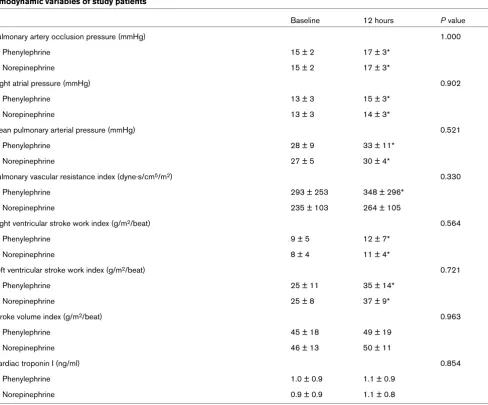
The amount of fluids infused during the study period in the phenylephrine and norepinephrine groups was similar (2,554 ± 1,140 ml versus 2,431 ± 1,010 ml, P = 0.751). Phenyle-phrine dosages were higher than those for norepinePhenyle-phrine 12 hours after randomization (P < 0.001) (Figure 2). The goal MAP of 65 to 75 mmHg was reached in all subjects. Twelve hours after randomization, the MAP was significantly higher in the norepinephrine group as compared with patients treated with phenylephrine (P = 0.011) (Figure 3). This difference remained, however, within the predefined threshold MAP of 65 to 75 mmHg. There were no significant differences between groups in any other variable of systemic hemodynamics (Fig-ure 3 and Table 2).
Whereas the heart rate significantly decreased in both study groups (P = 0.009 and P = 0.022 for phenylephrine and nore-pinephrine treatment versus baseline, respectively), the sys-temic vascular resistance index and the left ventricular stroke work index both increased as compared with baseline (each P
Regional hemodynamics, acid-base homeostasis, and oxygen transport variables
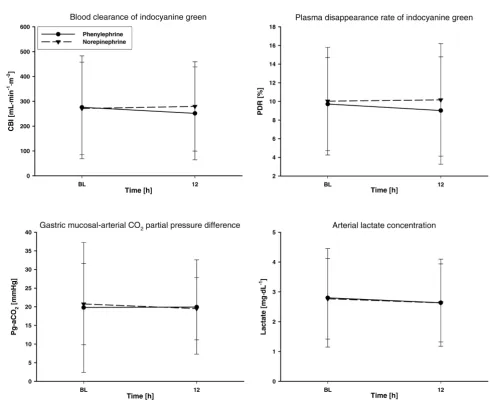
There were no significant overall differences between groups in any variable of regional hemodynamics, acid-base homeos-tasis, or oxygen transport (Figure 4 and Table 3).
Variables of organ function and injury
Urine output and creatinine clearance were similar between groups throughout the 12-hour interventional period (P = 0.170 and P = 0.609, respectively) (Figure 5). Likewise, tro-ponin I plasma concentrations were comparable between groups (Table 2).
Length of ICU stay and outcome
The length of ICU stay and the ICU mortality were similar between groups (Table 1).
Discussion
[image:4.612.85.542.95.346.2]The major findings of the present study are that, when admin-istered as a first-line vasopressor agent in septic shock patients, phenylephrine did not worsen hepatosplanchnic per-fusion as compared with norepinephrine, had similar effects as norepinephrine on cardiopulmonary performance and global oxygen transport, and was less effective than norepinephrine to counteract sepsis-related arterial hypotension as reflected by the higher dosages required to achieve the same goal MAP. Figure 1
Study design
Study design. MAP, mean arterial pressure; NE, norepinephrine; PHE, phenylephrine.
Table 1
Baseline characteristics of study patients
Phenylephrine (n = 16) Norepinephrine (n = 16) P value
Age (years) 70 (53 to 74) 70 (59 to 74) 0.850
Gender (percentage male) 75 56 0.457
Simplified Acute Physiology Score II 57 ± 8 55 ± 7 0.434
Cause of septic shock Pneumonia (n = 7), peritonitis (n = 8), meningitis (n = 1)
Pneumonia (n = 8), peritonitis (n = 8), meningitis (n = 0)
0.587
Mortality (n (%)) 10/16 (63%) 9/16 (56%) 1.000
Intensive care unit length of stay (days) 16 (7 to 25) 16 (10 to 24) 0.597
[image:4.612.54.562.591.714.2]Phenylephrine increases systemic vascular resistance by selectively stimulating α1 adrenoceptors without a
compensa-tory increase in myocardial contractility, and thus in cardiac output [6]. From a hemodynamic point of view, it might be argued that, in volume-resuscitated patients, norepinephrine may potentially be advantageous over phenylephrine, since it simultaneously stimulates α1, β1 and β2 receptors, thereby
counteracting arterial hypotension by increasing systemic vas-cular resistance and possibly myocardial inotropy [6]. On the other hand, phenylephrine could be preferable over norepine-phrine, since β1-receptor stimulation may increase the heart rate and myocardial oxygen demand. In this regard, a previous study reported that prolonged tachycardia may increase the incidence of major cardiac events in critically ill patients [17].
In the present study we did not find any differences between groups treated with either norepinephrine or phenylephrine in terms of systemic hemodynamics. We recently reported that, in a series of septic shock patients, the systemic hemodynam-ics and global oxygen transport remained unchanged after replacing norepinephrine with phenylephrine except for a sig-nificant decrease in heart rate [8]. The different severity of the cardiovascular dysfunction among the studied patients, how-ever, could have affected the results of the latter study [8]. In
addition, the investigated patients were already treated with high norepinephrine dosages (0.8 ± 0.7 μg/kg/min) at study entry. It is therefore conceivable that – different from delayed treatment [8] – early administration of phenylephrine in the hypotensive patients enrolled in the present study could have played a pivotal role in this regard.
Nevertheless, at the end of the study period, phenylephrine dosages were higher than (that is, 220%) those for norepine-phrine to maintain the predefined threshold MAP. Although a comparative dose-finding study in human septic shock has not yet been performed, our observation suggests that phenyle-phrine may be less effective as compared with norepinephenyle-phrine to counteract arterial hypotension when high dosages of cate-cholamines are required.
Clinical evidence indicates that infusion of norepinephrine doses ranging from 0.01 to 3 μg/kg/min neither worsen splanchnic perfusion nor compromise organ function in the presence of septic shock [3,18-24].
[image:5.612.115.536.100.400.2]Whereas only few clinical studies including a small number of patients have been performed on phenylephrine in septic shock [2,4,5,8], several studies have evaluated the impact of Figure 2
Study drug requirements of study patients
Study drug requirements of study patients. Vasopressor dosage throughout the study. #P < 0.05 versus baseline (BL) (significant time effect). *P
phenylephrine on splanchnic perfusion in experimental septic shock. In this regard, Breslow and colleagues reported no dif-ferences between phenylephrine (5.9 ± 2.7 μg/kg/min) and norepinephrine (3.0 ± 1.6 μg/kg/min) in terms of the splanch-nic oxygen supply [25]. These findings were confirmed by Schwarz and colleagues, who reported that – despite major differences in systemic hemodynamics – progressively increasing phenylephrine from 0.1 to 10 μg/kg/min did not decrease jejunal tissue oxygen supply as compared with nore-pinephrine (from 0.01 to 2 μg/kg/min) [18]. In endotoxemic dogs, Zhang and colleagues likewise demonstrated that 1 μg/ kg/min phenylephrine influenced neither hepatosplanchnic blood flow nor global and liver oxygen extraction capabilities [26]. Krejci and colleagues reported recently that norepine-phrine in doses of 0.7 ± 0.3 μg/kg/min distributes blood flow
away from the splanchnic circulation (for example, small intes-tine) to other regions of the body by the β-adrenergic stimula-tion [7]. Importantly, whereas norepinephrine reduced blood flow in both the jejunal mucosa and in the jejunal muscularis, phenylephrine at doses of 3.1 ± 1.0 μg/kg/min did not affect blood flow in the jejunal mucosa and even increased blood flow in the jejunal muscularis. It is therefore conceivable that an α1-receptor agonist such as phenylephrine -due to the lack of
the β-adrenergic stimulation – may be beneficial in septic shock, because it increases blood pressure without causing negative effects on tissue blood flow.
In the clinical setting, Reinelt and colleagues reported that hepatosplanchnic oxygen delivery and blood flow decreased in six septic shock patients when norepinephrine was gradu-Figure 3
Systemic hemodynamics of study patients
[image:6.612.61.553.96.492.2]ally replaced by phenylephrine at identical levels of MAP and cardiac index [2]. Our research group reported recently that, in a series of 15 septic shock patients, whereas phenylephrine did not impair gastrointestinal mucosal perfusion as measured by the gradient between gastric mucosal and arterial pCO2, it
decreased hepatosplanchnic perfusion as indicated by a decrease in the PDR and CBI associated with a slight increase in arterial lactate concentration [8]. The latter study, however, was designed as a cross-over study replacing norepinephrine infusion with phenylephrine and then once again replacing with norepinephrine after 8 hours. Importantly, the patients involved were already treated with high norepinephrine dos-ages at study entry.
In the present study, phenylephrine administration did not neg-atively affect gastrointestinal perfusion (that is, the gradient between gastric mucosal and arterial pCO2) when compared
with norepinephrine as first-line therapy in septic shock patients. The absence of detrimental splanchnic hemodynamic effects of phenylephrine during the observation period is fur-ther confirmed by the lack of overall differences between groups in terms of the PDR, CBI, acid-base homeostasis, as well as arterial lactate concentrations.
There are several reasons helping to explain the discrepancies between studies. First, in the studies of Reinelt and colleagues and of Morelli and colleagues, the MAP at baseline was 65 to 75 mm Hg [2,8], whereas it was considerably lower in the present study. Second, the mean time elapsed from meeting the criteria for study entry to infusion of phenylephrine was about 32 hours in the cited studies [2,8]. By contrast, in the present study, a different hemodynamic condition at baseline (that is, arterial hypotension) and, more importantly, the admin-Table 2
Hemodynamic variables of study patients
Baseline 12 hours P value
Pulmonary artery occlusion pressure (mmHg) 1.000
Phenylephrine 15 ± 2 17 ± 3*
Norepinephrine 15 ± 2 17 ± 3*
Right atrial pressure (mmHg) 0.902
Phenylephrine 13 ± 3 15 ± 3*
Norepinephrine 13 ± 3 14 ± 3*
Mean pulmonary arterial pressure (mmHg) 0.521
Phenylephrine 28 ± 9 33 ± 11*
Norepinephrine 27 ± 5 30 ± 4*
Pulmonary vascular resistance index (dyne·s/cm5/m2) 0.330
Phenylephrine 293 ± 253 348 ± 296*
Norepinephrine 235 ± 103 264 ± 105
Right ventricular stroke work index (g/m2/beat) 0.564
Phenylephrine 9 ± 5 12 ± 7*
Norepinephrine 8 ± 4 11 ± 4*
Left ventricular stroke work index (g/m2/beat) 0.721
Phenylephrine 25 ± 11 35 ± 14*
Norepinephrine 25 ± 8 37 ± 9*
Stroke volume index (g/m2/beat) 0.963
Phenylephrine 45 ± 18 49 ± 19
Norepinephrine 46 ± 13 50 ± 11
Cardiac troponin I (ng/ml) 0.854
Phenylephrine 1.0 ± 0.9 1.1 ± 0.9
Norepinephrine 0.9 ± 0.9 1.1 ± 0.8
[image:7.612.68.556.106.511.2]istration of phenylephrine at the time of shock onset could have played a pivotal role in this regard [12,27].
The effects of phenylephrine on renal function have not yet been fully elucidated. We recently reported that delayed administration of phenylephrine replacing norepinephrine in a series of septic shock patients negatively affected renal func-tion, as indicated by a decrease in creatinine clearance com-pared with norepinephrine administration [8]. In the present study, we noticed no differences between the two study drugs in terms of urine output or creatinine clearance. The number of patients who required renal replacement therapy at the end of the 12-hour study period, however, although not statistically significant, tended to be higher in the phenylephrine group (7
patients versus 2 patients, P = 0.133). Although speculative, this finding supports the notion that mixed α-adrenergic and β -adrenergic agents when given to increase or maintain the MAP may better preserve renal blood flow as compared with sole α -agonists [28-31]. Nevertheless, the implication of this finding for the course of the disease remains uncertain and should be clarified in future studies.
[image:8.612.60.550.96.498.2]The present study has some limitations that we would like to acknowledge. First, direct measurements of regional and local splanchnic blood flow in septic shock patients are invasive and require special skills and instruments that are not readily avail-able at the bedside. In the present study, therefore, hepat-osplanchnic perfusion was assessed using the PDR, CBI, and Figure 4
Regional hemodynamics of study patients
Table 3
Global oxygen transport variables and acid-base balance of study patients
Baseline 12 hours P value
Oxygen delivery index (ml/min/m2) 0.951
Phenylephrine 500 ± 205 498 ± 177
Norepinephrine 499 ± 139 506 ± 140
Oxygen consumption index (ml/min/m2) 0.568
Phenylephrine 164 ± 48 150 ± 41
Norepinephrine 173 ± 53 161 ± 58
Oxygen extraction ratio (%) 0.816
Phenylephrine 34 ± 9 32 ± 8
Norepinephrine 36 ± 11 32 ± 10*
Hemoglobin (g/dl) 0.699
Phenylephrine 8.4 ± 0.9 8.4 ± 1.1
Norepinephrine 8.3 ± 0.7 8.4 ± 0.6
pHa (-log10c(H+)) 0.435
Phenylephrine 7.37 ± 0.07 7.37 ± 0.08
Norepinephrine 7.35 ± 0.09 7.34 ± 0.08
Arterial base excess (mmol/l) 0.228
Phenylephrine -0.2 ± 5.8 0.2 ± 6.3
Norepinephrine -2.4 ± 6.6 -3.0 ± 6.4
Arterial carbon dioxide partial pressure (mmHg) 0.346
Phenylephrine 44 ± 10 44 ± 10
Norepinephrine 41 ± 6 41 ± 6
Arterial oxygen partial pressure (mmHg) 0.963
Phenylephrine 128 ± 36 119 ± 31
Norepinephrine 121 ± 24 120 ± 26
Arterial oxygen saturation (%) 0.912
Phenylephrine 98 ± 2 98 ± 2
Norepinephrine 98 ± 1 98 ± 2
Mixed venous oxygen saturation (%) 0.431
Phenylephrine 66 ± 9 67 ± 9
Norepinephrine 64 ± 11 67 ± 10
PaO2/FiO2 0.971
Phenylephrine 229 ± 103 208 ± 89
Norepinephrine 222 ± 75 218 ± 71
PaO2/FiO2, ratio of arterial oxygen partial pressure and inspiratory oxygen fraction (Horovitz index). *P < 0.05 versus baseline (significant time
gastric tonometry as surrogates of hepatosplanchnic per-fusion and function. Second, as phenylephrine was adminis-tered as a first-line vasopressor agent in the present study, for safety reasons we investigated only a small number of septic shock patients to evaluate the effects on cardiopulmonary and regional hemodynamics over a relative brief period (that is, 12-hour intervention period). We therefore cannot rule out the possibility of adverse metabolic alterations or worsening of hepatosplanchnic perfusion in response to administration of phenylephrine for a prolonged period. Third, even though it was possible to define the exact time when the enrolled patients required vasopressor support during the ICU stay, we cannot exclude differences in the time of onset of sepsis before ICU admission. Finally, since the present study was powered to demonstrate a 30% difference in the PDR and CBI, smaller differences, even though of scarce clinical impli-cations, cannot be excluded by the present data. This question
can only be answered by studies investigating a larger sample size.
Conclusion
This is the first prospective, randomized, controlled study com-paring systemic and regional hemodynamic effects of phenyle-phrine and norepinephenyle-phrine infusion in the early phase of septic shock. Our results suggest that phenylephrine – when admin-istered as a first-line vasopressor agent in septic shock – is effective in increasing the MAP without compromising gas-trointestinal and hepatosplanchnic perfusion as compared with norepinephrine.
Competing interests
The authors declare that they have no competing interests.
Authors' contributions
AM and MW conceived of the study, were responsible for its design and coordination, and helped to draft the manuscript. CE, ML, SR, and HVA participated in the design of the study, performed the statistical analysis, and helped to draft the man-uscript. AO and AL participated in the study design and helped to draft the manuscript. AB and MD participated in the study design, performed laboratory measurements, and helped to draft the manuscript. PP participated in the study design and coordination, helped to draft the manuscript, and obtained funding. All authors read and approved the final man-uscript.
Acknowledgements
The present study was funded by an independent research grant from the Department of Anesthesiology and Intensive Care of the University of Rome 'La Sapienza'.
Key messages
• There are no differences between norepinephrine and phenylephrine in terms of systemic hemodynamics when they are administered as a first-line vasopressor agent in septic shock.
• Phenylephrine is less effective than norepinephrine to counteract sepsis-related arterial hypotension.
• Phenylephrine does not impair gastrointestinal mucosal perfusion.
• Delayed administration of phenylephrine in septic shock patients causes a more pronounced hepatosplanchnic vasoconstriction as compared with norepinephrine.
[image:10.612.61.300.92.473.2]• Phenylephrine – when administered as a first-line vaso-pressor agent in septic shock – is effective for increas-ing the MAP without compromisincreas-ing gastrointestinal and hepatosplanchnic perfusion, as compared with nore-pinephrine administration.
Figure 5
Variables of renal function
References
1. Dellinger RP, Levy MM, Carlet JM, Bion J, Parker MM, Jaeschke R, Reinhart K, Angus DC, Brun-Buisson C, Beale R, Calandra T, Dhai-naut JF, Gerlach H, Harvey M, Marini JJ, Marshall J, Ranieri M, Ram-say G, Sevransky J, Taylor Thompson B, Townsend S, Vender JS, Zimmerman JL, Vincent JL: Surviving Sepsis Campaign: interna-tional guidelines for management of severe sepsis and septic shock: 2008. Crit Care Med 2008, 36:296-327.
2. Reinelt H, Radermacher P, Kiefer P, Fischer G, Wachter U, Vogt J, Georgieff M: Impact of exogenous beta-adrenergic receptor stimulation on hepatosplanchnic oxygen kinetics and meta-bolic activity in septic shock. Crit Care Med 1999, 27:325-331. 3. Beale RJ, Hollenberg SM, Vincent JL, Parrillo JE: Vasopressor and inotropic support in septic shock: an evidence-based review. Crit Care Med 2004, 32(11 Suppl):S455-S465. 4. Gregory JS, Bonfiglio MF, Dasta JF, Reilley TE, Townsend MC,
Flancbaum L: Experience with phenylephrine as a component of the pharmacologic support of septic shock. Crit Care Med 1991, 19:1395-1400.
5. Flancbaum L, Dick M, Dasta J, Sinha R, Choban P: A dose-response study of phenylephrine in critically ill, septic surgical patients. Eur J Clin Pharmacol 1997, 51:461-465.
6. Hofmann BB, Lefkowitz RJ: Catecholamines and sympathomi-metic drugs. In Goodman and Gilman's the pharmacological basis of therapeutics Edited by: Alfred Gilman, Louis S Goodman, Brian B Hoffman, Robert J Lefkowitz. New York: Pergamon; 1991:187-220.
7. Krejci V, Hiltebrand LB, Sigurdsson GH MD: Effects of epine-phrine, norepineepine-phrine, and phenylephrine on microcirculatory blood flow in the gastrointestinal tract in sepsis. Crit Care Med 2006, 34:1456-1463.
8. Morelli A, Lange M, Ertmer C, Dünser M, Rehberg S, Bachetoni A, D'Alessandro M, Van Aken H, Guarracino F, Pietropaoli P, Traber DL, Westphal M: Short-term effects of phenylephrine on sys-temic and regional hemodynamics in patients with septic shock: a crossover pilot study. Shock 2008, 29:446-451. 9. Rivers E, Nguyen B, Havstad S, Ressler J, Muzzin A, Knoblich B,
Peterson E, Tomlanovich M, Early Goal-directed Therapy Collabo-rative Group: Early goal-directed therapy in the treatment of severe sepsis and septic shock. N Engl J Med 2001, 345:1368-1377.
10. Rivers EP, Kruse JA, Jacobsen G, Shah K, Loomba M, Otero R, Child EW: The influence of early hemodynamic optimization on biomarker patterns of severe sepsis and septic shock. Crit Care Med 2007, 35:2016-2024.
11. Parrillo JE: Septic shock – vasopressin, norepinephrine, and urgency. N Engl J Med 2008, 358:954-956.
12. Sakka SG, Reinhart K, Meier-Hellmann A: Prognostic value of the indocyanine green plasma disappearance rate in critically ill patients. Chest 2002, 122:1715-1720.
13. Sakka SG, van Hout N: Relation between indocyanine green (ICG) plasma disappearance rate and ICG blood clearance in critically ill patients. Intensive Care Med 2006, 32:766-769. 14. Creteur J, De Backer D, Vincent JL: Monitoring gastric mucosal
carbon dioxide pressure using gas tonometry: in vitro and in vivo validation studies. Anesthesiology 1997, 87:504-510. 15. Groeneveld AB, Kolkman JJ: Splanchnic tonometry: a review of
physiology, methodology, and clinical applications. J Crit Care 1994, 9:198-210.
16. Winer BJ, Brown DR, Michels KM: Statistical principles in exper-imental design. 3rd edition. New York: McGraw-Hill; 1991. 17. Sander O, Welters ID, Foex P, Sear JW: Impact of prolonged
ele-vated heart rate on incidence of major cardiac events in criti-cally ill patients with a high risk of cardiac complications. Crit Care Med 2005, 33:81-88.
18. Schwarz B, Hofstötter H, Salak N, Pajk N, Knotzer H, Mayr A, Labek B, Kafka R, Ulmer H, Hasibeder W: Effects of norepine-phrine and phenylenorepine-phrine on intestinal oxygen supply and mucosal tissue oxygen tension. Intensive Care Med 2001, 27:593-601.
19. Zhang H, Smail N, Cabral A, Rogiers P, Vincent JL: Effects of norepinephrine on regional blood flow and oxygen extraction capabilities during endotoxin shock. Am J Respir Crit Care Med 1997, 155:1965-1971.
20. Alia I, Esteban A, Gordo F, Lorente JA, Diaz C, Rodriguez JA, Fru-tos F: A randomized and controlled trial of the effect of
treat-ment aimed at maximizing oxygen delivery in patients with severe sepsis or septic shock. Chest 1999, 115:453-461. 21. Meier-Hellmann A, Specht M, Hannemann L, Hassel H, Bredle DL,
Reinhart K: Splanchnic blood flow is greater in septic shock treated with norepinephrine than in severe sepsis. Intensive Care Med 1996, 22:1354-1359.
22. Duranteau J, Sitbon P, Teboul JL, Vicaut E, Anguel N, Richard C, Samii K: Effects of epinephrine, norepinephrine, or the combi-nation of norepinephrine and dobutamine on gastric mucosa in septic shock. Crit Care Med 1999, 27:893-900.
23. Marik PE, Mohedin M: The contrasting effects of dopamine and norepinephrine on systemic and splanchnic oxygen utilization in hyperdynamic sepsis. JAMA 1994, 272:1354-1357. 24. Levy B, Bollaert PE, Charpentier C, Nace L, Audibert G, Bauer PH,
Nabet P, Larcan A: Comparison of norepinephrine and dob-utamine to epinephrine for hemodynamics, lactate metabo-lism, and gastric tonometric variables in septic shock: a prospective, randomized study. Intensive Care Med 1997, 23:282-287.
25. Breslow MJ, Miller CF, Parker SD, Walman AT, Traystman RJ: Effect of vasopressors on organ blood flow during endotoxin shock in pigs. Am J Physiol 1987, 252:H291-H300.
26. Zhang H, De Jongh R, De Backer D, Cherkaoui S, Vray B, Vincent JL: Effects of α- and β-adrenergic stimulation on hepat-osplanchnic perfusion and oxygen extraction in endotoxic shock. Crit Care Med 2001, 29:581-588.
27. Levy MM, Macias WL, Vincent JL, Russell JA, Silva E, Trzaskoma B, Williams MD: Early changes in organ function predict even-tual survival in severe sepsis. Crit Care Med 2005, 33:2194-2201.
28. Bersten AD, Rutten AJ: Renovascular interaction of epine-phrine, dopamine and intraperitoneal sepsis. Crit Care Med 1995, 23:537-544.
29. Bersten AD, Rutten AJ, Summersides G, Ilsley AH: Epinephrine infusion in sheep: systemic and renal hemodynamic effects. Crit Care Med 1994, 22:994-1001.
30. Bellomo R, Kellum JA, Wisiniewsky SR, Pinsky MR: Effects of norepinephrine on the renal vasculature in normal and endo-toxemic dogs. Am J Respir Crit Care Med 1999, 159:1186-1192.