2
Language use and
coalitional place frames:
The case of Twente
Author
Klaas Johan Kloppenburg University of Twente
Master Communication Studies 7 december 2012
Conducted on behalf of Drs. D. de Vries
Dhr. M.B. Albers
Albers De Vries communicatie
3
Abstract
Theory: The concept of regional identity can be divided in the identity of a region and regional identity. The former refers to the structural dimensions of a region, the latter complements this with peoples’ experiential dimensions. Place frames form a lens through which individuals experience the identity of a region. Different coalitions can produce different place frames resulting in different migratory outcomes.
Case: Twente is a region in the east of the Netherlands. Despite the presence of two institutions for higher education the region is dealing with a brain drain problem. The brain drain situation suggests the existence of coalitions of highly educated individuals tending to leave the region whilst other coalitions show a tendency to stay. Twente is therefore an ideal region for research on different place frames.
Research goal: Goal of this research was to find out whether coalitions with certain migratory outcomes differed from coalitions with other migratory outcomes in their language use about the identity of the region. Existing differences would indicate the existence of different place frames resulting in different migratory outcomes.
Method: An adapted version of the Twenty Statement Test was used to assess differences between four coalitions: students living with their parents, students living in student housing, former students who moved out of the region and professionals working within the region. A total of 78 respondents completed participation with a minimum of 15 and a maximum of 23 per coalition. The professionals were also interviewed about the labor market situation
Results: Coalitions varied in the subjects they talked about; positivity and negativity in their statements; and the meaning they gave to terminology. Former students were overall most negative about the region, students living with their parents and professionals were very positive. Students living in student housing were in between. Former students and students living in student housing did not regard themselves as a part of the region, but merely as a guest in the region.
4
Samenvatting
Theorie: Het concept regionale identiteit kan worden verdeeld in de identiteit van een regio en regionale identiteit. De laatste refereert aan de structurele dimensies van een regio terwijl de eerste refereert aan de experiëntiële dimensies. ‘Place frames’ vormen een lens waardoor de individu de identiteit van een regio ervaart. Verschillende coalities produceren verschillende ‘place frames’ die resulteren in homogene migratiebeslissingen binnen coalities.
Case: Twente is een regio in het oosten van Nederland. Ondanks de aanwezigheid van twee instellingen voor hoger onderwijs heeft de regio te maken met een ‘brain drain’. Deze ‘brain drain’ wijst op het bestaan van verschillende coalities; de ene coalitie is geneigd te blijven terwijl de ander een neiging heeft weg te trekken uit de regio. Dit wijst op het bestaan van verschillende ‘place frames’ die resulteren in verschillende migratie-uitkomsten.
Doel: Het doel van dit onderzoek was vast te stellen of coalities met bepaalde migratie-uitkomsten verschillen van coalities met andere migratie-migratie-uitkomsten in hun taalgebruik over de regio. Gevonden verschillen zouden wijzen op het bestaan van verschillende ‘place frames’ bij coalities die uiteindelijk resulteren in verschillende migratie-uitkomsten.
Methode: Een aangepaste versie van de ‘Twenty Statement Test’ is gebruik om verschillen tussen vier coalities te onderzoeken: thuiswonend studenten, uitwonend studenten, voormalig studenten die zijn weggetrokken uit de regio; en professionals die werkzaam zijn in de regio. In totaal namen 78 respondenten deel aan het onderzoek. Er was een variatie van 15 tot 23 respondenten per coalitie. De professionals zijn ook geïnterviewd over de arbeidsmarktsituatie.
Resultaten: De coalities varieerden in de onderwerpen die ze bespraken; de positieve, neutrale of negatieve ondertoon in hun statements; en de uitleg die ze gaven aan bepaalde
terminologie. Voormalig studenten zijn het meest negatief over de regio, thuiswonend studenten en professionals zijn zeer positief over de regio. Uitwonend studenten zitten daar tussenin. Voormalig studenten en uitwonend studenten zien zichzelf niet als een onderdeel van de regio maar meer als gast in de regio.
Conclusie: Dit onderzoek bevestigd het bestaan van verschillende place frames. Uitwonend studenten en voormalig studenten vormen een ‘place frame’ rond de instellingen voor hoger
5
Preface
George Orwell. 1984. Newspeak. By deliberately impoverishing the vocabulary of the British language the party wants to make concepts such as freedom and individuality unknowable. Thinking about these subjects would be impossible because these concepts do not exist in the minds of people. Our language use limits our understanding of reality. It is an intriguing thought.
Language use is an interesting phenomenon because it both shapes and conveys our thoughts. When investigating experiences of individuals in a social context it is interesting to focus on language as an object rather than a using language as means. During this research project I have gained interesting insights in how language use shapes our experience. Place frames created in coalitional language use form a strong lens that heavily influences the way we see our environment. Insights like these made working on this thesis, even towards the end, an interesting and even entertaining exercise. Respondents’ straightforward opinions about the region were even very amusing from time to time. The saying goes ‘it is the last straw that breaks the camel’s back’, well it did not.
As I said, the last straw did not break the camel’s back. This does not mean it was easy; it cost a substantive amount of time and resources, not only my own. Without the support of other people it would have been difficult to finish this project and of course to be able to start a master’s thesis in the first place. This research report marks the end of my research project, the end of my study Communication Science and the end of my student life. It would be impossible to thank all the people who made the last six and half years as awesome as they were. However, some people deserve some special attention. Nienke, you are awesome, thanks for supporting me. Mom, dad and the rest of the family, thanks for all the support, both emotional and financial. Panta Rhei, Hogerop, Equitatus and CW-friends, thanks for spending my financial support, it is good to know that it was spent wisely. All of you were indispensable during my student life and I hope you will be far beyond. There are several people who supported me in the final phase of this research project. Mark van Vuuren and Joyce Karreman, thanks for your guidance and critical reviews of my intermediates. Danny and Martijn, thanks for giving me the opportunity to perform my own research project under the wings of Albers De Vries communicatie, I look forward to really working there. Klinkers, Marcus, Boonen, Loonen, van Loo and Heersink, thanks for participating in multiple card sorts. Meurs, thanks for checking the intermediates of this report, twice. And again Nienke, thanks for performing the final check.
6
Table of contents
Abstract --- 3
Samenvatting --- 4
Preface --- 5
1. Theoretical Framework --- 8
1.1 Regional identity 8 1.2 Place framing 8 1.3 Regional identity and migration 9 1.4 Conceptual model 10
2. Case --- 12
2.1 Twente 12 2.2 Brain drain 12
2.3 Employer branding 13
2.4 Research question 14
3. Method --- 15
3.1 Research design 15 3.2 Instruments 15 3.2.1 Twente Twenty Statement Test 16
3.2.2 Interview 16
3.3 Respondents 16 3.3.1 Students living with their parents 17
3.3.2 Students living in student housing 17 3.3.3 Former students 18
3.3.4 Professionals 18 3.4 Procedure 18
3.5 Analysis 19 3.5.1 Qualitative analysis top five statements 19
Creating a categorization 3.5.2 Quantitative analysis 22 3.5.3 Interview analysis 22 4. Results --- 23
4.1 Language use 23 4.1.1 Own situation 23 4.1.2 Possibilities 25 4.1.3 Student life 27 4.1.4 Brands 30 4.1.5 Distance 31
4.1.6 Places 33 4.1.7 Business activity and entrepreneurship 34 4.1.8 Geographical properties 37
4.1.9 Value judgments 39
4.1.10 Nature, mentality and reputation of the inhabitants of Twente 41
4.1.11 Overall tone 44 4.2 Interviews 45
7
4.2.2 Expected views of other groups 46
4.2.3 Labor market communication 47
Labor market situation
Dealing with difficulties in recruitment Labor market propositions
5. Conclusion and discussion --- 48
5.1 Conclusion 48
5.2 Practical implications 51
5.3 Reccomendations 52
5.4 Instrument 53
5.5 Limitations 54
5.5.1 Respondents 54
5.5.2 Scoring quantitative data 54
5.5.3 Categorization 55
5.6 Future research 55
Bibliography --- 56 Appendices --- 58
Appendix A 58
Appendix B 60
8
1. Theoretical framework
How people experience the region they live in is important for decisions to migrate. This theoretical framework aims to clarify the connection between regional identity and migratory tendencies within a region. The first section will elaborate on the concept of regional identity and the formation of regional identity. An important aspect in the formation of regional identity, place framing, will receive special attention in the following section. The third section will link the regional identity to migration. Based on scientific literature a conceptual model was developed. This model will be explained in the fourth and final section of this chapter.
1.1 Regional identity
In recent years regional identity has received much attention in scientific literature. Against the background of globalization the creation of interstate regions within Europe shifted attention to the formation of regions, a sense of regionality and the formation of regional identity. This section deals with the concept of regional identity.
Regional identity is a process of the production of territorial boundaries, symbolism and institutions. Through this process the region becomes institutionalized. The process is conditioned by discourse, practice and rituals, bringing experiential and structural dimensions together (Paasi, 2003). The combination of experiential and structural dimensions in the regional identity concept makes it confusing. Paasi (2003) suggests creating an analytical distinction between ‘the identity of a region’ and ‘regional identity of the people living inside or outside the region’ (Antonsich, 2010)(Paasi, 2003, 2009, 2011). The ‘identity of a region’ refers to the features, or structural dimensions, used by coalitions to distinguish the region from others. ‘Regional identity’ refers to the way coalitions of individuals experience the region (Pierce, Martin, & Murphy, 2011).
The formation of regional identity starts with a territorial shape (Raagma, 2002). The structural dimensions (Paasi, 2003, 2009, 2011) or raw materials (Pierce, Martin, & Murphy, 2011) such as physical features, individuals, groups, coalitions and corporations form the basic elements of a region (Pierce, Martin, & Murphy, 2011) (Raagma, 2002). Individuals select the raw materials that comprise the region. This is the second step in the process of the formation of regional identity. Selecting what does and what does not comprise the region is a seemingly individualistic process. However, this process is already heavily influenced by the third step in the process; place framing. Coalitions shape the experiences of individuals by framing bundles of elements that comprise place such as “ideas on nature, landscape, the built environment, culture/ethnicity, dialects, economic success/recession, periphery/centre relations, marginalization, stereotypic images of a recession, people/community, both of ‘us’ and ‘them’, actual/invented histories, utopias and diverging arguments on the identification of people” (Paasi, 2003, p. 477). The fourth step in the formation process is the establishment of the region and formation of regional identity. The formation of regional identity is an ongoing process as both the raw materials and the way coalitions perceive these materials changes.
1.2 Place framing
9 environment they live in. Coalitional place framing creates a lens through which individuals see and experience the lived environment (Pierce, Martin, & Murphy, 2011). This section will give insight in the process of place framing.
The concept of place framing stems from collective action frames. Collective action framing refers to the collective set of values, beliefs and goals for some sort of change that allows individuals to make sense of events. These frames are also considered to be discourses (Larsen, 2004, 2008; Martin 2003). The simplest way to define discourse is as ‘text and talk in context’ (van Dijk, 1997). The discursive nature of place framing causes homogeneous place frames within social structures. Martin (2003) describes place framing as organizations efforts to constitute a place identity to stimulate activism. This definition of place framing reveals a focus on organizational or at least institutional efforts to influence individuals, i.e. it describes the place frame as a tool in persuasive communication. Place framing refers to the intentional positioning of a selection of raw materials toward social and political ends, a view found throughout place framing literature (Larsen, 2004, 2008; Martin, 2003; Pierce, Martin& Murphy, 2011). However, Pierce, Martin & Murphy (2011, p. 60) also state that “what we see or select derives very much from our contexts and relationships; from what we learn to see, the built environment we are in, the discourses about place and connectivity already built up, or sedimented in social relations and structures.” This suggests that place frames can also stem from social relations and structures other than institutions. According to Pierce, Martin and Murphy (2011) this can be attributed to the fact that individuals can have relational ties to multiple communities. Because of that individuals and coalitions can develop competing place frames. This research focuses on socially constructed coalitional place frames . The extent to which differences in place frames exist between coalitions determines certain socio-spatial outcomes.
1.3 Regional identity and migration
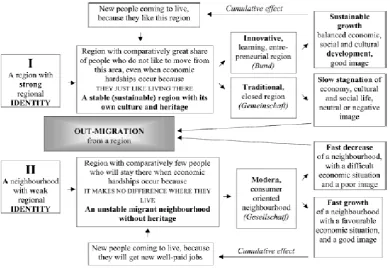
10 Figure 1: Regional identity and migratory outcomes.
Figure 1 describes regional identity as a fixed value consisting of the sum of individuals experienced geographies. Paasi (2003) suggests analytical distinction between regional identity and the identity of a region. The lack of this analytical distinction limits understanding of the influence of place frames as an experiential dimension on migratory decisions. Different coalitions can create different place frames resulting in differences in experienced geography by individuals causing differing migratory outcomes. Understanding the influence of regional identity on migration should not ignore, but focus on the influence of different place frames within a region.
1.4 Conceptual model
Based on the theoretical framework a conceptual model was developed. In this section the different aspects of the conceptual model will be explained.
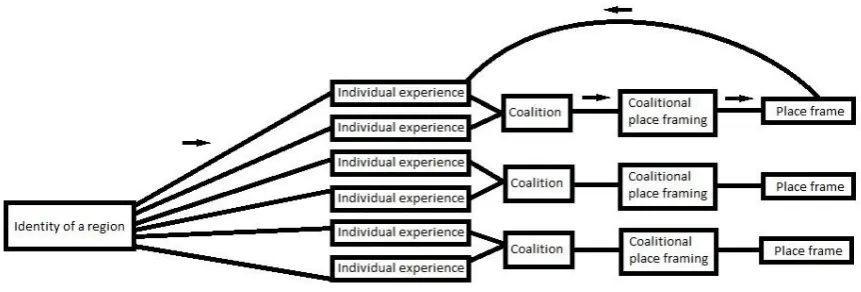
11 are built up from the different coalitional migratory tendencies. Regional migratory tendencies influence the composition of the regions’ inhabitants, thereby influencing the identity of a region, this is an ongoing process. Figures 2 and 3 together form the conceptual model. Figure 2 gives an overview of the initial formation of coalitions and place frames. From the moment place frames are created these place frames form an important lens through which individuals experience the identity of a region. Figure 3 shows how these place frames are situated between the structural elements or identity of the region and the individual’s experience. Place-framing continuously strengthens place-frames thereby strengthening the embeddedness of ideas within a coalition. Over time place-place-frames become more important in how individuals experience the region.
Figure 2: Conceptual model part 1; Initial formation of coalitions and coalitional place frames
[image:11.595.90.510.459.622.2]12
2. Case
The theoretical framework links regional identity, through place framing to migration. Coalitions play an important role in the formation of place frames and thereby in individuals’ decision to migrate. This chapter elaborates on the case of Twente. A brain drain situation causes scarcity on the labor market. Finding place frames causing a tendency within certain coalitions to migrate out of the region provides an opportunity for organizations to deal with scarcity on the labor market through institutional place framing in employer branding.
2.1 Twente
Twente is a region situated in the east of the Netherlands. About 625 thousand people inhabit the region. Larger cores in the region are Enschede, Hengelo and Almelo. Two large institutions of higher education attract a large number of students. Despite the presence of these institutions of higher education the region has difficulties in attracting and retaining highly educated individuals: Until recently the region dealt with a brain drain situation; according to Stichting Twente Index (2011) this has recently evolved to a brain gain situation; the number of highly educated individuals rose from 25 to 29 percent of the labor force within the region.
The figures of Stichting Twente Index (2011) raise some doubts. It is unclear whether students are included in the percentage of highly educated individuals, although the growing amount of students in the two large institutions for higher education within the region is mentioned within the same paragraph (Stichting Twente Index, 2011, p. 7). Amongst academic students there is a high tendency to leave the region after graduating. About 78 percent of the students of the University of Twente leave the region after graduation. From the academic students originating from the region 40 percent leaves the region after graduating. Students at Saxion University of Applied Sciences Enschede show a lower tendency to leave the region. About half of the students leave the region after graduating. From Saxion students originating from the region 27 percent leaves the region (Stichting Twente Index, 2011, p. 61). The percentage of students in the region originating from the region is unknown. However students from both institutions show a high tendency to leave the region, also amongst students in higher education originating from the region. The brain gain Stichting Twente Index (2011) presents seems to result from creativity in the definition of ‘highly educated’.
2.2 Brain drain
The term brain drain refers to a tendency in the population of an area where more highly educated people migrate out of the region than into the region (Kwok & Leland, 1982). A brain drain situation is often associated with negative outcomes such as economic decline and a negative image of the region. Human capital movement argues that brain drain has a short term negative effect on the region but can also have positive effects (Timmer, de Jong, & Gutteling, 2008). The possibility to migrate towards a region where, in contrast to a brain drain region, education is valuated, the functionality of higher education rises, stimulating more people to follow higher education. On a regional level the negative effects can still be felt and employers will have difficulties to attract highly educated employees.
13 dissatisfaction. On the other hand there are pull factors, these are the possibilities the possible region of settlement has to offer (Timmer, de Jong, & Gutteling, 2008).
Traditional brain drain literature focuses on migration from low developed countries to higher developed countries (Kwok & Leland, 1982). Modern brain drain studies also focus on brain drain within and between developed countries (Timmer, de Jong, & Gutteling, 2008). Migratory decisions in the brain drain process within or between developed countries are more often based on non economical factors (Timmer, de Jong, & Gutteling, 2008). Raagma (2002) describes how regional identity influences migratory decisions. This is an example of a non-economic factor possibly influencing the brain drain process within a developed country.
2.3 Employer branding
Aging and declining birth rates cause a decline in the labor force of developed countries. This results in scarcity of talented personnel. A growing competition to attract talented personnel is also referred to as ‘the war for talent’ (Beechler & Woodward, 2009). A brain drain situation causes scarcity of highly educated personnel. The combination of a brain drain situation, aging and declining birth rates is therefore expected to lead to extreme scarcity in highly educated talented personnel.
To gain competitive advantage in competition for talented employees, organizations use employer branding. Employer branding is a concept first posed in popular business press and later adopted in scientific literature. The concept refers to a company’s efforts to communicate that the company is a desirable place to work and the use of marketing and branding principles to create strong employer brands (Berthon, Ewing, & Hah, 2005).
Employer branding is not only about attracting a competent workforce, but also about retaining employees. Employer branding efforts can therefore be aimed at both potential and current employees (Berthon, Ewing, & Hah, 2005) (Helm, 2011) (Martin & Hetrick, 2006) (Sartain, 2005) (Wilden, Gudergan, & Lings, 2010). Aiming employer branding at employees can be seen as an investment in willingness to engage in internal bonding and the production of a strong sense of corporate identity (Martin, Gollan, & Grigg, 2011). Employees can have an important role as brand ambassadors for the organization.
Communication should focus on communicating identity in a realistic and attractive manner, towards groups the organization has a dependent relationship with (Dowling, 2006). Martin and Hetrick (2006) suggest a sustainable corporate story as the solution to attract talent. A sustainable corporate story has four key criteria. First, stakeholders should view the story as a realistic representation of their organization; second, the story should be relevant to all members’ interests; third, the story should be responsive and fit in with de ongoing conversation between internal and external stakeholders; fourth, the story should be sustainable and withstand the test of time in which competing demands of stakeholders and members exist. Talent is not a homogeneous group but is spread out over different social groups. It is therefore important to aim an employer branding story at all relevant stakeholders. Knowing these stakeholders is critical to ensure the relevance of stories to these stakeholders.
14
2.4 Research question
This chapter introduces a case to study the coalitional place frames. A brain drain situation suggests that more highly educated individuals migrate out of the region than into the region. This suggests large differences between coalitions in society. This makes a region with a brain drain situation suitable for research aimed at finding differences between different coalitions in society, Twente is such a region. Therefore this research focuses on differences between coalitions in Twente. Some coalitions of highly educated individuals tend to leave the region whilst others tend to stay within the region. It is expected that individuals within coalitions share a sense of place conflicting with the sense of place members of other coalitions have. This resulted in the following research question: ‘How are place frames of coalitions expressed in the language use of individuals about their experience of the identity of a region?’
And in the sub questions:
15
3. Method
This chapter describes how this research has been conducted. Research design, respondent groups, instruments, procedure, rationale, and the analysis will be described in the following sections.
3.1 Research design
This study aims to find differences in place frames between different coalitions in Twente. Place frames influence individual’s experience of place. By investigating how individuals within different coalitions describe the region different place frames will be uncovered.
To investigate how individuals describe the region a qualitative method seems obvious. This research used both qualitative and quantitative measures. The language use of individuals will be studied to uncover commonalities and differences within and between coalitions within Twente. Grafffigna, Vegni, Barello, Olson and Bosio (2011) describe the creation of dictionaries as a method to investigate the social construction of experience. As place frames are socially constructed and influential on individuals’ experience this method seems to fit this research. Graffigna et al. (2011) use interviews to create a dictionary, at this point this research diverges; respondents are asked to create a dictionary themselves and from the dictionaries they create an underlying place frame will be reconstructed. The language use from four coalitions within the Twente region was analyzed both qualitative and quantitative: focus lied on what was said, how many times it was said, how it was said and what was meant by it.
3.2 Instruments
As the first section of this chapter reveals this research combines quantitative and qualitative research. Both types of research were mostly combined into one instrument. Whereas research aimed at finding the influence of social construction on individual experiences often uses interviews as the method of gathering data, this research leaves the creation of dictionaries to the respondents. Originally designed to empirically investigate self-attitudes Kuhn and McPartland’s (1954) Twenty Statement Test was adapted for the purposes of this research.
The Twenty Statement Test is based on the idea that the conceptualization of the self can be viewed as an object. The instrument was developed to measure the individual’s attitude towards the self. (Kuhn & McPartland, 1954, p. 68). It is used to obtain self descriptions of identity (Vindhya, 2011). The original test contained twenty times the words ‘I am” followed by a blank space. Respondents filled out these blank spaces with descriptions of themselves. The test has also been used to measure group identities (Bettencourt & Hume, 1999) and social identity (Jackson & Smith, 1999). In several cases the instrument has been adapted for the purposes of the research (Bettencourt & Hume, 1999) (Vindhya, 2011) (Jackson & Smith, 1999). As the Twenty Statement Test is based on measuring attitudes towards an object (the self), other objects, i.e the region, can also be subject to a Twenty Statement Test. The instrument can be used to obtain individual’s descriptions of regional identity. In the past the Twenty Statement Test has been adapted to fit research goals several times. In this research the instrument was also adapted. However, the basic idea remains obtaining individual’s attitudes towards an object, in this case, Twente.
16 focusing on language use and discourses usually have a more qualitative focus. Adapting the Twenty Statement Test to create ‘dictionaries’ leave the notion of what is characteristic in the language use of the respondent to the respondent instead of to the researcher as narrative interviews would do.
3.2.1 Twente Twenty Statement Test
The Twente Twenty Statement Test does not differ a lot from the original test; two elements have been changed. One of them is very obvious the other has been implemented to fit in the possibility for qualitative analysis.
The first part of the Twente Twenty Statement Test exists of twenty statements started by the words “Twente is” and followed by a blank space. Like the original test, respondents were asked to fill in the blanks. The following introduction was used: “This is the start of the ‘Twenty-statement-test’. You are asked to fill out a statement 20 times. Each statement begins with the words ‘Twente is’. You have to fill in the rest of the statement. The statement can comprise of a single word or a sentence. You can fill out twenty statements. Doe not fill out a long story at the first statement.” 1
As analysis in this research focused on both qualitative and quantitative elements respondents were asked to distract a top five out of their twenty statements. These had to be the five statements that are most characteristic for the region. This adaptation is similar to the adaptation made by Jackson and Smith (1999) to the Twenty Statement Test. However, subsequently the respondents were asked to elaborate on the five statements they thought of as most characteristic for the region. This resulted in a better comprehension of the meaning given to the statements. The complete instrument can be found in appendix A.
3.2.2 Interview
In addition to the Twenty Statement Test the respondents were asked several open and closed questions. These questions differed per group. Former students were asked why they had left the region after graduating; both student groups were asked to describe the expected image the other group would have of the region; and professionals were asked to describe the expected images for both groups of students.
In addition to this the professionals were also interviewed about the labor market situation and the way their organizations dealt with this. This was done trough a semi-structured interview. The interview scheme can be found in appendix A.
3.3 Respondents
Out of an undoubtedly very large number of coalitions within Twente, four coalitions relevant to the brain drain situation were selected for this research. “Although a significant proportion of the students of the University of Twente leaves the region, many highly educated individuals establish in the region. HBO-students are relatively sedentary. From the Saxion-students living in Twente at age 16, three quarters stays in the region and 95% stays in the east of the country.” (Stichting Twente Index, 2011). This suggests a distinction between academic and Saxion-students and between students originating from the region and students not originating from the region. Another common differentiation is between students living with their parents and students living in student housing (Sival & Wonnink, 2012). Students living in student housing show more active participation in student life and often do not originate from the region. Students living with their parents often originate
17 from the region and have a lower participation in student life (Sival & Wonnink, 2012). Different migratory outcomes suggest the existence of different place frames leading to different coalitions. As the formation of place frames is a process of social construction, strong networks and shared experiences are likely to result in a common place frame. Students living with their parent often share a similar background, originating from Twente and often do not participate in student life, students living in student housing often share their origin outside the region and their current situation in a student community. The existence of these coalitions has been assumed to be able to compare coalitions. Another coalition interesting for the brain drain situation was the group of former students who have left the region. They have somehow experienced the region in such a way that they were not willing to stay within the region. It is therefore interesting to compare the results of this group to the other groups. The last group exists of HR and personnel managers from large organizations within the region. These respondents have a dual function, they were selected as professionals who live and work in the region and thus decided to stay and they were selected because they have knowledge about the labor market situation. The groups and the procedure to select respondents will be discussed in more detail per group.
3.3.1 Students living with their parents
In the Netherlands there is a common distinction between students living with their parents and students living in student housing. Students living with their parents usually live and have lived for a while in close range of the institution for higher education. These students are therefore expected to have a different image of the region than students living in student housing. There were 22 students living with their parents participating in this research. Seventeen of them completed their participation in this research.
Selecting these students went through different channels. Students were asked to participate in this research via online invitations sent over the internal communication system of institutions for higher education. The instrument was also spread out over social media, like Facebook and Twitter. Finally, the researcher recruited six male students to recruit respondents at the two large institutions for higher education. This way of recruiting yielded most participants. By recruiting in this fashion bias was prevented. The researcher tried to prevent selecting respondents from his own social circle, thereby possibly selecting a limited group of students.
3.3.2 Students living in student housing
Students living in student housing usually move to student housing because they do not live in close range of the institution for higher education. Usually this group participates more in student life and student activities and moves in new social circles. Because of this they are expected to have views differing from the other group of students. There were 24 students living in student housing participating in this research. Only one of them did not complete participation, thus there were 23 completed responses.
18
3.3.3 Former students
Former students have studied in Twente and left the region. They have experienced the region in a way that did not stimulate them to stay within the region. They have however experienced the region and it is interesting to compare their language use with the language use of groups within the region. A lot of former students started participating in this research but did not finish it, this can be attributed to the medium through which this group was approached. There were however also a lot of former student completing participation. From the 35 participants that have started the test 23 have completed their participation.
For recruiting former students the University of Twente -alumni page on LinkedIn was used. A brief explanation of the goal of the research and the instrument was given combined with a link to the online instrument. Because of the online recruitment of participants it was harder to stimulate respondents to complete their participation. This resulted in the relatively large group of incomplete responses.
3.3.4 Professionals working within the region
Professionals working within the region were selected for both their professional opinion on the labor market situation within the region as their personal descriptions of the region. They were all HR, P&O or recruitment managers within the largest organizations within the region. The group of professionals was the only group participating through a live interview. All fifteen participants completed their participation.
Professionals were recruited via telephone. First a set of organizations was drawn. The organizations had to be situated within the region and had to employ highly educated personnel. Contacts within organizations were gathered through personal networks and from the internet. A total of 25 organizations were approached via different paths. Respondents were asked to participate in a study about, labor market communication, regional identity and brain drain. It was explained that a regional identity focus on the labor market situation and migratory situation was taken to find possible outcomes for employer branding within the region. This resulted in a total of fifteen organizations willing to participate in the study. All respondents completed the instruments.
3.4 Procedure
This section describes the procedure followed during data collection. The former students were approached online and there has been no direct contact, therefore there was no specific procedure for this group. A large part of the respondents from both students’ groups have been recruited by the six male students mentioned in section 3.3. These students received instruction from the researcher to stimulate respondents to completely fill out the test. Students were recruited at different locations in the two institutions for higher education within the region. The questioners brought a laptop and let the respondents fill out the online-test.
19 The session started with the request to completely fill out the Twenty Statement Test. They were given a pen and a form with the twenty statements. They were asked to make a top 5 out of their statements. Then the actual interview started. The recorder was started and the respondents were asked to give an explanation per statement; to describe why it was characteristic for the region. Subsequently it was explained the session thus far consisted the same elements as the online questionnaire for students and former-students did. It was explained that the next part was an interview about the labor market situation. After the interview the respondents received the possibility to ask questions and they were promised to receive a copy of the results of this research.
3.5 Analysis
A total of 78 respondents generated a total of 1558 codes. They produced 387 unique explanations of their top five codes and also answered several additional questions. There was interview data from fifteen short interviews about the labor market situation and the employer branding activities of the largest employers in the region. The analysis will be described in three sections. First analysis of the qualitative codes will be described, subsequently quantitative analysis of the 1560 codes will be described, finally the analysis of the data from the interviews will be described.
3.5.1 Qualitative analysis top five statements
The first step in the process of analyzing the qualitative data was gathering it in one place. Al the codes had to be subtracted from the other data. From every group a file with all codes, with an explanation was made. Every group received a number and all statements were put together in one file.
20
Creating a categorization
Burnard (1991) gives an extensive description of the method for creating a categorization for qualitative data. A variation on this method was used to create a coding system for the top five statements. This section elaborates on the steps taken to create a coding for the Twenty Statement Test aimed at regional identity.
Open coding: card sort
Six male students, also involved in the data collection, were asked to participate in a card sort to create a coding system. ‘All in one’ card sorts can be used to find underlying factors and regularities in sorted entities (Rugg & McGeorge, 1997). All in one sorts refer to several approaches that have in common that respondents perform only one sort on the entities being sorted. One of the techniques is simply sorting entities into clusters based on similarity of the content. Graffigna et al. (2011, p. 404) refer to this as a Q-sort: “the participant was free to create as many piles as he/she considered appropriate(Q-sort)”.
Regardless of the name, this research uses a Q-sort (Graffigna et al, 2011) or all in one sort (Rugg & McGeorge, 1997). The six sorters were asked to each independently sort 387 codes in as many piles as they liked. They were also asked to come up with a name for each of the categories. This resulted in six sets of categories. An overview of these categories can be found in Table 1.
Respondent 1 Respondent 2 Respondent 3 Respondent 4 Respondent 5 Respondent 6 -Grolsch -Distant -Places -Accent -Football -Environment -Quiet -Culture -Education -Work -Character -Work -Environment -Studying -Inhabitants -Organizations -Government -Mentality -Active -Location -Economy -Hobby/sports -Going out -Development -Distant -Repution/ Characteristics -Innovative -Work -Environment/ residing -going out / liveliness -Local culture -Enschede -Sports -Finances -Social circle -Education -Work environment -Entrepreneur -Environment -Geographic location -Culture -Growing up -Characteristic companies -Politics -Enschede -Faith -Education -Environment -The city -Like-knows-like
-Proud of region -Cheap -Tukkers -Quiet -Employment -FC Twente -Diversity -Born, raised and stayed -Far away from
Randstad
-entre-preneurial and innovative -University of Twente -Farmers -Temperate -Small
-Sociable and snug
21 -Boring
Table 1: Codes resulting from open coding in a card sort by six respondents (first round)
Coding scheme
Table 1 shows a lot of similarities but also a lot of differences in the codes the respondents in the card sort came up with. A group discussion was set up. The respondents were asked to explain the codes they formulated. After a round of explanations the researcher asked the respondents to decide on a coding scheme. They received instruction to use general but clear codes to lower the number of categories and minimize chance of misinterpretation and disagreement. This resulted in a total of twelve categories. All categories are named and briefly explained in table 2.
Category Explanation
Own experiences Respondents describe the region as a part of their life or identity Places Respondents describe the region using names from places in the region Leisure Respondents describe the possibilities for spending leisure time in the region Brands Respondents describe the region by well-known brands from the region Reputation Respondents describe the region by its reputation
Entrepreneurship Respondents describe the region by characteristics of business in the region Distance Respondents describe the region by its physical and emotional distance
towards other places
Inhabitants Respondents describe the region through characteristics of its inhabitants Students city Respondents describe the region as a place to study and live the students life Mentality Respondents describe the region by characteristics of the mentality of
inhabitants within the region Geographical
characteristics
Respondents describe the region by its geographical characteristics, what the environment looks like
[image:21.595.65.534.642.774.2]Value Judgements Respondents give value judgments about the region Table 2: Categories selected by six respondents from card sort
Testing and adapting coding scheme
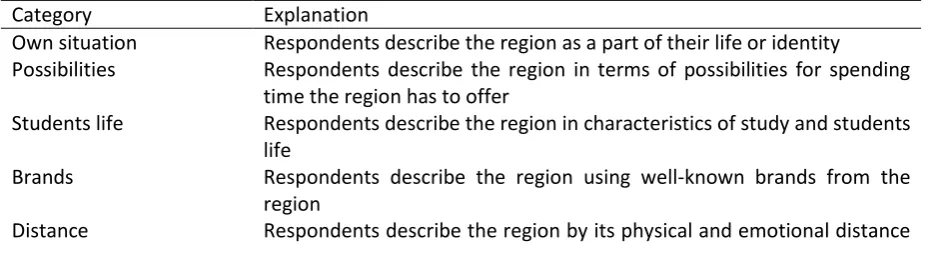
After this discussion the six respondents in the card sort were divided into two groups of three. Both groups were asked to use the categories they agreed on, in a second card sort. This time fixed categories were used. Although the categories were discussed extensively beforehand there were large dissimilarities in the categorization. Calculating Cohen’s kappa would have resulted in very low counts and were therefore not yet calculated. Instead the codes were discussed once more by the six respondents. This discussion resulted in the merge of the categories reputation, inhabitants and mentality. The distinction between these categories was too vague which resulted in large differences. Other categories received minor cosmetic adaptations to prevent misinterpretation. This resulted in ten codes shown, with a brief explanation, in table 3.
Category Explanation
Own situation Respondents describe the region as a part of their life or identity
Possibilities Respondents describe the region in terms of possibilities for spending time the region has to offer
Students life Respondents describe the region in characteristics of study and students life
Brands Respondents describe the region using well-known brands from the region
22 towards other places
Places Respondents describe the region using names from places in the region Business activity Respondents describe the region by characteristics of business and
business activity in the region Physical environment
without explicit value judgments
Respondents describe the region by its environmental characteristics without explicit value judgments attached to it
Value judgments Respondents give explicit value judgments about the region. Nature, mentality and
reputation of inhabitants
Respondents describe the region by describing the nature, mentality or reputation of its inhabitants.
Table 3: Final categorization after second discussion and second card sort
Cohen’s kappa
After this discussion the six respondents in the card sort were thanked for their effort and the researcher coded the complete set of top five statements N=387. A second coder was asked to code a part of the data to measure inter-rater reliability. She received the categories and explanations shown in table 3. She was asked to code 81 statements, a little bit more than twenty percent of the data. There was agreement on 70 statements (86% of the coded data). Cohen’s kappa was 0,85. That is considered a very strong agreement. Therefore this categorization was used in this research.
3.5.2 Quantitative analysis
For the 1558 codes resulting from the Twenty Statement Test the same categorization was used as was used for the qualitative data. Besides the division over different categories the data was also categorized in negative, neutral and positive statements. This resulted in a series of crosstabs. Analytical software (SPSS 20.0) was used to analyze the crosstabs and measuring Pearson’s Chi-square. This resulted in a significance level for each cross tab. Standardized residuals shows the strength of the attribution of the cell to the significance of the cross tab. The results are significant when actual counts strongly differ from expected counts.
3.5.3 Interview analysis
23
4. Results
This chapter is divided into two main sections: ‘Twenty Statement Test’ and ‘Interviews’. In the Twenty Statement Test section the data gathered through the Twenty Statement Test is compared. This section aims to find different place frames in different coalitions. The interview section deals with the data gathered in the additional interview. These results help placing the Twenty Statement Test results into context.
4.1 Language use
The first section of this chapter deals with the results of the Twenty Statement Test. The language use of the four coalitions will be compared using qualitative and quantitative data. This section is organized around the ten categories of statements about Twente. This section describes the way respondents talked about these subjects: In each category the tone; positive or negative, quantity and explanations of statements will be discussed.
4.1.1 Own situation
Several respondents described the region in terms of its impact on their own life. They describe how they experienced growing up in the region, living in the region and how they feel at home in the region.
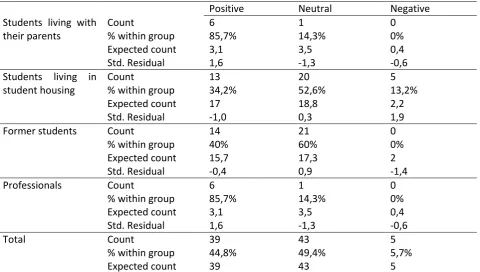
Table 4 gives an overview of the differences in tone between coalitions.
Positive Neutral Negative
Students living with their parents
Count 6 1 0
% within group 85,7% 14,3% 0%
Expected count 3,1 3,5 0,4
Std. Residual 1,6 -1,3 -0,6
Students living in student housing
Count 13 20 5
% within group 34,2% 52,6% 13,2%
Expected count 17 18,8 2,2
Std. Residual -1,0 0,3 1,9
Former students Count 14 21 0
% within group 40% 60% 0%
Expected count 15,7 17,3 2
Std. Residual -0,4 0,9 -1,4
Professionals Count 6 1 0
% within group 85,7% 14,3% 0%
Expected count 3,1 3,5 0,4
Std. Residual 1,6 -1,3 -0,6
Total Count 39 43 5
% within group 44,8% 49,4% 5,7%
[image:23.595.68.549.386.658.2]Expected count 39 43 5
Table 4: Differences in tone between coalitions in statements regarding their own situation
24 due to the small number of statements about this subject the expected count is too low in some cells. Results are therefore plausible, especially in the light of the high significance levels, but not strong enough for making definite conclusions.
Appendix B gives an overview of how statements within coalitions are divided over different categories. The differences in division over categories are compared with the other coalitions. Table 5 is distracted from appendix B and gives insight in the amount of statements about respondents’ own situation regarding the region as a percentage of the total amount of statements within that coalition. The table in appendix B had significance below 0,001 and the expected counts were high. Results from this table are thus both reliable and significant.
Students living with their parents
Students living in student housing
Former students Professionals Total Count
Expected count % within Group Std. Residual
7 38 35 7 87
19 25,7 25,7 16,6 87
2,1% 8,3% 7,6% 2,3% 5,6%
[image:24.595.60.556.241.322.2]-2,8 2,4 1,8 -2,4
Table 5: Division of statements about the own situation as a percentage of the total per coalition (distracted from appendix B)
The amount of statements dedicated to the own situation differs over different coalitions. Students living in student housing and former students dedicated around 8 percent of their statements to their own situation. The other two groups dedicated around 2 percent of their statements to their own situation.
Appendix C gives an overview of all the explanations offered by respondents for their top five statements. The most remarkable differences between and within coalitions are displayed.
Explanations about the own situation varied in the group of students living with their parents. Students who are positive about their situation are born and raised in the Twente region. They feel well at home in the region: “As a born and bred Twentenaar I feel at home here. It is not as much a characteristic of Twente as it is a personal preference. Of all the regions in the Netherlands where I have been Twente gives me the most homely feeling.” 2 One of the respondents lived outside the region and made a negative statement about the time and distance he or she had to travel. Three top five statements were dedicated to this subject by the students living with their parents.
Most students living in student housing described Twente in terms of their own situation because it entailed a new situation for them. To them Twente means being away from their parents, making new friends and getting to feel at home. “Today I have to do many things on my own, things like cooking and so on. This eventually results in maturity and being able to stand on my own two feet.”3 A student living in student housing who was born and raised in the region had a view very similar to students living with their parents who were born and raised in the region. Students originating from other regions use roughly the same terminology. However, they focus on a small part of the region,
2
25 their own, new situation, to describe the region. Students living in student housing dedicated five top five statements to this subject.
Former students’ comments are like the comments of students living in student housing; very personal. They describe the region as ‘the place where…’: they grew up, they became adults or their friends or parents live. They often describe Twente in terms of a memory4, these memories can again be divided into those who were born and raised in the region and those who were not. The latter referring to memories of the student life whilst the first refer to a sense of feeling at home in the region. Former students dedicated five top five statements to this subject.
Professionals working in the region feel at home and love working in the region. They elaborate on their current situation, by stating that Twente is ‘their’ region because it offers them everything they need. Professionals dedicated three top five statements to this subject.
Results of the Twenty Statement Test show that students living in student housing and former students tend to talk significantly more about their own situation in their statements about Twente than professionals within the region and students living with their parents do. This difference did not reflect in the amount of top five statements dedicated to this subject.
Students living in student housing were the only coalition describing Twente using negative remarks about their own situation. Qualitative data showed a variation within coalitions based on the place of origin. Amongst students living with their parents some students made statements about how they have to travel towards the region every day. Students originating from the region talk about growing up within the region. This is the same in the group of students living with their parents and students living in student housing. Students in student housing often referred to the consequences of living on their own when they describe Twente in statements about their own situation. This means the same terminology is used to describe different situations; home is the student life to one group while it is the region as a whole to the other.
4.1.2 Possibilities
Another way to describe the region is by describing the possibilities it has to offer. How these possibilities are described differ, some statements are dedicated to the amount of possibilities the region has to offer while other statements refer to specific possible activities within the region. This section gives an overview of the tone, quantity and explanations of statements about the possibilities the region has to offer.
Table 6 gives an overview of the tone used in statements about the possibilities the region has to offer.
Positive Neutral Negative
Students living with their parents
Count 4 17 0
% within group 19% 81% 0%
Expected count 3,8 14,7 2,5
Std. Residual 0,1 0,6 -1,6
[image:25.595.84.546.667.737.2]26 Students living in
student housing
Count 7 23 4
% within group 20,6% 67,6% 11,8%
Expected count 6,2 23,8 4
Std. Residual 0,3 -0,2 0,0
Former students Count 2 7 4
% within group 15,4% 53,8% 30,8%
Expected count 2,4 9,1 1,5
Std. Residual -0,2 -0,7 2,0
Professionals Count 1 7 1
% within group 11,1% 78,8% 11,1%
Expected count 1,6 6,3 1,1
Std. Residual -0,5 0,3 -0,1
Total Count 14 54 9
% within group 18,2% 70,1% 11,7%
[image:26.595.65.553.413.495.2]Expected count 14 54 9
Table 6: Differences in tone between coalitions in statements regarding possibilities the region has to offer
The differences between the coalitions in table 6 are small; Pearson’s Chi-Square test showed that these differences were insignificant. The expected count is also very small, thus even when differences would have been significant they would have been less reliable. From the data can be concluded that there are no significant differences in tone between the groups when talking about possibilities the region has to offer. There are however differences in the amount of statements dedicated to the possibilities the region has to offer. Table 6 gives an overview of the figures.
Students living with their parents
Students living in student housing
Former students Professionals Total Count
Expected count % within Group Std. Residual
21 34 13 9 77
16,8 22,7 22,7 14,7 77
6,2% 7,4% 2,8% 3% 4,9%
1 2,4 -2,0 -1,5
Table7: Division of statements about the possibilities the region has to offer as a percentage of the total per coalition (distracted from appendix B)
Several differences could be found in the amount of statements about the possibilities the region has to offer. Students living in student housing talked most about possibilities. Students living with their parents also talked a lot about this. Former students and professionals talked less about these subjects.
Too few former students talked about the possibilities the region has to offer, to produce significant differences from the other coalitions. However, when they talk about these possibilities they seem to use a more negative tone. Qualitative data can give more insight on this matter. Differences that were found in the explanations of top five statements about possibilities the region has to offer are displayed.
27 everyone happy. I think Twente does so. There is quietness but also a lot of activity. There is always something to do in Twente. There are villages, peasant life, but also city and student life. Every sport you want to attend is offered. There are several concert halls, large discotheques and sociable bars, all within close range.5” Students living with their parents dedicated three statements to the possibilities the region has to offer.
Students living in student housing also have a positive view regarding the possibilities the region has to offer. They tend to focus on specific activities like, drinking bear, sports, going out, cycling or relaxing.6 However one of the respondents also states that “the possibilities are endless, there is so much to do.”7 Another student also made a statement on the amount of possibilities the region has to offer, however this statement focuses on activities organized by students. Students living in student housing dedicated five statements to the possibilities the region has to offer.
In the coalition of former students there was just one respondent who included a statement about the possibilities the region has to offer in the top five. This is in line with the quantitative results showing lower amounts of statements dedicated to this subject by this coalition. This response had a negative undertone: “There is too little to do in Twente to make it lively for young professionals. Now and then there is something to do, but that is it.”8
There was also one professional including a statement about the possibilities the region has to offer in the top five. This statement added cultural activities to the possibilities the region has to offer. The amount of distribution of statements over the different coalitions in this subject was similar in the twenty statement and the top five statements. Both coalitions of students referred to the possibilities the region has to offer significantly more than the other two groups. Students living with their parents tend to talk more about the amount of possibilities the region has to offer whilst students living in student housing tend to talk about specific activities. The other two coalitions dedicated just one top five statement to this subject: the former student was negative about the amount of possibilities and the professional working within the region was positive about a specific activity.
4.1.3 Student life
With over 20.000 students within two institutions for higher education, students form an important part of Twente. Student life concentrates around the town-centre and the university campus in Enschede. Respondents often describe the region with characteristics related to student life. This section gives an overview of the tone, quantity and explanations of statements about student life. Table 8 gives an overview of the differences in tone between groups when they talk about the region in terms of student life.
Positive Neutral Negative
Students living with their parents
Count 1 8 0
% within group 11,1% 88,9% 0%
5
Appendix C: Translation statement 19 6
Appendix C: see statements 21,23,24,25 7
28
Expected count 0,3 8,5 0,2
Std. Residual 1,2 -0,2 -0,5
Students living in student housing
Count 1 38 1
% within group 2,5% 95% 2,5%
Expected count 1,4 37,6 1
Std. Residual -0,3 0,1 0
Former students Count 2 58 2
% within group 3,2% 93,5% 3,2%
Expected count 2,2 58,2 1,6
Std. Residual -0,1 0,0 0,3
Professionals Count 0 4 0
% within group 0% 100% 0%
Expected count 0,1 3,8 0,1
Std. Residual -0,4 0,1 -0,3
Total Count 4 108 3
% within group 3,5% 93,9% 2,6%
[image:28.595.69.547.71.304.2]Expected count 4 108 3
Table 8: Differences in tone between coalitions in statements regarding student life
The differences in tone between the different groups are very small in the student life category. The differences shown in table 1 turn out to be insignificant. The expected counts in the negative and positive tones are very low, found differences would therefore haven been less reliable. They could just as well have been attributed to coincidence. There are however large differences in the amount of statements about student life. Table 9 gives an overview of the differences.
Students living with their parents
Students living in student housing
Former students Professionals Total Count
Expected count % within Group Std. Residual
9 40 62 4 115
25,1 34 34 22 115
2,6% 8,7% 13,5% 1,3% 7.4%
-3,2 1 4,8 -3,8
Table9: Division of statements about student life as a percentage of the total per coalition (distracted from appendix B)
In the category student life, most statements were made by students living in student housing and former students. The distance to the other two groups is remarkable. Especially former students refer a lot to the region in terms of student life. Students living in student housing also talk a lot more about student life than the other two groups. There is however also a substantial difference between former students and students living in student housing. It is also remarkable how a coalition of students, the students living with their parents, dedicate so few statements to student life. This suggests they identify less with student life and more with the region as a whole.
[image:28.595.65.553.424.507.2]29 Students living in student housing produced a wide variety of statements with characteristics related to student life. A lot of statements can be placed in the same category as the students living with their parents: Moderately positive statements about the amount of students and studying in the region. Several statements describe institutions and education as very important for the region because of their ability to attract students: “Enschede is a student city that attracts a lot of students. Without the possibility to study this group would not have a reason to go to Twente.”9 Characteristic for the student life is the distance between students and other inhabitants of the region: “Students have their own world, others have little to do with students and students have little to do with others.”10
Former-students mainly describe how they know the region from a student’s perspective. They describe the students’ community and the distance between the student community and other inhabitants of the region. The University of Twente is the reason they came to Twente, they have a very positive view on the student life they had in the region. The student life keeps the city of Enschede, about the only place in the region they refer to, lively. Nevertheless makes the distance between the student community and other inhabitants of the region, the lack of career perspectives and the relative distance to other places in the Netherlands the region unattractive to stay after graduating: “Like knows like, because of the University of Twente Enschede becomes a small town. However, there is a distance between inhabitants of Twente (especially the youth) and students. That’s the main reason Twente, especially Enschede, is nice for students, but not a place to stick after graduating.”11
Very few professionals describe Twente in terms of student life or student characteristics. One respondent describes the importance of knowledge institutes as a means to attract students to the region and the positive impact this has on the region.
No differences in tone were found in the quantitative analysis of statements about student life. There were however large differences in the amount of statements about student life. Especially former students tend to describe Twente in terms of student life. The small amount of statements dedicated to student life by students living with their parents was also remarkable.
Important differences in tone do emerge in the qualitative data. Students living with their parents and people living and working in the region give a more positive representation about the presence of students in the region. Students living in student housing and former-students that have moved out of the region show a strong sense of us and them. They sense a distance between them and other inhabitants of the region resulting in aversive feelings towards settling in the region. These differences are not confirmed by quantitative data, because the same terminology is used to describe a different sensation. It seems that students living in student housing and former-students that have left the region describe the region in terms of student life because it is al there is to it from their point of view. They only know the region from a students’ perspective.
9
Appendix C: statement 43 10
Appendix C: Statement 45
30
4.1.4 Brands
Table 10 gives an overview of the distribution of statements about well known brands in the region.
Positive Neutral Negative
Students living with their parents
Count 0 29 0
% within group 0% 100% 0%
Expected count 0,4 28,3 0,3
Std. Residual -0,6 0,1 -0,6
Students living in student housing
Count 0 22 1
% within group 0% 95,7% 4,3%
Expected count 0,3 22,5 0,3
Std. Residual -0,5 -0,1 1,4
Former students Count 1 25 0
% within group 3,8% 96,2% 0%
Expected count 0,3 25,4 0,3
Std. Residual
Professionals Count 0 10 0
% within group 0% 100% 0%
Expected count 0,1 0,98 0,1
Std. Residual -0,3 0,1 -0,3
Total Count 1 86 1
% within group 1,1% 97,7% 1,1%
[image:30.595.64.550.117.388.2]Expected count
Table 10: Differences in tone between coalitions in statements regarding well known brands in the region
There were few differences in tone in statements about brands. These statements often just entailed naming the brand without any judgment. Most responses are therefore neutral and as a result of the low expected counts and similarity in the results, found differences were both insignificant and unreliable. Table 11 gives an overview of the differences between coalitions in the amount of statements.
Students living with their parents
Students living in student housing
Former students Professionals Total Count
Expected count % within Group Std. Residual
29 23 26 10 88
19,2 26 26 16,8 88
8,5% 5% 5,7% 3,4% 5,6%
2,2 -0,6 0,0 -1,7
Table 11: Division of statements about well known brands in the region as a percentage of the total per coalition (distracted from appendix B)
[image:30.595.67.553.512.593.2]