ONDERZOEKS- EN ADVIESGROEP POLITIE
Using diaries in value
co-creation
An explorative study of the applicability of a diary practice aimed at value co-creation in the Dutch police organization
Name: Renske Jassies
Student number: S1007394
Faculty: School of Management Master: Business Administration Master Track: Service Management First supervisor: Dr. J.S. Svensson
Second supervisor: Prof. Dr. Ir. O.A.M. Fisscher Company supervisor: Else Wind-Fransen
Drs. Ingrid Oostenenk
Date: december 20, 2013
Preface
Although always fascinated by police work, I made my tradeoffs in 2009 and started my study at the University of Twente. This thesis announces an end to my period of being a student Business Administration at the University of Twente. Still fascinated by police work at the end of my study, I wanted to end my study period with an assignment concerning police work. As I became accustomed with issues and theories about competitive companies during my student time, doing an assignment at the police organization with no competitors seemed even more challenging. As citizens become more critical toward police and, by the force of the internet, also become more aware of their power, I also felt that business administration theories are increasingly suitable in the police organization.
At the end of my assignment, I look back with pleasure on doing this assignment. I have taken real satisfaction and I can say that I really learned a lot about organizational and strategic issues and police work. However, without several people, this would not have been possible. Therefore I would first like to thank drs. Ingrid Oostenenk for giving me the access to the police organization to conduct and fulfill my assignment satisfactory. Moreover, she coached me in making strategic considerations and decisions. As head of the ‘Onderzoeks- & Adviesgroep’
(Consultancy & Research Group) Ingrid provided me a workplace with great student colleagues. Although the Consultancy & Research Group formed a close team, my research design required me to go outside the team, take actions on police working floor level and partner with police colleagues. Without the involvement of several police colleagues, the goal of this research would have never been achieved. I would like to thank Gert Telman (deputy director emergency & intake) and Wim Kanis (deputy director of enforcement) for their trust and openness in this research and access to resources for this research. Additionally, I would like to thank Berto Nijland and Albert Timmerman for their support and initiatives to hand out the diaries for this research. Thanks go to all police employees who have handed out diaries and provided me additional input. Furthermore, special thanks go to Rinke Borger from the domestic burglary team for his input, involvement, trust and support, Else Wind-Fransen from corps support for her input and mental coaching and Richard Hulsman from the forensic team for his support and input. For all the victims who have participated in the research, thank you. Without your input, the research would not have succeeded as intended.
Although the research required active involvement in the police organization, this thesis would not have succeeded without the support and supervision of Dr. Jörgen Svensson and Prof. Dr. Ir. Olaf Fischer, from the University of Twente, whom I would like to thank. From the start of this thesis I wanted to bring the police organization into motion. An action research approach seemed therefore a well-suited approach. However, the approach was rather unusual for doing a master thesis. As both supervisors gave me the benefit of the doubt, I was able to conduct action research. This research provided me the opportunity to explore the police work field, develop myself, but also explored possibilities for connecting business administration insights about value co-creation with the public administrative police organization.
Zwolle, December 2013
Abstract
The Dutch police should be able to improve service delivery by partnering with victims of domestic burglary (Inspectie Veiligheid en Justitie, 2012). However, questions are raised when one wants to treat victims as partner: What is an appropriate partner treatment and how could a partner treatment add up to what is valued by victims? From managerial literature comes forward that customer value in a specific service (e.g. process of filing police report) is optimally created by partnering and discussing with stakeholders of that specific service. This is called
value co-creation. However, literature also shows that value co-creation can be carried out in many practical forms. As value co-creation concerns searching collaboratively for improvements in a service, value co-creation practices could (1) meet more customer value and (2) give hands and feet to partnering with victims. However, the question remains:
‘In what way can value co-creation be applied in improving the process of filing a police report and what improvements can be made by applying value co-creation?’
First, literature is studied about value co-creation. Based upon literature, a conceptual model for applying value co-creation is designed. Second, the conceptual model is carried out in a case study. The aim of the case study is to improve the police service based on what is valued by victims and provide the police organization with an example of how value co-creation can be applied.
The first part of the research question is answered by jointly finding a way to design and test a co-creation practice with police employees (i.e. in what way?). The answer to the first part of the question is based upon theoretical input, decisions, actions, outspoken and actual willingness to participate and behavior while testing the jointly designed co-creation practice. However, the answer is also based upon victims’ reactions to the co-creation practice. The answer to the second part of the research question (i.e. what improvements?) is based upon the tested practice, researcher-victim conversations, discussions between victim and police during an evaluating meeting and interviews with police employees.
In collaboration with police employees the value co-creation practice of a diary was designed. Victims were able to write about their experiences with the burglary incident and the associated encounters with police by providing victims of domestic burglary the diary, directly after they are victimized. From the diaries it became apparent what is appreciated or missed by victims while experiencing the police service of filing a police report. In an evaluation meeting and in personal conversations, ideas were put forward in order to meet those missing values from victims. Reactions and ideas for improvements from victims and police (e.g. by personal conversations and discussions in briefings) ensured enough information to provide an answer of the applicability of the diary as value co-creation practice by setting up this diary action. Results showed, for example, that the information provision after the police report is filed is often regarded as insufficient by victims. Victims also indicated that they are curious to results from the forensic investigation executed in their home. Furthermore, a threshold is noticed at victims’ side causing victims waiving to report seemingly unimportant information. The provision of a reporting officers’ personal work phone number might lower this threshold. However, providing a personal phone number is considered sensitive topic within police.
4
Table of content
1 Introduction: Police partnering with victims of domestic burglary ... 5
1.1 Problem statement ... 6
1.2 Scientific relevance ... 7
1.3 Practical relevance ... 7
1.4 Reading guide ... 7
2 Theoretical framework: Value co-creation... 8
2.1 The service logic of doing business ... 8
2.2 Definition of value co-creation ... 9
2.2.1 Value ... 10
2.2.2 Co ... 10
2.2.3 Creation ... 11
2.2.4 Conclusion ... 12
2.3 The advantages and challenges of value co-creation ... 13
2.3.1 Advantages of value co-creation ... 13
2.3.2 Challenges of value co-creation ... 14
2.3.3 Conclusion ... 16
3 Research strategy: Model for designing a value co-creation practice... 17
3.1 Research approach: Action research ... 17
3.2 Research model ... 19
3.3 Case study design... 22
4 Results: Implementing the designed value co-creation practice ... 23
4.1 Designing and applying a value co-creation practice ... 23
4.1.1 Making the design: a diary practice ... 23
4.1.2 Testing the design: handing out diaries ... 24
4.1.3 Evaluating the design: reactions to the diary ... 26
4.2 Improvements regarding the process of filing a domestic burglary police report ... 31
4.2.1 The filing process and its victim-police encounters ... 32
4.2.2 Critical encounters: an analysis of value and missing value in the filing process ... 32
4.2.3 Ideas for improving the filing process ... 34
5 Reflection: research design and researchers’ role ... 37
6 Conclusion: design of value co-creation for improving police service... 40
6.1 Evaluating the research process against results... 40
6.2 Answer to the main question ... 42
6.3 Recommendations ... 43
6.4 Scientific and practical implications ... 44
6.5 Future research ... 45
Literature ... 46
Appendices ... 49
Appendix I – Overview positive and negative aspects of the pivotal factors of action research (Waterman et al., 2001) ... 49
Appendix II – Overview Co-s derived from Russo-Spena & Mele (2012) ... 52
Appendix III – Victim diary design (partially) ... 53
Appendix IV – Invitation letter toward victims ... 55
5
1
Introduction: Police partnering with victims of domestic burglary
Victims of domestic burglary want to be informed by the police what does and does not happen with their case. Victims want to be taken seriously by the police and want to be treated as a partner of the police (Inspectie Veiligheid en Justitie, 2012). These findings have been made by the Dutch inspection Justice and Safety in the report ‘Aangifte doen: de burger centraal?’
(Inspectie Veiligheid en Justitie, 2012). The purpose of the inspection was to find points for improvements in the process of filing a police report. Citizens’ satisfaction and willingness to report a crime to the police increases when the filing process improves and victims’ needs are met. It is stated by the inspection that increasing citizen’s satisfaction and willingness to report a crime ensures more information about crimes, leading to improved crime investigation by the police (Inspectie Veiligheid en Justitie, 2012, p.35). The inspection recommended to ‘work toward awareness of an appropriate treatment of the citizen as partner’ and ‘consider the citizen as partner in the process of filing a police report’, as the inspection found that citizens want to be treated as partner of the police. However, the recommendation of partnering raises the question of what exactly is meant by an appropriate approach for treating citizens as partners and how does partnering with victims add to what is valued by victims. The raised questions about partnering and value initiated this research.
In the search for appropriate partnertreatment, literature and theoretical models are reviewed for effective ways to uncover and meet value for customers. From literature it comes forward that a proactive approach of capturing value and needs of a customer (or citizen) will be suitable for uncovering needs. Approaching customers proactively means that customers actively contribute to a product or service design-process by submitting their needs while experiencing a product or service in situ (Witell, Kristensson, Gustafsson & Löfgren, 2011, p.143). When actively involving customers in a design-process, an organization gains in-depth knowledge about the needs and values of the customer and how a customer determines the value of a product or service (Witell et al., 2011). As a result, an organization can become more servable in meeting the needs of customers. Future situations where citizens are dissatisfied or complaining can be prevented by actively involving customers in organizational design-processes. The active involvement of citizens makes the citizen a real partner.
Valueco-creation is considered a proactive approach for (re-)designing organizational working processes in managerial literature. The term value co-creation is increasingly used to describe an iterative way of improving products or processes where stakeholders of that process (e.g. receivers or producers of a service or product) are involved in the production process. Moreover, the term is used to address how environmental changes (e.g. social, cultural, and economic) enable organizations to interact, collaborate and solve problems with their environment (e.g. customer, provider) by jointly generating ideas, solutions and value for a service (Russo-Spena & Mele, 2012). Practices of value co-creation are therefore argued to fulfil the recommendation of treating citizens as partners of the police.
6 attempted to ensure actual responses instead of expected responses by actively involving in police handling.
Action research is argued to be a proactive approach for establishing change in organizations and make a change supported by employees, as action research is ‘a period of inquiry, which describes, interprets and explains social situations while executing a change intervention aimed at improvement and involvement of stakeholders (Waterman, Tillen, Dickson & de Koning, 2001, p. 11). Action research is regarded as a mode of inquiry for establishing supported changes in organizations (Middel, Coghlan, Coughlan, Brennan & McNichols, 2008, p. 99). Changes toward improvement can be initiated by testing and gauging theoretical models on their applicability for solving problems in organizations. These theoretical models are tested and gauged by conducting repeated cycles of collaboratively planning, acting and evaluating actions with stakeholders concerning the change (Waterman et al., 2001).
Action research is carried out in this research in a case study. The aim of the case study is to motivate the police organization to work toward treating victims as partners of the police (Inspectie Veiligheid en Justitie, 2012). The case study in this research concerns an iterative process where employees of police unit Eastern-Netherlands and victims of domestic burglary will be actively involved in testing the applicability of value co-creation in the process of filing a domestic burglary police report. Moreover, action research will be evaluated against the result of applied value co-creation practices. The case study consists of interatively and collaboratively planning, acting and evaluating practices of value co-creation in the process of filing a police report.
It is attempted to draw victims of domestic burglary into optimizing police working processes, provide police management a tool for optimizing police working processes and make value co-creation supported on the working floor level by combining value co-co-creation with action research.
1.1 Problem statement
This research has a twofold focus. First, the applicability of value co-creation practices in the process of filing a police report is evaluated. Second, the research aims to improve that filing process, based upon victims’ perception of value. Therefore, the following main question is central in this research:
‘In what way can value co-creation be applied in improving the process of filing a police report and what improvements can be made by applying value co-creation?’
To elaborate this research question properly, a theoretical framework will firstly deepen the subject of value co-creation. Eventually, a research model for conducting the case study based on action research will be proposed. The following sub-questions will support in answering the main question:
- In what way can the investigation of the applicability of value co-creation be initiated in police context aimed at improving a police service?
- How can value co-creation be applied for improving the process of filing a police report at domestic burglary?
- What improvements can be made in the process of filing a police report at domestic burglary, based on applying a designed value co-creation practice?
7
1.2 Scientific relevance
The scientific relevance of this thesis lies in the exploration of value co-creation practices in the public administrative police organization. Value co-creation practices are often applied in commercial organization in order to meet what customer value in organizational services. By applying co-creational practices in commercial organizations, they gain insights in how they can involve in and contribute to their customers’ life. By doing so, organizations try to keep ahead of competitors. Although the Dutch police organization has no competitors, Dutch citizens are increasingly critical toward police handling. Citizens gain power by expressing their critics on the internet, ensuring fast spread of words (Prahalad & Ramaswamy, 2004). The growing demand for customized experiences requires individual tailoring and therefore increased focus toward collaborating and customizing the products and services that an organization delivers in order to deliver value to a customer (Etgar, 2008, p. 99). In order to prevent negative expressions and remain ensured from information flows from victims to police, value co-creation practices could be applied in order to meet what is valued by victims of the police organization. Besides, Prahalad & Ramaswamy (2004) also state that value co-creation becomes a basis of value. The research attempts to find out whether value co-creation practices are also a basis of value in a public administrative organization such as the police.
In this research, value co-creation, derived from the service logic approach, is investigated on its applicability in the police organization. By establishing a model value co-creation practices and putting this model into practice, it is attempted to see whether the model could establish value co-creation in the organization. A contribution to the knowledge of value co-creation is made. Additionally, by uncovering needs of victims in situ, contributions are made upon the needs of victims.
Besides contributing to knowledge about value co-creation and victims’ in situ experiences, the study also provides insight in how action research can be applied in the public administrative organization of police.
1.3 Practical relevance
The practical relevance of this thesis lies in the attempt to improve police service in order to satisfy victims related to their service experience with the Dutch police. Through allowing victims to co-create in the process of filing a police report, the attitude toward the police will be influenced positively, as victims get more satisfied. The willingness of crime witnesses to report crimes and provide information to the police increases by when attitudes toward the police change positively. With the increase of information about crimes, police should be able to raise solved crime rates. Ideally, safety of Dutch citizens is to increase. At the same time, by applying action research, it is attempted to provide the Dutch police a method for setting up and implementing changes. When changes are repeatedly implemented on an action research basis, it is likely that the implementation speed of changes increases. Increased implementation speed of changes will eventually result in a more responsive police organization, adapting quicker to environmental changes and customer demands.
1.4 Reading guide
8
2
Theoretical framework:
Value co-creation
Focus is given to the establishment of the case study by providing different aspects of the scientific conversations about value co-creation. This chapter starts with explaining the service logic of doing business. Service logic is considered a basis for elaborating value co-creation in organizations. Service logic and value co-creation are considered as the conception or change to be gauged in the case organization.
2.1 The service logic of doing business
The service logic of doing business focusses on the interactions between customer and organization. Interactions between customer and organization can be considered as ‘moments of truth’ in determining the value of a service. In these interactions resources such as goods, information and/or emotions are exchanged between organization and customer. By following a traditional business view to resources (i.e. the resource-based view (RBV) (Barney, 1991)), resources (mainly physical and tangible) are considered as firm’s assets and strengths. When a firms’ resources are judged as having value, being rare, inimitable and non-substitutable, these resources should bring a firm competitive advantage. Resources are considered as valuable
‘when they enable a firm to conceive of or implement strategies that improve its efficiency and effectiveness’ (Barney, 1991, p. 106). However, the RBV focusses on individual resources and considers resources not relative to its environment (Kraaijenbrink, Spender & Groen, 2010, p. 356). In contrast to the RBV, the postmodern business view considers resources as means where value is extracted from (Foss, Klein, Kor & Mahoney, 2008; Kraaijenbrink et al., 2010; Grönroos, 2011; Gustafsson, Kristensson & Witell, 2012). That is, value of a resource is subjective, often not monetary and not always inherent to a resource. According to Grönroos’ (2011) service logic, value is determined and only created by the person who consumes the offered service, mostly during the interactions with the organization. During consumer-organization interactions, the organization offers potential valuable resources to the customer. ‘Potential’ here is emphasized as the customer eventually uses (or does not use) that potential and determines the value by judging whether he or she could use and frame the offered resources in such a way that it will increase his or her well-being. This will result in judging whether the service is valuable for him or her (Grönroos, 2011).
‘There are no facts, only interpretations’ – Friedrich Nietzsche
According to the service logic of Grönroos (2011), every resource offers a service. Take for example a car. Whereas one might find it valuable to take a ride (a rendered service from a car as resource) in a Rolls Royce, another only values the destination where the ride has taken him or her to (e.g. a party with great friends). In both cases, value is extracted from the car, however in two different ways. When the Rolls Royce was not a Rolls Royce, but a Nissan Micra, for one person the value of the ride would drop dramatically, whereas the value of the car for the other might stay the same, as he or she renders a whole different service from the car (e.g. the fact that he or she arrives at the party). In short, the customer creates the value that is extracted from the offered resources by a provider. Therefore, getting deeply involved in these interactions might provide a better understanding of the value-creating process for a customer.
Value is thus not created by just delivering and transferring resources by an organization, but is created by the customer. The value of an offered service from a firm is to be found in the
customer’s perception (Witell et al., 2011). Therefore, taking a customer perspective to value is important to contribute to their value from organization view. Eventually, the provider could participateas co-producer of value forthe customer.
9 by the firm. That feeling will increase the chance of customers losing faith in the service of a firm, causing downsize in the number of customers and service requests (Homburg & Batelaan, 2005). In that case, the value that the customer wants to extract from the service (i.e. the feeling of being taken serious), is not delivered. According to Osborne (2009) ‘the key role for successful services management lies both in governing and responding to the service expectations of customers and in training and motivating the service workforce to interact positively with the customer’ (p. 3).
It is attempted to downsize negative experiences and improve the attitude toward a firm and therefore the number of service requests through gaining a deeper understanding of the interaction moments where value is created for customers. When truly involved in these interactions, the customer could participate as co-producer of resources and processes with the provider as they could provide the organization with information to meet their value wishes.
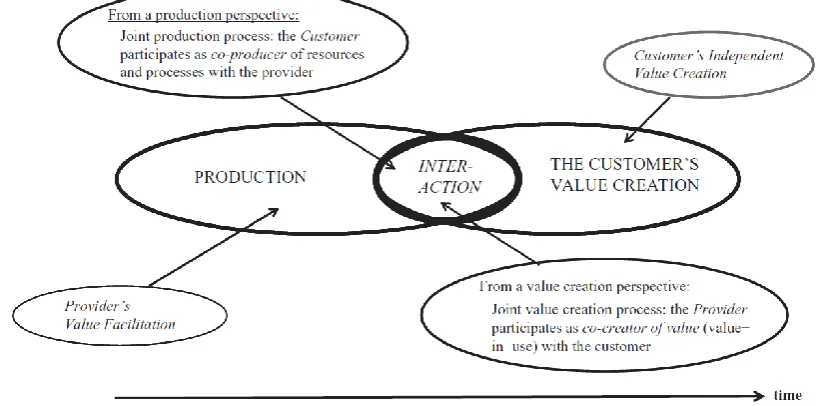
[image:9.595.90.501.313.516.2]As it might be already noticed, interactions are of main interest for as well as customer as for organizations to uncover value (and needs) for stakeholders of the interactions. The importance of interactions in value creation is acknowledged by Payne, Storbacka & Frow (2008) and Grönroos (2011) and is visualized by Grönroos (2011) in the following figure.
Figure 1 - A value-in-use creation mode – (Grönroos, 2011)
According to Ravald (2010) a major challenge for service providers lies in integrating their production process with the customers’ value creation process. A service can be co-created by giving the customer an active role in this integrating and optimizing process. In this view, the customer is alsoseen as provider, as he or she provides the firm with resources (e.g. information or tips) that is necessary to accomplish your offered service (Grönroos, 2011).
As the value from an offered service is determined by the customer, it is organizations’ task to participate in the customers’ process in order to adapt the organizational production process to become more valuable for the customer. Value for a customer will eventually result in satisfaction and therefore in the decision for an on-going relationship with the organization (Payne, Storbacka & Frow, 2008). In the following part, the term of value co-creation will be elaborated.
2.2 Definition of value co-creation
10 and after interactions with an organization. Customers integrate the offered resources from the organization and uses the resources’ value potential in such a way that they add to a customers’ well-being. Although the customer determines the value, space remains for the organization to participate in the customers’ value creating process. Customers can be influenced in their value creating process from organizational side by teaching customers how to use, maintain, repair or apply the offered resources to their needs, setting or behavior (Saarijärvi, Kannan, & Kuusela, 2013, p.8). Concludingly, an organization takes part as co-creator of value (Grönroos, 2011; Saarijärvi, Kannan & Kuusela, 2013). Saarijärvi, Kannan & Kuusela (2013) ascertain that a proper elaboration of the words value co-creation provide increased meaning for research data. Therefore Saarijärvi, Kannan & Kuusela (2013) direct researcher, organization or other reader to elaborate the meaning of the words value, co and creation when intended to apply value co-creation practices.
2.2.1 Value
Saarijärvi, Kannan & Kuusela (2013) mention that it is important to clarify for whom what value is co-created. By starting the analysis who wants what value, it is important to know how value can be defined and what determines the value of co-creation. According to Ravald (2010), value is closely related to people’s perception of goodness. In the marketing setting it means that a customer prefers good things over bad things and prefers engagement in relationships with an organization that offer good things over a relationship with an organization that offers bad things.
Ravald (2010) concludes that value can be defined as a positive emotional response to a resource, action or service. This corresponds with Grönroos (2011) defnition of value in that a customer values a service when they are or feel better off than before receiving the service (p. 282). Referring to the example in paragraph 2.1 (i.e. the ride in the Rolls Royce) the second person, who was going to the party, having not so much to do with Rolls Royce, would probably say about the ride: ‘I am driving the car’. In contrast, the first person would probably say about the ride: ‘I enjoy driving the car’. The difference between the two is the positiveemotional response to the service rendered from the car. It can be concluded that both persons can value the same car in a different way.
For a common conclusion it can be stated that in order to become valuable for a customer, one must be able to find out to what service aspects a customer shows a positive emotional response or to what a customer reacts negative. Additionally, the present consumption culture demands a more customized treatment (Etgar, 2008, p. 99). Therefore, responding to individual values by actively involving the customer in the organizational design-process seems not misplaces. However, to be able as an organization to deliver high quality, the customer must also be able to recognize the factors and goals valued by the organization. If the customer is not able to recognize value propositions of the organization (e.g. organizational expectations from the customer), the customer is also not able to adapt his or hers’ behavior that contributes to achieving these organizational value propositions. Both parties must know each others’ goals in order to exchange the requirements achieving those goals (Payne, Storbacka & Frow, 2008, p.90). Both parties should become transparent, explain and explicate each others’ value propositions and processess. That does not only result in more understanding of each others goals and activities, but also enables customers to see whether the organizations’ value propositions fits their own and will behave according to that (Payne, Storbacka & Frow, 2008, p. 88). Communicating about these value propositions is therefore considered as crucial.
2.2.2 Co
11 it is important that organizations identify the different encounters and the critical encounters (i.e. encounters adding to or detract from a positive value judgment). Payne, Storbacka & Frow (2008) describe three main types of interactions between organization and customer. These three are (1) direct communication, (2) actual usage of a product or service and (3) interactions with the customerservice that affect the customers’ value creating process (Payne, Storbacka, & Frow, 2008, p.90-91).
In addition to emphazising the importance of knowing who is included in what interaction in achieving positive results, Russo-Spena & Mele (2012) ascertain the importance of finding out what the preferred degree of collaboration is from customers and organization in the interaction to gain positive results. Russo-Spena & Mele (2012) describe five different graduations of involvement in collboration between the organization and the customers. One could work toward convergent co-creation design for an organization when it is known to which extent the customer whishes be included in the production process. With several case studies Russo-Spena & Mele (2012) identified the following five degrees:
(1)co-ideation (e.g. providing ideas about subjects), (2)co-evaluation (e.g. voting and commenting on ideas),
(3)co-design (both provider and customer play pivotal roles in designing), (4)co-test (e.g. pointing toward critical points as userfriendlyness) and
(5)co-launch (e.g. using customer-testers’ comments to invigorate the product or service) (Russo-Spena & Mele, 2012, p. 535).
Noticed is that the five types of co-creation from Russo-Spena & Mele (2012) is one out of two types of co-creation. Elg et al. (2012) and Witell et al. (2011) describe a difference in customers’ engagement in co-creation and distinguish therefore between customer engagement for ones
own benefit and/or for other’s benefit (i.e. future customers). As the five collaboration types of Russo-Spena & Mele (2012) are focussed toward innovations and future products and thus for others’ benefit, engaging in co-creation for ones own benefit is missing. Besides and perhaps prior to the five co-s of Russo-Spena & Mele (2012) another type of co can be identified: the co of the customers’ own treatment (i.e. customization). This form of cooperation shows many similarities with the third type of collaboration (i.e. co-design) of Russo-Spena & Mele (2012), as in both forms customer and organization learn from and teach each other and thereby influence each other’s’ value creating processes during the design of the service (p. 545). The main difference is that co-design is focused toward others’ benefits and customization toward one’s own benefit.
The (possible) degree of togetherness needs to be uncovered in each moment of encounter as well as the actors involved with the degree of co.
2.2.3 Creation
Saarijärvi, Kannan & Kuusela’s (2013) latter point of value co-creation refers to the actual establishment of collaborations contributing to actualizing value potentials (p. 11). The creation part concerns how and with what means the collaboration activities are enabled and executed. As already mentioned shortly in the previous section of co, there are three types of encounters between providers and customers. These are direct communication (i.e. bringing messages across about offerings, values or goals of both customer and organization), actual usage (i.e. utilizing the offered resources for a desired goal) and customer service (i.e. requesting and utilizing services from organizations). It may be that these encounters should be enabled with a variety of techniques or tools.
12 can reduce several costs (e.g. time and number of people involved in a case) by routinizing processess, technology can also be applied to utilize potential room for collaboration. However, it must be noticed that technological sources are not always appropriate for encountering. Elderly people, for example, representing a large group of people, often do not prefer or reject technology in communicating, using or interacting with customerservice. Therefore, elderly people risk being excluded for co-creation when co-creation practices would rely solely on technological sources (Karahasanović et al., 2009). This point of attention emphazises that, when one wants to apply co-creation, also non-technological tools should be included in the options for facilitating co-creation.
As Grönroos (2011) states that value is created during the interactions between organization and customer, proactively approaching your customer will increase the accurancy of their needs and requirements. Therefore, it is argued that the requirements for value co-creation should be captured during the actual service-experience. Russo-Spena & Mele (2012) provide in their research an overview of various tools for facilitating collaboration (see appendix II). Corresponding with, for example, co-design, tools for documentation, images and software are proposed to establish co-creation of value. Although the tools that are summarized in the overview correspond with a web-based research environment, it can be argued that the use of documents, for example, can also be executed in a non-technological setting. An example of this non-technological design is the use of a written diary (Elg et al., 2012). By using a diary Elg et al.
(2012) attempted to get involved in the customers’ experience of a service and obtain a better understanding of the customers’ value creating process (Van de Ven & Johnson, 2006). Customers were asked to keep a diary while they were receiving a service. Insights are gained for improving the service quality by collecting ideas and uncovering critial points in the service delivery. The participating organization in Elg et al. (2012)’s research was provided with narratives that visualised and cleared multiple problems to employees.
For both, technological as wel as non-technological tools for co-creation, it is crucial that no limitations are present in these tools when a customer wants to put efforts in the development of a service. That is, the customer should always be able to provide input, whether it is directly communicated (e.g. calling) or indirectly (e.g. diary) (Prahalad & Ramaswamy, 2004). As there are plenty of tools for communication, the art should be to find the tools providing most potential for usage on a large scale and also fit within the capabilties of the organization.
The diary method of Elg et al. (2012) falls under ethnograpical methods. Ethnography concerns describing and/or visualizing social events (Fetterman, 2010). In the diary method, pen and paper are used for describing the social event of the service experience. However, ethnography can also be done by using (1) digital voice recorders, (2) personal digital assistants (PDA) and smartphones, (3) laptops and computers and (4) cameras (Fetterman, 2010). Moreover, technological devices can be used to execute an interesting ongoing collaborative process. That is, technological tools that have access to the internet provide customers the opportunity to participate in online collaborative environment, such as Google Docs (Fetterman, 2010, p. 89). In Google Docs, a project-specific document is accessible 24/7 for all who are invited. Writing in the project-specific document can be done simultaneously with other participants. However, collaborating in an online document misses actual behavior and spoken or non-spoken expressions which do can be observed with camera. Every tool has got its advantages and disadvantages and dependent on the preferences of the organization and the customer these tools can be applied.
2.2.4 Conclusion
13 where organization and customer encounter. The existing critical encounters of direct communication, actual usage and customer service should be uncovered. However, also the not yet existing encounters should be mapped by uncovering expressed needs for encounters. Besides, it is important to find out which parties are involved in the encounters where value is (or is not) created and to what degree customer and organization want to co-create in order to arrive at an optimal result.
Thereby, the technological and/or non-technological means for establishing value co-creation practices should be chosen. It might be wise to give customers the option to choose between multiple tools, as the consumer culture encourages a more customized consumer treatment. However, required is that the chosen means should always be accessible for customers’ input toward the organization.
2.3 The advantages and challenges of value co-creation
In this paragraph it is attempted to understand what the possible advantages of co-creation are and so what the value of value co-creation could be for organization and customer. Additionally, in order to prevent unnecessary failures and gaps in co-creating, this paragraph will explore the challenges attached to co-creation.
2.3.1 Advantages of value co-creation
Co-creation is mentioned in the introduction as facilitator of treating customers as partners and meeting the needs of customers more accurate. Co-creation can be seen as a response to the present consumer culture that demands a more individualistic and customized approach. However, more effects can be found in literature. Prahalad & Ramaswamy (2004) elaborate on the aspect of the consumer culture. The accessibility of information, the provision of worldwide reviews, opportunities and products or services has strengthen the customers’ position toward organizations. Customers make decisions more deliberately as they have become more critical toward products and services. In order to make a deliberate decision, customers should be provided with enough information about products and services from organizational side. By providing the customer more information, the information asymmetry will be straightenned and customers will be more satisfied as they are enabled to make deliberate decisions. When co-creating with customers, information exchange will be increased and customers gain more direct control over their own product or service to be received (Prahalad & Ramaswamy, 2004). Increased information sharingy shared by organizations could result in satisfied customers, leading to a possitive judgement of the organization.
Furthermore, it is mentioned that ‘the co-creation experience becomes the very basic of value itself’ (Prahalad & Ramaswamy, 2004, p.5). That is, co-creation practices per se are positively contributing in the customers’ value creating process (Payne, Storbacka, Frow & Knox, 2009, p. 382). Co-creation practices are also valuable for the organization itself, as an organization cannot create anything of value for customers without the engagement of customers (Prahalad & Ramaswamy, 2004). Moreover, co-creation contributes possitively to organizational branding and performance as possitive results from collaborative practices makes customers active carriers of an organizations’ brand, spreading positive words (Payne, Storbacka, Frow & Knox, 2009, p. 384; Narver, Slater & MacLachlan, 2004, p. 338).
14 2011). Additionally, by meeting the preferences of customers, the customers’ satisfaction with the organization is likely to increase.
Furthermore, as co-creation requires transparancy by sharing information from customer as wel as organization about goals and values, customers gain more insights in the production processes in order to co-create. Therefore, employees become aware of the fact errors in the process become more visible for customers. As a result, co-creation could also enable control practices to the work of employees. As the asymmetry dissapears or blurs between organization and customer and the customers’ role becomes more that of a partner, opportunities for external control and feedback increases (Prahalad & Ramaswamy, 2004, p.9). In order to perform well, employees are incented to involve in the interactions and value creating process from the customer. This could lead to a deeper understanding of and emphatizing with the customer and increased service quality management. Moreover, by collecting customer information about a referred process, as Elg et al. (2012) did with their diary technique, stories could be narrated and shared by collegues which activates dialogue between employees and could provide additional improvements in the process. It is therefore argued that applying co-creation in the process could encourage peer-reviewing.
An organization can benefit from value co-creation practices in several ways. As the customers’ perception of a service is increasingly taken into account when designing or changing a service, services can be tuned and processes could potentially gain efficiency. Furthermore, customers are likely to be more satisfied with an organization as they are provided with more information and are treated as real partner, enabling the customer to provide input and make deliberate decisions. Additionally, as employees get more involved with the customers’ perception of the service and peer-reviewing by collegues and customers is encouraged, employees are stimulated to increase the service quality and would therefore make efforts to achieve a customers’ positive brand experience.
2.3.2 Challenges of value co-creation
Apart from the advantages of co-creation, challenges of value co-creation practices lie ahead when co-creation practices are not well-elaborated. A not well-elaborated value co-creation concept could result in non-engagement of customers or employees, even in a downsize of employees’ motivation and lack of trust in the organization (Reichers, Wanous & Austin, 1997).
Drummond, Ensor, Laing & Richardson (2000) mention for example the increased importance of shifting an organizations’ service orientation from inside-out toward a more outside-in orientation in designing the work. That is, shifting service designing in accordance with organizations’ ideas and beliefs toward service designing in accordance with customers’ ideas and belieds. Thereby establishing a good and trustful relationship between customer and organization is desirable as the customers’ input is needed for designing and delivering good products (Drummond et al., 2000, p. 573). However, a pure outide-in focus in designing the organizational processess is just as undesirable as a pure inside-out focus. That is, both orientation and customer offer valuable input for designing a service. The organization should therefore be able to balance between the outside-in and inside-out in the interactions. That is, take value for customers as a starting point, but do not forget the organizational values in designing a service.
15 Furthermore, in order to arive at a well-elaborated value co-creation concept contributing to service development, one must be able to motivate the stakeholders to provide efforts in practicing value co-creation. From a customer percpective to engaging in co-creation, Etgar (2008) describes five different stages or prerequisities for engaging customers in co-creating with an organization.
The first stage describes the conditional factors influencing the possibilities for co-creation. As mentioned previously and corresponding with Etgar (2008), the growing number of technological sources provide a maturating environment for co-creation (p. 100). However, as mentioned by Karahasanović et al. (2009) this brings along the risk of excluding elderly people when relying solely on technical sources. Besides, lacking technical skills and devices threaten appropriate use of these means for co-creation. Also psychological skills (e.g. knowing how to discuss or motivate one another) are required (Etgar, 2008). It is stated that these skills are evolvable from organizational side and that lacking these skills could be overcome by learning and training (Etgar, 2008, p. 100). Concludingly, it is described in the first stage that the presence of management s’ belief in co-creational efforts is crucial. When customers do not have the feeling that their co-creating efforts are taken serious (e.g by not acting upon their efforts), the willingness to co-create will soon be lost (Etgar, 2008, p.101). That is, the show of empathy toward the customer and their efforts is one of the major prerequisties.
The second stage describes the motivational drives for customers to engage in the co-creation process with the organization. Customers engage in the co-creation process when preset goals, which reflect diverse customer values, could be achieved with co-creation practices (Etgar, 2008, p. 101). Etgar (2008) mentions several common customer motivation drives: (1) eventual cost reduction of receving a service (e.g. resources as time or economical costs), (2) reducing risks in receiving inappropriate products or services, (3) the degree to which their product or service is customized to their wishes, (4) meeting intrinsic values (e.g. in accordance with a customers’ ethics), (5) extrinsic values (e.g. in order to gain psychological remuneration) and (6) possible status and social esteem (p. 101-103).
In the third stage customers evaluate the costs and benefits and decide to what extent the customer wants to participate in co-creation practices. It can be argued that the eventual decision to engage in co-creation with the organization and to which degree corresponds with a positive value perception of co-creation itself (Prahalad & Ramaswamy, 2004).
The fourth stage describes the activation of co-creation. Here, the actual participation and production of a service takes place. The activation follows the line of (1) initiating the degree of involvement and goals to be achieved, (2) designing the process, (3) constructing and assembling the service, (4) distributing or implementing the designed process and eventually (5) consuming the service and experiencing the potential benefits of co-creation.
In the fifth stage, after consuming the organizations’ product or service which is co-created, the experience is evaluated and the customer determines whether his or her effort was worthwhile (Etgar, 2008). Concluding, it can be stated that the customer needs to recognize value for him or herself in order to engage in co-creation (Etgar, 2008; Saarijärvi, Kannan & Kuusela, 2013).
16 and loyalty (Ahmed & Rafiq, 2003, p. 1177-1178). To create internal support for projects, the inclusion of key persons or ambassadors determines success or failure of the internalization of the project. To bring a project to success, employees’ reciprocal trust, commitment and understanding and intimacy are required (Ahmed & Rafiq, 2003, p. 1181).
2.3.3 Conclusion
Although it is argued that co-creation between a firm and its customers can improve service quality, increase customer satisfaction and add positively to customers’ brand perception, a firm should consider the following points when applying value co-creation practices.
When a firm intends to apply value co-creation practices, attention should be given to:
- The customers’ engagement process in value co-creating practices. The decision to engage in value co-creation practices depends on the customers’ assessment of potential costs and benefits. An organization could increase the chance of customer engagement by providing proper resources, information and facilities for value co-creating practices and convey trust from management to the customer.
- Internal marketing of value co-creation. To prevent misperformance in exercising value co-creating practices, the organizational task is to motivate employees and engage the employees in the set-up of a project concerning co-creational practices. By creating employee ambassadors for co-creation practices it is attempted to build organizational support for these practices. However, technological and psychological skills and devices are required from organizational side for appropriate engagement in co-creation practices. Employees should be capable and enabled to exercise value co-creation practices.
- Information transparency between parties included in value co-creation. Without transparency and communication between parties involved in value co-creation, it is difficult to discover and meet value for both parties, as goals and values are unknown. - The value adding potential that a value co-creation practice can bring forward in itself.
17
3
Research strategy:
Model for designing a value co-creation practice
In the introduction it was stated that in order to investigate whether a change or innovative conception fits the organization and corresponds with police craftsmanship and handling, the research should be set up and carried out proactively. That is, the research should actively involve in police handling. By actively involving in police handling it is attempted to ensure actual responses instead of spoken expected responses upon value co-creation.
In order to answer the main question and find potential for implementing value co-creation within a practice-oriented organization, it can be argued that the qualitative action research
approach will fit in this research.
By applying an action research strategy, answer is given to the sub-questions of:
- In what way can the investigation of the applicability of value co-creation be initiated in police context aimed at improving a police service?
- How can value co-creation be applied for improving the process of filing a police report at domestic burglary?
- What improvements can be made in the process of filing a police report at domestic burglary, based on applying a designed value co-creation practice?
- What are do’s and don’ts in testing and applying value co-creation practice for improving police services on an action research basis?
3.1 Research approach:
Action research
Action research is a complex research process and hard-definable in one sentence. Action research is largely characterized by the cyclical processes of collaboratively planning, acting and evaluating actions toward change boosted by theoretical models for improvement (Waterman et al., 2001, p. 12; McNiff, 2013). Action research is characterized by its iterative character of establishing change by involving and letting stakeholders participate in that change (Waterman
et al., 2001). Action research includes, in contrast to traditional research, those being studied (e.g. stakeholders of a process) always as co-researchers in the actions toward change. By conducting action research, chances to successfully implement theoretical models are likely to increase, as executed actions based upon theoretical models are actively interpreted by organizations’ employees and applied only when a model fits their own situation (Van de Ven & Johnson, 2006, p. 807). Gaps between theory and practice are likely to be bridged. As action research is regarded an iterative process of acting and reflecting upon theory by the provision of participants’ feedback, it is difficult to determine and describe in advance how a research process will unfold. Therefore, one can only take into account important requirements while executing action research.
The key components for executing action research successfully concern (1) participation of stakeholders, (2) inclusion of key persons, (3) awareness of the researcher–participant relationship, (4) having a real-world focus, (5) availability of resources, (6) proper research methods, (7) monitoring the project process and management and (8) generating knowledge (Waterman et al., 2001; Middel et al., 2008). Waterman et al. (2001) provide an overview of these important aspects and requirements for planning, acting and evaluating a change and theoretical models (appendix I).
Participation of stakeholders
18 30). On employees’ side, by letting employees participate in the project, the feeling is generated by employees as if they are all owners of the project. Additionally, employees will feel allowed to provide inputs in the project; they get empowered. Besides the positive effects of participation, the major issue to overcome is the participants’ time. Particpants need to be willing and able to spend time for the project. It is therefore important to use the available time in an effective way (Waterman et al., 2001).
Inclusion of key persons
The second important factor for executing action research concerns the inclusion of key persons in the process. Waterman et al. (2001) view key persons as the employees having formal positions with the power to infuence others, processes and decisions within organizations. These managers or chiefs are often considered as the ones providing positive influence on the execution of a project as they have the ability to provide resources, access, knowledge and networks. However, it must be governed that the influence of the higher ranked persons should not dominate the collaborative process as this could demotivate others to provide efforts.
Relationship between researcher and participants
The third factor is the relationship between researcher and participants. There are two types of relationships. One type considers the action researcher as an insider and the other as an outsider of the organization. Both types provide pro’s and con’s for the establishment of changes. For example, an outsider researcher often provides fresh ideas in an organization, whereas an insider researcher often contributes to sustained change (Waterman et al., 2001, p. 33). As several stakeholders are included in the actions, roles and duties in the research project should be clearly outlined. The division of roles and duties are often outined in the early phase of planning the action. In action research the researcher is often the provider of theoretical and methodological insights, initiator of meetings and actions and collector and processor of data. By discussing the collected data with the co-researchers and stakeholders of the research project, data is collaboratively interpreted and given meaning to in the organizational context (Watters, Comeau & Restall, 2010).
Real world focus
Fourth is the urge to have a real-world focus of the context in which the organization is situated. The real-world focus is often created for the researcher in the initial phases of action research. During discussions, the researcher will find out which theory, change or application is suitable and feasible for an organization.
Availability of resources
Additionally, the fifth factor, resources, concerns the resource requirement of mostly time. Besides time, other resources (e.g. money, staff) can be crucial for executing a project. However, which resources are required for a project is dependent on the setting in which the project is situated.
Proper research method
The sixth factor concerns the right decision for data collection methods during the act phase of action research. Waterman et al. (2001) mentioned that qualitative methods are used most by researchers in doing action research, as it provides data and facilitates participation.
Monitoring
19 Furthermore, as action research is characterized by responsiveness, direct feedback should contribute to the guidance en execution of the subsequent steps in a project.
Knowledge
The eight factor of knowledge is an overall characteristic in the process of action research, as knowledge is created continuously. Knowlegde is generated through action learning. Individuals or groups learn when for example gaps, failures and/or successes pop up during the actions. Additionally, knowledge about theoretical models is generated when aspects theoretical models which seem difficult to apply in a certain context (Waterman et al., 2001, p. 12). It is therefore important to constantly reflect on actions by asking questions in order to collect data, learn and reflect, uncover and and challenge assumptions, clarify and confirm listening, solve problems and make decisions, build relationships and think critically and creative (Adams, 2009)
As action research is often carried out to establish change and create knowledge (Waterman et al., 2001) one should be able to assess the effectiveness of the conducted action research. The effectiveness of a conducted action research can be assessed by the degree of organizational improvement and collaboration or the degree to which an organization is able to learn about themselves and act on the learning and generated knowledge (Middel et al., 2008, p. 100).
3.2 Research model
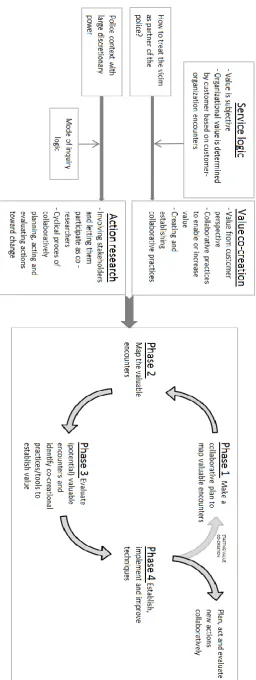
In order to discover opportunities for value co-creation between organization and customer, theoretical aspects from value co-creation are gauged in the organization on an action research basis.
As the customers’ value determination of an organization is largely dependent on the encounters between organization and customer during a specific service process, these encounters should be mapped (Grönroos, 2007; Prahalad & Ramaswamy, 2004; Payne, Storbacka & Frow, 2008). The encounters between organization and customer concern communication, usage and service encounters (Payne, Storbacka & Frow, 2008).
Besides mapping the existing encounters in the service process, also not yet existing encounters between organization and customer should be uncovered (e.g. by capturing expressed needs and preferences). Thereby, as the customer determines organizational value, opportunities in encounters for value co-creation should be captured from the customers’ point of view. With respect to the cycles of action research (i.e. planning, acting and evaluating actions) and the iterative character of action research, the method by which these encounters should be designed collaboratively with stakeholders of the specific service process. A plan for action should be designed in the first stage (phase 1).
After designing the data collection method, the encounter data is collected in the second acting
phase (phase 2). Here, data concerning communication, usage and service encounters between organization and customer during the service process is gathered (Payne, Storbacka & Frow, 2008). From the data it should come clear whether there are potential encounters where value could be co-created. For example, it could be that customers express the need for an additional phone call during the service process or it could be that a large part of the customers is unsatisfied about one specific encounter.
20 should therefore be evaluated on its effectiveness to provide valuable improvements (Payne, Storbacka & Frow, 2008, p. 89).
After the actual data collection phase, the data about the encounters and the used value co-creation method should be evaluated in the third phase (phase 3). In order to evaluate the data, a discussion meeting and additional conversations with stakeholders of the service process should be organized. Beforehand, the encounter data should be mapped and salient features about the encounters should be clear as these features provide input for evaluating conversations. The goal of the evaluating conversations is to interpret and translate the data into meaningful messages for the organization which could encourage the organization to take further actions based upon those messages. It should (1) become clear whether there are organization-customer encounters which give rise to improve the process of filing a police report of domestic burglary and (2) how the applied value co-creation method is perceived and whether and how the method is applicable for future value co-creation (phase 4).
22
3.3 Case study design
This paragraph answers the following sub-question:
In what way can the investigation of the applicability of value co-creation be initiated in police context aimed at improving a police service?
The research model will be applied and executed in a case study. By conducting a case study, the focus is on a single instance of a social phenomenon, such as a culture, group or action (Babbie, 2010, p. 309). In this research, the case selected is the process of filing a police report for domestic burglary at IJsselland police. The case study is set up and executed in accordance with characteristics of action research. Although action research is a proactive way of doing and designing a research where progress and (re-)actions are based on emerging situations, starting the research without any focus and plans is undesirable. Therefore, the case study is initiated according to the following plan.
In order to collect data about victims’ experiences with the domestic burglary crime and corresponding police handling, a meeting is set up (phase 1 – figure 3). The goal of the meeting is to design, with police-employees and the researcher a method by which victim data can be mapped which can reveal possibilities for improvement. The design meeting is boosted with managerial theories about value co-creation in order to arrive at a design. The attendees are (1) a team leader and deputy director of emergency & intake, (2) a second team leader, (3) a police reporting officer, (4) an employee of Zwolle domestic burglary team (WIT-team), (5) an employee of corps support and (6) the researcher. During the meeting different theoretical perspectives about value creation are inserted to provide guidance in designing a value co-creating practice. For example, the service logic is introduced, just as ethnographic methods for mapping victims’ experiences (Fetterman, 2010). Ethnographic methods can be used to display how a service is executed and experienced ‘in situ’. In order to display a service in situ, one can either film, record audio or write on paper or online about the service experience. Besides that ethnographies gain insights in experiences in situ, ethnographies in forms of writing can also contribute to processing impact of a traumatic incident (Pizarro, 2004).
When decided which practice will be used to uncover and eventually co-create value for victims, the practice is tested in the process of filing a police report (phase 2 – figure 3). Based upon test results (e.g. number of participants, written, verbal and nonverbal reactions and ideas), evaluating practices are held with victims and police employees (phase 3 – figure 3). From evaluating conversations with victims, an evaluating meeting with victims and police and evaluating conversations with police employees conclusions are drawn upon the applicability of the tested practice and results are shown regarding potential improvements in the filing process (phase 4 – figure 3).
23
4
Results:
Implementing the designed value co-creation practice
In this chapter the actions and reactions are described coming from the tested value co-creation practice and content derived thereof. The designed and tested practice concerns a diary which domestic burglary victims keep during a period of 14 days after a domestic burglary incident occurred. The chapter starts with describing the process of how the value co-creation practice was designed, how the practice was tested and received by the stakeholders of the process of filing a domestic burglary police report. Hereafter, evaluating results are shown upon the tested value co-creation practice.
Further, the chapter describes what improvements can be made in the process of filing a police report of domestic burglary, based upon content results from the tested value co-creation method. This is done by first describing what the filing process looks like. Then, critical encounters in the filing process are identified based upon what is valued or missed by victims of domestic burglary. These values or missing values are the input for potential improvements to be made. Also described is how police could profit from improving the filing process.
4.1 Designing and applying a value co-creation practice
In this paragraph the process regarding designing, testing and evaluating the value co-creation practice is described. This paragraph and its sub-paragraphs deepen the actions and reactions to the designed diary practice. The process of designing, testing and evaluating the practice answers the question:
How can value co-creation be applied for improving the process of filing a police report at domestic burglary?
4.1.1 Making the design: a diary practice
Phase 1 of the research concerned the design of the value co-creation practice. In order to design the practice, a meeting was set up with police employees. As it was stated that the customer eventually judges an organization on its value, it was decided in the meeting that in this case it should be the victim being able to make ethnography about the service experience. By letting victims create their own ethnography, victims were enabled to provide data in their own time. When doing so, victims are able to provide insights from their own viewpoint. It was attempted to gain insights in what victims expect from the police to do by asking victims to display their experience themselves. The following characterizes the need from police side to co-create with victims and to see what victims appreciate or miss in police service:
‘We need feedback from citizens concerning police handling. How can we make a feedback loop? In this case, concerning domestic burglary, we especially need the feedback to the I281 rule of providing feedback within 14 days.’ (deputy director of emergency & intake)
(…) ‘Exactly! It seems that we are more and more concerned with filling the police computer systems witch checkmarks and less concerned with the police profession and victims.’ (team leader)