warwick.ac.uk/lib-publications
A Thesis Submitted for the Degree of PhD at the University of Warwick
Permanent WRAP URL:
http://wrap.warwick.ac.uk/108029
Copyright and reuse:
This thesis is made available online and is protected by original copyright.
Please scroll down to view the document itself.
Please refer to the repository record for this item for information to help you to cite it.
Our policy information is available from the repository home page.
COORDINATION STUDIES OF THE HALIDES OF GROUPS (IV), (V) AND (VI)
By
STEVEN RONALD WADE B.Sc
Submitted to the U niversity of Warwick in p a rtia l fu lfilm en t of the
degree of Doctor of Philosophy.
Parts of the work contained in t h is th e sis have been published
in the s c ie n t if ic lit e ra t u r e with the following references
S. R.
S. R.
S. R.
S. R.
S. R.
S. R.
Wade and G. R. W ille y ,
Wade and G. R. W ille y ,
Wade and G. R. W ille y ,
Wade and G. R. W ille y ,
Wade and G. R. W ille y ,
Wade and G. R. W ille y ,
Inorg. Nucl. Chem. L e t t ., 1978, 1£, 363.
Inorg. Chim. Acta, 1979, 35, 61.
J . Less-Common. M et., 1979, 68, 105.
J . Inorg. Nucl. Chem., 1980, 42, 113.
Inorg. Chim. Acta, 1980, in press.
J . Inorg. Nucl. Chem, 1980, in p ress.
The donor-acceptor chemistry of some Groups ( IV ) , (V) and (V I) halides was investigated with a number of lig ands.
Trimethylamine provided donor complexes with Hf (IV ), Mo (V ), Mo ( I I ) , As (TIT) and Sb (TIT) h alid es. With Cp2T iC l2, M0OCI4 and AuCli trim eth yl- amine was found to a c t as a reducing agent. The use o f MCl4.2NMe7
CM = Z r, Hf) adducts as intermediates in complex synthesis was b r ie f ly studied, and the Megtren adducts (MCl2Megtren)z+2Cl~ (M = T i , Z r, Hf) iso la te d .
Hexamethylphosphoramide (HMPA) gave adducts with both M (IV) (M = T i , Z r, Hf, Sn) and M C H I) (M = T i , V, Cr) ch lo rides. From the TiCVHMPA system, adducts of 2:1, 1 : 1 and 1 ; 2 stoichiom etries were iso late d .
O C I3.3HMPA was iso la te d as both fac and mer isomers. The (Me2N)xC l3_xPS Cx = 1 ,2 ,3 ) se rie s are much weaker donors than HMPA* although they
provided a number of adducts with hard Lewis acid s. Changes in the e le ctro n ic structure of the phosphoryl and thiophosphoryl ligands that occur on complexation were examined by *H, 13c, 31p an(j i r spectroscopy.
(Me2N)2CH2 and bis(dipheny1phosphino)methane gave 1 : 1 adducts with MCIV) h a lid e s. The dominant reaction in the CpTi(NMe2)3 and Cp2Zr(NMe?)o/ MX4 systems, however, was group exchange to give the respective CpM halides. Me2Si(NMe2)2 gave both 1:1 adducts (M (IV) = T i , Z r, Hf, Sn) and group exchange (M = S t , Ge, T i j . The donor-acceptor chemistry of Me2SiCl(NMe2) and C l3Tt(NMe2) was B r ie f ly studied, and was found to be dominated by disproportionation.
(CH20)3 and CCHoS)3 act as weak monodentate donors towards hard M (IV) a c id s. Dynamic behaviour in the SnCl4.2(CH2S ) i system was investigated by 'H NMR and interpreted in terms of both ring inversion and donor-site interchange. (MeBNMe)3 was found to a ct as a bridging bidentate o-donor in (MeBNMe)3.2T iC l4.
C O N T E N T S
Page
ABSTRACT
CHAPTER 1 - INTRODUCTION
1.1 The Early Tr r s it io n Metals 1
1.2 Structure and R e a ctiv ity of the Early t-M etals 4
1.3 Coordination Chemistry of the E a rly t-Metals 20
1.4 Halides and Complexes of Group IVB and Group VB 28
CHAPTER 2 - COMPLEXES AND REACTIONS OF TRIMETHYLAMINE
2.1 Introduction 31
2.2 Reactions of HfX^ (X = B r, I ) and ZrCl4 with NMe3 34
2.3 Reactions of NMe3 with CpgMClg (M = T i, Z r, Hf) 36
2.4 Reactions of NMe3 with some Group VB Halides 37
2.5 NMe3 Complexes of some Halides and Oxyhalides of Mo 40
2.5.1 Reactions of NMe3 with MoC13 and MoCl^ 40
2 .5 .2 Reactions of MoOC13 , MoOC14 and NMe3 42
2.6 Reactions of NMe3 with Zirconium Trih alid e s 45
2.7 Reaction of NMe3 with AuC13 46
2.8 Ligand Exchange Reactions of NMe^ Complexes 47
2.8.1 Substitution reactions of MC1^.2NMe3 (M = Z r, Hf) 47
2 .8 .2 Complexes of MC14 (M - T i , Z r , Hf) with tren and Megtren 48
2.9 Experimental 51
CHAPTER 3 - COMPLEX CHEMISTRY OF DIMETHYLAMINO SUBSTITUTED PHOSPHINE CHALCONIDES
3.1 Introduction 62
3.2.1 Adducts o f (NMe2)3P0 with MC14 (M = T1, Sn, Zr and Hf)
and Snl4 68
3 .2 .2 MC13.3HMPA complexes (M = T i , V, Cr) 76
3.3.1 Complexes and reactions of (NMe2)xC1 3-xPS ( x = 1»2»3 )
with metal chlorides 80
3 .3 .2 Complexes with SnCl4 , Z rC l4 , HfCl4 and SbClg 81
3 .3 .3 Reaction of (NMe2)2ClPS with BC13 93
3.4 Experimental 95
CHAPTER 4 - C0MPLEXATI0N AND EXCHANGE REACTIONS OF SOME DIMETHYLAMINO SUBSTITUTED GROUP (IV ) COMPOUNDS
4.1 Introduction 102
4.2 Complexes o f (Me2N)2CH2 with MC14 (M = T i , Sn), VCI3 and
C rC l3.2NMe3 110
4.3 Reaction o f bis(diphenylphosphino)methane (dpm) with T i C l4 112
4.4.1 Exchange reactions between Me2Si(NMe2)2 and MC14 (M = S i , Ge) 115
4 .4 .2 Exchange reaction between Me2Si(NMe2 )2 and T iC l4 118
4 .4 .3 Mechanism of Si-N bond cleavage 119
4 .5 Complexes o f Me2Si(NMe2 ) 2 with MX4 (M = T i , Zr, Hf, X = C l,
M = Sn, X = C l, Br) 121
4 .6 Reactions o f Me2SiCl(NMe2 ) with MC14 (M = Sn, T i) 125
4.7 Reaction of C l3TiNMe2 with MC14 (M * S i , Ge, Sn, T i) and
Donor Solvents 127
4 .8 Exchange Reactions between CpTi(NMe2 )3 and Cp2Zr(NMe2 )2 with some
Covalent Metal Tetrahalides 128
4.8.1 Reaction o f Cp2T iC l2 with Me2NLi 128
4 .8 .2 Reaction of CpTi(NMe2 )3 and Cp2Zr(NMe2) 2 with MC14 (M = S i , Ge,
Sn, T i , Z r , Hf) 129
Page
CHAPTER 5 - SOME COMPLEX CHEMISTRY OF INORGANIC HETEROCYCLES
5.1 Introduction 146
5.1.1 Bonding In inorganic heterocycles 146
5.1 .2 Donor chemistry of alternation heterocycles 150
5.2.1 Reactions of (CH20)3 with MC14 (M = T1, Sn) and ZrCl4.2NMe3 153
5.2 .2 Reaction of (CH20)3 with MCl3.2NMe3 (M = V, Cr) 154
5.3 Complexes of (CH2S) 3 with Covalent Metal Chlorides 155
5.4 Reactions of (Me2S10)3 4 with some Covalent Metal Halides 163
5.5 Complexes of Hexamethylborazine w ith Covalent Metal Halides 164
5.6 Comments on the Synthesis of (RgTiPR )x 167
5.7 Experimental 170
CHAPTER 6 - COMPLEXES OF SUBSTITUTED OXAMIDES, THIOOXAMIDES AND MALONAMIDES WITH METAL TETRAHALIDES
6.1 Introduction 176
6.2 Complexes of Substituted Oxamides, Thiooxamides and Malonamides
with MC14 (M = T t , Sn) 179
6.3 Experimental 186
APPENDIX A 189
APPENDIX B 197
I would l ik e to express my thanks to Dr G* R. W illey fo r his
continued help and encouragement in the three years 0976-1979)
during which the work described in t h is th esis was undertaken.
t would l i k e to thank the techn ical s t a f f of the U n iv ersity of
Warwick for t h e ir a ssista n ce , in p a rtic u la r the glass-blowing
department under the directio n of Mr E. Burgess fo r an inexhaustible
supply of * p ig s‘ . The contributions o f Mr D. Rylance and
M ile. C. M abillard who a ssisted in the work described in Chapter 6 as
part of a t h ird year p ro ject, are acknowledged.
A very sp e cia l thankyou goes to Ms. Vicki Narbett fo r the typing
of th is manuscript.
A postgraduate award from the Science Research Council i s also
T A B L E S
<T* *,v
CHAPTER 1
Table 1.3.1 P-21
Table 1 .3 .2 P - 21
Table 1 .3 .3 p.22
Table 1.4.1 p.29
CHAPTER 2
Table 2.4.1 p. 38
CHAPTER 3
Table 3.1.1 p.64
Table 3 .1 .2 p.65
Table 3 .1 .3 p.66
Table 3 .1 .4 p.66
Table 3.2.1 p.70
Table 3 .2 .2 p.73
Table 3 .2 .3 p.74
Table 3 .2 .4 p.78
Table 3.3.1 p.83/4
Table 3 .3 .2 p.86/7
Table 3 .3 .3 p.89
CHAPTER 4
Table 4.1.1 p.104
C la s s if ic a t io n of Bases
C la s s if ic a t io n of Lewis Acids
Heats of Formation of MX^ + 2L -*■ MX^.2L in
Standard S tates
Donor Numbers of some Selected Ligands
p .38 NMR Data fo r MX3.M!1e3 and MX3.2NMe3
V e rtic a l Io n isatio n Energies fo r (NMe2) xC l3_xP0(S)
Thermodynamic Data fo r (Me2N)3PY + I2
Selected o-Phosphoryl Substituent Constants
Thermodynamic Data fo r the Reaction
(NMe2)xCl 3-xP0(S) + l 2 = ( NMe2) xC l3. xP 0 ( S ) .I2
IR Spectra o f M(IV) HMPA Adducts
Low IR Spectra of some Sn (IV ) Species
NMR Data fo r M (IV) HMPA Complexes
IR Spectra o f M (III).HMPA Adducts
IR Spectral Data of (NMe2)3PS Complexes
IR Spectral Data of (NMe2) 2ClPS Complexes
^H and 31P Spectra of the (NMe2 ) 3PS and (NMe2) 2ClPS
Complexes. (MeN02 s o ln ., T = 298 K)
Table 4 .1 .2 p. 104
Table 4 .1 .3 p.105
Table 4.4.1 p.116
Table 4.5 .1 p.124
CHAPTER 5
Table 5.8.1 p.157
CHAPTER 6
Table 6.2.1 p.181
Table 6 .2 .2 p.184
Table 6 .2 .3 p.185
Table 6.3.1 p.188 13
C-H Coupling Constants fo r Selected Amines
220 MHz NMR Chemical S h if t Data fo r Various
S ila n e s, Aminosilanes and Aminogermanes (2%, CgDg)
NMR Spectra of MX4 .L (220 MHz in CgDg) (R elative
In te n s itie s given in brackets)
p.157 IR Spectra of (CHgS^ Adducts
P rin cip le IR Bands of MCl^.B Complexes
] H NMR Spectra of MC14.B, C0^02/TMS 90 MHz)
13C NMR S h ift Data of the Ligands (a) CD^OD and
(b) CDCI3
'A nalytical Data of MC14 .B Complexes
[image:11.637.18.613.28.715.2]F I G U R E S
I
r
CHAPTER 1
F ig . 1.2.1 p.7 MgXg(a) and MgX1 2(b) Metal C lu s te r Centres
F ig . 1 .2 .2 P-9 C ry sta l Structure of NbClg
F ig . 1 .2 .3 p. 10 C ry sta l Structure of ZrC^
F ig . 1 .2 .4 p . l l S tru ctu re of NbCl^ (39)
Fig . 1 .2 .5 P-12 S tru c tu ra l Units of (a) s-TiC l^ and (b) a , y and
« T i C l3
F ig . 1 .2 .6 p.14 C ry sta l Structure of Nb-jClg
F ig . 1 .2 .7 p . 15 Schematic Representation of a Sheet of (MoCl2)C lg^2
Octahedra Showing Short (— ) and long (---- ) Mo-Mo
Bonds
Fig . 1 .2 .8 p . 15 C ry sta l Structure of MoBr3
F ig . 1 .2 .9 p.16 S tru ctu re of WCI3 (50)
F ig . 1.2.10 P-17 The Cadmium Diiodide Structure
F ig . 1.2.11 p.18 Unit C e ll of C rC l2 Showing Short (2.39 8) and Long
(2.93
X)
Cr-Cl Bonds (53) F ig . 1.2.12 p.19 C ry sta l Structure of ZrClF ig . 1.3.1 p.25 C ry sta l Structures of TiCl^.ZPOCl^ (83) and (TiCl^ .
P0C13 ) 2 (87)
F ig . 1 .3 .2 p.27 Schematic Structure of T lC l^ .Z d ia rs
F ig . 1.4 p.30 Usual Geometries of Group VB H alide Adducts
CHAPTER 2
F ig . 2.1.1 p.32 X-ray Structu re of C rC l3.2NMe3 (69, 78)
F ig . 2.4.1 p.39 Proposed Geometries of AsBr3.NMe3 and SbX3.2NMe
(X * C l , Br)
F ig . 2 .4 .2 p.40 Proposed Structure of SbX3«NMe3 (X « C l, Br)
F ig . 2.7.1 p.47
F ig . 2.8.1 p.50
CHAPTER 3
F ig . 3.1.1 p.63
F ig . 3.2.1 p.72
F ig . 3 .2 .2 p.73
F ig . 3 .2 .3 P - 7 9
F ig . 3.3.1 p.91
F ig . 3 .3 .2 p.92
F ig . 3 .3 .3 p.93
CHAPTER 4
F ig . 4.1.1 p.103
F ig . 4 .1 .2 p.106
F ig . 4.2 .1 p. 1 1 2
F ig . 4.3.1 p.113
F ig . 4 .3 .2 p.114
F1g. 4.4 .1a p.119
F ig . 4.4.1b p.119
F ig . 4 .4 .2 p.119
F ig . 4 .4 .3 p.119
F ig . 4.5.1 p.122
F1g. 4 .5 .2 p.124
CHAPTER 5
F ig . 5.1.1 p.147
Reaction Scheme for AuC13 + NMe3 Au
Proposed Structure of MCl4.Megtren
X-ray Crystal Structures of ^NJ-jPO and (Me2N)3PSe
Proposed Structures of T iC l4.2HMPA, TiCl^.HMPA and
2TiCl4 .HMPA
Possible Structures fo r SnCl^.HMPA
Proposed Structures of MC133HMPA
] H NMR Spectra (.220 MHz, CD3N02 s o in ., r e l . TMS)
for SbCl5.(NMe2)3PS + (NMe2)3PS 1:1
NMR Spectra (220 MHz of SbCl5.(NMe2)3PS,
CD3N02 soin.
^H NMR Spectrum of (BClgNMeg^. (CDC13, 220 MHz)
Bonding Schemes for M-NR3 Species
Crystal Structure of T iC l3(NEt2) (268)
Proposed Structure of MCl4.(Me2N)2CH2 (M = T i , Sn)
Proposed Structure of TiCl^.dpm
*H NMR Spectra (220 MHz, CD3N02) o f dpm and T iC l4 .d
^4-Centre* Mechanism
'Sommer-Type Mechanism*
6 Coordinate Intermediate
5 Coordinate Intermediate
Proposed Structure of MX4.Me2Si(NMe2 )2
Possible Structures for MX4.Me2Si(NMe3 )2
Schematic Diagram of Borazine Showing B -*• N
o-Donat1on, N + B ir-Donatlon and Overall Charges on
F ig . 5.1 .2 p.148 Formation of Skeletal dir-pw Bonds
F ig . 5.1.3 p.149 "Island" Model fo r Cyclophosphazines (R2PN) 3
F ig . 5.1.4 p.151 Crystal Structure of Cr(CO)3.(EtN BEt)3
F ig . 5.1 .5 p.152 Proposed Structure of (Me2SiNH)3MCl3 , (M = T i , V)
F ig . 5.3.1 p.156 C rystal Structure of (CH2S)3
F ig . 5.3.1 p.158 C rystal Structure of SbCl3.(CH2S) 3 (projection on
xy plane)
F ig . 5.3.3 p.159 Proposed Structures of MC14.2L (M = Sn, T i ) ,
AuCl3 .L and SbClg.L
F ig . 5.3.4 p.160 s-T rith ia n e Showing Axial and E q u ito ria l Protons
F ig . 5.3 .5 p.160 V ariable Temperature NMR Spectra of (CH2S)3
(.400 MHz, CDC13)
F ig . 5.3.6 p.160 V ariable Temperature ^H NMR Spectra of SnCl4.3(CH,
(220 MHz, CDC13)
Fig . 5.3.7 p.161 SnC1^.2(CH2S)3 Showing Magnetically Inequivalent
.Protons
Fig . 5.4.1 p.166 Proposed Structure of 2TiCl4 .HMB
CHAPTER 6
F ig . 6.1.1 p.176 X-ray Crystal Structures of (C0NH2 )2 and (CSNH2 )2
Fig . 6.1.2 p.177 C rystal Structure o f N,N-dimethyldithiooxamide
F ig . 6.2.1 p.182 Proposed Structures of MCl^.B
F ig . 6.2 .2 p. 183 P ossible Isomers o f MC14 (Y2C2N2(NR)2)
APPENDIX A
Fig . A1 p.192 Apparatus fo r the Preparation of MX4 (M ■ H f,
X = C l , B r, M - Z r, X = Cl)
Fig . A2 p.192 Furnace Tube
APPENDIX B
Fig . B1 p.197 Vacuum Line
Fig. B4 p.198
Fig. B5a p.198
Fig. B5b p.198
Fig. B6 p.201
Fig . B7 p. 201
Single (a) and Double (b) Bomb Glass Reaction V e sse ls
Loading on the Vacuum Line
Extraction on the Vacuum Line
UV Cell
[image:15.627.9.596.6.700.2]ABBREVIATIONS
L a monodentate Ligand
B a bidentate Ligand
DEDTO N,N -diethyldithiooxam ide
DEM N,N -diethylmalonamide1
DEO N,N -diethyloxamide
d iars o-phenylenebisdimethylarsine
DMDTO N,N -dimethyldithiooxamide•
DMO N,N -dimethyloxamide•
dpm Bis(diphenylphosphi no)methane
Megtren T ri s(.2-di methyl ami noethyl) ami ne
HMB Hexamethylborazi ne
HMPA T r i s (d i methy 1 ami no) pho s ph i ne oxi de
py Pyridine
THF Tetrahydrofuran
THT Tetrahydrothrophene
tren T r i s (2-ami noethyl)amine
Abbreviations used in the description of IR Spectra
s strong
m medium
w weak
br broad
1. INTRODUCTION
The follow ing introductory sectio n s are concerned with the
binary h alid es of the T i , V and Cr subgroups, th e ir stru ctu ral
chemistry and donor-acceptor properties in non-aqueous media. The
halides of Groups IVB and VB plqy a le ss important role in terms
of the su b ject matter of th is th e s is , and are therefore examined
only in a general sense (Section 1.4) with the relevant chemistry
being introduced to the text as and where appropriate.
1.1 The E a rly Transition Metals
The elements of groups IVA, VA and VIA exh ib it many common
p ro p erties, and are c o lle c tiv e ly known as 'the ea rly tra n sitio n
m etals'. A ll have r e la t iv e ly few electrons outside an in e rt gas
configuration, and low e ffe ctiv e nuclear charges. The resu lta n t
expansion in the size of the d -o rb itals gives r is e to low ionisatio n
p o te n tia ls, and the p o s s ib ilit y of high oxidation states with no or
few e le ctro n s. One cla ss of compounds which tends to take fu ll
advantage o f the possible range of oxidation states i s the h a lid e s,
this being p a rtic u a lly noticeable for the second and th ird row
elements. The halides play an important part in early t-metal
chemistry fo r a number of reasons. In high oxidation sta te s they
are often e it h e r monomeric, or possess weakly bonded la t t ic e s , and
can thus provide a wide range of donor chemistry. This is in contrast
to the e a rly t-metal chalconides, fo r example, the chemistry of
which i s dominated by polymeric la t t ic e s and polyanions, both
being unreactive in a donor-acceptor sense.
Another feature of early t-metal chemistry concerns metal-metal
elements has important repercussions for the coordination chemistry
of the lower valence s t a t e s , and i s further discussed in Section 1 .1 .3 .
In those h alid es where metal-metal bonding i s not present,
cleavage of the metal-halogen bond i s unusually f a c i l e , and although
th is presents some technical problems in m aterial handling, the
inconvenience is more than o ffset by the extensive f ie ld of halo-
substituted d e riva tiv es made possible by such reactio ns. The
halides can, therefore,be u t ilis e d as syn th etic precursors fo r a
whole range of 0 , N, S , and P bonded species as well as in the
rapidly expanding region of organometallic chemistry. Since the
problems of hydrolysis and a eria l oxidation have larg ely been
overcome by the widespread introduction of high vacuum techniques,
the e a rly t-metal halides have become the focus of considerable
attention, and several texts have appeared, the works of Canterford
and Colton (1 ,2 ) , Kepert (3) and Clark (4) being of note.
1.1.1 Occurrence o f oxidation states of e a rly t-metal halides
Despite the a v a ila b ilit y of much thermodynamic data (5 ), no
simple pattern has y e t emerged for the prediction of stable
oxidation states e ith e r along a row (e .g . T i , V, Cr) or down a
group (e .g . T i , Z r, H f). One point th at i s f a i r l y c le a r , however,
i s the a b ilit y of highly electronegative elements such as flu o rin e
and oxygen to s t a b ilis e high oxidation s t a t e s , whereas bromine and
iodine favour low oxidation sta te s. For example, the known stab le
binary halides of molybdenum consist o f
:-MoFg
m°f5 MoC15
MoF4 MoC14 MoBr4
are as yet unknown.
S im ila r ly , although VC14 is thermally unstable, with slow
decomposition to VC13 and chlorine being found even at room
temperature, examples of sta b le V(IV) and V(V) species e x is t in
the oxohalides (V(IV)0C12 , V(V)0C13 and V(V)02C1).
1.1 .2 Metal-metal bonding in early t-metal halides
Metal-metal bonding i s an important feature of e a rly t-metal
chem istry, dominating the stru ctu ra l (1.2) and complex (1.3)
chemistry of the second and third row elements in low oxidation
s ta te s. Kepert (3 , 6, 7) and Vrieze (6) have reviewed the
su b je c t, and have summarised on an em pirical b asis the factors
which tend to produce metal-metal bonding rather than mononuclear
or halogen bridged sp ecies:
(a) High energies of atomisation and d-orbital overlap, both
of which are favourable towards metal-metal bonding, are more
pronounced for the early t-metals than fo r elements la t e r in the
d block. Thus metal-metal in teractio n s are found in B -T iC l3 but
not VC13 or C rCl3, in HfCl3 , TaCl3 and WC13 but not OsCl3 or
I r C l 3, in NbCl^ and a-MoCl4 (m arginally), but not in b-MoC14 or
TcC14. As these properties are enhanced in the second and third
row elements, a s im ila r trend i s found on going down a p a rticu la r
group. For example, metal-metal bonding e x ists in TaCl3 and
NbCl3, but not VC13 , in TaCl4 and NbCl4 but not VC14 and in WC14,
with o-MoC14 (m arginal), but not b-MoC14.
s ta te s , where contracting d -o rb itals and a reduction in the number
o f electrons availab le fo r m-m bonding are unfavourable in flu en ces.
In addition, a high metal:ha1ogen ra tio would produce weakening
o f a projected m-m in teractio n on s t e r i c grounds. Examples of
t h is phenomenon are numerous and e x is t in T i , and a ll the
second and third row elements of the f i r s t three periods.
(c) A decreasing la t t ic e energy in the order F>Cl>Br>I
s t a b ilis e s metal-metal bonding in the reverse order. I t i s , therefore
found that while m-m bonded bromo and iodo species are comparatively
numerous, NbgF i5 appears to be the so le example involving flu o rin e (6)
An estimation of the re la tiv e cap acities of F vs. I for m-m bonded
sp ecies, purely on the b asis of the number of known compounds,
should be approached with caution, however, as F favours high
oxidation states which are usually F bridged polymers for reasons
examined in (b). However, the se rie s MoX3 (X = F , C l, B r, I ) does
provide a v a lid example, with MoI3 and MoBr3 consisting of
metal-metal bonded chains, MoC13 of chains of metal-metal bonded
metal atom p a irs , and MoF3 showing no signs of any interaction
at a l l .
1.2 Structure and R eactivity of Ea rly T-Metal Halides
I t i s a generally held p rin cip le that the structure of the
e a rly t-metal halides pleys an important ro le in th e ir r e a c t iv it y ,
with decreasing r e a c tiv ity accompanying an increase in the
polymeric nature of the metal halide. At a f i r s t approximation th is
that have to be broken in order to achieve a mononuclear metal
centre. A metal halide with a highly polymerised la t t ic e would
then be expected to be less vigorous in i t s reactio ns than that
of a sim ila r mononuclear or weakly associated sp ecies. With
the Ti ch lo rid es, fo r example, monomeric TiCl^ i s a strong
acceptor, forming donor adducts with a large number of both
strong and weak donors. The chioro-bridged stru ctu re of a -TiC l^ ,
however, requires the use of stronger donors and more forcing
conditions, while the donor chemistry of the even more highly
polymerised T iC l2 i s minimal and poorly understood. The introduction
into the la t t ic e of a strong metal-metal in te ra ctio n has a
large influence on r e a c t iv it y . Thus the metal-metal bonded
6 modification of T iC l3 is not only chemically in e r t , but i s
capable of surviving an e le c t r o ly t ic oxidation-reduction c y c le ,
apparently without change (8).
Despite th is general correlatio n between stru ctu re and
r e a c t iv it y , i t is impossible to predict the reactio ns of a p a rticu la r
metal halide purely on stru ctu ral grounds. The factors involved
are many and complex, and knowledge of some a re a s , p a rtic u la rly
the nature of the reacting metal halide su rfa ce , i s v irtu a lly
non-existent.
1.2.1 Structural aspects
Structural data have now been obtained fo r the majority of
the e a rly t-metal h a lid e s , and from th is work several points have
emerged.
(a) Within a sin g le oxidation s t a t e , sp ecies with eith e r
stru ctu ra l type has been studied by sin g le crystal X-ray methods
with the remainder of the group being confirmed as isomorphous
by comparison of powder X-ray photographs.
(b) Many of the early t-metal haltdes exh ib it polymorphism.
Th is phenomenon can e ith e r take the form of metal-metal bonded vs.
non-metal-metal bonded m odifications as in B-and a - T iC l3 re sp e c tiv e ly ,
or i t can be a difference in ha lid e ion packing (e .g . a , y» and 6
forms of T iC l3) . M odifications of the second type, present no
change in the immediate environment of the metal ion, and there
i s no evidence for any d ifferen ce in re a c t iv it y between polymorphs.
Consequently, modifications o f th is type w ill be omitted from the
te x t.
(c) The small s iz e and high electroneg ativity o f fluorine
gives r is e to metal fluo rides which are atypical in both a chemical
and a stru ctu ra l sense. As the fluorides have l i t t l e d ire c t
relevance in terms of the su b je ct matter of th is d isse rta tio n ,
they have been excluded from the following sectio n s. The fluorides
have been the subject of se ve ra l reviews (9-13).
(d) Recent studies have found that a number of metal halides
previously thought to be of a simple composition are in fact non-
sto ich io m etrie, e .g . Z rC l3, Z rC l2 and H fl3 (14-16). The extent to
which th is phenomenon applies to the other metal halides has yet
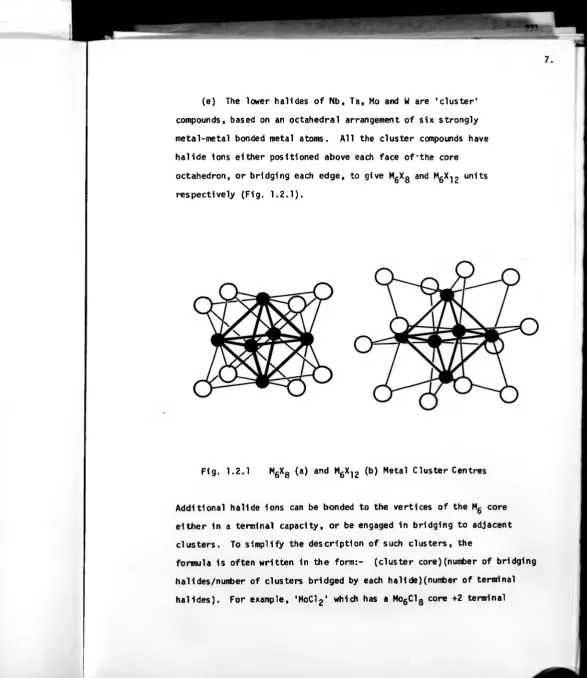
(e) The lower halides o f Nb, Ta, Mo and W are 'c lu s te r'
compounds, based on an octahedral arrangement of s ix strongly
metal-metal bonded metal atoms. A ll the c lu s te r compounds have
h a lid e ions eith e r positioned above each face of-the core
octahedron, or bridging each edge, to give MgXg and M6X12 units
resp ectively (F ig . 1 .2 .1 ).
Fig . 1.2.1 MgXg (a) and MgX^2 (b) Metal C lu ste r Centres
Additional halide ions can be bonded to the vertice s o f the Mg core
e it h e r in a terminal cap acity, or be engaged in bridging to adjacent
c lu s t e r s . To sim plify the descrip tio n of such c lu s t e r s , the
formula 1s often w ritten in the form:- (c lu s te r core)(number of bridging
halides/number of clu sters bridged by each halide)(number of terminal
[image:24.627.13.601.15.694.2]would be described as (MOgClg)Cl4/2C l2. Sim ilarly» WC13 (F ig . 1 .2 .9 )
would be (WgCli2)C lg . This nomenclature has also been applied to
no n-cluster metal-metal bonded compounds (e .g . MoCl3 (F ig . 1 .2 .7 ) is
(MoC12)C18/2).
The following sections describe the stru ctu ra l chemistry by
oxidation s ta te :
Oxidation State VI
The v o la t ile liq u id s MFg (M = Mo and W) and c r y s t a llin e
so lid s MoClg, WXg (X = C l , Br) are the only known examples of the
+6 s ta te . In the s o lid s t a t e , the structures show a high degree
of polymorphism, but a ll contain a metal atom in an octahedral
monomeric environment (17). The hexahalides being coordinatively
saturated have no w ell established coordination chem istry, but often
give complexes as part of th e ir reduction products, e . g .,
MeCN
W C l g
T H F
— > W C l 4 . 2 M e C N ( 1 8 )
( 1 9 ) w d g / W U L I j t l H r
Oxidation State V
Of the known pentahalides, NbXg (X = C l , B r, I) (2 0 ), TaXg (X = C l,
B r, I ) , MoClg (21) and WXg (X = C l , Br) (22) are a ll iso stru ctu ra l
9.
Fig . 1.2.2 Crystal Structure o f NbClg (20)
D istortion of the MXg octahedra occurs hy mutual repulsion of the
two Nb atoms from th e ir octahedral centres. Nblg (23) and VFg (24)
are more highly associated forming in f in it e halide bridged chains.
A ll of the pentahalides are v o la t ile , the gas phase stru ctu re being
based on a monomeric trigonal hipyramidal unit (25).
Oxidation State IV
A wide range of stru ctu ra l chemistry is presented by the +4
s ta te . I t is also the highest oxidation state in which metal-metal
bonding is of any sig n ifica n c e . Titanium i s the only f i r s t row element
that forms thermally sta b le tetra h a lid es. TiCl^ i s a colourless fuming
liq u id , with a monomeric tetrahedral stru ctu re , both in the gas phase
(26) and in solution (27) although Raman studies of the neat liq u id
in d icate some association via chloride bridges (28). A monomeric
structure was also found for the low melting point so lid s TiBr^ (29, 30)
and T i I4 (3 0 ); the X-ray crystal structures show the la t t ic e to
slow ly disproportionates to VCl^ and C l2 a t room temperature and
rap id ly on heating in vacuo (3 1 ). As with T iC l4 a monomeric
tetrahedral configuration i s adopted in both solution and the gas
phase, but here d isto rtio n occurs due to Jahn -T eller e ffe cts (32).
VBr4 is unstable, decomposing above -45°C w hile CrCl4 has only been
observed as a constituent of high temperature gas phase e q u ilib r ia ,
and i s unknown in the condensed phase.
The second and th ird row halides c r y s t a llis e in only two b asic
stru ctu ra l types. ZrC14 , ZrBr4 , HfCl4 and HfBr4 are isomorphous,
the stru ctu re being ty p ified by ZrCl4 (F ig . 1 .2.3) (33, 34).
Here, octahedrally coordinated Zr atoms each share two edges with
adjacent octahedra via chloride bridges to form an in f in it e one-dimensional
'zig -zag ' polymer. Variations in the bond lengths of the Zr-Cl bridges
O C l
between alternate octahedra are caused by d isto rtio n s from ideal
octahedral geometry rather than metal-metal bonding, which was
eliminated on the b asis of a value for the shortest Zr-Zr
interatomic distance of 3.962 8.
C ry sta llin e ZrF^ and HfF^ have structures based on eight
coordinate Zr or Hf. Each square an tip rism a tica lly coordinated
Zr (Hf) i s linked to neighbouring anti prisms through a ll eight
vertice s to form a three-dimensional s o lid (35).
In the gas phase, electron d iffra ctio n studies reveal the MX^
(M = Z r, Hf; X = F , C l , B r, I ) polymers d isso ciate to give regular
tetrahedral species as with the TiX4 se rie s (36-38).
The second stru ctu ra l type (F ig . 1.2.4) accounts f o r the so lid
phase chemistry of a-MoCl^, MoBr^, MX^ (M = Nb, Ta, W; X = C l , Br)
a ll of which are iso stru c tu ra l (7 , 39).
11.
•N b
O C l
NbCl^ consists of edge sharing octahedra forming an in f in it e chain,
the Nb being displaced towards each other in altern ate octahedra
forming d is t in c t Nb-Nb p a ir s , i . e . metal-metal bonding. Nbl^ (40)
i s stru c tu ra lly re la te d , but a ltern a te Nb-Nb distances of 3.31 and
MoCl^ has also been obtained in a second 8 form (41). This was
found to be related to a - T i C l j , having the same b asic l a t t i c e , but
with only three-quarters of the metal s ite s occupied. The Mo atoms
are located in s t a t i s t i c a l l y disordered 'domains'. In each domain,
h a lf the metal s it e s are vacant in alternate layers to give
2+ 2
-alternating sheets composed of (Mo2Clg) and MoClg u n its. There
is no evidence for any metal-metal bonding in the 8 m odification.
Oxidation State I I I
In the +3 sta te a l l the early t-metals except vanadium and
chromium exh ib it metal-metal bonding in one or more m odifications.
T iC l3 has four m odifications, a ll of which have been studied by
Natta and coworkers (F ig . 1 .2 .5 ) (42).
4.36 8 were considered long, and the metal-metal in te ra ctio n , th erefo re,
weak.
(b)
o Tt
Cl
The mauve a , y and <5 forms are c lo se ly related forming layer
la t t ic e s in which each Ti atom i s octahedrally coordinated to s ix Cl
atoms. In the a form the chloride ions are hexagonally close
packed, and in the y form cu b ica lly close packed. Prolonged
grinding of eith e r the a or r forms re su lts in fi-TiCl^ which has
a disordered la t t ic e co n sistin g s t a t i s t i c a l l y o f 63% hexagonal close
packing and 37% cubic close packing. The stru ctu re of the brown e
metal-metal bonded form is quite d iffe re n t. As with a - T iC l3 , the Cl
atoms are hexagonally clo se packed, but the Ti atoms are arranged
in such a way that the stru ctu re can be considered as an in f in it e
one-dimensional polymer formed by T iC lg octahedra sharing opposite
fa ce s. Although the T i-C l bond lengths in a ll four modifications
are id en tica l (.2.45 - 2.46 J?), the T i-T i interatom ic distance
in the 6 form is much shorter (2.91 X) than that found in the a , y
and 5 forms (3.54 8) , equalling the T i-T i distance in m eta llic
t i taniurn.
T iB r3 e x ists in both a and & forms, but T i l 3 , ZrCl3 (4 3 ),
ZrBr3 (4 4 ), Z r l3 (45) and H fl3 (45) are known only in the metal-metal
bonded B m odification.
VC13 is a mauve c r y s t a llin e so lid with an « - T iC l3 type stru ctu re.
VBr3 forms continuous s o lid solutions with VC13 over the whole
composition range, and i s , therefore, considered as isomorphous with
VC13 (3 , 4 ). The isomorphous C rC l3 and CrBr3 stru ctu res (46) are
made up of close packed halide sh eets, with Cr atoms occupying two-thirds
of the octahedral vacancies in every second layer to form repeating
14.
Niobium and tantalum form no simple t r ih a lid e s , MX3 g being
only one constituent in a continuous phase between upper and lower
lim its (e.g. for ‘NbClj*, NbCl2 g7 - NbClg 1 3). The lower lim it
correspond to M3Xg, the stru ctu re of which is known in the case of
Nb3Clg (Fig. 1.2.6) (47, 48).
Fig . 1.2.6 Crystal Structure of NbgClg
The main feature of this structure is a strongly metal-metal bonded
Nb trian gu lar c lu ste r which occupies three out of four site s in a
sheet composed of Cl octahedra. A niobium-niobium distance of
2.81 8 was found which is shorter than the metal-metal distance in
NbCl^ (3.06 8) or in the metal i t s e l f (2.94 8) . Increasing the Nb:Cl
ra tio resu lts in the disruption of the Nb3 clusters to form diamagnetic
Nb2 units u n til an upper lim it of NbCl3 13 is reached. Perhaps not
su rp risin g ly , there is no evidence for any coordination compounds with
a-MoClj is related to both Cr C l3 and CrBr3, the structure (^39)
consisting of Mo atoms occupying two-thirds o f the octahedral vacancies
in a sheet of cubic close packed chloride ions. Metal-metal bonding
between p a irs of Mo atoms d isto rts the M0C I3 octahedra, i . e . Mo2C12C1q^2
Instead of forming sheets of octahedra by edge bridging (as in MoC13) ,
MoBr3 (49) and MoI3 (49) co n sist of in f in it e chains of MoXg octahedra
sharing oppositve faces with the two adjacent u n its, sim ila r to B -TiCl3.
Metal-metal bonding between pairs of Mo atoms create Mo2Brg u n its,
i . e . (Mo2Br3)Brg^2 . as can be seen from the altern ate short and long Mo-Mo
bonds (F ig . 1 .2 .8 ).
(F ig . 1 .2 .7 ) . Consequently there i s one short (2.77 8) and two long
(3.71 8) Mo-Mo intern u clear d istan ces, as opposed to the three equal
C r- C r i n t e r n u c l e a r d is t a n c e s in C r C l , or C rB r-,.
F i g . 1 . 2 . 7 Schematic R e p re s e n ta tio n o f a Sheet o f (MoCl? )C l
c
Octahedra Showing Short (— ) and Long (---- ) Mo-Mo Bonds.
®Mo
O B r
¿92
3 - Uconsisting of Mo atoms occupying two-thirds of the octahedral vacancies
in a sheet of cubic close packed chloride ions. Metal-metal bonding
between p airs of Mo atoms d isto rts the MoC13 octahedra, i . e . Mo2C1 2C1 8^2
(F ig . 1 .2 .7 ) . Consequently there i s one short (2.77 8) and two long
(3.71 8) Mo-Mo intern u clear d istan ces, as opposed to the three equal
C r- C r i n t e r n u c l e a r d is t a n c e s in CrC l-, or C r B r , .
*->
J
F i g . 1 . 2 . 7 Schem atic R e p re se n ta tio n o f a j h e e t o f ( M o C ^ j C l ^ , Octahedra Showing Short (— •) and Long (---- ) Mo-Mo Bonds.
Instead of forming sheets of octahedra by edge bridging (as in MoC13) ,
MoBr3 (49) and MoI3 (49) co n sist of in f in it e chains of MoXg octahedra
sharing oppositve faces with the two adjacent u n its, s im ila r to e -T iC l3.
Metal-metal bonding between pairs of Mo atoms create Mo2Brg u n its,
i . e . (Mo2Br3)Brg^2» as can be seen from the alternate short and long Mo-Mo
bonds (F ig . 1 .2 .8 ).
<I< )1
WCIg (50) and WBrg (51) are both c lu ste r compounds. The tric h lo rid e
(F ig . 1.2.9) contains a Wg metal bonded octahedral core with tw elve-
edge bridging Cl atoms and s ix terminal Cl atoms, i . e . (WgC 1 -|2)C16*
Fig. 1.2.9 Structure of WClg (50)
'WBr3 l (51) is based on a (WgBrg)6+ octahedral core with two bridging
O C , n
polybromide (Br4 ) groups per c lu s t e r , i . e . (WgBrg) ( Br4 )4^,2Br2 *
WIg i s isomorphous with MoBrg and MoIg. The stable c lu ste r structures
of WXg (X = C l, Br) prevents the d ire c t formation of coordination
complexes, although reduction of complexes of the higher halides does
provide a synthetic route to W (III) adducts (52).
Oxidation State I I
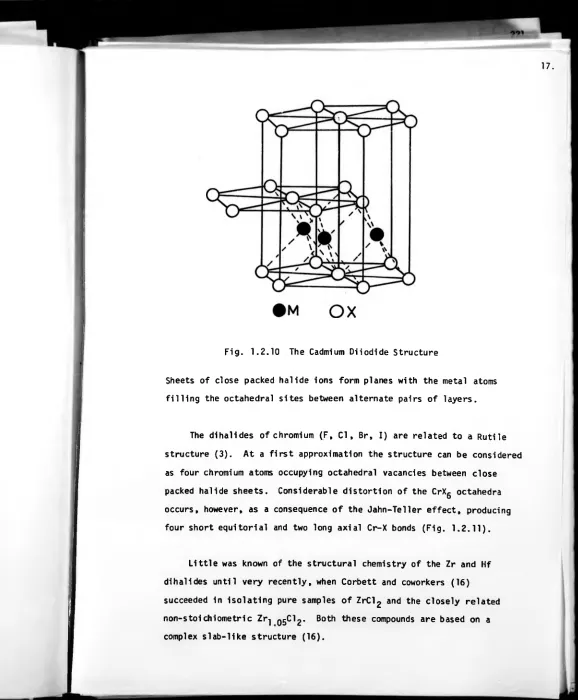
The structures of the dihalides o f titanium and vanadium a l l belong
F ig . 1.2.10 The Cadmium Diiodide Structure
Sheets of close packed halide ions form planes with the metal atoms
f i l l i n g the octahedral s it e s between alternate pairs of la y e rs.
The dihalid es of chromium (F , C l , Br, I) are related to a R utile
structure (3 ). At a f i r s t approximation the structure can be considered
as four chromium atoms occupying octahedral vacancies between close
packed halide sh e e ts. Considerable d isto rtio n of the CrXg octahedra
occurs, however, as a consequence o f the Jahn-Teller e f f e c t , producing
four short eq u ito ria l and two long a x ia l Cr-X bonds (F ig . 1 .2 .1 1 ).
L i t t l e was known of the stru ctu ra l chemistry of the Zr and Hf
dihalides u n til very rece n tly , when Corbett and coworkers (16)
succeeded in is o la tin g pure samples o f Z rC l2 and the clo sely related
non-stoichiometric Zr-j QgC l2 . Both these compounds are based on a
[image:35.634.27.605.8.708.2]18.
O
O cr
F ig . 1.2.11 Unit C e ll of C rC l2 Showing Short (2.39 8) and
Long (2.93 8) Cr-Cl Bonds (53)
Z r l2 provides the sole example of a neutral Group IVA c lu s t e r , the
structure being based on an I bridged trigonal antiprism (ZrgI 12) (54).
Niobium and tantalum form no true d ih a lid e s, instead giving a
se rie s of clu ste rs based on (M6X3) 3+, (MgX12) 2+, (MgX12) 3+ and (MgX12) 4+
with average metal oxidation states of 1.8 3, 2.33, 2.50 and 2.67
resp ectively. The chemistry of these compounds is extensive, and has
been summarised (3 , 6).
MX2 (M = Mo , W; X = C l , B r, I) are isomorphous. S tru ctu ra lly they
are related to WC13 (F ig . 1 .2 .8 ) , but with four meridinal centrifugal
halide atoms bridging to four adjacent clu sters to form sheets, i . e .
(M6X8^X4/2X2 ( 39)- 4s W1th the niob'*un' and tantalum c lu s te rs, oxidation
y ield s a variety of c lu ste r based compounds, depending on the conditions,
e.g. (WgBrg)Br^2Br2 + Br2 -*• °~WgBr-|g, 6- WgBr-jg, WgBr.jg, WgBr-j^ and
Rather su rp risin g ly , the molybdenum and tungsten d ihalid es also have
a coordination chem istry, which is discussed in Chapter 2.
Oxidation State I
ZrCl and HfCl appear to be the only monohalides known. The
cry sta l stru ctu re (55) o f ZrCl (F ig . 1.2.12) and that of the isomorphous
HfCl show some rather remarkable fea tu res, including a Zr-Zr interatomic
distance (3.09 ft) which i s considerably le ss than that in the twelve
coordinate metal (3.19 ft).
The unique four layer structure (here presented as a projection on the
001 plane) consists of Cl-Zr-Zr-Cl stacked sh eets, with each Zr atom
The monohalides have no known coordination chem istry, as might be
expected from such a highly metal-metal bonded stru ctu re.
O Zr below olane Zr above plane
Fig. 1.2.12 C rystal Structure of ZrCl
having s ix in phase Zr neighbours (a t 3.42 ft), three Zr neighbours in
the sheet below (a t 3.09 ft) and three Cl neighbours in the sheet above
20.
1.3 Coordination Chemistry of the Early T-Metals
The complex chemistry of the tra n sitio n metal halides has long
been a su b ject of in te re s t. In p a r t ic u la r, the non-aqueous chemistry
of the anhydrous metal halides has recently received much attentio n.
There are two inherent problems associated with th is area of chem istry,
(a) the production of pure samples of the anhydrous metal h a lid e s , and
(b) handling such m aterials once prepared, as most are e a sily hydrolysed
by moist a ir to oxo and hydroxo sp ecies.
Coordination compounds are u su ally prepared by one of two b a s ic
methods. Complexes of monomeric or weakly associated sp ecies, e .g . NbClg,
are read ily obtained by simply mixing the reactants in a su itab le
non-coordinating so lven t, or by d isso lvin g the metal halide in excess
lig an d, the ligand here acting as solvent. With more highly polymerised
metal h a lid e s , ligand sub stitutio n reactions provide an altern a tiv e
syn th etic route, e.g .
MeCN, THF, py 3L
MX3 (M = T i , V, C r ) --- >MX3.3 S ---> MX3.3L
\ NMe3 l
\ --- > MX3.2NMe3---»MX-J.3L
1.3.1 Hard and so ft acids and bases
In the terminology of G. N. Lew is, complexation can be thought of
as an acid-base reactio n. Metal ions are examples of Lewis a cid s, and
considering the vast amount of potential donor-acceptor complexes, i t
would be advantageous to have a q u a lita tiv e idea of the s t a b ilit y or
v ia b ili t y o f a projected adduct. An attempt at such a prediction can
be made using the p rin cip le of hard and so ft acids and bases (HSAB).
Sidgwick (56) and la t e r Ahrland, Chatt and Davies (57) d ifferen tiated
21
p block bases (N, 0 , F) which they ca lle d c la s s A, and those species
preferring to complex to second and th ird row donors (P , S , As, S e ),
called C la ss B. Pearson (58, 59) extended t h is id ea, c la s s ify in g bases
in which the donor atom is at high e le c tro n e g a tiv ity , low p o la r iz a b ilit y ,
and hard to oxidise as 'hard' (C lass A) bases, and those of low
e le ctro n e g a tiv e ly , high p o la riz a b ilit y and e a s i ly oxidised as 's o f t '
(Class B) (Table 1 .3 .1 ).
HARD SOFT BORDERLINE
h2o, oh" , ro" , r2o r2s, rsh, rs" CgHgNHg, CgHgN
ROH, P043" , S042" SCN", R3P, R3As N3' , B r ', N02" , N2
C l ' , F" I ' , CO, (R0)3p
nh3 rnh2 , n2h4 c2h4, h"
Table 1.3.1 C la s s if ic a t io n of Bases
Lewis acids were likew ise categorised by t h e ir a f f in it y fo r e ith e r
hard or s o f t bases (Table 1 .3 .2 ).
HARD SOFT BORDERLINE
H+, L i +, Na+, K+ Cu+, Ag+, Au+ Fe2+, C o " , N i " , Cu2+
C r3+, Co3+, Fe3+, As3* Pd2+, Cd2+, Pt2+ Pb2+, Sn2+ Sb3+, B i3+
S i 4+, Sn4+, T i 4+, Zr4+, Hf4* T l3+, BH3 , GaCl3 Rh3+, BMe3 , S02
W04+, V02+, Mo03+ In C l3, Brg GaH3
BeMe2 , BF3 , B(0R)3
AlMe3, A1C13 , A1H3
Table 1.3.2 C la s s ific a tio n o f Lewis Acids
The character of an acid or base can be modified by changing the oxidation
sta te . Thus Ni(0) is a so ft a cid , N i( I I ) b o rd e rlin e , and N i(IV ) hard.
Addition of so ft ligands has the e ffe c t of softening the acceptor atom,
22.
Having estab lish ed the nature of both Lewis acids and Lewis bases,
the s t a b ilit y of an acid-base complex can be described by the rule
'Hard acids p refer to bind to hard bases, and so ft acids p refer to bind to
so ft b ases'. This i s a t o t a lly em pirical co rrela tio n .
Inspection of Table 1.3.2 reveals that the early t-m eta ls, where
present, are a ll hard, and the preference fo r donor atoms should thus
be in the o rd e
r:-N » P > As > Sb
0 » S > Se > Te
F > Cl > Br > I
L i t t l e qu antitative evidence e x ists to substantiate the expected trend,
but i t is a general observation that the number of known complexes with
0 and N donor atoms f a r outweighs those with so ft donors. Chung and
Westland (60) have, however, obtained thermochemical data fo r the
reaction of THF and THT with some Group IV te tra h a lid e s, which does
illu s t r a t e the HSAB p rin c ip le as in Table 1 .3 .3 .
COMPLEX -AH (KJ mol-1 )
Z rC l4.2THF 140.5 ± 2.0
Z rC l4.2THT 124.6 ± 3.8
ZrBr4.2THF 151.3 ± 1.7
ZrBr4.2THT 36.4 ± 1.7
HfC14. 2THF 144.6 ± 0.8
HfCl4.2THT 138.3 ± 0.8
Table 1 .3 .3 Heats of Formation of MX4 + 2L -*■ MX^.2L in Standard States
For HfCl4 , the small d ifference in enthalpy between the reaction between
THF and THT was seen in terms of Hf possessing more B (s o ft) character
23.
Several workers have attempted to explain the HSAB phenomenon,
the ir-bonding theory of Chatt (61) being p a rtic u la rly appropriate
fo r metal ions. Here, the important feature of so ft acids was the
presence of loosely held outer d -electro n s, which can form ir-bonds
w ith a ligand by donation into empty d -o rb itals on so ft bases such as
P , S e tc . Hard acids have t ig h tly held outer electrons but empty d
o r b it a ls , which again, can form ir-bonds by accepting electron density
from a hard donor atom. A hard base/soft acid interaction would be
disfavoured by the repulsion between the f ille d o rb ita ls on both
metal and ligand.
Care should be taken in applying the HSAB p rin cip le too s t r i c t l y ,
as the predicted and experimental behaviour of a complex do not always
co incid e. For example, the complex T iC l4. 2 thioxan (thioxan = S(CH2)40)
i s S bonded rather than the 0 bonded isomer expected from HSAB (62).
1 .3 .2 Geometry of coordination complexes
The following section is intended as a b rie f introduction to the
types of geometry encountered in th is area of chemistry, with (where
p o ssib le) v e rifie d examples of each c la s s .
Low coordination numbers (<5)
There are no true three coordinate halide sp ecies, although a
number of compounds of f i r s t row elements of the type MR3 (R = NR2 ' , I
SiMe3 , CH(SiMe3) 2, SR , e t c .) have been isolated v ia halide substitution
rea ctio n s.
Four coordination i s very ra re , the VX4" (X = C l , Br) ions observed
complexes prepared by Scaife (64) being amongst the few known examples.
5 coordination
Penta-coordinate complexes appear to be r e s t r ic t e d to f i r s t row
elements, possibly due to the increased s iz e (and thus a b ilit y to attain
higher coordination numbers) of the second and th ird row metals. A
common facto r in a ll of these complexes is the presence of a bulky ligand,
such as NR3, PRg, SR£, e tc . A ntler and Laubengayer (65) iso late d the
f i r s t 5 coordinate complexes in 1955 by the reaction o f T iC l4 with
NMe3 , giving TiCl^.NMe^ or T i C l3.2NMe3 depending on the reaction
conditions. Fowles and coworkers (66-69) extended the trimethyl amine
se rie s in both the +4 (T iB r4.NMe3 (6 7 ), VX4.NMe3 (66) ) and +3 (T iB r3.2NMe3
(6 7 ), HCl3.2NMe3 , M = V (66) , Cr (68) ) sta te s. These complexes are
discussed in greater d e ta il in Chapter 2. Further work by a number of
groups has sin ce produced 5 coordinate adducts with a varie ty of
nitrogen (66, 7 0 ), phosphorus (7 1 ), a rsen ic (6 2 ), oxygen (72, 73) and
sulphur (68, 70) donors.
Spectroscopic (74, 75) and cry sta llo g ra p h ic (6 9 , 76-78) studies
have confirmed a trigonal bipyramidal (D3h or C3V) stru ctu re in a
number of in sta n ce s, the lig an d (s) occupying an axial position in
each case. S t e r ic compression prevents the occupation of adjacent
s i t e s , i . e . 1 axial + 1 equatorial or 2 e q u a to ria l, elim inating the
p o s s ib ilit y of geometric isomerism. The tendency to dimerise in the
so lid sta te forming 6 coordinate species has also been noted (68, 70).
5 coordinate species have been reviewed (79-81). 6
6 coordination
One of the dominant facto rs 1n e a rly tra n sitio n metal chemistry
pseudo-octahedral 6 coordinate sp e c ie s. Consequently this i s the most common
geometry, adopted by the larg e majority of early t-metal complexes.
Examples can be found fo r a l l the early t-metals in a v a rie ty of
oxidation states and sto ichio m etries.
For an adduct at general formula MXy L2 , when x + y = 6 an octahedral
environment is obtained simply by the ligands occupying vacant s it e s on
the metal io n , e.g . MXg.L (8 2 ), MX4.I_2 ( 83 , 84), MX3L3 (85) and
MX2L4 (86). Complexes which are coordinatively unsaturated as monomers,
i . e . x + y < 6, can achieve 6 coordination by halogen b ridging, e .g .
(MC14. L ) 2, M = T i , L = P0C13 (8 7 ), MeN02 (88) , EtOAc (8 9 ), M = W,
L = C I3CCN (9 0 ), (MX4) 2L (9 1 ), (MX3L2) 2 (68, 70), (MX2L2 ) x (92).
Oct
#n
O
p
00
Fig . 1.3.1 C rystal Structures of T iC l4.2POCI3 (83) and ( T iC l4.P0Cl3 )2 (87)
When the number of ligands in a simple complex is two or more,
geometrical Isomerism can o ccu r, e.g. c is T iC l4.2P0Cl3 (83) and trans
WCl4.2py (84). In certain favourable in stan ces, e.g . with the In e rt
OOl
26.
L = NH3 (9 3 ), THT (9 4 ), dien (95).
7 coordination
Theoretical aspects of 7 coordination have been examined by
Kepert (3 ). A number of 7 coordinate adducts have been iso late d with
the polydentate arsine ligands o -p h en ylen ebis(d im ethylarsin e)(d iars),
methylbis(o-dimethyarsinophenyl)arsine(o-TAS) and t r i s - 1 ,1 ,l-(d im eth y l-
arsino methyl)ethane(v-TAS),
r ^ ^ Ix A s M e2
diars
AsMe
2
AsMe2/
AsMe
AsMe
2
o-TAS
^ C H
2
AsMe
2
Me—C— CH
2
As M e
2
v-TAS
^ C H
2
As M e
2
Clark and coworkers have prepared the 1:1 adducts MXg.diars (M = Nb, Ta,
X = C l, Br (96); M = W, X = Cl (9 7 ), MC14(o-TAS) and MC14(v-TAS) (M = T i , V)
(98). These are diamagnetic and non-conducting. Equivalent AsMe sig nals
in the NMR spectra were taken as evidence of 7 coordination. The
p o s s ib ilit y of a more common 6 coordinate structure with rapid exchange
occurring in solution between free and coordinated donor s it e s (which
would give an id en tical re su lt to above) was, however, not discussed.
Confirmatory X-ray, or variable temperature NMR studies on these
species have yet to be carried out.
A number of potential 7 coordinate trimethyl amine adducts have been
isolated (WClg.NMe3 (99), MCl5.2NMe3 (M = Nb (100), Ta (101), Mo (102) )
L = NH3 (9 3 ), THT (9 4 ), dien (95).
7 coordination
Theoretical aspects of 7 coordination have been examined by
Kepert (3 ). A number of 7 coordinate adducts have been iso late d with
the polydentate a rsin e ligands o -p h en ylen eb is(d im ethylarsin e)(d iars),
methylbis(o-dimethyarsinophenyl)arsine(o-TAS) and t r i s - 1 ,1 ,l-(d im e th y l-
arsino methyl)ethane(v-TAS).
Clark and coworkers have prepared the 1:1 adducts MXg.diars (M = Nb, Ta,
X = C l, Br (96); M = W, X = Cl (9 7 ), MC14(o-TAS) and MC14(v-TAS) (M = T i , V)
(98). These are diamagnetic and non-conducting. Equivalent AsMe sig n a ls
p o s s ib ility of a more common 6 coordinate structure with rapid exchange
occurring in solutio n between free and coordinated donor s it e s (which
would give an id e n tica l re su lt to above) was, however, not discussed.
AsMe
2
AsMe
2
AsMe
2
o-TAS
2
diars
^ C H
2
AsMe
2
Me—C—CH
2
As M e
2
v-TAS
^ C H
2
As M
g
2
in the H NMR spectra were taken as evidence of 7 coordination. The
Confirmatory X-ray, or variable temperature H NMR studies on these
species have y et to be carried out.
A number of p otential 7 coordinate t r i methyl amine adducts have been
isolated (WClg.NMe3 (9 9 ), MCl5.2NMe3 (M = Nb (.100), Ta (101), Mo (102) )