Linearization of the Liouville Equation, Multiple Splits
of the Chandler Frequency, Markowitz Wobbles,
and Error Analysis
Cheh Pan
Pan Filter Technology, Saratoga, USA Email: [email protected]
Received June 27, 2012; revised July 27, 2012; accepted August 29, 2012
ABSTRACT
The rotation of the physical Earth is far more complex than the rotation of a biaxial or slightly triaxial rigid body can represent. The linearization of the Liouville equation via the Munk and MacDonal perturbation scheme has oversimpli- fied polar excitation physics. A more conventional linearization of the Liouville equation as the generalized equation of motion for free rotation of the physical Earth reveals: 1) The reference frame is most essential, which needs to be unique and physically located in the Earth; 2) Physical angular momentum perturbation arises from motion and mass redistribution to appear as relative angular momentum in a rotating Earth, which excites polar motion and length of day variations; 3) At polar excitation, the direction of the rotation axis in space does not change besides nutation and pre-cession around the invariant angular momentum axis, while the principal axes shift responding only to mass redistribu-tion; 4) Two inertia changes appear simultaneously at polar excitaredistribu-tion; one is due to mass redistribution, and the other arises from the axial near-symmetry of the perturbed Earth; 5) The Earth at polar excitation becomes slightly triaxial and axially near-symmetrical even it was originally biaxial; 6) At polar excitation, the rotation of a non-rigid Earth be-comes unstable; 7) The instantaneous figure axis or mean excitation axis around which the rotation axis physically wobbles is not a principal axis; 8) In addition to amplitude excitation, the Chandler wobble possesses also multiple fre-quency-splits and is slow damping; 9) Secular polar drift is after the products of inertia and always associated with the Chandler wobble; both belong to polar motion; 10) The Earth will reach its stable rotation only after its rotation axis, major principal axis, and instantaneous figure axis or mean excitation axis are all completely aligned with each other to arrive at the minimum energy configuration of the system; 11) The observation of the multiple splits of the Chandler frequency is further examined by means of exact-bandwidth filtering and spectral analysis, which confirms the theo-retical prediction of the linearized Liouville equation. After the removal of the Gibbs phenomenon from the polar mo-tion spectra, Markowitz wobbles are also observed; 12) Error analysis of the ILS data demonstrates that the incoherent noises from the Wars in 1920-1945 are separable from polar motion and removable, so the ILS data are still reliable and useful for the study of the continuation of polar motion.
Keywords: Liouville Equation; Polar Motion; Chandler Wobble; Markowitz Wobble; Error Analysis
1. Introduction
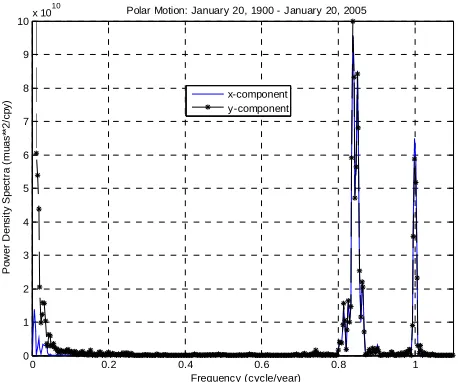
It has long been known from classical mechanics that the Earth rotates like a biaxial [1,2] or slightly triaxial [3-5] rigid body. However, such a rigid model is not able to fully depict the complexity of the Earth’s rotation. The Earth is multilayered, deformable, energy-generating and dissipative. In addition to the fluidal layers of the atmos- phere, oceans and outer core, geological deformation, plate tectonics, seismicity, and volcanism observed on the Earth’s surface indicate motion and mass redistribu- tion are also to occur in the solid Earth. A renowned evi- dence for the Earth’s non-rigidity is the Chandler wobble, which is observed, as shown in Figure 1, to possess mul-
0 0.2 0.4 0.6 0.8 1 0
1 2 3 4 5 6 7 8 9 10x 10
10
Frequency (cycle/year)
P
o
w
e
r D
e
n
s
it
y S
p
ec
tr
a
(
m
ua
s
**
2
/c
py
)
Polar Motion: January 20, 1900 - January 20, 2005
[image:2.595.58.287.86.277.2]x-component y-component
Figure 1. The power density spectrum of polar motion of the POLE2004 series (Gross, 2005), span January 20, 1900 to January 20, 2005 at 30.4375-day intervals, where the multiple split-periods of the Chandler wobble are respec-tively, 424 days (0.861 cycle/year), 430 days (0.850 cycle/ year), 436 days (0.838 cycle/year), 442 days (0.826 cycle/ year), and 448 days (0.815 cycle/year), while the annual wobble is 365 days (1 cycle/year). The 105-year observation is not long enough to reach a full resonance cycle of the Chandler wobble. Note the presence of secular polar drift and long-period (Markowitz) wobbles near zero-frequency.
around the invariant angular momentum axis to trace out a space cone, and not a body cone for free wobble of the rotation axis around the major principal axis. The separa-tion of the major principal axis from the rotasepara-tion axis must be due to motion and mass redistribution, but which does not occur in a rigid Earth.
There had been a marathon of errors in the study of polar instability [6]. Gold [7] is the first to present a con- vincing qualitative discussion on the instability of the rotation axis in an anelastic Earth. Utilizing the genera- lized Eulerian equation of motion or the Liouville equa- tion, Munk and MacDonald [8] are the first to explain the separation of the major principal axis from the rotation axis via polar excitation. Polar excitation means motion and mass redistribution are to occur in the Earth to per- turb the angular momentum, or a change in the Earth’s inertia to force the rotation axis to revolve away from the major principal axis according to the three-finger rule of the right-handed system and the law of conservation of angular momentum. This is indeed the case for a multi- layered, deformable, energy-generating, dissipative, and perpetually rotating Earth that allows motion and mass redistribution. However, as the first-time transition from a rigid rotation to a non-rigid rotation and in attempt to make the two compatible, Munk and MacDonald’s scheme [8] has oversimplified polar excitation physics, and ends up, as will see below, practically still a rigid
Earth rotation but with polar excitation superimposed on independent of rotation. It hence can not predict the multi- ple splits of the Chandler frequency. The problems en- countered in the Munk and MacDonald scheme have been fragmentally investigated [9-14] and summarily discussed [15]. Geophysical problems that involve rota- tion, such as the angular momentum function of the at- mosphere, secular polar drift owing to the postglacial viscoplastic rebound, seismic excitation of the Chandler wobble, true polar wandering, and impact of a giant aste- roid or comet to the Earth, have also been re-investigated [14]. In order for a more proper depiction of the polar excitation physics, it needs a standard linearization of the Liouville equation through which the Earth’s non-rigidity is correctly represented. The present paper is a synthetic review of the linearization of the Liouville equation, as well as a systematic examination of the fundamental physics of the rotation of a non-rigid Earth that are over- simplified in the Munk and MacDonald scheme. So a thorough familiarity of the Munk and MacDonald sche- me is essential. However, non-rigidity here is still treated as what the Liouville equation allows; physical properties of the Earth are not yet added. It is an updating of fun-damental polar motion modeling to keep up with obser-vation, while the physical causes of polar excitation are not explored. Gross [16] and Gross et al. [17] identify the physical excitation of the Chandler amplitude, and Gross [18] reviewed polar motion, theory and observation, in detail. Observation of the multiple splits of the Chandler frequency is further examined here, which is consistent with the prediction of such a linearized Liouville equa-tion. However, the linearization of the Liouville equation is for free rotation of a non-rigid Earth in the absence of external torques, modeling of nutation and precession based on the Munk and MacDonald scheme [19-21] is not discussed here; related topics can be found elsewhere [13,22].
2. Review of Rigid-Body Rotation
The rotation of the Earth is conventionally cited in clas- sic mechanics as a typical case governed by the Eulerian equation of motion for a rigid body [1]; no other scien- tific models have ever lasted as long. A review of the linearization of the equation will help to see its limitation to represent the rotation of the physical Earth.
For a rigid Earth, inertia tensor I is a constant and rota- tion is the only variable. The law of conservation of angular momentum requires that the rate of change of the Earth’s angular momentum in a reference frame rigidly fixed in the Earth rotating relative to an inertial frame fixed in space be equal to the external torque L exerting on the Earth; i.e.,
where the over dot designates d/dt relative to the refer- ence frame fixed in the Earth. This is the well-known Eulerian equation of motion for a rigid body. Now cho- osing the Earth’s principal axes (a, b, c) as the reference frame and with constant principal inertia I = (A < B < C) and variable rotation = (a, b, c), then, for free rota-tion of a rigid Earth at L = 0, Equation (1) expands to,
– 0 – 0 – 0.a b c
a c
c a b
C B C A b B A C B A (2)
Equation (2) is not linear with respect to variable
so it needs to be linearized to make the equation easier to solve. Fortunately, the Earth is only slightly triaxial; i.e.,
C – A >> B – A and C – B >> B – A. For simplicity, let A
= B; Equation (2) is then linearized as a special case for a biaxial rigid Earth in free rotation; i.e.,
– 0 – 0 a b b a C A A C
, c A A (3)
where is a constant. Now let C A A
, or
C B
C A AB
0 0. a b b a . if the Earth’s slight triaxia-
lity is counted [3-5], the equation further reduces to, (4)
This is the equation of motion for free “Eulerian” nu- tation of a biaxial rigid Earth. Its solution gives a har- monic motion of single frequency σ, which is where the single frequency of the Chandler wobble came from. However, in the solution it needs to assume an initial condition, a slight misalignment between the rotation axis and the c-axis, to give the Chandler wobble constant amplitude. There is no physical explanation why the ro- tation axis and the c-axis of a rigid Earth in stable con- stant rotation can become separated from each other.
From above brief review we see that the Eulerian equation of motion is linearized as a special case only for free rotation of a biaxial or slightly triaxial rigid Earth. If the equation is to fully represent the rotation of the phy- sical Earth, it requires: 1) The Earth has to be perfectly rigid. However, the physical Earth is a multilayered, de- formable, energy-generating, and dissipative heavenly body orbiting in space that allows motion and mass re- distribution; the Earth’s non-rigidity is totally ignored by the equation; 2) The location of the principal axes in the Earth must be known in order for the reference frame to rigidly fix to. Yet, the physical location of the Earth’s principal axes is far from certain, fixing the reference frame to them is, as Munk and MacDonald [8] have al- ready pointed out, only for mathematical simplicity. Such
an idealized reference frame is inconsistent with that for observation [23]. 3) The Earth’s rotation axis and major principal axis have to be already misaligned to give con-stant wobble amplitude. However, the direction of the Earth’s rotation axis is nearly fixed in space besides nu- tation and precession, while the principal axes shift re- sponding to mass redistribution. The separation of the major principal axis from the rotation axis thus cannot occur in a rigid Earth in free rotation. 4) The Earth has to be always in stable constant rotation. On the contrary, observation shows the Earth’s rotation irregularities in- clude not only the Chandler wobble and its damping, but also secular polar drift, changes in the length of day, as well as the annual and Markowitz wobbles. All of them are not accounted for by the equation.
In conclusion, the Eulerian equation of motion for a rigid body is not able to represent the complexity of the rotation of the physical Earth. It needs a generalized equation of motion, the Liouville equation, to account for the Earth’s non-rigidity, and which is what the Munk and MacDonald scheme is all after.
3. Generalized Equation of Motion: Liouville
Equation
Liouville equation is the generalized Eulerian equation of motion that allows motion and mass redistribution in a rotating system [8]; the physical Earth is such a rotating system, and Munk and MacDonald [8] are the first to use the Liouville equation to study the Earth’s rotation. In the equation, after the variable rotation , the inertia tensorI
is also no longer a constant but subject to change, while motion and mass redistribution will induce relative an- gular momentum h. The three-finger rule of the right- handed system [2] then becomes essential. The law of conservation of angular momentum requires the rate of change of the Earth’s total angular momentum I· + h in a reference frame located in the Earth rotating relative to an inertial frame fixed in space be equal to the external torque L exerting on the Earth; i.e.,
I I h I h L (5)
I
Equation (5) has three terms, , h, and × h, more than Equation (1) due to the Earth’s non-rigidity. The equation is general and the fundamental physics it represents are clear. The study of the rotation of the physical Earth is a matter of correct interpretation of the equation according to the law of conservation of angular momentum and the three-finger rule of the right-handed system.
The perturbation scheme developed by Munk and Mac- Donald [8] for such a linearization laid out the founda- tion for modern Earth rotation studies [24,25]. With such a scheme, the equation is linearized to three simple first- order linear differential equations that separate the equa-torial components of the rotation from its axial compo-nent [8], just like that for the rigid Earth rotation in Equations (3) and (4). The equatorial components of the rotation can thus be mapped into a complex plan for the study of the Chandler wobble [8], while the axial com- ponent is no longer a constant as that in Equation (3) but differentiated to represent changes in the length of day. The equation explains the separation of the rotation axis from the major principal axis via polar excitation, but the axial and equatorial components of the excitation are defined not in the same dimension [8]. Such a lineariza- tion of the Liouville equation still gives the Chandler wobble a single frequency and is non-damping, while secular polar drift will not appear in the solution of the equation [23]; these are no different from what are ob- tained from Equation (4) for a rigid-body rotation, and are thus not consistent with observation [15]. What fol- lows is an exploration of these inconsistencies in the Munk and MacDonald scheme.
4. Reference Frame
The reference frame is most essential, for all motions in the Earth are relative to it. For a biaxial rigid Earth, the choice is idealized: The major axis of the frame is the major principal axis, while the two equatorial axes can be aligned anywhere on the equatorial plane in the right- handed system. However, for a non-rigid Earth, as Munk and MacDonald [8] have already pointed out, it is unlikely to find a truly body-fixed frame, and frames such as Tisserand and principal axes are obvious choices for mathematical simplicity. Chao [23] examines the different theoretical frames, including Smith’s invariant
frame [3], and concludes that there is an inconsistency between the frame used for observation and those for theoretical calculation. Pan [14] observes that all the conventional theoretical frames are idealized systems that are not physically located in the Earth. The frame of Mathews et al. [26] is no exception. This is because the direction of the rotation axis is not truly space-fixed ow-ing to nutation and precession; the true direction invari-ant in space is the angular momentum axis. Also, a frame cannot keep a constant rotation of its own if it is fixed to the physical Earth. Munk and MacDonald [8] align the major axis of their frame nearly parallel to the rotation axis. However, as the rotation axis traces out a body cone in the Earth, there can be an infinite number of frames with their major axis nearly parallel to the rotation axis; the frame is thus not unique. Once it is fixed to the Earth, its
ap-proximation will deteriorate on the order twice the Chan-dler amplitude [12,14]. It will eventually disassociate itself from polar motion as the rotation axis revolves away to pursue after the instantaneous figure axis or mean excitation axis for polar stability. Munk and Mac-Donald [8] hence point out that their frame is not valid for polar wandering. A reference frame in the Earth should be chosen to avoid above problems; it needs to be physically located in the Earth, unique, consistent with observation, and always associated with polar motion. However, a satisfactory choice of a both theoretically and observationally practical reference frame in a rotating Earth that allows motion and mass redistribution in its different layers is most difficult. Frames may be mathe-matically transformable, but not physically. Pan [10-14] chooses a frame as that shown in Figure 2. The (a, b, c)
frame is the Earth’s original principal axes prior to polar excitation, which is diagonal; whereas, the (x, y, z) frame is the axes of the Earth’s inertia tensor that appear simul-taneously with polar excitation, which is not diagonal. The angle pair
, is defined as the Earth’s axial near-symmetry, which will be further discussed below, where is the deviation angle between the c- andz-axes, and is the azimuth angle between corre- sponding equatorial axes. The frame is geocentric. Its
[image:4.595.310.536.398.656.2]
z-axis is the instantaneous figure axis or mean excitation axis that is aligned with the axis of reference [8] or the
geographic axis [3] around which the rotation axis phy-
sically wobbles. Its y-axis is along the direction of secu- lar polar drift, while x-axis is perpendicular to the y- and
z-axis in the right-handed system. The Liouville equation is fully described in the frame, for it can be assumed rotating relative to an instantaneously coinciding iner- tial frame fixed in space without loss of generality [8,10, 14].
5. Matter Perturbation and Relative
Angular Momentum
Physical perturbation to angular momentum arises from motion and mass redistribution in a rotating Earth. In the Munk and MacDonald scheme [8], however, first-order mathematical matter perturbation is linearly added to the principal inertia of a biaxial rigid Earth independent of rotation. Mathematically such a perturbation is legitimate but physically is unjustifiable, because it allows, as Pan [14,15] points out, the perturbed inertia to become greater than the principal inertia. If it were true, then, the Earth’s matter distribution would not be conserved, and the Earth would no longer have rotation stability. This pertains not only to internal perturbations within the Earth, but also external perturbations such as the impact of a giant meteorite or asteroid. A meteorite or asteroid becomes a part of the Earth as soon as it reaches the Earth; then, the Earth’s principal moments of inertia will again become greater than the perturbed moments of iner- tia, and the Earth’s matter distribution is still conserved. Physically, perturbing inertia appears as motion and mass redistribution about the terrestrial (x, y, z) frame rotating relative to an instantaneously coinciding inertial frame fixed in space [14]. So the differentiation operator d/dt +
× applies to the whole rotating system, including h. However, in the h defined in the Munk and MacDonald scheme [8], the differentiation operator is only d/dt, which means motion is only about an inertial frame not rotating with the Earth. A single rotating system cannot have two reference frames coexisting, and motion in the system cannot bypass the rotation of the system to refer to an inertial frame that is not fixed to the system. If so, then motion in the Earth will induce no gyroscopic effect or gyricity in the Earth as is observed; this violates the three-finger rule of the right-handed system. So h has to refer to the same terrestrial (x, y, z) frame in the Earth ro- tating relative to an instantaneously coinciding inertial frame fixed in space as the whole system does. This is the fundamental physics of the rotation of a non-rigid Earth that mathematical matter perturbation is not able to represent. The motion that induces h is thus not ubut u+
× r, where u = (ux, uy, uz) is the motion of mass M
about the (x, y, z) frame, and r = (x, y, z) is the position vector of mass M. Let be the Earth’s average rotation speed, h= (hx, hy, hz) thus becomes [10,14],
,
x x xz
y y yz
z z z
h p I
h p I
h p I
(6)
where the first term p = (px, py, pz) arises from the motion u of mass M about the (x, y, z) frame that does not in-volve rotation; i.e.,
d d
d ,
y
x z
y x z
z y x
p u y u z M p u z u x M p u x u y M
2 2
dd d z
xz
yz
(7)
which is identical to the relative angular momentum de- fined in the Munk and MacDonald scheme [8]. On the other hand, since the (x, y, z) frame is fixed in the Earth rotating relative to an instantaneously coinciding inertial frame fixed in space, the gyroscopic effect or gyricity from rotation to motion × rwill then induce the second term in Equation (6), in which,
I x y M
I xz M
I yz M
(8)
are the inertia changes arising from redistribution of mass M under the gyroscopic effect or gyricity from ro- tation to motion [14,22,27]. They are named the residual
moment and products of inertia by Pan [13], while Munk and MacDonald [8] define them as matter excitation.
layers in the Earth, the atmosphere, oceans, and outer core, can each be represented by an individual h of its own mobility and density, while the rest of the Earth is still represented by the overall angular momentum I·.
6. Axial Near-Symmetry and Major
Principal Axis
In a non-rigid Earth, after its inertia is altered by motion and mass redistribution, the rotation axis will revolve, not
shift, away from its alignment with the original major
principal axis according to the three-finger rule of the right-handed system, to trace out a body cone around an instantaneous figure axis that has shifted to its new posi- tion, the mean excitation axis, as illustrated in Figure 3.
Yet, the direction of the rotation axis is still nearly fixed in space besides nutation and precession; it is the instan- taneous figure axis that shifts its direction in space, while the principal axes shift responding to mass redistribution. As Figure 3 exhibits, if the original major principal axis
[image:6.595.60.287.372.629.2]at c is a symmetrical axis, then, the instantaneous figure axis or mean excitation axis at z, around which the rota- tion axis wobbles, can not be also a symmetrical axis as
Figure 3. Geometric interpretation of polar excitation on a plane projection about the North Pole. c is the pole of the c-axis in Figure 2, and ca and cb are the projections of a- and b-axes respectively. z is the pole of the z-axis in Figure 2, and zx and zy are the projections of x- and y-axes respec-tively. The circular curve is the trace of the rotation pole , while c’ is the assumed major principal pole at polar excita-tion. The figure is not in actual scale, and the multiple fre-quency-splits of the Chandler wobble are not depicted. (Af-ter Pan, 1999, Figure 3).
well, no matter how close is it to c. This is the axial near- symmetry of the Earth at polar excitation, as defined by the angle pair
,
2 2
2 2 2 2
2 2 2 2
2 2
cos sin
sin cos cos sin sin cos sin cos
sin cos cos sin cos sin
sin cos sin cos .
x
y
z
xy
xz
yz
I A B
I A B C
I A B C
I B A
I B A
I C A B
in Figure 2, which will induce ad-
ditional changes in the Earth’s inertia [10,14]. Let the Earth’s original principal moments of inertia in the (a, b,
c) frame be A < B < C; then, for the conservation of the Earth’s inertia, the moments and products of inertia in the (x, y, z) frame will be [10,12,14],
(9)
The mathematical matter perturbation in the Munk and MacDonald scheme [8] fails to differentiate the two phy- sically distinct changes in the Earth’s inertia, respectively shown in Equations (8) and (9), that will appear simulta- neously at polar excitation. Note both inertia changes in Equations (8) and (9) involve physically in polar excita- tion in a rotating Earth, while the mathematical matter perturbation in the Munk and MacDonald scheme [8] is directly added to an inertial Earth regardless of rotation.
The above demonstration then raises a critical question: Can the mean excitation axis be a principal axis or “a ge- neralization of principal axis” as Munk and MacDonald [8] suggest? There exist no products of inertia about the principal axes, so the mean excitation axis can be a prin-cipal axis only if the residual products of inertia in Equa-tion (8) and the products of inertia arising from axial near-symmetry in Equation (9) can totally cancel each other. We can resolve the problem through the excitation function in the Liouville equation [8], which provides amplitude to the Chandler wobble. With Equations (8) and (9) incorporated into the Liouville equation, the three components of the excitation function become [10,12], in the absence of external torques,
2
2
2
2
2
1
1
1
.
x
z x
xz xz yz yz x y
y
z y
yz yz xz xz y x
z z z z
z
I I
I I I I p p
I I
I I I I p p
I I p
I
(10)
[image:6.595.314.540.580.706.2]metry do not cancel each other, but instead superimpose each other to enhance polar excitation. This manifests that the mean excitation axis around which the rotation axis wobbles is not a principal axis at all; otherwise the products of inertia about it should be zero. Munk and MacDonald [8] have overlooked this slight deviation of the mean excitation axis from the major principal axis. The conventional belief that the axis around which the rotation axis wobbles is the major principal axis is thus not valid in a non-rigid Earth. Figure 3 and Equation (9)
also exhibit that at polar excitation, the Earth becomes slightly triaxial and axially near-symmetrical even it was originally biaxial [13,14]. On the other hand, because of the appearance of h, the original principal axes (a, b, c) prior to polar excitation are no longer the Earth’s prince- pal axes; then, where are the principal axes at polar exci- tation? The principal axes are singular lines that are, like the rigid body, only mathematically defined; how to ex- actly locate them in the physical Earth is yet a good geo- detic question. As Figures 2 and 3 imply, the physical
appearance of polar excitation is practically a perturba- tion to the Earth’s axial symmetry. If the principal axes in the physical Earth are not determined, then, the mea- surement of the Earth’s axial near-symmetry angle pair
, is also a good question.Here is also another interesting question. If a motion, such as seasonal fluctuations of the atmosphere or the atmospheric and oceanic excitation of the Earth’s wob- bles [16,17] that induces only negligible mass redistribu- tion in the solid Earth; then, there will be little changes in the positions of the principal axes in the Earth. However, as shown in Figure 3, according to the three-finger rule
of the right-handed system, the relative angular momen- tum induced by the motion will force the rotation axis to revolve away from the major principal axis around an instantaneous figure axis that has also been forced to shift to a new position at the mean excitation axis [8,14], about which the inertia tensor is no longer diagonal but becomes Equation (9) due to its axial near-symmetry [10,14]. Polar excitation by motion alone hence can also induce products of inertia in the solid Earth. In such a case, polar excitation is due to continuous motion as well as the products of inertia arising from the near-symmetry of the instantaneous figure axis at its new position. The instantaneous figure axis thus will shift responding to both motion and mass redistribution, while the principal axes shift only responding to mass redistribution. Con- tinuous motion maintains the wobble; whereas, the in- stantaneous figure axis will gradually drift toward the major principal axis via rheological deformation until they are realigned with each other. If motion stops, the wobble it excites will stop, but the rotation axis will still revolve toward the instantaneous figure axis according to the three-finger rule of the right-handed system, with the
major principal axis dragged along, until they are all re- aligned with each other to reach at stable rotation of minimum energy configuration of the system.
7. Linearization
Munk and MacDonald [8] assume the perturbation to the Earth’s inertia and rotation as well as the motion-only relative angular momentum p, after normalized, are small dimensionless quantities whose products and squares can be neglected. After such a linearization, the equatorial components of the Liouville equation can be mapped into a complex plan, while the axial component represents changes in the length of day [8]. On the other hand, at right-side of the equation is the excitation function arising from the motion-only relative angular momentum
pand the products of inertia, which provides the Chan- dler amplitude, while the coefficients of the terms at the left-side contribute to the Chandler frequency. However, the same motion-only relative angular momentum pand the products of inertia that contribute to the Chandler amplitude at the right-side are totally neglected from the coefficients at the left-side. This leaves only the excitation function at the right-side [8] to represent a non-rigid Earth, while the left-side is no different from that for a rigid Earth as that in Equation (4). The Chandler wobble hence still possesses a single frequency like that of a rigid Earth, in conflict with the observed multiple splits of the Chandler frequency as that shown in Figure 1.
What such a linearized Liouville equation represents is, therefore, practically equivalent to the rotation of a rigid Earth with polar excitation superimposed on independent of rotation, and not yet truly of a non-rigid Earth.
In the Liouville equation, only rotation is an un- known that needs a solution; motion and inertia changes are the physical quantities that excite polar motion. So in the linearization only the terms that involve squares of the variable are needed to be neglected, just like that in Equations (2)-(4) for a rigid Earth rotation. The other terms that involve the product of and non-variable physical quantities are linear by definition and shall not be neglected before they are physically identified as genuinely negligibly small. In the Liouville equation, Equation (5), only the fourth term × I· and partially the fifth term × hthat contain -squares. × I· is
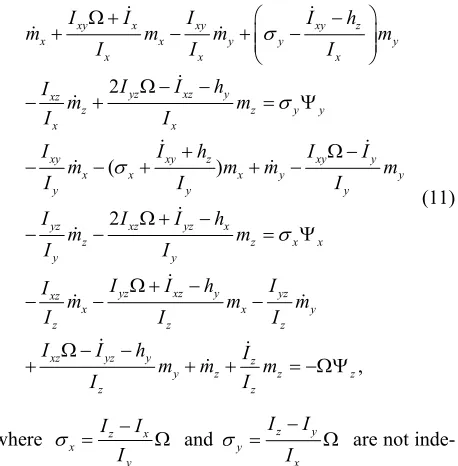
angular momentum are neither in the same physical dimension nor on the same order of magnitude, and their normalized values are not necessarily negligibly small or physically insignificant in comparison to the normalized differences of the axial and equatorial moments of inertia; the latter comprises the fundamental Chandler frequency constituents. On the other hand, if motion and mass redistribution can excite the Chandler amplitude, there is no reason to assume that they are too small to affect the Chandler frequency. It is hence inappropriate to neglect them before they are physically identified indeed too small to contribute to the Chandler frequency. Take into account of above considerations and let the only mathe- matical perturbation be = (mx, my, 1 + mz), where (mx, my, mz) are dimensionless small quantities [8], the lineari- zation of the Liouville equation in the absence of external torques becomes [10,12],
2
( )
2
xy x xy xy z
x x y
x x
yz xz y
xz
z z
x x
xy xy z
y y
x
y y
xy y
x x x
y y
yz xz yz x
z z
y y
yz xz y yz
xz
x x
z z
xz yz
I I I
m m m
I I
I I h
I
m m
I I
I I h
m m
I I
I I I h
m m
I I
I I h I
I m m I I I I y y y x x y z I h m I I I m m I m I , z y z
y z z
z z
h I
m m m
I I
(11)
where z x
y x
I I
I
and y z y x
I I I
, ,
are not inde- pendent components but the constituents of the funda- mental Chandler frequency arising from matter distribu- tion in a slightly triaxial and axially near-symmetrical Earth [12], and x y z is the excitation function in Equation (10). The coefficients of left-side terms in Equation (11) provide frequencies to the Chandler wob- ble, thus not only moments of inertia but also products of inertia and motion will contribute to the Chandler fre- quency [12]. Equation (11) is three dimensional, and its
x- and y-components can no longer be mapped into a complex plan mathematically as that in the Munk and MacDonald scheme [8]. The solution of Equation (11) [10,12] gives a slow damping Chandler wobble of multiple frequency-splits as well as secular polar drift,
consistent with the observation that the Chandler wobble hardly changes except exhibiting a “beat” phenomenon
of resonant coupled oscillations [8,12,15,31,32]. This confirms that single frequency is not the intrinsic property of the Chandler wobble, but is only for the free rotation of a biaxial or slightly triaxial rigid Earth under an assumed initial condition of a slight misalignment be- tween the rotation and major principal axes. The ob- servation of apparent single Chandler frequency is be- cause the length of data analyzed is shorter than the resonance cycle and in a time span within the modulation envelope of the oscillations [15].
The solution of Equation (11) [10,12] is very compli- cated. In the solution [12], the wobble frequency consists of a natural frequency plus or minus three small feedback frequency series that are equivalent to adding of small springs and dashpots in series with the main oscillator. Yet, the natural frequency can further be separated into a fundamental frequency attributing to the Earth’s slight triaxiality just like that of a rigid Earth, and also three small feedback frequency series that are equivalent to adding of small springs and dashpots in parallel with the main oscillator. Such a feedback mechanism causes the multiple splits of the Chandler frequency. The small feedback frequency series are due respectively to instan- taneous inertia, relative angular momentum, and inertia variation arising from the same motion and mass redis- tribution that excite the Chandler amplitude [16-18]. However, physical details of the frequency excitation are not yet identified; the Liouville equation and its solution can be further simplified if the orders of magnitude of some of the terms are physically identified to be negligi- bly small.
8. Rotation Instability
The solution of Equation (11) [10,12] gives an exponen- tially damping Chandler wobble together with an ex- ponentially increasing secular polar drift, suggesting the Earth’s rotation is unstable. Secular polar drift represents the Earth’s attempt to eliminate its products of inertia, so it is always associated with the Chandler wobble that is also involved with the products of inertia [14,22]; they together constitute polar motion for the Earth to seek rotation stability. The damping relaxation time for a Chandler wobble of multiple frequency-splits is on the order of 104 to 106 years [12], and available observation
[image:8.595.60.289.302.535.2]rotation, secular internal torques [10,13,22], particularly those due to the gyroscopic effect or gyricity from rotation to motion [13,22,27], dominate secular global geodynamics and also cause free nutation. The Earth will reach a stable rotation via self-deformation and quadru- polar adjustment according to the law of conservation of angular momentum and the three-finger rule of the right-handed system, until its rotation, major principal, and instantaneous figure axes are all completely realig- ned with each other to arrive at the minimum energy configuration of the system [14]. Then, (mx, my, mz) = 0,
, and (x, y, z) = (a, b, c).
, 09. Chandler and Markowitz Wobbles,
Secular Polar Drift
Assuming the Chandler wobble to be a complex time series, Okubo [33] tests the variability of the Chandler amplitude, and concludes that it is an artifact depending on the analysis methods. Here we further examine this particular problem via direct analysis of observation, to see whether the multiple splits of the Chandler frequency are artifacts. The data used for this analysis is the 105- year POLE2004 series [15,34], which is, as error- analysis below will show, reliable and useful for the study of the continuation of polar motion. Complex Liou- ville equation [8] predicts only a non-damping single- frequency Chandler wobble with no secular polar drift, as if the Earth were rigid after an amplitude excitation. It is therefore not appropriate to map real observations into a complex plan for the analysis of the frequency excitation it does not cover; our analysis reflects Equation (11). The analysis tool is a simplest radix-2 FFT; no further assumptions or parameters are added to generate artifacts. All artifacts in an FFT are due to the finite truncation of input, and among them only the Gibbs phenomenon smears the whole spectrum; the others are uncom- pensated spectral leakages at local frequencies that will neither contaminate the signals nor transfer to the time domain to induce amplitude modulation. So after the Gibbs phenomenon is removed, no other artifacts will smear the spectra or induce amplitude modulation, while digital filtering is exact, not approximation like conven- tional filters.
We start from Figure 1, the power density spectrum of
the POLE2004 series from 0.0 to 1.1 cycle/year, includ- ing secular polar drift, Markowitz, Chandler, and annual wobbles as well as background noises. There is no Gibbs phenomenon in a power density spectrum, so the baseline tilting method [15,35] that removes the Gibbs pheno- menon but will introduce a near-DC component into the spectrum, is not applied. What in Figure 1 are thus either
input signals/noises or uncompensated leakages due to finite truncation of the input. For the study of the Chan-
dler wobble, we remove the annual wobble from polar motion, it then gives a waveform as that in Figure 4 and
a power density spectrum in Figure 5.
Pan [15] observes that the bandwidth of the Chandler wobble is a constant 0.79 - 0.875 cycle/year regardless of data length, data quality, time span, and time sampling rate; whereas, that of the annual wobble varies from 0.99 - 1.01 cycle/year for the 105-year (1900-2005) POLE- 2004 series at 30.4375-day intervals to a broader 0.975 - 1.025 cycle/year for the more modern 42-year (1962- 2005) COMB2004 series at daily intervals. A broad band- width consists of more than a single discrete frequency even it has only a single peak [15]. The Chandler spec- trum splits within its bandwidth with the increase of time span regardless of time sampling rate, but the annual wobble only shifts its frequency content. This exhibits that the annual wobble varies timely in response to seasonal fluctuations of the atmosphere; whereas, splits of Chandler frequency reflect the amplitude modulation cycles within the time span [15]. The Gibbs phenomenon is already removed, and spectral leakages will not contaminate the wobble frequencies, so the splits within the constant bandwidth all belong to the Chandler com- ponents that will induce amplitude modulation in the time span. To further look into it, we isolate the Chandler bandwidth; its power density spectrum is shown in
Figure 6, and waveform in Figure 7 (also [15]). A com-
parison of Figures 4 and 7, we can see that their dif-
ference is only that Figure 4 still contains all the remain-
ders of polar motion, secular polar drift, the Markowitz wobbles, and background noises except the annual wobble, while Figure 7 consists of only what is within
the Chandler bandwidth. Figures 4 and 7 reflect each
other; both exhibit the resonant oscillations or amplitude modulation cycles that a single-frequency wobble cannot have. However, there is a general belief that if the Chan- dler frequency is to split, it is a single split [31,32,36,37]. So one may still suspect the side-splits of the Chandler frequency are artifacts. To test this, we remove the side- splits from the Chandler frequency. This is equivalent to spectral leakages are totally compensated as if the input length were infinite, which hence will not affect the signals. Figure 8 is the power density spectrum of the
main-split and Figure 9 is its waveform, which displays
a typical single coupled oscillation obviously different from the multiple amplitude modulations as that in Fig- ures 4 and 7. A comparison of Figures 7 and 9, we can
easily conclude that the side-splits cannot be artifacts but belong to the Chandler components, for artifacts or spectral leakages are not able to add to the main-split to induce the multiple amplitude modulations beyond a single coupled oscillationas that shown in Figure 7.
1900 1910 1920 1930 1940 1950 1960 1970 1980 1990 2000 -4
-2 0 2 4 6x 10
5
Time (year)
X-C
o
m
p
o
n
en
t (
m
u
a
s)
Polar motion with annual wobble removed: January 20, 1900 - January 20, 2005
1900 1910 1920 1930 1940 1950 1960 1970 1980 1990 2000
-4 -2 0 2 4 6x 10
5
Time (year)
Y-Co
m
p
o
n
e
n
t (
m
u
a
s
[image:10.595.125.473.87.370.2])
Figure 4. Polar motion of the POLE2004 series (Gross, 2005) with annual wobble removed, span January 20, 1900 to January 20, 2005 at 30.4375-day intervals.
0 0.2 0.4 0.6 0.8 1
0 1 2 3 4 5 6 7 8 9 10x 10
10
Frequency (cycle/year)
P
o
w
e
r D
e
n
s
it
y S
p
e
c
tr
a (
m
ua
s
**
2
/c
py
)
Polar motion with annual wobble removed: January 20, 1900 - January 20, 2005
x-component y-component
[image:10.595.131.469.422.700.2]0 0.2 0.4 0.6 0.8 1 0
1 2 3 4 5 6 7 8 9 10x 10
10
Frequency (cycle/year)
P
ow
e
r D
e
ns
it
y S
p
ec
tr
a
(m
ua
s
**
2
/c
py
)
The Chandler wobble only: January 20, 1900 - January 20, 2005
[image:11.595.122.478.87.380.2]x-component y-component
Figure 6. The power density spectrum of the Chandler wobble from the POLE2004 series (Gross, 2005), span January 20, 1900 to January 20, 2005 at 30.4375-day intervals.
1900 1910 1920 1930 1940 1950 1960 1970 1980 1990 2000
-4 -2 0 2 4 6x 10
5
Time (year)
X
-C
o
m
pon
e
n
t (
m
u
a
s)
The Chandler wobble only: January 20, 1900 - January 20, 2005
1900 1910 1920 1930 1940 1950 1960 1970 1980 1990 2000
-4 -2 0 2 4 6x 10
5
Time (year)
Y
-C
o
m
pon
e
n
t (
m
u
a
s)
[image:11.595.125.474.422.710.2]0 0.2 0.4 0.6 0.8 1 0
1 2 3 4 5 6 7 8 9 10x 10
10
Frequency (cycle/year)
P
ow
e
r
D
e
n
s
it
y S
p
e
c
tr
a (
m
ua
s
**
2
/c
py
)
The Chandler wobble main-split only: January 20, 1900 - January 20, 2005
[image:12.595.122.479.89.374.2]x-component y-component
Figure 8. The power density spectrum of the main-split of the Chandler wobble from the POLE2004 series (Gross, 2005), span January 20, 1900 to January 20, 2005 at 30.4375-day intervals.
1900 1910 1920 1930 1940 1950 1960 1970 1980 1990 2000
-4 -2 0 2 4 6x 10
5
Time (year)
X-C
o
m
p
on
ent
(
m
u
a
s
)
The Chandler wobble main-split only: January 20, 1900 - January 20, 2005
1900 1910 1920 1930 1940 1950 1960 1970 1980 1990 2000
-4 -2 0 2 4 6x 10
5
Time (year)
Y-C
o
m
p
on
en
t (
m
u
a
s
)
[image:12.595.123.478.420.702.2]0.6 0.65 0.7 0.75 0.8 0.85 0.9 0.95 1 1.05 1.1 0
0.5 1 1.5 2 2.5 3 3.5
4x 10
10
Frequency (cycle/year)
P
ow
e
r D
e
ns
it
y
S
p
ec
tr
a (
m
ua
s
**
2
/c
py
)
The Chandler side-splits: January 20, 1900 - January 20, 2005
x-component y-component
Figure 10. The power density spectrum of the side-splits of the Chandler wobble from the POLE2004 series (Gross, 2005), span January 20, 1900 to January 20, 2005 at 30.4375-day intervals.
power density spectrum of the side-splits and Figure 11
is its waveform, which further exhibit that the side-splits are not leakages but components of the resonant oscilla- tions of the Chandler wobble that are missed in Figures 8
and 9. Note in Figure 10 there are two non-zero uncom-
pensated leakage peaks within the original bandwidth of the main-split, but which will not contaminate the side- splits or induce amplitude modulations in the time domain. In Figure 11, the magnitude of the amplitude modulation
is slowly decreasing, which may reflect the imbalances of the splits at each side of the removed main-split. We now remove both the Chandler and annual wobbles wholly to see how the remainders of polar motion will behave; Figure 12 is the power density spectrum and Figure 13 is the waveform. The remainders in Figure 12
are secular polar drift, the Markowitz wobbles, back- ground noises, as well as uncompensated leakages. How- ever, as what is shown in Figure 13, none of the re-
mainders will generate resonant oscillations or amplitude modulations. This further exhibits that artifacts or uncompensated spectral leakages have nothing to do with the multiple splits of the Chandler frequency.
In Figure 1 or 4 we can also find that near the zero-
frequency of the power density spectrum, there exist three conspicuous and one minor spectral peaks in the
x-component. The y-component is dominated by secular polar drift, but there are yet two peaks that can be
identified corresponding to those in the x-component.
Figure 14 plots the enlarged part of the spectrum from 0.0
to 0.3 cycle/year, and Table 1 lists the measurements of
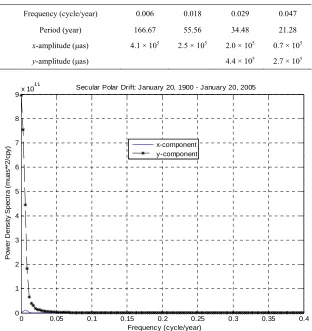
those low-frequency spectral peaks. Because of the do- mination of secular polar drift in this near-DC frequency range, only two peaks, respectively at 0.029 cycle/year (34.48 years) and at 0.047 cycle/year (21.28 years), can be commonly identified from both the x- and y- com- ponents, which are close to the Markowitz wobble. Gross [18] reports the Markowitz wobble has a period of 24 years and an amplitude of 30 mas. The wobbles in this frequency range are within or close to the bandwidth of secular polar drift; their measurements are therefore corrupted by it and are also heavily dependent on spectral resolution. The corruption of the wobbles by secular polar drift is another reason that to map polar motion into a complex plan may be misleading. However, what listed in Table 1 are yet apparent and cannot be taken too
seriously. Longer observation is needed for more detailed study of these long-period wobbles. It is not yet certain whether Equation (11) will predict such long-period wobbles. If it does not, then they are not free wobbles. Finally, we can also make a glance at secular polar drift. Based on Figure 14, we pick 0.000 - 0.012 cycle/
year as its bandwidth. Then, its power density spectrum is shown in Figure 15, and waveform is plotted together
1900 1910 1920 1930 1940 1950 1960 1970 1980 1990 2000 -4
-2 0 2 4 6x 10
5
Time (year)
X
-C
o
m
pon
ent
(
m
u
a
s)
The Chandler side-splits: January 20, 1900 - January 20, 2005
1900 1910 1920 1930 1940 1950 1960 1970 1980 1990 2000
-4 -2 0 2 4 6x 10
5
Time (year)
Y
-C
o
m
pon
ent
(
m
u
a
[image:14.595.125.474.84.377.2]s)
Figure 11. The waveform of the side-splits of the Chandler wobble from the POLE2004 series (Gross, 2005), span January 20, 1900 to January 20, 2005 at 30.4375-day intervals.
0 0.2 0.4 0.6 0.8 1
0 0.5 1 1.5 2 2.5 3 3.5
4x 10
10
Frequency (cycle/year)
P
o
w
e
r D
e
ns
it
y S
p
e
c
tr
a (
m
u
a
s
**
2
/c
py
)
The Chandler and annual wobbles removed: January 20, 1900 - January 20, 2005
[image:14.595.119.476.427.700.2]x-component y-component
1900 1910 1920 1930 1940 1950 1960 1970 1980 1990 2000 -4
-2 0 2 4 6x 10
5
Time (year)
X-Co
m
p
on
en
t (
m
u
as
)
The Chandler and annual wobbles removed: January 20, 1900 - January 20, 2005
1900 1910 1920 1930 1940 1950 1960 1970 1980 1990 2000
-4 -2 0 2 4 6x 10
5
Time (year)
Y-Com
po
n
en
t (
m
u
as
[image:15.595.113.486.85.363.2])
Figure 13. Remainders of polar motion from the POLE2004 series (Gross, 2005) with Chandler and annual wobbles removed, span January 20, 1900 to January 20, 2005 at 30.4375-day intervals.
0 0.05 0.1 0.15 0.2 0.25 0.3
0 1 2 3 4 5 6 7 8x 10
10
Frequency (cycle/year)
P
o
w
e
r D
e
ns
it
y S
p
ec
tr
a (
m
ua
s
**
2
/c
py
)
Polar Motion: January 20, 1900 - January 20, 2005
x-component y-component
[image:15.595.131.471.412.701.2]Table 1. The long-period (markowitz) wobbles.
Frequency (cycle/year) 0.006 0.018 0.029 0.047
Period (year) 166.67 55.56 34.48 21.28
x-amplitude (μas) 4.1 × 10⁵ 2.5 × 10⁵ 2.0 × 10⁵ 0.7 × 10⁵
y-amplitude (μas) 4.4 × 10⁵ 2.7 × 10⁵
0 0.05 0.1 0.15 0.2 0.25 0.3 0.35 0.4
0 1 2 3 4 5 6 7 8 9x 10
11
Frequency (cycle/year)
P
o
w
e
r D
e
ns
it
y S
p
ec
tr
a
(m
u
a
s
**
2
/c
py
)
Secular Polar Drift: January 20, 1900 - January 20, 2005
[image:16.595.146.452.471.705.2]x-component y-component
Figure 15. The power density spectrum of secular polar drift from the POLE2004 series (Gross, 2005), span January 20, 1900 to January 20, 2005 at 30.4375-day intervals.
1900 1910 1920 1930 1940 1950 1960 1970 1980 1990 2000 -4
-2 0 2 4 6x 10
5
Time (year)
X-C
o
m
p
on
en
t (
m
u
a
s
)
Polar Motion and Secular Polar Drift: January 20, 1900 - January 20, 2005
1900 1910 1920 1930 1940 1950 1960 1970 1980 1990 2000 -4
-2 0 2 4 6x 10
5
Time (year)
Y
-Com
pon
ent
(
m
u
a
s)
Polar motion Secular polar drift
Figure 16. Secular polar drift and polar motion from the POLE2004 series (Gross, 2005), span January 20, 1900 to January 0, 2005 at 30.4375-day intervals.
10. Error Analysis of the ILS Data
The observation examined above includes the less reli- able ILS data [15,34]; the high noise level in the ILS data, particularly those recorded during the 1920-1945 War period, may introduce errors into the analysis and thus lead to misinterpretation. However, Pan [15] observes that the noises in the data are mostly random and inco- herent between x- and y-components, and the incohe- rency is higher in higher frequencies. As exhibited by the observation analysis above, such incoherent random noises will not affect the periodic signals in the Chandler frequency range much, for they are incapable of periodi- cally feeding enough energy back to split the Chandler frequency [12,38], while noises with periods less than a month are already eliminated by the monthly sampling of the data. If the noises could ever affect the wobble fre- quencies, they would separate the x- and y-components of the wobbles incoherently rather than nearly identical to each other as what is observed in Figure 1 (and Fig- ure 18). On the other hand, since complex Liouville equa-
tion predicts only a non-damping single-frequency wob- ble of constant amplitude and no secular polar drift, mapping the x- and y-components of observation, par- ticularly those contain incoherent background noises, into a complex plan is misleading. In order to further clarify the problem, we will do an error analysis of the ILS data, particularly those of 1920-1945 War years, in
three directions:
1) Time domain: Figure 17 plots the original polar
motion data of the POLE2004 series, span 20 January 1900 to 20 January 2005, at 30.4375-day intervals, in- cluding the ILS data [34]. As shown, with the presence of the annual wobble, the amplitude modulation in 1920- 1945 is slightly lower but not exceptionally low. How- ever, the incoherency between the x- and y-components is conspicuous, as is also exhibited by the amplitude spectra of the data in Figure 18, which indeed reflect the
War disturbances. Figure 18 shows the incoherency gets
worse at higher frequencies, but yet hardly gets into the bandwidths of the Chandler and annual wobbles. Now we remove the annual wobble from the data, as that in
Figure 4, then the much lower amplitude modulation and
the incoherency between the x- and y-components in 1920-1945 become more conspicuous, which lead to a belief that the split of the Chandler frequency is caused by the “phase ambiguity” associated with the exception- ally low amplitude in 1920-1945. However, here we need to note that, as is already mentioned above, the x- and
[image:17.595.62.536.437.701.2]y-components of the data are not mapped to a complex plan but each treated alone and then plotted together. The amplitude spectra are all zero phase, so there is not “phase ambiguity” but incoherent noises as that shown in
Figure 18. Yet, the multiple splits of the Chandler fre-
quency are still there intact, not disappeared with “phase
1900 1910 1920 1930 1940 1950 1960 1970 1980 1990
6x 10
5
2000 -4
-2 0 2 4
Time (year)
X
-C
om
pon
ent
(
m
u
as
)
Polar Motion Observation: January 20, 1900 - January 20, 2005
1900 1910 1920 1930 1940 1950 1960 1970 1980 1990
6x 10
5
2000 -4
-2 0 2 4
Time (year)
Y
-C
om
pon
ent
(
m
u
as
)
Figure 18. Amplitude spectra of polar motion from the POLE2004 series; Gibbs phenomenon removed.
ambiguity”. There are also questions: Why the annual wobble seems less affected by the Wars but the inco- herency around it becomes worse? Why the amplitude modulation during 1914-1918 WWI period was not as low as the years afterward? These questions will become clear below. Figure 7 is the waveform of the Chandler
wobble extracted from its exact bandwidth in Figure 18,
which exhibits clearly not a single frequency motion but multiple resonant oscillations with lowest amplitude at 1927. The incoherency between the x- and y-components that is conspicuous in Figures 4, 17 and 18 is disap-
peared in Figure 7. The incoherent noises are thus sepa-
rable and removable, as exhibited by a comparison of
Figure 18 to Figure 6, since the noises do not contami-
nate the wobble frequencies. On the other hand, Figure 9
is the waveform of the main-split of the Chandler spec- trum, which exhibits a single coupled oscillation with its lowest amplitude at 1932, no longer at 1927 as that in
Figure 7, but there were no major wars in 1927-1932. If
the low amplitude modulation in 1920-1945 was indeed caused by the Wars, then there should be only one lowest point in the period, more likely closer to 1939-1945 or even 1914-1918. The envelope of amplitude modulation as that shown in Figures 7 and 9 will then be interrupted
at the same lowest point, and there will also be no shift of the amplitude modulation cycles corresponding to the Chandler frequency splits as that shown in Figures 7, 9
and 11. The amplitude modulation in Figure 9 is a typi-
cal single coupled oscillation, no longer reflects the excep- tionally low amplitude in 1920-1945 as that in Figure 4.
The shift of amplitude modulation from Figures 7 to 9 is
thus due to the removal of the three side-splits from the Chandler spectra, not because of Wars. More importantly, as is also exhibited in Figure 9, a resonant coupled os-
cillation cannot have an open end; it must be cyclic. Only one low amplitude end is not able to physically split the natural frequency of the Chandler wobble; it needs an energy feedback mechanism to achieve it [38].
2) Frequency domain: As is already demonstrated above, the bandwidth of the Chandler wobble is a con- stant regardless of data length, data quality, time span, and time sampling rate, while that of the annual wobble shifts its frequency content. The incoherent noises intro- duced during the 1920-1945 War period are separable from the constant Chandler bandwidth and removable, so the Wars have not affected the frequency content of the Chandler spectrum. A broad bandwidth contains more than a single discrete frequency; the splits of the Chan- dler spectrum within its bandwidth are expected all to be the Chandler components. Fourier theory says a periodic waveform can always be decomposed into a series of harmonics each having its individual amplitude and fre- quency. So the multiple amplitude modulations of the Chandler wobble, as demonstrated above, are due to the multiple splits of its bandwidth, and not a single fre- quency motion with time-varying amplitude¸ which is only apparent.
of the 105-year polar motion, while the lower plot is the same simulation but with the annual wobble removed. In the plots magnitude and time span are not exact but rela- tive. By comparing these two plots respectively with
Figures 4 and 17, we can find the Chandler amplitude
[image:19.595.101.493.197.430.2]modulation in certain time span can become conspicu- ously lower without War interruptions. On the other hand,
Figure 20 shows the same simulations but free of noises.
By comparing the lower plot of Figure 20 with Figures 7 and 9, we can see after the annual wobble is removed,
the Chandler amplitude modulation can become excep- tionally low in certain time span, and the envelope of a resonant coupled oscillation cannot have an open end but cyclic.
From above error analysis, it can be concluded that what the War disturbances during 1920-1945 introduced
5
0 10 20 30 40 50 60 70 80 90 100
-5 0
Time (year)
O
ri
gi
na
l S
ynt
he
ti
c
0 10 20 30 40 50 60 70 80 90 100
-5 0 5
Time (year)
A
n
nua
l W
o
bb
le
R
e
m
ov
[image:19.595.104.490.476.703.2]ed
Figure 19. Synthetic simulation of the 105-year polar motion of the POLE2004 series. Upper plot is the original simulation; lower plot is with the annual wobble removed. Magnitude and time span are not exactly simulated.
5
0 10 20 30 40 50 60 70 80 90 100
-5 0
Time (year)
O
ri
gi
na
l S
ynt
he
ti
c
0 10 20 30 40 50 60 70 80 90 100
-5 0 5
Time (year)
A
n
nu
a
l W
o
bbl
e
R
e
m
ov
ed
Figure 20. Synthetic simulation of the 105-year polar motion of the POLE2004 series free of noises. Upper plot is the original imulation; lower plot is with the annual wobble removed. Magnitude and time span are not exactly simulated.