http://www.scirp.org/journal/wjm ISSN Online: 2160-0503 ISSN Print: 2160-049X
DOI: 10.4236/wjm.2018.82004 Feb. 14, 2018 46 World Journal of Mechanics
A Study of the Elastodynamic Problem by
Meshless Local Petrov-Galerkin Method
Using the Laplace-Transform
Jaouad Eddaoudy, Touria Bouziane
Department of Physics, Faculty of Sciences, Moulay Ismail University, Meknes, Morocco
Abstract
The Meshless Local Petrov-Galerkin (MLPG) with Laplace transform is used for solving partial differential equation. Local weak form is developed using the weighted residual method locally from the dynamic partial differential equation and using the moving least square (MLS) method to construct shape function. This method is a more effective alternative than the finite element method for computer modelling and simulation of problems in engineering; however, the accuracy of the present method depends on a number of para-meters deriving from local weak form and different subdomains. In this pa-per, the meshless local Petrov-Galerkin (MLPG) formulation is proposed for forced vibration analysis. First, the results are presented for different values of
s
α , and αq with regular distribution of nodes nt =55. After, the results are
presented with fixed values of αs and αq for different time-step.
Keywords
Meshless, MLPG, Weak Form, MLS, PDEs, Elastodynamic, Laplace Transform, Support Domain, Quadrature Domain, Regular Distribution
1. Introduction
Generality of physical or mechanical problems are modeled by partial differen-tial equations (PDEs). Moreover, a high number of numerical methods and techniques have been developed for the approximation of solution of the PDEs in much research that focused mainly on the improvement of accuracy and effi-ciency of them. In recent years, attention has turned on the development of meshless methods, especially for the numerical solution of partial differential
equations. The meshless local Petrov-Galerkin (MLPG) approach [1]-[14] has
How to cite this paper: Eddaoudy, J. and Bouziane, T. (2018) A Study of the Elasto-dynamic Problem by Meshless Local Pe-trov-Galerkin Method Using the Laplace- Transform. World Journal of Mechanics, 8, 46-58.
https://doi.org/10.4236/wjm.2018.82004 Received: December 19, 2017
Accepted: February 11, 2018 Published: February 14, 2018 Copyright © 2018 by authors and Scientific Research Publishing Inc. This work is licensed under the Creative Commons Attribution International License (CC BY 4.0).
http://creativecommons.org/licenses/by/4.0/
DOI: 10.4236/wjm.2018.82004 47 World Journal of Mechanics
become very attractive, as a promising method for solving problems. This me-thod based on a local weak form and Moving Least Squares (MLS)
approxima-tion [15][16][17][18]. The main advantage of this method over the widely used
finite element methods (FEM) is that it does not need any mesh, either for the interpolation of the solution variables or for the integration of the weak forms
[19][20]. The MLPG method and its variations have been applied for
elastody-namic and elastostatic problems by several authors. For example, it is applied to
free and forced vibration analysis for solids by Gu Y. T. et al. [21] they found
that the parameter which decides the size of the sub-domain needs to be chosen
carefully. Long S. Y. et al., have applied MLPG5 method used the Heaviside
function as the test function for elastic dynamic problems [22]. They found a
good agreement compared with the results obtained by (FEM). This method also
applied by Ping Xia et al. in elastic dynamic analysis of moderately thick plate
using meshless LRPIM [23]. They have used the Newmark method for solving
the dynamic problem and have studied the effects of the size of the quadrature subdomain and the influence domain on the dynamic properties. They found if appropriate sizes are selected, good results and stability can be obtained. A meshfree-based local Galerkin method with condensation of degree of freedom
for elastic dynamic analysis by De-An Hu et al. [24], they have used the standard
implicit Newmark’s time integration scheme for solving the global dynamic sys-tem equations obtained by assembling all local discrete equations. Recent results
founded by Moussaoui and al concerning the effects of support domain αs for
elastostatic problem by MLPG [25].
The MLPG formulation is proposed in this paper to extend the MLPG method to dynamic analysis and for solving the problem of a thin elastodynamic
homo-geneous rectangular plate [26]. The Laplace transform [27] is applied to
elimi-nate the time variable, then, the obtained equations by the local formulation be-comes in function with coefficient of Laplace transform. The Stehfest inversion
method is applied to obtain the time-dependent solutions [28]. The result
pre-sented for different values of αs and αq with regular distribution of nodes
55 t
n = . After, the results are presented with fixed values of αs and αq for
different time-step. We found large domains of αs, αq and time-step by using
Laplace transform method. The integral equations have a very simple non-singular form. Moreover, both the contour and domain integrations can be easily carried out in rectangular sub-domains.
DOI: 10.4236/wjm.2018.82004 48 World Journal of Mechanics
2. Moving Least Square (MLS) Approximation
We Consider a sub-domain Ωs the neighbourhood of point
( )
T ,
X = x y ,
which is located within the problem domain Ω. To approximate a function
(
X t,)
u in Ωs, a finite set of monomial basis functions P
( )
X , is consideredin the space coordinates X in two-dimension is given by:
( )
[
]
T1, ,
X = x y
P (1)
The approximation function of a field variable u
(
X t,)
is defined in asub-domain Ωs by:
(
)
( ) (
)
T( ) (
)
1
, m , ,
h
j j
j
X t =
∑
= p X a X t = X X tu P a (2)
where P
( )
X is the monomial basis function of the spatial coordinates( )
T ,
X = x y for two dimensional problem, and m is the number of the
mo-nomial basis functions. a
(
X t,)
is a function of point X and time t and is avector of coefficients a X ti
(
,)
given by:(
X t,)
={
a X t1(
,) (
a2 X t,) (
a3 X t,)
am(
X t,)
}
a (3)
The coefficient a
(
X t,)
is obtained at any point X by minimizing a weigh-ted discrete L2 norm
(
)
T( ) (
)
( )
21 ,
n
i i i
i= R X X X X t u t
=
∑
− − J P a (4)
where n is the number of nodes in the support domain of X for which the
weight function R X
(
−Xi)
≠0, and ui is the nodal parameter of u ati
X =X .
The stationarity of J with respect to a
(
X t,)
gives:0
∂ =
∂ J
a (5)
which leads to the following linear relations:
( ) (
X X t,)
=( ) ( )
X tA a B u (6)
where
( )
tu is the vector that collects the nodal displacements for all nodes in the
support domain:
( )
{
( ) ( )
( )
}
T1 2 n
t = u t u t u t
u (7)
( )
XA is called the weighted moment matrix defined by:
( )
( ) ( ) ( )
T 1n
i i i
i
X =
∑
= R X p X p XA (8)
and the matrix B is defined by:
( )
X = R X p X1( ) ( )
1 R2( ) ( )
X p X2 Rn( ) ( )
X p Xn B (9)
Solving a
(
X t,)
from Equation (6) as:(
)
1( ) ( ) ( )
,X t = − X X t
a A B u (10)
DOI: 10.4236/wjm.2018.82004 49 World Journal of Mechanics
(
)
( ) ( )
T( ) ( )
1
, n
h
i i
i
X t =
∑
=ϕ X u t = X tu Φ u (11)
where T
( )
X
Φ is the matrix of MLS shape functions corresponding n nodes in
the support domain of the point X and can be written as:
( )
{
( ) ( )
( )
}
( )( )
( ) ( )
T T 1
1 2 n 1n
X =
ϕ
Xϕ
Xϕ
X × = p X A− X B XΦ (12)
The shape function φi
( )
X for the ith node is defined by:
( )
( )
(
1( ) ( )
)
T( )
(
1)
1m
i X j pj X A X B X ji X i
− −
=
=
∑
= p A Bφ (13)
The following quartic spline function is used, it has the following form of
( )
1 6 2 8 3 3 4 10 1
i i i i
i
i
r r r r
R r
r
− + − ≤
= ≥
(14)
i i i X X r d − =
In which X−Xi is the distance from node Xi to point X, and di is
the size of the influence domain for the weight function.
3. Basic Equations of Elastodynamics
The governing equations for a linear two-dimensional elastodynamic problem on a domain Ω bounded by a boundary Γ are:
, in
ij j bi ui cui
σ + =ρ+ Ω (15)
(
, ,)
in 2
i j j i ij
u u
ε = + Ω (16)
in ijkl ij Dijkl
σ = ε Ω (17)
where ρ the mass density, c is the damping coefficient, 22i
i u u t ∂ = ∂
is the
acce-leration, i i u u t ∂ = ∂
the velocity, σij the stress tensor, bi the body force tensor,
and
( )
,j denotesj
X
∂ ∂
The initial and boundary conditions are given as follows:
o
ˆ n
i i u
u =u Γ (18)
ˆ on
i ij j i t
t =σ n =t Γ (19)
(
)
( )
1 ,0 i0
u X t =u X X∈Ω (20)
(
)
( )
2 ,0 i0
u X t =v X X∈Ω (21)
where uˆi and tˆi are the prescribed displacement and traction on the
boun-dary Γu and Γt respectively, ui0 and vi0 denote the initial displacement
and initial velocity, nj is the unit outward normal to the boundary Γ. Γu
and Γt are complementary subsets of Γ.
DOI: 10.4236/wjm.2018.82004 50 World Journal of Mechanics
( )
(
,)
0( )
, e dst( )
,L f x t =
∫
+∞ f x t − τ= f x s (22)( )
(
,)
(
( )
,)
( )
, 0L f′ x t =sL f x s − f x (23)
( )
(
)
2(
( )
)
( )
( )
, , , 0 , 0
L f′′ x t =s L f x s −sf x − f′ x (24)
Then the Laplace-transform of the basic Equation (15) gives the general ex-pression of the partial differential equation:
(
)
(
)
2(
)
(
)
, , , , ,
ij j X s scui X s s ui X s Fi X s
σ − −ρ = − (25)
where
(
,)
(
, 0)
(
, 0)
(
, 0)
(
,)
i X s cui X sui X ui X b X si
F = +ρ +ρ + (26)
4. The MLPG Weak Formulation in Laplace-Transformed
Domain
The MLPG (meshless local Petrov-Galerkin) method constructs the weak form
over local subdomain such as Ωs, which is a small region taken for each node
inside the global domain. The local subdomains overlap, and cover the whole
global domain Ω. In the present paper, the local subdomains are taken to be of
a quadrature shape. The local weak form [20][21] of the governing Equation (25)
can be written as:
(
)
(
2)
(
)
( )
, , , ( , ) d 0, and 1, 2
s ij j i i i
X s sc s u X s F X s X i j
σ ρ
Ω − + + Θ Ω = =
∫
(27)where Θi
( )
X is a test function:by using
(
)
, , ,
ij j i ij i j ij i j
σ
Θ =σ
Θ − Θσ
(28)and applying the Gauss divergence theorem we can write:
(
) ( ) ( )
(
)
( )
(
)
(
) ( )
,
, d , d
d , , d
s s
s s
ij j i ij i j
h
i s i i i
X s n X X X s
q X X s F X s X
σ σ
∂Ω Ω
Ω Ω
Θ Γ − Θ Ω
− Θ Ω = − Θ Ω
∫
∫
∫
u∫
(29)where
2
q=sc+ρs (30)
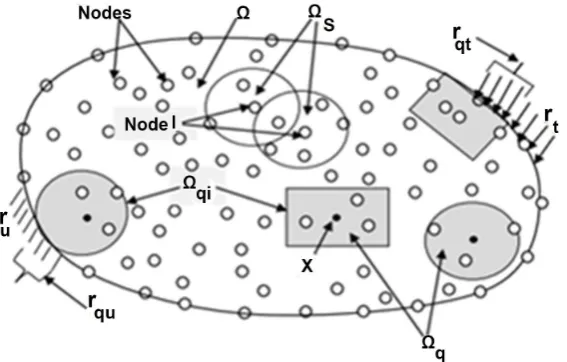
s
∂Ω is the boundary of the local subdomain, which is consisted of three parts,
i.e.
s si st su
∂Ω = Γ ∪Γ ∪Γ (See Figure 1)
si
Γ is the local boundary that is totally inside the global domain,
st
Γ is the part of the local boundary, which lies on the global boundary with
prescribed tractions, i.e. Γ = ∂Ωst s∩Γt
su
Γ is the part of the local boundary that lies on the global boundary with
prescribed displacements, i.e. Γ = ∂Ωsu s∩Γu
and considering:
(
,)
(
,) ( )
i ij j
DOI: 10.4236/wjm.2018.82004 51 World Journal of Mechanics
Figure 1. The support domain ΩS and integration domain Ωq for node I.
The local weak form in Equation (29) is leading to the following local integral equation:
(
) ( )
(
) ( )
(
)
( )
(
)
(
) ( )
(
) ( )
,
, d , d , d
ˆ
d , , d , d
si su s
s st s
i i i i ij i j
L
h
i s i i i i i
t X s X t X s X X s
q X X s t X s X F X s X
θ θ σ
θ
Γ Ω
Ω Γ Ω
− Γ − Γ + Θ Ω
+ Θ Ω = Γ + Θ Ω
∫
∫
∫
∫
u∫
∫
(32)The strains can be obtained using the approximated displacements:
( )3 1
(
,)
( ) ( )3 2 2 1(
,)
hX s X s
× =L × u ×
ε (33)
Considering Equation (11) with Laplace transform:
(
)
( ) ( )
T( ) ( )
1
, n
h
i i
i
X s =
∑
=ϕ X u s = X su Φ u (34)
( )3 1
(
)
( )3 2 1( ) ( )
( ) (3 2 2 2)( )
(2 1)( )
T, ni i i n n
X s
ϕ
X u s X s× =L ×
∑
= =L × Φ × u ×ε
(35)The constitutive equation gives the relationship between the stress and the strain:
(
,)
(
,)
ij X s =D ij X sσ ε
(
,)
1( ) ( )
ni i
i
X s =D
∑
=B X u sσ (36)
The traction vectors t X si
(
,)
at a boundary point X∈∂Ωs areapprox-imated by numbers of nodal values u si
( )
as:(
,)
(
,) ( )
i ij j
t X s =σ X s n X
(
,)
( )
1( ) ( )
ni i
i
X s = X
∑
= X st N D B u (37)
where the matrix N
( )
X related to the normal vector ni of ∂Ωs by:( )
1 22 1
0
0
n n
X
n n
=
N (38)
DOI: 10.4236/wjm.2018.82004 52 World Journal of Mechanics
( )
,1 ,2 ,2 ,1 0 0 i i i i i X ϕ ϕ ϕ ϕ = B (39)
The stress-strain matrix D for plane stress is defined by:
2 1 0 1 0 1 1 0 0 2
E ν ν
ν ν = − −
D (40)
In which E is the Young’s modulus and
ν
is the Poisson’s ratio.Obeying the boundary conditions at those nodal points on the global boun-dary, where displacements are prescribed, and making use of the approximation formulae Equation (11), we obtains the discretized form of the displacement boundary conditions:
( ) ( )
(
)
1 ˆ , for
n
k k u
k=ϕ χ u s = χ s χ∈Γ
∑
u (41)Substituting equations. (36) and (37) into Equation (32) we obtain the discre-tized Local integral equations:
( ) ( )
( )
( ) ( )
( )
( )
( ) ( )
( )
(
) ( )
(
) ( )
d d
d d
ˆ , d , d
si su
s s
st s
i i
i i s i s
i
X X X X X X
X q X X s
t X s X X s X
Γ Γ
Ω Ω
Γ Ω
− Γ − Γ
+ Ω + Ω
= + Γ + Ω
∫
∫
∫
∫
∫
∫
N DB N DB
W DB u
F Φ θ θ θ θ θ (42)
where θ
( )
X is a matrix of weight functions given by:( )
( )
( )
0 0 i i X X X θ θ = θ (43)
i
W is a matrix that collects the derivatives of the weight:
( )
( )
( )
( )
( )
, , , , 0 0 i xi i y
i y i x
X X X X X θ θ θ θ =
W (44)
The cubic spline functions are used as the test functions for the local weak form:
( )
2 3
2 3
2
4 4 0.5
3
4 4
4 4 0.5 1
3 3 0 1 j i i i i i i i i
r r r
r r r r r
r θ − + ≤
= − + − < ≤
>
(45)
where i i .
i X X r d − =
DOI: 10.4236/wjm.2018.82004 53 World Journal of Mechanics
size of the influence domain for the weight function.
Collecting the discretized local integral equations together with the discretized boundary conditions for displacements, we get the complete system of algebraic equations for computation of nodal displacements, which are the Laplace
trans-forms of fictitious parameters uk
( )
p .The time dependent values of the transformed variables can be obtained by an inverse Laplace transform. There are many inversion methods available for the
Laplace transformation. In the present analysis, the Stehfest algorithm [28] is
used. If g p
( )
is the Laplace-transform of g t( )
, an approximate value ga of( )
kg t for a specific time t is given by:
( )
1ln 2 N ln 2
a i i
g t v g i
t = t
=
∑
(46)( )
( )
( )
( )
(
) (
) (
) (
)
2 min , 2
2
1 2
2 ! 1
2 ! ! 1 ! ! 2 !
N i N
N i i
k i
k k
v
N k k k i k k i
+ = +
= −
− − − −
∑
The selected number N = 10 with a single precision arithmetic is optimal to
receive accurate results. It means that for each time t, it is needed to solve N
boundary value problems for the corresponding Laplace parameters force
ln 2
s=i t with i=1, 2,,N. If M denotes the number of the time instants in
which we are interested to know g(t), the number of the Laplace transform
solu-tions g s
( )
j is then M × N.5. Numerical Results and Discussions
In this section, numerical results will be presented to illustrate the implementa-tion and effectiveness of the proposed method. We present a numerical study for
elastodynamic 2-D problem of a rectangular homogeneous isotropic plate [26]
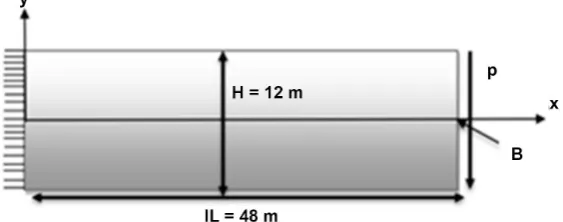
by using MLPG method, subjected to a dynamic force at the right end (Figure 2).
A plane stress problem is considered, and a unit thickness is used. The
dimen-sions of plate are length L=48 m and height H=12 m. The external
excita-tion force P=1.0f t
( )
, where f t( )
=sin( )
wt (simple harmonic load with27 rad s
w= ) is a function of time, the damping coefficient c=0.4 is fixed for
all numerical computation. A total number nt =55 uniformly distributed
nodes is used, as shown in Figure 3, to represent the problem domain.
The dimension of the quadrature domain rq is set to dq=αqdc, where αq
is the size of the quadrature domain, dc is a distance to the first nearest
neigh-bouring point from node i. The dimension of the influence domain ds is set to
s s c
d =α d , where αs is the size of the support domain.
The isotropic rectangular plate analyzed with the following material
proper-ties:
(
3)
200 GP; 0.29; 7860 kg m
E= ν = ρ= in Steel. Some important
parame-ters on the performance of the method have been investigated.
Figure 4 displays the variations of displacements uy as a function of time at
point B under the harmonic load for different values of size of support domain
1.5,1.8,1.9, 2.0, 2.5 and 3.0 s
DOI: 10.4236/wjm.2018.82004 54 World Journal of Mechanics
Figure 2. Rectangular homogeneous isotropic plate subjected to a
dynam-ic force at the right end of the plate.
[image:9.595.234.511.353.533.2]Fgure 3. Configuration and nodal arrangement for the plate.
Figure 4. Displacements uy at the middle point B at the free end of the
plate excited by the time-step load for different values of αs where 0.01 s
t
∆ = and α =q 2.0.
from this figure that the size of support domain influences on the results if
1.8 s
α < , and has a small effect on the results if α >s 1.8). When α =s 3.0, the
results obtained by the present method is very good compared with the other
authors [21] that have used the Newmark method. In the following analysis,
3.0 s
α = is employed.
The time variation of displacements uy are given in Figure 5 with different
values of size of the quadrature domain αq, where ∆ =t 0.01 s. It is found that
the size of the quadrature domain αq influences seriously the results if
0.8 q
DOI: 10.4236/wjm.2018.82004 55 World Journal of Mechanics
Figure 5. The time variation of displacements uy for different values of αq
where ∆ =t 0.01 s and α =S 3.0.
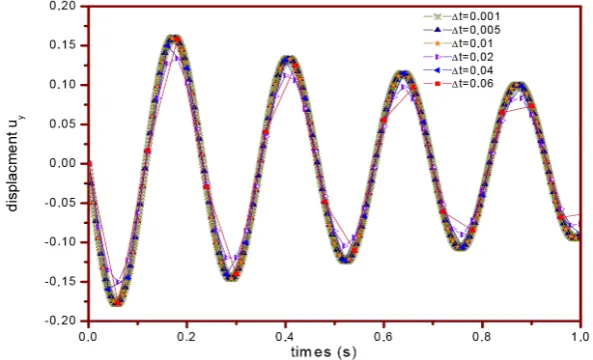
Figure 6. The time variation of displacements in the y direction at the point B
with different time steps ∆t using the fixed values αs=3.0,αq=2.0.
However, if the size of the quadrature domain is too large, the result obtained
for displacements by MLPG is great. We found good results with αq=2.0
comparing with the results obtained by Long S. Y et al. [22], they have used
0.59 q
α = .
Many time steps are used in computation to check the stability of the pre-sented MLPG formulation. The displacement variations as a function of time
and results for different time steps are plotted in Figure 6. It can be found that
when the time step ∆t is less than 0.02 s, perfect results have been obtained
using the Laplace transform comparing with the results obtained by other
au-thors [23][24] that have used the Newmark method. It also can be found that
when a time step ∆t is larger than 0.02 s, the results are not convergent and not
[image:10.595.224.521.315.495.2]DOI: 10.4236/wjm.2018.82004 56 World Journal of Mechanics
6. Conclusion
The present method MLPG that uses the cubic spline test function is used to analyze elastodynamic problem. The equation formulation based on MLPG me-thod in Laplace transform and time domain with MLS approximation has been successfully implemented to solve elastodynamic problems in isotropic solids, subjected to a dynamic force at the right end of the plate. We found that the am-plitude of the vibration decreases with time because the effects of damping and the harmonic load, the response should converge to the static deformation. We
found that when the time step ∆t is less than 0.02 s, perfect results have been
obtained by using the Laplace transform and when a time step ∆t is larger than
0.02 s the results are not accurate. We found that the size of the quadrature
do-main αq has a small effect on the results if αq>0.8, and the size of the
sup-port domain αs influences on the results if α <s 1.8. The sizing parameters
s
α and αq, which decides the size of the subdomain needs to be chosen
care-fully, especially, in the dynamic analysis.
References
[1] Atluri, S.N. and Zhu, T.L. (1998) A New Meshless Local Petrov-Galerkin (MLPG) Approach in Computational Mechanics. Computational Mechanics, 22, 117-127.
https://doi.org/10.1007/s004660050346
[2] Atluri, S.N. and Zhu, T.L. (2000) The Meshless Local Petrov-Galerkin (MLPG) Ap-proach for Solving Problems in Elasto-Statics. Computational Mechanics, 25, 169- 179. https://doi.org/10.1007/s004660050467
[3] Sladek, J., Sladek, V., Wen, P.H. and Aliabadi, M.H. (2006) Meshless Local Petrov- Galerkin (MLPG) Method for Shear Deformable Shells Analysis. CMES: Computer
Modeling in Engn. & Sciences, 13, 103-118.
[4] Sladek, J., Sladek, V., Zhang, C. and Solek, P. (2007) Application of the MLPG to Thermopiezoelectricity. CMES: Computer Modeling in Engn. & Sciences, 22, 217- 233.
[5] Mirzaei, D. and Dehghan, M. (2010) Meshless Local Petrov-Galerkin (MLPG) Ap-proximation to the Two Dimensional Sine-Gordon Equation. Journal of
Computa-tional and Applied Mathematics, 233, 2737-2754.
https://doi.org/10.1016/j.cam.2009.11.022
[6] Sladek, J., Stanak, P., Han, Z.D., Sladek, V. and Atluri, S.N. (2013) Applications of the MLPG Method in Engineering & Sciences: A Review. CMES, Computer Model-ing in Engn. & Sciences, 92, 423-475.
[7] Zhang, T., Dong, L.T., Alotaibi, A. and Satya, A.N. (2013) Application of the MLPG Mixed Collocation Method for Solving Inverse Problems of Linear Isotropic/Aniso- tropic Elasticity with Simply/Multiply-Connected Domains. CMES, Computer Mo- deling in Engn. & Sciences, 94, 1-28.
[8] Stanak, P., Sladek, V., Sladek, J., Krahuleca, S. and Sator, L. (2013) Application of Patch Test in Meshless Analysis of Continuously Non-Homogeneous Piezoelectric Circular Plate. Applied and Computational Mechanics, 7, 65-76.
DOI: 10.4236/wjm.2018.82004 57 World Journal of Mechanics [10] Sladek, J., Sladek, V. and Keer, R.V. (2003) Meshless Local Boundary Integral Equa-tion Method for 2D Elastodynamic Problems. International Journal for Numerical
Methods in Engineering, 57, 235-249. https://doi.org/10.1002/nme.675
[11] Qian, L.-F. and Ching, H.-K. (2004) Static and Dynamic Analysis of 2-d Function-ally Graded Elasticity by using Meshless Local Petrov Galerkin Method. Journal of
the Chinese Institute of Engineers, 27, 491-503.
https://doi.org/10.1080/02533839.2004.9670899
[12] Han, Z.D. and Atluri, S.N. (2004) Meshless Local Petrov-Galerkin (MLPG) Ap-proaches for Solving 3D Problems in Elasto-Statics. Computer Modeling in Engi-neering & Sciences, 6, 168-188.
[13] Han, Z.D. and Atluri, S.N. (2004) A Meshless Local Petrov-Galerkin (MLPG) Ap-proach for 3-Dimensional Elastodynamics. Computers Materials & Continua, 1, 129-140.
[14] Atluri, S.N., Han, Z.D. and Shen, S. (2003) Meshless Local Petrov-Galerkin (MLPG) Approaches for Solving the Weakly-Singular Traction & Displacement Boundary Integral Equations, CMES, 4, 507-517.
[15] Lancaster, P. and Salkauskas, K. (1981) Surfaces Generated by Moving Least Squares Methods. Mathematics of Computation 37, 141-158.
https://doi.org/10.1090/S0025-5718-1981-0616367-1
[16] Li, D., Wei, A., Luo, K. and Fan, J. (2015) An Improved Moving-Least-Squares Re-construction for Immersed Boundary Method, International Journal for Numerical
Methods in Engineering, 104, 789-804.https://doi.org/10.1002/nme.4949
[17] Shivanian, E. (2016) Local Integration of Population Dynamics via Moving Least Squares Approximation, Engineering with Computers, 32, 331-342.
https://doi.org/10.1007/s00366-015-0424-z
[18] Belytschko, T., Krongauz, Y., Organ, D., Fleming, M. and Krysl, P. (1996) Meshless Methods: An Overview and Recent Developments. Computer Methods in Applied
Mechanics and Engineering, 139, 3-47.
https://doi.org/10.1016/S0045-7825(96)01078-X
[19] Pandey, S.S., Kasundra, P.K. and Daxini, S.D. (2013) Introduction of Meshfree Me-thods and Implementation of Element Free Galerkin (EFG) Method to Beam Prob-lem. International Journal on Theoretical and Applied Research in Mechanical
En-gineering, 2, 2319-3182.
[20] Atluri, S.N., Cho, J.Y. and Kim, H.G. (1999) Analysis of Thin Beams using the Meshless Local Petrov-Galerkin Method with Generalized Moving Least Squares Interpolations. Computational Mechanics, 24, 334-347.
https://doi.org/10.1007/s004660050456
[21] Gu, Y.T. and Liu, G.R. (2001) A Meshless Local Petrov-Galerkin (MLPG) Method for Free and Forced Vibration Analyses for Solids. Computational Mechanics,27, 188-198.https://doi.org/10.1007/s004660100237
[22] Long, S.Y., Liu, K.Y. and Hu, D.A. (2006) A New Meshless Method Based on MLPG for Elastic Dynamic Problems. Engineering Analysis with Boundary Elements, 30, 43-48.https://doi.org/10.1016/j.enganabound.2005.09.001
[23] Xia, P., Long, S. and Cui, H. (2009) Elastic Dynamic Analysis of Moderately Thick Plate using Meshless LRPIM. Acta Mechanica Solida Sinica,22, 116-124.
https://doi.org/10.1016/S0894-9166(09)60096-3
DOI: 10.4236/wjm.2018.82004 58 World Journal of Mechanics [25] Moussaoui, A. and Bouziane, T. (2013) Comparative Study of the Effect of the Pa-rameters of Sizing Data on Results by the Meshless Methods (MLPG). World
Jour-nal of Mechanics, 3, 82-87.https://doi.org/10.4236/wjm.2013.31006
[26] Timoshenk, S. (1959) Theory of Plates and Shells. McGraw-Hill, New York, 2. [27] Davies, B. and Martin, B. (1979) Numerical Inversion of the Laplace Transform: A
Survey and Comparison of Methods. Journal of Computational Physics, 33, 1-32. https://doi.org/10.1016/0021-9991(79)90025-1
[28] Stehfest (1970) Algorithm 368: Numerical Inversion of Laplace Transform.