Abstract—In this paper we have studied the energy overhead performance of three different routing protocols under three different energy models. The three different energy models considered are a) Bansal Energy Model b) Vaddina Energy Model and c) Chandrakasan Energy Model. We apply these energy models to AOMDV, TORA and OLSR routing protocols to determine the energy overhead among these three routing protocols by varying the transmission range. Our aim is not to determine which energy model has less overhead, but to analyze how these routing protocols behave under different energy models. In the analysis of energy overhead the underlying mobility model also plays a very important role. We have selected the RWP-SS mobility model. In literature many research papers skip the initial simulation time while simulating the routing protocols but this particular mobility model enables us to calculate the energy overhead from the start of the simulation. The results obtained in our paper are in complete conjugation with the results obtained in [3]. We also claim that our work is the first to compare these three different energy models for determining the energy overhead of different routing protocols in mobile ad hoc networks.
Index Terms—energy, overhead, routing protocols, simulation, ad hoc networks
I. INTRODUCTION
Wireless Ad hoc networks are a hot research topic in various academias across the world. Energy efficiency plays a very important role in the battery operated ad hoc networks. Energy consumption can be due to receiving the data, transmitting the data, traffic, mobility and size of the network. The topology of a mobile ad hoc network changes continuously. Some of the nodes in the path may not be available for transmission leading to broken paths. This results in retransmission of packets. All these activities will deplete the energy available in the nodes very quickly. So, routing algorithms deployed in ad hoc networks play a key role in reducing the overhead involved in energy consumption thus ensuring the longevity of the network.
Most of the research papers proposed in the literature concentrate on the energy consumption and not on the overhead involved. There is a need to study the energy
1Department of Electronics and Telecommunication Engineering,
Jadavpur University, Kolkata 700032, West Bengal, India. [email protected], [email protected]
2Department of Computer Science and Engineering, Acharya Institute of
Technology, Visvesvaraya Technological University, Belgaum 590004, Karnataka, India.
consumption from a routing overhead point of view. The main contribution of this paper is that we have made a substantial effort to study the performance of various routing protocols like AOMDV, TORA and OLSR under three different energy models like Bansal Energy Model, Vaddina Energy Model and Chandrakasan Energy Model. To the best of our knowledge, no work has been reported that compares and studies the energy overhead of these three routing protocols under three different energy models.
The rest of the section is divided as follows. In section two we discuss some of the related work in the literature, we present the different energy models, mobility model and routing protocols in section three, the simulation parameters selected is discussed in four and analysis of result is done in section five and finally we conclude the paper.
II. RELATED WORK
Early work on energy consumption in ad hoc networks was done by Feeney et al [1]. The authors conduct various experiments to determine the energy consumption of a Lucent Wireless WaveLan IEEE 802.11 network card. The authors also formulate a linear equation to quantify the “per packet energy consumption”.
In [2] the authors have considered various mobility models like Random waypoint (RWP), Manhattan Grid Model (MG), Gauss Markov Model (GM), Community Mobility Model (CM) and RPGM. The authors have analyzed the energy consumption to receive, transmit and drop the control packets. They have calculated the energy consumption by mapping it against the mobility speed. The authors have shown that as the mobility speed is increased the energy goodput also decreases. Among these three mobility models RWP has the highest energy consumption. For CM and RPGM mobility models it is shown that as the number of groups increases then the energy consumption also decreases.
In [3] the authors have mapped the energy consumption of AODV, DSDV, DSR and TORA routing protocols. The authors have calculated the energy consumed by these four routing protocols by mapping them against varying mobility speed, traffic patterns, node numbers and area. The authors conclude that TORA routing protocol had worst performance in all the scenarios.
In [4] as in [3] three different routing protocols AODV, DSR and DSDV are considered. They are compared against Random Waypoint, RPGM and Manhattan Grid model. They use the same energy model as specified by Feeney. Through simulation the authors show that AODV has more energy
Simulation Based Overhead Analysis of
AOMDV, TORA and OLSR in MANET Using
Various Energy Models
consumption under RWP and RPGM, while DSR consumes more energy under Manhattan Grid model.
III. DESCRIPTION OF ROUTING PROTOCOLS,MOBILITY MODEL AND ENERGY MODELS
In this section we give a description of various routing protocols like AOMDV, TORA, OLSR, Energy model applied in this paper and RWP-SS mobility model.
A. Adhoc On Demand Multipath Distance Vector Routing Algorithm
Adhoc On Demand Multipath Distance Vector Routing Algorithm (AOMDV) is proposed in [5]. AOMDV employs the “Multiple Loop-Free and Link-Disjoint path” technique. In AOMDV only disjoint nodes are considered in all the paths, thereby achieving path disjointness. For route discovery RouteRequest packets are propagated through out the network thereby establishing multiple paths at destination node and at the intermediate nodes. Multiples Loop-Free paths are achieved using the advertised hop count method at each node. This advertised hop count is required to be maintained at each node in the route table entry. The route entry table at each node also contains a list of next hop along with the corresponding hop counts. Every node maintains an advertised hop count for the destination. Advertised hop count can be defined as the “maximum hop count for all the paths”. Route advertisements of the destination are sent using this hop count. An alternate path to the destination is accepted by a node if the hop count is less than the advertised hop count for the destination. We have used the AOMDV implementation for NS-2 provided by [6].
B. Temporally Ordered Routing Algorithm
TORA comes under a category of algorithms called “Link Reversal Algorithms”. TORA is an on demand routing protocol. Unlike other algorithms the TORA routing protocol does not uses the concept of shortest path for creating paths from source to destination as it may itself take huge amount of bandwidth in the network. Instead of using the shortest path for computing the routes the TORA algorithm maintains the “direction of the next destination” to forward the packets. Thus a source node maintains one or more “downstream paths” to the destination node through multiple intermediate neighboring nodes. TORA reduces the control messages in the network by having the nodes to query for a path only when it needs to send a packet to a destination. In TORA three steps are involved in establishing a network. A) Creating routes from source to destination, B) Maintaining the routes and C) Erasing invalid routes. TORA uses the concept of “directed acyclic graph (DAG) to establish downstream paths to the destination”. This DAG is called as “Destination Oriented DAG”. A node marked as destination oriented DAG is the last node or the destination node and no link originates from this node. It has the lowest height. Three different messages are used by TORA for establishing a path: the Query (QRY) message for creating a route, Update (UPD) message for creating and maintaining routes and Clear (CLR) message for erasing a route. Each of the nodes is associated with a height in the network. A link is established between the nodes based on the height. The establishment of
the route from source to destination is based on the DAG mechanism thus ensuring that all the routes are loop free. Packets move from the source node having the highest height to the destination node with the lowest height. It’s the same top to down approach.
[image:2.595.322.548.116.218.2]
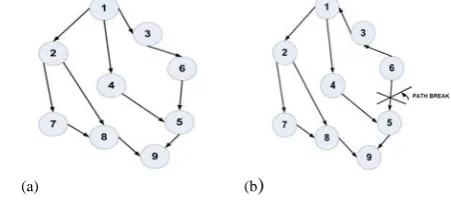
(a) (b) Figure 1. Directed Path in TORA
When there is no directed link from source to destination the source node trigger the QRY packet. The source node (node 1) broadcasts the QRY packet across all the nodes in the network. This QRY packet is forwarded by all the intermediate nodes which may contain a path to the destination. Consider fig 1(a). When the QRY packet reaches the destination node (node 9) then the destination node replies with a UPD message. Each node receiving this UPD message will set the value of the height to a value greater than the height of the node from which it had received. This results in the creation of the directed link from the source to the destination. This is the concept involved in the link reversal algorithm. This enables to establish a number of multiple routes from the source to destination. Assume that the path between node 5 and node 6 is broken (fig 1(b)). Then node 6 generates an UPD message with a new height value with in a given “defined time”. Node 3 reverses its link on receiving the UPD message. This reverse link indicates that the path to destination through that directed link is not available. If there is a break between node 1 and node 3 then it results in partition of the network where the resulting invalid routes are erased using the CLR message [7, 8, 9, 10, 11].
C. Optimized Link State Routing Protocol (OLSR) Optimized Link State Routing Protocol (OLSR) is a table driven, proactive based routing protocol. Multipoint Relay (MPR) nodes are used to optimize the OLSR routing protocol. By MPRs the number of packets broadcasted in the network is minimized. A node selects a set of one hop neighboring nodes to retransmit its packets. This subset of selected neighboring nodes is called the Multipoint Relays of that node. The MPR nodes are the only nodes those forward the packets during broadcasting. All the links between the nodes are assumed to be bidirectional. The MPR node is chosen in such a way that the chosen node is one hop and this one hop node also covers those neighboring nodes which are two hops away from the originating node. The MPR nodes are affiliated to this original node. This reduces the number of messages that needs to be retransmitted.
information is called as MPR Selector List.
Figure 2. Transmission of Packets Using MPR
Optimization in OLSR is achieved in two ways. First the amount packets broadcasted in the network is reduced as only a selected few nodes called MPR broadcast the packets. Secondly the size of the control packets is reduced as the information regarding its multipoint relay selector set is provided instead of providing an entire list of neighboring nodes [12, 13, 14, 15, 16, 17].
D. Random Waypoint Mobility Model-Steady State (RWP-SS)
While considering the Random Waypoint Mobility Model for simulation, a dissimilar mobility pattern is observed during the initial mobility duration and at the later stage of the simulation. In literature, to avoid the mentioned situation, many of the papers follow a procedure where the initial few seconds are discarded and then it is assumed that the remaining seconds of the simulation are assumed to have a similar pattern. But this method is too crude, as it can not be told at which point the dissimilar pattern starts or stops. To overcome this problem the authors of [18] have proposed the Random Way Point-Steady State Mobility Model (RWP-SS). “The initial speed and the stationary distribution location are sampled” to overcome the problem of discarding the initial simulation data. The RWP-SS without pause is given by
10 1 1
u u
S
S
u
F
(1)
Here S is the initial speed chosen uniformly over (0, 1) and F-1 (u) is the inverse of the cumulative distribution function. RWP-SS with pause is given by
p
E
dt
t
H
p
H
p
0 01
(2)
Where, H(p) is the cumulative distribution function, E(p) is the expected length of a pause. (The equations (1) and (2) are from [18])
E. Energy Model
For transmission and receiving of energy can be modeled as “E(ptx/rcv) = i * v * t p Joules”, where i is the current value, v
is the voltage and tp is the time taken to transmit or receive the
[image:3.595.81.257.71.213.2]packet [1, 2, 3]. The following table gives the various values considered for Bansal Energy Model (BEM) [19], Vaddina Energy Model (VEM) [20] and Chandrakasan Energy Model (CEM) [21].
TABLE I. VALUES OF DIFFERENT ENERGY MODELS
ENERGY MODEL TRANSMISSION
POWER
RECEIVING
POWER
IDLE
POWER
BANSAL MODEL 0.0271 0.0135 0.00000739
VADDINA MODEL 0.0744 0.0648 0.00000552
CHANDRAKASAN
MODEL
0.175 0.175 0.00000175
IV. SIMULATION ENVIRONMENT
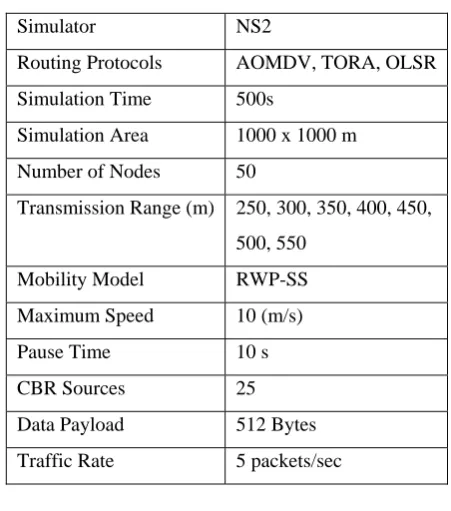
Simulations are performed using Network Simulator NS-2 [22]. The simulated values of the radio network interface card are based on the 914MHz Lucent WaveLan direct sequence spread spectrum radio model. This model has a bit rate of 2 Mbps and a radio transmission range of 250m. The IEEE 802.11 distributed coordinated function with CSMA/CA is used as the underlying MAC protocol. Interface Queue (IFQ) value of 70 is used to queue the routing and data packets.
TABLE II. VARIOUS SIMULATION PARAMETERS
Simulator NS2
Routing Protocols AOMDV, TORA, OLSR Simulation Time 500s
Simulation Area 1000 x 1000 m Number of Nodes 50
Transmission Range (m) 250, 300, 350, 400, 450, 500, 550
Mobility Model RWP-SS Maximum Speed 10 (m/s)
Pause Time 10 s
CBR Sources 25
Data Payload 512 Bytes Traffic Rate 5 packets/sec
V. RESULT ANALYSIS
[image:3.595.313.539.458.714.2]starting of the simulation time. Conserving energy leads to extended battery life in ad hoc networks. Nodes in the ad hoc networks are battery powered. A number of factors shape the extendibility of battery life in ad hoc networks like the speed at which the nodes are moving, the transmission range, the amount of packets sent and received and the amount of information that needs to be processed. It is desirable to find an optimum transmission range to conserve energy without compromising on the amount of data delivered.
Transmission range plays a very important role in deciding the amount of energy overhead needed for establishing connectivity among various nodes in the network. Increasing the transmission range leads to less hop count and there will be less breaks in the connectivity of the mobile nodes.
TORA routing protocol has maximum energy consumption at 400m across all the energy models. AOMDV has highest energy consumption at 300m, 350m and 400m for BEM, VEM and CEM models. OLSR has peak energy consumption at 550m. Here the idea is not find an optimized transmission or the amount of energy consumed by each protocol. But the intention is to see the behavior of these protocols under various energy models.
[image:4.595.329.523.55.216.2]AOMDV maintains high connectivity even at high mobility due to multiple paths resulting in less energy overhead for maintaining the network. Even though AOMDV by virtue of its multiple route maintenance has less energy overhead, the maintenance of these multiple paths itself may lead to energy overhead. The amount of energy spent in signaling tends to decrease with increase in transmission range across all the routing protocol. Energy consumption is less in OLSR when compared to TORA and AOMDV. OLSR has less energy overhead as only MPR selector nodes will broadcast its status across the network.
[image:4.595.325.526.255.440.2]Figure 3. Energy Exhausted (J) v/s Transmission Range for Bansal Energy Overhead Model
Figure 4. Energy Exhausted (J) v/s Transmission Range for Vaddina Energy Overhead Model
Figure 5. Energy Exhausted (J) v/s Transmission Range for Chandrakasan Energy Overhead Model
In TORA the number of nodes that can be accessed increases with the increase in transmission range. This increases the amount of interference and collisions, resulting in retransmission of packets. Energy spent in signaling is maximum for TORA protocol at up to 400m. After this point the energy consumption is comparable to OLSR and AOMDV routing protocols. This can be summed to the amount of packets used in maintaining links among various nodes in the network. Establishment of connectivity across the nodes is stabilized with the increase in transmission range. This reduces the energy consumed in the network.
In literature it has been mentioned that the packet delivery increases with increase in transmission range but with higher energy consumption for every transmission [23]. But we found a contrasting result in our simulation. Here energy consumption increases up to a transmission range. After that energy consumption decreases and it remains the same across all the transmission range. This tendency can be seen across all the routing protocols.
[image:4.595.77.264.464.641.2]receiving power. In CEM model the energy spent in signaling is almost same for both AOMDV and OLSR routing protocols. After a transmission range of 400m the amount of energy spent in signaling between AOMDV and TORA routing protocol remains the same across all the energy models.
VI. CONCLUSION
In this paper we consider three widely refereed research papers. We have compared the energy overhead involved in various routing protocols by using these energy models. Results are obtained through extensive simulation. We deduce that TORA routing protocol has highest energy overhead across all the three different mobility models. We have also described the role of transmission range in mobile ad hoc networks. For our future work we are planning to investigate the effect of mobility, traffic, source and network size on the energy overhead of various other routing protocols.
ACKNOWLEDGMENT
The first author of this paper would like to acknowledge the help of Sorav Bansal, Vaddina Prakash Rao and Anantha Chandrakasan in this work.
REFERENCES
[1] Laura Marie Feeney and Martin Nilsson,”Investigating the Energy Consumption of a Wireless Network Interface in an ad hoc Netwroking Environment”,
[2] Preetha Prabhakaran and Ravi Sankar, ”Impact of Realistic Mobility Models on Wireless Networks Performance“, IEEE International Conference on Wireless and Mobile Computing, Networking and Communications, Montreal, 19-21 June 2006, pp 329-334.
[3] Juan-Carlos Cano and Peitro Manzoni,”A Performance Comparison of Energy Consumption for Mobile Ad hoc Network Routing Protocols”, Proceedings of the 8th International Symposim on Modeling, Analysis
and Simulation of Computer and Telecommunication Systems, IEEE Computer Society, 2000.
[4] Bor-rong Chen and C.Hwa Chang, “Mobility Impact on Energy Conservation of Ad hoc Routing Protocols”, SSGRR 2003, Italy, Jul 28 – Aug 2, 2003.
[5] Mahesh K. Marina and Samir R.Das, “ On-Demand Multipath Distance Vector Routing in Ad-hoc Networks”, In proceedings of the IEEE International Conference on Network Protocols, 2001 pp 14-23. [6] M.Caleffi, G.Ferraiuolo and L.Pauro, “On Reliability of Dynamic
Addressing Protocols in Mobile Ad hoc Networks”, Proceedings of WRECOM’07, Wireless Rural and Emergency Communications Conference, Roma, Italy, October 2007.
[7] Vincent Park and M.Scott Corson,”Temporally Ordered Routing Algorithm”, IETF Internet Draft
[8] Vincent D.Park and M.Scott Corson,”A Performance Comparison of the Temporally Ordered Routing Algorithm and Ideal Link State Routing”, Proceedings of IEEE ISCC’98, 30 June – 2 July, Athens, Greece.
[9] Josh Broch et al,”A Performance Comparison of Multi-Hop Wireless Ad hoc Network Routing Protocols”, Proceedings of the Fourth Annual ACM/IEEE International Conference on Mobile Computing and Networking (MobiCom’98), October 25-30, 1998, Dallas, Texas, USA.
[10] N Vetrivelan and A.V.Reddy,”Performance Analysis of Three Routing Protocols for Varying MANET size”, Proceedings of the International Multiconference of Engineers and Computer Scientists 2008 Volume2, IMECS 2008, 19-21 March 2008, Hong Kong.
[11] Allen C. Sun,” Design and Implementation of Fisheye Routing Protocol for mobile ad hoc Networks”, Master of Engineering thesis, MIT.
[12] T.Clausen and P.Jacquet,”Optimized Link State Routing Protocol for Ad hoc Networks”, http://hipercom.inria.fr/olsr/rfc3626.txt
[13] Mounir Frikha and Manel Maamer,” Implementation and Simulation of OLSR protocol with QOS in ad hoc Networks”, Proceedings of the Second International Symposium on Communications, Control and Signal Processing (ISCCSP’06), 13-15 March, Marrakech, Morocco. [14] John Novatnack and Harpreet Arora,”Evaluating ad hoc Routing
Protocols with Restpect to Quality of Service”, IEEE International Conference on Wireless and Mobile Computing, Networking and Communications (WiMob’05), 03 October 2005.
[15] Kenneth Holter,”Comparing AODV and OLSR”, folk.uio.no/kenneho/studies/essay/essay.html
[16] Ying Ge et al,”Quality of Service Routing in ad Hoc Networks Using OLSR”, Proceedings of the 36th IEEE International conference on
System Sciences (HICSS’03), 2002.
[17] Rolf Ehrenreich Thorup,”Implementing and Evaluating the DYMO Routing Protocol”, Master’s Thesis, Department of Computer Science, University of Aarhus, Denmark.
[18] William Navidi, Tracy Camp and Nick Bauer,”Improving the Accuracy of Random Waypoint Simulations Through Steady-State Initialization”, Proceedings of the 15th International Conference on
Modeling and Simulation (MS’04), pp 319 -326, March 2004. [19] Sorav Bansal, Rajeev Shorey and Archan Misra, “ Comparing the
Routing Energy Overheads of Ad-hoc Routing Protocols”, IEEE Wireless Communications and Networking (WCNC 2003), 20 March 2003, New Orleans, LA, USA 2003.
[20] Vaddina Prakash Rao and Dimitri Marandin, “ Adaptive Channel Access Mechanism for Zigbee IEEE 802.15.4”, Journal of Communications Software and Systems (JCOMSS), Volume 2, Number 4, December 2006, page : 283 – 293. ISSN 1845-6421. [21] Chandrakasan,” Energy Efficient Communication for Ad-hoc Wireless
Sensor Networks”, Conference Record of the thirty fifth Asilomar Conference on Signals, Systems and Computers, 2001, pp 139-143. [22] Information Sciences Institute, “The Network Simulator Ns-2”,
Http://www.isi.edu/nanam/ns/
[23] Jing Deng et al, “Optimum Transmission Range for Wireless Ad hoc Networks”, 2nd IEEE Upstate Newyork Workshop on Sensor