PERFORMANCE COMPARISON OF TCP
VARIANTS FOR WIRELESS SENSOR NETWORKS
Nutan Bhati, Dr. Ashish Bansal
Abstract: Mobile Ad hoc Networks (MANETs) are a
collection of mobile nodes forming a dynamic autonomous network.Wireless-capable devices may operate as autonomous entities, communicating via multiple wireless hops without a pre-established fixed infrastructure. Nodes can also join or leave the network freely and arbitrarily without any restriction. Routing in WSN is becoming more complex compared to in a typical wired LAN or ad-hoc network. Therefore, a detailed analysis is required in order to gain an insight of these factors that determine the performance of the routing protocol. More specifically, it would be important to study how the different network parameters and protocols interact, and to what extent each of the individual factors affects the routing performance observed from the transport layer, i.e., the TCP. It is observed that Vegas gives better performance as compared to other variants of TCP.
Index Terms
:
WSN, AODV, DSR, DSDV, MANET, RENO, TCP, SACK, VEGASI. INTRODUCTION:
Wireless access points, representing a fixed infrastructure, allow devices equipped with wireless adapters to be linked together in a Local Area Network (LAN) and to get access to the Internet. Wireless-capable devices may operate as autonomous entities, communicating via multiple wireless hops without a pre-established fixed infrastructure. Such a network is called a Mobile Ad-hoc Network (MANET) where the nodes employed in the network can change their location from time to time.
Because of the lack of centralized control and frequent changes of network topology, routing becomes a vital
Manuscript received Oct 2014.
Nutan Bhati, Information Technology, Sri Vaishnav Institute Of
Technolgy and Science; Indore, India,+919584715785.
Dr. Ashish Bansal, Information Technology, Sri Vaishnav Institute Of
Technolgy and Science; Indore, India +919827346542.
issue and a major challenge in wireless networks. Transmission Control Protocol (TCP) is also needed to establish a reliable end-to-end connection in the network. the TCP also facilitates in managing the flow and congestion control in the data communication mechanism. Due to congestion problem, the network performance can go down by several orders of magnitude. As a consequence of that, the TCP executes four intertwined algorithms, which prevent senders from overwhelming the TCP receiver. The algorithms are defined as slow-start, congestion-avoidance, fast-retransmit and fast-recovery [3]. By implementing these mechanisms, the TCP can realize the throughput maximization so as to maintain a high performance of the network.
II. EXISTING ARCHITECTURE:
The idea of mobile ad-hoc networking is sometimes also known as infrastructure-less networking as it does not require any servers, routers, access-points or cables. Instead, a MANET is comprised of a set of autonomous mobile nodes where the nodes must work together in a distributed manner to enable routing among them. Consequently, a variety of MANET routing protocols has evolved over recent time. Examples of such routing protocols are, among others Optimized Link State Routing (OLSR) protocol Wireless Routing Protocol (WRP) Ad-hoc On-Demand Distance Vector (AODV) routing protocol [39], Dynamic Source Routing (DSR) protocol . Among several TCP variants, five types are considered important for our investigation namely TCP Reno, TCP New Reno, TCP Tahoe, TCP Vegas and TCP Selective Acknowledgment (SACK). These five variants are reckoned as the most prominent transport layer mechanisms.
ANALYSIS OF EXISTING ARCHITECTURE:
For our work to be done successfully we have used MANET scenario with varying node density which are 30, 40 and 50 nodes and constant 100 sec under dynamic scenario using various routing protocols. We have reached to the results with the help of various performance matrices for now we have used following performance matrices.
1. End to End Delay 2. Packet Delivery Ratio 3. Residual Energy
III.ADETAILED ANALYSIS OF ABOVE MENTIONED MATRICES ARE AS FOLLOWS.
3.1 End to End Delay
(A) End to End Delay for AODV nodes:- Figure shows
the End to End Delay under various node density i.e. 30, 40 and 50 nodes for AODV routing protocol.
III.I(a) End To End Delay for AODV
Fig: 3.1(a) End To End Delay for AODV
(B) End to End Delay for DSDV nodes:- Figure shows
the End to End Delay under various node density i.e. 30, 40 and 50 nodes for DSDV routing protocol.
III.I(b) End To End Delay for DSDV
Fig: 3.1(b) End To End Delay for DSDV
(C) End to End Delay for DSR nodes:- Figure shows
the End to End Delay under various node density i.e. 30, 40 and 50 nodes for DSR routing protocol.
III.I(c) End To End Delay for DSR
Fig: 3.1(c) End To End Delay for DSR
3.2 Packet Delivery Ratio
(A) Packet Delivery Ratio for AODV:- Figure shows
the PDR under various node density i.e. 30, 40 and 50 nodes for AODV routing protocol.
III.II (a) Packet Delivery Ratio for AODV
End to End Delay for DSDV
No. Of
Nodes NewReno RENO TCP SACK Vegas 30 nodes 139.4 137.7 138.3 139.4 23.9 40 nodes 131.1 131.5 131.1 131.1 22.6 50 nodes 146.4 142.7 145.1 142.8 146.4
End to End Delay for AODV
No. of
Nodes NewReno RENO TCP SACK Vegas 30 node 157.506 161.805 146.735 154.786 35.7482 40 node 332.825 507.088 339.32 496.123 54.8288 50 node 234.306 350.673 234.306 390.48 234.306
End to End Delay for DSR
No. Of
Nodes NewReno RENO TCP SACK Vegas 30 nodes 182.58 191.75 182.68 189.27 137.99 40 nodes 200.24 213.41 429.395 449.7 56.119 50 nodes 461.32 253.66 461.32 502.58 461.32
Packet Delivery Ratio for AODV
No. of
Nodes NewReno RENO TCP SACK Vegas 30 node 96.98 96.23 96.19 96.68 97.27 40 node 93.98 94.15 94.98 92.89 97.56 50 node 91.08 94.31 91.08 87.78 91.08
Fig: 3.2(a) Packet Delivery Ratio for AODV
(B) Packet Delivery Ratio for DSDV:- Figure shows
the PDR under various node density i.e. 30, 40 and 50 nodes for DSDV routing protocol.
III.II (b) Packet Delivery Ratio for DSDV
Packet Delivery Ratio for DSDV
No. of
Nodes NewReno RENO TCP SACK Vegas 30 nodes 93.6 92 92.8 92.9 93.1 40 nodes 90.5 90.5 90.5 90.5 26.1 50 nodes 85.5 85.3 85.1 85.4 85.5
Fig: 3.2(b) Packet Delivery Ratio for DSDV
(C) Packet Delivery Ratio for DSR:- Figure shows the
PDR under various node density i.e. 30, 40 and 50 nodes for DSR routing protocol.
III.II (c) Packet Delivery Ratio for DSR
Packet Delivery Ratio for DSR
No. of Nodes
New Reno
RENO TCP SACK Vegas 30 nodes 96.49 96.79 96.16 97.51 92.11 40 nodes 81.17 97.06 96.22 96.9 97.05 50 nodes 94.54 95.41 94.54 93.39 94.54
Fig: 3.2(c) Packet Delivery Ratio for DSR
3.3 Residual ENERGY
(A) Residual Energy for AODV:- Figure shows the
Residual Energy under various node density i.e. 30, 40 and 50 nodes for AODV routing protocol.
III.III (c) Residual Energy for AODV
Energy for AODV
No. of
Nodes NewReno RENO TCP SACK Vegas 30 node 31.952 32.89 29.569 30.819 44.89 40 node 26.45 29.13 28.74 29.701 27.72 50 node 26.66 27.43 26.66 28.05 26.66
Fig: 3.2(a) Residual Energy for AODV
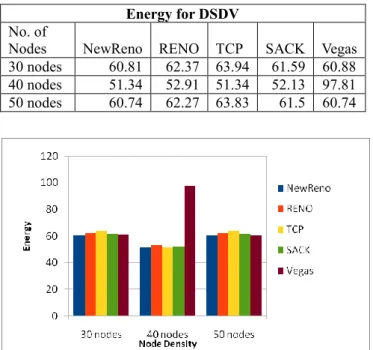
(B) Residual Energy for DSDV:- Figure shows the
Residual Energy under various node density i.e. 30, 40 and 50 nodes for DSDV routing protocol.
Energy for DSDV
No. of
Nodes NewReno RENO TCP SACK Vegas 30 nodes 60.81 62.37 63.94 61.59 60.88 40 nodes 51.34 52.91 51.34 52.13 97.81 50 nodes 60.74 62.27 63.83 61.5 60.74
Fig: 3.3(b) Residual Energy for DSDV
(C) Residual Energy for DSR:- Figure shows the
Residual Energy under various node density i.e. 30, 40 and 50 nodes for DSR routing protocol.
III.III (c) Residual Energy for DSR
Energy for DSR
No.of Nodes
NewReno RENO TCP SACK Vegas 30nodes 36.45 28.94 47.71 28.13 80.89 40nodes 26.55 26.8 28.76 27.82 26.64 50nodes 28.81 28.88 28.81 28.3 28.81
Fig: 3.3(c) Residual Energy for DSR IV.CONCLUSIONS:
The detailed study in MANET over five main variants which are Reno, NewRENO, TCP, SACK and Vegas concluded that DSR and DSDV protocols performs better with PDR for all variants. Also Packet Delivery
Ratio for SACK is better as compared to other variant. But TCP variant Vegas is giving good result with End to End Delay and energy.
V.FUTURE ENHANCEMENT:
Current research work has focused on few parameters like End-to-end, Packet Delivery Ratio, and Residual Energy. But there are also other efficiency parameters of TCP like packet drops, Flow control , Error control and connection control and throughput which can be studied in future.
Refrences
[1] S. Senouci, and G. Pujolle, “Energy efficient consumption in wireless ad hoc networks” IEEE ICC 2004 (International conference on communications), Paris JUNE 2004.
[2] M. Zorzi and R. Rao, “Energy Efficiency of TCP in a local wireless environment”mobile networks and applications,, vol. 6, no. 3, July 2001.
[3] S. Agrawal and S. Singh, “An Experimental Study of TCP’ s Energy Consumption over a Wireless Link” 4th
European personal Mobile Communications Conference , Feb 20-22, 2001, Vienna Austia.
[4] H. Singh and S. Singh, “Energy consumption of TCP Reno, New Reno, and SACK in multi-hop wireless networks”, in ACM SIGMETRICS 2002, June 15-19 2002.
[5] W. Stevens, “TCP slow start, congestion avoidance, fast retransmit and fast recovery algorithms," RFC 2001, IETF, January 1997.
[6] V. Bhanumathi and R. Dhanasekaran, "TCP variants - A comparative analysis for high bandwidth – delay product in mobile adhoc network," in 2nd International
Conference on Computer and Automation Engineering (ICCAE),2010, Singapore, 2010, pp. 600-604.
[7] D. Kliazovich and F. Granelli, “Cross-layer congestion control in ad hoc wireless networks,” Ad Hoc
Networks, vol. 4, no. 6, pp. 687-708, November 2006.
[8] M. Allman, V. Paxson, and W. Stevens, “TCP congestion control," RFC 2581(Proposed Standard),
Obsoleted by RFC 5681, IETF, September 2009.
[9] Y. G. Doudane, S. M. Senouci, and A. S. Ghaleb, "A performance study of TCP variants in terms of energy
consumption and average goodput within a static ad hoc environment," in Proceedings of the 2006 international
conference on Wireless communications and mobile computing, New York, NY, USA, pp. 503-508, 2006.
[10] V. Jacobson., “Congestion avoidance and control”, SIGCOMM symposium on communications architectures and protocols, pages 314-329,1988. An updated version
is available via ftp://ftp.ee.lbl.gov/papers/congavoid.ps.z. [11] ] K. Fall and S. Floyd., “Simulation-based comparison of Tahoe, Reno, and sack TCP”, in ACM computer communications review, july 1996.
[12] Thomas Clausen, “Comparative Study of Routing Protocols for Mobile Ad-Hoc NETworks”, INRIA, March 2004.
[13] L. Brakmo and L. Peterson, “TCP Vegas: end-to-end congestion avoidance on a global internet,” IEEE
Journal on Selected Areas in Communication, vol. 13,
pp. 1465-1480, Oct. 1995.
[14] A. Huhtonen, “Comparing AODV and OLSR Routing Protocols”, session on Internetworking, April 2004.
[15] D. Triantafyllidou and K. Al Agha, "Evaluation of TCP performance in MANETs using an optimized scalable simulation model," in 15th International
Symposium on Modeling, Analysis, and Simulation of Computer and Telecommunication Systems, 2007, MASCOTS '07, pp. 31-37, November 2008.