A phoneme clustering algorithm based on the obligatory contour principle
Mans Hulden Department of Linguistics
University of Colorado [email protected]
Abstract
This paper explores a divisive hierarchi-cal clustering algorithm based on the well-known Obligatory Contour Principle in phonology. The purpose is twofold: to see if such an algorithm could be used for un-supervised classification of phonemes or graphemes in corpora, and to investigate whether this purported universal constraint really holds for several classes of phono-logical distinctive features. The algorithm achieves very high accuracies in an unsu-pervised setting of inferring a consonant-vowel distinction, and also has a strong tendency to detect coronal phonemes in an unsupervised fashion. Remaining classes, however, do not correspond as neatly to phonological distinctive feature splits. While the results offer only mixed support for a universal Obligatory Contour Princi-ple, the algorithm can be very useful for many NLP tasks due to the high accuracy in revealing consonant/vowel/coronal dis-tinctions.
1 Introduction1
It has long been noted in phonology that there seems to be a universal cross-linguistic tendency to avoid redundancy or repetition of similar speech features within a word or morpheme, especially if the phonemes are adjacent to one another. Many different names are given to variants of this gen-eral phenomenon in the linguistic literature: “iden-tity avoidance” (Yip,1998), “similar place avoid-ance” (Pozdniakov and Segerer, 2007), “oblig-atory contour principle” (OCP) (Leben, 1973), and “dissimilation” (Hempl,1893). Some special
1All code data sets used are available at https:// github.com/cvocp/cvocp
cases such as haplology (avoidance of adjacent identical syllables) also fall in this general cate-gory of avoiding repetition along some dimension. The general phenomenon itself is supported by robust, although inconsistent, evidence across a number of languages. An early example is the observation of Spitta-Bey (1880),2 that the
Ara-bic language tends to favor combination of con-sonant segments (phonemes) in morphemes that have different places of articulation; this was also later pointed out by Greenberg (1950) and those Semitic root outliers that deviate from this pat-tern were analyzed in depth inFrajzyngier(1979). In Proto-Indo-European (PIE) roots, which are mostly structured CVC, stop-V-stop combinations have been found to be statistically underrepre-sented (Iverson and Salmons,1992). That is, PIE seems to obey a cross-linguistic constraint that dis-favors two similar consonants in a root. Another specific example comes from Japanese, where the phenomenon called Lyman’s law—which effec-tively says that a morpheme may consist of max-imally one voiced obstruent—can also be inter-preted as avoidance (Itˆo and Mester,1986).
In light of such evidence, proposals have been put forth to define the concept of phoneme by distributional properties alone as opposed to the prevalent distinctive feature systems which are largely based on articulatory features ( Fischer-Jørgensen, 1952). Elsewhere, after finding a sta-tistical tendency to avoid similar place of articula-tion in word-initial and word-medial consonants, Pozdniakov and Segerer(2007) offer the argument
2Nun hat, wie schon l¨angst bemerkt ist, die arabische Sprache die Neigung, solche Buchstaben in einem Worte zu vereinigen, deren Organe weit von einander entfernt liegen, wie Kehllaute und Dentale. Translation: Now, the Arabic language, as has long been noted, has the tendency to com-bine such letters in a word where the place of articulation is distant, such as gutturals and dentals (Spitta-Bey,1880, p. 15).
that this phenomenon of “Similar Place Avoid-ance” is a statistical universal.
This phenomenon is often filed under the generic heading “obligatory contour principle” (Leben,1973;McCarthy,1986;Yip,1988;Odden, 1988;Meyers,1997;Pierrehumbert, 1993; Rose, 2000;Frisch,2004). Originally, the OCP was ap-plied as a theoretical constraint only to tone lan-guages, with the argument that adjacent identical tones inunderlying forms were rare, and this re-flected an obligatory contour principle. The usage has since spread, and is assumed to account for segmental features other than tone.
It is unclear why the phenomenon is so widespread and why it manifests itself in the di-verse ways it does. Accounts range from informa-tion compression to a diachronically visible hyper-correction by listeners who misperceive the signal and make the assumption that repetition is unlikely (Ohala,1981).
This paper explores the simplest incarnation of the idea of similarity avoidance; namely, that two adjacent segments are preferably different in some way and that this difference reveals itself glob-ally. That is, it is not assumed that the con-straint is absolute; rather, an algorithm is devel-oped that induces grouping of unknown phoneme symbols so as to maximize potential alternation of clusters in a sequence of symbols, i.e. a cor-pus. If the OCP holds for phonological or phonetic features—primarily places of articulation—such a clustering algorithm could group phonemes along the lines of distinctive features. While, as we shall see, the observations do not support the pres-ence of a strong universal OCP effect, the top-level clusters discovered by the algorithm correspond nearly 100% to the distinction of consonants and vowels—or syllabic and non-syllabic elements if expressed in terms of features. Furthermore, a tier-based variant of the algorithm additionally groups consonants somewhat reliably into coronal/non-coronal places of articulation, and also often dis-tinguishes front vowels from back vowels. This is true even if the algorithm is run on alphabetic representations. An evaluation of the ability to detect C/V distinction against a data set of 503 Bible translations (Kim and Snyder,2013) is in-cluded, improving upon earlier work that attempts to distinguish between consonants and vowels in an unsupervised fashion (Kim and Snyder,2013; Goldsmith and Xanthos,2009;Moler and
Morri-son,1983;Sukhotin,1962). The algorithm is also more robust than earlier algorithms that perform consonant-vowel separation and works with less data, something that is also briefly evaluated.
This paper is structured as follows: an overview of previous work is given in section 2, mostly related to the simpler task of grouping conso-nants and vowels without labeled data, rather than identifying distinctive features. Following that, the general algorithm is developed in section 3, after which the experiments on both phonemic and graphemic representations in section4are re-ported. Four experiments are evaluated. The first uses phonemic data from 9 languages for clus-tering and evaluates clusclus-tering along distinctive feature lines. The second is a graphemic exper-iment that uses a data set of Bible translations in 503 languages where the task is to distinguish the vowels from the consonants; here, results are compared toKim and Snyder(2013) on the same data set. That data is slightly noisy, motivating the third experiment, which is also graphemic and evaluates consonant-vowel distinctions on vetted word lists from data taken from the ACL SIG -MORPHONshared task on morphological
reinflec-tion (Cotterell et al., 2016). The ability of a tier-based variant of the algorithm to separate coro-nals from non-corocoro-nals is evaluated in a fourth ex-periment where Universal Dependencies corpora (Nivre et al.,2017) are used.
The main results are presented in section 5. Given the high accuracy of the algorithm in C/V distinction with very little data and its consequent potential applicability to decipherment tasks, a small practical example application is evaluated which analyzes a fragment of text, a manuscript of only 54 characters.
2 Related Work
The statistical experiments of Andrey
Markov (1913) on Alexander Pushkin’s poem
Eugene Oneginconstitute what is probably one of
as a proxy for phonology since textual data is easier to come by. A spectral method was introduced by Moler and Morrison (1983) with the explicit purpose of distinguishing consonants from vowels by a dimensionality reduction on a segment co-occurrence matrix through singular value decomposition (SVD). An almost iden-tical SVD-based approach was later applied to
phonological data by Goldsmith and Xanthos
(2009). Hidden Markov Models coupled with the EM algorithm have also been used to learn consonant-vowel distinctions (Knight et al., 2006) as well as other latent structure, such as vowel harmony (Goldsmith and Xanthos, 2009). Kim and Snyder (2013) use Bayesian inference supported by simultaneous language clustering to infer C/V-distinctions in a large number of scripts simultaneously. We compare our results against a data set published in conjunction with that work. More directly related to the current work are Mayer et al. (2010) and Mayer and Rohrdantz (2013) who work with models for visualizing consonant co-occurrence in a corpus.
2.1 Sukhotin’s algorithm
Sukhotin’s algorithm (Sukhotin,1962,1973) is a well-known algorithm for separating consonants from vowels in orthographic data; good descrip-tions of the algorithm are given inGuy(1991) and Sassoon(1992). The idea is to start with the as-sumption that all segments in a corpus are con-sonants, then repeatedly and greedily find the seg-ment that co-occurs most with other segseg-ments, and declare that a vowel. This is performed until a stopping condition is reached. The algorithm is known to perform surprisingly well (Foster,1992; Goldsmith and Xanthos,2009), although it is lim-ited to the task it was designed to do—inferring a C/V-distinction (with applications to decipher-ment) without attempting to reveal any further structure in the segments. All the syllabic/non-syllabic distinction results in the current work are compared with the performance of Sukhotin’s al-gorithm.
3 General OCP-based algorithm
At the core of the new clustering algorithm is the OCP-observation alluded to above, already empir-ically established in (Markov, 1913, 2006), that there is a systematic bias toward alternating ad-jacent segments along some dimension. To reveal
this alternation, one can assume that there is a nat-ural grouping of all segments into two initial sets, called0and1, in such a way that the total number of 0-1 or 1-0 alternations between adjacent seg-ments in a corpus is maximized. For example, consider a corpus of a single stringabc. This can be split into two nonempty subsets in six different ways:0={ab}and1={c};0={a}and1={bc};
0={ac}and1={b}, and their symmetric variants which are produced by swapping0and1. Out of these, the best assignment is0={ac}and1={b}, since if reflects an alternation of sets whereabc7→
010. The ‘score’ of this assignment is based on the number of adjacent alternations, in this case 2 (01
and10).
Outside of such small examples which split per-fectly into alternating sets, once this optimal divi-sion of all segments into 0 and 1is found, there may remain some residue of adjacent segments in the same class (0-0and1-1). The sets0and1can then be partitioned anew into subsets00,01(from
0) and10 and11 (from1). Again, there may be some residue, and the partitioning procedure can be applied recursively until no further splitting is possible, i.e. until all of the adjacent segments fall into different clusters in the hierarchy.
More formally, given a corpus of words w1, . . . , wnand where each word is a sequence of
symbolss1, . . . , sm, this top-level objective
func-tion that we want to maximize can be expressed as
X
w
X
i
1(Group(si)6=Group(si+1)) (1)
whereGroup(s)is the set that segmentsis in. Given a suggested split of all the segments in a corpus into, say, the top-level disjoint sets 0 and
1, we obviously do not need to examine the whole corpus to establish the score but can do so by sim-ply examining bigram counts of the corpus.
Still, finding just the top-level split of segments into0and1is computationally expensive if done by brute force by trying all the possible assign-ments of segassign-ments into0and1and evaluating the score for each assignment. Since there are2nways
of partitioning a set of segments into two subsets (ignoring the symmetry of 0and 1), such an ap-proach is feasible in reasonable time only for small alphabets (<25, roughly).
of simulated annealing (Kirkpatrick et al., 1983; ˇCern`y,1985) to quickly find the optimum. The al-gorithm for the top-level split proceeds as follows:
(1) Randomly divide the setSintoS0andS00
(2) Draw an integer p from Uniform(1. . . K), whereKdepends on the cooling schedule
(3) Swapprandom segments betweenS0andS00
(4) If score is higher after swap, keep swap else discard swap. Go to (2).
The idea is to begin with an arbitrary partition ofSintoS0andS00, then randomly trying
succes-sively smaller and smaller random swaps of seg-ments between the two sets according to a cooling schedule, always keeping the swap if the score im-proves. The cooling schedule was tested against corpora that use smaller alphabets where the an-swer is known beforehand by a brute-force cal-culation. The cooling was made slow enough to give the correct answer in 100/100 tries on such development corpora. In practice, this yields an annealing schedule where early swaps (the size of K) are sometimes as large as |S|, ending in K equaling 1 for several iterations before termina-tion. This splitting is repeated recursively to pro-duce new sub-splits until no splitting is possible, i.e. the score cannot improve by splitting a set into two subsets.
3.1 A tier-based variant
Many identity avoidance effects have been doc-umented that seem to operate not by strict adja-cency, but over intervening material, such as con-sonants and vowels, as discussed in the introduc-tion. For example, Rose(2000) argues that OCP effects apply to adjacent consonants across inter-vening vowels in Semitic languages. This moti-vates a tier-based variant of the algorithm. In this modification, instead of repeatedly splitting sets based on a residue of adjacent segments that be-long to the same set, we instead modify the cor-pus, removing segments after each split. Each time we split a set S into S0 andS00 based on a
corpusC, we also create new corporaC0 andC00
where segments in S00 are removed from C0 and
segments in S0 are removed from C00. Splitting
then resumes recursively forS0 andS00, whereS0
uses the corpus C0 andS00 the corpus C00.
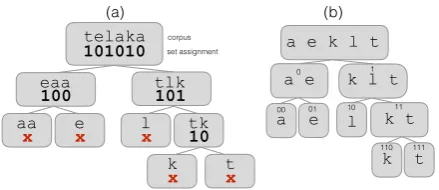
Fig-ure1 shows an example of this. Here, the initial
telaka
tlk 101010
101 eaa
100 aa
x ex lx tk10 k
x tx
a e k l t
a e k l t
a e l k t
k t
0 1
00 01 10 11
110 111 corpus
set assignment
[image:4.595.307.527.61.156.2](a) (b)
Figure 1: Illustration of the tier-based variant of the clustering algorithm. The left-hand side (a) shows the original corpus (the single wordtelaka), where each character is assigned a top-level group-ing, after which the corpus is modified to remove characters in the respective sets0and1. The al-gorithm is then applied recursively to the modified corpora. The resulting clustering is shown in (b).
corpus C = telaka, and the initial segment set S = {a, e, k, l, t} is split into S0 = {a, e} and S00 = {k, l, t} on a first iteration. Likewise, the
corpus is now modified by removing the S0 and S00 segments fromC00 andC0 respectively,
yield-ing new corpora C0 = eaa and C00 = tlk, and
splitting proceeds on these subcorpora. This way, if, say, consonants and vowels operate on different tiers and get split first into top-level sets, the re-maining consonants will become adjacent to each other on the next iteration, as will the vowels.
4 Experiments
Language Source Sample
Arapaho (Cowell and Moss Sr,2008) towohei hiiTetiPtohnookePtootheiPeihoo. . .
Basque Wikipedia + g2p meSikoko iriburuko espetSe batean sartu zuten eta meSiko. . .
English (Brent and Cartwright,1996) ju want tu siD@bUk lUkDErz @bOIwIDhIz hæt. . .
Finnish (Aho,1884) + g2p vai oli eilen kolmekymmentækotoapæinkøse matti ajelee. . .
Hawaiian Wikipedia + g2p Po kaP¯olelo hawaiPi kaP¯olelo makuahine a ka poPe maoli. . .
Hungarian (Gervain and Erra,2012) idZnintSj6j dE tSEtSEhol6montSik6hol v6n6montSi itt6. . .
Italian Wikipedia + g2p tSitta eterna kon abitanti e il komune piu popoloso ditalia. . .
Polish (Boruta and Jastrzebska,2012) gdýie jest bartuCgdýie jestñe ma xodýtu a kukuţo xovaS. . .
[image:5.595.308.524.243.406.2]Spanish (Taul´e et al.,2008) + g2p un akueRdo entRe la patRonal i los sindikatos fRanTeses sobRe. . .
Table 1: The data used for the phonemic clustering experiment, with sources indicated and a sample.
found. Both the non-tier algorithm and the tier-based algorithm is evaluated.
In the second experiment, the capacity of the algorithm to distinguish between consonants and vowels is evaluated, this time with graphemic data. To separate consonants from vowels—the most significant dimension of alternation between ad-jacent segments—the algorithm is run only for the top-level split, and it is assumed that the top two subsets will represent the consonants and vow-els. Here, the results are compared with those of Kim and Snyder(2013), who train a hierarchical Bayesian model to perform this distinction over all the 503 languages at the same time. Sukhotin’s al-gorithm is also used as another baseline.
In the third experiment, the capacity to distin-guish consonants and vowels in graphemic data in the form of word lists—i.e. where no frequency data is known—is evaluated compared against Sukhotin’s algorithm.
4.1 Phonemic splitting
Nine languages from a diverse set of sources were used for this experiment (see Table 1). Some of the language data were already represented as phonemes (English, Hungarian, and Polish), while for the others, which have close-to-phonemic writ-ing systems, a number of grapheme-to-phoneme (g2p) rules were created manually to convert the data into an International Phonetic Alphabet (IPA) representation. The conversion was on the level of the phoneme—actual allophones (such as /n/ be-ing velarized to [N] before /k/ in most languages or /d/ being pronounced [D] intervocalically in Span-ish) were not modeled. Table 1 summarizes the data and gives a sample of each corpus.
For this data, the clustering algorithm was run as described above and each split was annotated
a e d h i j k l m n ŋ o p r s t u v æ ø
a e i o u y æ ø
a e o æ ø
[-syllabic]
i u y h l ŋ p r s
h s
j k
u y a æ
e ø h s p n t
y u o a
l ŋ r æ
e ø
i l ŋ p r d m t v
l ŋ r
e o ø j k n
d m v
d j k m n t v
[+trill] [-high]
d h j k l m n ŋ p r s t v
[+back]
[+round] [+low] [-del rel]
[+back] [+front] [+cons] [+sonorant] [-coronal] [+voice]
[+round]
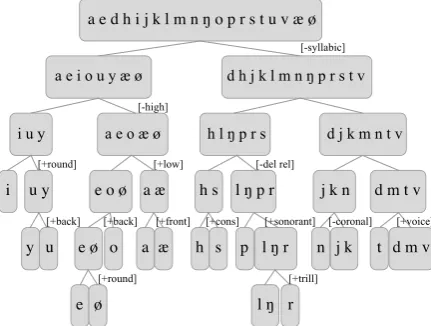
Figure 2: Resulting Finnish clusters with manual annotation of the distinctive feature splits.
with information about whether the splitcouldbe defined in terms of a single distinctive feature. Figure2shows the output of such a tree produced by the algorithm, with manual feature annotations. The percentage of correctly identified top-level splits (which are syllabic/non-syllabic segments) is also given, together with the corresponding results from Sukhotin’s C/V-inference algorithm, and Moler & Morrison’s SVD-based algorithm.
4.2 C/V distinction in Bible translations
This experiment relies on word lists and fre-quency counts from Bible translations covering 503 distinct languages. Of these, 476 use a Latin alphabet, 26 a Cyrillic alphabet, and one uses Greek. The data covers a large number of lan-guage groups, and has been used before byKim and Snyder(2013) to evaluate accuracy in unsu-pervised C/V-distinction.
a task where all languages’ consonants and vowels are learned at once, as if the corpus were one lan-guage, for clearer comparison with earlier work. Both token-level accuracy and type-level accuracy are given, again, for comparability reasons. For this data set, Sukhotin’s C/V-algorithm and Moler & Morrison’s algorithm were used as baselines in addition to the results ofKim and Snyder(2013).
4.3 C/V-distinction with word lists
An additional experiment evaluates the al-gorithm’s capacity to perform C/V-distinction against Sukhotin’s algorithm on a data set of 10 morphologically complex languages where lists of inflected forms were taken from theACL SIGMOR -PHON shared task data (Cotterell et al.,2016). In
this case, we have no knowledge of the frequency of the forms given, but need to rely only on type information. The Arabic data was transliterated into a latinate alphabet (by DIN 31635), with vow-els marked. For the other languages, the native al-phabet was used. Per-type accuracy is reported.
5 Results
On the first task, which uses phonemic data, consonant/vowel distinction accuracy is 100% throughout (see Table 2). Sukhotin’s algorithm also performs very well in all except two lan-guages. English, in particular, is a surprising out-lier, with Sukhotin’s algorithm only classifying 21.62% correctly. This is probably due to there existing a proportionately large number of syllabic phonemes in English (13/37). Moler & Morrison’s algorithm has less than perfect accuracy in three languages. There is great variation in the OCP algorithm’s capacity to produce splits that coin-cide with phonological features in both the tier-based and non-tier variants. Roughly speaking, the larger the phoneme inventory, the less likely it is for the splits to align themselves in accordance with phonological features. Also, since the tier-based variant naturally leads to more splits, the figures appear higher since splits in lower levels of the tree, which contain few phonemes, can almost always be done along distinctive feature lines. The depth of the induced tree also correlates with the variety of syllable types permitted in the language. An extreme example of this is Hawaiian (Figure 3), which only permitsVandCVsyllables, yield-ing a very shallow tree where no consonants are split beyond the first level. English and Polish lie
a e h i k l m n o p u w ʔ
h k l m n p w ʔ a e i o u
e i u
e u
i a o
e u
[image:6.595.328.505.58.243.2]a o
Figure 3: Hawaiian clusters reveal a predomi-nantly CV/V syllable type since the non-syllabic branch of the tree is shallow.
at the other extreme, with 37 splits each. This cir-cumstance may perhaps be further leveraged to in-fer syllable types from unknown scripts.
On the C/V inference task for 503 languages, the OCP algorithm outperforms Sukhotin’s algo-rithm and Kim and Snyder (2013) (K&S) when each language is inspected individually (see Fig-ure3). However, for the case where we learn all distinctions at once, the OCP algorithm produces an identical result with Sukhotin. Here the token level accuracy also exceeds K&S with 99.89 vs. 98.55.
The already high accuracy rate of the OCP algo-rithm on the Bible translation data is probably in reality even higher, especially when all languages are inspected at the same time. Out of the 343 grapheme types, OCP and Sukhotin only misclas-sify 7, and upon closer manual inspection, it is found that only two of these are bona fide errors. Five are errors in the gold standard—all in the Cyrillic-based data (see Table 5 for an overview of the errors in the gold standard or the classifica-tions). The first actual error, Cyrillics, only occurs in five word types in the entire corpus, and is al-ways surrounded by other consonants. The other error, ˇo, is more difficult to interpret—it occurs in three typologically different languages: Akoose (bss), Northern Grebo (gbo), and Pe˜noles Mixtec (mil).
Language SplitsOCP OCP(tier)Splits (OCP) (Sukh.) (M&M)C/V C/V C/V Inventorysize
Arapaho 9/14 (62.29) 11/15 (73.34) 100.0 100.0 100.0 16
Basque 8/14 (57.14) 16/20 (80.00) 100.0 100.0 100.0 21
English 3/12 (25.00) 15/25 (60.00) 100.0 21.62 94.59 37
Finnish 14/16 (87.50) 17/19 (89.47) 100.0 100.0 100.0 20
Hawaiian 4/5 (80.00) 8/12 (66.67) 100.0 100.0 92.30 13
Hungarian 10/20 (50.00) 21/31 (67.74) 100.0 96.97 100.0 33
Italian 7/11 (63.64) 15/20 (75.00) 100.0 100.0 100.0 22
Polish 10/21 (47.61) 23/33 (69.70) 100.0 100.0 97.30 37
Spanish 10/15 (66.67) 16/21 (76.19) 100.0 100.0 100.0 22
Table 2: Phonemic data: fraction of cluster splits that go exactly along single distinctive features (Splits with OCP/OCP (tier)), together with percentage. Also given are C/V-distinction accuracy (per type) for the OCP algorithm (OCP), Sukhotin’s algorithm (Sukh.), Moler and Morrison’s algorithm (M&M).
OCP Sukhotin M&M K&S
Individual TypeToken 95.1096.55 92.5093.65 94.1595.59 −95.99
All TypeToken 96.43 96.4399.89 99.89 89.7999.79 −98.55
Table 3: Results on the 503-language Bible trans-lations on consonant-vowel distinction. Both type and token accuracy are included. The Individ-ualcolumn shows the macro-averaged results on running all languages individually, and the All -column shows the results of running all data at once. Here, ‘OCP’ is the current algorithm; ‘Sukhotin’ is Sukhotin’s algorithm, ‘M&M’ is the SVD-method in Moler & Morrison (1983), and ‘K&S’ is the method given in Kim & Snyder (2013).
where the OCP algorithm misclassifies one sym-bol less (see Figure4).
6 Application to text fragments: the arrow of the gods
Given that the algorithm performs very well on consonant-vowel distinctions and groups seg-ments along distinctive features better with small alphabets, an additional experiment was per-formed on a small manuscript to get a glimpse of potential application to cryptography and the de-cipherment of substitution ciphers. In this experi-ment, the writing system is known to be alphabetic (in fact Cyrillic), and the purpose is to examine the clustering induced by so little available data.
Language OCP Sukhotin M&M
Arabic 1/40 (97.50) 1/40 (97.50) 1/40 (97.50) Finnish 0/31 (100.0) 0/31 (100.0) 0/31 (100.0) Georgian 1/33 (96.97) 1/33 (96.97) 0/33 (100.0)
German 1/30 (96.67) 1/30 (96.67) 2/30 (93.33) Hungarian 1/33 (96.97) 1/33 (96.97) 1/33 (96.97) Maltese 2/30 (93.33) 2/30 (93.33) 0/30 (100.0)
Navajo 2/30 (93.33) 3/30 (90.00) 1/30 (96.67)
Russian 0/34 (100.0) 0/34 (100.0) 2/34 (94.12) Spanish 0/33 (100.0) 0/33 (100.0) 2/33 (93.94) Turkish 0/34 (100.0) 0/34 (100.0) 0/34 (100.0)
Average 97.48 97.14 97.25
Table 4: Per type accuracy on C/V-distinction on word lists. Listed are the number of misclassifica-tions, and the accuracy per type.
The birch bark letter number 292 found in 1957 in excavations in Novgorod, Russia, is the oldest known document in a Finnic language (Karelian), stemming most likely from the early 13th century (Haavio, 1964). The document consists of only 54 symbols, written in Cyrillic.3 The clustering
method (see Figure 4) identifies the vowels and consonants, except for the graphemey(/u/). This is probably because the short manuscript renders the wordnuoli(Latinized form) ‘arrow’ inconsis-tently in three different ways, with Cyrillicy= /u/ occurring in different places, making the segment difficult for the algorithm. The high vowels /i/ and
Symbol Class Comments
s V Macedonian, only occurs four times.
ь V Cyrillic soft sign (neither vowel not consonant).
ѳ V Cyrillic; error, should be CYRILLIC SMALL LETTER BARRED O, a vowel. | V Halh Mongolian, incorrect words in corpus.
[image:8.595.123.478.66.162.2]й C Cyrillic, corresponds to the palatal approximant /j/, incorrect in gold. ї C Ukrainian iotated vowel sounds /ji/, unclear if vowel or consonant. ǒ C Bantu languages: high tone/long vowel in Bantu languages.
Table 5: The only misclassified segments in the 503-Bible test. The columnClassgives this ‘incorrect’ classification of the OCP algorithm. Most of these are errors in the data/gold standard. Only the Cyrillic
swhich occurs four times in the data (always adjacent to other consonants) and theˇo-symbol are actually incorrect.
/u/ (left) are also separated from the non-high vow-els (right) /a/, /o/, and /e/ (the Cyrillic soft sign also falls in this group). Sukhotin’s algorithm, which only infers the consonants and vowels, makes one more mistake than the current algorithm.
7 Identifying coronal segments with the tier-based variant
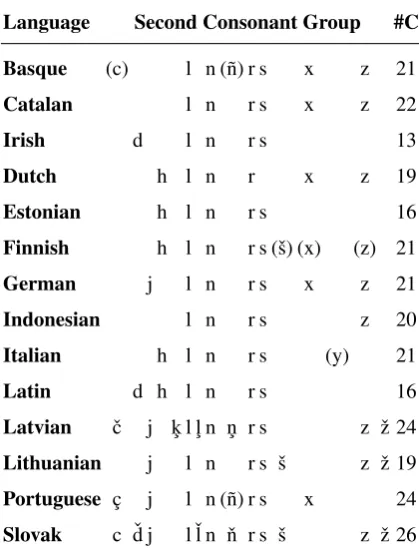
Although the only really robust pattern reliably discovered by the algorithm is the distinction be-tween consonants and vowels, there are strong pat-terns within some of the clusters that appear to be cross-linguistically constant, specifically with the tier-based variant. The first is that, when-ever a five-vowel system is present (such as in Basque, Spanish, and Italian), after the topmost split which divides up the vowels and the conso-nants, the first split within the vowel group is al-most always {a, o, u} and{e, i}. A second pat-tern concerns coronal segments. The first split within the consonant group tends to divide the seg-ments into coronal/non-coronal segseg-ments. This is not an absolute trend, but happens far above chance. This is also true when running the algo-rithm on graphemic data, where coronals can be identified. Table6gives an overview of how cross-linguistically coherent the resulting first consonant splits are. The data set is a selection of 14 lan-guages from the Universal Dependencies 2.0 data (Nivre et al.,2017).
8 Conclusion & future work
This paper has reported on a simple algorithm that rests on the assumption that languages tend to exhibit hierarchical alternation in adjacent phonemes. While such alternation does not always occur for any individual adjacent segment pair, on
Language Second Consonant Group #C
Basque (c) l n (˜n) r s x z 21
Catalan l n r s x z 22
Irish d l n r s 13
Dutch h l n r x z 19
Estonian h l n r s 16
Finnish h l n r s (ˇs) (x) (z) 21
German j l n r s x z 21
Indonesian l n r s z 20
Italian h l n r s (y) 21
Latin d h l n r s 16
Latvian ˇc j k¸ l l¸ n n¸ r s z ˇz 24
Lithuanian j l n r s ˇs z ˇz 19
Portuguese c¸ j l n (˜n) r s x 24
Slovak c ˇd j l ˇl n ˇn r s ˇs z ˇz 26
Table 6: The second consonant grouping found us-ing the tier-based OCP algorithm. This is the split below the top-level consonant/vowel split. The characters in this set largely correspond to coro-nal sounds. The data comes from 14 languages in the Universal Dependencies 2.0 data set. Shown in parentheses are symbols outside the native orthog-raphy of the language (most likely from named en-tities and borrowings found in the corpora). The rightmost column shows the total number of iden-tified consonants in the language. In particular,l,
[image:8.595.312.522.274.552.2](a) (b)
юмолануолиїнимижи ноулисѣханолиомобоу юмоласоудьнииохови
(c)
абвджилмносухьюїѣ
бвджлмнсух
вджлмнсх бу
аиоьюїѣ
июї аоьѣ
(d) (e)
C: б в ж л м н с у х ь
V: ѣ ю а д ї и о
C: б в ж л м н с у х V: ѣ ь ю а д ї и о (f)
[image:9.595.79.285.62.339.2]C: б в д ж л м н с у х V: ѣ ь ю а ї и о
Figure 4: Clustering the graphemes in the 54-symbolbirch bark letter 292manuscript (a), with transcription given in (b), and the results of OCP clustering (c). Also given are the C/V classifica-tions produced by the Moler and Morrison (1983) algorithm (d), Sukhotin’s algorithm (e), and the OCP algorithm (f), with errors marked with red boxes.
the corpus level this alternation largely holds and serves to reveal interesting structure in phonolog-ical organization. The top cluster discovered by the algorithm is also a highly reliable indicator of syllabic vs. non-syllabic segments, i.e. con-sonants and vowels, and improves upon the state-of-the-art in this unsupervised task. Interestingly, Sukhotin’s C/V algorithm, which has similar per-formance (Sukhotin,1962), can be interpreted as a greedy approximation of the first iteration in the current algorithm. A tier-based variant of the algorithm tends to detect front/back vowel con-trasts and coronal/non-coronal concon-trasts as well, although this is more of a robust trend rather than an absolute.
Lower levels in the clustering approach are less reliable indicators of classical feature alternation, but can serve effectively to reveal aspects of sylla-ble structure. For example, it is obvious from the Hawaiian clustering that the predominant syllable
in the language is CV. One is led to conclude that the obligatory contour principle may be manifest in larger classes of segments (such as [±syllabic]), but not necessarily in on the fine-grained level. Some resulting cluster splits such as for example {m,p}vs.{b,f,t}(example from Basque) are often not only inseparable by a single feature split, but are not separable by any combination of features. This lack of evidence for a strong OCP may be in line with the vigorous debate in the phonologi-cal literature on the universal role of the OCP (see e.g. McCarthy(1986);Odden(1988)). Some lan-guages (such as Finnish and Hawaiian) yield splits that almost always coincide with a single phono-logical feature, whereas other languages do not. Smaller inventories typically yield more robust re-sults, although this may be partly due to chance factors—there are more ways to split a small set according to distinctive features than large sets.
Of interest is the utility of the extracted clus-ters in various supervised and semi-supervised NLP applications. For example, in algorithms that learn to inflect words from annotated examples (Ahlberg et al.,2015;Cotterell et al.,2016), it is often useful to have a subdivision of the segments that alternate, since this allows one to general-ize behavior of classes of segments or graphemes, similar to the way e.g. Brown clusters (Brown et al.,1992) generalize over classes of words. La-beling segments with the position in a clustering tree and using that as a feature, for instance, is a cheap and straightforward way to inject this kind of knowledge into supervised systems designed to operate over many languages.
Acknowledgements
References
Malin Ahlberg, Markus Forsberg, and Mans Hulden.
2015. Paradigm classification in supervised
learning of morphology. In Proceedings of NAACL-HLT. Association for Computational Lin-guistics, Denver, Colorado, pages 1024–1029.
http://www.aclweb.org/anthology/N15-1107.
Juhani Aho. 1884. Rautatie [The Railroad].
Werner-S¨oderstr¨om, Porvoo, Finland.
Luc Boruta and Justyna Jastrzebska. 2012. A
phone-mic corpus of Polish child-directed speech. In
Pro-ceedings of the eighth international conference on Language Resources and Evaluation (LREC). Michael R. Brent and Timothy A. Cartwright. 1996.
Distributional regularity and phonotactic constraints
are useful for segmentation. Cognition61(1):93–
125.
Peter F. Brown, Peter V. deSouza, Robert L. Mer-cer, Vincent J. Della Pietra, and Jenifer C. Lai. 1992. Class-based n-gram models of natural
lan-guage. Computational Linguistics18(4):467–479.
Vladim´ır ˇCern`y. 1985. Thermodynamical approach to the traveling salesman problem: An efficient
simula-tion algorithm. Journal of Optimization Theory and
Applications45(1):41–51.
Ryan Cotterell, Christo Kirov, John Sylak-Glassman, David Yarowsky, Jason Eisner, and Mans Hulden. 2016. The SIGMORPHON 2016 shared task—
morphological reinflection. In Proceedings of the
2016 Meeting of SIGMORPHON. Association for Computational Linguistics, Berlin, Germany.
Andrew Cowell and Alonzo Moss Sr. 2008. The
Ara-paho Language. University Press of Colorado. Eli Fischer-Jørgensen. 1952. On the definition of
phoneme categories on a distributional basis. Acta
linguistica7(1-2):8–39.
Caxton C. Foster. 1992. A comparison of vowel
iden-tification methods. Cryptologia16(3):282–286.
Zygmunt Frajzyngier. 1979. Notes on the R1R2R2
stems in Semitic. Journal of Semitic Studies
24(1):1–12.
Stefan A. Frisch. 2004. Language processing and seg-mental OCP effects. In Bruce Hayes, Robert
Mar-tin Kirchner, and Donca Steriade, editors,
Pho-netically Based Phonology, Cambridge University Press, pages 346–371.
Judit Gervain and Ram´on Guevara Erra. 2012. The sta-tistical signature of morphosyntax: A study of
Hun-garian and Italian infant-directed speech. Cognition
125(2):263–287.
John Goldsmith and Aris Xanthos. 2009. Learning
phonological categories. Language85(1):4–38.
Joseph H. Greenberg. 1950. The patterning of root
morphemes in Semitic. Word6(2):162–181.
Jacques B. M. Guy. 1991. Vowel identification: an old
(but good) algorithm. Cryptologia15(3):258–262.
Martti Haavio. 1964. The oldest source of Finnish
mythology: Birchbark letter no. 292. Journal of the
Folklore Institute1(1/2):45–66.
Bruce Hayes. 2011. Introductory Phonology. John
Wi-ley & Sons.
George Hempl. 1893. Loss of r in English through
dis-similation.Dialect Notes(1):279–281.
Junko Itˆo and Ralf-Armin Mester. 1986. The phonol-ogy of voicing in Japanese: Theoretical
conse-quences for morphological accessibility. Linguistic
Inquirypages 49–73.
Gregory K. Iverson and Joseph C. Salmons. 1992. The phonology of the Proto-Indo-European root
struc-ture constraints. Lingua87(4):293–320.
Young-Bum Kim and Benjamin Snyder. 2013. Unsu-pervised consonant-vowel prediction over hundreds
of languages. In Proceedings of the 51st Annual
Meeting of the Association for Computational Lin-guistics (Volume 1: Long Papers). Association for Computational Linguistics, Sofia, Bulgaria, pages 1527–1536.
S. Kirkpatrick, Jr. C. D. Gelatt, and M. P. Vecchi.
1983. Optimization by simulated annealing.
Sci-ence220(4598):671–680.
Kevin Knight, Anish Nair, Nishit Rathod, and Kenji Yamada. 2006. Unsupervised analysis for
deci-pherment problems. In Proceedings of the
COL-ING/ACL. Association for Computational Linguis-tics, pages 499–506.
William Ronald Leben. 1973. Suprasegmental
Phonol-ogy. Ph.D. thesis, Massachusetts Institute of
Tech-nology.
A. A. Markov. 1913. Primer statisticheskogo issle-dovaniya nad tekstom “Evgeniya Onegina”,
il-lyustriruyuschij svyaz ispytanij v cep. Izvestiya
Akademii NaukSer. 6(3):153–162.
A. A. Markov. 2006. An example of statistical inves-tigation of the text “Eugene Onegin” concerning the
connection of samples in chains.Science in Context
19(4):591–600.
Thomas Mayer and Christian Rohrdantz. 2013. Phon-Matrix: Visualizing co-occurrence constraints of
sounds. In Proceedings of the 51st Annual
Thomas Mayer, Christian Rohrdantz, Frans Plank, Pe-ter Bak, Miriam Butt, and Daniel A Keim. 2010. Consonant co-occurrence in stems across languages: Automatic analysis and visualization of a
phonotac-tic constraint. In Proceedings of the 2010
Work-shop on NLP and Linguistics: Finding the Common Ground. Association for Computational Linguistics, pages 70–78.
John J. McCarthy. 1986. OCP effects: Gemination and
antigemination. Linguistic Inquiry17(2):207–263.
Scott Meyers. 1997. OCP effects in optimality theory.
Natural Language & Linguistic Theory15(4):847– 892.
Cleve Moler and Donald Morrison. 1983. Singular
value analysis of cryptograms. American
Mathe-matical Monthlypages 78–87.
Steven Moran, Daniel McCloy, and Richard Wright,
editors. 2014. PHOIBLE Online. Max Planck
Institute for Evolutionary Anthropology, Leipzig.
http://phoible.org/.
Joakim Nivre, ˇZeljko Agi´c, Lars Ahrenberg, Maria Je-sus Aranzabe, Masayuki Asahara, Aitziber Atutxa, et al. 2017. Universal dependencies 2.0. LIN-DAT/CLARIN digital library at the Institute of For-mal and Applied Linguistics, Charles University in Prague.
David Odden. 1988. Anti antigemination and the OCP.
Linguistic Inquiry19(3):451–475.
John Ohala. 1981. The listener as a source of sound change. In Carrie S. Masek, Roberta A. Hendrick,
and Mary Frances Miller, editors, Papers from the
Parasession on Language and Behavior, Chicago Linguistic Society, pages 178–203.
Janet Pierrehumbert. 1993. Dissimilarity in the Arabic
verbal roots. InProceedings of NELS. volume 23,
pages 367–381.
Konstantin Pozdniakov and Guillaume Segerer. 2007.
Similar place avoidance: A statistical universal.
Lin-guistic Typology11(2):307–348.
Sharon Rose. 2000. Rethinking geminates,
long-distance geminates, and the OCP.Linguistic Inquiry
31(1):85–122.
George T. Sassoon. 1992. The application of
Sukhotin’s algorithm to certain non-English
lan-guages. Cryptologia16(2):165–173.
Wilhelm Spitta-Bey. 1880. Grammatik des arabischen
Vulg¨ardialectes von Aegypten. Hinrichs, Leipzig. Boris V. Sukhotin. 1962. Eksperimental’noe vydelenie
klassov bukv s pomoshch’ju EVM.Problemy
struk-turnoj lingvistikipages 198–206.
Boris V. Sukhotin. 1973. M´ethode de d´echiffrage, outil
de recherche en linguistique. T. A. Informations
pages 1–43.
Mariona Taul´e, Maria Ant`onia Mart´ı, and Marta Re-casens. 2008. AnCora: Multilevel annotated
cor-pora for Catalan and Spanish. In Proceedings of
the sixth international conference on Language Re-sources and Evaluation (LREC).
Moira Yip. 1988. The obligatory contour principle and
phonological rules: A loss of identity. Linguistic
Inquiry19(1):65–100.
Moira Yip. 1998. Identity avoidance in phonology and morphology. In Steven Lapointe, Diane Brentari,
and Patrick Farrell, editors,Morphology and its