An Automatic Approach for Document-level Topic Model Evaluation
Shraey Bhatia1 Jey Han Lau1,2 Timothy Baldwin1 1School of Computing and Information Systems,
The University of Melbourne 2IBM Research
[email protected],[email protected],[email protected]
Abstract
Topic models jointly learn topics and document-level topic distribution. Extrin-sic evaluation of topic models tends to fo-cus exclusively on topic-level evaluation, e.g. by assessing the coherence of topics. We demonstrate that there can be large dis-crepancies between topic- and document-level model quality, and that basing model evaluation on topic-level analysis can be highly misleading. We propose a method for automatically predicting topic model quality based on analysis of document-level topic allocations, and provide empiri-cal evidence for its robustness.
1 Introduction
Topic models such as latent Dirichlet allocation (Blei et al., 2003) jointly learn latent topics (in the form of multinomial distributions over words) and topic allocations to individual documents (in the form of multinomial distributions over top-ics), and provide a powerful means of document collection navigation and visualisation (Newman et al.,2010a;Chaney and Blei,2012;Smith et al.,
2017). One property of LDA-style topic models that has contributed to their popularity is that they are highly configurable, and can be structured to capture a myriad of statistical dependencies, such as between topics (Blei and Lafferty, 2006), be-tween documents associated with the same individ-ual (Rosen-Zvi et al.,2004), or between documents associated with individuals in different network relations (Wang and Blei,2011). This has led to a wealth of topic models of different types, and the need for methods to evaluate different styles of topic model over the same document collections. Test data perplexity is the obvious solution, but it has been shown to correlate poorly with direct
human assessment of topic model quality (Chang et al., 2009), motivating the need for automatic topic model evaluation methods which emulate hu-man assessment. Research in this vein has focused primarily on evaluating the quality of individual topics (Newman et al.,2010b;Mimno et al.,2011;
Aletras and Stevenson,2013;Lau et al.,2014;Fang et al.,2016) and largely ignored evaluation of topic allocations to individual documents, and it has be-come widely accepted that topic-level evaluation is a reliable indicator of the intrinsic quality of the overall topic model (Lau et al.,2014). We chal-lenge this assumption, and demonstrate that topic model evaluation should operate at both the topic and document levels.
Our primary contributions are as follows: (1) we empirically demonstrate that there can be large discrepancies between topic- and document-level topic model evaluation; (2) we demonstrate that previously-proposed document-level evaluation ap-proaches can be misleading, and propose an al-ternative evaluation method; and (3) we propose an automatic approach to topic model evaluation based on analysis of document-level topic distri-butions, which we show to correlate strongly with manual annotations.
2 Related Work
Perplexity or held-out likelihood has long been used as an intrinsic metric to evaluate topic models (Wallach et al., 2009). Chang et al.(2009) pro-posed two human judgement tasks, at the topic and document levels, and showed that there is low correlation between perplexity and direct human evaluations of topic model quality. The two tasks took the form of “intruder” tasks, whereby sub-jects were tasked with identifying an intruder topic word for a given topic, or an intruder topic for a given document. Specifically, in the word intrusion
task, an intruder word was added to the top-5 topic words, and annotators were asked to identify the intruder word. Similarly in the topic intrusion task, a document and 4 topics were presented — the top-3 topics corresponding to the document and a random intruder topic — and subjects were asked to spot the intruder topic. The intuition behind both methods is that the higher the quality of the topic or topic allocation for a given document, the easier it should be to detect the intruder.
Newman et al. (2010b) proposed to measure topic coherence directly in the form of “observed coherence”, in which human judges rated topics directly on an ordinal 3-point scale. They experi-mented with a range of different methods to auto-mate the rating task, and reported the best results by simply aggregating pointwise mutual information (pmi) scores for different pairings of topic words, based on a sliding window over English Wikipedia. Building on the work ofChang et al.(2009),Lau et al.(2014) proposed an improved method for es-timating observed coherence based on normalised pmi(npmi), and further automated the word in-truder detection task based on a combination of word association features (pmi,npmi, CP1, and CP2) in a learn-to-rank model (Joachims,2006). Additionally, the authors showed a strong correla-tion between word intrusion and observed coher-ence, and suggested that it is possible to perform topic model evaluation based on aggregation of word intrusion or observed coherence scores across all topics.
3 Datasets and Topic Models
We use two document collections for our experi-ments: APNEWSand the British National Corpus (“BNC”:Burnard(1995)).APNEWSis a collection of Associated Press1 news articles from 2009 to
2016, whileBNC is an amalgamation of extracts from different sources such as books, journals, let-ters, and pamphlets. We sample 50K and 15K documents from APNEWSandBNC, respectively, to create two datasets for our experiments.
In terms of preprocessing, we use Stanford CoreNLP (Manning et al.,2014) to tokenise words and sentences. We additionally remove stop words,2 lower-case all word tokens, filter word
types which occur less than 10 times, and exclude 1https://www.ap.org/en-gb/
2We use Mallet’s stop word list: https://github.
com/mimno/Mallet/tree/master/stoplists
the top 0.1% most frequent word types. Statistics for each of the preprocessed datasets are provided in Table1.
Similarly toChang et al. (2009), we base our analysis on a representative selection of topic mod-els, each of which we train overAPNEWSandBNC to generate 100 topics:
• lda (Blei et al., 2003) uses a symmetric Dirichlet prior to model both document-level topic mixtures and topic-level word mixtures. It is one of the most commonly used topic model implementations and serve as a bench-mark for comparison. We use Mallet’s imple-mentation ofldafor our experiments. Note that Mallet implements various enhancements to the basic LDA model, including the use of an asymmetric–symmetric prior.
• ctm(Blei and Lafferty,2006) is an extension ofldathat uses a logistic normal prior over topic proportions instead of a Dirichlet prior to model correlations between different topics and reduce overlap in topic content.
• hca(Buntine and Mishra,2014) is an exten-sion to LDA to capture word burstiness (Doyle and Elkan,2009), based on the observation that there tends to be higher likelihood of gen-erating a word which has already been seen recently. Word generation is modelled by a Pitman–Yor process (Chen et al.,2011).
• ntm (Cao et al., 2015) is a neural topic model, where topic–word multinomials are modelled as a look-up layer of words, and topic–document multinomials are modelled as a look-up layer of documents. The output layer of the network is given by the dot prod-uct of the two vectors. There are 2 variants of ntm: unsupervised and supervised. We use only the unsupervised variant in our experi-ments.
• clusteris a baseline topic model, specifi-cally designed to produce highly coherent top-ics but “bland” topic allocations. We represent word types in the documents with pre-trained word2vecvectors (Mikolov et al.,2013a,b), pre-trained on Google News,3and create word
clusters usingk-means clustering (k= 100) to generate the topics. We derive the multi-nomial distribution for each topic based on the cosine distance to the cluster centroid, and
3Available from: https://code.google.com/
Dataset #Docs #Tokens
APNEWS 50K 15M
[image:3.595.110.251.64.115.2]BNC 15K 18M
Table 1: Statistics for the two document collections used in our experiments
Model APNEWS BNC
lda 0.16 0.14
ctm 0.07 0.09
hca 0.14 0.08
ntm 0.10 0.08
cluster 0.18 0.17
Table 2: Topic coherence scores (npmi)
linear normalisation across all words. To generate the topic allocation for a given document, we first calculate a document representation based on the mean of the word2vecvectors of its content words. For each cluster, we represent them by calculat-ing the meanword2vecvectors of its top-10 words. Given the document vector and clus-ters/topics, we calculate the similarity of the document to each cluster based on cosine ilarity, and finally (linearly) normalise the sim-ilarities to generate a probability distribution. 4 Topic-level Evaluation: Topic
Coherence
Pointwise mutual information (and its normalised variantnpmi) is a common association measure to estimate topic coherence (Newman et al.,2010b;
Mimno et al.,2011;Aletras and Stevenson,2013;
Lau et al.,2014;Fang et al.,2016). Although the method is successful in assessing topic quality, it tells us little about the association between docu-ments and topics. As we will see, a topic model can produce topics that are coherent — in terms ofnpmiassociation — but poor descriptor of the overall concepts in the document collection.
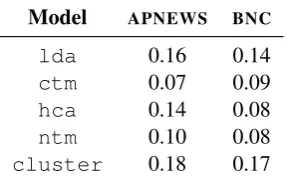
We first compute topic coherence for all 5 topic models overAPNEWSandBNCusingnpmi(Lau
et al.,2014) and present the results in Table2.4We
see thatldaandclusterperform consistently well across both datasets.hcaperforms well over 4We use the following open source toolkit to com-pute topic coherence: https://github.com/jhlau/ topic_interpretability.
APNEWSbut poorly overBNC. Bothctmandntm topics appear to have low coherence over the two datasets.
Based on these results, one would conclude that clusteris a good topic model, as it produces very coherent topics. To better understand the na-ture and quality of the topics, we present a random sample ofldaandclustertopics in Table3.
Looking at the topics, we see that cluster tends to include different inflectional forms of the same word (e.g.prohibited,probihiting) and near-synonyms/sister words (e.g.river,lake,creeks) in a single topic. This explains the strongnpmi as-sociation of the cluster topics. On the other hand,ldadiscovers related words that collectively describe concepts rather than just clustering (near) synonyms. This suggests that the topic coherence metric alone may not completely capture topic model quality, leading us to also investigate the topic distribution associated with documents from our collections.
5 Human Evaluation of Document-level Topic Allocations
In this section, we describe a series of manual evalu-ations of document-level topic allocevalu-ations, in order to get a more holistic evaluation of the true qual-ity of the different topic models (in line with the original work ofChang et al.(2009)).
5.1 Topic Intrusion
[image:3.595.110.254.166.257.2]Model Topics
lda oil gas drilling gulf spill natural pipeline wells industry energycomputer video screen program text disk windows electronic machine graphics health care hospital services medical staff patients service child authority
[image:4.595.95.268.224.333.2]cluster river creek lake rivers dam tributary lakes reservoir tributaries creeksprohibited forbid prohibiting prohibits violated prohibit contravened forbids violate barred terrace courtyard staircase staircases courtyards walls pergola walkway stairways walkways
Table 3: Exampleldaandclustertopics.
Topic Model Mean Model Precision
APNEWS BNC
lda 0.84 0.66
ctm 0.64 0.66
hca 0.60 0.44
ntm 0.26 0.17
cluster 0.39 0.48
Table 4: Mean model precision for human judge-ments
associated with some documents, and hence likely to be coherent and not a junk topic. Each topic is represented by its top-10 most probable words, and the target document is presented in the form of the first three sentences, with an option to view more of the document if further context is needed.
We used Amazon Mechanical Turk to collect the human judgements, with five document–topic combinations forming a single HIT, one of which acts as a quality control. The control items were sourced from an earlier annotation task where sub-jects were asked to score the top-5 topics for a target document on a scale of 0–3. The 50 top-scoring documents from this annotation task, with their top-3 topics, were chosen as controls. The intruder topic for the control was generated by ran-domly selecting 10 words from the corpus vocabu-lary. In order to pass quality control, each worker had to correctly select the intruder topic for the con-trol document–topic item over 60% of time (across all HITs they completed). Each document–topic pair was rated by 10 annotators initially, and for HITs where less than 3 annotations passed quality control, we reposted them for a second round of annotation.
For our annotation task, we randomly sampled 100 documents from each of our two datasets, for
Topic Model Mean Topic Log Odds
APNEWS BNC
lda -0.78 -1.84
ctm -1.04 -1.60
hca -2.09 -3.61
ntm -7.16 -6.32
cluster -0.12 -0.10
Table 5: Mean topic log odds for human judge-ments
each of which we generate document–topic items based on the five different topic models. In total, therefore, we annotated 1000 (100 documents×2 collections×5 topic models) document–topic com-binations. After quality control, the final dataset contains an average of 5.4 and 5.5 valid intruder topic annotations for APNEWS and BNC, respec-tively.
[image:4.595.326.506.225.333.2](a)APNEWS (b)BNC
Figure 1: Boxplots of model precision
[image:5.595.79.530.66.236.2](a)APNEWS (b)BNC
Figure 2: Boxplots of topic log odds
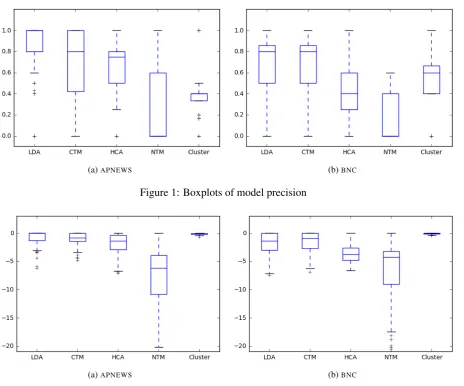
The results of the human annotation task are summarised in Tables4and5. Looking at model precision forAPNEWSfirst, we see thatlda out-performs the other topic models. ctm and hca perform credibly, whereas ntm and cluster are quite poor. Moving on to BNC, we see a drop in score forlda, to a level comparable with ctm. cluster improves slightly higher than BNC, whereashcadrops considerably (despite be-ing designed specifically to deal with word bursti-ness in the longer documents characteristic ofBNC). Figure1shows boxplots for topic-level model pre-cision, and reflects a similar trend.
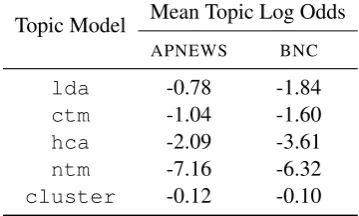
Looking next to TLO in Table5, we see a totally different picture, withclusterbeing rated as the best topic model by a clear margin. This exposes a flaw in the TLO formulation, in the case of adver-sarial topic models such asclusterwhich assign near-uniform probabilities across all topics. This results in the difference in probability mass being
very close to the upper bound of zero in all cases, meaning that even for random topic selection, TLO is near perfect. We can also see this in Figure2, where the boxes for clusterhave nearly zero range. Indeed, if we combined the results for TLO with those for topic coherence, we would (very wrongly!) conclude thatclusterperforms best over both document collections. More encourag-ingly, for the other four topic models, the results for TLO are much more consistent with those based on model precision.
5.2 Direct Annotation of Topic Assignments
(high-Topic Model Average rating
APNEWS BNC
lda 1.26 1.01
ctm 0.96 1.02
hca 0.95 0.90
ntm 0.36 0.46
[image:6.595.106.258.65.172.2]cluster 0.41 0.66
Table 6: Top-1 document–topic rating for each topic model
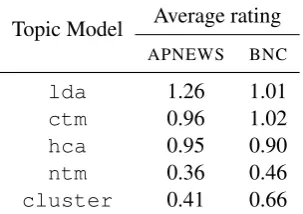
est probability) topic from each of the five topic models, and ask them to rate each topic on an or-dinal scale of 0–3. At the model level, we take the mean rating over all document–topic pairings for that topic model (based, once again, on 100 docu-ments per collection).5 We summarise the findings
in Table6.
We observe that, in the case of APNEWS, ldadoes considerably better thanctmandhca, whereas for BNC, lda andctm are quite close, with hca close behind. clusterand ntm do poorly across both datasets. The overall trend for APNEWSoflda >ctm >hca >cluster> ntmis consistent with the model precision results in Table4. In the case ofBNC, the observation of ctm ≈lda>hca >cluster>ntmis also broadly the same, except thathcadoes not do as well over the topic intrusion task. Here, we are more interested in the relative performance of topic models than absolute numbers, although the low absolute scores are an indication that it is a difficult annotation task.
Broadly combined across the two evaluation methodologies,ldaandctmare top-performing, hcagets mixed results, andclusterandntm are the lowest performers. These results generally agree with the model precision findings, demon-strating that model precision is a more robust met-ric than TLO.
6 Automatic Evaluation
A limitation of the topic intrusion task is that it requires manual annotation, making it ill-suited for large-scale or automatic evaluation. We present the first attempt to automate the prediction of the intruder topic, with the aim of developing an ap-proach to topic model evaluation which comple-5The 100 documents used for this task were different to the ones used in Section5.1.
ments topic coherence (as motivated in Sections4
and5).
6.1 Methodology
We build a support vector regression (SVR) model (Joachims,2006) to rank topics given a document to select the intruder topic. We first explain an intuition of the features that are driving the SVR.
To rank topics for a document, we need to first compute the probability of a topictgiven document d, i.e.P(t|d). We can invert the condition using Bayes rule:
P(t|d) = P(dP|t()dP)(t)
∝P(d|t)P(t)
We can omitP(d)as the probability of document dis constant for the topics that we are ranking.
Next we represent topictusing its top-Nhighest probability words, giving:
P(t|d)∝P(d|w1, ..., wN)P(w1, ..., wN) ∝logP(d|w1, ..., wN)+
logP(w1, ..., wN)
The first termlogP(d|w1, ..., wN)can be inter-preted from an information retrieval perspective, where we are computing the relevance of docu-ment dgiven query terms w1, w2, ..., wN. This term constitutes the first feature for the SVR. We use Indri6 to index the document collection, and
computelogP(d|w1, ..., wN)given a set of query words and a document.7
We estimate the second term,logP(w1, ..., wN), using the pairwise probability of the topic words:
X
0<i≤m X
i+1≤j≤m
log#(#(·)wi, wj)
wheremdenotes the number of topic words used,
#(wi, wj)is the number of documents where word wiandwj co-occur, and#(·)is the total number of documents. We explore using two values ofm here: 5 and 10.8 These two values constitute the
second and third features of the SVR.
To train the SVR, we sample 1700 random doc-uments and split them into 1600/100 docdoc-uments for the training and test partitions, respectively.
6http://www.lemurproject.org 7N= 10.
(a)APNEWS (b)BNC
Figure 3: Mean Model Precision Comparison
The test documents are the same 100 documents that were previously used for intruder topics (Sec-tion 5.1). As the intruder topics are artificially generated, we can sample additional documents to create a larger training set for the SVR; the ability to generate arbitrary training data is a strength of our method.
We pool together all 5 topic models when train-ing the SVR, thereby generattrain-ing 8000 traintrain-ing and 500 development and testing instances for each dataset. For each document, the SVR is trained to rank the topics in terms of their likelihood of being an intruder topic.9The top-ranking topic is selected
as the system-predicted intruder word, and model precision is computed as before (Section5.1).10
6.2 System results
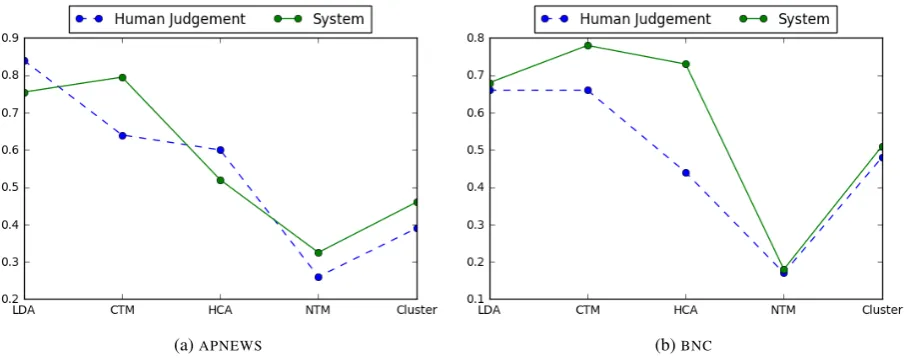
In Figure3, we present the human vs. system mean model precision on the test partition for each of the topic models. We see that the trend line for the system model precision very closely tracks that of human model precision. In general, the best sys-tems —lda andctm— and the worst systems —ntmandcluster— are predicted correctly.
The correlation between the two is very high, at r = 0.88and0.87forAPNEWSandBNC, respec-tively. This suggests that the automated method is a reliable means of evaluating document-level topic model quality.
9We use the default hyper-parameter values for the SVR (C = 0.01), and hence do no require a development set for tuning.
10Note that the system model precision for each document– topic combination is a binary value as there is only 1 system — as opposed to multiple annotators — selecting an intruder
word.
7 Discussion
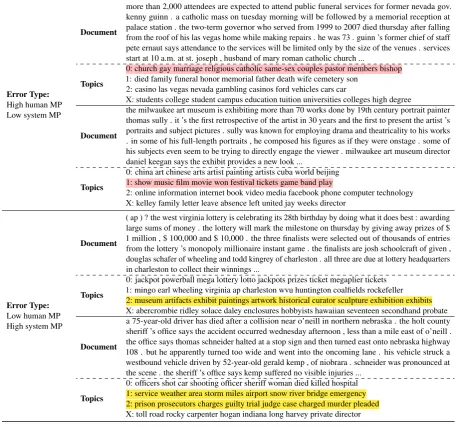
To better understand the differences between human- and system-predicted intruder topics, we present a number of documents and their associ-ated topics in Table 7, focusing specifically on: (a) intruder topics that humans struggle to identify but our automatic method reliably detects; and (b) conversely, intruder topics which humans readily identify but our method struggles to detect.
Looking at the topics across the two types of errors, we notice that there are often multiple “bad” topics for these documents: occasionally the anno-tators are able to single out the worst topic while the system fails (1st and 2nd document), but some-times the opposite happens (3rd and 4th document). In the first case, the top-ranking topic (church, gay, ...) from the topic model is associated with the doc-ument because of the service, but actually capturing a very different aspect of religion to what is dis-cussed in the document, which leads our method astray. A similar effect is seen with the second document. In the case of the third and fourth doc-uments, there is actually content further down in the document which is relevant to the topics the human annotators select, but it is not apparent in the document snippet presented to the annotators. That is, the effect is caused by resource limitations for the annotation task, that our automated method does not suffer from.
Error Type: High human MP Low system MP
Document
more than 2,000 attendees are expected to attend public funeral services for former nevada gov. kenny guinn . a catholic mass on tuesday morning will be followed by a memorial reception at palace station . the two-term governor who served from 1999 to 2007 died thursday after falling from the roof of his las vegas home while making repairs . he was 73 . guinn ’s former chief of staff pete ernaut says attendance to the services will be limited only by the size of the venues . services start at 10 a.m. at st. joseph , husband of mary roman catholic church ...
Topics
0: church gay marriage religious catholic same-sex couples pastor members bishop 1: died family funeral honor memorial father death wife cemetery son
2: casino las vegas nevada gambling casinos ford vehicles cars car
X: students college student campus education tuition universities colleges high degree
Document
the milwaukee art museum is exhibiting more than 70 works done by 19th century portrait painter thomas sully . it ’s the first retrospective of the artist in 30 years and the first to present the artist ’s portraits and subject pictures . sully was known for employing drama and theatricality to his works . in some of his full-length portraits , he composed his figures as if they were onstage . some of his subjects even seem to be trying to directly engage the viewer . milwaukee art museum director daniel keegan says the exhibit provides a new look ...
Topics
0: china art chinese arts artist painting artists cuba world beijing 1: show music film movie won festival tickets game band play
2: online information internet book video media facebook phone computer technology X: kelley family letter leave absence left united jay weeks director
Error Type: Low human MP High system MP
Document
( ap ) ? the west virginia lottery is celebrating its 28th birthday by doing what it does best : awarding large sums of money . the lottery will mark the milestone on thursday by giving away prizes of $ 1 million , $ 100,000 and $ 10,000 . the three finalists were selected out of thousands of entries from the lottery ’s monopoly millionaire instant game . the finalists are josh schoolcraft of given , douglas schafer of wheeling and todd kingrey of charleston . all three are due at lottery headquarters in charleston to collect their winnings ...
Topics
0: jackpot powerball mega lottery lotto jackpots prizes ticket megaplier tickets 1: mingo earl wheeling virginia ap charleston wvu huntington coalfields rockefeller 2: museum artifacts exhibit paintings artwork historical curator sculpture exhibition exhibits X: abercrombie ridley solace daley enclosures hobbyists hawaiian seventeen secondhand probate
Document
a 75-year-old driver has died after a collision near o’neill in northern nebraska . the holt county sheriff ’s office says the accident occurred wednesday afternoon , less than a mile east of o’neill . the office says thomas schneider halted at a stop sign and then turned east onto nebraska highway 108 . but he apparently turned too wide and went into the oncoming lane . his vehicle struck a westbound vehicle driven by 52-year-old gerald kemp , of niobrara . schneider was pronounced at the scene . the sheriff ’s office says kemp suffered no visible injuries ...
Topics
[image:8.595.70.529.65.495.2]0: officers shot car shooting officer sheriff woman died killed hospital 1: service weather area storm miles airport snow river bridge emergency 2: prison prosecutors charges guilty trial judge case charged murder pleaded X: toll road rocky carpenter hogan indiana long harvey private director
Table 7: Document and topic examples for two types of errors. “MP” denotes model precision, “X” the intruder topic, and the indices the ranking of the topics. Topics highlighted in pink (yellow) are those incorrectly selected by the system (humans) as intruder topics.
annotators and the automated method in intruder topic selection.
To further understand how the topics relate to the documents in different topic models, we present documents with the corresponding topics for differ-ent topic models in Table8.
In the human annotation task, we use the top-10 most probable words to represent a topic. We use 10 words as it is the standard approach to visualis-ing topics, but this is an important hyper-parameter which needs to be investigated further (Lau and Baldwin,2016), which we leave to future work.
8 Conclusion
lda Document
more than 2,000 attendees are expected to attend public funeral services for former nevada gov. kenny guinn . a catholic mass on tuesday morning will be followed by a memorial reception at palace station . the two-term governor who served from 1999 to 2007 died thursday after falling from the roof of his las vegas home while making repairs . he was 73 . guinn ’s former chief of staff pete ernaut says attendance to the services will be limited only by the size of the venues . services start at 10 a.m. at st. joseph , husband of mary roman catholic church ...
Topics 1: died family funeral honor memorial father death wife cemetery son0: church gay marriage religious catholic same-sex couples pastor members bishop
hca
Document
usa today founder al neuharth has died in cocoa beach , florida . he was 89 . the news was announced friday by usa today and by the newseum , which he also founded . neuharth changed american newspapers by putting easy-to-read articles and bright graphics in his national daily publication , which he began in 1982 when he ran the gannett co. newspaper group . he wanted to create a bright , breezy , fun newspaper that would catch people ’s attention and not take itself too seriously. its annual revenues increased from 200 million to more than 3 billion ...
Topics 0: honorary commencement philanthropist journalism distinguished honored bachelor pulitzerdoctorate harvard 1: shortfall premiums budget reductions cuts shortfalls salaries pensions revenues budgets
ctm Document
a teenage driver who survived a southeastern indiana crash that killed three other youths will spend 90 days in juvenile detention and surrender his driver ’s license until age 21 . the 17-year-old driver admitted to charges of reckless homicide and reckless driving during a ripley county juvenile court hearing thursday in versailles , indiana state police sgt. noel houze jr. told the associated press . the teenager choked back sobs throughout the half-hour hearing . the teen will be sent to a juvenile facility in muncie . he also must complete 350 hours of community service ..
Topics 1: prison prosecutors charges guilty trial judge case charged murder pleaded0: officers shot car shooting officer sheriff woman died killed hospital
ntm
Document
a judge in will county has approved further testing on the coat an oswego man was wearing when his wife and three children were found shot to death in 2007 . christopher vaughn is accused of killing his family inside their suv , which was parked on a frontage road along interstate 55 . authorities found kimberly vaughn shot to death , along with their children , 12-year-old abigayle , 11-year-old cassandra and 8-year-old blake . assistant state ’s attorney mike fitzgerald on monday said prosecutors asked for more dna testing on the coat ...
Topics 0: arraigned burglarizing arrested bigamy detectives motorcyclist arraignment coroner accomplicefondled 1: quarterly pretax dividend profit annualized earnings profits stockholders writedown premarket
cluster
Document
a southwest idaho district court judge has been arrested on suspicion of misdemeanor driving under the influence . the idaho press-tribune reports ( http://bit.ly/npiita ) that 3rd district court judge renae hoff was taken into custody early saturday morning in meridian . meridian deputy police chief tracy basterrechea says an officer pulled the 61-year-old hoff over after she failed to ” maintain the lane of travel . ”
[image:9.595.71.528.58.535.2]Topics 0: suppliers manufacturers companies importers supplier exporters distributors market wholesalersexport 1: deported deportation incarcerated prison detention jail parole imprisoned convicts incarceration
Table 8: Example documents and their corresponding topics for different topic models
Acknowledgements
This research was supported in part by the Aus-tralian Research Council.
References
Nikos Aletras and Mark Stevenson. 2013. Evaluating topic coherence using distributional semantics. In
Proceedings of the Tenth International Workshop on Computational Semantics (IWCS-10). Potsdam, Ger-many, pages 13–22.
David Blei and John Lafferty. 2006. Correlated topic
models. Advances in Neural Information Process-ing Systems18.
David M Blei, Andrew Y Ng, and Michael I Jordan. 2003. Latent Dirichlet allocation. Journal of Ma-chine Learning Research3:993–1022.
Wray L Buntine and Swapnil Mishra. 2014. Experi-ments with non-parametric topic models. In Pro-ceedings of the 20th ACM SIGKDD International Conference on Knowledge Discovery and Data Min-ing. pages 881–890.
Lou Burnard. 1995. User guide for the British National Corpus.
Ji. 2015. A novel neural topic model and its su-pervised extension. In Proceedings of AAAI 2015. pages 2210–2216.
Allison June-Barlow Chaney and David M. Blei. 2012. Visualizing topic models. InProceedings of the 6th International Conference on Weblogs and Social Me-dia (ICWSM 2012). Dublin, Ireland.
Jonathan Chang, Sean Gerrish, Chong Wang, Jordan L. Boyd-Graber, and David M. Blei. 2009. Reading tea leaves: How humans interpret topic models. In
Advances in Neural Information Processing Systems 21 (NIPS-09). Vancouver, Canada, pages 288–296.
Changyou Chen, Lan Du, and Wray Buntine. 2011. Sampling table configurations for the hierarchical poisson-dirichlet process. Machine Learning and Knowledge Discovery in Databasespages 296–311.
Gabriel Doyle and Charles Elkan. 2009. Accounting for burstiness in topic models. InProceedings of the 26th Annual International Conference on Machine Learning. pages 281–288.
Anjie Fang, Craig Macdonald, Iadh Ounis, and Philip Habel. 2016. Using word embedding to evaluate the coherence of topics from Twitter data. In Proceed-ings of the 39th International ACM SIGIR confer-ence on Research and Development in Information Retrieval. pages 1057–1060.
Thorsten Joachims. 2006. Training linear SVMs in lin-ear time. InProceedings of the 12th ACM SIGKDD International Conference on Knowledge Discovery and Data Mining. pages 217–226.
Jey Han Lau and Timothy Baldwin. 2016. The sensitiv-ity of topic coherence evaluation to topic cardinalsensitiv-ity. InProceedings of NAACL-HLT. pages 483–487.
Jey Han Lau, David Newman, and Timothy Baldwin. 2014. Machine reading tea leaves: Automatically evaluating topic coherence and topic model quality. InProceedings of EACL 2014. pages 530–539.
Christopher D. Manning, Mihai Surdeanu, John Bauer, Jenny Finkel, Steven J. Bethard, and David Mc-Closky. 2014. The Stanford CoreNLP natural lan-guage processing toolkit. InAssociation for Compu-tational Linguistics (ACL) System Demonstrations. Baltimore, USA, pages 55–60.
Tomas Mikolov, Kai Chen, Greg Corrado, and Jeffrey Dean. 2013a. Efficient estimation of word represen-tations in vector space. InProceedings of Workshop at the International Conference on Learning Repre-sentations, 2013. Scottsdale, USA.
Tomas Mikolov, Ilya Sutskever, Kai Chen, Greg S Cor-rado, and Jeff Dean. 2013b. Distributed representa-tions of words and phrases and their compositional-ity. InAdvances in Neural Information Processing Systems. pages 3111–3119.
David Mimno, Hanna Wallach, Edmund Talley, Miriam Leenders, and Andrew McCallum. 2011. Optimizing semantic coherence in topic models. In
Proceedings of the 2011 Conference on Empirical Methods in Natural Language Processing (EMNLP 2011). Edinburgh, UK, pages 262–272.
David Newman, Timothy Baldwin, Lawrence Cavedon, Sarvnaz Karimi, David Martinez, and Justin Zobel. 2010a. Visualizing document collections and search results using topic mapping. Journal of Web Seman-tics8(2–3):169–175.
David Newman, Jey Han Lau, Karl Grieser, and Timo-thy Baldwin. 2010b. Automatic evaluation of topic coherence. InHuman Language Technologies: The 2010 Annual Conference of the North American Chapter of the Association for Computational Lin-guistics. pages 100–108.
Michal Rosen-Zvi, Thomas Griffiths, Mark Steyvers, and Padhraic Smyth. 2004. The author-topic model for authors and documents. In Proceedings of the 20th Conference on Uncertainty in Artificial Intelli-gence. pages 487–494.
Alison Smith, Tak Yeon Lee, Forough Poursabzi-Sangdeh, Jordan Boyd-Graber, Kevin Seppi, Niklas Elmqvist, and Leah Findlater. 2017. Evaluating visual representations for topic understanding and their effects on manually generated labels. Transac-tions of the Association for Computational Linguis-tics5:1–15.
Hanna M Wallach, Iain Murray, Ruslan Salakhutdi-nov, and David Mimno. 2009. Evaluation methods for topic models. InProceedings of the 26th Inter-national Conference on Machine Learning (ICML 2009). Montreal, Canada, pages 1105–1112. Chong Wang and David M. Blei. 2011.