QOS Assured and Energy Efficient Load Balancing
Routing Algorithm for Wireless Video Delivery
A. B. Hemalatha
(Computer Science, UCEK, Kanchipuram.
Abstract: In wireless network, majority of application deals with Multimedia. The usage of multimedia data is tremendous in network services. The network is remarkable to think without multimedia data. Multimedia content dispatch is the daunting task in wireless network because it needs high bandwidth and effective network utilization. Also QoS of network depends on the multimedia content delivery. The major issues in transmitting the multimedia are Imbalance of load and energy in the network channel. When processing the multimedia data, the nodes in the network consumes high energy, which eventually leads to a link breakage. At this instance finding the alternate path for the data transmission holds considerable amount of time causing a transmission delay. Another serious issue is the load imbalance in the network the usage of single optimal path for a longer duration required by the application. To minimize the delay in multimedia data transmission this work proposes the idea of using the multiple optimal route. This is attained by considering the load and energy of the nodes in the transmission channel. To identify the multiple optimal route the utility values of the nodes pertaining to the transmission delay and node energy are considered. This raise the residual energy of the network which leads to the great enhancement in the QoS in multimedia data transmission.
Keywords: Energy -aware; wireless; load balancing; multi path routing; QoS multimedia
I. INTRODUCTION
The rapid expand of real time multimedia applications over mobile wireless networks, e.g. live streaming video, video conference, multi-player on-line gaming, etc… opens the possibility to consider multipath transmission as a promising solution due to its benefits, including high throughput and improved reliability. The tremendous growth of multimedia application together with advanced development in digital technology and with the increased use of mobile terminal has pushed the research towards new network technologies and standards for wireless environment. Viewers can now watch television at home or in a vehicle during transit using various Kinds of handheld terminals, including mobile phones, laptops computers, and in-car devices.
The concept of providing television-like services on a handheld device has generated much enthusiasm. Mobile telecom operators are already providing video-streaming services using their third-generation cellular networks. Simultaneous delivery of large amounts of consumer multimedia content to vast numbers of wireless devices is technically feasible over today’s existing networks, it is possible to use a multi-layer hierarchic platform that use satellite segment together with wireless network based on IEEE802.11 standard [2,3,4] and with cellular network in order to have an ubiquitous coverage. In order to grapple with the continuously increasing demand on multimedia traffic over high speed wireless broadband networks it is also necessary to make network able to deal with the QoS constraints required by users. In order to provide quality of service to user applications, networks need optimized scheduling and connection admission control algorithm. These mechanisms help to manage multimedia traffic guaranteeing QoS to calls already admitted in the system and providing QoS to the new connection.
In order to evaluate the quality of video traffic with the mobility it is important to examining the quality. Multiple disjointed paths have been demonstrated to be effective in delivering multimedia traffic in wireless networks, and improving the network performance in terms of bandwidth aggregation, reliability and network lifetime. . A Mobile Ad-hoc Network (MANET) is a self-configuring network composed of mobile nodes without any fixed infrastructure. Energy efficiency is a major issue of concern in mobile ad hoc networks as mobile nodes rely on batteries, which are limited sources of power, and in several environments, it is quite a unwieldy task to replace or renew them. Energy is limited factor in case of Ad-hoc networks. The life of a node is directly proportional to the battery of the node. Maximizing the use of energy and maximizes the life of network is still the key challenge of Mobile Ad hoc network. In this paper, we describe the LE-MESH routing protocol for multipath construction for multimedia data dissemination, and to address the challenging issue of achieving multipath balancing in proximity to the source/sink.
LE-Mesh(load balancing e-mesh) is proposed to achieve load balance thereby increasing the effectiveness of the network.
The rest of this paper is organized as follows. In section II, we summarize the related work of energy aware routing protocols. Section III introduces our proposed protocol LE-MESH in details. Section IV shows the simulation results of LE-MESH compared with E-MESH. Finally, we conclude our work and discuss about the future work in Section V.
II. RELATED WORK
In mobile nodes the main limiting factor is the energy consumption, so we need to effectively use the Performance Metric Performance Metric available energy at the nodes in WNs. The importance of load balancing energy-aware routing protocols increased in order to minimize the energy consumption of WNs nodes to extend the network lifetime. A lot of approaches was already done to carried out to address load balancing and energy saving factor to enhance WNs performance and to
maximize its lifetime.
In [1] E-Mesh, an Energy-aware wireless routing algorithm balances the energy saving with that of maintaining good quality of video content. In conjunction with this an innovative energy-aware MAC-layer duty cycle management scheme is used
In [3] the work proposed is an enhanced power-friendly access network selection solution (E-PoFANS) for multimedia delivery over heterogeneous wireless networks. E-PoFANS enables the battery of the mobile device to last longer, while performing multimedia content delivery, and maintains an acceptable user perceived quality by selecting the energy-aware cross-layer solution for high quality multimedia deliveries over wireless mesh networks.
In[6] AOC-MAC is deployed in conjunction with E-Mesh, an energy-aware routing algorithm in an energy-aware cross-layer solution for video delivery over wireless mesh networks, in order to provide fair trade-off between energy depletion on one side and network delivery performance and user-perceived quality on the other
In [7] the proposed system is E-Mesh, an energy-aware cross-layer solution for high quality multimedia deliveries over wireless mesh networks. The core idea of E-Mesh is to save energy at mesh network devices by managing their sleep-periods in a more smart way, while also trying to maintain high multimedia delivery quality. E-Mesh includes an innovative MAC-layer scheme for mesh device sleep period management and an energy-aware extension of the Optimized Link State Routing algorithm (OLSR). In [8] used the protocol known as delay aware load balancing algorithm (DALBA), a novel strategy that splits traffic at the granularity of packet. DALBA aims to minimize the splitting error and the end-to-end delay, packet reordering, etc The use of multiple paths simultaneously increases the available bandwidth. DALBA achieves higher PSNR values with smaller variations while the other compared algorithms struggle to maintain its performance at high traffic load set difference by effectively using all the available paths .
In [10], MAX-MIN Residual Energy Multipath Protocol was proposed. MMRE-AOMDV uses maximal minimal nodal residual energy concept to maintain energy consumption of the WSN. This protocol uses the minimum energy value of a node in the route as a metric of this route in the route discovery process, then it sort the discovered routes by descending metric. The route with maximal residual energy will have the highest metric and it will used to deliver data to destination.
In [11] a new protocol called Modified Energy Constrained Protocol based on AOMDV (MEC-AOMDV) was proposed. This protocol tries to enhance the energy consumption of nodes participating in communication process and make the WSN functional for a long Time. The route discovery procedure is the same as that in AOMDV protocol, but the residual energy of each mobile node and transmission power are used as a metric for determining the best routes.
In [12] A hybrid multimedia delivery solution is proposed which balances the benefits of multimedia content adaptation and of network selection to decrease power consumption in a heterogeneous wireless network environment.
III. PROPOSED WORK
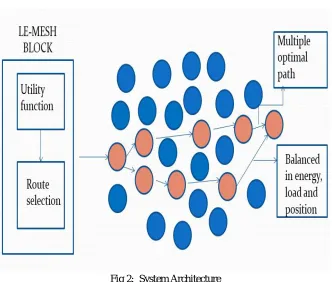
thereby enchancing the Qos for the video data delivery. The reliability of video data is also greatly improved by LE-MESH by reserving one optimal path for any uncertainty like link breakage, collision, etc. whenever it selects the multiple-optimal path for multimedia data transmission. To identify an optimal path, the information of energy, load, node position, neighbor nodes are collected from various layers of the network. The AOC-MAC duty cycle management scheme is implemented in the MAC layer. This duty cycle management scheme manages the sleep periods of the mesh nodes present in the netwok.
The AOC-MAC protocol, increases the residual energy of the network by making the mesh nodes to enter into a sleep mode when it is idle. In this section the details of the proposed LE-MESH is discussed in detail. First the cross-layer information collection module is discussed in the detail. Second the AOC-MAC protocol usage in our proposed work is discussed. Thirdly we discuss about the traditional E-MESH algorithm, which is simulated to do the comparison study with the proposed LE-MESH protocol. Then the detailed description of the LE-MESH protocol is done.
A. Cross layer Information Collection
In the first phase the information of energy, load, position of the source and neighbor nodes are calculated from the cross layer(i.e physical layer and MAC layer),device-condition-based information from the mesh routers, including the remaining energy levels at each mesh router, current traffic load amount and distance between mesh routers, are collected from the control packets exchanged among the nodes in the WNs. The utility values are computed from the collected cross-layer interface. The mesh router position are identified across the network for the neighboring nodes and also the readability of nodes are checked. Based on the evaluation the multiple optimal path are identified for the successful load and energy-aware video transmission.
B. Energy- Aware MAC Layer Duty Cycle Management
AOC-MAC, an adaptive MAC-layer operation cycle is implemented for excellent multimedia transmissions over wireless mesh networks. This duty cycle management scheme manages the sleep periods of the mesh nodes present in the netwok. The AOC-MAC protocol , increases the residual energy of the network by making the mesh nodes to enter into a sleep mode when it is idle AOC-MAC is deployed in conjunction with LE-Mesh, an energy-aware routing mechanism, as part of an energy-aware cross-layer scheme. The AOC-MAC manages the sleep periods of the network devices in a smarter way based on link-state communication condition thereby reducing the energy consumption of routers by extending their sleep periods. This is achieved by monitoring duty cycle of each mesh router is managed with the MAC-layer solution, which periodically detect the communication status of the mesh routers included in the network and adapt the length of the active periods of the mesh router in the duty cycle according to the communication states.
C. Data Transmission based on Energy-Aware Routing
This function introduces an energy-aware wireless routing algorithm and makes use of a novel multiplication based utility function determining the best route for traffic delivery. This function combines utility components which reflect remaining energy level, transmission distance and network load. Each mesh router ni in the wireless mesh network considers the following three key criteria for utility calculation: its local position in terms of the (Xi , Yi ) coordinates, its present network traffic load Li and its remaining energy Ei. The residual energy and network traffic load for each mesh router are updated regularly during the video streaming traffic delivery. Hence for each mesh router ni, the Energy-Load-Distance-based utility function is shown in equation
Utility Cni = Lni * Dni / Eni
Where,
Lni = L - Lmin / Lmax - Lmin
Dni = D - Dmin / Dmax - Dmin
Eni = E/ Emax
In these functions E , D and L represent the present residual energy, distance to the mesh client and traffic load of router ni, which are obtained by the Router Information Collector.
D. Load Balancing and Energy Aware Routing Protocol
M -> M1 + M2 + M3
[image:4.612.135.499.104.286.2]M1 -> p1; M2 -> p2; M3 -> p3
FIG 1: Implementation Of LE-Mesh IN OSI Layer
Fig 2: System Architecture
IV. SIMULATION AND PERFORMANCE EVALUATION
In this section, we present the simulation values using network simulator NS2.35. E-Mesh AODV (EM_AODV) protocol is developed by modifying AODV routing algorithm. Comparison is made between the EM_AODV and enhanced EM_AODV protocol. Both are evaluated for the simulation settings as per the simulation model and compared. Metrics such as Delay, Energy Consumption, and PDR are evaluated for the scenarios of varying number of nodes as 30, 40, and 50. Graphs are sketched for performance metrics using X graph in NS-2.35.
[image:4.612.141.473.306.588.2]V. RESULTS AND DISCUSSION
EARP and LBEARP are compared for the scenarios of varying number of nodes. Scenario is kept same for both protocols with same topology, energy and mobility. Totally 3 simulation runs are made by varying number of nodes such as 30, 40, and 50. Metrics such as energy consumption, delay and PDR are computed and plotted as Xgraph
A. Delay
[image:5.612.203.405.262.440.2]It is the time taken for the packet to reach from source sensor to destination. The delay is calculated by differing the no of nodes. The resultant graph Fig[3] gives the comparison values of EARP and LEARP. The graph is plotted by using the Xgraph. The x-axis in the graph denotes the no of nodes and y-axis denotes the delay time in seconds. The graph shows that the LEARP decrease gradually whereas the EARP delay increased gradually. At later point the delay get increased in both the LEARP and EARP. But when it is closely examined the LEARP routing algorithm delay is very less when compared with EARP delay. Also when the number of nodes increases the delay is also increased. Thus it is studied that EARP (E-Mesh) incurs increased delay compared to the LBEARP (LB_Mesh) increases the delay is also increased. Thus it is studied that EARP (E-Mesh) incurs increased delay compared to the LBEARP (LB_Mesh).
FIG 3: DELAY
B. Packet Delivery Ratio
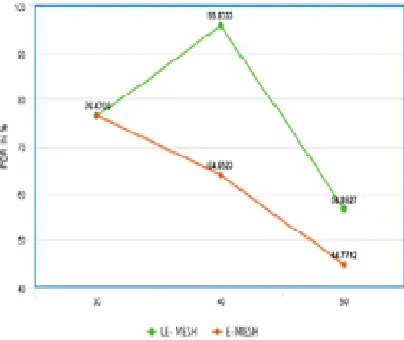
PDR is the ratio of the total number of packets delivered to the destination and number of packets sent by the source. Fig[4] gives the comparison of LEARP
and EARP. The x- axis denotes the no of nodes y-axis denotes the packet delivery ratio in percentage(%). The graph shows that the PDR value of EARP is very high when compared with EARP PDR values. When the number of nodes increased the packet delivery ratio is increased. The LBEARP (LB-Mesh) contributes increased packet delivery ratio compared to the EARP (E_Mesh).
[image:5.612.202.404.540.710.2]C. Energy Consumption
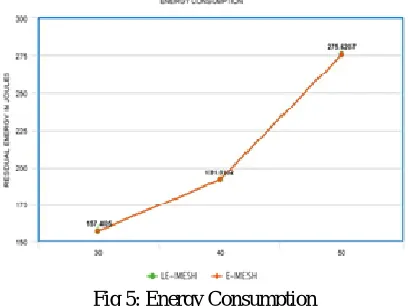
[image:6.612.204.408.173.326.2]It is the amount of energy consumed to deliever the data from source to destination. the below graph give the comparison outcome of overall residual energy of the system. The x-axis denotes the no of nodes and the y-axis denotes energy consumption in joules. The analysis is made between the LEARP and the EARP routing algorithm. Fig[5] shows that the residual energy of the LARP is 0.1% superior when compared to the EARP residual energy. When the number of nodes increased the energy is increased. The LBEARP (LE-Mesh) and EARP (E_Mesh) provides similar performance.
Fig 5: Energy Consumption
VI. CONCLUSION
An Load Balancing and Energy-Aware LE-MESH routing algorithm in wireless mesh networks along with the AOC-MAC duty cycle management in the MAC layer for balancing energy and quality of a multimedia content is implemented in this paper. From the simulation results, it is observed that the proposed LE-MESH shows better performance in terms such as network lifetime, energy consumption, end-to-end delay, routing load and PDR Future researches might be done in order to enhance the quality by finding the packet loss issues and the algorithm to overcome the packet loss so that it will further boost the quality of the video delivery.
REFERENCES
[1] Shengyang Chen, IEEE, Zhenhui Yuan, IEEE, and Gabriel-Miro Muntean,(2016),“Energy aware routing algorithm for quality oriented wireless video delivery”, IEEE Transaction on Broadcasting, Volume. 62, No.1.pp.55-68
[2] Mariazogkou,AggelikiSgora; Dimitrios D .Vergados(2013), “Energy aware routing in IEEE 802.11s wireless mesh networks”, IEEE Conference on Wireless Information Network and System ., pp 1-6.
[3] R.Trestian, O.Ormond and G.M.Muntean,(2014), “Enhanced power- friendly access network selection strategy for multimedia delivery over heterogeneous wireless networks,” IEEE Transaction on Broadcasting, Volume. 60, No. 1,pp. 85–101.
[4] R.Trestian, O.Ormond, and G.-M. Muntean,(2013), “Energy–quality–cost trade-off in a multimedia-based heterogeneous wireless network environment,” IEEE Transaction on Broadcasting, Volume. 59, No. 2, pp. 340–357.
[5] Shengyang Chen; Zhenhui Yuan; Gabriel Miro Muntean,(2017), “Balancing Energy and Quality Awareness: A MAC-Layer Duty Cycle Management Solution for Multimedia Delivery Over Wireless Mesh Networks” IEEE Transaction on Broadcasting ,Volume. 66,No.2, pp.1547-1560
[6] Shengyang Chen and Gabriel-Miro Muntean, (2013) ,“AOC-MAC: A Novel MAC_layer Adaptive Operation energy aware in wireless mesh networks”, IEEE Conference on Vehicular Technology,pp.1-6
[7] Shengyang Chen and Gabriel-Miro Muntean,(2017), “E-Mesh An Energy-efficient Cross-layer Solution for Video Delivery in Wireless Mesh Networks” IEEE Conference on Broadcasting, pp. 1-7.
[8] Oscar Delgado, and Fabrice Labeau,(2017), “Delay aware load balancing over multipath wireless network” IEEE Transaction on Vehicular Technology,Volume:66,pp. 7485 - 7494.
[9] Koffka Khan, Wayne Goodridge,"Energy Aware Ad Hoc On-Demand Multipath Distance Vector Routing", International Journal of Intelligent Systems and Applications (IJISA), 2015
[10] Yumei Liu, Lili Guo, Huizhu Ma, Tao Jiang, “Energy efficient on demand multipath routing protocol for multi-hop ad hoc networks”, in the Proceedings of ISSSTA-08, IEEE 10th International symposium on Spread spectrum and applications, Bologna, Italy, August 2008.
[11] May Cho Aye and Aye Moe Aung, “A Modified Energy Constrained Protocol based on AOMDV for mobile Ad-Hoc Networks”, International Journal of Scientific Engineering and Technology Research Volume 3, November 2014
[12] R. Trestian, O. Ormond, and G.-M. Muntean, (2013) “Energy–quality–cost trade-off in a multimedia-based heterogeneous wireless network environment,” IEEE Transaction on Broadcasting., Volume.59, No. 2, pp. 340–357G.