Optimizing the polyester cargo box of the Mobile Solar Kiosk for serial production at Kamworks
Bachelor graduation report
Written by
Geeske Berga, s0101729
Within the bachelor program of the faculty of Industrial Design Engineering at Twente University.
In cooperation with Kamworks:
Jeroen Verschelling
Arjen Luxwolda
Supervisory team:
Angele Reinders
Arthur Eger
Jeroen Verschelling
Henry de Gooijer
Preface
This report documents the fi ndings and results of the bachelor assignment; the graduation project to obtain a bachelors degree at the faculty of Industrial Design Engineering at Twente University. The project was carried out at the company of Kamworks, situated in the small rural town of Sre Ampil, Cambodia.
In Cambodia things don’t often go according to the plan. It takes a while to understand how and why things work the way they work. Especially on social and cultural level Cambodia differs a lot from western countries. These cultural aspects are refl ected in Cambodia’s workspace and economy. Next to this, the country is still recovering from the civil war which means the country’s system and regulations don’t work according to western standards.
Getting exposed to such a different culture resulted in learning about myself, my values and perseverance. It also gave a different perspective on my own country and it’s culture. For example, I can now recognize peculiarities in the western culture as well and at the same time enjoy them because they are ‘cul-tural’.
This, at the same time, being my fi rst experience of studying abroad, makes it memorable and of great impact on personal level.
I am grateful to all who where there and gave me such a warm welcome. Looking back, I think of the Khmer people who always gave me the feeling of being special and I think myself lucky for having made such wonderful friends.
All in all, it was a wonderful experience and I would like to thank the following people for there collaboration and support:
First of all, I thank my company mentors, Arjen Luxwolda and Jeroen Verschelling; Jeroen for all the enthusiastic skype meetings and his never ending list of ideas and Arjen for his valuable help with all kinds of practical issues, like taking me to Phnom Penh to buy parts as well as solving technical problems during the prototyping.
Also my UT supervisor, Angele Reinders, deserves a thank you. She always gave me the feeling that I was doing things in the right way. It gave me self-con-fi dence and I felt no restrictions.
I also want to thank Henry de Gooijer for his support on every imaginable level. Although he is not a member of the Kamworks crew anymore he still proved to be of great value and support during the entire process. From preparation, to fi nancial stuff, to writing the report: Henry offered his help always and ev-erywhere. A big thank you!
Furthermore, I would like to thank Leap for being a great source of information as well as being a jokist and friend. Also Pip deserves a thanks for being my translator, for helping with all the everyday things like fi xing the internet and for all her kindness.
I cannot forget the rest of the Kamworks staff: Sarin, Serey, Sitha, Phalla and Sak. Sarin for his help with all kinds of composite problems, for sharing his thoughts about problems. Serey, Sitha and Phalla for their kindness and help in the workshop. They were always willing to share their tools, the plug sockets and space. Sak for being so playful and annoying, it pepped things up.
Executive summary
This report documents the results of the bachelor graduation project, which is part of the study Industrial Design Engineering at Twente University in the Netherlands. The assignment is carried out on behalf of a small Cambodian company, named Kamworks, founded by the Dutch charity foundation Pico Sol. Kamworks is specialized in solar energy and is situated in the rural areas of Cambodia, 30 km south of Phnom Penh.
The Cambodian economy is still recovering from the civil war in the 1970’s. In rural areas 40 to 45 % of the people live below the poverty line. Many people are poorly educated or not educated at all, which leads to high unemployment rates especially in the rural areas. Furthermore, less than 9% of the rural Cambodian have access to a proper and reliable electricity grid. In rural areas small diesel generators serve as charging stations for car batteries which makes electricity rather expensive. Also petrol products, like gasoline and kerosene are used for lighting. All in all, the rural people’s means for living are pol-luting and unhealthy.
Kamworks tries to improve this situation by developing small solar products for rural people, e.g. solar lights, and by offering employment. The previous years, these goals led to the development of a distribution concept for solar products under the name of Kamunasal in the rural area of Kandal province, which won a World bank Prize.
The concept in short: Young people from the province are trained in a four week course to become a Micro-Entrepreneur at Kamworks and sell the Kamuna-sal products. For this purpose stationary stalls and a market bike were developed. This market bike is subject for this bachelor graduation project.
The market bike was the result of the graduation project of Miriam Reitenbach. She used an old bike for the frame and glass fi ber reinforced plastics for the cargo box. This box was not reproducible and thus it required redesigning to make it suitable for a small serial production at Kamworks.
Therefore, the goal of the assignment is to redesign the market bike for Cambodian Micro-Entrepreneurs to distribute solar products in the rural areas of Cambodia, and make this bike suitable for serial production.
This project asked for knowledge about glass fi ber reinforced plastics, the Cambodian economy and trends and of course the cultural aspects which infl uenc-es the way of working at Kamworks, economy, every day life, et cetera. Because Cambodia douenc-es have slim to non expertise in composituenc-es, this project was started with a small internship at NPSP Composites in Haarlem, to gain experience with and knowledge about composites. This knowledge proved valuable during the time in Cambodia. Furthermore, literature and the reports of previous students were examined thoroughly, to get insight in Cambodia’s economy, the products of Kamworks and the distribution model. The experience of being on Cambodian grounds helped to understand the decisions made by preceding students and Kamworks.
The Khmer participants of the Micro-Entrepreneurial course served as subjects in user tests with the original Mobile Solar Kiosk. These tests were performed in order to see whether design adjustments were recommended. The subjects were also asked about the appearance of the bike. These tests resulted in valuable information for the rest of the project.
To get insight in the production situation and possibilities, tests with composites were performed at the workshop of Kamworks. Soon it became clear that the composite work situation at Kamworks is still very primitive, which asked for a fl exible, easy-to-adjust, design approach.
The new concept makes better use of the characteristics of the glass fi ber reinforced material, such as form freedom and a high quality surface fi nish. In order to achieve a satisfying prototype, the production process was adjusted. It was necessary to produce the positive form or so-called plug in a different way to achieve a high surface quality. A major difference with the old production process is that the positive form remained intact and can be used over and over again. Furthermore, the positive mold does have mold division lines, but they are not visible in the fi nal product. Also the shape is much more complex. By means of the user tests and interviews with Micro-Entrepreneurs the shape was defi ned.
During prototyping a fl exible approach was applied. The design was adjusted a few times to cope with some unforeseen problems. Especially problems with the paint layer of the plug and the mold releasing asked for radical changes in the mold design. The fi nal mold combination now contains four mold parts instead of the three mold parts in the initial concept.
The fi nal prototype is an electric market bike, with a polyester cargo box and a sun-blocking roof. Compared to the existing mobile stores, this market bike is much lighter due to the composite material which makes the bike easy to steer. The redesigned frame with its damping system enables the driver to drive along bumpy roads. The electric system makes it possible to cover large distances on rough terrain. The batteries can be recharged by solar energy which makes the bike less polluting than conventional mobiles stores, using moto’s on gasoline.
The cargo box is fi t with a product display in the lid, onto which products can be attached. This way the public can see the products. In the cargo box all sorts of products can be placed, from large to small products. Also, the equipment of the Micro-Entrepreneur can be stored. At the moment the prototype is used to further develop the fi nal product.
Terms and abbreviations
Don Bosco
Technical school in Phnom Penh with workshop for welding and woodworks
Female mold
Negative mold
GFRP
Glass Fiber Reinforced Plastic
Khmer
1) inhabitant of Cambodia
2) the language spoken in Cambodia
MDF
Medium
Density
Fiberboard
ME
Micro-Entrepreneur
MSK
Mobile
Solar
Kiosk
Moto
Moped
Plug
Positive
form
1
2
4
3
Domain of the project
10
1.1 Introduction 11
1.2 Involved parties 11
1.3 Problem description 12
1.4 Objective 12
1.5 Design approach 14
1.6 Structure of the report 14
1.7 Naming conventions 17
General analysis
18
2.1 Context analysis 19
2.2 Kamworks’ activities 20
2.3 Kamunasal products & identity 20
2.4 Distribution concept 22
2.5 Micro entrepreneurs 23
2.6 Stakeholders 24
The Mobile Solar Kiosk
26
3.1 Choice of material 27
3.2 Exterior 28
3.3 Interior 28
3.4 Size 30
3.5 Frame 31
3.6 Ergonomics 33
3.7 General opinion of costumers 34
3.8 General opinion of micro entrepreneurs 34
3.9 Total costs 37
3.10 Conclusions for the redesign 38
Production processes
40
4.1 Present production process 41
4.2 Processing composites 42
4.3 Testing 46
4.4 Production facilities 49
4.5 Future perspective 50
7
6
5
Concept development
52
5.1 Action plan 53
5.2 Design improvements 54
5.3 Stakeholders 55
5.4 Product functions 55
5.5 Requirements 56
5.6 Morphology 58
5.7 Combination 1: old-fashioned 59
5.8 Combination 2: aero-dynamic 60
5.9 Combination 3: friendly 61
5.10 Survey 62
5.11 Display 63
5.12 Conclusion 63
Final design
64
6.1 Approach 65
6.2 Final concept 66
6.3 Prototyping 69
6.4 Details and fi nishing touch 70
6.5 Dimensions and ergonomics 72
6.6 Reproducing the cargo box 74
6.7 Cleaning and maintenance 75
6.8 Cost price 76
Evaluation
78
7.1 The criteria 79
7.2 Process evaluation 81
7.3 Recommendations 84
7.4 Conclusion 87
7.5 Personal refl ection 89
Domain of the project
1.1 Introduction
This report refl ects the results of the bachelor assignment carried out at a small Cambodian company, named Kamworks, which specializes itself in solar en-ergy. The company is situated in Kandal Province, a rural area south of the capital Phnom Penh. Being one of the world’s least developed countries, Cambo-dia scores low on the electrifi cation rate. According to CamboCambo-dia Renewable Energy and Rural Electrifi cation1, only 15% of Cambodia’s people have
continu-ous access to electricity via a reliable grid and most of these people life in Phnom Penh. In rural areas less than 9% has access to so-called ‘grid-quality’ power. The rest of the rural population uses rechargeable batteries and petroleum products, like gasoline and kerosene. Concerning cooking, still 90% of the population uses fi rewood and charcoal.
The fuels used in rural areas are not harmless for environment and health. For instance, kerosene and diesel are causing pollution and the constant exposure to petroleum products, fi rewood, charcoal and defect batteries are causing serious risk for people’s health.
According to Arjen Luxwolda the government subsidizes the power from the grid which results in lower costs in the city for electricity than in the rural areas. However, 40 to 45 % of the people in Cambodian rural areas are living below the poverty line.2 Due to the absence of a subsidized grid the electricity for the
poorest people in the rural areas is much more expensive.
All together, the Cambodian rural areas are demanding a cleaner, cheaper and more reliable energy supply. Solar energy is a promising way of electrifi ca-tion in the rural areas of Cambodia, as the country is one of the sunniest in the world. With this goal in mind Kamworks developed a market bike and some stationary shops to provide the rural population with solar products.
The goal of this assignment is to redesign the market bike for Cambodian Micro-Entrepreneurs. The ME’s use the bike to distribute the products. Hereby, it is important to pay attention to the Micro-Entrepreneurs, the possibilities of Kamworks, the availability of materials, wishes and trends among the public and the cultural aspects infl uencing the Cambodian market and economy.
1.2 Involved parties
Twente University – Industrial Design Engineering
Twente University is operative in research and education varying from social studies to science. One of the science studies at Twente University is Industrial Design. This educational program trains students to design consumer products. The fi rst three years consist of compulsory courses to gain general essential knowledge. This so-called bachelor program is completed with an individual assignment.
Pico Sol
Kamworks
The bachelor assignment is performed at Kamworks. Kamworks is a spin-off of Pico Sol, therefore its fi eld of expertise is solar energy. However, unlike Pico Sol, Kamworks is a commercial company. Therefore it is a long-term project independent of donations. Kamworks is located in the rural area of Cambodia in a village named Sre Ampil, next to an orphanage. Its goal is to provide ‘affordable energy for sustainable development’. Based on this mission, Kamworks developed a list of fi ve credo’s for its products: Affordable, sustainable, locally producible, durable and desirable. Additionally, Kamworks provides employ-ment in rural Cambodia.
Products
The main business of Kamworks is the installation of solar systems in community facilities and households. This main business will be extended with cheaper products for the consumer market. These products will be produced at Kamworks and are designed to comply with the demands of the rural population. The products are distributed under the brand Kamunasal. The production of the fi rst locally produced product, the Angkor Light, starts at the end of 2008. In order to explore the consumer market import solar products are already being sold today.
Trainings
Kamworks also provides courses for orphans and other young people without perspective. A successfully completed course enables the student to become a micro-entrepreneur at Kamworks. They can work as installers of solar systems or as vendors of other solar products in small shops.
1.3 Problem description
Currently, Kamworks is developing a distribution network in Kandal Province for the sale of solar consumer products. This network exists of fi xed shops and mobile vendors. Kamworks plans to produce functional and appealing mobile stalls for the mobile vendors.
At this moment, a prototype of the mobile kiosk is available in the form of a delivery tricycle. This prototype is the result of a graduation project of a student at Delft University, Miriam Reitenbach. However, this prototype cannot be produced with local production techniques at Kamworks. To enable this, several adjustments have to be made. Besides local producibility there are other important issues such as outer appearance, volume, adaptability of interior and materials. The kiosk needs to represent the micro-entrepreneur and its products on the Cambodian market effectively. The interior has to be adaptive to a wide product range.
1.4 Objective
The objective of this assignment is to:
‘Optimize the polyester parts of the delivery tricycle for serial production at Kamworks. Important issues are the local producibility, appearance, volume, adaptive interior, materials, affordability and demands of the rural population in Cambodia. These issues will be analyzed and taken into account in the de-sign.’
1.5 Design approach
The book Productontwerpen by Arthur Eger et al.3 is the basis for the applied design approach. The project follows mainly the procedure described in chapter
3 of the book. Phases and topics of the book can be found in fi gure 1.1, a schematic representation of the applied design approach.
Four succeeding phases are executed, beginning with the research phase. This phase consists of general and practical analyses. The general analyses are about getting to know the context in which to design the product and it’s market. Social and cultural standards and the economic situation are examined, as well as their effects on each other. Furthermore, Kamworks and it’s product brand Kamunasal are examined.
These general analyses are performed by reading the previous reports of fellow students at Kamworks and additional literature.
The practical analyses consist of a product analysis and user tests. By means of the fi ve credo’s of Kamworks, the Mobile Solar Kiosk is analyzed step by step. Additionally, user tests and questioning of local people is used to obtain conclusions for the redesign.
The second part of the practical analyses consists of gathering information about GFRP production processes and the facilities at Kamworks. By visiting the company of NPSP Composites in the Netherlands, useful information about processing GFRP’s is acquired.
The production facilities at Kamworks are analyzed at the moment of arriving and these are decisive for the fi nal production process.
On basis of the fi ndings of the research phase, the exact functions as well as suggestions for approving the design are developed. By means of this, the requirements are set up. Thereafter, the actual designing starts by fi nding solutions for every product function and combining these solutions to fi nd the fi nal concept. Mainly, sketching is used in this phase.
During the detailing phase the fi nal design is developed as well as a prototype. Also the fi nal cost price is estimated. Prototyping is done at the workshop of Kamworks. With the aid of 3D-modeling program Solid Works the concept is further developed and work drawings for the prototype and molds are made. Af-ter fi nishing the prototype, the production plan and important facts are described to provide Kamworks’ employees and future students with important GFRP knowledge and guidelines.
In the last phase the project is evaluated. Conclusions and recommendations are set up to help future students in their attempt to improve the design, it’s production process or facilities at Kamworks.
1.6 Structure of the report
The schematic representation of the design approach in fi gure 1.1 also represent the structure of the report. Left, the phases are described while at the right the corresponding chapters are presented.
To increase the legibility, some phases and topics are divided over more chapters, whereas other topics are combined.
Chapter 1
Problem description
Setting design criteria
Concept development
requirements
Chapter 5
DESIGN
design improvements product functions
fi nding solutions combining solutions design sketching
DETAILING
Final concept
Chapter 6
prototyping ornaments & fi nishing cost price
EVALUATION
Chapter 7
Chapter 2
Chapter 3 & 4
Analyzing concext & market
cultural
Practical analyses
user tests analyzing MSK prototype
social
analyzing production facilities economic
RESEARCH
analyzing GFRP production processes
[image:16.595.120.732.94.500.2]1.7 Naming conventions
To avoid ambiguity, the following naming agreements are set up:
The word consumer market can be interpreted as a market for consumer products in rural Cambodia. A Micro-Entrepreneur or ME is someone who works for Kamworks as a vendor or installer.
2.1 Context analysis
Because Cambodia differs in so many ways from The Netherlands an analysis of the country’s characteristics is performed. The aim is to get insight into the Cambodian situation concerning employment, people, selling methods and economy.
Cambodia
Cambodia is a country in South East Asia, located in the tropics. It is surrounded by Thailand, Laos and Vietnam. Cambodia has a shoreline at the Gulf of Thailand. The country covers an area of 181.035 square kilometers and counts 13.6 million inhabitants. According to the Cambodia Development and Re-search Institute 4 only 20% of the people live in cities and more than 50% of Cambodia’s population is younger than 20 years old.
Economic situation
Cambodia is one of the least developed countries of the world. After many years of war the economic situation was very poor. Today Cambodia’s economy is stabilizing step by step and despite of the challenging international economic environment, Cambodia’s economy is even showing resilience. According to The World Bank it’s economic growth is mainly driven by an expanding tourism sector and robust garment exports. Besides the above mentioned sectors, the agricultural sector is also an important and large source of income for Cambodia.
According to the Cambodia Development Resource Institute (CDRI) the number of unemployed people is 20 percent and most unemployed people live in rural areas. Note that 80% of Cambodia’s population is living in the rural areas. 2
Micro-entrepreneurship is the base of the traditional Cambodian way of life. Most people earn money in small family fi rms that are based on agriculture (85%), trade and skills. Only a few percent of the Cambodians earn income from large-scale industry. Kamworks’ development strategy is to connect to this situation by supporting small-scale business of micro-entrepreneurs. 5 In the meantime Kamworks also contributes to the employment in the rural area of
Kandal Province.
Sales and distribution
In de rural area people buy their food and other needs at little market shops in villages or alongside the road.
Many different kinds of products are being sold in the market shops, varying from electronic devices to foods and clothing.
Mobile kiosks can be found in both urban and rural areas but the kiosks in rural areas are often powered by a motorbike because of the unpaved roads and long distances. In the cities the mobile kiosks vary from a hand pulled cart to a motor powered vehicle. 6
The goods sold by mobile kiosks are mainly foods and other cheap products. More expensive products are sold in fi xed shops. In general, the quality of the product is uncertain because of the many fake brands imported from China. Therefore, it is a challenge for Kamworks to convince people of the quality of their products. 7
People and culture
Due to the violent history of the country people tend to be suspicious towards outsiders. This effects the entire society, including the way of purchasing prod-ucts. People tend to buy from whom they know.
Khmer people always try to be polite and this effects the way of interviewing people.
A typical poor family in rural Cambodia earns between $300 - $500 per year and spends about $20 - $24 per year on lighting.
very poor ($1 per day)
A typical very poor family owns only few technical products, as some lamps and a radio. They live from day to day and are not able to make larger expenditure. Their main source of income is some cultivation, catching rats or frogs. In general, only one or two bikes serve for family transport.
poor ($1.5 - $3 per day)
These families seem to form the largest group in the rural area. They own some lamps and several other technical products, such as black and white television and a radio. They are often farmers and besides they run a very small shop. Sometimes these families own one family shared motorbike.
Rural affl uent (>$3 per day)
In the rural area also some richer families can be found. In the Cambodian culture it is not very common to move to another place, when they climb up in social status. These families are often farmers that are able to purchase machines to cultivate their land. They often have black and white or color television, a DVD-player and/or music players. Often these families own several motorbikes for the family.
Source: Design of a Mobile Solar Kiosk for Cambodian Micro-en-trepreneurs, Miriam Reitenbach, 2007
2.2 Kamworks’s activities
Until today Kamworks main activity is the installation of solar systems at Cambo-dian companies, institutions and organizations. However, Kamworks aims to enter the consumer market in rural areas as well. Two products for the consumer mar-ket have already been developed; the Solar Home System and the Angkor Light. Figure 2.1 is a schematic representation of Kamworks and its business. Each line represents a different activity of Kamworks; the upper one shows the high-end business of installing solar panels at e.g. companies, the other two show the sales of solar-goods at the consumer market using stationary stalls and mobile shops.
Kamworks already sold a few Solar Home Systems to some affl uent families living in Kandal Province. In the future a growth of the sales of consumer products like Solar Homes Systems and the Angkor light is expected.
Kamworks’s products for the consumer market are distributed under the brand Kamunasal. Kamworks developed fi ve company credo’s for their products: afford-able, desirafford-able, produced locally, sustainable and high quality.
2.3 Kamunasal products & identity
According to Kirsten Rijke 8, the identity of the new brand Kamunasal is based
mainly on two things. First of all, Kamworks contributes to the brand identity, fore Kamunasal is produced and developed by Kamworks. Secondly, the fi rst Kamu-nasal product for the consumer market, named the Angkor Light, infl uences the attitude of consumers towards the Kamunasal brand and thus its identity. The fi ve credo’s of Kamworks are important pillars for the Kamunasal products. Kamunasal presents itself as a high quality brand which produces affordable prod-ucts which fulfi ll the needs and wishes of rural people. The prodprod-ucts are sustain-able and produced locally.
Also the western origin of Kamworks glimmers through in the Kamunasal identity. This results in a western and therefore modern brand identity.
Already two products have been developed: the Angkor Light and the Solar Home system. They are designed to fulfi ll the needs of the affl uent people living in rural areas.
Recently, a third product prototype has been developed, named the Ampul light. This light has to be further developed to make it suitable for serial production.
The Angkor Light
electronic devices. This product is designed for the affl uent rural people: See the blue cadre. The Angkor Light is locally producible as well as sustainable, high quality and affordable for its target group.
The Solar Home System
This product has been designed for the most affl uent people in rural areas. It contains some solar panels and a battery pack in a box. The box has sockets for some plugs. See fi gure 2.2. The affl uent people in the rural areas often own a television, a DVD-player and some music players. See blue cadre. The solar home system can be used to provide these larger products with energy.
The system satisfi es with the fi ve credo’s of Kamworks; it is afford-able and desirafford-able for its target group and at the same time it is a sustainable, high quality product which is produced locally.
The Ampul light
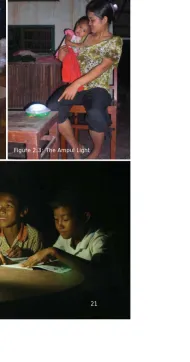
Ampul means light in Khmer. This light has been developed to substi-tute the kerosene light. The target group are the very poor and poor people in rural areas. See cadre. The battery of the Ampul light can be recharged by a small solar panel that comes with the lamp. People can hang the light around their necks if they don’t have free hands and the lamp can also be attached to a beam or nail in the wall. The light intensity can be adjusted.
The light will cost no more then ten US dollars which makes it a suit-able product for selling at a mobile store. Figure 2.3 shows a proto-type of the Ampul Light.
Future products
Mando Rotman 9 developed possible product market combinations for
Kamworks. See appendix A. Some of these products are suitable for the Kamunasal tricycle, like a battery recharging service for medium and large capacity batteries.
The market bike can ride its route through villages and pick up empty batteries and deliver recharged batteries. This is especially useful for people who live very remote in the rural area. People in rural areas can not rely on brand names, for there are many fake brands and they hardly ever get warranty. Through regular visits of the mobile kiosk and the possibility for warranties, trust between people and Ka-munasal can be built. This trust is essential for the high quality label that Kamunasal wishes to have.
[image:22.595.405.759.59.534.2]Because mobile stores are generally used to sell cheap products also
Figure 2.2: The Solar Home System Figure 2.3: The Ampul Light
Legenda
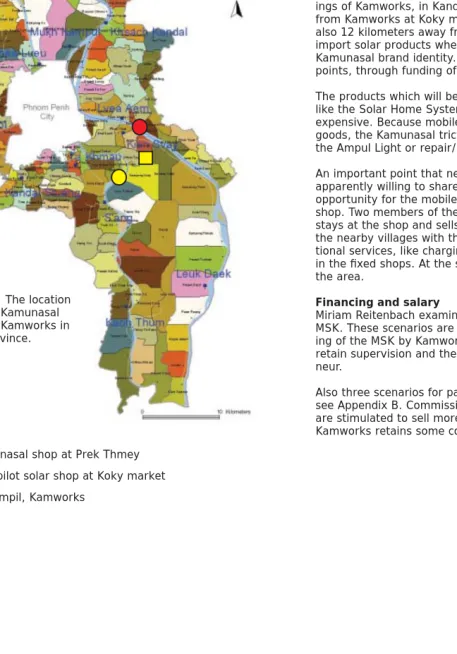
Kamunasal shop at Prek Thmey First pilot solar shop at Koky market Sre Ampil, Kamworks
2.4 Distribution concept
At the moment Kirsten Rijke is developing a network of fi xed shops in Kandal Province. Already two shops are operative. They are situated in the surround-ings of Kamworks, in Kandal Province. The fi rst shop is situated 12 kilometers from Kamworks at Koky market and the second one just opened at Prek Thmey, also 12 kilometers away from Kamworks. See fi gure 2.5. The fi rst shop sells only import solar products whereas the concept of the second shop is based on the Kamunasal brand identity. The initial idea is to set up eight Kamunasal selling points, through funding of the World Bank.
The products which will be sold in the fi xed shops are the Kamunasal products like the Solar Home System and the Angkor Light. These products are relatively expensive. Because mobile kiosks are usually not used for selling expensive goods, the Kamunasal tricycle should be used for smaller, cheaper products like the Ampul Light or repair/recharge services.
An important point that needs to be considered is that micro-entrepreneurs are apparently willing to share their business with their family. [7] This forms an opportunity for the mobile kiosk; it can be launched as an extension of the fi xed shop. Two members of the same family can form an alliance; one family member stays at the shop and sells products whereas the other one drives around through the nearby villages with the mobile kiosk. Than the kiosk can be used for addi-tional services, like charging batteries, conducting repairs e.g. of products bought in the fi xed shops. At the same time it will promote the new Kamunasal shop in the area.
Financing and salary
Miriam Reitenbach examined three different scenarios for the fi nancing of the MSK. These scenarios are described in Appendix B. The best scenario is the rent-ing of the MSK by Kamworks to the Micro-entrepreneur. This way, Kamworks will retain supervision and the MSK requires low investment of the Micro-entrepre-neur.
[image:23.595.131.360.93.449.2]Also three scenarios for paying the ME’s were examined. For more information see Appendix B. Commission based salary turned out to be the best option. ME’s are stimulated to sell more and they do not have to invest in the stock. This way, Kamworks retains some control over what the ME does.
2.5 Micro entrepreneurs
The future users of the mobile kiosk will be adolescents who live nearby Sre Ampil in Kandal province. These young people will receive a training of four weeks at the solar school at Kamworks. See fi gure 2.6. After fi nishing the course successfully, they are ready to hit the road with the solar kiosk. [5]
Selection procedure
During the course the students gain marketing and technical knowledge. According to their abilities and affi nity towards the subjects the best students are selected. Kamworks aims to select both male and female.
According to Kirsten Rijke the family and social network of the micro-entrepreneur need to be considered during selection. Because people tend to buy from family and friends it is best for the sales to have a micro-entrepreneur from the vicinity of the shop. For the mobile shop this means that the micro-entrepre-neur should live near the matching fi xed shop.
Present situation
[image:24.595.121.727.61.314.2]Today only fi xed shops are situated nearby Kamworks, so the students will be selected for the fi xed shops. In the future, also students for mobile kiosks will be selected at the end of the course.
2.6 Promotional activities
As mentioned before, today only two Kamunasal products are being produced at Kamworks today: the Angkor Light and the Solar Home System. Both products have not been sold on large scale yet. Only few Solar Home Systems have been sold to families living in the area of Kamworks and two systems were do-nated to families who served as test families during development of the Solar Home System. The reputa-tion of the SHS is still very poor.
Also the Angkor Light is not widely known yet. It is being produced at Kamworks right now, but because there is only one Kamunasal solar shop so far and this one is not known to the large public yet, sales are still low.
To achieve a well-known reputation for the Kamunasal brand, some promotion of it’s products and shops is required. The launch of a new shop can be promoted through driving the Kamunasal bike around the shop area and inform people about the new shop and it’s products. The Angkor Light, Solar Home System and Ampul Light can be used to demonstrate the principle of Solar energy to the people in the nearby vil-lages.
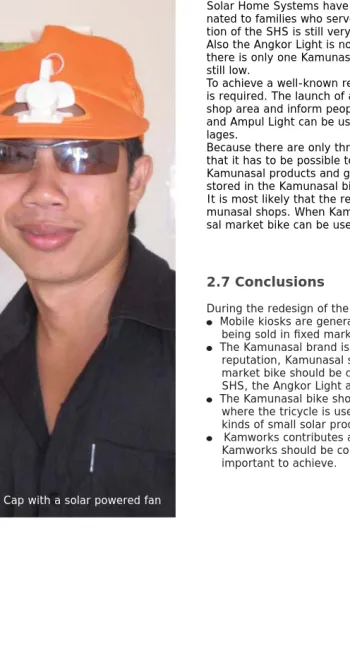
Because there are only three Kamunasal products, using the market bike for promotional purposes means that it has to be possible to carry along the SHS and the Angkor Light as well. Then people can see the Kamunasal products and get to know them. Additional some smaller non-Kamunasal products can be stored in the Kamunasal bike, like the funny solar powered cap-fan. See fi gure 2.7.
It is most likely that the redesigned market bike will be used at fi rst to promote the launching of new Ka-munasal shops. When KaKa-munasal is better known and there are more KaKa-munasal products, the Kamuna-sal market bike can be used as the initial distribution concept prescribes.
2.7 Conclusions
During the redesign of the market bike the following issues have to be taken into account:
Mobile kiosks are generally used to sell relatively cheap products and food. More expensive goods are being sold in fi xed market stalls.
The Kamunasal brand is still developing and rather unknown to the public. To get a well-known reputation, Kamunasal should be promoted in the areas round the Kamunasal shops. The Kamunasal market bike should be designed to draw attention and to store all three of the Kamunasal products: the SHS, the Angkor Light and the Ampul Light. Also place for some promotional fl yers should be designed.
The Kamunasal bike should also satisfy the original distribution concept described in paragraph 2.4, where the tricycle is used as an extension of the fi xed shop. Therefore it should be adjustable to all kinds of small solar products and recharge and delivery services of the Kamunasal shop.
[image:25.595.119.294.95.505.2]Kamworks contributes a lot to the identity of Kamunasal. During the redesign the fi ve credo’s of Kamworks should be considered very carefully. Also the modern identity of Kamunasal is very important to achieve.
In this chapter the prototype of the Mobile Solar Kiosk is analyzed to get an understanding of the decisions made during the development of the MSK by Miriam Reitenbach. This may help to get the redesign to a higher level.
First the technical aspects of the MSK will be analyzed, like the size of the box, the interior and the materials. Also the frame which was redesigned by Jeroen Jansen is analyzed.
Thereafter the ergonomic situation is tested and the opinion of the future Micro-entrepreneurs is ex-amined. Finally the decisions concerning the costs are reconsidered.
3.1 Choice of material
The carrier of the MSK is made from glass fi ber reinforced polyester using the hand lay-up method. The kiosk is painted yellow, as the Kamunasal color is yellow. Compared to other mobile kiosks in Cambodia, the MSK appears very modern. Figures 3.1, 3.2 and 3.3 show what kind of materials are regularly applied in mobile kiosks and at the left page the Kamunasal kiosk is displayed.
The choice for GFRP was made by Miriam Reitenbach because of the following reasons: GFRP’s enable to design complex shapes and the production of GFRP’s can be performed at Kamworks, so costs for outsourcing will be saved. Another reason is that Kamworks can gain expertise in the processing of GFPR’s and expand its business, for GFRP’s are barely used in Cambodia. If expertise is suffi cient it may even be possible to use natural fi bers, which makes recycling possible. 6
An additional study on materials is performed to see if the choice of material was indeed the right choice. See appendix D and E for more information.
The study revealed that fi ber reinforced plastics are the best materials for the carrier when compared to other materials. Some great advantages of GFRP’s are the good weather resistance, the very low weight and the low maintenance costs.
Other plastics produced by e.g. vacuum molding are no option because the carrier is to big to produce in the vacuum molding machine at Kamworks and outsourcing the production would be very expen-sive. Wood and sheet metal are discarded because of the limited form freedom.
The Kamunasal identity is partly presented by the choice of material. For example, the shiny plastic is very striking and the rounded corners are rather exceptionally. However, composite materials offer much more form freedom than the forms of the present carrier. During the redesign even more com-plex forms can be applied. This will be in line with the modern identity Kamunasal wishes to have.
Conclusions
[image:28.595.528.759.58.534.2]The carrier will be made of fi ber reinforced plastics, because the material has great advantages on different levels
Figure 3.1: delivery tricycle in Phnom Penh
Figure 3.2: moto with side-car in Phnom Penh
3.2 Exterior
Surface fi nish
The MSK was produced in a mold which was divided into four pieces, because the form is not drafting. Figure 3.4 shows some details of the prototype of the MSK. The walls are slightly curved (A) and the upper brims are bending inwards (H). Prints on all sides of the MSK carrier are the result of this mold division (K). The gelcoat used to color the MSK was applied too irregularly which resulted in an uneven coloring (N). Therefore the entire carrier was spray painted yellow. This resulted in a fi ner surface fi nish. However, the spray paint peels off very quickly (L) and if the sun shines into the carrier the walls will see through (N). Also air pockets can be recognized in the walls (N). Additionally, there are some odds in the fi nishing of the brims (H) and the insert of the solar panel (I). Finally, a gap between the two lids will result in a very wet interior when it rains (C)
Branding
The Kamunasal brand is hand painted on both sides of the carrier using a beamer for projection (B) The letters are a bit untidy.
Solar panel
On top of the front lid of the carrier a solar panel is embedded (M). This panel is placed with the intention to use it for educational and promotional purposes, like explaining how solar energy works. However, it contributes a lot to the total costs of the mobile kiosk. Because the mobile kiosk will probably be used for selling cheaper products and services like battery charging and repair, the solar panel is rather superfl uous. Any promotional and educational activities can be performed using a small solar product.
Lights
In the front, the carrier has two refl ector lights embedded (E). This enables the driver to be seen in the darkness. However, the lights are not powerful enough to lighten up the road for the driver.
3.3 Interior
Fixing the goods
During the design of the MSK, no attention for the inside of the kiosk was paid. On the inside, the surfaces of the walls are very odd, and fi bers are extend-ing from the polyester (J).
A wooden tray was made to present an idea about how products can be placed and fi xed inside the carrier. However, the tray was made very quickly, be-cause it was meant as a prototype, and therefore it does not have a quality look (G). The tray is placed upon Perspex profi les which are laminated onto the walls (D). To make this idea work, some adjustments have to be made.
Hinges and lid
The brims of the box are bended inwards which made it necessary to design and produce hinges (F) for the cargo box. The hinges are able to keep the lid in a vertical position. It is better to design the opening mechanism in such a way that no custom made hinges are required.
Battery pack, wires and lights
The MSK contains two batteries to power the driving mechanism and the lights. The batteries should be recharged at regular intervals by an external source and they can be placed somewhere inside the carrier. The batteries should be fi xed properly and protected against other products, rain, moisture and vibra-tions from driving over bumpy roads. Also the wires connecting the lights and the driving mechanism to the batteries should also be fi xed properly, protected against products and moisture. To connect the driving mechanism to the battery some outlets have to be designed in the carrier. A solution for fi xing the wires of the driving mechanism to the frame should also be found.
Conclusions
During the redesign special attention has to be paid for the fi nishing of the product. better solutions for e.g. the hinges, the tray, the spray paint layer and the application of the brand should be found. Also the box should be made watertight and the refl ector lights should be replaced by real head lights, so the driver can see the road.
Because the mold division leaves its marks clearly, mold divisions should only be applied in areas out of sight or where two surfaces hit each other. The solar panel should be reconsidered, because it adds a lot of costs to the MSK
Space for battery, lights, wires, e.g. should be reserved in the box.
B
: BrandingE
: refl ector light on the insideA
: Curved walls and refl ector lightsD
: Perspex profi les forsupporting the wooden layer
C
: Gap between lidsF
: Laminated hingesG
: wooden trayJ
: Fibers extending fromsurface
H
: Odd brimsI
: Insert for solar panelK
: Print of mold divisionL:
M
: solar panelN
: Air-pockets, uneven coloring3.4 Size
The size of the carrier depends on the products that will be stored. Sections 2.3 to 2.6 deal with the Kamunasal product range and how to use the Mobile Solar Kiosk. Because the products sold from mobile stores should not be too expensive, the carrier has to be designed for cheap and small products. The recently developed Ampul Light [Team Lumen, 2008] fulfi lls these requirements. However, because the Kamunasal brand needs promotion during the launch-ing of a new shop [section 2.6] it has to be possible to carry along one of each present Kamunasal product. This means that also space for the larger prod-ucts like the SHS and the Angkor Light should be reserved.
Because in the future more Kamunasal products will be developed, the market bike must also have space for other future Kamunasal products. In addition, recharging services for e.g. penlite batteries can be offered by the tricycle, to make it more profi table for the Micro-Entrepreneur.
Miriam Reitenbach assumed, based on the product range at the present stationary stalls, that between 10-15 products should be sold, with about 1-3 products per group of products. The volume of these small products range from 150 cm3 to 25000 cm3. She stated that the volume should be around 200-300 liters to store the products and the additional equipment of the ME (cash box, repair kit).
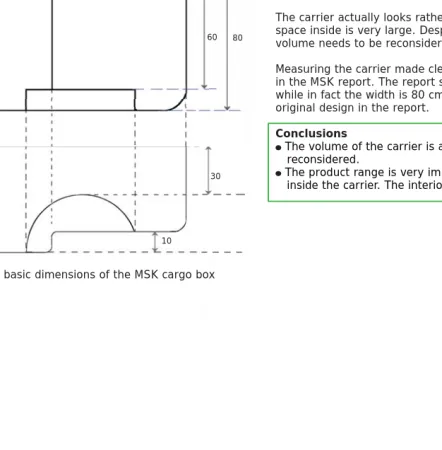
The actual volume of the MSK prototype is around 300 liters. The drawings in fi gure 3.5 present the dimensions of the carrier.
The carrier actually looks rather lumbering. It seems as if steering the bike is very diffi cult. The space inside is very large. Despite the fact that the 300 liters fi ts the demand of Miriam, the volume needs to be reconsidered.
Measuring the carrier made clear the dimensions are not conform the dimensions of the carrier in the MSK report. The report states for example that the width of the carrier should be 62 cm, while in fact the width is 80 cm. Appendix C describes all difference between prototype and the original design in the report.
Conclusions
The volume of the carrier is around 300 liters. This seems rather large, so this needs to be reconsidered.
The product range is very important for the design of the interior and the required space inside the carrier. The interior must be adjustable to a lot of different products.
40 15
60 80
50
30
[image:31.595.114.335.196.460.2]10
3.5 Frame
The frame of the MSK was redesigned by Jeroen Jansen. 10 The redesign differs in some ways from the original design. For instance, a roof support construction has been de-signed, because a roof is required to protect the micro-entrepreneur against the sun.
The roof
Two ideas were already presented by Jeroen Jansen:
The roof is made from cloth
This is easy to construct, light weight and cheap. The cloth does not block the sun com-pletely, so the micro-entrepreneur is not fully protected against the sun. The color of the fabrics will probably also fade really fast. The weather resistance is also low, because cloth will wear out rather quick.
The roof is made from a lid of the MSK
The lid from the MSK can also be used as a roof to block the sun. See fi gure 3.6 B. The mold is already present, so it is very easy to produce a roof. The composite material is weather resistant, so rain and sun do not affect the material much. Maintenance costs are low. The appearance of the roof matches the appearance of the carrier. However, the roof is quite heavy.
The dimensions of the roof support construction are a limiting factor for the design of the actual roof. The construction of the roof is shown in fi gure 3.6 A.
Connecting the carrier
The carrier needs to be connected to the front part of the frame. See the gray parts in the fi gure 3.6 C. The size of the front frame is a limiting factor for the size of the carrier. The dimensions of the redesigned frame are different from the original design.
Appendix C gives more information about the important frame dimensions.
Conclusions
[image:32.595.496.725.68.365.2]During redesign of the carrier, the redesigned frame should be thoroughly analyzed Ideas for the roof should be examined and additional ideas should be thought of.
Figure 3.6: Models of the redesigned frame.
A
B
3.6 Ergonomics
Miriam Reitenbach determined the optimum height of the carrier by measuring the body dimensions of several Cambodian people and by making use of literature about ergonomics. Appendix M gives an overview of the data.
As cited in the graduation report of M. Reitenbach, Molenbroek (2007) states that the best working height for a standing person is 63% of the body height.
According to Jurgens (1989), also cited in Reitenbachs report, the ideal working height for South East Asian people is between 900 and 1070 mm. Because the data are rather old and could well be outdated, it does not necessarily mean that the data are representative for Cambodian people. Therefore, also measurements among Cambodian people were made. This measuring resulted in a optimum height between 97 cm and 110 cm.
Finally, the height of the carrier to the ground was established at 92 cm, to enable every user to look into the carrier.
Tests
As mentioned before, no user tests were performed with micro-entrepreneurs and the interior was not thought of well. To get more information about how to design the interior some tests with the people attending the Micro-Entrepreneurial training at Kamworks were performed. Because the carrier is not fi rm enough to conduct a real user test, a different approach was applied.
The Micro-Entrepreneurs were asked to pretend the MSK was well functioning and they were the vendors. Their opinion about the way of handling the carrier was asked.
The general opinion of the group was that the height of the carrier was good. They all could reach the bottom of the carrier if they bent a bit forward. The tray made it easier to reach the products because they did not have to bend that far.
Opening the lids was no problem for the ME’s. The lids open to two sides: the front and the back. However, the opened lids are blocking the view of the cos-tumers and the ME. The two lids force people to stand at the side of the vehicle to see what’s inside.
The back lid opens towards the frame of the bicycle. No costumers can stand in that area because of the frame. But if the ME wants to stay on his saddle, he can’t look into the carrier because the lid is too high. He has to stand on the pedals and stretch his neck to see what’s inside. See fi gure 3.7. These issues need to be considered during the redesign.
Suggestions
The group suggested a movable tray to make it easier to pick something from underneath the tray. They thought the tray should cover half of the box and should be able to slide from one side to the other.
Conclusions
The height of the carrier seems good. All the subjects can reach the bottom easily.
The lids block the sight of the ME when opened. The lids force the ME to step off the bike and stand next to it. The costumers can only look into the carrier if standing on one of two sides.
3.7 General opinion of costumers
Previous interviews among costumers and local people performed by Miriam Reitenbach resulted in the below mentioned knowledge.
Appearance
The subjects reacted all positive on the MSK. They liked the round shapes and appearance. Except for one, they all liked the yellow color. However, except for one subject, non could guess what kinds of products were being sold. Five of the subjects assumed that rather expensive products were being sold , two thought about cheaper products while the other two did not know what to expect.
The subjects thought it is important to show the products on the outside. Besides displaying the products, in addition a microphone can be used. Two sub-jects stated that only using the microphone would be suffi cient to communicate the product range.
Material
When asked their opinion about the material of the MSK, the majority of the subjects thought that steel was better than plastic, as steel is stronger and has a longer life span. Only three thought that plastic was a good choice as it is lighter and therefore easier to maneuver over bumpy roads.
Conclusions
It is important to make clear what products are being sold. Cambodian people are used to display the entire stock of products. For the redesign a solution to display some products should be found.
The MSK appears new and modern and this draws attention from the costumers. The majority liked the yellow color and the round shapes.
3.8 General opinion of Micro-Entrepreneurs
It is also important what the ME thinks of the MSK, for the ME is the one that has to work all day with the vehicle. Because Miriam did not have access to Micro-Entrepreneurs she did not interview them. Today, a group of ME’s are being trained at Kamworks, so these people are interviewed about the appear-ance, size, form and other features.
Outside appearance
fi rst impression
The fi rst thing the ME’s said about the carrier was that the gap between the lids would let the rain trough and all the products would get wet. Also some remarks about the rigidity and solidity of the bike were made. They thought the bike was not rigid enough to drive.
color
All subjects liked the yellow color. They thought yellow is a good choice because it is the Kamunasal color and it is striking.
size
The subjects discussed the size of the carrier. They thought it should not be bigger because the steering would become diffi cult. They agreed that making the carrier smaller would make steering easier. But the volume has to be big enough to carry along products and additional equipment.
shape
imagine the carrier having more fl uid lines, like race cars, they answered that it would be nice to design the carrier more like the hull of a boat. Because a boat is more streamlined and they like the streamlines.
branding
The subjects discussed the branding and they thought it would be better for recognizing the brand to put the logo also on top and on the front of the carrier. This means they want to have the logo visible from all sides of the carrier.
mud-guards
All subjects agreed that the mud-guards were not satisfying. The mud-guard should be longer as to protect the ME against mud when driving over wet dirt roads. They also thought that the carrier needs to be protected against the mud by the mud-guards, so no dirt will get on the carrier.
panel
When asked about the use of the panel, the subjects thought the panel should be present to communicate the products and the principle of solar energy. The panel should be visible for the costumers, so costumers can see that something with solar energy is inside the carrier. To make the panel better visible, the panel should not be at the same level as the surface of the carrier. Instead, the panel should extend from the surface for a couple of inches, so the costum-ers can see there is a panel on top of the carrier.
lights
Interior
tray
The subjects suggested to install a movable tray to display the products. The tray should cover half of the box. If the ME wants to pick something from un-derneath the tray, he can slide the tray to the other side of the box and reach for the things he wants.
products and other equipment
The tray should be used to store and display the products. Underneath the tray more products can be stored as well as personal belongings of the ME and the electronic components for e.g. propulsion of the bike, lights, fl ashing light device, horn, etcetera. The ME suggested that divisions for every product should be made onto the tray. The products should not be loose in the carrier. A solution for protecting and fi xing the products should be made.
Remaining
roof
The ME’s suggested to attach a parasol to the vehicle, like the one on ice-cream carts.
lock
It should be possible to lock the cargo box.
music
The ME’s thought it would be nice to have some music because the distances are long and music would make it less boring to cover the distances from one village to the other. They also thought that it would be useful to attract costumers.
Conclusions
It is important for the trust of ME’s and costumers to present a fi rm, high quality shop. The state of the MSK does not make people believe that high-quality products are being sold.
Everybody likes the yellow color as it is the brand’s color. The redesign should also be yellow.
Although the ME’s like the appearance of the carrier because of its rounded corners or clean-cut edges some of them suggest to design the form more like a hull of a boat. More streamlined.
The mud-guards should be considered well, because the ME’s don’t want to get dirty when driving over a wet dirt road.
Suggestions are made concerning the possibilities to apply more logo’s on the carrier and to add fl ashing direction lights and stop lights. This should be considered during redesign.
The panel is thought of in a positive way, despite the high costs. The ME’s think it is important to show the people that something with solar energy is inside. It will make people curious.
The ME’s think the carrier is a bit to big. They think a smaller carrier would make steering easier.
Some suggestions about a movable tray are made, to make it easier for the ME to get something from underneath the tray. This feature should be considered during the redesign.
Space for personal belongings should be reserved.
3.9 Total costs
The costs of the original tricycle were calculated by Miriam Reitenbach. Prominent cost infl uencing factors are the addition of promotional materials, such as a solar panel and posters and the size of the series. Miriam made three estimations. The estimations are based on the assumption that the production pro-cess will be performed at Kamworks as much as possible. The fi rst two were based on a series of 10 pieces and the third on a series of three:
The bike will cost $627.36 if promotional material is included. Without the promotional materials the bike will only cost $482.36. A series of three will cost $526 per piece without promotional materials
Promotional material
The addition of the promotional material results in a 30 percent increase of the total cost price. The promotional materials exist of posters, a led display and a solar panel to explain the principle of solar energy. The solar panel contributes the most to the increasing costs with its $125. The posters and the led dis-play are both estimated at $10 a piece. Leaving the panel and led disdis-play out will result in a much cheaper and more affordable vehicle. The principle of solar energy can also be explained by simply making use of the Angkor light and some posters.
Test series
The third estimation was made based on a series of three to test the acceptance and functioning of the Mobile Solar Kiosk. The price will go up to $526 per piece without promotional materials.
Frame redesign and roof
The frame which is redesigned by Jeroen Jansen is a bit more expensive than estimated by Miriam Reitenbach. The labor costs and the new damping system are cost increasing, because some steel parts have to be built at DonBosco’s. The roof however, turned out to be cheaper than estimated. Because the lid of the cargo box can also be used as a roof, no costs for an extra mold have to be made. The roof will be about $20, instead of the $50 according to Miriam Reitenbach.
The total costs of the redesigned frame, including the costs for the roof and electric components are $304,80. Assuming that the costs for composite mate-rial will not differ much from the estimations Miriam made, the total costs will become $570 for a delivery tricycle without promotional matemate-rials.
The building of the fi rst frame is entirely boarded out to Don Bosco because it is not possible at the time to build it at Kamworks. This will make the costs for the fi rst tricycle somewhat higher.
Conclusions
Addition of promotional material should be considered once more, because it makes the whole much more expensive.
3.10 Conclusions for the redesign
After analyzing the MSK it can be concluded that special attention for the unfi nished parts, like the roof and the interior is required.
Shape and material
The carrier will be made of fi ber reinforced plastics, because the material has great advantages such as high form freedom, good strength, low maintenance costs, light weight and no corrosion.
The Micro-entrepreneurs like the color and material and also the rounded corners and clear-cut edges. They are positive about the idea to design a stream-lined box with more complex forms. To utilize the possibilities of the material and to fulfi ll the wishes of the ME’s, the shape of the box will be changed. This will result in an even more modern looking tricycle. During redesign of the exterior, the wishes and remarks of the micro-entrepreneurs are important to keep in mind.
Interior, product storage and roof
The inside of the present-day carrier does not have a quality look. Fibers are extending from the surface and no solutions for fi xing and protecting the goods are present. A tray is present to store some products but the Micro-entrepreneurs think that it would be diffi cult to pick something from underneath the tray. Therefore, solutions for fi xation, storage and protection of the goods should be developed. At the same time, the interior should be designed to have a nice, high quality appearance.
The roof of the new bike has to fi t the redesign of the carrier. The roof can be made of a lid of the prototype, but additional ideas should be developed to make the best choice.
Finally, ergonomics and wishes of Micro-entrepreneurs are important for the redesign.
Lighting
The refl ector lights should be replaced by real head lights so the driver can see in the dark. At the side some refl ectors can be added to make the driver visible form the side. Also some fl ashing direction lights can be added.
Size
The dimensions of the redesigned frame are a limiting, yet important factor for the size of the carrier and these dimensions should be taken into account during redesign of the carrier.
According to the ME’s, the size of the carrier appears big and it seems diffi cult to steer. Possibilities to reduce the size in such a way that it fi ts the redesigned frame and can store the products and personal belongings, should be investigated.
Promotional material
The solar panel is very expensive and contributes to high costs. Leaving out the solar panel will reduce the costs. However, ME’s think that the solar panel helps draw attention if placed a couple of inches above the surface of the cargo box. The pros and cons should be weighed carefully. Other promotional ma-terials can be used to substitute for the solar panel.
Sound
4.1 Analyzing the present production process
Analysis of the production of the Solar Home System
Today Kamworks is producing the Solar Home System. The box with battery and plug-sockets exists of glass fi ber reinforced polyester. The fi rst series of 5of the box have been produced using the hand lay-up method. Many different problems occurred during the production of the fi rst boxes. Below the problems are listed:
The inner surface of the box remained very sticky in the fi rst attempts. Later on, the stickiness decreased a bit, but it is still a problem. The stickiness is
probably the result of absorbing moisture from the air in the resin.
Putty which was used to fi ll up the holes in the mold attached to the fi nal product. Filling up holes in the mold can also be done with gelcoat.
The polyester resin dried too fast. The accelerator cobalt was already in the resin, so it was not possible to change the amount of accelerator. Inhibitor was used to overcome this problem. However, until now a supplier of inhibitor has not been found in Cambodia and resin without cobalt is also unknown in Cam-bodia.
It turned out that it is best to mix the resin in small quantities, so no resin will be spoiled. Tranparency of the gelcoat. There is no solution to this problem yet.
The weather infl uences the reaction time of the resin. In the morning, the resin dries slower than in the afternoon. White gelcoat dries slower than transparent gelcoat because there is less cobalt in the white gelcoat.
Analysis of the production of the Mobile Solar Kiosk
During the production of the MSK the following problems occurred. Combined with the above mentioned problems, it gives a complete list of all the points that need to be considered during the redesign. The following diffi culties appeared:
All above mentioned problems also occurred during the production of the MSK.
Finishing the surface of the positive form: The positive form was made from polystyrene. This is a rather coarse foam which is really hard to handle. Grinding it will crumble the foam. Therefore, an epoxy layer was applied onto the foam and this layer was polished.
Removing the mold from the positive form: Probably because the positive form has slightly curved walls it was not possible to release the mold from the positive form. The mold was divided in four to overcome this problem. The mold division remained visible in the end product.
Very long after-treatment of the fi nal product: This was due to all the imperfections in the mold. Resin did not reach all the fi bers, this resulted in dry fi bers extending from the inner surface.
Conclusion
To produce a high quality surface, solutions for the stickiness, producing the positive form, mold divisions, making putty and transparency of the gelcoat must be found.
This fourth chapter gives insight in the production possibilities at Kamworks. First, the production of the Solar Home System is analyzed and compared to the production of the MSK. Problems are listed. Additionally, the facilities at Kamworks are analyzed.
4.2 Processing composites
To get insight in the possibilities of glass fi ber reinforced plastics, three production processes were analyzed. The fi rst one is the hand lay-up process which was used to make the MSK and the SHS.
The other two processes are more sophisticated processes which are used in composite processing factories, such as NPSP Composites Haar-lem in the Netherlands.
Hand lay-up
The Mobile Solar Kiosk was produced by hand lay-up of glass fi ber mats. This process is quite time consuming and consists of a lot of successive steps. In short, the steps are as follows:
Step 1: producing the plug,
Step 2: use this form to make a female mold
Step 3: use the female mold to produce the fi nal product.
Step 1 and 2 only have to be performed once so these are one time expenditures.
The hand lay-up process is generally applied in the boat production industry. Large sail boats and catamarans are being produced with glass fi ber reinforced plastics. The boat is produced layer by layer. All imper-fections are grinded out before the next layer will be applied. This results in a very high quality boat hull. However, to produce such a high quality all steps have to be performed perfectly. At fi rst, the positive form has to be perfectly smoothened. No imperfections are allowed, because these imperfections will also show on the negative mold and all imperfections in the negative mold will return in the fi nal product. Through after-treat-ment these imperfections can be removed, but this takes a lot of time and should therefore be avoided. An accurate way of working is required to produce a high quality product.
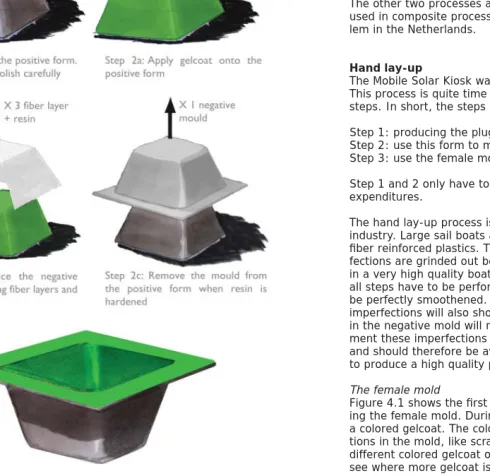
The female mold
[image:43.595.137.382.101.339.2]Figure 4.1 shows the fi rst two steps of the hand lay-up process: produc-ing the female mold. Durproduc-ing step 2 the female mold is produced includproduc-ing a colored gelcoat. The coloring of the mold helps to notice any imperfec-tions in the mold, like scratches. Secondly, during the application of the different colored gelcoat of the fi nal product a contrasting mold helps to see where more gelcoat is required.
The fi nal product
Figure 4.2 shows the required steps to produce the fi nal product. First, the desired gelcoat is applied onto the mold. The color of the gelcoat should differ from the color of the mold because then imperfections in the gelcoat can be noticed very easily.
By applying the fi bers and resin into the mold, the fi nal product is obtained. The layers of the fi ber mats are rolled on layer per layer. It is important that all imperfections are eliminated before adding a new layer.
Shrinkage and draft angles
The positive form should be designed with draft angles to enable the mold to release from the form. These angles should be at least 1.5 degrees.
The shrinkage of the materials should also be considered during the designing of the positive form. Through shrinkage, it is possible that the fi nal product can get stuck in the mold.
Resin and fi ber types
The hand lay-up process can be performed with two types of glass fi ber: Chopped strand mats and woven roving. In the boat building industry these two types are both used in the hull and deck of the boat. The woven roving is stronger but also harder to shape into the right form. They are applied as inner layer to strengthen the material. Appendix F1 describes the necessities for the hand lay-up process.
The resins which can be used for hand lay-up are epoxy, polyurethane and polyester. Polyester is the cheapest ($2.60/liter).
Epoxy and polyurethane have better mechanical properties than polyester. Polyurethane also emits less gases during the chemical reaction than polyester, and it is not as sensitive to absorption as polyester. 11 According to Bill O’Leary from boat building company Steppaboat 12, all three resins are used on large scale in the boat building industry.
Conclusions
The plug requires a thorough treatment to smoothen the surface and eliminate all odds. The color of the gelcoat of the female mold should contrast with the color of the fi nal product, so small faults can be recognized.
Draft angles and shrinkage should be considered during the design of the product. The choice for a certain resin should be carefully considered.
The advantages and possibilities of the different fi ber types should be considered.
Resin injection molding
Because the hand lay-up process is very basic and time consuming, two other processes are investigated th