The User Oriented Knowledge Management Method
A knowledge management method for a small organization with a distributed environment.
E.J.W. van Bloem July 2008
University of Twente, Enschede – the Netherlands Computer Science
Management Summary
Knowledge plays an increasingly important role in business these days and thus most organizations have already begun, or are considering some level of knowledge management.
This thesis describes a model for knowledge management for a small organization with a distributed environment like Seven Stars, with the focus on the Dot Net professionals. The approach is applied within Seven Stars and evaluated.
The first step has been the study of today’s knowledge management methods. There is evaluated where most of these knowledge management methods fail and how to overcome this failure. This results in advice to use a simple to use knowledge management method which has less focus on the technology and more on the user.
In order to overcome the failing derived from the study of today’s knowledge management methods a new knowledge management method is designed based on this advice. This newly introduced knowledge management method, the User Oriented Knowledge Management Method, consists of today’s knowledge management methods base components combined with building blocks from the User-Centered Design (UCD) method.
The focus of the User Oriented Knowledge Management Method lies on user involvement and infrastructure to create a knowledge environment that supports the business strategy.
It consists of three phases:
1 Initial Information Gathering phase which gains information and understanding with the emphasis on knowledge. This information and understanding is used to create a simple design.
2 Prototyping phase creates a pilot application based on the simple. This application is evolves with every iteration where the application is evaluated by the users and based on this evaluation altered. 3 Installation phase which introduces the resulting system to all users.
The User Oriented Knowledge Management Method is put to practice at the organization Seven Stars. Based on interviews with the users, analyzing the infrastructure and business goal of the Initial Information Gathering phase is concluded that it is important that the professionals accomplish their tasks but that also the tacit knowledge needed for this is sometimes hard to gain. Based on the information gained from the Initial Information Gathering phase a prototype is created and iteratively developed to a real useful and likely to be used solution.
During the third iteration the project came to a hold because an organizational wish could not be applied to the prototype. The organization must take a business decision about this.
The User Oriented Knowledge Management Method Page 2 Foreword
Having started with this thesis project in 2006, this thesis is long due. When, during the creation of the application, I ran into a problem, it was not clear for me how to proceed with this thesis and when I in 2007 started working, it did not made the challenge easier to finish the last part.
Without the support of my Seven Stars colleagues, family, friends and both my university mentors Pascal van Eck and Jeff Hicks with their most useful guidance, I never would have been able to create this thesis. Thank you!
But most of all, I like to thank my girlfriend Esther who kept on believing in me and helped me by pushing me to finalize this thesis.
Thank you,
1 Introduction...4
1.1 The environment...4
1.2 Research Motivation ...5
1.3 Goal...6
1.4 Structure of thesis ...6
2 Literature Review ...7
2.1 Knowledge ...7
2.2 Knowledge Management ...8
2.3 Failure ...9
2.3.1 Not designed for small organizations ...10
2.3.2 Focus only on technology ...10
2.3.3 Insufficient user involvement ...10
2.4 summary...11
3 Development of Knowledge Management. ...12
3.1 The User Oriented Knowledge Management Method...13
3.2 Initial Information Gathering ...15
3.2.1 Interviews ...16
3.2.2 Business Strategy...19
3.2.3 Infrastructure ...20
3.2.4 Synthesis...21
3.3 Prototyping...23
3.3.1 Build...24
3.3.2 Evaluation...25
3.4 Installation...26
3.5 Summary ...27
4 Practise...28
4.1 Case Initial Information Gathering...29
4.1.1 Interviews ...30
4.1.2 Aligning Knowledge Management and Business Strategy...36
4.1.3 Infrastructure case...39
4.1.4 Synthesis...41
4.1.5 summary...49
4.2 Prototyping...50
4.2.1 Iteration 1 ...51
4.2.2 Iteration 2 ...57
4.2.3 Iteration 3 ...61
4.3 Installation...62
5 Conclusion and recommendations ...63
5.1 Recommendations ...64
5.2 Proposition ...65
References...66
The User Oriented Knowledge Management Method Page 4 1 Introduction
For some time, the importance of knowledge management has been recognized, but failure rates remain high. Despite the importance, and the high failure rates, as of today there are few standards available to guide the creation of a knowledge management system. In addition to this, the material on this for small organization is especially scarce. This master thesis formulates a knowledge
management method for a small organization, with particular emphasis on the users of the knowledge management system. The method will be applied within the organization Seven Stars.
1.1 The environment
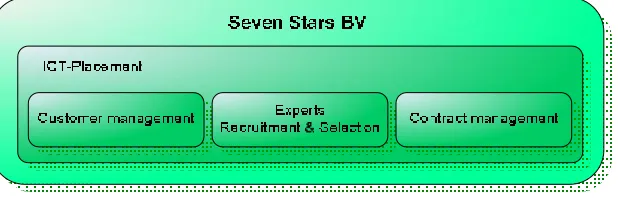
[image:5.612.156.465.300.399.2]Seven Stars, founded in 2005, is an ICT-service organization with three primary offerings: customer management, expert recruitment and selection, and contract management. Seven Stars is a young growing company that places ICT-experts in Zwolle and its surrounding area. At the moment it consists of one director, one recruiter and approximately twenty ICT-experts. The director’s focus is on all the services the organization provides, e.g. customer management, experts recruitment and selection, contract management, planning the company’s future etc. The recruiter mainly focuses on recruitment and selection of ICT-experts. These experts are placed at different organizations to fulfill certain needs of the customer organizations. Figure 1 depicts the main services provided by Seven Stars.
Figure 1: Seven Stars Service
At the moment the organization makes use of experts looking for another job, experts hired from other organizations and freelance experts. These experts have different specializations such as Project Leader, Analysist, Architect etc. and make use of different platforms such as PHP, Java and Dot NET. In the near future the organization additionally wants to create a specialized group, with professionals who will be contracted directly by the organization.
Throughout this thesis these contracted experts are called professionals. These professionals will have much experience with the Dot NET platform. This means Seven Stars will, as depicted in Figure 2, have a group with experts that make use of different platforms, including the Dot NET platform, and a group with professionals that mainly use the Dot NET platform.
Figure 2: Seven Stars Organization
[image:5.612.153.466.543.668.2]This strategy is the main thread that runs through the organization and stands for differential and customer-specific solutions. An important factor of a strategy, with Customer Intimacy as a base, is to support our experts that work at other organizations with finding these solutions. This specially applies for the professionals of the Dot NET Group.
Professionals of the Dot NET Group work most of the time within groups at other organizations. These groups will consist of just one or a few members of the Dot NET Group, the rest will be professionals from the customers organization. When creating the Dot NET Group the organization recognized that it is important to support the professionals that are placed at these organizations.
1.2 Research Motivation
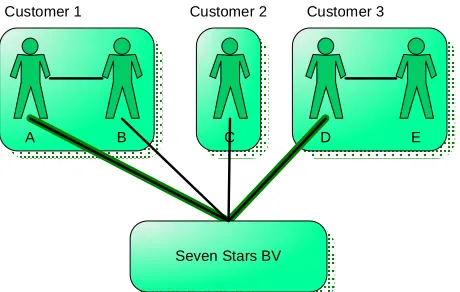
Knowledge plays an increasingly important role in business these days and thus most organizations have already begun, or are considering some level of knowledge management. For Seven Stars, every professional has so-called personal knowledge, i.e. experiences, understanding of certain functions and procedures etc. Some professionals have personal knowledge which other professionals do not have and which might be useful for their work. In Figure 3 professional A, working at customer 1, but has information that professional D, working at customer 3, needs. Problem is that professional D does not know professional A very well and does not know that professional A can help him with his knowledge need. This results in professional D having to put in more effort in finding the information he needs. In this situation D might get the needed information from a colleague at the organization where he is placed but this doesn’t apply to C.
Figure 3: Distributed Situation
The User Oriented Knowledge Management Method Page 6 A
Seven Stars BV
B C D E
[image:7.612.197.427.70.216.2]Customer 1 Customer 2 Customer 3
Figure 4: Distributed Situation with Social Network
1.3 Goal
The goal of this thesis is to designs a model for knowledge management for a small organization with a distributed environment like Seven Stars, with the focus on the Dot Net professionals. The approach is applied within Seven Stars and evaluated at the end of this thesis.
1.4 Structure of thesis
The structure of the thesis is as follows: Literature Review
Some of todays popular knowledge management methods are researched to see how they apply knowledge management. The basic elements of those methods are derived and there is also looked if they go where they go wrong.
Development
The base elements of the knowledge management methods in combination with the elements needed for this case are used to create own method.
Apply method to practice
To really put the method to the test, the developed knowledge management method is put into practice.
Validation
2 Literature Review
In this chapter failure of today’s knowledge management methods are elaborated. To overcome these failures in the case, a model is proposed. First of all, however, some basic concepts and terms of knowledge and knowledge management will be introduced to enhance the readers’ understanding of the used matter in this thesis. Additional literature research can also be used to widen the
understanding on knowledge, examples are literatures such as [Nonaka, 1995], [Davenport, 1998], [O'Dell, 1998].
2.1 Knowledge
There is no single definition of knowledge on which a majority agrees. According to [Fenstermacher, 2005] a common starting point in epistemology is the Socratic dialog Theaetetus, in which Socrates, Theodorus, and Theaetetus discuss the nature of knowledge and conclude that knowledge is “justified, true belief”. A more up-to-date definition comes from [Schreiber, 2000] that claims knowledge to be the whole body of data and information that people bring to bear to practical use in action, in order to carry out tasks and create new information. This does not mean that it can only be viewed as part of a person, but it can also be viewed as part of a group, organization or even across organizational levels. As stated in [Polanyi, 1962] [Tsoukas, 2002], Polanyi makes a distinction between tacit and explicit knowledge. Explicit knowledge is knowledge that has been or can be articulated, codified, and stored in certain media. Tacit knowledge in contrary to explicit knowledge is hard to share. It is too rich and subtle to incorporate in a written report, because of this it is often shared person to person. Tacit knowledge is knowledge that a person carry’s in his or her mind, for example the insight a database expert has in the back of his mind about which methods works well together and when to use them.
Knowledge in our context:
As the goal describes the main focus is to support the knowledge needs of the Dot NET professionals at Seven Stars. Those knowledge needs will be work-related. The kind of persons that will form the Dot NET professionals are of high education. Knowledge is closely tied to the person who develops it, and is best shared through direct person to person contacts. This implies that the knowledge will be complex and mostly tacit.
The User Oriented Knowledge Management Method Page 8 Scenario:
Based on the situation of the example described in chapter 1.2, a Dot Net professional, who normally works on user interfaces, must, because he is now working in a smaller team, also work on the inner functionality of the application.
The professional is aware he has to place data in a database and has to make a connection to transport the data. But at this stage the professional has not assimilated the relevant knowledge to design suited database connections. If he now creates the application it probably will take much time and effort and still there is a big change the application creates unwanted results or even creates errors.
A database expert could tell him what is important and how that impacts the application. For instance, the number of request may have influence on the architecture and used queries, or till what level the ACID properties should be implemented, etc.
The database expert could suggest some reading so that the software engineer can study material so that he, if he is intelligent enough, not only sees the data to be stored but also the rich amount of variables that will determine the best suited database connection.
From the above can be conclude that knowledge in the context of this thesis is:
Something a professional needs to have, to successfully fulfill a task.
2.2 Knowledge Management
The definition of knowledge management changes with the years, but a fairly representative definition is that of the Dutch Van der Spek and Spijkervet [Spek, 1997].
The strife to an optimal use and development of knowledge, now and in the future.
This definition of knowledge management implies that there is more than just acquiring some information and placing it in a database.
A knowledge management strategy has to clearly pursue a goal and address the components: • the work processes or activities that create and leverage organizational knowledge
• creating and sustaining a technology infrastructure to support knowledge capture, transfer, and use behavioural norms and practices, often labelled “organizational culture”, that is essential to effective knowledge use.
Knowledge management is applied on the definition of knowledge in paragraph 2.1: Looking to the context of knowledge in the example of chapter 1.2:
One professional of the Dot Net group might have the tacit knowledge another professional of that group needs. The tacit knowledge of the professional, who has the knowledge, needs to be transferred to the professional with need for that knowledge. This converting of tacit knowledge from one person to tacit knowledge of another person is called socialization [Nonaka, 1995].
From the above can be concluded that knowledge management in the context of this thesis is:
2.3 Failure
Since the end-nineties knowledge management has attracted more and more attention. To successfully implement knowledge management in organizations, strategies and methods where designed. Many existing knowledge management methods[Aben, 1991][Tiwana, 2000] are there to provide guidance for large organizations with their knowledge management, their literature also comes with examples of large multinationals and how they successfully applied it. The results of these knowledge management methods can include; change in communication, used methods or even change in business strategy but in practice they mainly result in changes to the infrastructure components. This means that organizations create large data warehouses where they store a big amount of organizational knowledge. And when the organizations put their resulting infrastructure component(s) in use, a large percentage seams to fail.
So, despite the knowledge management guidance, many organizations implementing knowledge management fail to successfully implement it. [Fahey, 1998] describes where most organizations did go wrong, and provides advice to overcome this.
The latest trend[Iyer, 2004] of knowledge management are methods that include the business strategies and organizational infrastructure. [Tiwana, 2000], [Gudas, 2007] are such methods, that makes use of the business strategy and infrastructure, that is a well known method. The base components of this method are depicted in Figure 5, it gives an impression on how they relate to each other. The environment impacts the business strategy and knowledge strategy. The business strategy drives knowledge management and the organizations infrastructure components enables knowledge management, resulting in the creation of a knowledge system that is useful for the organization. A knowledge management method that makes use of these components can also be useful for the case, it makes it likely that the resulting knowledge management system fits the organization.
KM Strategy Infrastructure
Business Strategy
Enables Influences
Enables
Aligns Influences
Environment
Impacts
[image:10.612.157.454.381.633.2]Impacts
The User Oriented Knowledge Management Method Page 10
2.3.1 Not designed for small organizations
Most of today’s knowledge management methods are designed for large organizations. Some claim their method can be applied to small organizations as well, but the problem with this is that those methods are unclear as to which operations are useful for a smaller organization and which are not. To which level of detail an operation must be executed is also unclear.
Large organizations also have more resources, money, skills and more infrastructure components, to make knowledge management a success, even though an employee is to knowledge management more important within a small organization than a large organization.
For instance, if a database expert of our example [chapter 2.1] does not like to use the resulting knowledge management system and therefore does not share his knowledge. Within a large organization this is not desirable, but not a mayor problem because there are more database experts who still might share their knowledge. But within a small organization where the database expert is one of only a few database experts or even the only one, this might be a significant knowledge problem.
Because today’s knowledge management methods are designed for large organizations and therefore do not take the above problems in consideration, a specific knowledge management method must be designed for the case.
2.3.2 Focus only on technology
Many organizations, implementing knowledge management, have the tendency to focus on the use of technology [Fahey, 1998]. The organizations disconnect the knowledge from its uses, focus on building a technological solution and forget other aspects that are useful for knowledge management like organizational processes and culture. This narrowed focus results in knowledge systems becoming ends in themselves instead of supporting organizational members with their needs.
They view knowledge as something separate from the organizational processes, and independent of organizational culture that helps generate and nurture knowledge[Fahey, 1998]. [Beveren, 2002] has indicated that not only the need to create the right technological infrastructure but also the right culture in which knowledge can be created and shared is important. Although technology infrastructure components may assist creating and sharing knowledge, they will fail to do this without attention to the cultural and organizational context [Clarke, 2001].
2.3.3 Insufficient user involvement
2.4 summary
The User Oriented Knowledge Management Method Page 12 3 Development of Knowledge Management.
In this chapter proposes the User Oriented Knowledge Management Method to make it more likely to succeed the findings of the previous chapter are used to design it to achieve the goal.
A knowledge management method is needed to manage the tacit knowledge of the Dot Net professionals of Seven Stars. Because today’s knowledge management methods are likely to fail, as described in chapter 2.3, the User Oriented Knowledge Management Method is introduced.
The main focus of this method will be on user involvement and infrastructure to create a knowledge environment that supports the business strategy. Technology infrastructure components may assist with creating and sharing knowledge, but the focus will lay on the cultural and organizational context.
Chapter 2.3.1 emphasizes that insufficient user involvement, even on a small scale can have big consequences for small organizations. To make sure the to be designed method is more likely to succeed, users should be involved in applied method. In-depth understanding of user behaviour and the reasons that governs this behaviour should be known. This determines if a resulting system, of the knowledge management, will be used. Researching this in-depth understanding of behavior is better known as qualitative research, and can be done by interviewing the users.
Interviewing users should thereby be part of the approach.
One approach where this is the case is User-Centered Design (UCD) [Greene, 2003] which makes use of four phases namely:
• Discovery: gain understanding of stakeholders, goals, problems, and how they may be addressed by technology
• Prove of concept: instantiate and refine understanding in a limited function demonstration system.
• Pilot: iteratively add function to system while it is being used and tested in target environment. • Deployment: complete and harden system and hand off to operations team
3.1 The User Oriented Knowledge Management Method.
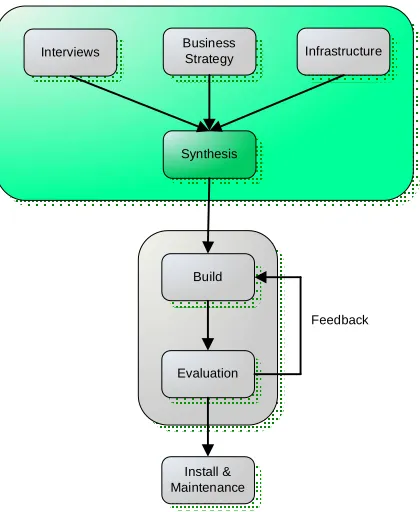
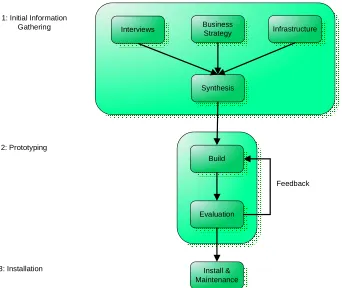
The User Oriented Knowledge Management Method is created by combining the base components of today’s knowledge management methods with the four phases from UDC. This method consists of three phases as depicted in Figure 6, consists of three phases.
The first phase combines the UCD discovery phase with the business strategy analysis step and infrastructure analysis step of the knowledge management methods. The synthesis step introduces a simple design based on the results of the three previous steps.
The second phase has with the UCD prove of concept and the pilot phase in common that a pilot is created and that it matures in iterations.
The third phase focuses on supporting the user when the system is introduced and keeping up with possible knowledge changes.
Interviews Business
Strategy Infrastructure
Synthesis
Build
Evaluation
Install & Maintenance
Feedback 1: Initial Information
Gathering
2: Prototyping
[image:14.612.145.487.223.511.2]3: Installation
Figure 6: User Oriented Knowledge Management Method
1 Initial Information Gathering
In this phase information is gathered to make the system not only containing knowledge functionalities but also sure to be used by the intended users. Like the UCD discovery phase it’s main goal is to gain information and understanding, but with the emphasis on knowledge, that can be used to create a limited system.
The initial information gathering phase consists of four steps; interviews, business strategy, infrastructure and synthesis.
The User Oriented Knowledge Management Method Page 14 2 Prototyping
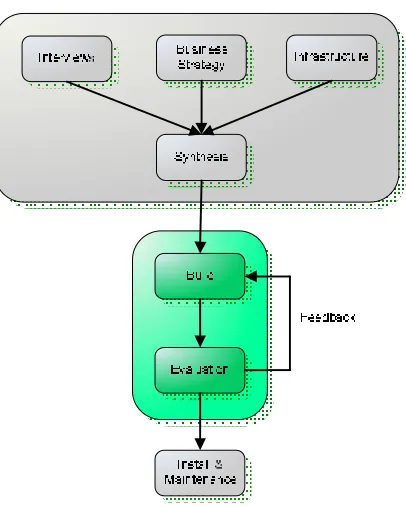
This phase starts, like the pilot phase of UCD, with building a simple prototype that through means of iteration evolves in a usable knowledge system.
The prototyping phase consists of two sub-phases; build and evaluation. Based on the design, of the information gathering phase, a simple prototype is made. This prototype is evaluated by the intended users in the evaluation phase, which feedback is then used to create a better prototype. By iterating the prototype phase the prototype will grows into a knowledge system that will be able to manage the needed knowledge and will fulfill the users’ requirements and expectations.
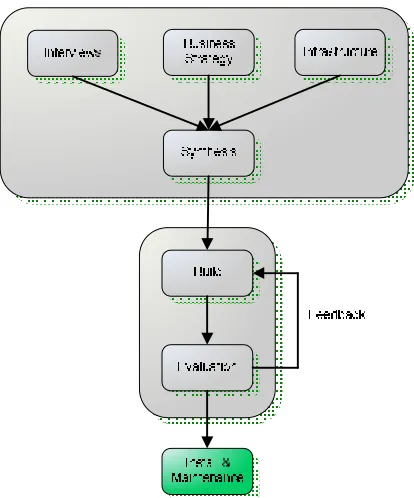
3 Installing
Eventually the knowledge system will be ready for use. It will be installed and when put into use, it needs to be maintained.
Figure 7: Initial Information Gathering
3.2 Initial Information Gathering
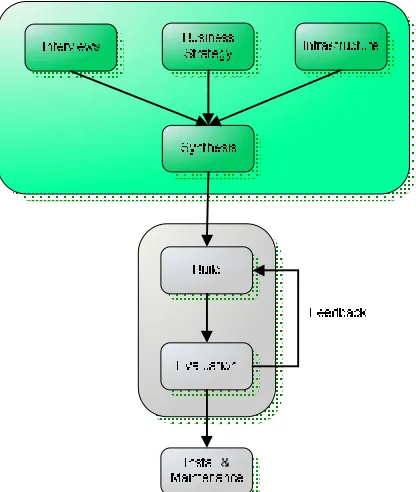
Initial Information Gathering, Figure 7, is the first phase of the knowledge method.
It contains three steps. These are all information gathering steps which gather information that is needed to build a successful knowledge system. The interviews provide user understanding and organizational information which might not be found in organizational documents.
The business strategy step provides information on the business strategy and how it relates to knowledge management. The infrastructure provides an overview of the existing infrastructure components and their properties. There is researched if there are not currently used infrastructure components and how it might be useful for knowledge management.
The information gathered in the Initial Information Gathering phase will be used in the following Synthesis step.
The User Oriented Knowledge Management Method Page 16
3.2.1 Interviews
To make sure the created approach is more likely to be successful, the intended users should be involved in the approach taken. Interviewing the users can provide understanding of their behaviour and the reasons that governs this behaviour. This understanding can help making the resulting knowledge system more likely to be used by the intended users. Besides providing information about their behaviour, the users can provide other useful information for managing knowledge, like information about the organization and infrastructure.
Before interviewing the users it is important to understand them. This chapter is ordered as follows. First, how the user characteristics influence the knowledge system is explained, followed by the case interview. This chapter ends with a short summary and reflection.
3.2.1.1 Users
User involvement is discussed at chapter 2.3.3. At this step user involvement can be implemented by holding interviews with the users. Users are experts of their environment, they know the organization, the methods they use and when, how and why they use it. The involvement of users makes it more likely that the product will be suitable for its intended purpose in the environment in which it will be used. Interviewing the users can help to understand the organization’s culture, to know when knowledge is needed, to know what infrastructure components are used to gain that knowledge, etc. It also helps software engineers manage user’s expectations about a new product. When users have been involved in the design of a product, they know from an early stage what to expect from a product and they feel that their ideas and suggestions have been taken into account during the process. [Preece, 1994] argues that this leads to a sense of ownership for the final product that often results in higher customer satisfaction and smoother integration of the product into the environment.
Example:
Looking again to example 2.1, the customers, colleagues at customers location or other stakeholders should be involved with the design, and to what level? A problem might occur if the customer has some concerns, from security to functionality, and not prohibit the use of the system at his location.
The above example shows that other stakeholders beside the future users have influence on the usage of the system. For this reason other stakeholders should not be neglected.
Although the main focus still lays on the user, there can be decided to involve a select few of the other stakeholders or use other means to avoid situations described in the above example.
[Long, 1997] states that knowledge management which supports the business strategy must address the organization element ‘behavioral values, norms and practices’ which is often labeled organizational culture, that are essential to effective knowledge use.
· Values indicate what the user group believes is worth doing or having. They indicate preferences for specific outcomes or behaviours, or what the professionals aspires to achieve. It is important to differentiate espoused values, which are talked about but that don’t influence behaviour, from values that truly motivate behaviour in the group.
· Norms are the shared beliefs about how people in the organization should behave, or what they should do to accomplish their work. Norms represent the expected patterns of behaviour. For example, they describe how professionals actually create, share, and use knowledge in their work.
· Practices are the formal or informal routines used to accomplish work. Practices include project implementation processes, team meetings, as well as having conversation at the coffee machine. Each practice – formal or informal – has specific roles and rules (often unspoken) guiding how they are carried out.
[image:18.612.143.473.333.417.2]Culture impacts the behaviour of the group, depicted in Figure 9. Its values, norms and practices determine if a member of the group will or will not request for knowledge. The member may for instance think that the knowledge he/ she needs is not needed enough to border a colleague. Another example is that the culture of the group may also be competitive, with a result that colleagues are not likely to share knowledge.
Figure 8: Culture and Behaviour Relation [Long, 1997]
The User Oriented Knowledge Management Method Page 18
3.2.1.2 Interview Approach
The main goal of the interviews is to gather information from the users, that is useful for the knowledge management.
One advantage of a young small organization is that it might be possible to interview a large percentage of the employees, which provides a better picture of the organization. If it is not possible to interview a large portion of the organization, it is important to try to make as much use of the different kinds of perspectives by having at least interviews with every kind of stakeholder.
Example:
In an organization there might work 10 professionals, of which 8 are programmers and 2 are project leaders. The developers are young and do not have a lot of experience in contrary to the project leaders. In this case it might be beneficial if it is not possible to interview all of the professionals, to at least interview one person from each group, which is one developer and one project leader.
When preparing an interview it is important to take into account whom you are interviewing. The role a person plays within the organization, their relation towards the organization, their personality, intelligence, etc. all play a role in their feedback.
It might for instance be useful to ask a senior project leader about past experiences with knowledge needs and how was dealt with it.
Most important is to focus on the subjects that probably lead to information that is useful to knowledge management. This means that, based on Figure 8 and 9, the questions can be asked about: the processes and activities, infrastructure and behavior concerning to knowledge.
The method of interviewing does not need to be purely focusing on the questions. Besides a totally structured approach, can it also be lose or semi-structured, although some form of structure is recommended to keep the focus more on the information needed for knowledge management.
One way of guiding the interview is by preparing questions based on the topics and use these as a guide and before starting the interview making the purpose of the interview clear to the interviewee. The latter also helps to create a shared understanding and vision of the work with the user.
Besides interviewing other means to get useful information of the users are videotaping them in their work environment and brainstorming about a topic or possible solution. These methods can be used additionally.
Involvement of the user by means of interviewing ensures that the knowledge system will be better suitable for intended purpose in the environment in which it will be used, especially in the eyes of the intended users who are experts of their environment.
3.2.2 Business Strategy
It is advisable to have some guidance when trying to successfully implement a knowledge management initiative. By aligning knowledge management to the business strategy, the focus on the most important knowledge needs of the organization is enhanced.
To make sure knowledge management delivers results to the organization, we make sure that knowledge management and business strategy should drive each other.
This is only possible if the two are in alignment. Knowledge management is aligned to the business strategy by connecting the knowledge to actionable goals, depicted in Figure 9 as what the
organization must do.
Figure 9: [Zack, 1999]
Members of an organization must have the means to implement the business strategy. One such mean is knowledge. Employees must have certain knowledge to successfully accomplish a task to implement the business strategy. This relation is depicted in Figure 9 as strategy-knowledge link.
If this knowledge is not there, the task can not be executed successfully, it may take to much time or the wanted result stays out. This relation between what the organization knows and what the organization can do is called the knowledge-strategy link.
If there is a difference between what an organization must know and actual knows this is called a gap. When there is a knowledge gap, the organization does not know what is needs to know and therefore can not do what it needs to do. This results in a strategy gap, causing a unsuccessfully implementation of the business strategy, which can lead to not achieving the organizational goals.
Analyzing the business strategy has two main purposes:
1 it confirms the importance of the knowledge needs provided by the users during the interviews.
2 it provides inside in possible knowledge gaps not indicated by the users. These can be addressed during the first contact point with the users.
[image:20.612.114.503.222.395.2]The User Oriented Knowledge Management Method Page 20
3.2.3 Infrastructure
It is important to understand the current state of the infrastructure of the organization because the components can be used to support knowledge management. By accurately analyzing and accounting for what is already in place in the organization, an impression is given of what will work and what will not work as part of the knowledge management system. By doing this and by understanding how these components constitute the knowledge management, gaps in the existing infrastructure can be identified and if necessary fixed.
Summarized, the following sub-steps are taken:
• Understand the knowledge management technology framework and its components. • Identifying the existing components in the organization.
• Understand the components characteristics.
• Recognize the values of those characteristics for knowledge management.
Technical and organizational initiatives, when aligned and integrated, can provide a comprehensive infrastructure to support knowledge management processes. But while the appropriate infrastructure can enhance an organization's ability to create and exploit knowledge, it does not ensure that the organization is making the best investment of its resources or that it is managing the right knowledge in the right way. One minor point of doing it this way, is that the result is as strong as the people who analyze the infrastructure. Small organizations might not have the resources to do a detailed analysis, e.g. they might not have the time, money or knowledge to do this right. The person or team that is going to analyze the infrastructure components and its characteristics must also find a balance to what detail the characteristic are analyzed, too global can mean that you miss opportunities for your knowledge strategy but too much detail will cost time and might cause you to loose your overall view. Keeping this in mind, organizations with a small infrastructure might find it useful to look further then its own organizational infrastructure.
[Tiwana, 2000] suggest to leverage the internet. For almost all organizations this is an important and valuable technology. Specially for a young organization the internet can mean a cheap extension of their network which enables users to connect anyplace at any time. This distributed connection technology can also be used for resources such as databases and information of sites.
These characteristic are of high value to small organizations, especially those with users working on distributed locations.
Analyzing the current infrastructure and infrastructure possibilities provides understanding of how the infrastructure components support knowledge management and how it can be altered or extended to close knowledge gaps.
Small organization. Limited infrastructure
Interviews Business Strategy Infrastructure
Synthesis
Build
Evaluation
Install & Maintenance
Feedback
[image:22.612.245.455.105.361.2]1: Initial Information Gathering
Figure 10: Synthesis
3.2.4 Synthesis
The synthesis step, Figure 11, combines all the information gained at the previous steps of the Initial Information Gathering phase. Based on the business information gained from the Initial Information phase, there can be checked if the knowledge needs that the users indicate to have are important to the business strategy of the organization. If the knowledge needs are found to be important to the organization, there can be checked if the organizational infrastructure can support the knowledge need, or if the infrastructure must be altered to support it.
If infrastructure components must be created or altered, a preliminary design is made.
This preliminary design is created on the information gained for the Initial Information Gathering phase.
To be sure the system will be useful and will be used by the intended users, the preliminary design is made based on the results of the interviews with the users. This will be a description of the functions the users indicated the system must contain combined with some sketches on how it might be implemented, nothing more.
The preliminary design is a rough sketch about how the resulting system must function. But besides the user’s wishes, which assures that the system will be used, the system must be made by available techniques and within money and time constraints.
The User Oriented Knowledge Management Method Page 22 Besides resources, there must also be thought about design characteristics. The preliminary design handles the core functionality, it describes the system roughly and the parts of the design might need change because of security reasons or because there are no current techniques to implement it this way.
Also may some situations change, sometimes rapidly, sometimes on the longer term. The number of users that make use of the system may change, which is called scalability, and the practices of the users may also change which may result in other wishes resulting in other system’s functionalities.
Figure 11: Prototyping
3.3 Prototyping
In the prototyping phase, depicted in Figure 12, a knowledge management system is built.
Based on the results of the synthesis step the first prototype is built. This prototype will be evaluated and based on the feedback from this evaluation the prototype will be altered. These steps, build and evaluation, iterate until a satisfactory knowledge management system is created.
The User Oriented Knowledge Management Method Page 24
3.3.1 Build
Based on the design a simple prototype is built, which is just a mock-up or representation of the final system. This prototype is intended to give the users an impression. The first prototype can just contain some core functionalities and not much effort is put into the user interface and is made at an early stage. This because the earlier the testing and evaluation begins the cheaper it is to make alterations. The prototype should be broadly oriented, this means that it should address all the core functionalities, but these functionalities are not implemented in detail.
For instance, when search capability will be part of the system, there can be made use of a standard search algorithm, or the system can contain only a text input box with a search button next to it that does not do anything. Also the navigation may not be implemented; screen may not be linked to each other.
Prototypes are there to add and alter functionality, especially at the first iteration. By keeping the first ones simple, less effort is put in functionalities that at the end will not be used.
After a few iterations the functionalities of the prototype are less likely to change and it will change from a mock-up of the user interface to a highly functional, visually appealing, working prototype of the system.
Make the prototype broad enough to cover all functionalities of the system, when concerned about a certain functions there can be chosen to probe in depth a limited set of functions. But it is recommended to do this only after a few iterations, otherwise much effort might be put in a function of which, after evaluation, is decided to change or even removed.
3.3.2 Evaluation
The evaluation phase is a contact point with the users. The prototype is evaluated by the users and feedback is given for further prototyping.
A prototype can validate user requirements. Although a functional specification captures the specific items the user pointed out during the interviews, it sometimes fails to convey how the user experiences the prototype. “Walking through” a prototype with an user enables more feedback. Early on in the project, observe users’ reactions on the early prototypes. As development progresses, and interaction with the prototype is possible, let the users use the prototype while observing and analyzing their behavior and reactions. If possible, let the users use the system in reality for a short period, and ask for feedback.
The feedback given by the users will be used building a more evolved prototype. And with every iteration the prototype will evolve more, until eventually the final knowledge system is created. Ideally is this when the users are satisfied.
Be careful when evaluating a prototype, there might be a pitfall. For instance, a prototype that includes placeholders for components not yet implemented may give the user an interpretation of a function the developer interprets in a different way.
The developer has developed a prototype. In this prototype he creates a large text field and explains to the user that that is the place where a document is displayed. They both agree that the document should be displayed in that context.
The developer works on the system and creates an editor where the text is displayed. This editor is integrated in other parts of the system.
When evaluating the prototype at a later stage, the user tells the developer that he had expected a link which then opens Word. This is a must because the text has some properties which require the use of Word.
The User Oriented Knowledge Management Method Page 26
Figure 12: Installation
3.4 Installation
When the final knowledge system is build in the prototyping phase, the knowledge system will be put in use. But simply installing the system, let the users use the system and run away, can result in system that is poorly used and manages the knowledge badly. Before the system is put into use it must be introduced to all the users. A simple workshop and a manual help the users to familiarize themselves with the application, making the step to use the system in practice smaller.
When after a good introduction the application is in use it is important to evaluate the application over time. The organization and its knowledge change over time [paper Hicks], which may cause the need for altering the knowledge system.
3.5 Summary
Chapter three introduces the User Oriented Knowledge Management Method to make it more likely to create a knowledge environment for the users. The main focus of this method will be on user involvement and infrastructure to create a knowledge environment that supports the business strategy. The User Oriented Knowledge Management Method consists of three phases as depicted in Figure 6, namely:
1 Initial Information Gathering phase which gains information and understanding with the emphasis on knowledge. This information and understanding is used to create a simple design.
The User Oriented Knowledge Management Method Page 28 4 Practise
[image:29.612.181.436.153.366.2]Chapter 4 puts the User Oriented Knowledge Management Method into practice by applying it to the Seven Stars organization. This chapter describes the results of this practice. The results are presented in order of the model’s structure.
Figure 14: Initial Infromation Gathering Phase
4.1 Case Initial Information Gathering
The User Oriented Knowledge Management Method Page 30
4.1.1 Interviews
Although the main focus lies on the users, other stakeholders should not be overlooked. Chapter 3.1 mentioned that not everyone who is a stakeholder needs to be involved by the project, but their effects on the final product be considered.
4.1.1.1 Users
The main stakeholders of the system are: • Dot Net professionals
The professionals have, as the goal [Chapter 1.2.2] describes, the main focus, they will be the main users of the system. It is important to understand their knowledge need, culture, infrastructure components and their processes and activities, to successfully create the knowledge management system.
• Mixed group
The mixed group consists of experts who are placed by Seven Stars at customers’ locations, but are not contracted by Seven Stars. They are freelancers or employees from other organizations placed by Seven Stars to work at a customer’s location. They have the same work, and therefore the same ‘processes and activities’ and ‘infrastructure components’ as the professionals but are only temporary linked to Seven Stars.
• Customers
The customers are more indirectly involved with the system. This is the place where the professionals works and have their need of knowledge. The customers want the professionals to fulfill the task he/she is given. This of course as good as possible and in as less time as possible. But the customer might also have some other demands; the customer might be a bank or some other organization with sensitive information which they do not want to leak.
• Staff members
The Dot Net professionals should be interviewed; they are the main users and can make or break the use of the resulting knowledge management system. One disadvantage of the case is, that not all members of the future Dot Net group were contracted when the project was in the Interview step of the Tacit Knowledge Model, Figure 4. To compensate for this disadvantage, the first interviews where also held with experts of the mixed group which already worked a long time for the organization. This way this group of practice is better represented in the first stages of the Tacit Knowledge Model.
Customers do not have a big influence on the project, although they may affect the project with specific demand and their infrastructure. Interviewing the customers is not useful because customers come and go. Seven Stars has many customers, taking all their wishes in consideration takes a lot of effort. With the involvement of the customers the focus might shift from the users to the customers. For these reasons customers are not interviewed.
The professionals are also familiar with the infrastructure components and they are aware of the kind of demands the customer might have. During the interview questions will be asked to clear these demands and to leverage the customer’s infrastructure.
Although the staff members are a totally different group of practice and the only link they have with the future users is that they work within the same organization and they provide them with assignments, they can be useful for knowledge management. The staff members are in contrary to the Dot Net group more familiar with the organization and its infrastructure. This because the part that is already contracted did not work, or just a short time for the organization, and the staff members are working for a long time within the organization.
An other reason is that the staff members received notion of experts and professionals indicating that they had a need for knowledge.
The director is interviewed because he is aware of this knowledge need and is familiar with the organization and its infrastructure. He also created the Dot Net group and has a close connection with its members and a large portion with some of the experts.
The interviews where held one-on-one with the professionals and experts so they do not influence each other. The interviews where conducted in a semi-structured way, questions about the subjects; ‘processes and activities’, ‘infrastructure components’ and ‘behaviour’ which are mentioned in chapter 3.1.1 where used to guide the interview. Besides these subjects, questions [Appendix 3] about knowledge where asked to better understand the current state of knowledge use and transfer.
The User Oriented Knowledge Management Method Page 32
Knowledge
Questions were asked about the current state of knowledge to understand how the professionals deal with their knowledge needs and if there are knowledge gaps. Knowledge gaps indicate that the professionals have a need for knowledge but that this need takes a lot of effort to fulfill or can not be fulfilled at all.
Questions 7, 8a, 8b, 8c and 11 are used as a guideline to gain information of the professionals that helps understanding the current state of knowledge and its possible gaps.
Processes and practices
It is important to know what the professionals really do and when they do it.
These can be activities that are part of their work assignment, like implementing, but also less obvious activities like talking to someone during lunch break about work.
During these processes and activities the professionals create, use and share knowledge.
Questions 1, 3, 4, 6, 7 and 8b are there to give inside to the processes and activities of the professionals.
Infrastructure components
Important to know which infrastructure components are used to support knowledge activities. Sometimes infrastructure components are used by the professionals for different activities then where it was indented for. It can also happen that it isn’t used at all.
This understanding can help determine the functionalities of the to be created system. Questions 2, 5, 6 and 8c help to gain this understanding.
Behaviour
The behaviour of the professionals should be considered when designing a system. If the system does not fit the behaviour of the professionals then the system will probably not be used.
Understanding the behaviour of the professional can be critical to the system. For instance if the behaviour of the professionals is that they do not communicate with people on the phone when working at a customer location and the created system depends on this, it probably will not be used. That is why questions about what they believe is worth doing or having, how they should behave, and which routines they use to accomplice their work.
To gain this understanding questions 8c, 9-16 were asked.
Discuss possible solutions with the user. This creates involvement but also help considering other opportunities provided by the professionals.
4.1.1.2 From the interviews can be concluded
The professionals describe his practice as working assignments, which means that they work only for a certain period at a customer and then change environment. These periods vary between just a few months and one or two years. The professional’s practices change also per the project, they mostly depend on the role the professional fulfills within the project. When a professional assumes the role of lead developer he has other practices than when he assumes the role of architect. Interpretation of a role also varies from customer to customer.
The infrastructure components, practices, methods and processes also vary based on the customer the professional is working and the role he there fulfills.
But there are infrastructure components that are almost always used, independent of customer or role. These infrastructure components are depicted in Figure 15.
Professional Infrastructure
Phone
MS Outlook/MS Exchange/ G-mail/ etc.
Customer Computer/ Own Laptop
Meeting Room Customer File Server/
Organizational File Server via Internet
Coffee Machine/ Water Cooler Customer Workflows and
Standards Internet
Car MS Office
Development tools like: MS Visio Enterprise Architecture
[image:34.612.98.522.221.536.2]My SQL Etc.
Figure 15: User infrastructure components
Processes and methods change per assignment, but these assignments are part of a project. These projects have always the structure as depicted in Figure 16.
The User Oriented Knowledge Management Method Page 34 Resulting from the interviews the knowledge needs can be divided in two kinds of knowledge needs, namely:
• Organizational knowledge needs • Technical knowledge needs
The organizational knowledge needs are needs that are specific to the project or the organization. These are needs like how the databases are structured or how what standard is used by the customer organization.
Technical knowledge needs are not specific to the organization or its project. This type of knowledge can be gained by people as well as inside as outside the customers organization. An example is knowledge about how to implement this new technology so that it can be used in certain situation and still is secure.
The professionals indicated that multiple times a day they help others gaining the knowledge they need. These are all kinds of knowledge, organizational, technical, explicit, tacit, easy and hard to gain knowledge.
The technical knowledge needs can be easy to gain knowledge needs, which can be solved by means of explicit or tacit knowledge, but also much harder to gain knowledge, which proves generally to be tacit, like knowledge on security issues with specific technologies or architecture knowledge as mentioned in the example of chapter 1.2. For this type of knowledge need the interviewee needs to put in a lot of effort to gain it. This situation happens to him ones every one or two weeks.
[image:35.612.174.430.355.500.2]How the professionals solve a knowledge need depends on why the knowledge is needed and on the kind of knowledge. But the professionals follow the flow depicted in Figure 17.
Figure 17: Gain knowledge flow
Most needed knowledge is reasonably simple to gain, the only problem is when a professional is in need of technical knowledge, which colleagues at the customer location and resources like internet and documentation can not support in gaining this knowledge. This hard to gain knowledge is tacit knowledge.
Behaviour: open culture, professionals do not mind helping each other out. They understand that this can save a lot of time and effort, and helps getting work done.
Based on the interviews the following main norms, values and practices were noted.
Value, Norm, Practice
01 Learn from each other Value
02 Share knowledge Value
03 Help to finish project Value
04 Help to make a good product Value
05 Help if interested Value
06 You can contact someone you know to ask hem/her for help Norm
07 You do not bother someone if you do not need to Norm
08 You do not bother someone without tying to solve it first Norm
09 You do not bother someone if he/she is busy Norm
10 You try help someone Norm
11 Help people when it does not have a negative impact on your own activities Norm 12 More likely to help when giving help is not hindered. Norm 13 More likely to ask someone that person knows well Norm
14 You should not bother someone if he/she is busy Norm
15 It is worth bothering someone if the project is at stake Norm 16 You should try to find it out by yourself before asking for help Norm 17 The must know the person and know he can help him before he is targeted to
be asked.
Norm
18 Checking and answering email Practice
19 Discussing work related topics at the coffee machine Practice
20 Search the internet Practice
21 Help colleague Practice
22 Discussing work related topics at lunch break Practice
The User Oriented Knowledge Management Method Page 36
4.1.2 Aligning Knowledge Management and Business Strategy
Seven Stars realizes the importance of strategy. Research about its strategy was recently done. A SWOT in combination with a confrontation matrix and an analysis of the current market determined its current course.
Seven Stars provides, as a service, professional Dot Net developers to customers. With the main focus on quality and innovation, and following P. Kotler’s business approach category ‘marketing’; satisfying needs and desires of target group more effectively and efficiently. The strategy that the organization follows is based on Customer Intimacy. Customer Intimacy has the main focus on the superior management of the customer experience and relationship. It commits to deliver a high level of service to every customer across all channels. Simply put, Customer Intimacy means knowing a customer’s habits and
needs and delivering on, or even anticipating, their needs. This, to the extent that customer loyalty is increased, the customer’s desire to switch to a competing vendor is vastly decreased, thus creating formidable competitive barriers.
The main goal of the customer intimacy strategy is extending this customer loyalty, [Heskett, 1994] provides with the service profit chain a relationship between employee and customer attitudes. The service profit chain establishes relationships between internal quality drives employee satisfaction, employee satisfaction drives loyalty, employee loyalty drives productivity, employee productivity drives value, value drives customer satisfaction and customer satisfaction drives loyalty.
The question then rises, how supports the organization the professional so that he/she will be productive and create the needed value. The answer to this is also given by [Preece, 2002], that is by creating internal quality. This internal quality must be viewed from the secondee perspective and is depicted in Table 1.
Table 1: Internal Quality Parameters
Seven Stars provides:
Primary working conditions – Salary etc.
Secondary working conditions – Car, laptop, collective insurance, pension etc. Interest from our organization – Motivation, support, interest
Short distance to work.
Good job – professional match.
Besides the above, needs the professional to be able to be productive. For this he/she must have the resources to accomplice the customer’s assignment. This means the professional must have the right tools, know-how, access to necessary data, etc.
Much of this is provided by the customer. Seven Stars additionalily provides the secondee with basic needs like a laptop to work on, a car to get to the location of the customer and training for basic skills. The customer provides the necessary data, tools and specific organizational know-how related to assignment.
4.1.2.2 Knowledge map
From a knowledge management perspective it is important to know your environment, chapter 2.3. The environment impacts the business strategy and knowledge management strategy, depicted in Figure 18. Changes in the environment, for instance new technical opportunities, can impact the knowledge management strategy. This new technology might be useful in the knowledge management system [Tiwana, 2000], it might bring a solution in the synthesis step.
There are also other influences of the environment that impact the business and knowledge management strategies. Many competitors within a small market can for instance be a reason to change the business strategy. There are big IT service organizations that operate across the whole country, these organizations might occasionally compete with the organization over a customer. But the real competition comes from organizations that, like Seven Stars, are focusing on the region. The organizational focus lies on Customer Intimacy, which strives to quality of service. To accomplice this it tries to be on top of new technologies that might be useful to the customer and provides this service directly to the customer.
KM Strategy Infrastructure
Business Strategy
Enables Influences
Enables
Aligns Influences
Environment
Impacts
[image:38.612.157.453.257.510.2]Impacts
Figure 18: Knowledge Management Methods Components
The User Oriented Knowledge Management Method Page 38
In
n
o
v
a
ti
v
e
A
d
v
a
n
g
e
d
C
o
re
O
rg
a
n
iz
a
ti
o
n
a
l
k
n
o
w
le
d
g
[image:39.612.123.446.106.305.2]e
4.1.3 Infrastructure case
The problem with leveraging the infrastructure of the organization is that part of the employees, namely the professionals, works at other companies. The professionals, in contrary to the staff members who always make use of infrastructural components of the organization, have their own infrastructures at the customers’ location. This infrastructure is no steady infrastructure. From the interviews can be derived that the professionals have a small base of infrastructure components, the organization provides them with a laptop on which they install their own applications. But their overall infrastructure is highly dependent on the customer. In fact, the professional makes mainly use of the customer’s infrastructure. When a professional is finished with an assignment and he switches to a different customer, the professional also switches infrastructure.
Known from interviewing professionals that currently work for Seven Stars, is that until now all professionals are provided by the customer with access to the internet, a phone and a computer. They can also talk to colleagues of that organization. But they make use, or are given the ability to use, only a part of the customer’s infrastructure, depending on the assignment and the role they fulfill. An architect needs for instance other infrastructure components than a tester, but might also be depending on something else like organizational policy.
Not having a real steady infrastructure and having most of the infrastructure at the customer location makes it hard to manage the knowledge of the professionals. This because there is no clear understanding which infrastructure components are used and for what. Filling possible knowledge gaps, adding an infrastructure component to the infrastructure to solve or help solving a knowledge need, is hard because the organization can not demand the customer to add components to their infrastructure.
The staff members are in contrary to the professionals working in a static environment. This means that they always work at the office of the organization. The infrastructure at the office can be inventoried and analyzed. When analyzing the infrastructure, it was taken into account that some components of organizational infrastructure can fulfill multiple roles within the knowledge management framework.
Figure 20 depicts the infrastructure components of the Seven Stars staff. The following explains the multiple roles these components fulfill within knowledge management:
• Phone: used for formal conversation making, such as making appointments, intakes
but also informal conversation making to create or maintain a connection with a customer, secondee or a candidate. The main use is information and knowledge exchange.
• MS Outlook: this tool is used for its mailing capabilities, informal conversation,
appointment making and sending and receiving documents such as résumés. A résumé is temporary stored in the mail box till it is decided that they might be to some value to the organization.
MS Outlook is also used for managing the agenda’s.
Tasks are also managed in MS Outlook, an example of a task is; at this date we start an advertisement campaign.
The organization is at the moment busy with setting up a groups agenda for all the staff members.
• Maximizer is a CRM tool which is used for managing and storing all customer and
secondee data, such as information about the company, information about meeting with the companies contact person, résumé of a freelancers etc. When a new résumé is uploaded into the system the older version is still accessible.
Maximizer is a collaborative platform for all the staff members where information about the customers, secondees and candidates are stored.
The User Oriented Knowledge Management Method Page 40 for is documentation. One of the tools is MS Word, which is used for creating, viewing and altering the résumés.
• Meeting Room: this room is used for formal conversations. Staff members
conduct mutual meetings, they have meetings with customers, secondees, candidates and employees. Information from this meeting is sometimes documented and placed in Maximizer or the file system.
• File Server: Not all the documents are stored in Maximizer or MS Outlook. Some files do not fit in the category where these tools are used; they then are stored at the file server.
• Web Server: a server where the organizational website runs on. This is a server which is hosted by an other company.
• Coffee machine: Staff members communicate also when they are getting coffee at the
coffee-machine or are for instance on lunch break. For instance, Seven Stars recently got a new staff member. She sits at a desk with a staff member who did this kind of work for a longer period. The new staff member picks things up when watching the more experienced staff member and is sometimes told information about a customer during a lunch break.
• Internet: this is used finding people that search for jobs, for instance on sites like Monsterboard. It is also used for getting other work-related information.
Seven Stars Infrastructure
Phone
MS Outlook
Maximizer
Meeting Room File Server
Coffee Machine Workflow
Internet
[image:41.612.106.510.332.556.2]Web server
Figure 20: Seven Stars Infrastructure Components
To get a full understanding of the infrastructure components, it is useful to create a workflow that describes how and when the components are used. Understanding the infrastructure components and their functions in the workflow, might help you with brainstorming on how the infrastructure components can help in supporting knowledge management.
Understanding the workflow and the functionality of the components helps with searching for possible new useful components to be integrated in the infrastructure.
![Figure 5: Base Components [Tiwana, 2000]](https://thumb-us.123doks.com/thumbv2/123dok_us/1226933.646923/10.612.157.454.381.633/figure-base-components-tiwana.webp)
![Figure 8: Culture and Behaviour Relation [Long, 1997]](https://thumb-us.123doks.com/thumbv2/123dok_us/1226933.646923/18.612.143.473.333.417/figure-culture-and-behaviour-relation-long.webp)
![Figure 9: [Zack, 1999]](https://thumb-us.123doks.com/thumbv2/123dok_us/1226933.646923/20.612.114.503.222.395/figure-zack.webp)