T H E B E R K E L E Y U N I X C O N S U L T A N T P R O J E C T
R o b e r t W i l e n s k y , D a v i d N. C h i n M a r c L u r i a , J a m e s M a r t i n J a m e s M a y f i e l d , a n d D e k a i W u 1
Division o f C o m p u t e r Science D e p a r t m e n t o f E E C S University o f California, B e r k e l e y
Berkeley, CA 94720
UC (UNIX Consultant) is an intelligent, natural language interface that allows naive users to learn about the UNIX 2 operating system. UC was undertaken because the task was thought to be both a fertile domain for artificial intelligence (AI) research and a useful application of AI work in planning, reasoning, natural language processing, and knowledge representation.
The current implementation of UC comprises the following components: a language analyzer, called ALANA, produces a representation of the content contained in an utterance; an inference component, called a concretion mechanism, that further refines this content; a goal analyzer, PAGAN, that hypothesizes the plans and goals under which the user is operating; an agent, called UCEgo, that decides on UC's goals and proposes plans for them; a domain planner, called KIP, that computes a plan to address the user's request; an expression mechanism, UCExpress, that determines the content to be communicated to the user, and a language production mechanism, UCGen, that expresses UC's response in English.
UC also contains a component, called KNOME, that builds a model of the user's knowledge state with respect to UNIX. Another mechanism, UCTeacher, allows a user to add knowledge of both English vocabulary and facts about UNIX to UC's knowledge base. This is done by interacting with the user in natural language.
All these aspects of UC make use of knowledge represented in a knowledge representation system called KODIAK. KODIAK is a relation-oriented system that is intended to have wide representational range and a clear semantics, while maintaining a cognitive appeal. All of UC's knowledge, ranging from its most general concepts to the content of a particular utterance, is represented in KODIAK.
1 INTRODUCTION TO THE UNIX CONSULTANT (UC) PROJECT
Several years ago, we began a project called UC (UNIX Consultant). UC was to function as an intelligent, natural language interface that would allow naive users to learn about the UNIX operating system by interact- ing with the consultant in ordinary English. We some- times refer to UC as " a n intelligent 'help' facility" to emphasize our intention to construct a consultation system, rather than a natural language front end to an operating system. Whereas front ends generally take the place of other interfaces, UC was intended to help the user learn how to use an existing one.
We had two major motivations for choosing this task. These can be summarized by saying that we believed the task to be both interesting and doable. It seemed to us that much natural language work indeed, much of AI research--has fallen into two largely non-inter- secting categories: On the one hand, there are quite interesting and ambitious projects that have been more the fertile source of exciting speculations than of useful technology. In contrast, there are projects whose scope is severely limited, either to some intrinsically bounded, real-world task or to a laboratory microworld. These projects result in much excitement by the production of a working system or successful technology. But such projects have rarely produced much in the way of
Copyright 1988 by the Association for Computational Linguistics. Permission to copy without fee all or part of this material is granted provided that the copies are not made for direct commercial advantage and the CL reference and this copyright notice are included on the first page. To copy otherwise, or to republish, requires a fee and/or specific permission.
0362-613X/88/010035-84503.00
Robert Wilensky, David N. Chin, M a r c Luria, ,lames Martin, James Mayfield, and Dekai W u The Berkeley UNIX Consultant Project
progress on fundamental issues that comprise the cen- tral goals of AI researchers.
Our hope was that the consultation task would re- quire us to address fundamental problems in natural language processing, planning and problem solving, and knowledge representation, all of which are of interest to us. We believe this to be the case because (1) the domain of an operating system is quite large and com- plex, (2) users' conceptions of computer systems are often based on other domains, particularly space and containment, and (3) the structure of a consultation session requires the consultant to understand the user's language, hypothesize the user's intentions, reason about the user's problem, access knowledge about the topic in question, and formulate a reasonable response. In sum, virtually all the problems of language process- ing and reasoning arise in some fashion.
While the task is interesting, it is nevertheless lim- ited. Arbitrary knowledge of the world is generally not required, as it may be in other natural language tasks, such as text processing. Even knowledge about the domain might be limited in ways that do not compro- mise the overall integrity of the system. In particular, the task is intrinsically "fail-soft". Since the system is a help facility, it need not be capable of handling every task put to it to serve a useful function. This is probably less true of systems that are intended to be interfaces. In their case, failure to correctly process a request by the user leaves the user with little recourse. However, a consultant may be quite useful even if it cannot help all the time.
Similarly, there are strategies that might be employed in a consultant task that further reduce the degree of coverage required by the system. For example, if asked a very specific question, it is not unreasonable that a consultant respond by telling the user where to look for the information. Thus the degree of expertise of the consultation system may be circumscribed.
In other words, we felt that the operating system domain was an appropriate replacement for the "blocks world". Building a consultant for the domain is a real task one would like to have accomplished. The domain would limit the breadth, but not the depth, of AI research required.
1.1 U C - - S C I E N C E O R E N G I N E E R I N G ?
Our approach to AI has had a distinctly cognitive bent. While a lengthy exposition might be needed to define this precisely, let it suffice here to say that we are interested in modeling human beings at least to a first approximation. Thus, as far as we could, we have attempted to build a system that modeled how we believe a human consultant actually functions.
In some cases, this goal meant that we would make some problems harder for ourselves than one might if one's goals were strictly technological. For example, since many word senses are unlikely to be used when talking to a consultant, a purely engineering approach
might play down the problem of ambiguity. However, it is our goal to address such problems in a general fashion.
At the same time, there were many pragmatic con- cessions that were made in implementing UC. Some of these were: forced on us by the nature of university research. For example, a process might be divided into two components for the sake of implementation, al- though the particular division may not be motivated otherwise. These components might even exercise two different approaches to similar subproblems, depending on the biases of their authors. Sometimes, for the sake of efficiency, we chose to implement only part of what we believed to be a larger process. Also for efficiency's sake, and to prevent truly difficult but infrequent prob- lems from scuttling the entire effort, we implemented some solutions that we did not believe in completely. For example, UC's control structure is overly simplistic in ways that we understand but have not corrected. We will make note of other such situations in the text below. In general, when this was the case, the solution used takes the form of checking for certain frequently occurring cases in order to preclude having to solve a general problem.
Since our goals were not strictly technological, we did not feel that it was necessary or appropriate in order for our system to be considered a success to produce a product that could actually be used in a real-world setting. However, we did feel that we should show that one could develop such a system along the lines that our research suggested. This would be accomplished by developing an extendible prototype.
1.2 UC O L D AND N E W
We initially built a prototype version of UC consisting largely of off-the-shelf components (Wilensky, Arens, and Chin 1984). While this system seemed to suggest that our goal was feasible, it was deficient in many ways. There were whole components that needed to be included but were not. For example, the initial system made few inferences and was not capable of planning its own actions. In addition, each individual component was in need of much refinement.
Probably the most important deficiency was in the area of knowledge representation. The initial prototype of UC was implemented in PEARL (Deering, Faletti, and Wilensky 1981). PEARL is an AI language and database management package that supports framelike structures similar to those employed by other represen- tation languages, with perhaps some more attention given to efficient retrieval. However, we found that our underlying representational system was inadequate. Unfortunately, the problems with our system were not unique to it, but were shared by most other efforts to represent and organize knowledge.
Much of the focus of our recent work has been to address and rectify these problems of knowledge repre- sentation. Our critiques of existing knowledge represen-
Robert Wilensky, David N. Chin, Marc Luria, James Martin, James Mayfield, and Dekai Wu The Berkeley UNIX Consultant Project
tation schemes, along with our new prescription for these deficiencies, can be found in Wilensky (1986). That report contains a description o f K O D I A K , the knowledge representation system that our work has led us to, and upon which our current implementation of the U N I X Consultant is based.
Since o n e ' s knowledge representation is generally fundamental to the structure o f most o f the modules o f o n e ' s systems, developing a new one means redesigning each c o m p o n e n t around a new representational system. This report is a description o f a new p r o t o t y p e of UC so designed.
1.3 REASONABLE AGENTS VERSUS INTELLIGENT INTERFACES
Our goal in building UC is to simulate a human consult- ant. As a result, the system has a structure that is more complex than o t h e r so-called intelligent interfaces. In- deed, we feel that looking at such a system as an interface is misleading. Instead, we prefer the m e t a p h o r o f a reasonable agent. Unlike an interface, which is a conduit through which information flows, an agent is a participant in a situation. In particular, an agent has explicit goals o f its own, and a reasonable agent must be able to make obvious inferences and display judgment in making decisions. Typically, a consultant con- structed along the lines o f a reasonable agent will make a user's goals its own in trying to help that user. H o w e v e r , a reasonable agent is not always compelled to do so. H u m a n consultants will not obligingly give out information to which a user is not entitled or which they suspect will be put to ill use. Similarly, a good consul- tant might deflect a user's request because the consul- tant feels that the user does not have an adequate grasp o f the domain, has a particular misconception, or is lacking some particular fact. In addition, a good con- sultant might do something more than simply answer a question. H e might take the opportunity to show the user how to do a more general task o f which the user's particular request is merely a special case. In all these situations, an action o t h e r than simply responding to a request is warranted.
A reasonable agent is ideally suited to handle such a broad class o f situations. It does so by deciding what its goals should be in the given situation, and then planning for them. F o r example, when UC is asked how to crash the system, it forms two goals, one o f helping the user to know what he or she wants, and one o f protecting the integrity of the system. It then realizes that these two goals are in conflict, and eventually decides the conflict in favor o f the latter goal.
O f course, it is possible to achieve by other means various parts o f the functionality here attributed to the model o f a reasonable agent. F o r example, one can simply build one c o m p o n e n t that tries to detect miscon- ceptions, a n o t h e r that checks for requests having to do with crashing the system, yet a n o t h e r to capitalize on opportunities to educate the user, etc. H o w e v e r , the
reasonable agent f r a m e w o r k provides a single, flexible control structure in which to accomplish all these tasks, and, in particular, deal with interactions between them. That is its engineering motivation. Our primary reason for adopting it is that it is our t h e o r y about how humans function in consulting situations.
1.4 OVERVIEW
The structure o f this report is as follows. First, we present an outline of the structure o f the current version o f our consultation system. We follow this with a brief description o f K O D I A K . The next sections constitute the bulk of this report and are essentially a detailed description o f a trace of a rather simple sentence through UC's components. In doing so, the mechanisms o f those c o m p o n e n t s that are primarily responsible for UC's agentlike qualities are described. Finally, we conclude with some discussion of the deficiencies of our current design.
1.4.1 OUTLINE OF UC'S STRUCTURE
UC is comprised o f a n u m b e r o f c o m p o n e n t s , which are invoked in a more or less serial fashion.
1. LANGUAGE ANALYSIS (ALANA)
Language analysis is that c o m p o n e n t o f the understand- ing process that computes a representation o f the con- tent of an utterance. A L A N A , written by Charles Cox, produces a K O D I A K representation o f the content o f an utterance. This representation generally contains only what can be determined from the words and linguistic structures present in the utterance.
In our theoretical framework, we call such an analy- sis of an utterance its primal content. The concept of primal content is related to what is usually described as the literal meaning or sentence meaning of an utterance. H o w e v e r , unlike literal meaning, the primal content of an utterance involves certain idiomatic interpretations (i.e., it is not necessarily c o m p o s e d from words and general grammatical constructions). Also, the primal content of an utterance may be rather abstract, perhaps so much so that it may not be a suitable candidate for a meaning. F o r example, the literal meaning of " T h e cat is on the m a t " is generally taken to be a conventional situation in which a cat is resting upon a mat. H o w e v e r , the primal content o f this sentence would be more abstract, where the contribution of " o n " is identical to that in the primal content of " T h e light fixture is on the ceiling" or " T h e notice is on the bulletin b o a r d . " Presumably, this c o n v e y s some sort o f support relation. Note that such an abstract content appears n e v e r to be in itself the meaning o f such an utterance (cf. Searle 1979).
In contrast to primal content is the actual content o f an utterance. The actual content is context dependent, generally requires some a m o u n t o f inference based on world knowledge, and is a suitable candidate for the meaning of an utterance. F o r example, the actual con-
Robert Wilensky, David N. Chin, Marc Luria, .James Martin, James Mayfield, and Dekai Wu The Berkeley UNIX Consultant Project
tent of " T h e cat is on the m a t , " without a further context specified, is what the literal meaning of this sentence is generally taken to be. Computing this con- tent from the primal content requires pragmatic knowl- edge about the kind of support relation a cat and a mat are likely to be in, and requires makinlg an inference that cannot be justified by the meanings of the terms and the grammatical constructions,present in l:he utterance. The primal/actual content distinction is elaborated on in Wilensky (1987).
2. INFERENCE (CONCRETION MECHANISM)
The particular kind of inference needed to go from a primal content to an actual content sometimes involves a process known as concretion (Wilensky 1983). Con- cretion is the process of inferring a more specific interpretation of an utterance than is justified by lan- guage alone. Concretion may involve finding a more specific default interpretation or some other interpreta- tion based on the context. For example, in the example " T h e cat is on the m a t " above, the actual content computed is the default support relation between a cat and a mat. In some compelling context, a quite different actual content may be computed from the same primal content.
(There are other possible relations between primal and actual content besides the latter being a more specific interpretation of the former. For example, a conventionalized metaphor might have a primal content that more closely resembles its literal interpretation but an actual content resembling its metaphoric interpreta- tion. Thus one analysis of a sentence like " J o h n gave Mary a kiss" will have as its primal content an instance of giving, but as its actual content an instance of kissing. We will not pursue further the details of the primal/ actual content distinction here. This is largely because, in UC, the need for concretion is widespread, and our handling of other kinds of primal/actual content compu- tations is more haphazard.)
In UC, concretion is needed primarily because we need to organize knowledge about more specific inter- pretations of utterances than can be arrived at through linguistic knowledge alone. For example, if UC is asked the question " H o w can I delete a file?", ALANA can represent that this is a question about how to delete a file. But it would not have any reason to assume that deleting a file is a specific kind of deleting. Determining that this is so is likely to be important for several reasons. For example, knowledge about how to delete a file will be found associated with the concept of "file deletion", say, but not with the concept of deletion in general. Thus UC must infer that "deleting a file" refers to the specific kind of deletion having to do with computer storage in order to perform subsequent tasks like finding plans for accomplishing the user's request. In UC, concretion is the function of a special mech- anism designed specifically for that purpose by Dekai Wu. The output of the concretion mechanism is another
KODIAK representation, generally one containing more :specific concepts than that produced by ALANA. Having a specific concretion mechanism is a pragmatic concession. We feel it is unlikely that such a specific mechanism is theoretically warranted. A more justifi- able position is that a general inference mechanism should be exploited here, concretion being only one of the kinds of inference such a mechanism accomplishes. A unified text-inference mechanism that accomplishes concretion as well as other forms of inference has been built (Norvig 1987). It is our belief that some mechanism akin to Norvig's should be used in UC in place of a specialized concretion engine, but no attempt has yet been made to do so.
3. GOAL ANALYSIS (PAGAN)
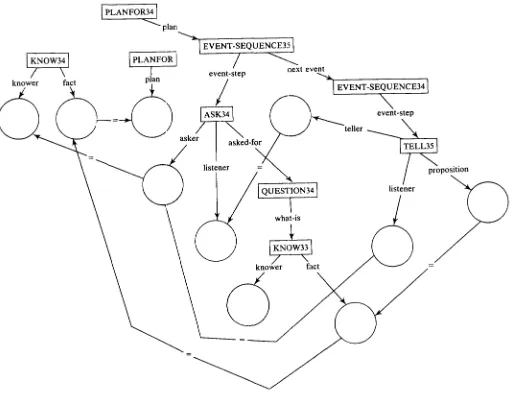
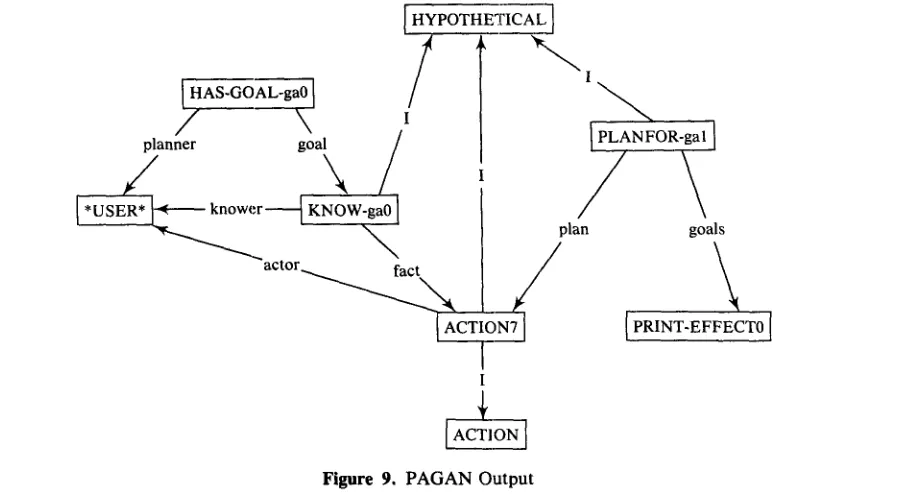
Having computed an actual content for an utterance, UC then tries to hypothesize the plans and goals under which the user is operating. This level of analysis is performed by PAGAN, written by James Mayfield. PAGAN performs a sort of speech act analysis of the utterance. The result of this analysis is a KODIAK representation of the network of plans and goals the user is using with respect to UC.
Goal analysis is important in many ways for UC. As is generally well known, an analysis of this sort is necessary to interpret indirect speech acts, such as " D o you know how to delete a file?", or "Could you tell me how to delete a file?". Furthermore, goal analysis helps to provide better answers to questions such as " D o e s Is -r recursively list subdirectories?". An accurate re- sponse to the literal question might simply be, " N o . " But a better response is, " N o , it reverses the order of the sort of directory listing; Is -R recursively lists subdirectories." To produce such a response, one needs to realize that the goal underlying the asking of this question is either to find out what 'Is -r' does, or to find out how to recursively list subdirectories. It is the job of the goal analyzer to recognize that such goals are
likely to be behind such a question. 4. AGENT (UCEGO)
Having hypothesized what the user wants of it, we would expect a system like UC to do what the user requested. But, as mentioned above, this is not always appropriate. UC should not aid and abet a user trying to perform malicious mischief; it might need to correct an errant user or it might decide to supply unasked-for information to one diagnosed as not knowing an impor- tant fact.
In order to deal with such situations UC is con- structed as an agent. This agent reacts to users' requests by forming goals and acting on them. The central mechanism of UC is called UCEgo, and has been developed by David Chin.
In a typical transaction, UCEgo will simply adopt the goal of having the user know what the user wants to know. However, as the example above illustrates,
Robert Wilensky, David N. Chin, Marc Luria, James Martin, James Mayfield, and Dekai Wu The Berkeley UNIX Consultant Project
UCEgo may adopt other goals as well, such as protect- ing the integrity of the system. It may also have to detect conflicts between these goals. Sometimes, UCEgo, attempting to be educational, may adopt a somewhat different goal from the user's. Thus, if the user asks UC to actually perform some request, such as telling the user who is on the system, UC will decide to tell the user how to perform such a function, rather than do what the user requested.
UCEgo implements much of the agentlike character of UC. While interfaces are generally thought of as passive conduits through which information flows, UC is an agent that listens to the user and is generally helpful. But it has its own agenda, and the requests of the user are merely a source of input to it.
5. USER MODELING (KNOME)
Several of UC's components may need information about the user to make an effective choice. For exam- ple, an expert user certainly knows how to delete a file. Thus such a user uttering " D o you know how to delete a file?" is unlikely to be asking for this information-- more likely this user is testing the consultant's knowl- edge.
Assessing the knowledge state of the user is the function of a user modeling program called KNOME, developed by David Chin. It is exploited by several components, including the "expression mechanism" described below.
6. DOMAIN PLANNER (KIP)
Typically, UCEgo tries to help the user. This usually requires determining a fact that the user would like to know. This task is accomplished by KIP. KIP is a "domain planner" developed by Marc Luria. While UCEgo infers its own goals, and plans to act on them, KIP is given a task by UCEgo of determining how to accomplish what the user wants to accomplish. KIP tries to determine how to accomplish this task, using knowledge about UNIX and knowledge about the user's likely goals. KIP returns a plan, represented in KO- DIAK. For example, UCEgo may give KIP the task of determining how to move a file to another machine, if this is something the user wants to know. Here, KIP would come up with the plan of copying the file to the target machine and then deleting the original.
Since UCEgo is also a planner, UC in effect has two planners within it. Again, this is probably not theoreti- cally justifiable, although the two planners have ended up focusing on rather different aspects of planning. It remains to be seen whether a single mechanism might accommodate both functions.
7. EXPRESSION MECHANISM (UCEXPRESS) Having gotten KIP to compute a plan for the user's request, UCEgo now tries to communicate this plan to the user. To do so, it must determine which aspects of the plan are worthy of communication and how best to
communicate them. For example, if it is likely that the user knows how to use commands in general, it might be sufficient just to specify the name of the command. In contrast, it might be helpful to illustrate a general command with a specific example.
UCExpress is an expression mechanism written by David Chin. It edits out those parts of the conceptual answer returned by KIP that, for various reasons, appear unnecessary to communicate. UCExpress may also choose to illustrate an answer in several formats. For example, it might illustrate a general answer by generating a specific example, or it might explain one command in terms of another, simpler, command.
The result of UCExpress is an annotated KODIAK network, where the annotation specifies which part of the network is to be generated.
8. LANGUAGE PRODUCTION (UCGEN)
Once UC has decided what to communicate, it has to put it into words. This is done by a generation program called UCGen. UCGen is a simple generator, pro- grammed by Anthony Albert and Marc Luria. It takes the marked KODIAK network produced by UCExpress and, using knowledge of English, produces sentences to complete the transaction with the user.
9. LEARNING MECHANISM (UCTEACHER)
Since it is intended that UC be an extensible system, a mechanism has been developed to add new knowledge to the system by talking to it in natural language. This mechanism, called UCTeacher, is the work of James Martin. UCTeacher has capabilities to extend both UC's knowledge base of UNIX facts as well as its knowledge of English vocabulary.
Note that several UC components deal with goals and plans, but in rather different ways. To minimize confusion, we emphasize the different tasks that these programs perform: PAGAN hypothesizes goals of the user with respect to UC; UCEgo reacts to the user by forming goals of its own and then trying to accomplish them; and KIP is given the goal of solving some underlying UNIX problem. Thus PAGAN is a goal analyzer, i.e., a program that attempts to determine someone else's goals, while UCEgo and KIP are plan- ners, i.e., programs that determine and produce plans for their own goals.
UCEgo and KIP exist as two separate programs primarily for pragmatic reasons. It may be possible that a single planner could accomplish the tasks of both UCEgo and KIP. Such an integration will have to await a revision of our system.
1.5 UC EXAMPLES
The first set of examples illustrates the scope of the current UC prototype. They are intended to show the kind of requests the system can handle, as well as its scope. The second set demonstrates some more com- plex capabilities.
Robert Wilensky, David N. Chin, Marc Luria, ,lames Martin, James Mayfield, and Dekai Wu The Berkeley UNIX Consultant Project
Each sentence below preceded by the prompt ' # ' is supplied by the user. The rest of the text is a computer- generated response. Note that the system handles a variety of request forms, some direct and some indirect. Also, the responses to general questions will cause an example to be generated. Finally, the reader may notice that the vocabulary used to respond to a request is often different from that used in the request itself. For exam- ple, a question about file protection is answered in terms of file permission; a question about changing a directory is answered in terms of connecting to a directory. This is because the representations used to encode the system's knowledge are kept in a canonical form, so that different expressions of the same meaning are mapped to the same internal representation. Upon generating a response, the system use,.; only this internal representation, which, coupled with its generating bi- ases, causes an expression of an answer that is largely independent of the vocabulary that appeared in the request.
1.5.1 SIMPLE EXAMPLES
% UC
Welcome to UC (Unix Consultant) version 3.23 To a UC ' # ' prompt, please type in your questions about the Unix file system in English.
To leave, just type a 'AD' or '(exit)'. Hi.
How can I help you?
# Can you tell me how to move a file? Use mv.
For example, to move the file named foo to the file named fool, type 'mv foo fool'.
# Do you know how to delete a file named dekai? Type 'rm dekai'.
# Do you know how to delete a file? Use rm.
For example, to delete the file named foo, type 'rm foo'.
# How can I delete the file charlie? Type 'rm charlie'.
# How can I delete the file named tony? Type 'rm tony'.
# How can I get rid of the file named boob? Type 'rm boob'.
# I want to delete a file named peter. Type 'rm peter'.
# I want to delete a file. Use rm.
For example, to delete the file named foo, type 'rm foo'.
# I want to delete the file dave. Type 'rm dave'.
# How can I add read permission to a file?
Use chmod.
For example, to add individual read permission to the file named foo, type 'chmod u + r foo'.
# Elow can I add the owner execute permission to a file'!
Use', chmod.
For example, to add individual execute permission to the file named foo, type 'chmod u + x foo'.
# How can I change the group execute permission of a file?
Use chmod.
For example, to remove group execute permission from the file named foo, type 'chmod g-x foo'. # How can I change the user read permission of a file?
Use chmod.
For example, to remove individual read permission from the file named foo, type 'chmod u-r foo'. # How can I remove the group write permission from the file named bimbo?
Type 'chmod g-w bimbo'.
# ltow do I change the protection of a file? Use chmod.
For example, to remove individual read permission from the file named foo, type 'chmod u-r foo'. # How can I compact a file?
Use compact.
For example, to compact the file named foo, type 'compact foo'.
# How can I create a directory? Use mkdir.
For example, to create the directory named foo, type 'mkdir foo'.
# How can I find a file? Use whereis.
For example, to find the file named foo, type 'where is foo'.
# How can I find out how much disk space I am using?
Type 'du'.
# How can I find out who is using the system? Type 'finger'.
# How can I find out wilensky's phone number? Type 'finger wilensky'.
# How can I list a directory? Use Is.
For example, to list the directory named foo, type 'Is foo'.
# How can I logout? Type 'logout'.
# Tell me how to leave. Type 'logout'.
Robert Wilensky, David N. Chin, Marc Luria, James Martin, James Mayfield, and Dekai Wu The Berkeley UNIX Consultant Project
# H o w can I m o v e a file to the file named blah? Use mv.
F o r example, to m o v e the file named foo to the file named blah, type 'mv foo blah'.
# H o w can I m o v e the file j u n k ? Use mv.
F o r example, to m o v e the file named junk to the file named foo, type 'mv j u n k f o o ' .
# H o w do I m o v e a file? Use mv.
F o r example, to m o v e the file named foo to the file named fool, type 'mv foo fool'.
# H o w do I change my d i r e c t o r y ? Use cd.
F o r example, to c o n n e c t to the directory named foo, type 'cd f o o ' .
# H o w do I c o p y a file? Use cp.
F o r example, to copy the file named foo to the file named fool, type 'cp foo fool'.
# H o w do I c o p y the file foo to the file blah? T y p e 'cp foo blah'.
# H o w do I create a d i r e c t o r y ? Use mkdir.
F o r example, to create the directory named foo, type 'mkdir f o o ' .
# H o w do I print a file named info? T y p e 'lpr info'.
# I want to print a file. Use lpr.
F o r example, to print the file named foo, type 'lpr f o o ' .
# I want to change my working directory. Use cd.
F o r example, to c o n n e c t to the directory named foo, type 'cd f o o ' .
# I want to c o p y the file named rick. Use cp.
F o r example, to copy the file named rick to the file named foo, type cp 'rick f o o ' .
# I want to delete a directory. Use rmdir.
F o r example, to delete the directory named foo, type 'rmdir f o o ' .
# I want to r e m o v e a directory. Use rmdir.
F o r example, to delete the directory named foo, type 'rmdir f o o ' .
# What's the best way to delete a directory? Use rmdir.
F o r example, to delete the directory named foo, type 'rmdir f o o ' .
# I want to display a file. Use more.
F o r example, to display the file named foo, type ' m o r e foo'.
# I want to edit a file. Use vi.
F o r example, to edit the file named foo, type 'vi foo'. # I want to find out J o e ' s address.
T y p e 'finger j o e ' .
# I want to remove a directory named junk. T y p e 'rmdir j u n k ' .
# What's the c o m m a n d to c o m p a c t a file? Use compact.
F o r example, to compact the file named foo, type ' c o m p a c t foo'.
# What is a d i r e c t o r y ?
A directory is a file that is used to contain files. # What is a file?
A directory is a container that is used to contain text, code or files.
# What is a r m ?
Rm is a c o m m a n d that is used to delete files. # What is a search path?
A search path is a list of directories that is used by the csh to search for programs to execute.
1.5.2 MORE COMPLEX EXAMPLES % UC
Welcome to UC (Unix Consultant) version 3.23 T o a UC ' # ' prompt, please type in y o u r questions about the Unix file system in English.
T o leave, just type a 'AD' or '(exit)'. Hi.
H o w can I help you?
# Is rn used to rename files? No, rn is used to read news.
To rename a file to another file, use mv.
F o r example, to rename the file named foo to the file named fool, type 'mv foo fool'.
In this example, UC hypothesized that the user asked the question in order to get an answer to some under- lying question. In particular, P A G A N hypothesized possible goals of wanting to know how to rename a file and wanting to know what rn does. Since the answer to the direct question is negative, U C E g o realizes that the underlying goals are not addressed by this answer, and, therefore, attempts to answer them. This results in the extended answer.
# H o w can I crash the system? I ' m sorry, I cannot tell you.
In this example, UC detected a conflict between its goal o f helping the user and that o f preserving the integrity of the system. It resolved this conflict in f a v o r of the latter
Robert Wilensky, David N. Chin, Marc Luria, James Martin, James Mayfield, and. Dekai Wu The Berkeley UNIX Consultant Project
goals. H o w e v e r , since it could not a c c o m m o d a t e the user's request, it attempts to be polite by apologizing to the user.
# What does Is -v do? Ls does not have a -v option.
H e r e , the user asks about a nonexistent c o m m a n d option. Actually, the U N I X 'Is' c o m m a n d ignores op- tions that it does not recognize, so the consultant could have answered truthfully by saying that 'Is -v' causes o n e ' s directory to be listed. It did not, because P A G A N interpreted the request as a question about the function associated with the c o m m a n d . U C E g o reasons that, since (1) it d o e s n ' t know about such an option, and (2) it knows all the options to all simple commands, and (3) Is is a simple c o m m a n d , the user must have a miscon- ception. It then generates the goals o f correcting the misconception, which results in the answer shown. N o t e that UC uses an open-world hypothesis together with metaknowledge to determine whether it knows some facts about U N I X .
In the next example, two different sessions with two different users are represented.
% UC
W e l c o m e to UC (Unix Consultant) version 3.23 T o a UC ' # ' prompt, please type in y o u r questions about the Unix file system in English.
To leave, just type a 'AD' or '(exit)'. Hi.
H o w can I help you? # H o w can I delete a file? Use rm.
F o r example, to delete the file named foo, type 'rm f o o ' .
# What does rwho do?
Rwho is used to list all users on the network, the users' tty, the users' login time, and the users' idle time.
% UC
W e l c o m e to UC (Unix C o n s u l t a n t ) v e r s i o n 3.23 T o a UC ' # ' p r o m p t , please type in y o u r questions about the Unix file s y s t e m in English.
T o leave, just type a 'AD' or '(exit)'. H i .
H o w I can I help y o u ?
# H o w can I find out the inode o f a file? Use Is -i.
# What does rwho do?
Rwho is like who, e x c e p t rwho lists all users on the network.
Because he asked such a simple question, the first user was diagnosed by K N O M E as being a novice user. This resulted in the a n s w e r to his first question being illus- trated by an example, and the e x t e n d e d format o f his answer to the second. In contrast, the second user
asked about a relatively technical aspect of U N I X . Thus this user is likely to be a relatively sophisticated user. As a result, the answer to that u s e r ' s first question was not illustrated with an example. F o r the same reason, UC presumes that the second user knows about the 'who' command, and takes advantage o f this knowledge in generating the response.
Note this example also illustrates U C ' s ability to generate different types o f responses. This example was able to use a simile format, because the c o m m a n d to be generated was thought to be sufficiently close to one UC believes the user to already know. Formating is discussed in section 8.
The next example illustrates some aspects o f U C ' s ability to generate plans.
# H o w do I print Jim's file on the lineprinter? Use lpr. This plan will not work if you d o n ' t have read permission on Jim's file.
In this example, KIP, U C ' s domain planner, suspects that the plan it is suggesting might fail. This is because the plan involves printing s o m e o n e else's file, and K I P knows that the lack of appropriate permission in such cases is a likely source o f plan failure. H o w e v e r , since it does not know a more certain plan, it delivers the suspect one, but warns the user of the possible problem. A fact about a possible problem with a plan is called a concern. Concerns are explicitly r e p r e s e n t e d in U C ' s knowledge base. At this stage, U C ' s knowledge of concerns is fragmentary. Thus questions a b o v e that have the same structure as this one may not cause any warnings to be generating simply because the requisite knowledge is lacking. Concerns are discussed further in Section 7.2.3 below.
# Who is on the system?
I ' m sorry, I d o n ' t know. Use users to find out who is on the system.
H e r e , UC fails to answer the user's question, because it does not have any way o f r u n n i n g U N I X c o m m a n d s itself. Its failure causes it to apologize. UC then forms the goal of the user knowing how to determine the requested information. It addresses this goal, which leads to the second part of the response.
2 K O D I A K
The knowledge used by UC is r e p r e s e n t e d in K O D I A K , as are the various stages o f the processing o f an utter- ance. K O D I A K ( K e y s t o n e to Overall Design for Inte- gration and Application of Knowledge) is an implemen- tation of CRT (Cognitive Representation T h e o r y ) , an approach to knowledge representation that bears simi- larities to numerous o t h e r systems, but especially those o f Schank (1975), Schubert (1976), Shapiro (1979), and Brachman and Schmolze (1985). K O D I A K differs from these systems in significant ways; h o w e v e r , here we shall try to trivialize rather than a c c e n t u a t e these dif- ferences so that the reader can relate o u r representa-
Robert Wilensky, David N. Chin, Marc Luria, James Martin, James Mayfield, and Dekai Wu The Berkeley
UNIX Consultant
Projecttions to more familiar ones. The reader should consult Wilensky (1986) for a more detailed account and justi- fication of this representation system.
KODIAK is a relation-oriented rather than object- oriented system. In an object-oriented system, one thinks of objects as having slots, and the representa- tional weight is carried by such structured objects. In a relation-oriented system, objects are thought of as atomic elements, and knowledge is captured by the relations in which these objects participate.
For example, suppose we want to represent a con- cept like "state change", i.e., an event in which some state is thought of as changing into another state. Among other things, we would like to capture the fact that any state change has an initial state and a final state. In KODIAK, we would represent this by first creating objects corresponding to the concepts STATE- CHANGE and STATE. Then we would indicate that a relation, say, INITIAL-STATE, holds between each instance of a state change and some instance of a state. Similarly, another relation, say, FINAL-STATE, holds between each state change and some state.
This description sounds equivalent to saying that INITIAL-STATE and FINAL-STATE are slots of STATE-CHANGE. For the purposes of this paper, we will not strenuously resist this interpretation. However, the underlying philosophy (and actual representation) is different. In particular, rather than accounting for the relatedness of STATE-CHANGE and INITIAL- STATE and FINAL-STATE by creating a primitive notion of slot and asserting that the latter two items are slots in the former, this relatedness is simply attributed to the fact that every STATE-CHANGE participates in an INITIAL-STATE relation and a FINAL-STATE relation. On the other hand, we think of these relations as being less closely related to STATE because not every state participates in these relations.
In our terminology, we refer to objects like STATE and STATE-CHANGE as absolutes, and the relations in which they participate, such as INITIAL-STATE and FINAL-STATE, as aspectuals. The motivation for hav- ing a more fine grain representation than objects with slots is described in Wilensky (1986). However, here we shall use a more conventional notation for the sake of exposition. For example, we will write the above facts about state changes using the following notation:
[ STATE-CHANGE l
/ \
Ot Ot
This diagram should be interpreted as follows: the individual instances of the concept STATE-CHANGE always participate in two relations, one called INI- TIAL-STATE and one called FINAL-STATE. That is, if we ever encountered an individual of the concept STATE-CHANGE, it will be in an INITIAL-STATE and a FINAL STATE relation to something. The circles themselves represent the idea of being in a given relation to something. Thus they correspond most closely to the roles of other systems.
Of course, there is much more to say about state changes. For example, we have not yet expressed the fact that the other argument to both INITIAL-STATE and FINAL-STATE must always be a state. Also, the state that is in a INITIAL-STATE relation to a state change always occurs before the state that is in the FINAL-STATE relation. STATE-CHANGE itself is a type of event. We will now describe how such facts are represented.
We represent individuals of a concept, and subtypes of a concept, using KL-ONE-Iike structured inheritance technique. For example, to represent an instance of a state change, we would create the following structure:
I STATE-CHANGE
I/
\
o/ O/
STATE-CHANGEI I
/
initial-state
\
final-state
The instantiate (I) link states that STATE-CHANGE 1 is an individual STATE-CHANGE. Initial-statel should be interpreted as the assertion that the initial state relation holds between STATE-CHANGEI and some (as yet unspecified) value; the surrounding circle repre- sents the idea of being in the initial state relation to STATE-CHANGE1. We sometimes say that initial- state l plays the role of the initial-state relation with respect to STATE-CHANGE1.
Note that role-play is a relation between a relation and its use, not a relation between a role and its filler. Indeed, the values to which initial-state and final-state connect STATE-CHANGE1 have not yet been de-
Robert Wilensky, David N. Chin, Marc Luria, James Martin, James Mayfieid, and Dekai Wu The Berkeley UNIX Consultant Project
picted. T o include these values in our representation, we use the v a l u e (V) link. Thus we would typically find instances like the a b o v e elaborated to include the following:
state and final-state must be an instance o f a S T A T E , we would ,draw a constrain (C) link from the circles labeled initial-state and final-state to a box labeled S T A T E , as in the following diagram:
I STATE-CHANGEI I
/
\
initial state final state
\
(
v v
C
o~
C STATE-CHANGE ]
That is, the initial-state relation holds b e t w e e n S T A T E - C H A N G E 1 and something called S T A T E 1 , and the final-state relation holds b e t w e e n S T A T E - C H A N G E 1 and something called S T A T E 2 . In other terminology, the object at the end o f the value link represents the filler, and the object at the source, the slot. Presumably, we would also include what o t h e r information we knew about S T A T E I and S T A T E 2 , namely, what categories they are instances of, etc.
We can abbreviate this notation if we have no need for the showing the slots o f an individual, but merely their fillers. We do this by drawing a labeled link directly to the target o f the value link. F o r example, we could simplify the a b o v e two diagrams by drawing a link labeled initial-state b e t w e e n S T A T E - C H A N G E 1 and S T A T E 1 , and one labeled final-state b e t w e e n S T A T E - C H A N G E 1 and S T A T E 2 . Thus it is sometimes conve- nient to draw the following.
I STATE-CHANGE1 [
/
\
initial-state final-state
These links would be interpreted as saying that any object in a Value relation with a use o f initial state or final state must be o f type S T A T E .
Subtypes are represented using a Dominate (D) link instead o f an Instantiate (I) link. The aspectuals are created for the subtype that play the role o f the aspect- uals of the parent. T h e s e are typically differentiated from those of the parent c o n c e p t by being subject to a further constraint. F o r example, we can begin to define dying as a kind o f state change as follows:
,s Z
\
I STATE-CHANGE ]
/
\
I
/
\
initial-stale
patient
final-stale
Usually, the aspectuals o f a c o n c e p t are constrained so that their o t h e r argument must be o f a certain type. F o r example, to indicate that the other argument to initial-
We have represented D E A T H - E V E N T as being a kind of S T A T E - C H A N G E in which the initial state is con-
Robert Wilensky, David N. Chin, Marc Luria, James Martin, James Mayfield, and Dekai Wu The Berkeley UNIX Consultant Project
st.,. o cate
objec,
s
/
\
• I °EA " EWN I state
strained to be a state of something being alive, and the final state to be that of something being dead.
In this diagram, we have not bothered to show the constraints on the aspectuals of STATE-CHANGE. In general, we will only show those parts of previous concepts that are pertinent to the knowledge being represented. Also, we introduced a new aspectual, dier, which specializes patient. Patient is inherited from some quite abstract absolute, which ultimately dominates STATE-CHANGE, and which has the meaning " e v e n t that affects an object". Also, since patient is an aspect- ual of some concept dominating STATE-CHANGE, we should have specialized it at STATE-CHANGE, say, to state-change-object. However, when such specialized versions of relations are not substantially differentiated from their ancestors, we will use the ancestor's name instead. The KODIAK interpreter understands the oc- currence of an inherited relation as being the most specific inheritable specialization of that relation, so using the more abstract name has the same semantics of using the more specialized one.
One item missing from this diagram is the fact that the fellow who dies is the same fellow as the one who
was alive and then was dead. This fact can be captured with the aid of the Equate (=) link. This is similar to K L - O N E ' s role chains. For example, we can improve our representation for dying by creating a state of being alive and a state of being dead, and then using Equate links to state the relationships between their components.
In the diagram above, we state that the dier of D E A T H - E V E N T is the same as the is-alive-object of some IS-ALIVE state, and also the same as the is-dead- object of some is-dead state.
The Equate links belong to a particular absolute. For example, in the diagram above, the Equate links ema- nating from dier belong to D E A T H - E V E N T . The sig- nificance of this fact is that it is true of dying that there must be an associated event of being alive, but it is not true of being alive that there must be a death event. We represent this aspect of Equates by the direction of the arrows in the diagram.
Having defined D E A T H - E V E N T , it is easy to rep- resent a concept like killing, assuming an analysis in which killing is a kind of causing in which the thing caused is a kind of death event.
Here we define K I L L as being a subtype of CAUS-
Robert Wilensky, David N. Chin, Marc Luria, James Martin, James Mayfield, and Dekai Wu The Berkeley UNIX Consultant Project
[CAUSAL-EVENT ]
0a,}o3\
~ / ~ ~ ' ~ patient c a u s ~
AL-EVENT. CAUSAL-EVENT is a concept shown as participating in an effect and a cause relation. K I L L is also shown as participating in a kill-effect and a kill- cause relation. Because effect and cause are written on the links to these relations, we know that kill-effect is just a specialized version of the effect relation, and that kill-cause is a specialized version of cause. To differen- tiate K I L L from CAUSAL-EVENT, we need to cap- ture the fact that the effect of a kill is a death event. The additional semantics of kill-effect (and thereby, of KILL) come from the constrain link on kill-effect. This says that the effect of a K I L L is a DEATH-EVENT. Finally, we use an Equate link to state that the person killed is the same one as the one who died.
Of course, many parts of the meaning of these simple concepts have been omitted from these diagrams. For example, we have not stated any information about time, such as the fact that the initial state precedes the final state. In general, the diagrams presented in this paper have been simplified to present the crucial knowl- edge needed without being even more complex than they already are.
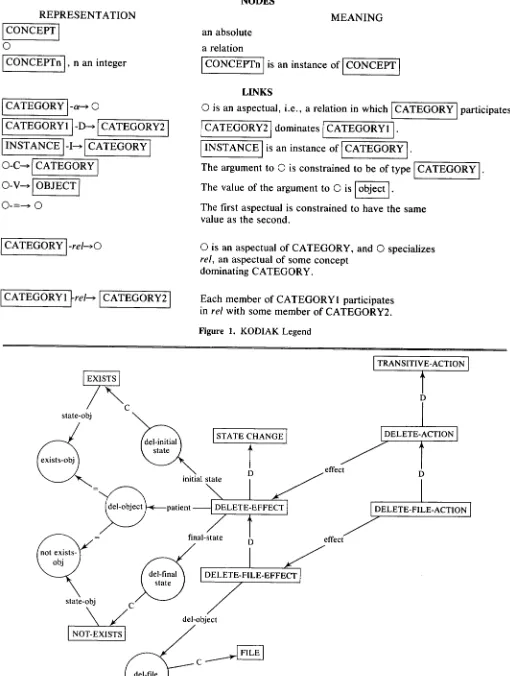
KODIAK has additional features that are not de- scribed herein. The reader is referred to Wilensky (1986) for a more complete description. A summary of all the KODIAK features used in this report is found in the legend in Figure I.
Note that the legend contains one additional abbre- viation, namely, that drawing a link bearing the name of a relation between two categories is interpreted as stating that the individuals of the domain category participate in that relation with some member of the range category.
2.1 UNIX KNOWLEDGE IN UC
The KODIAK knowledge representations used in UC include several rather general notions, such as state change, goal, and action, plus many specific facts about UNIX. The complete collection is too lengthy to include here. (UC is currently constructed from approximately 200 KODIAK diagrams, consisting of about 1,000 ab- solutes and 2,000 relations. While a scope of a diagram is to some degree arbitrary, diagrams roughly corre- spond to definitions of meaningful entities, like the definition a particular command.) Some more important concepts used in modeling the domain will be explained in the individual sections of this report.
To facilitate understanding the KODIAK diagrams that follow, consider the representation that the UC's knowledge base contains about the UNIX rm com- mand. This is used to delete a file named by its argument. The following diagram shows how knowl- edge about deletion is represented in UC.
The central node in this diagram is DELETE-EF- FECT. D E L E T E - E F F E C T is shown as being a kind of STATE-CHANGE that causes a something to go from existence to nonexistence. (The notions of existence and negation do play a special role in KODIAK, but also exist as ordinary states, as is the case here. From the point of view of this example, these are just like any other states.)
D E L E T E - E F F E C T specifies the minimal deletion event. For example, it says nothing about the cause of such an event, or who the actor of it may be. In UC in particular and in CRT in general, such state changes are the bases from which we build more elaborate concepts. For example, the action of deleting something is repre- sented as an action that causes something to be deleted.
Robert Wilensky, David N. Chin, Marc Luria, James Martin, James Mayfield, and Dekai Wu The Berkeley UNIX Consultant Project
REPRESENTATION
CONCEPT
O
[image:13.612.49.559.45.721.2]CONCEPTn , n an integer
[ CATEGORY ]-a---~ ©
[ CATEGORY1 -D--> [ CATEGORY2
[INSTANCE ]-I--, CATEGORY
O-C-~ [ CATEGORY 1
O-V---> OBJECT
O- =--> O
CATEGORY
-rel-->O
CATEGORY1
trel--->
CATEGORY2
N O D E S
MEANING
an absolute
a relation
CONCEPTn is an instance of CONCEPT]
I L I N K S
O
is an aspectual,
i.e., arelation in which [ CATEGORY
]participates
[CATEGORY2]dominates CATEGORYI ].
INSTANCE is an instance of [ CATEGORY ].
The argument to O is constrained to be of type [CATEGORY .
The value of the argument to O is ~ .
The first aspectual is constrained to have the same
value as the second.
O is an aspectual of CATEGORY, and O specializes
rel,
an aspectual of some concept
dominating CATEGORY.
Each member of CATEGORYI participates
in
re!
with some member of CATEGORY2.
Figure 1. KODIAK Legend
I TRANSITIVE-ACTION I
t
/ \
ostate-obj
C
[
~. ~at,eot I ° ~ ~ ' 1
I ~'~'~-~''~~'Io~l
/
t
/
state-oN
C
/
/
del-object
I NoT-E×ISTS
~ c
Robert Wilensky, David N. Chin, Marc Luria, James Martin, James Mayfield, and Dekai Wu The Berkeley UNIX Consultant Project
] EXECUTE-UNIX-COMMAND I
~D I UNIX'COMMAND I
I
[ EXECUTE-UN IX-RM-COMMAND ] / / ~ r
~ / / FDELETE.FILE.EFFECT
execute command ~ ~ | . . . . C" I
plan goals aei-ooje~ / name
/
" , ,
[ RM-FORM.AT
]
/
/
nam~ aN~rrg = C /
~ ~ I ~
This is encoded by showing D E L E T E - E F F E C T to be the effect of DELETE-ACTION.
Using names like D E L E T E - E F F E C T may be some- what misleading. In particular, D E L E T E - E F F E C T is not required to be the effect of anything--while DELETE-ACTION is defined as having DELETE- E F F E C T as its result, this statement imposes a require- ment on DELETE-ACTION, not on DELETE-EF- FECT. We call such concepts effects rather than events, say, to emphasize that we me, an to include only the most essential elements of the concept, i.e., just a specialized state change.
D E L E T E - F I L E - E F F E C T is a specialized version of D E L E T E - E F F E C T in which the object deleted is con- strained to be a file. DELETE-ACTION is correspond- ingly specialized to DELETE-FILE-ACTION. It is also shown as being a kind of TRANSITIVE-ACTION. This is a very general category denoting any action that acts upon an object.
This sort of structure, in which there exists parallel effect and action hierarchies, with the effect hierarchy carrying most of the semantic weight, is typical of the representation that appear in UC.
The figure above connects this general knowledge about deletion with knowledge about UNIX.
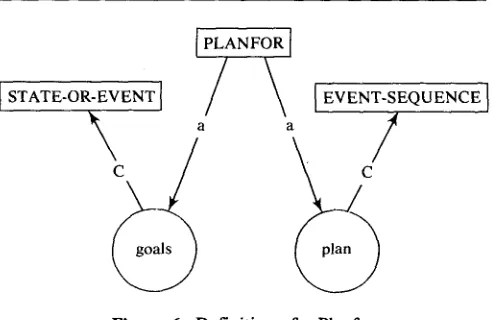
Here we state how to achieve a DELETE-FILE- EFFECT. This accomplished by the node labeled PLANFOR2, which points to EXECUTE-UNIX-RM- COMMAND and to D E L E T E - F I L E - E F F E C T . A
P L A N F O R indicates that something is conceptualized as a plan for a particular goal (PLANFORs are dis- cussed below). In other words, this notation represents the particular fact that the 'rm' command (i.e., the command whose name is " r m " ) is used to achieve the effect of deleting a file. Again, this structure is typical of that seen in U C - - m o s t of the information about a command is represented as information about the use of that command; the intended function of the use of a command is represented by a planfor between a node representing the use of the command and some effect.
The rest of the diagram specifies the format of the command. In particular, the Equate link specifies that, to delete a particular file, its name must be the same as that of the argument supplied to 'rm.'
A TOUR THROUGH UC
The following sections describe the components of UC in more detail. To aid in understanding how these components contribute to the processing of an individ- ual utterance, we show how each section processes the example sentence " D o you know how to print a file on the imagen [a kind of laser printer used at our site]?" In most cases, a module is capable of doing a great deal more than is required for this example, and such capa- bilities are attested to. However, the example is useful for illustrating the kind of processing that is performed for a typical request.
In order to produce a paper of reasonable length, we
Robert Wilensky, David N. Chin, Marc Luria, James Martin, James Mayfield, and Dekai Wu The Berkeley UNIX Consultant Project
ACTION [
HYPOTHETICAL / ~ D
asked-for ]~ ~ " ~ /
, I / ~ N I x / [PRINT-ACTION I
I QUESTION II I / ~ " ~ fl'
w~'hat_is / I /I' "N,,,, N ,/I
/
RINTACTI°N°i
\
I" [ fact. ~ / cause \
kno[wer ""~ ~ /j~/ \
NOWl
I *ON61
\
PRINT-EFFECT ]
IMAGEN
print-effect print-object / I
I / ~ t - d e s t
[image:15.612.87.533.43.291.2][ PRINT-EFFECT01
Figure 2. ALANA's output for "Do you know how to print a file on the Imagen?"
reduced considerably the description of some of UC's modules. We have focused on those processes that contribute to UC's agentlike nature, while some more conventional modules, such as the conceptual analyzer, are mentioned only in passing. References are given to descriptions of these neglected components, which have all appeared elsewhere in print, should the reader find the account herein dissatisfying.
3 THE ANALYZER
A conceptual analyzer maps a string of words into a meaning representation. ALANA (Augmentable LAN- guage Analyzer), the conceptual analyzer for UC, takes as input a sentence typed by a user, and builds a conceptual representation using the KODIAK knowl- edge representation language. ALANA constructs the primal content of the input utterance. The primal con- tent is the interpretation that can be computed from grammatical and lexical knowledge; it is generally rather abstract. ALANA's results are further inter- preted and refined by other parts of the system, such as the concretion mechanism, to produce an actual con- tent, and the goal analyzer, to produce a representation of the intentions underlying the utterance.
ALANA is a descendent of PHRAN (Wilensky and Arens 1980), the front end natural language component for the original UC (Wilensky, Arens, and Chin 1984). Like PHRAN, ALANA reads the user's input and forms a concept that the other UC components can use for their tasks. Also like PHRAN, the ALANA uses as its primitive knowledge unit the pattern-concept pair, which relates a natural language structure to a concep-
tual structure. UC has a total of 476 patterns and knows 284 words.
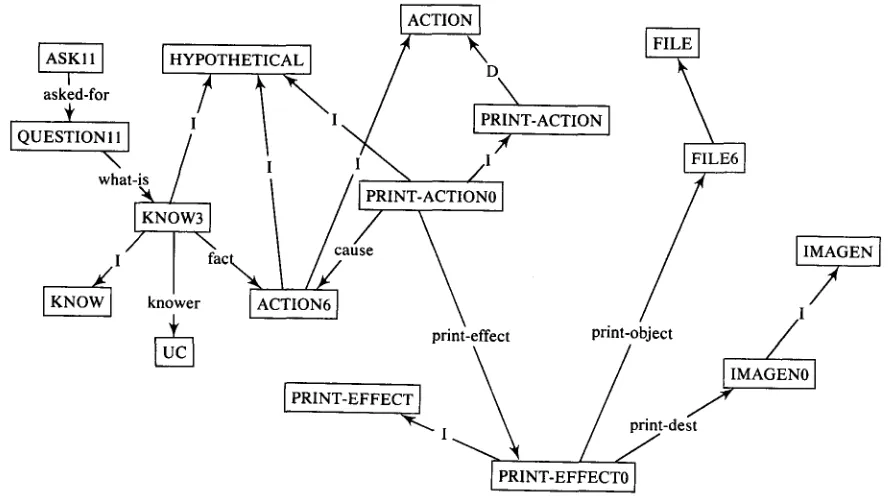
ALANA differs from PHRAN in its generality. ALANA generalizes on the idea of pattern concept pair analysis, while making it easier than it was with PHRAN for a knowledge adder to add new patterns to the system. Since a more detailed description of ALANA can be found in Cox (1986), we will not elaborate on it here. Instead, we merely show in Figure 2 the output produced by ALANA upon reading the sentence "Do you know how to print a file on the imagen?".
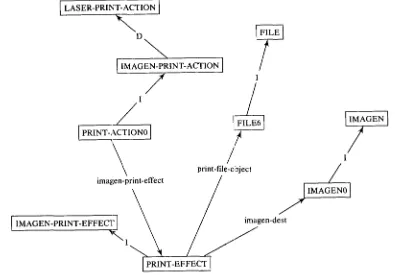
This diagram may be interpreted as follows: The entire request is summarized as A S K l l , i.e., some asking event. What is asked for is verification of some item, Q U E S T I O N l l , whose content is KNOW3, i.e., an instance of knowing. The knower of the item is UC, and the fact is ACTION6. ACTION6 is interpreted as something that is the cause of a printing action PRINT- ACTION0, which is itself an action whose effect (PRINT-EFFECT0) is to cause a file (FILE6) to be printed on an imagen printer (IMAGEN0).
Some of the nodes in this diagram point to a node labeled HYPOTHETICAL. This is a tentative conven- tion used to indicate that the knowing and printing event, etc., are not real events, but merely hypothetical ones.
4 THE CONCRETION MECHANISM
4.1 INTRODUCTION
A concretion inference is a kind of inference in which a more specific interpretation of an utterance is made