Finding the way from ¨a to a:
Sub-character morphological inflection for the SIGMORPHON 2018
Shared Task
Fynn Schr¨oder∗ Marcel Kamlot∗ Gregor Billing∗ Arne K¨ohn Department of Computer Science
Universit¨at Hamburg Germany
{7schroed,6kamlot,5billing,koehn}@informatik.uni-hamburg.de
Abstract
In this paper we describe the sys-tem submitted by UHH to the CoNLL– SIGMORPHON 2018 Shared Task: Univer-sal Morphological Reinflection. We pro-pose a neural architecture based on the concepts of UZH (Makarov et al.,2017), adding new ideas and techniques to their key concept and evaluating different com-binations of parameters. The resulting sys-tem is a language-agnostic network model that aims to reduce the number of learned edit operations by introducing equivalence classes over graphical features of individ-ual characters. We try to pinpoint ad-vantages and drawbacks of this approach by comparing different network configura-tions and evaluating our results over a wide range of languages.
1 Introduction
The system described in this paper1 was
submit-ted for theCoNLL–SIGMORPHON 2018 Shared Task(Cotterell et al.,2018), part 1 only. This as-signment challenges the participants to design sys-tems that generate inflected forms based on an input lemma and feature set as shown inFigure 1.
Training data is usually provided in three differ-ent volumes (seeTable 1), all conforming to the UniMorphstandard proposed byKirov et al.(2018). The entire data set comprises 103 languages, al-though not every training volume is available for every language. In addition, some languages have significantly less training samples than the maxi-mum depicted inTable 1.
With such a high count of diverse languages, our system is not tailored towards specific linguistic
∗These authors contributed equally
1Source code available at https://gitlab.com/ nats/sigmorphon18
bungas N;INST;PL ⇓
bung¯am
Figure 1: An example for word inflection in Lat-vian, ”a drum/drums”
# of Samples Volume max avg
low 100 99.6
medium 1.000 934.5 high 10.000 8553.6 Table 1: Maximum training data volumes
features of a language, but instead learns transition-based character actions to transform a lemma into its inflected form. We try to limit the number of output actions that our network has to learn by grouping certain characters into common groups based on graphical features like accents or symbol modifiers. Lastly, we propose a method to enhance the training data of the low setting without the use of external resources.
2 String Transducer
The inflection process itself is realized in our sys-tem through a finite set of edit actions, resulting in a standard transducer process. An input string is traversed left-to-right via an index pointer that indicates which symbol is currently being regarded. The following actions are available:
• EMITs(for any symbols): Appendssto the
output string, irrespective of pointer symbol • COPY: Append the pointer symbol to the
out-put string
• PATCHx: Apply the graphical patch matrix x(cf. Section 3) to the pointer symbol and
append the result to the output string
traversing the input word
• EOW(end of word): Stop traversing the string and consider the current output string as the final inflection result
2.1 Alignment
We chose to implement our own mechanism to align input lemma and output strings, to accommo-date for our patch concept.
The aligner itself is based on plain Levenshtein metrics (Levenshtein, 1966), with the additional constraint that two symbols a, b are considered
equal (cost 0) if there is a patch that transforms
aintob. We then pick the alignment with the low-est cost according to this customized Levenshtein metric to encourage our system to learnCOPYand PATCHactions as much as possible.
2.2 Oracle Algorithm
The actions needed to transform an input lemma
w into the inflected target form t are generated through a deterministic algorithm that acts as static oracle gold standard. This algorithm works with an aligned pair(w0, t0)as input, where the originalw
andtare filled with arbitrary characters not
appear-ing in the original strappear-ings. The exact procedure can be seen in algorithm1with#-symbols being used as gap fill characters.
Algorithm 1Deriving oracle actions gold standard
from aligned input strings
for all(cw, ct)inalignmentdo
ifcw = #then
actions.append(EMITct)
else ifct= #then
actions.append(MOVE)
else ifcw =ctthen
actions.append(COPY)
actions.append(MOVE)
else ifpatchtable.contains(cw, ct)then
actions.append(PATCHcwtoct)
actions.append(MOVE)
else ifcw 6=ctthen
actions.append(EMITct)
actions.append(MOVE)
end if end for
actions.append(EOW)
return actions
Lemma Inflection Features Baumhaus Baumh¨auser N;ACC;PL Kanarienvogel Kanarienv¨ogeln N;DAT;PL Milchkuh Milchk¨uhen N;DAT;PL Table 2:Germannoun declension examples: tree house, Canary bird, (milk-)cow
Lemma Inflection Features chacer chac¸ons V;POS;IMP;1;PL ´evincer ´evinc¸ant V.PTCP;PRS concevoir conc¸usse V;SBJV;PST;1;SG Table 3: French verb conjugation examples: to hunt, to cut up, to conceive (of)
3 Patches
An essential part of our system concept is to intro-duce so-calledpatchesthat act as string transducer actions. Apatchin this context is a shortcut oper-ation between two graphically similar characters (seeFigure 2), like the acute accent that transforms the letterainto the letter´a. It acts as a partial func-tionp(x), so that the same patch can be applied to the lettereto yieldp(e) =´e— however it does not produce a valid result character when applied to the letterbfor example.
Figure 2: Example patch generated fromotoˆo(on the right)
3.1 Idea and Motivation
The basic idea for these patches comes from the tendency of some languages to slightly modify the root of the word during inflection. This can ei-ther be due to phonological requirements (Kendris,
2001) or historical linguistic influences (Wiese,
2009;Wunderlich,1999). Two examples for inflec-tion inGerman(note the addedUmlautsymbols for the inflected forms) andFrench (with added cedillamarks) can be seen inTable 2and3, respec-tively. The underlying intention is to capture this modification to the word stem while retaining the idea that it still is based on the same letter or group of letters. A plain transducer would identifynand ˜
Another motivation was the previous work per-formed on machine translation systems byLiu et al.
(2017). They achieved promising results by explor-ing visual features on the sub-character level for machine translation, and their ideas and implemen-tations proved useful as a starting ground for the concept presented in this section.
3.2 Generation
To calculate meaningful patches, we render all unique and distinct symbols contained in a given training set into binary 2D pixel matrices that con-tain information whether a pixel is set/black or not. The resulting matrices are then compared with an element-wiseXORoperation that yields all pixels different between the two images. We furthermore only consider patch matrices that are based on the same ASCII character and that don’t surpass a cer-tain heuristic threshold of set pixels. Through these checks, patches from i.e. xtomget discarded be-cause although possible, it does not produce any advantage to use them in the transducing compo-nent. The resulting effect would be the exact same as a straight-forwardEMITaction.
The only non-intuitive heuristic involves the let-teri, which contains a dot on top of a vertical bar that ”disappears” when applying typical patches like accents. To counter this effect, we introduced a hard-coded set of replacement rules where the letteriis effectively replaced by the Turkish dot-lessıin graphical representations, in order to fool the system into correctly applying modifications. A similar principle might apply to other symbols in languages unknown to the authors, so the pro-posed architecture is capable of extending to more symbol exceptions if desired.
3.3 NFD Unicode Decomposition
The Unicode standard proposes normalization forms2that are capable of converting between
com-posite symbols and their integral parts. In particu-lar, theNFDnormalization achieves an effect very similar to our patch concept.
However, when designing the system we con-sciously decided against the use of such a feature, mostly because we were not aware of the complex NFD standard and coding a similar system by hand was not a viable alternative at all.
2see http://www.unicode.org/reports/ tr15/
3.4 Font Choice and Rendering
The font choice for our system has to focus on two main aspects:
1. It has to always render all characters in the exact same position
2. It should have high Unicode coverage to be able to render as many foreign alphabets’ sym-bols as possible
Regarding point1, we only considered mono-space fonts and examined 14 of them. Most of them were appropriate, only two of them still had issues with pixel-perfect alignment of the target symbols on several occasions. Regarding Point2, we did not find a single font that covered all alphabets in use for this Shared Task, so we had to take some draw-backs and accept rendering of ”unknown symbol” placeholders for some languages.
The symbol rendering is handled through the pygame3library. More sophisticated alternatives
perform anti-aliasing that nullifies the desired effect of pixel-based comparison. An anti-aliased lettera looks slightly different than the same letter¨awith GermanUmlaut added on top, and the resulting patch would contain this noise and therefore be different from the one between e.g.oand¨o.
3.5 Equivalence Classes
After rendering, all resulting patch matrices are grouped by pixel similarity, resulting in a finite number of equivalence classes that can later be used as actions for the transducer. These actions are symmetrical, so that irrespective of lemma and inflection order we definep(p(c)) =c.
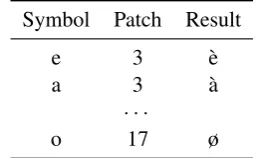
Once the patches are grouped, the original pixel representation is discarded so that our data can be arranged as a simple lookup table where patches are represented by numerical indices – as can be seen inTable 4.
We deal with unseen characters during predic-tion by populating the lookup table over a big por-tion of the entire Unicode plane, and then filtering the result based on a given input alphabet: We keep all rows of any patchpin the pre-populated table
if at least one example ofpwas observed in the
input alphabet. Although this computation is quite costly, we can still keep runtime demands at a min-imum because the whole overview only has to be computed once. Individual languages can then be filtered out ”on demand” while holding a complete
Symbol Patch Result
e 3 `e
a 3 `a
· · ·
[image:4.595.115.246.63.142.2]o 17 ø
Table 4: Symbol patch lookup table
copy of the Unicode-based lookup table in memory.
4 Enhancing Training Data
To improve our training on low data quantities, our system can enhance training data by generating ar-tificial samples based only on the existing data. By detecting patterns in words with the same features and generating more data with the same patterns, we assumed that this would aid the network in detecting and applying patterns, such as common prefix and suffix changes.
Similar approaches were taken by submis-sions for previous CoNLL–SIGMORPHON Shared Tasks. The winning submission (Kann and Sch¨utze,
2016) of the 2016 Shared Task employed data enhancement for the low resource setting. The team of the 2017 submission fromBergmanis et al.
(2017) used two variants of a sequence autoen-coder, with one using lemmas and target forms as inputs and the other using randomly generated strings. The additional training data proved to in-crease the average performance on development sets. Kann and Sch¨utze(2017) used several aug-mentation methods, including a rule based system.
Silfverberg et al. (2017) employ a data augmen-tation system splitting a word in three parts - inflectional prefix, word stem and ininflectional suffix -and then generating new words using existing pre-and suffixes. Further works using data augmenta-tion are provided byZhou and Neubig(2017) and
Nicolai et al.(2017).
4.1 Basic Enhancement Process
To generate artificial training samples for a data set, our system sorts the input data into groups of inflections that share the same features. Within each group, it aligns and compares each pair of lemma and inflected form with every other pair, only retaining the common characters at the aligned positions. The different characters are replaced semi-randomly using a language model based on n-grams with one gap each. Finally, these gaps are filled with letters from the dataset based on their
n-gram Letter Frequency p
?ad r 433 0.4446
p 182 0.1869 t 107 0.1099 . . . .
?ade r 265 0.5311
[image:4.595.323.508.63.202.2]p 91 0.1824 n 46 0.0922 . . . .
Table 5: Excerpt from the language model for swedish(low volume)
frequency (an example is discussed in Section4.2), using the same letters for both the artificial lemma and inflected form. If there are still any gaps left, more characters are selected based on n-grams from the language model.
The system produces a specified number of words per alignment match. While creating the sys-tem we found that more than five enhanced words per match is not beneficial to the end result, with one word generated per match being the best option for most languages. We have also tried adding a constraint regarding the minimum number of occur-rences of a pattern necessary to produce artificial words, but found no improvement overall by speci-fying this minimum support during development.
4.2 Language Model Example
In Table 6, after inserting iomm, one more gap (symbolized by #) is left to fill. To find an appro-priate letter, the current word is compared to the language model’s n-grams, starting withn = 5 and reducingnwhile shifting the beam from left
to right until an n-gram with the corresponding gap is found in the language model. In this case, the longest n-gram found is the 4-gram?adethat can also be seen inTable 5. Through using each let-ter’s probability (the frequency of the n-gram in the dataset where the letter replaced the?-symbol) the letter to replace the?gets chosen; in this example it isp.
skapad skappade #fixad ##fixade ####ad #####ade
⇓ ⇓
iommad iomm#ade
⇓ ⇓
[image:5.595.307.523.63.386.2]iommad iommpade
Table 6: An example for creating artifical data for skapad–skapade(ADJ;DEF), ”created”
5 System Architecture
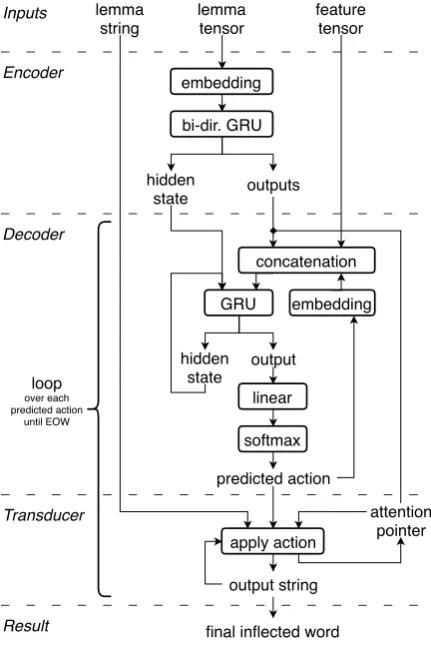
The system proposed in this work is an encoder-decoder recurrent neural network combined with hard attention and the string-based transducer shown in Section2. The architecture is displayed in
Figure 3. After processing the inputs through both encoder and decoder the resulting action sequence is applied on the lemma string by the transducer to produce the inflected word.
5.1 Baseline
The baseline system that was distributed along with the details for this Shared Task by the organizers is based on pattern matching in strings. It is heavily inspired by the methods proposed in the research ofLiu and Mao(2016).
For any given pair of aligned input lemma and output form, the baseline extracts prefix and suffix rules throughout the entire string, and then greedily applies them on a new input lemma that is to be inflected. The replacement rules are derived incre-mentally, so that if multiple rules would match a new sample, the longest one gets applied to pro-duce the most accurate results possible.
Further details about the baseline system can be found in the proceedings of last year’s Shared Task (Cotterell et al.,2017), as the architecture is virtually identical.
5.2 Neural Network Model
We use the same neural network architecture across all 103 languages and training set sizes (low, medium, high). The neural network acts as an ora-cle for the string transducer shown in Section2. Its inputs are the lemma of a word and the features of the inflected target form. The outputs correspond to the defined transducer actions (COPY,PATCHp,
MOVE,EMITsandEOW).
We use an encoder-decoder architecture (Cho et al.,2014;Sutskever et al., 2014) to transform
Decoder
Transducer Encoder Inputs
embedding
bi-dir. GRU
concatenation
GRU
linear
softmax
apply action
output string
final inflected word predicted action
output outputs hidden
state
feature tensor lemma
tensor lemma
string
hidden state
embedding
attention pointer
Result
loop
over each predicted action
until EOW
Figure 3: System architecture
a sequence of characters into a sequence of trans-ducer actions. The decoder uses hard monotonic at-tention which has been found beneficial for the task of morphological inflection (Aharoni and Goldberg,
2016;Aharoni et al.,2016) and allows our system to meaningfully performCOPYandPATCH opera-tions.
Both encoder and decoder contain a single gated recurrent unit (GRU) introduced by Cho et al.
(2014) and character embeddings to obtain a dense numerical representation from each input symbol. The encoder is using a bi-directional GRU whose outputs are summed up from both directions. Since the encoder is uni-directional we only use the for-ward path of the hidden encoder state to start the decoder. The decoder concatenates the character embedding, attention context and feature tensor as a combined input to the GRU. The decoder GRU output is fed into a linear transform followed by a log softmax layer to obtain the log-likelihoods for each transducer action.
Biases and weights for the GRUs and linear lay-ers are initialized randomly from a uniform dis-tributionU(−p1/s,p1/s)wheresis the size of
[image:5.595.125.238.65.169.2]initial-ized randomly from a normal distributionN(0,1). The input lemma is processed at once by the en-coder, generating output representations for every input character and hidden state representations for the whole input sequence. By using an external loop the decoder produces one transducer action per step. In each step the previous hidden state and output action, inflection features, as well as the attended encoder output is put into the decoder. Which encoder output is being attended is con-trolled by the index pointer of the transducer. If the network outputs aMOVEaction, the index pointer is increased so that the decoder will see the next encoder output in the following loop iteration. Ac-tions moving the index pointer beyond the input lemma are discarded.
To improve the prediction performance we im-plemented a beam-search decoding process. This results in multiple paths out of which the path with the highest probability is selected to produce the final inflected word. An additional transducer state object stores the decoder hidden state, predicted ac-tion and its log-likelihood plus the resulting output string for each step and path in the beam.
5.3 Training
As the network outputs a sequence of transducer actions, the training targets are not the inflected words but an action sequence which produces the correct inflected form when applied on the lemma. This action sequence is generated by looping over the aligned lemma and inflection word in lockstep. For each character combination the corresponding actions are appended to the new output sequence. The detailed algorithm is described in Section2.2. Training updates are performed via backpropa-gation with the Adam optimizer (Kingma and Ba,
2014) using the following parameters: Learning rate α = 0.005, momentum decays β1 = 0.9, β2 = 0.999, numerical stabilizer = 10−8 and
a weight decay (L2 penalty) of0.001.
The beam-decoding allows a global normaliza-tion of the model according toAndor et al.(2016). Unfortunately, training the model with global nor-malization in beam-search failed to converge. An-dor et al.(2016) used pre-training with local nor-malization to overcome this difficulty, but since we could not find a robust way to switch local to global normalization during training for all 103 languages, we used local normalization only. Once the correct path falls out of the beam, the log-likelihoods of
the correct path build the basis of our custom loss function.
The loss function shown in eq. (1) is based on the locally normalized path probability presented in eq. (4) ofAndor et al.(2016). It calculates the negated sum over the log-likelihoodlof the correct
action in each step of the path. Dividing by the nat-ural logarithm of the sequence lengthsresults in
a consistent loss magnitude, thus helping the train-ing process to converge more easily. We assume this is the case because we sum up the error across all steps, also punishing the correct predictions if the system was not 100% confident. The resulting lossLis used to perform the training update back
through the entire network.
L=− Ps
i li
ln (1 +s) (1) Although local normalization restored conver-gence of learning, we could not find a significant advantage in using multiple beams during training. One explanation why our model did not benefit from beam-search might be that it requires many training updates. Punishing the correct steps in the decoding process leads to many updates while with beam-search updates may be too infrequent.
Our final training and evaluation is done with a beam-size of 1. However, the architecture is prepared to utilize both beam-search and global normalization in the future. Training with a single beam and evaluating with multiple beams to find better predictions is also supported. Due to the complex implementation of beam search and com-bined batching the system works on single training samples by using a batch size of 1.
5.4 Comparison to previous architectures
Although our approach follows the ”Align and Copy” idea ofMakarov et al.(2017) the architec-tures differ.Makarov et al.proposed two different models: Hard attention model with copy mecha-nism (HACM) and hard attention model over edit actions (HAEM). Both contain an encoder-decoder with LSTMs. HACM uses a mixture of character generation and copying probability distribution to implement the copy mechanism.
through a rectified linear unit followed by a soft-max to produce outputs like COPY, WRITE and DELETE.
6 Tuning and Evaluation
While we used the same architecture for all lan-guages and training set sizes, we performed individ-ual hyperparameter optimization for each language-size-pair. The parameters tested are the hidden size of encoder/decoder (32,64,128), size of the
char-acter embeddings (8,16), whether to use patches
or not and what amount of additional training data to hallucinate with the enhancer (1×,5×).
During the development we noticed that the re-sults are strongly influenced by the random ini-tialization of the network weights. We therefore tested every parameter combination with five differ-ent random seeds to mitigate this issue. Our final evaluation on the test set used the best parameters we found during the hyperparameter search on the development set for each language-size-pair.
Furthermore, we observed our model sometimes fails to outputEOWand instead either tries to copy non-existent lemma characters or endlesslyEMITs the same character. The string transducer includes fixes for these issues when the pointer has moved beyond the input lemma. In this caseCOPYand PATCHdo not modify the output sequence at all and EMIT actions cannot append the previously written character again. However, this results in a few missing characters at the end of inflected forms in some corner cases.
7 Results and Discussion
Compared to the other CoNLL–SIGMORPHON 2018 Shared Tasksubmissions, our system proved to be in the mid-range (top 59%-67%). By average accuracy, it improved the most over other submis-sions for the medium volume datasets. While the average accuracy increased from40.3%on the low set by33.7points to74.0%on the medium set, it improved by only3.5more points from the medium set to77.5%on the high set.
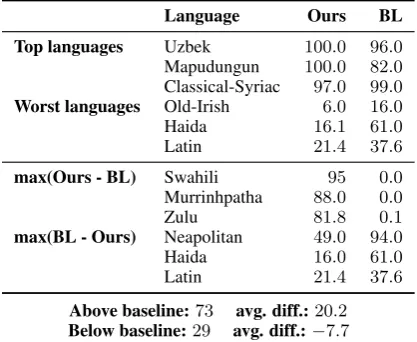
An overview over the results on the medium data set is shown inTable 7. It shows that this system is working exceptionally well on some languages compared to the baseline, such asSwahilior Mur-rinhpatha. Likewise, this system performs remark-ably worse on some languages, such asHaidaand Neapolitan.
Language Ours BL
Top languages Uzbek 100.0 96.0
Mapudungun 100.0 82.0
Classical-Syriac 97.0 99.0 Worst languages Old-Irish 6.0 16.0
Haida 16.1 61.0
Latin 21.4 37.6 max(Ours - BL) Swahili 95 0.0
Murrinhpatha 88.0 0.0
Zulu 81.8 0.1
max(BL - Ours) Neapolitan 49.0 94.0
Haida 16.0 61.0
[image:7.595.312.521.63.234.2]Latin 21.4 37.6 Above baseline:73 avg. diff.:20.2 Below baseline:29 avg. diff.:−7.7
Table 7: Results for our system compared to the baseline. Languages with the best and worst accu-racies and languages that were the furthest above and below the baseline, trained on the medium set and evaluated on the test set.
7.1 Patches
Our system is generally able to deduce a meaning-ful set of patches (that is, a lookup table with more than one trivial entry) for about one third of all languages. While the precise numbers differ per training volume, the overall performance is justi-fied given the font choice discussed in Section3.4. We could possibly achieve a higher coverage by combining different fonts for different languages, but for us the manual tuning process did not out-weigh the work efforts this selection would have required.
We can still observe that out of 42 languages with patches, our hyperparameter tuning algorithm opted to use patches in 17 cases on the low en-vironment. While 17
42 = 40,4%clearly signifies
little to no global improvement, the same fraction rises to 29
42 = 69%when evaluating on the medium
environment.
In other words, the usefulness of patches rises (among languages that use patches at all) when training our system on larger quantities of data. However at the same time, the selection of which languages actually use patches to achieve maxi-mum accuracy partially differs. Only slightly more than half of the17positively patching languages in the low environment also apply patches on medium, so it is imperative to consider the actual linguistical structures behind the data in order to maximise the benefit of this method.
font rendering to achieve hybrid patch generation in an effort to maximise its effectiveness. This idea was not pursued further by us and is left open as future work.
7.2 Data Enhancer
On low volume, the accuracy on the development set increased for 42 of the enhanced data sets (best of enhancement by 1 / by 5) when compared to the accuracy on the regular data set. For 53 sets they decreased, no matter the enhancement proportion. The probability of these being random observances is 0.3049 (Zar, 1998). However, by testing the accuracy of the enhanced and the regular training data for each language on the development set, we can select which languages will be enhanced and which will not. This is part of the hyperparameter search from Section6. On the low development set, the enhancer is leading to a total improvement of1.245%in accuracy and a negligible0.044 char-acters in Levenshtein distance, with improvements for single languages of up to10.8%(french). The average improvement is3.6667%.
7.3 Network Hiccups
Our system’s accuracy is poor on Haida and Neapolitancompared to other submissions and the baseline. The reason is that for both languages the post-processing used to combat a missingEOWis often triggered erroneously. The example below shows our system missing the last character in the output because the transducer discards the second identical action toEMITanain this case.
• ˜n´ıiy¨a→˜n´ıiy¨a’wa (prediction) • ˜n´ıiy¨a→˜n´ıiy¨a’waa(target)
As the inflected words are almost correct, the Lev-enshtein distance is much lower than the accuracy might indicate. For Haida the Levenshtein dis-tance is even significantly lower than the baseline results. In hindsight, it would have been better to replace non-ending predictions with the lemma in-stead of trying to clean the output as the negative side-effects most likely outweigh any benefits. In the future, a better approach would be to improve the training process by using a dynamic oracle for the target sequence and correctly implementing global normalization with beam-search decoding. These changes are likely to eliminate the need for any post-processing.
Another weakness of our system is the inability to transform a prefix into a suffix or vice versa as shown in the followingGermanlanguage example:
-9.0 -6.4 -3.9 -1.3 1.3 3.9 6.4 9.0
effect on accuracy
0 10 20 30 40 50
[image:8.595.313.515.69.199.2]number of languages
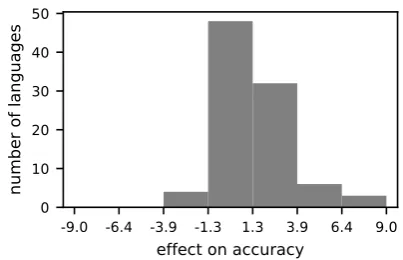
Figure 4: Histogram showing the effect of beam size 16 compared to size 1 on the test set (trained on low)
• abstellen→stellt (prediction) • abstellen→stellt ab(target) This behavior is expected as our neural network works with hard monotonic attention. It would need to store the information within the hidden-state over the whole sequence as it cannot attend the encoder outputs from the beginning again. A cure for this symptom would be to use a model with soft attention – which in turn cannot meaningfully use COPYorPATCHoperations on the input lemma.
7.4 Beam-Decoding
While we did not use beam-decoding for the offi-cial results, we experimented with the evaluation performance after the submission.Figure 4shows the number of languages for which beam-decoding with 16 beams makes a difference in comparison to greedy decoding. For half of the languages there are either no or only negligible differences in ac-curacy. About one third shows a small positive effect. Some languages show a larger accuracy increase while only few languages show a small accuracy decrease. A binomial test shows that the probability of the increase being random is as low as2.4×10−10. Beam-decoding therefore clearly leads to an increase in accuracy which matches the intuition of beam-decoding producing better or equal results compared to greedy decoding.
Acknowledgements
References
Roee Aharoni and Yoav Goldberg. 2016. Se-quence to seSe-quence transduction with hard monotonic attention. CoRR abs/1611.01487.
http://arxiv.org/abs/1611.01487.
Roee Aharoni, Yoav Goldberg, and Yonatan Belinkov. 2016. Improving sequence to sequence learning for morphological inflection generation: The biu-mit systems for the sigmorphon 2016 shared task for morphological reinflection. In Proceedings of the 14th SIGMORPHON Workshop on Computational Research in Phonetics, Phonology, and Morphology. Association for Computational Linguistics, pages 41–48.https://doi.org/10.18653/v1/W16-2007.
Daniel Andor, Chris Alberti, David Weiss, Aliaksei Severyn, Alessandro Presta, Kuzman Ganchev, Slav Petrov, and Michael Collins. 2016. Globally nor-malized transition-based neural networks. CoRR
abs/1603.06042. http://arxiv.org/abs/1603.06042.
Toms Bergmanis, Katharina Kann, Hinrich Sch¨utze, and Sharon Goldwater. 2017. Training data aug-mentation for low-resource morphological inflection. In The CoNLL-SIGMORPHON 2017 Shared Task.
https://doi.org/10.18653/v1/K17-2002.
Kyunghyun Cho, Bart van Merrienboer, C¸aglar G¨ulc¸ehre, Fethi Bougares, Holger Schwenk, and Yoshua Bengio. 2014. Learning phrase repre-sentations using RNN encoder-decoder for statis-tical machine translation. CoRR abs/1406.1078.
http://arxiv.org/abs/1406.1078.
Ryan Cotterell, Christo Kirov, John Sylak-Glassman, G´eraldine Walther, Ekaterina Vylomova, Arya D. McCarthy, Katharina Kann, Sebastian Mielke, Gar-rett Nicolai, Miikka Silfverberg, David Yarowsky, Jason Eisner, and Mans Hulden. 2018. The CoNLL– SIGMORPHON 2018 shared task: Universal mor-phological reinflection. In Proceedings of the CoNLL–SIGMORPHON 2018 Shared Task: Uni-versal Morphological Reinflection. Association for Computational Linguistics, Brussels, Belgium.
Ryan Cotterell, Christo Kirov, John Sylak-Glassman, G´eraldine Walther, Ekaterina Vylomova, Patrick Xia, Manaal Faruqui, Sandra K¨ubler, David Yarowsky, Jason Eisner, and Mans Hulden. 2017.
Conll-sigmorphon 2017 shared task: Universal mor-phological reinflection in 52 languages. CoRR
abs/1706.09031. http://arxiv.org/abs/1706.09031.
Katharina Kann and Hinrich Sch¨utze. 2016. Med: The lmu system for the sigmorphon 2016 shared task on morphological reinflection. In Proceed-ings of the 14th SIGMORPHON Workshop on Computational Research in Phonetics, Phonol-ogy, and Morphology. Association for Computa-tional Linguistics, Berlin, Germany, pages 62–70.
http://anthology.aclweb.org/W16-2010.
Katharina Kann and Hinrich Sch¨utze. 2017. The lmu system for the conll-sigmorphon 2017
shared task on universal morphological re-inflection. In Proceedings of the CoNLL SIGMORPHON 2017 Shared Task: Universal Morphological Reinflection. Association for Com-putational Linguistics, Vancouver, pages 40–48.
http://www.aclweb.org/anthology/K17-2003.
Christopher Kendris. 2001. French Grammar. Bar-ron’s Educational Series.
Diederik P. Kingma and Jimmy Ba. 2014. Adam: A method for stochastic optimization. CoRR
abs/1412.6980. http://arxiv.org/abs/1412.6980.
Christo Kirov, Ryan Cotterell, John Sylak-Glassman, G´eraldine Walther, Ekaterina Vylomova, Patrick Xia, Manaal Faruqui, Sebastian Mielke, Arya D. McCarthy, Sandra K¨ubler, David Yarowsky, Ja-son Eisner, and Mans Hulden. 2018. UniMorph 2.0: Universal Morphology. In Nicoletta Calzo-lari (Conference chair), Khalid Choukri, Christopher Cieri, Thierry Declerck, Sara Goggi, Koiti Hasida, Hitoshi Isahara, Bente Maegaard, Joseph Mariani, H´el`ene Mazo, Asuncion Moreno, Jan Odijk, Stelios Piperidis, and Takenobu Tokunaga, editors, Proceed-ings of the Eleventh International Conference on Language Resources and Evaluation (LREC 2018). European Language Resources Association (ELRA), Miyazaki, Japan.
Vladimir I Levenshtein. 1966. Binary codes capable of correcting deletions, insertions, and reversals. In
Soviet physics doklady. volume 10, pages 707–710.
Frederick Liu, Han Lu, Chieh Lo, and Graham Neu-big. 2017. Learning character-level composition-ality with visual features. CoRR abs/1704.04859.
http://arxiv.org/abs/1704.04859.
Ling Liu and Lingshuang Jack Mao. 2016. Morpho-logical reinflection with conditional random fields and unsupervised features. In Proceedings of the 14th SIGMORPHON Workshop on Computational Research in Phonetics, Phonology, and Morphology. Association for Computational Linguistics, pages 36–40. https://doi.org/10.18653/v1/W16-2006.
Peter Makarov, Tatiana Ruzsics, and Simon Clematide. 2017. Align and copy: UZH at SIGMORPHON 2017 shared task for morpho-logical reinflection. CoRR abs/1707.01355.
http://arxiv.org/abs/1707.01355.
Garrett Nicolai, Bradley Hauer, Mohammad Motallebi, Saeed Najafi, and Grzegorz Kondrak. 2017. If you can’t beat them, join them: the university of al-berta system description. In Proceedings of the CoNLL SIGMORPHON 2017 Shared Task: Uni-versal Morphological Reinflection. Association for Computational Linguistics, Vancouver, pages 79–84.
http://www.aclweb.org/anthology/K17-2008.
the CoNLL SIGMORPHON 2017 Shared Task: Uni-versal Morphological Reinflection. Association for Computational Linguistics, Vancouver, pages 90–99.
http://www.aclweb.org/anthology/K17-2010.
Ilya Sutskever, Oriol Vinyals, and Quoc V. Le. 2014. Sequence to sequence learning with neural networks. CoRR abs/1409.3215.
http://arxiv.org/abs/1409.3215.
Richard Wiese. 2009. The grammar and typology of plural noun inflection in varieties of german.
The Journal of Comparative Germanic Linguistics
12(2):137–173.
Dieter Wunderlich. 1999. German noun plural recon-sidered. Behavioral and Brain Sciences22(6):1044– 1045.
Jerrold H. Zar. 1998. Biostatistical Analysis (4th Edi-tion). Prentice Hall.
Chunting Zhou and Graham Neubig. 2017. Morpho-logical inflection generation with multi-space vari-ational encoder-decoders. In Proceedings of the CoNLL SIGMORPHON 2017 Shared Task: Uni-versal Morphological Reinflection. Association for Computational Linguistics, Vancouver, pages 58–65.