521
Filtering Pseudo-References by Paraphrasing
for Automatic Evaluation of Machine Translation
Ryoma Yoshimura Hiroki Shimanaka
Hayahide Yamagishi Mamoru Komachi Tokyo Metropolitan University, Tokyo, Japan
{yoshimura-ryoma, shimanaka-hiroki, matsumura-yukio
yamagishi-hayahide}@ed.tmu.ac.jp,[email protected]
Yukio Matsumura
Abstract
In this paper, we introduce our participation in the WMT 2019 Metric Shared Task. We propose a method to filter pseudo-references by paraphrasing for automatic evaluation of machine translation (MT). We use the out-puts of off-the-shelf MT systems as pseudo-references filtered by paraphrasing in addi-tion to a single human reference (gold refer-ence). We use BERT fine-tuned with para-phrase corpus to filter pseudo-references by checking the paraphrasability with the gold reference. Our experimental results of the WMT 2016 and 2017 datasets show that our method achieved higher correlation with hu-man evaluation than the sentence BLEU (Sent-BLEU) baselines with a single reference and with unfiltered pseudo-references.
1 Introduction
In general, automatic evaluation of MT is based on n-gram agreement between the system output and a manually translated reference of the source sentence. Therefore, automatic evaluation fails to evaluate a semantically correct sentence if the sur-face of the system output differs from that in the reference. To solve this problem, many automatic evaluation methods allow the use of multiple ref-erences that potentially cover various surfaces; in particular, Finch et al.(2004) reported that corre-lation between automatic evaluation results and human evaluation increases when multiple refer-ences are used for evaluation. However, owing to the time and costs involved in manually creating references, many datasets only include one refer-ence per source sentrefer-ence, which leads to improper translation evaluation, especially in the case of di-verse machine translation systems.
In order to obtain cheap references without any human intervention,Albrecht and Hwa(2008) used the outputs of off-the-shelf MT systems as pseudo-references; They showed that using
mul-tiple references consisting of gold and pseudo-references may yield higher correlation with hu-man evaluation than using a single gold reference. However, because they did not consider the qual-ity of the pseudo-references, this may result in us-ing poor references. Thus, in some cases the cor-relation becomes worse when using multiple ref-erences consisting of gold and pseudo-refref-erences relative to only using a gold reference.
To address the quality of pseudo-references, we filtered pseudo-references by checking the para-phrasability to the gold reference. Our approach can be applied to various MT evaluation metrics which can be evaluated with multiple references. The experimental results show that our method achieves higher correlation with human evaluation than the previous work.
2 Related Work
Albrecht and Hwa (2008) showed that using the outputs of off-the-shelf MT systems as pseudo-references in n-gram based metrics such as BLEU (Papineni et al., 2002) and METEOR (Denkowski and Lavie, 2011) may yield higher correlation with human evaluation than using a gold reference. They use the outputs of off-the-shelf MT systems as they are, whereas we filter them by paraphrasing the gold reference.
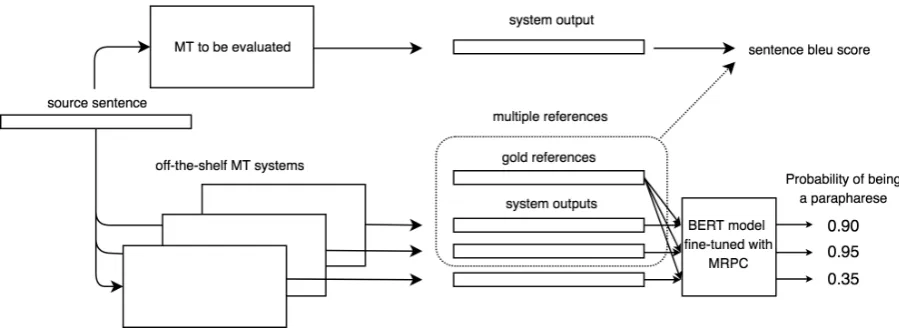
Figure 1: Overview of the proposed method.
reference information.
3 MT Evaluation Metric Using Filtered Multiple Pseudo-References
3.1 Overview
Figure 1 shows the overview of our proposed method. The procedure of our proposed method is as follows.
1. Prepare off-the-shelf MT systems for gener-ating pseudo-references.
2. Translate the source sentence in the evalua-tion data using the abovemenevalua-tioned MT sys-tems.
3. Filter the outputs of off-the-shelf MT systems by checking the paraphrasability of being a paraphrase to the single gold reference.
4. Calculate the sentence evaluation score with multiple references obtained by adding fil-tered pseudo-references to the single gold references.
3.2 Automatic pseudo-reference generation
Any MT system can be used as a pseudo-reference generation system except for the translation sys-tem to be evaluated.1There are no restrictions on the type of MT systems, such as neural machine translation (NMT) or statistical machine transla-tion (SMT) systems, or the number of MT sys-tems.
1If the system to be evaluated were used as a
[image:2.595.309.525.272.426.2]pseud-reference generation system, the output would be used as a reference.
Figure 2: BERT model architecture for sentence pair classification.
3.3 Filtering by paraphrasing
We use Bidirectional Encoder Representations from Transformers (BERT) (Devlin et al., 2019) to filter pseudo-references by checking the para-phrasability with a gold reference. BERT is a new approach to pre-train language representa-tions, and it obtains state-of-the-art results on a wide variety of natural language processing (NLP) tasks, including question answering (QA), seman-tic textual similarity (STS), natural language infer-ence (NLI). The key to pre-training BERT is the prediction of masked words and of the next sen-tence. Masking words allows bidirectional learn-ing, which improves joint training of language context relative to Embeddings from Language Models (ELMo) (Peters et al.,2018), which com-bines forward and backward training. Prediction of the next sentence leads to capturing the rela-tionship between two sentences.
architec-cs-en de-en fi-en ru-en
single reference 0.557 0.484 0.448 0.502
[image:3.595.124.477.64.136.2]single reference + pseudo-references 0.565 0.499 0.543 0.456 single reference + filtered references (MAS) 0.576 0.473 0.517 0.469 single reference + filtered references (BERT) 0.589 0.519 0.572 0.490
Table 1: Segment-level Pearson correlation between SentBLEU and human evaluation scores in WMT 2016.
cs-en de-en fi-en ru-en
single reference 0.435 0.433 0.571 0.484
[image:3.595.310.511.312.460.2]single reference + pseudo-references 0.515 0.565 0.653 0.519 single reference + filtered references (MAS) 0.524 0.586 0.650 0.517 single reference + filtered references (BERT) 0.555 0.580 0.671 0.545
Table 2: Segment-level Pearson correlation between SentBLEU and human evaluation scores in WMT 2017.
corpus train dev test Accuracy
MRPC 3,669 408 1726 0.845
Table 3: Numbers of sentences in each split of MRPC and accuracy of BERT.
ture for sentence pair classification. In classi-fication tasks where labels are attached to sen-tence pairs, BERT encodes sensen-tence pairs to-gether with a [CLS] token for classification and a [SEP] token for sentence boundaries; The out-put of the [CLS] token is used for the inout-put of classifier of a feedforward neural network with softmax. BERT achieves state-of-the-art perfor-mance in a paraphrase identification task on the Microsoft Research Paraphrase Corpus (MRPC) (Dolan and Brockett,2005) with this architecture. For that reason, we use BERT to estimate the paraphrasability between pseudo-references and the gold reference. We fine-tune BERT with MRPC. The output of the classifier is the probabil-ity of the paraphrase from 0 to 1. We use pseudo-references whose paraphrase probability is greater than 0.5.
4 Experiments
4.1 Data
We used the segment-level evaluation datasets of Czech-English (cs-en), German-English (de-en), Finnish-English (fi-(de-en), Russian-English (ru-en) language pair from WMT 2016 (Bojar et al., 2016) and 2017 (Bojar et al.,2017). The datasets consist of 560 pairs of sources and references,
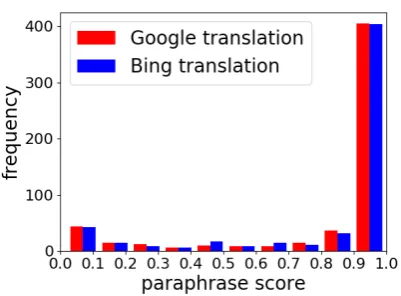
Figure 3: Histograms of paraphrase score of pseudo-references in the fi-en language pairs of WMT 2016.
along with the outputs of each system and human evaluation scores.
4.2 Off-the-shelf MT systems
We used Google Translation2and Bing Microsoft Translator 3 as MT systems to generate pseudo-references. We chose these two MT systems be-cause they are widely used, easy to use, and well known to have good performance. We automati-cally translated source files using each translation API.
4.3 Fine-tuning BERT with MRPC
We use the pre-trained BERT-Base Uncased model4, which has 12 layer, 768 hidden, 12 heads
2
https://translate.google.com/
3
https://www.bing.com/translator
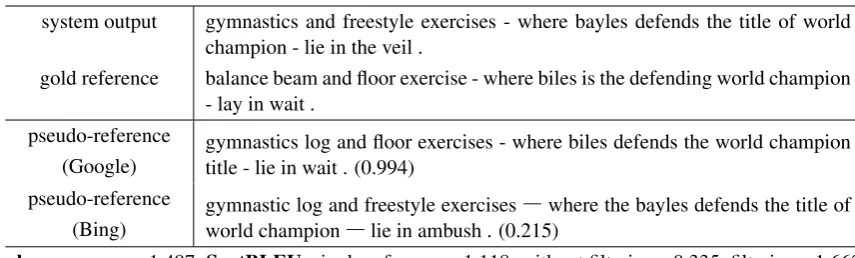
system output gymnastics and freestyle exercises - where bayles defends the title of world champion - lie in the veil .
gold reference balance beam and floor exercise - where biles is the defending world champion - lay in wait .
pseudo-reference (Google)
gymnastics log and floor exercises - where biles defends the world champion title - lie in wait . (0.994)
pseudo-reference (Bing)
gymnastic log and freestyle exercises―where the bayles defends the title of world champion―lie in ambush . (0.215)
[image:4.595.79.507.60.189.2]human score: -1.497;SentBLEU: single reference: -1.118, without filtering: -0.335, filtering: -1.662
Table 4: Example of pseudo-references in ru-en language pair of WMT 2017; The value in parentheses at the end of each pseudo-reference indicates the paraphrase score by BERT. Each score is standardized according to the mean and standard deviation to compare human evaluation and each SentBLEU score.
and 110M parameters. We fine-tuned BERT with MRPC. MRPC is a dataset extracted from web news articles along with human annotations indi-cating whether each pair is a paraphrase. If the pair is paraphrase, the label is 1, if not, the label is 0. The original dataset consists of 4,077 sen-tences for training and 1,726 sensen-tences for testing. We divided the test set in half and used it as devel-opment data. The numbers of sentences in each corpus and the accuracy of the fine-tuned BERT model are listed in Table3.
Figure 3 shows the histogram of paraphrase score of pseudo-references in the fi-en language pair of WMT 2016. Due to the use of high qual-ity MT systems, more than 50% of the pseudo-references have paraphrase scores between 0.9 and 1.0. The same trend was observed in all languages and years.
4.4 Evaluation
We calculated the SentBLEU score with system output and multiple references which consisted of a single gold reference and pseudo-references. The SentBLEU is computed using the sentence-bleu.cpp 5, a part of the Moses toolkit. It is a smoothed version of BLEU (Lin and Och,2004). We followed the tokenization method for each year’s dataset. We measured Pearson correlation identically to WMT 2016 and WMT 2017 between the automatic and human evaluation scores. In order to compare with our method, we also per-formed filtering by Maximum Alignment Similar-ity (MAS) (Song and Roth, 2015), which is one of the unsupervised sentence similarity measures based on alignments between word embeddings
5https://github.com/moses-smt/
mosesdecoder/blob/master/mert/sentence-bleu.cpp
and is known to achieve good performance on Se-mantic Textual Similarity (STS) task. We used GloVe6(Pennington et al.,2014) as word embed-dings. We used pseudo-references whose MAS score is higher than 0.8.
5 Results
Tables 1 and 2 show the segment-level Pearson correlation coefficients between automatic and hu-man evaluation scores. The result shows that our proposed method outperforms the baselines except in the case of the ru-en language pair in WMT 2016 and filtering by MAS does not produce any consistent result.
6 Discussion
Table 4 shows an example of pseudo-references with BERT’s paraphrase score for the ru-en lan-guage pair in WMT 2017. The pseudo-reference from Bing translation has a low paraphrase score because “biles” in the gold reference remains as “bayles” in the pseudo-reference, and “floor exer-cise” became “freestyle exerexer-cise” in Bing transla-tion. In the unfiltered method, the BLEU score is unreasonably high because the surface of the pseudo-reference from Bing translation is simi-lar to the output sentence. Filtering the pseudo-references prevents the problem. The pseudo-reference from Google translation has different surfaces but carry the same meaning as in the gold reference. Our filtering method correctly retains the sentence because BERT assigned high para-phrase score.
6https://nlp.stanford.edu/projects/glove/
7 Conclusions
We proposed a method to filter pseudo-references in terms of paraphrasability with a gold ref-erence that addresses the problem of using poor pseudo-references from previous work (Albrecht and Hwa, 2008). We use BERT fine-tuned with MRPC to filter pseudo-references. By filtering pseudo-references in terms of para-phrasability with a gold reference, we can keep the references having the same meaning with the gold reference but different surface and solve the problem of using poor pseudo-reference from pre-vious work. The experimental results show that our method outperforms baselines.
Acknowledgement
We would like to thank Tomoyuki Kajiwara for providing a script to calculate the MAS score.
References
Joshua S. Albrecht and Rebecca Hwa. 2008. The role of pseudo references in MT evaluation. In Proceed-ings of the Third Workshop on Statistical Machine Translation (WMT2008).
Ondˇrej Bojar, Yvette Graham, and Amir Kamran. 2017. Results of the WMT17 metrics shared task. In Proceedings of the Second Conference on Ma-chine Translation (WMT2017).
Ondˇrej Bojar, Yvette Graham, Amir Kamran, and Miloˇs Stanojevi´c. 2016. Results of the WMT16 metrics shared task. InProceedings of the First Con-ference on Machine Translation (WMT2016).
Michael Denkowski and Alon Lavie. 2011. Meteor 1.3: Automatic metric for reliable optimization and evaluation of machine translation systems. In Pro-ceedings of the 2011 Conference on Empirical Meth-ods in Natural Language Processing (EMNLP2011).
Jacob Devlin, Ming-Wei Chang, Kenton Lee, and Kristina Toutanova. 2019. BERT: pre-training of deep bidirectional transformers for language under-standing. Proceedings of the 2019 Conference of the North American Chapter of the Association for Computational Linguistics (NAACL2019).
William B. Dolan and Chris Brockett. 2005. Automati-cally constructing a corpus of sentential paraphrases. InProceedings of the Third International Workshop on Paraphrasing (IWP2005).
Andrew M Finch, Yasuhiro Akiba, and Eiichiro Sumita. 2004. How does automatic machine transla-tion evaluatransla-tion correlate with human scoring as the number of reference translations increases? In Pro-ceedings of the Fourth International Conference on Language Resources and Evaluation (LREC2004).
David Kauchak and Regina Barzilay. 2006. Paraphras-ing for automatic evaluation. In Proceedings of the Human Language Technology Conference of the North American Chapter of the ACL (NAACL2006).
Chin-Yew Lin and Franz Josef Och. 2004. ORANGE: a method for evaluating automatic evaluation met-rics for machine translation. In Proceedings of the 20th International Conference on Computational Linguistics (COLLING2004).
Kishore Papineni, Salim Roukos, Todd Ward, and Wei-Jing Zhu. 2002. BLEU: a method for automatic evaluation of machine translation. In Proceedings of the 40th Annual Meeting of the Association for Computational Linguistics (ACL2002).
Jeffrey Pennington, Richard Socher, and Christo-pher D. Manning. 2014. Glove: Global vectors for word representation. In Proceedings of the 2011 Conference on Empirical Methods in Natural Lan-guage Processing (EMNLP2014).
Matthew Peters, Mark Neumann, Mohit Iyyer, Matt Gardner, Christopher Clark, Kenton Lee, and Luke Zettlemoyer. 2018. Deep contextualized word repre-sentations. InProceedings of the 2018 Conference of the North American Chapter of the Association for Computational Linguistics (NAACL2018).