351
Scheduled Sampling for Transformers
Tsvetomila Mihaylova Instituto de Telecomunicac¸˜oes
Lisbon, Portugal
Andr´e F. T. Martins
Instituto de Telecomunicac¸˜oes & Unbabel Lisbon, Portugal
Abstract
Scheduled sampling is a technique for avoid-ing one of the known problems in sequence-to-sequence generation: exposure bias. It con-sists of feeding the model a mix of the teacher forced embeddings and the model predictions from the previous step in training time. The technique has been used for improving the model performance with recurrent neural net-works (RNN). In the Transformer model, un-like the RNN, the generation of a new word attends to the full sentence generated so far, not only to the last word, and it is not straight-forward to apply the scheduled sampling tech-nique. We propose some structural changes to allow scheduled sampling to be applied to Transformer architecture, via a two-pass de-coding strategy. Experiments on two language pairs achieve performance close to a teacher-forcing baseline and show that this technique is promising for further exploration.
1 Introduction
Recent work in Neural Machine Translation (NMT) relies on a sequence-to-sequence model with global attention (Sutskever et al.,2014; Bah-danau et al., 2014), trained with maximum like-lihood estimation (MLE). These models are typ-ically trained by teacher forcing, in which the model makes each decision conditioned on the gold history of the target sequence. This tends to lead to quick convergence but is dissimilar to the procedure used at decoding time, when the gold target sequence is not available and decisions are conditioned on previous model predictions.
Ranzato et al.(2015) point out the problem that using teacher forcing means the model has never been trained on its own errors and may not be robust to them—a phenomenon called exposure bias. This has the potential to cause problems at translation time, when the model is exposed to its own (likely imperfect) predictions.
A common approach for addressing the prob-lem with exposure bias is using a scheduled strat-egy for deciding when to use teacher forcing and when not to (Bengio et al., 2015). For a recur-rent decoder, applying scheduled sampling is triv-ial: for generation of each word, the model decides whether to condition on the gold embedding from the given target (teacher forcing) or the model pre-diction from the previous step.
In the Transformer model (Vaswani et al.,
2017), the decoding is still autoregressive, but un-like the RNN decoder, the generation of each word conditions on the whole prefix sequence and not only on the last word. This makes it non-trivial to apply scheduled sampling directly for this model. Since the Transformer achieves state-of-the-art re-sults and has become a default choice for many natural language processing problems, it is inter-esting to adapt and explore the idea of scheduled sampling for it, and, to our knowledge, no way of doing this has been proposed so far.
Our contributions in this paper are:
• We propose a new strategy for using sched-uled sampling in Transformer models by making two passes through the decoder in training time.
• We compare several approaches for condi-tioning on the model predictions when they are used instead of the gold target.
• We test the scheduled sampling with trans-formers in a machine translation task on two language pairs and achieve results close to a teacher forcing baseline (with a slight im-provement of up to 1 BLEU point for some models).
2 Related Work
for sequence-to-sequence RNN models: a method where the embedding used as the input to the de-coder at time stept+1is picked randomly between the gold target and the argmax of the model’s output probabilities at stept. The Bernoulli prob-ability of picking one or the other changes over training epochs according to a schedule that makes the probability of choosing the gold target de-crease across training steps. The authors propose three different schedules: linear decay, exponen-tial decay and inverse sigmoid decay.
Goyal et al. (2017) proposed an approach based on scheduled sampling which backpropa-gates through the model decisions. At each step, when the model decides to use model predictions, instead of theargmax, they use a weighted aver-age of all word embeddings, weighted by the pre-diction scores. They experimented with two op-tions: a softmax with a temperature parameter, and a stochastic variant using Gumbel Softmax (Jang et al., 2016) with temperature. With this tech-nique, they achieve better results than the standard scheduled sampling. Our works extends Bengio et al. (2015) and Goyal et al.(2017) by adapting their frameworks to Transformer architectures.
Ranzato et al. (2015) took ideas from sched-uled sampling and the REINFORCE algorithm (Williams,1992) and combine the teacher forcing training with optimization of the sequence level loss. In the first epochs, the model is trained with teacher forcing and for the remaining epochs they start with teacher forcing for the firstttime steps and use REINFORCE (sampling from the model) until the end of the sequence. They decrease the time for training with teacher forcingtas training continues until the whole sequence is trained with REINFORCE in the final epochs. In addition to the work ofRanzato et al. (2015) other methods that are also focused on sequence-level training are using for example actor-critic (Bahdanau et al.,
2016) or beam search optimization (Wiseman and Rush,2016). These methods directly optimize the metric used at test time (e.g. BLEU). Another pro-posed approach to avoid exposure bias is SEARN (Daum´e et al.,2009). In SEARN, the model uses its own predictions at training time to produce se-quence of actions, then a search algorithm deter-mines the optimal action at each step and a policy is trained to predict that action. The main draw-back of these approaches is that the training be-comes much slower. By contrast, in this paper we
focus on methods which are comparable in train-ing time with a force-decodtrain-ing baseline.
3 Scheduled Sampling with Transformers
In the case with recurrent neural networks (RNN) in the training phase we generate one word at a time step, and we condition the generation of this word to the previous word from the gold target se-quence. This sequential decoding makes it simple to apply scheduled sampling - at each time step, with some probability, instead of using the previ-ous word in the gold sequence, we use the word predicted from the model on the previous step.
The Transformer model (Vaswani et al.,2017), which achieves state-of-the-art results for a lot of natural language processing tasks, is also an au-toregressive model. The generation of each word conditions on all previous words in the sequence, not only on the last generated word. The model is based on severalself-attention layers, which di-rectly model relationships between all words in the sentence, regardless of their respective position. The order of the words is achieved by position em-beddings which are summed with the correspond-ing word embeddcorrespond-ings. Uscorrespond-ing position maskcorrespond-ing in the decoder ensures that the generation of each word depends only on the previous words in the sequence and not on the following ones. Because generation of a word in the Transformer conditions on all previous words in the sequence and not just the last word, it is not trivial to apply scheduled sampling to it, where, in training time, we need to choose between using the gold target word or the model prediction. In order to allow usage of scheduled sampling with the Transformer model, we needed to make some changes in the Trans-former architecture.
3.1 Two-decoder Transformer
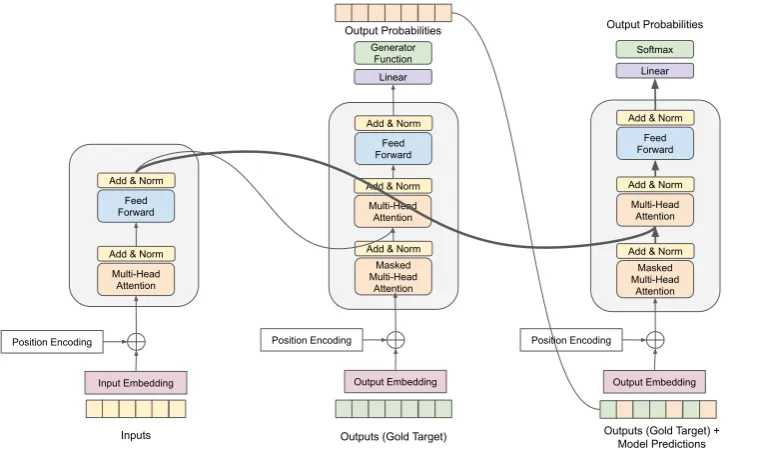
The model we propose for applying scheduled sampling in transformers makes two passes on the decoder. Its architecture is illustrated on Figure1. We make no changes in the encoder of the model. The decoding of the scheduled transformer has the following steps:
trans-Masked Multi-Head
Attention Add & Norm
Feed Forward Add & Norm
Masked Multi-Head
Attention Add & Norm
Feed Forward Add & Norm
Multi-Head Attention Add & Norm
Output Embedding Multi-Head
Attention Add & Norm
Feed Forward Add & Norm
Input Embedding Position Encoding
Output Embedding Position Encoding
Inputs Outputs (Gold Target) Outputs (Gold Target) + Model Predictions Linear
Generator Function Output Probabilities
Linear Softmax Output Probabilities
Position Encoding Add & Norm
[image:3.595.114.497.63.288.2]Multi-Head Attention
Figure 1: Transformer model adapted for use with scheduled sampling. The two decoders on the image share the same parameters. The first pass on the decoder conditions on the gold target sequence and returns the model pre-dictions. The second pass conditions on a mix of the target sequence and model predictions and returns the result. The thicker lines show the path that is backpropagated in all experiments, i.e. we always make backpropagation
through the second decoder pass. The thin arrows are only backpropagated in a part of the experiments. (The
image is based on the transformer architecture from the paper ofVaswani et al.(2017).)
former model. Those scores are passed to the next step.
2. Mix the gold target sequence with the pre-dicted sequence.After obtaining a sequence representing the prediction from the model for each position, we imitate scheduled sam-pling by mixing the target sequence with the model predictions: For each position in the sequence, we select with a given probability whether to use the gold token or the predic-tion from the model. The probability for us-ing teacher forcus-ing (i.e. the gold token) is a function of the training step and is calcu-lated with a selected schedule. We pass this “new reference sequence” as the reference for the second decoder. The vectors used from the model predictions can be either the em-bedding of the highest-scored word, or a mix of the embeddings according to their scores. Several variants of building the vector from the model predictions for each position are described below.
3. Second pass on the decoder: the final pre-dictions. The second pass of the decoder uses as output target the mix of words in the gold sequence and the model predictions.
The outputs of this decoder pass are the ac-tual result from the models.
It is important to mention that the two decoders are identical and share the same parameters. We are using the same decoder for the first pass, where we condition on the gold sequence and the second pass, where we condition on the mix between the gold sequence and the model predictions.
3.2 Embedding Mix
For each position in the sequence, the first decoder pass gives a score for each vocabulary word. We explore several ways of using those scores when the model predictions are used.
• The most obvious case is to not mix the em-beddings at all and pass theargmaxfrom the model predictions, i.e. use the embedding of the vocabulary word with the highest score from the decoder.
• We also experiment with mixing thetop-k embeddings. In our experiments, we use the weighted average of the embeddings of the top-5 scored vocabulary words.
Using a higher temperature parameter makes a better approximation of theargmax.
¯ ei−1=
X
y
e(y)Pexp(αsi−1(y))
y0exp(αsi−1(y0))
wheree¯i−1 is the vector which will be used
at the current position, obtained by a sum of the embeddings of all vocabulary words, weighted by a softmax of the scoressi−1.
• An alternative of using argmax is sampling an embedding from the softmax distribu-tion. Also based on the work ofGoyal et al.
(2017), we use the Gumbel Softmax ( Maddi-son et al.,2016;Jang et al.,2016) approxima-tion to sample the embedding:
¯ ei−1=
X
y
e(y)Pexp(α(si−1(y)) +Gy)
y0exp(α(si−1(y0) +Gy0))
where U ∼ Uniform(0,1) and G =
−log(−logU).
• Finally, we experiment with passing a sparsemax mix of the embeddings ( Mar-tins and Astudillo,2016).
3.3 Weights update
We calculate Cross Entropy Loss based on the out-puts from the second decoder pass. For the cases where all vocabulary words are summed (Softmax, Gumbel softmax, Sparsemax), we try two variants of updating the model weights.
• Only backpropagate through the decoder which makes the final predictions, based on mix between the gold target and the model predictions.
• Backpropagate through the second, as well as through the first decoder pass which predicts the model outputs. This setup resembles the differentiable scheduled sampling proposed byGoyal et al.(2017).
4 Experiments
We report experiments with scheduled sampling for Transformers for the task of machine trans-lation. We run the experiments on two language pairs:
• IWSLT 2017 German−English (DE−EN,
Cettolo et al.(2017)).
Encoder model type Transformer Decoder model type Transformer # Enc. & dec. layers 6
Heads 8
Hidden layer size 512
Word embedding size 512
Batch size 32
Optimizer Adam
Learning rate 1.0
Warmup steps 20,000
Maximum training steps 300,000
Validation steps 10,000
Position Encoding True
Share Embeddings True
Share Decoder Embeddings True
Dropout 0.2 (DE-EN)
[image:4.595.317.517.62.296.2]Dropout 0.1 (JA-EN)
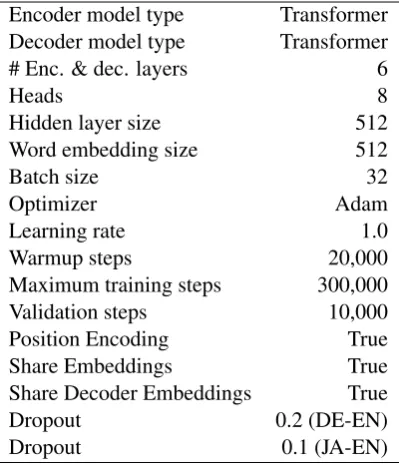
Table 1: Hyperparameters shared across models
• KFTT Japanese−English (JA−EN, Neubig
(2011)).
We use byte pair encoding (BPE; (Sennrich et al.,
2016)) with a joint segmentation with 32,000 merges for both language pairs.
Hyperparameters used across experiments are shown in Table1. All models were implemented in a fork of OpenNMT-py (Klein et al.,2017). We compare our model to ateacher forcing baseline, i.e. a standard transformer model, without sched-uled sampling, with the hyperparameters given in Table1. We did hyperparameter tuning by trying several different values for dropout and warmup steps, and choosing the best BLEU score on the validation set for the baseline model.
With the scheduled sampling method, the teacher forcing probability continuously decreases over the course of training according to a prede-fined function of the training steps. Among the decay strategies proposed for scheduled sampling, we found that linear decay is the one that works best for our data:
t(i) = max{, k−ci}, (1)
Experiment DE−EN JA−EN Dev Test Dev Test
Teacher Forcing Baseline 35.05 29.62 18.00 19.46
No backprop
Argmax 23.99 20.57 12.88 15.13
Top-k mix 35.19 29.42 18.46 20.24
Softmax mixα = 1 35.07 29.32 17.98 20.03
Softmax mixα = 10 35.30 29.25 17.79 19.67
Gumbel Softmax mixα= 1 35.36 29.48 18.31 20.21 Gumbel Softmax mixα= 10 35.32 29.58 17.94 20.87
Sparsemax mix 35.22 29.28 18.14 20.15
Backprop through model decisions
Softmax mixα = 1 33.25 27.60 15.67 17.93
Softmax mixα = 10 27.06 23.29 13.49 16.02
Gumbel Softmax mixα= 1 30.57 25.71 15.86 18.76 Gumbel Softmax mixα= 10 12.79 10.62 13.98 17.09
[image:5.595.140.460.62.295.2]Sparsemax mix 24.65 20.15 12.44 16.23
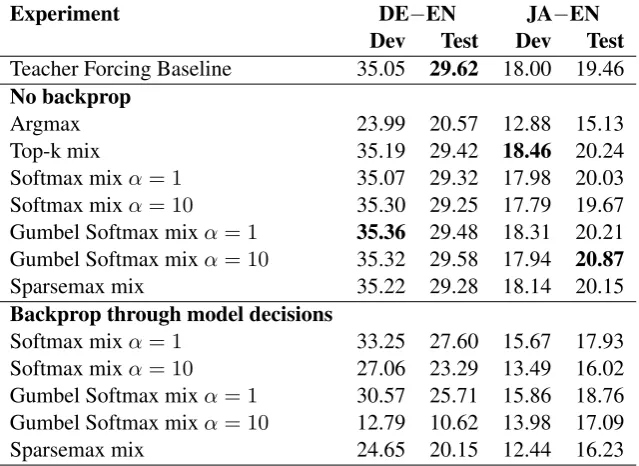
Table 2: Experiments with scheduled sampling for Transformer. The table shows BLEU score for the best check-point on BLEU, measured on the validation set. The first group of experiments do not have a backpropagation pass through the first decoder. The results from the second group are from model runs with backpropagation pass through the second as well as through the first decoder.
The results from our experiments are shown In Table2. The scheduled sampling which uses only the highest-scored word predicted by the model does not have a very good performance. The models which use mixed embeddings (the top-k, softmax, Gumbel softmax or sparsemax) and only backpropagate through the second decoder pass, perform slightly better than the baseline on the val-idation set, and one of them is also slightly better on the test set. The differentiable scheduled sam-pling (when the model backpropagates through the first decoder) have much lower results. The perfor-mance of these models starts degrading too early, so we expect that using more training steps with teacher forcing at the beginning of the training would lead to better performance, so this setup still needs to be examined more carefully.
5 Discussion and Future Work
In this paper, we presented our approach to ap-plying the scheduled sampling technique to Trans-formers. Because of the specifics of the decoding, applying scheduled sampling is not straightfor-ward as it is for RNN and required some changes in the way the Transformer model is trained, by using a two-step decoding. We experimented with several schedules and mixing of the embeddings in the case where the model predictions were
used. We tested the models for machine trans-lation on two language pairs. The experimental results showed that our scheduled sampling strat-egy gave better results on the validation set for both language pairs compared to a teacher forcing baseline and, in one of the tested language pairs (JA−EN), there were slightly better results on the test set.
One possible direction for future work is exper-imenting with more schedules. We noticed that when the schedule starts falling too fast, for exam-ple, with the exponential or inverse sigmoid de-cay, the performance of the model degrades too fast. Therefore, we think it is worth exploring more schedules where the training does more pure teacher forcing at the beginning of the training and then decays more slowly, for example, inverse sigmoid decay which starts decreasing after more epochs. We will also try the experiments on more language pairs.
Acknowledgments
This work was supported by the European Re-search Council (ERC StG DeepSPIN 758969), and by the Fundac¸˜ao para a Ciˆencia e Tecnolo-gia through contracts UID/EEA/50008/2019 and CMUPERI/TIC/0046/2014 (GoLocal). We would like to thank Gonc¸alo Correia and Ben Peters for their involvement on an earlier stage of this project.
References
Dzmitry Bahdanau, Philemon Brakel, Kelvin Xu, Anirudh Goyal, Ryan Lowe, Joelle Pineau, Aaron Courville, and Yoshua Bengio. 2016. An actor-critic
algorithm for sequence prediction. arXiv preprint
arXiv:1607.07086.
Dzmitry Bahdanau, Kyunghyun Cho, and Yoshua
Ben-gio. 2014. Neural machine translation by jointly
learning to align and translate. arXiv preprint
arXiv:1409.0473.
Samy Bengio, Oriol Vinyals, Navdeep Jaitly, and Noam Shazeer. 2015. Scheduled sampling for se-quence prediction with recurrent neural networks. InAdvances in Neural Information Processing
Sys-tems, pages 1171–1179.
Mauro Cettolo, Marcello Federico, Luisa Bentivogli, Niehues Jan, St¨uker Sebastian, Sudoh Katsuitho, Yoshino Koichiro, and Federmann Christian. 2017. Overview of the iwslt 2017 evaluation campaign. In
International Workshop on Spoken Language Trans-lation, pages 2–14.
Hal Daum´e, John Langford, and Daniel Marcu. 2009.
Search-based structured prediction. Machine
learn-ing, 75(3):297–325.
Kartik Goyal, Chris Dyer, and Taylor
Berg-Kirkpatrick. 2017. Differentiable scheduled
sampling for credit assignment. arXiv preprint
arXiv:1704.06970.
Eric Jang, Shixiang Gu, and Ben Poole. 2016.
Categor-ical reparameterization with gumbel-softmax. arXiv
preprint arXiv:1611.01144.
G. Klein, Y. Kim, Y. Deng, J. Senellart, and A. M.
Rush. 2017. OpenNMT: Open-Source Toolkit for
Neural Machine Translation.ArXiv e-prints.
Chris J Maddison, Andriy Mnih, and Yee Whye Teh.
2016. The concrete distribution: A continuous
relaxation of discrete random variables. arXiv
preprint arXiv:1611.00712.
Andre Martins and Ramon Astudillo. 2016. From soft-max to sparsesoft-max: A sparse model of attention and
multi-label classification. In International
Confer-ence on Machine Learning, pages 1614–1623.
Graham Neubig. 2011. The kyoto free translation task.
Marc’Aurelio Ranzato, Sumit Chopra, Michael Auli, and Wojciech Zaremba. 2015. Sequence level
train-ing with recurrent neural networks. arXiv preprint
arXiv:1511.06732.
Rico Sennrich, Barry Haddow, and Alexandra Birch. 2016. Neural machine translation of rare words with
subword units. arXiv preprint arXiv:1508.07909.
Ilya Sutskever, Oriol Vinyals, and Quoc V Le. 2014. Sequence to sequence learning with neural
net-works. InAdvances in neural information
process-ing systems, pages 3104–3112.
Ashish Vaswani, Noam Shazeer, Niki Parmar, Jakob Uszkoreit, Llion Jones, Aidan N Gomez, Łukasz Kaiser, and Illia Polosukhin. 2017. Attention is all
you need. InAdvances in Neural Information
Pro-cessing Systems, pages 5998–6008.
Ronald J Williams. 1992. Simple statistical gradient-following algorithms for connectionist
reinforce-ment learning. Machine learning, 8(3-4):229–256.
Sam Wiseman and Alexander M Rush. 2016. Sequence-to-sequence learning as beam-search
opti-mization. InProceedings of the 2016 Conference on
Empirical Methods in Natural Language