Stability Behavior of the Zero Solution for Nonlinear
Damped Vectorial Second Order Differential Equation
Mohamed A. Ramadan1, Samah M. El-Kholy2
1Department of Mathematics, Faculty of Science, Minufiya University, Shebeen El-koom, Egypt
2Department of Engineering Physics and Mathematics, Faculty of Engineering, Kafr El-Sheikh University, Kafr El-Sheikh, Egypt
Email: [email protected], [email protected], samahelkholy77@ yahoo.com Received October 7, 2012; revised November 9, 2012; accepted November 18,2012
ABSTRACT
In this paper, a theoretical treatment of the stability behavior of the zero solution of nonlinear damped oscillator in the vectorial case is investigated. We study the sufficient conditions for the boundedness of solution of the nonlinear damped vectorial oscillator and the conditions for the stability of the zero solution to be uniformly stable as well as as- ymptotically stable.
Keywords: Zero Solution; Damped Oscillator; Uniformly Stable; Asymptotically Stable
1. Introduction
We consider the nonlinear second order vectorial differ- ential equation of the form
2f t t t,
x x x g x 0
.
R
(1) where;
1, , ,2
, : ,and , :
,
n,
n
n n
t R x x x R
t R R R f t t R
x
g x
Stability problems for the second order ordinary differ- ential equation has been intensively and widely studied [1-5]. Based on Schauder fixed point theorem T. A. Bur- ton and T. Furumochi [2] introduced a new method to study the stability of the zero solution for Equation (1). This problem is considered also by Gheorghe Morosanu and Cristian Vladimirescu [5,6]. In [6], they used rela- tively classical arguments to prove the stability of the zero solution of Equation (1). While in [5], they obtained new stability results for this ordinary differential equa- tion under more general assumptions. Their approach al- lows extensions to both the vector case and the case of the whole real line. In [7] the dynamics of various oscil- lators had been studied.
2. The Main Results
In the next theorem we state sufficient conations for the boundedness of the solution of Equation (1) are given.
Theorem 1
If the following hypotheses are hold: 1)
1
f t C R and f t
0, t 0.2)
1
,t C R
is decreasing and
1t
,
t R
.
3)
n
R ,
n C R R
g and g is locally Lipschit- zian
in
x1, , xn
,4) g satisfies the following estimate
t, f t o
g x x , t R , where denotes
some norm in . then the solution of Equation (1) is bounded.
n R
Proof
For the n-dimensional system, we have
T1, , , , , , ,2 1 2
m
n n
x x x y y y R
z , where m = 2n.
Applying the transformation, yi xi f t x
i and 1, 2, ,i n Equation (1) can be converted into a first order system of differential equations of the form:
,
A t B t t
z z z r z (2)
where
1)
1 2
3 4
A t A t
A t
A t A t
and are
m × m matrices.
1
0 0
0
B t
B t
2) A t1
A t4
f t I
, A t2
I,
3
A t t I , and B t1
f2
t f
t
I0n n
are n × n matrices. Note that, and I are the zero and the
identity matrices, respectively.
3) r
t,x 0 g t1
,x gn
t,x T
1 0,
n
t
g x
which is a 2m1 vector.
For i j, 1, 2, , n, let is an arbitrary fixed
and let 0
0
11 0 12 0 1 0
, ,
21 0 22 0 2 0
0
, ,
1 0 0
, , ,
, , ,
,
, ,
m
i j i n j m
n i j n i n j
mm m
z t t z t t z t t
Z Z
z t t z t t z t t
Z t t
Z Z
z t t z t t
(3)
be a fundamental matrix solution to the linear system:
A t
z z (4)
which equal to the identity matrix for 0. Consider with
tt
00
z z0 small enough, and
let us denote by
0 0
t
t t, ,0 0
z z
0 z
the unique solution of Equa- tion (2) which equal to at tt0. By hypotheses (1) and (2), z
t t, ,0 z0
is defined on a maximal right inter-val,
t l0,
, and satisfies the following integral equation:
0
1
0 0 0 0 0 0 0 0 0 0
, , , , , , , , , , d
t
t
t t Z t t
Z t t Z s t B s s t s s t sz z z z z r z z
This gives us the following integral inequality:
0
1
0 0 0 0 0 0 0 0 0 0
, , , , , e , , , , , d
t
t
t t Z t t
Z t t Z s t B s s t s s t sz z z z z r z z (5)
where e
0 1 0
T.Equations (3) and (4) give us the following differential equations:
, ,
i j i j n i j
z f t z z,
,
,
,
(6)
, ,
n i j i j n i j
z t z f t z (7)
, ,
i n j i n j n i n j
z f t z z (8)
, ,
n i n j i n j n i n j
z t z f t z (9)
for i j, 1, 2, , n.
Since is a decreasing function, so Equations (6) and (7) lead to:
t
2 2
2 2, , , ,
1
2 t zi j zn i j f t t zi j zn i j
0 2 d
2 2
, , 0 e
t
t f u u
i j n i j
t z z t
(10)
By the same way we can obtain from Equations (8) and (9) the following:
0 2 d
2 2
, , e
t
t f u u
i n j n i n j
t z z
(11)
For
1, , , , , , ,2 1 2
Tm
n n
x x x y y y R
z , consider
the norm 2
1
m
i i
z
z , where is the norm defined
in m.
R
For
T
0 01, 02, , 0 , 01, 02, , 0
m
n n
x x x y y y R
z we
have:
, , 0 , 0 , 0
0 0
, , 0 , 0 , 0
2 2
, 0 , 0 , 0 , 0
1 1 1
, i j i n j i j i n j
n i j n i n j n i j n i n j
n n n
i j j i n j j n i j j n i n j j
i j j
Z Z Z Z
Z t t
Z Z Z Z
z x z y z x z y
x y
x z
x y
y
satisfies (4), then we get: Using Shwartz inequality, Minkowski inequality [8] and
suitable assumptions lead to:
0 2 d
0 0 0 0
, 3 1e
t
t f u u
Z t t n t
z z (12)
We have also:
0 0
t s t
1
0 0
T
1 0 2 0 0
, , e
, , , , m , ,
Z t t Z s t
t s t t s t t s t
1
0 0
0 1
2 2
0 0
1
, , e
, , , ,
i i
n
i i n
i
Z t t Z s t
t t s t t s t
Since
2 , ,
m
t s t
t is a decreasing function of , we get:
2
2
2
2
0 0 0 0
, , , , , , , , e S
2tf udu
i n i i n i
t t s t t s t s s s t s s t
So,
1
d0 0 0
, , e
t
S
f u u
Z t t Z s t e n t
(13)
As mentioned the system satisfies the integral inequality (5), then inequalities (12) and (13) give
0
1
0 0 0 0 0 0 0 0 0 0
, , , t , , e , , , , , d
t
t t Z t t Z t t Z s t B s s t s s t s
z z z z z r z z
0
d d
2
0 0 0 0 0 0 0
, , 3 1e e
t t
t tS
f u u t f u u
t t n t n t n f s
0
t
, , , d
f s s t s s
z z z
For all t we can replace g by another function say g
defined as follows. By hypothesis (4) it follows that there exists a
z z g x (14)
0
such that if x , then
t, f t o
g x x
We defined the function : n n by:
RR R
g
, if
,
, if
g t t
g t
ave
x x
g x
x x
and we h x , t 0.
ry ,x
It is clear that for eve
t RRn
t,
g x f t o x
is of class and is locally Lipschitzian
g
in
n C RR
x x1, , ,2 xn
ginal function. So, we wg satisfies
ill admit from now that the all the properties of the
ori g.
Since 1
f C R we get from inequality (14) that:
0
0 0 0 0
, , 3 1e
t
t f u
t
t t n t
D
00 0
, , d
t
s t s
du
z z z
u g
z z
0,
t t l
, with positive constant D [9,10]. This gives s the followin
t t, ,0 0
n 3
t0 1eDh 0 , t
t l0,
z z z (15)
Thus z
t t, ,0 z0
as well as z
t t, ,0 z0
are boundedon
t l0,
and so z
t t, ,0 z0
can be extended to theright of l. This contradicts the maximality of l. This means that the solution of Equation (1) is bo nded. The proof of theorem 1 is complete.
Theorem 2
If the hypotheses of theorem 1 are hold and lowing assumption is satisfied:
1) There exist two constants such that: u
the fol-
, 0
h k
2
,
f t f t kf t t h
then the zero solution of Equation (1) is uniformly stable solution.
If in addition
2)
0
d
f t t
holds, then the zero solution of Equation (1) is asymptotically stable.Proof n
Our stability question is reduced to the stability of the zero solutio z
t 0will be divided into two intervals. In the
to the system (2). The interval of
t first interval
we have t
t h0,
and in the second interval t
h,
. lh and sion a ma
Firstly, with nce the hypotheses of theorem 1 are hold, and then the solution z
t,t z0, 0
of Equationl right interval
(1) is defined xima
t l0,
. It isproved in theorem 1 that the solution is bounded and
t t, ,0 0
z z can be extended to the right of l. Therefore,
t t, ,0 0
z z exists on
t l0,
with lh.Assume h l . We are going to find an estimate for z
t t, ,0 z0
on the interval
h l,
. From hypothesis(1) of theorem 2, we have for t
h l,
:
, ,
,
dt u
nk f s z s t z g s x s
d d
0 0 0 0
, , 3 1e , e
t
S S
t
f u u f u
t t n h h t n h
z z z ,z0
h
0 0
0,
d
,
d
t
h S
f u u
n h nk f s f s
z0 z0 0 0
h
0 0 0 0
e , , , , d
t f u u
s t s t s
z z x z
, 3 1e ,
t
t t h t n h
with
10, nk
n h
(16)
0 0
d
0 0 0
d
0 0
, ,
3 1e , ,
e t
h
t
S
f u u
t f u u
h
t t
n h h t
n h nk f s s t s
z z
z z
z , ,z d
(17)
d
0 0 0
d
0 0
3 1e , ,
e ,
t
h
t
S
f u u
t f u u
h
v t h h t
n h nk f s s t s
z z
z z
So
, d
1
,
v t n h nk f t v t t h l .
By integration we get:
1 d
0 0
, , e ,
,
t
h
n h nk f u u
t t t h
t h l
v v
z z (18
with
)
3
1
, ,0 0
v h n h z h t z
From inequality (18) we can see that z
t t, ,0 z0
isbounded since z
t t, ,0 z0
is also bounded, it foll sthat For
ow l . 0 we can get:
2
e
1 3 0 1 3
Dh
n h
From (15) it follows that
0 0
, ,
1 3
t t
n h
z z
for all t
t h0, provided that z0 ore,from (16) and (18), we get z
t t, ,0 z0
v h. Theref
for all th. So, if 0t0h, then the solution
starting , ,0 0
t t
z z
from any point z0, with z0 , exists on
t0,
and satisfies z
t t, ,0 z0
for alusly we btain that l 0
tt . If
and:
0
t h, then analogo o l
0
1 d
0 e ,
t
nh nk f u u
(19
,t h
Therefore, with the same
0 0 0
, , 3 1
t t n t
z z z )
t
as before, z0
im-plies again
t t, ,0 z0
Hence theIf in
z for all tt0.
zero solution is uniformly stable. addition
0
d
f t t
is satisfied, then by (16), (18) and (19) it follows tha zero solution to (1) is asymptotically stable. The proof of
theorem 2 is complete.
3. Examples
We confirm the results of the introduced theorems by considering two numerical examples for which the func-tions
t the
f t ,
t and g
t satisfy theorems assump-tions.
For the system
2f t t,
t
0x x x g x
where
,
x x1, 2
x .
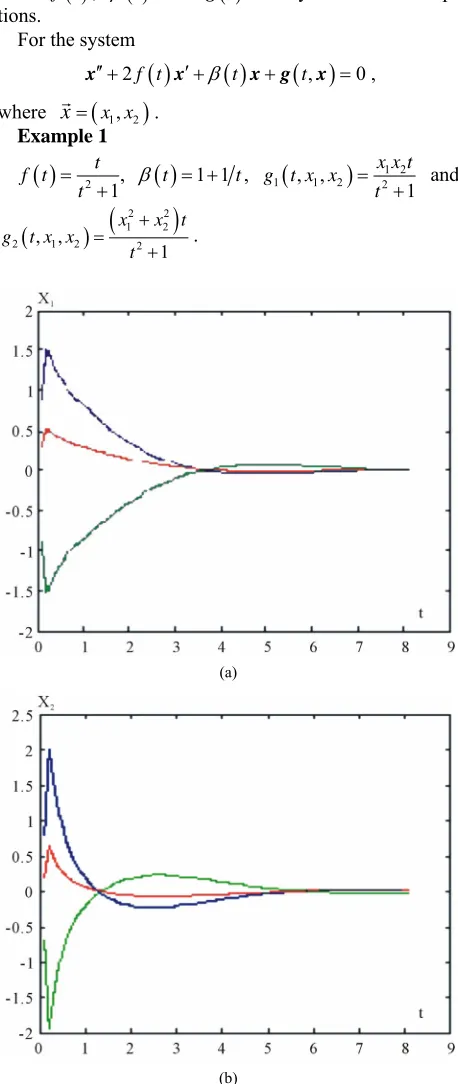
Example 1
2 1t f t
t
,
t 1 1t,
1 2 1 , ,1 2 2 1x x t g t x x
t
and
12 22
2 , ,1 2 2 1x x t
g t x x
t
.
(a)
[image:4.595.309.538.165.707.2](b)
Figure 1. Numerical solutions if Example 1, x1 component (a)
(a)
(b)
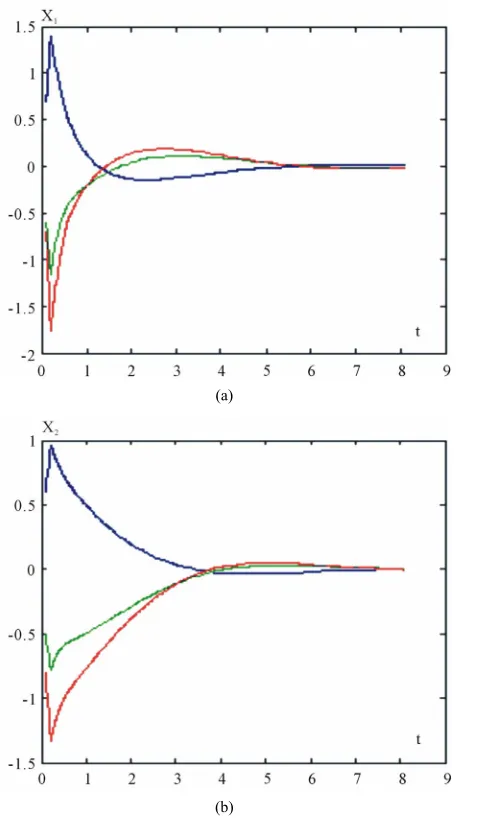
Figure 2. Numerical solutions if example 2, x1 component (a)
and x2 component (b).
Example 2
21 f t
t
,
1 e t2 , t
1 21 , ,1 2 2
x x g t x x
t
and
12 22
2 2 , ,1 2x x
t
.
g t x x
We solved these two examples numerically using th order Runge-Kutta method. The results of example 1 are drawn as shown in Figure 1 and the results of
exam-own in Figure 2. The curves are rawn for different initial values of
d 2 demonstrate time increases all the comp ents of the solutions tends to zero. means, that t e a ptotically stable. W verify the rightness of our proved theorems.
4. Conclusion
ifo ly stable as well as
REFERENCES
nd T. Furumochi, “A Note on Stability by
87.
[4] J. Hale, “Ordina ,” Wiley Inter- science, John W oken, 1969.
four-
ple 2 are drawn as sh
d x0.
that, as the Figures 1 an
on This
he solutions ar sym hich
We introduced two theorems which provide the sufficient conditions for the boundedness of solution of the nonlin- ear damped vectorial oscillator and the conditions for the stability of the zero solution to be un rm
asymptotically stable. We verified our theoretical re- sults by solving two examples satisfying the assumptions of the two proved theorems.
[1] T. A. Burton a
Schauder’s Theorem,” Funkcialaj Ekvacioj, Vol. 44, No.
1, 2001, pp. 73-82.
[2] V. A. Coppel, “Stability and Asymptotic Behavior of Dif- ferential Equations,” D. C. Heath and Company, Lexing- ton, 1965.
[3] D. Grossman, “Introduction to Differential Equations with Boundary Value Problems,” Wiley-Interscience, John Wiley & Sons, Inc., Hoboken, 19
ry Differential Equations iley & Sons, Inc., Hob
[5] G. H. Moroşanu and C. Vladimirescu, “Stability for a Non- linear Second Order ODE,” Funkcialaj Ekvacioj,Vol. 48, No. 1, 2005, pp. 49-56. doi:10.1619/fesi.48.49
[6] G. H. Moroşanu and C. Vladimirescu, “Stability for a Damped Nonlinear Oscillator,” Nonlinear Analysis, Vol. 60, No. 2, 2005, pp. 303-310.
[7] J. Awrejcewicz, “Classical Mechanics. Dynamics,” Sprin- ger-Verlag, New York, 2012,
[8] R. F. Curtain and A. J. Pritchard, “Functional Analysis in
l and Inte- Modern Applied Mathematics,” Academic Press Inc. Ltd., London, 1977.
[9] R. Bellman, “Stability Theory of Differential Equations,” Dover Publications Inc., Mineola, 1953.
[10] V. Lakshmikantham and S. Leela, “Differentia
[image:5.595.60.300.83.492.2]