Improving Hypernymy Detection
with an Integrated Path-based and Distributional Method
Vered Shwartz Yoav Goldberg Ido Dagan
Computer Science Department Bar-Ilan University
Ramat-Gan, Israel
[email protected] [email protected] [email protected]
Abstract
Detecting hypernymy relations is a key task in NLP, which is addressed in the literature using two complemen-tary approaches. Distributional methods, whose supervised variants are the cur-rent best performers, and path-based meth-ods, which received less research atten-tion. We suggest an improved path-based algorithm, in which the dependency paths are encoded using a recurrent neural net-work, that achieves results comparable to distributional methods. We then ex-tend the approach to integrate both path-based and distributional signals, signifi-cantly improving upon the state-of-the-art on this task.
1 Introduction
Hypernymy is an important lexical-semantic rela-tion for NLP tasks. For instance, knowing that Tom Cruise is an actor can help a question an-swering system answer the question “which ac-tors are involved in Scientology?”. While seman-tic taxonomies, like WordNet (Fellbaum, 1998), define hypernymy relations between word types, they are limited in scope and domain. Therefore, automated methods have been developed to deter-mine, for a given term-pair(x, y), whetheryis an hypernym of x, based on their occurrences in a large corpus.
For a couple of decades, this task has been ad-dressed by two types of approaches: distributional, and path-based. In distributional methods, the de-cision whether y is a hypernym of x is based on the distributional representations of these terms. Lately, with the popularity of word embeddings (Mikolov et al., 2013), most focus has shifted to-wards supervised distributional methods, in which
each (x, y) term-pair is represented using some combination of the terms’ embedding vectors.
In contrast to distributional methods, in which the decision is based on theseparate contexts of xandy, path-based methods base the decision on the lexico-syntactic paths connecting thejoint oc-currences of x andy in a corpus. Hearst (1992) identified a small set of frequent paths that indicate hypernymy, e.g. Y such as X. Snow et al. (2004) represented each(x, y)term-pair as the multiset of dependency paths connecting their co-occurrences in a corpus, and trained a classifier to predict hy-pernymy, based on these features.
Using individual paths as features results in a huge, sparse feature space. While some paths are rare, they often consist of certain unimportant components. For instance, “Spelt is a species of wheat” and “Fantasy is a genre of fiction” yield two different paths: X be species of Y and X be genre of Y, while both indicating that X is-a Y. A possible solution is to generalize paths by replac-ing words along the path with their part-of-speech tags or with wild cards, as done in the PATTY sys-tem (Nakashole et al., 2012).
Overall, the state-of-the-art path-based methods perform worse than the distributional ones. This stems from a major limitation of path-based meth-ods: they require that the terms of the pair oc-cur together in the corpus, limiting the recall of these methods. While distributional methods have no such requirement, they are usually less precise in detecting a specific semantic relation like hy-pernymy, and perform best on detecting broad se-mantic similarity between terms. Though these approaches seem complementary, there has been rather little work on integrating them (Mirkin et al., 2006; Kaji and Kitsuregawa, 2008).
In this paper, we present HypeNET, an inte-grated path-based and distributional method for hypernymy detection. Inspired by recent progress
in relation classification, we use a long short-term memory (LSTM) network (Hochreiter and Schmidhuber, 1997) to encode dependency paths. In order to create enough training data for our net-work, we followed previous methodology of con-structing a dataset based on knowledge resources. We first show that our path-based approach, on its own, substantially improves performance over prior path-based methods, yielding performance comparable to state-of-the-art distributional meth-ods. Our analysis suggests that the neural path rep-resentation enables better generalizations. While coarse-grained generalizations, such as replacing a word by its POS tag, capture mostly syntactic sim-ilarities between paths, HypeNET captures also semantic similarities.
We then show that we can easily integrate dis-tributional signals in the network. The integration results confirm that the distributional and path-based signals indeed provide complementary in-formation, with the combined model yielding an improvement of up to 14F1points over each
indi-vidual model.1
2 Background
We introduce the two main approaches for hyper-nymy detection: distributional (Section 2.1), and path-based (Section 2.2). We then discuss the re-cent use of recurrent neural networks in the related task of relation classification (Section 2.3).
2.1 Distributional Methods
Hypernymy detection is commonly addressed us-ing distributional methods. In these methods, the decision whetheryis a hypernym ofxis based on the distributional representations of the two terms, i.e., the contexts with which each term occurs sep-aratelyin the corpus.
Earlier methods developed unsupervised mea-sures for hypernymy, starting with symmetric sim-ilarity measures (Lin, 1998), and followed by di-rectional measures based on the distributional in-clusion hypothesis (Weeds and Weir, 2003; Kotler-man et al., 2010). This hypothesis states that the contexts of a hyponym are expected to be largely included in those of its hypernym. More recent work (Santus et al., 2014; Rimell, 2014) introduce new measures, based on the assumption that the
1Our code and data are available in:
https://github.com/vered1986/HypeNET
most typical linguistic contexts of a hypernym are less informative than those of its hyponyms.
More recently, the focus of the distributional ap-proach shifted to supervised methods. In these methods, the (x, y) term-pair is represented by a feature vector, and a classifier is trained on these vectors to predict hypernymy. Several methods are used to represent term-pairs as a combination of each term’s embeddings vector: concatenation ~x⊕~y(Baroni et al., 2012), difference~y−~x(Roller et al., 2014; Weeds et al., 2014), and dot-product ~x·~y. Using neural word embeddings (Mikolov et al., 2013; Pennington et al., 2014), these methods are easy to apply, and show good results (Baroni et al., 2012; Roller et al., 2014).
2.2 Path-based Methods
A different approach to detecting hypernymy be-tween a pair of terms(x, y)considers the lexico-syntactic paths that connect thejointoccurrences ofx andy in a large corpus. Automatic acquisi-tion of hypernyms from free text, based on such paths, was first proposed by Hearst (1992), who identified a small set of lexico-syntactic paths that indicate hypernymy relations (e.g. Y such as X,X and other Y).
In a later work, Snow et al. (2004) learned to de-tect hypernymy. Rather than searching for specific paths that indicate hypernymy, they represent each
(x, y)term-pair as the multiset of all dependency paths that connectxandyin the corpus, and train a logistic regression classifier to predict whethery is a hypernym ofx, based on these paths.
Paths that indicate hypernymy are those that were assigned high weights by the classifier. The paths identified by this method were shown to subsume those found by Hearst (1992), yield-ing improved performance. Variations of Snow et al.’s (2004) method were later used in tasks such as taxonomy construction (Snow et al., 2006; Kozareva and Hovy, 2010; Carlson et al., 2010; Riedel et al., 2013), analogy identification (Tur-ney, 2006), and definition extraction (Borg et al., 2009; Navigli and Velardi, 2010).
taxon-parrot is a bird
NOUN VERB DET NOUN
NSUBJ
ATTR
[image:3.595.103.259.63.116.2]DET
Figure 1: An example dependency tree of the sen-tence “parrot is a bird”, with x=parrotand y=bird, repre-sented in our notation asX/NOUN/nsubj/< be/VERB/ROOT/-Y/NOUN/attr/>.
omy of term relations from free text. For each path, they added generalized versions in which a subset of words along the path were replaced by either their POS tags, their ontological types or wild-cards. This generalization increased recall while maintaining the same level of precision.
2.3 RNNs for Relation Classification
Relation classification is a related task whose goal is to classify the relation that is expressed between two target terms in a given sentence to one of pre-defined relation classes. To illustrate, consider the following sentence, from the SemEval-2010 relation classification task dataset (Hendrickx et al., 2009): “The[apples]e1 are in the[basket]e2”. Here, the relation expressed between the target en-tities isContent−Container(e1, e2).
The shortest dependency paths between the tar-get entities were shown to be informative for this task (Fundel et al., 2007). Recently, deep learning techniques showed good performance in capturing the indicative information in such paths.
In particular, several papers show improved per-formance using recurrent neural networks (RNN) that process a dependency path edge-by-edge. Xu et al. (2015; 2016) apply a separate long short-term memory (LSTM) network to each sequence of words, POS tags, dependency labels and Word-Net hypernyms along the path. A max-pooling layer on the LSTM outputs is used as the in-put of a network that predicts the classification. Other papers suggest incorporating additional net-work architectures to further improve performance (Nguyen and Grishman, 2015; Liu et al., 2015).
While relation classification and hypernymy de-tection are both concerned with identifying se-mantic relations that hold for pairs of terms, they differ in a major respect. In relation classification the relation should be expressed in the given text, while in hypernymy detection, the goal is to rec-ognize a generic lexical-semantic relation between terms that holds in many contexts. Accordingly, in relation classification a term-pair is represented
by a single dependency path, while in hypernymy detection it is represented by the multiset of all de-pendency paths in which they co-occur in the cor-pus.
3 LSTM-based Hypernymy Detection We present HypeNET, an LSTM-based method for hypernymy detection. We first focus on im-proving path representation (Section 3.1), and then integrate distributional signals into our network, resulting in a combined method (Section 3.2).
3.1 Path-based Network
Similarly to prior work, we represent each depen-dency path as a sequence of edges that leads from xtoyin the dependency tree.2Each edge contains
the lemma and part-of-speech tag of the source node, the dependency label, and the edge direction between two subsequent nodes. We denote each edge aslemma/P OS/dep/dir. See figure 1 for an illustration.
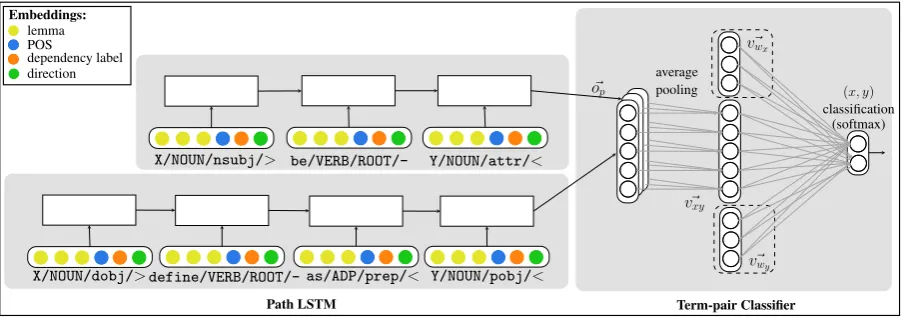
Rather than treating an entire dependency path as a single feature, we encode the sequence of edges using a long short-term memory (LSTM) network. The vectors obtained for the different paths of a given(x, y)pair are pooled, and the re-sulting vector is used for classification. Figure 2 depicts the overall network structure, which is de-scribed below.
Edge Representation We represent each edge by the concatenation of its components’ vectors:
~ve = [~vl, ~vpos, ~vdep, ~vdir]
where ~vl, ~vpos, ~vdep, ~vdir represent the embedding
vectors of the lemma, part-of-speech, dependency label and dependency direction (along the path fromxtoy), respectively.
Path Representation For a pathpcomposed of edges e1, ..., ek, the edge vectors v~e1, ..., ~vek are
fed in order to an LSTM encoder, resulting in a vector ~op representing the entire path p. The
LSTM architecture is effective at capturing tem-poral patterns in sequences. We expect the train-ing procedure to drive the LSTM encoder to focus on parts of the path that are more informative for the classification task while ignoring others.
2Like Snow et al. (2004), we added for each path,
X/NOUN/nsubj/> be/VERB/ROOT/- Y/NOUN/attr/<
X/NOUN/dobj/>define/VERB/ROOT/-as/ADP/prep/< Y/NOUN/pobj/<
Path LSTM Term-pair Classifier
~op
average pooling
~ vwx
(x, y) classification
(softmax)
~ vwy ~
vxy
Embeddings:
lemma POS
[image:4.595.75.527.62.221.2]dependency label direction
Figure 2:An illustration of term-pair classification. Each term-pair is represented by several paths. Each path is a sequence of edges, and each edge consists of four components: lemma, POS, dependency label and dependency direction. Each edge vector is fed in sequence into the LSTM, resulting in a path embedding vectoro~p. The averaged path vector becomes the term-pair’s feature vector, used for classification. The dashedv~wx, ~vwy vectors refer to the integrated network described in Section 3.2.
Term-Pair Classification Each(x, y)term-pair is represented by the multiset of lexico-syntactic paths that connected x and y in the corpus, de-noted as paths(x, y), while the supervision is given for the term pairs. We represent each(x, y)
term-pair as the weighted-average of its path tors, by applying average pooling on its path vec-tors, as follows:
~
vxy =~vpaths(x,y) = P
p∈paths(x,y)fp,(x,y)·o~p P
p∈paths(x,y)fp,(x,y) (1)
wherefp,(x,y)is the frequency ofpinpaths(x, y).
We then feed this path vector to a single-layer net-work that performs binary classification to decide whetheryis a hypernym ofx.
c=softmax(W ·v~xy) (2)
c is a 2-dimensional vector whose components sum to 1, and we classify a pair as positive if c[1]>0.5.
Implementation Details To train the network, we used PyCNN.3 We minimize the cross
en-tropy loss using gradient-based optimization, with mini-batches of size 10 and the Adam update rule (Kingma and Ba, 2014). Regularization is applied by a dropout on each of the components’ embed-dings. We tuned the hyper-parameters (learning rate and dropout rate) on the validation set (see the appendix for the hyper-parameters values).
We initialized the lemma embeddings with the pre-trained GloVe word embeddings (Pennington et al., 2014), trained on Wikipedia. We tried both
3https://github.com/clab/cnn
the 50-dimensional and 100-dimensional embed-ding vectors and selected the ones that yield bet-ter performance on the validation set.4 The other
embeddings, as well as out-of-vocabulary lemmas, are initialized randomly. We update all embedding vectors during training.
3.2 Integrated Network
The network presented in Section 3.1 classifies each(x, y)term-pair based on the paths that con-nect xand y in the corpus. Our goal was to im-prove upon previous path-based methods for hy-pernymy detection, and we show in Section 6 that our network indeed outperforms them. Yet, as path-based and distributional methods are con-sidered complementary, we present a simple way to integrate distributional features in the network, yielding improved performance.
We extended the network to take into account distributional information on each term. In-spired by the supervised distributional concatena-tion method (Baroni et al., 2012), we simply con-catenate x and y word embeddings to the(x, y)
feature vector, redefiningv~xy:
~
vxy = [v~wx,~vpaths(x,y), ~vwy] (3)
where v~wx and v~wy are x and y’s word
embed-dings, respectively, and~vpaths(x,y)is the averaged path vector defined in equation 1. This way, each
(x, y)pair is represented using both the distribu-tional features of x and y, and their path-based features.
4Higher-dimensional embeddings seem not to improve
resource relations
WordNet instance hypernym, hypernym
DBPedia type
Wikidata subclass of, instance of
[image:5.595.96.265.61.116.2]Yago subclass of
Table 1:Hypernymy relations in each resource.
4 Dataset
4.1 Creating Instances
Neural networks typically require a large amount of training data, whereas the existing hypernymy datasets, like BLESS (Baroni and Lenci, 2011), are relatively small. Therefore, we followed the common methodology of creating a dataset us-ing distant supervision from knowledge resources (Snow et al., 2004; Riedel et al., 2013). Fol-lowing Snow et al. (2004), who constructed their dataset based on WordNet hypernymy, and aiming to create a larger dataset, we extract hypernymy relations from several resources: WordNet (Fell-baum, 1998), DBPedia (Auer et al., 2007), Wiki-data (Vrandeˇci´c, 2012) and Yago (Suchanek et al., 2007).
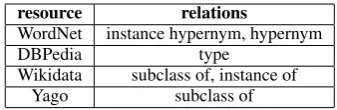
All instances in our dataset, both positive and negative, are pairs of terms that are directly lated in at least one of the resources. These re-sources contain thousands of relations, some of which indicate hypernymy with varying degrees of certainty. To avoid including questionable relation types, we consider as denoting positive examples only indisputable hypernymy relations (Table 1), which we manually selected from the set of hyper-nymy indicating relations in Shwartz et al. (2015). Term-pairs related by other relations (including hyponymy), are considered as negative instances. Using related rather than random term-pairs as negative instances tests our method’s ability to dis-tinguish between hypernymy and other kinds of semantic relatedness. We maintain a ratio of 1:4 positive to negative pairs in the dataset.
Like Snow et al. (2004), we include only term-pairs that have joint occurrences in the corpus, re-quiring at least two different dependency paths for each pair.
4.2 Random and Lexical Dataset Splits
As our primary dataset, we perform standard ran-dom splitting, with 70% train, 25% test and 5% validation sets.
As pointed out by Levy et al. (2015), super-vised distributional lexical inference methods tend
train test val all random split 49,475 17,670 3,534 70,679
lexical split 20,335 6,610 1,350 28,295 Table 2:The number of instances in each dataset.
to perform “lexical memorization”, i.e., instead of learning a relation between the two terms, they mostly learn an independent property of a single term in the pair: whether it is a “prototypical hy-pernym” or not. For instance, if the training set contains term-pairs such as (dog, animal), (cat, animal), and(cow, animal), all annotated as posi-tive examples, the algorithm may learn thatanimal is a prototypical hypernym, classifying any new(x, animal)pair as positive, regardless of the relation between x and animal. Levy et al. (2015) sug-gested to split the train and test sets such that each will contain a distinct vocabulary (“lexical split”), in order to prevent the model from overfitting by lexical memorization.
To investigate such behaviors, we present re-sults also for a lexical split of our dataset. In this case, we split the train, test and validation sets such that each contains a distinct vocabulary. We note that this differs from Levy et al. (2015), who split only the train and the test sets, and dedicated a subset of the train for validation. We chose to devi-ate from Levy et al. (2015) because we noticed that when the validation set contains terms from the train set, the model is rewarded for lexical mem-orization when tuning the hyper-parameters, con-sequently yielding suboptimal performance on the lexically-distinct test set. When each set has a dis-tinct vocabulary, the hyper-parameters are tuned to avoid lexical memorization and are likely to perform better on the test set. We tried to keep roughly the same 70/25/5 ratio in our lexical split.5
The sizes of the two datasets are shown in Table 2. Indeed, training a model on a lexically split dataset may result in a more general model, that can better handle pairs consisting of two unseen terms during inference. However, we argue that in the common applied scenario, the inference in-volves an unseen pair (x, y), in which x and/or yhave already been observed separately. Models trained on a random split may introduce the model with a term’s “prior probability” of being a hyper-nym or a hypohyper-nym, and this information can be exploited beneficially at inference time.
5The lexical split discards many pairs consisting of
[image:5.595.310.520.61.96.2]path
X/NOUN/dobj/> establish/VERB/ROOT/- as/ADP/prep/< Y/NOUN/pobj/< X/NOUN/dobj/> VERB as/ADP/prep/< Y/NOUN/pobj/<
X/NOUN/dobj/> * as/ADP/prep/< Y/NOUN/pobj/< X/NOUN/dobj/> establish/VERB/ROOT/- ADP Y/NOUN/pobj/<
X/NOUN/dobj/> establish/VERB/ROOT/- * Y/NOUN/pobj/<
Table 3:Example generalizations ofX was established as Y. 5 Baselines
We compare HypeNET with several state-of-the-art methods for hypernymy detection, as described in Section 2: path-based methods (Section 5.1), and distributional methods (Section 5.2). Due to different works using different datasets and cor-pora, we replicated the baselines rather than com-paring to the reported results.
We use the Wikipedia dump from May 2015 as the underlying corpus of all the methods, and parse it using spaCy.6 We perform model selection on
the validation set to tune the hyper-parameters of each method.7 The best hyper-parameters are
re-ported in the appendix.
5.1 Path-based Methods
Snow We follow the original paper, and extract all shortest paths of four edges or less between terms in a dependency tree. Like Snow et al. (2004), we add paths with “satellite edges”, i.e., single words not already contained in the depen-dency path, which are connected to either X or Y, allowing paths like such Y as X. The number of distinct paths was 324,578. We applyχ2 feature
selection to keep only the 100,000 most informa-tive paths and train a logistic regression classifier.
Generalization We also compare our method to a baseline that uses generalized dependency paths. Following PATTY’s approach to general-izing paths (Nakashole et al., 2012), we replace edges with their part-of-speech tags as well as with wild cards. We generate the powerset of all possi-ble generalizations, including the original paths. See Table 3 for examples. The number of features after generalization went up to 2,093,220. Simi-larly to the first baseline, we apply feature selec-tion, this time keeping the 1,000,000 most infor-mative paths, and train a logistic regression classi-fier over the generalized paths.8
6https://spacy.io/
7We applied grid search for a range of values, and picked
the ones that yield the highestF1score on the validation set.
8We also tried keeping the 100,000 most informative
paths, but the performance was worse.
5.2 Distributional Methods
Unsupervised SLQS (Santus et al., 2014) is an entropy-based measure for hypernymy detec-tion, reported to outperform previous state-of-the-art unsupervised methods (Weeds and Weir, 2003; Kotlerman et al., 2010). The original paper was evaluated on the BLESS dataset (Baroni and Lenci, 2011), which consists of mostly frequent words. Applying the vanilla settings of SLQS on our dataset, that contains also rare terms, resulted in low performance. Therefore, we received as-sistance from Enrico Santus, who kindly provided the results of SLQS on our dataset after tuning the system as follows.
The validation set was used to tune the thresh-old for classifying a pair as positive, as well as the maximum number of each term’s most associated contexts (N). In contrast to the original paper, in which the number of each term’s contexts is fixed toN, in this adaptation it was set to the minimum between the number of contexts with LMI score above zero andN. In addition, the SLQS scores were not multiplied by the cosine similarity scores between terms, and terms were lemmatized prior to computing the SLQS scores, significantly im-proving recall.
As our results suggest, while this method is state-of-the-art for unsupervised hypernymy de-tection, it is basically designed for classifying specificity level of related terms, rather than hy-pernymy in particular.
random split lexical split method precision recall F1 precision recall F1
[image:7.595.91.508.62.150.2]Path-based SnowSnow + Gen 0.8430.852 0.4520.561 0.5890.676 0.7600.759 0.4380.530 0.5560.624 HypeNET Path-based 0.811 0.716 0.761 0.691 0.632 0.660 Distributional SLQS (Santus et al., 2014)Best supervised (concatenation) 0.4910.901 0.7370.637 0.5890.746 0.3750.754 0.6100.551 0.4640.637 Combined HypeNET Integrated 0.913 0.890 0.901 0.809 0.617 0.700 Table 4:Performance scores of our method compared to the path-based baselines and the state-of-the-art distributional methods for hypernymy detection, on both variations of the dataset – with lexical and random split to train / test / validation.
6 Results
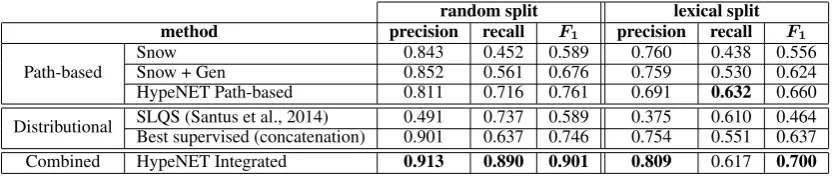
Table 4 displays performance scores of HypeNET and the baselines. HypeNET Path-based is our path-based recurrent neural network model (Sec-tion 3.1) andHypeNET Integratedis our combined method (Section 3.2). Comparing the path-based methods shows that generalizing paths improves recall while maintaining similar levels of preci-sion, reassessing the behavior found in Nakas-hole et al. (2012). HypeNET Path-based outper-forms both path-based baselines by a significant improvement in recall and with slightly lower pre-cision. The recall boost is due to better path gen-eralization, as demonstrated in Section 7.1.
Regarding distributional methods, the unsuper-vised SLQS baseline performed slightly worse on our dataset. The low precision stems from its inability to distinguish between hypernyms and meronyms, which are common in our dataset, causing many false positive pairs such as(zabrze, poland) and (kibbutz, israel). We sampled 50 false positive pairs of each dataset split, and found that 38% of the false positive pairs in the random split and 48% of those in the lexical split were holonym-meronym pairs.
In accordance with previously reported results, the supervised embedding-based method is the best performing baseline on our dataset as well. HypeNET Path-based performs slightly better, achieving state-of-the-art results. Adding distri-butional features to our method shows that these two approaches are indeed complementary. On both dataset splits, the performance differences betweenHypeNET IntegratedandHypeNET Path-based, as well as the supervised distributional method, are substantial, and statistically signifi-cant with p-value of 1% (paired t-test).
We also reassess that indeed supervised distri-butional methods perform worse on a lexical split (Levy et al., 2015). We further observe a similar reduction when using HypeNET, which is not a
re-sult of lexical memorization, but rather stems from over-generalization (Section 7.1).
7 Analysis
7.1 Qualitative Analysis of Learned Paths
We analyze HypeNET’s ability to generalize over path structures, by comparing prominent indica-tive paths which were learned by each of the path-based methods. We do so by finding high-scoring paths that contributed to the classification of true-positive pairs in the dataset. In the path-based baselines, these are the highest-weighted features as learned by the logistic regression classifier. In the LSTM-based method, it is less straightforward to identify the most indicative paths. We assess the contribution of a certain pathpto classification by regarding it as the only path that appeared for the term-pair, and compute itsTRUElabel score from the class distribution: softmax(W ·v~xy)[1],
set-tingv~xy = [~0, ~op,~0].
A notable pattern is that Snow’s method learns specific paths, like X is Y from (e.g. Megadeth
is an American thrash metalband from Los An-geles). While Snow’s method can only rely on verbatim paths, limiting its recall, the generalized version of Snow often makes coarse generaliza-tions, such as X VERB Y from. Clearly, such a path is too general, and almost any verb assigned to it results in a non-indicative path (e.g. X take Y from). Efforts by the learning method to avoid such generalization, again, lower the recall. Hy-peNET provides a better midpoint, making fine-grained generalizations by learning additional se-mantically similar paths such asX become Y from andX remain Y from. See table 5 for additional example paths which illustrate these behaviors.
re-method path example text
Snow
X/NOUN/nsubj/> be/VERB/ROOT/- Y/NOUN/attr/<
direct/VERB/acl/> Eyeballfilmdirected by Umberto Lenziis a 1975 Italian-Spanish
X/NOUN/nsubj/> be/VERB/ROOT/- Y/NOUN/attr/<
publish/VERB/acl/> Alluremagazineis a U.S. women’s beautypublished monthly Snow +
Gen
X/NOUN/compound/> NOUN∗ be/VERB/ROOT/-Y/NOUN/attr/< base/VERB/acl/>
CalicoLight Weapons Inc. (CLWS) is an American privately held manufacturing
companybased in Cornelius, Oregon
X/NOUN/compound/> NOUN Y/NOUN/compound/< WestonTownCouncil
HypeNET Integrated
X/NOUN/nsubj/> be/VERB/ROOT/- Y/NOUN/attr/<
(release|direct|produce|write)/VERB/acl/> Blinkyfilmdirected by Edward Sedgwickis a 1923 American comedy
X/NOUN/compound/>
[image:8.595.70.527.61.245.2] [image:8.595.110.254.299.362.2](association|co.|company|corporation| foundation|group|inc.|international
|limited|ltd.)/NOUN/nsubj/> be/VERB/ROOT/- Y/NOUN/attr/<
((create|found|headquarter |own|specialize)/VERB/acl/>)?
RetalixLtd. is a softwarecompany
Table 5:Examples of indicative paths learned by each method, with corresponding true positive term-pairs from the random split test set. Hypernyms are marked red and hyponyms are marked blue.
Relation % synonymy 21.37% hyponymy 29.45% holonymy / meronymy 9.36% hypernymy-like relations 21.03%
other relations 18.77%
Table 6:Distribution of relations holding between each pair of terms in the resources among false positive pairs.
lations. We note that X is Y is a rather “noisy” path, which may occur in ad-hoc contexts with-out indicating generic hypernymy relations (e.g.
chocolateis a bigproblemin the context of chil-dren’s health). While such a model may identify hypernymy relations between unseen terms, based on general paths, it is prone to over-generalization, hurting its performance, as seen in Table 4. As discussed in§4.2, we suspect that this scenario, in which both terms are unseen, is usually not com-mon enough to justify this limiting training setup.
7.2 Error Analysis
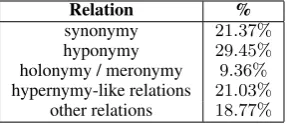
False Positives We categorized the false positive pairs on the random split according to the rela-tion holding between each pair of terms in the re-sources used to construct the dataset. We grouped several semantic relations from different resources to broad categories, e.g. synonym includes also aliasandWikipedia redirection. Table 6 displays the distribution of semantic relations among false positive pairs.
More than 20% of the errors stem from confus-ing synonymy with hypernymy, which are known to be difficult to distinguish.
An additional 30% of the term-pairs are
re-versed hypernym-hyponym pairs (yis a hyponym ofx). Examining a sample of these pairs suggests that they are usually near-synonyms, i.e., it is not that clear whether one term is truely more general than the other or not. For instance, fictionis an-notated in WordNet as a hypernym ofstory, while our method classifiedfictionas its hyponym.
A possible future research direction might be to quite simply extend our network to classify term-pairs simultaneously to multiple semantic re-lations, as in Pavlick et al. (2015). Such a multi-class model can hopefully better distinguish be-tween these similar semantic relations.
Another notable category is hypernymy-like re-lations: these are other relations in the resources that could also be considered as hypernymy, but were annotated as negative due to our restrictive selection of only indisputable hypernymy relations from the resources (see Section 4.1). These in-clude instances like(Goethe, occupation, novelist) and(Homo, subdivisionRanks, species).
Lastly, other errors made by the model often correspond to term-pairs that co-occur very few times in the corpus, e.g. xebec, a studio produc-ing Anime, was falsely classified as a hyponym of anime.
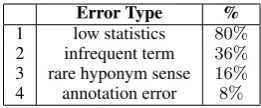
False Negatives We sampled 50 term-pairs that were falsely annotated as negative, and analyzed the major (overlapping) types of errors (Table 7).
Error Type % 1 low statistics 80% 2 infrequent term 36% 3 rare hyponym sense 16% 4 annotation error 8%
Table 7: (Overlapping) categories of false negative pairs: (1) x and y occurred less than 25 times (average co-occurrences for true positive pairs is 99.7). (2) Eitherxor
yis infrequent. (3) The hypernymy relation holds for a rare sense ofx. (4)(x, y)was incorrectly annotated as positive.
play) holding for “Night”, a dramatic sketch by Harold Pinter). Such a term-pair may have too few hypernymy-indicating paths, leading to clas-sifying it as negative.
8 Conclusion
We presented HypeNET: a neural-networks-based method for hypernymy detection. First, we fo-cused on improving path representation using LSTM, resulting in a path-based model that per-forms significantly better than prior path-based methods, and matches the performance of the pre-viously superior distributional methods. In partic-ular, we demonstrated that the increase in recall is a result of generalizing semantically-similar paths, in contrast to prior methods, which either make no generalizations or over-generalize paths.
We then extended our network by integrating distributional signals, yielding an improvement of additional 14F1points, and demonstrating that the
path-based and the distributional approaches are indeed complementary.
Finally, our architecture seems straightfor-wardly applicable for multi-class classification, which, in future work, could be used to classify term-pairs to multiple semantic relations.
Acknowledgments
We would like to thank Omer Levy for his in-volvement and assistance in the early stage of this project and Enrico Santus for helping us by com-puting the results of SLQS (Santus et al., 2014) on our dataset.
This work was partially supported by an In-tel ICRI-CI grant, the Israel Science Foundation grant 880/12, and the German Research Founda-tion through the German-Israeli Project Coopera-tion (DIP, grant DA 1600/1-1).
References
S¨oren Auer, Christian Bizer, Georgi Kobilarov, Jens Lehmann, Richard Cyganiak, and Zachary Ives. 2007. Dbpedia: A nucleus for a web of open data. Springer.
Marco Baroni and Alessandro Lenci. 2011. How we blessed distributional semantic evaluation. In Pro-ceedings of the GEMS 2011 Workshop on GEomet-rical Models of Natural Language Semantics, pages 1–10.
Marco Baroni, Raffaella Bernardi, Ngoc-Quynh Do, and Chung-chieh Shan. 2012. Entailment above the word level in distributional semantics. InEACL, pages 23–32.
Claudia Borg, Mike Rosner, and Gordon Pace. 2009. Evolutionary algorithms for definition extraction. In
Proceedings of the 1st Workshop on Definition Ex-traction, pages 26–32.
Andrew Carlson, Justin Betteridge, Bryan Kisiel, Burr Settles, Estevam R Hruschka Jr, and Tom M Mitchell. 2010. Toward an architecture for never-ending language learning. InAAAI.
Christiane Fellbaum. 1998. WordNet. Wiley Online Library.
Katrin Fundel, Robert K¨uffner, and Ralf Zimmer. 2007. Relexrelation extraction using dependency parse trees. Bioinformatics, pages 365–371. Marti A Hearst. 1992. Automatic acquisition of
hy-ponyms from large text corpora. InACL, pages 539– 545.
Iris Hendrickx, Su Nam Kim, Zornitsa Kozareva, Preslav Nakov, Diarmuid ´O S´eaghdha, Sebastian Pad´o, Marco Pennacchiotti, Lorenza Romano, and Stan Szpakowicz. 2009. Semeval-2010 task 8: Multi-way classification of semantic relations be-tween pairs of nominals. InSemEval, pages 94–99. Sepp Hochreiter and J¨urgen Schmidhuber. 1997. Long
short-term memory. Neural computation, pages 1735–1780.
Nobuhiro Kaji and Masaru Kitsuregawa. 2008. Using hidden markov random fields to combine distribu-tional and pattern-based word clustering. In COL-ING, pages 401–408.
Diederik Kingma and Jimmy Ba. 2014. Adam: A method for stochastic optimization. arXiv preprint arXiv:1412.6980.
Lili Kotlerman, Ido Dagan, Idan Szpektor, and Maayan Zhitomirsky-Geffet. 2010. Directional distribu-tional similarity for lexical inference. NLE, pages 359–389.
Omer Levy, Steffen Remus, Chris Biemann, and Ido Dagan. 2015. Do supervised distributional methods really learn lexical inference relations. NAACL.
Dekang Lin. 1998. An information-theoretic defini-tion of similarity. InICML, pages 296–304.
Yang Liu, Furu Wei, Sujian Li, Heng Ji, Ming Zhou, and Houfeng Wang. 2015. A dependency-based neural network for relation classification. arXiv preprint arXiv:1507.04646.
Tomas Mikolov, Ilya Sutskever, Kai Chen, Gregory S Corrado, and Jeffrey Dean. 2013. Distributed rep-resentations of words and phrases and their compo-sitionality. InNIPS, pages 3111–3119.
Shachar Mirkin, Ido Dagan, and Maayan Geffet. 2006. Integrating pattern-based and distributional similar-ity methods for lexical entailment acquisition. In
COLING and ACL, pages 579–586.
Ndapandula Nakashole, Gerhard Weikum, and Fabian Suchanek. 2012. Patty: a taxonomy of rela-tional patterns with semantic types. InEMNLP and CoNLL, pages 1135–1145.
Roberto Navigli and Paola Velardi. 2010. Learning word-class lattices for definition and hypernym ex-traction. InACL, pages 1318–1327.
Thien Huu Nguyen and Ralph Grishman. 2015. Combining neural networks and log-linear mod-els to improve relation extraction. arXiv preprint arXiv:1511.05926.
Ellie Pavlick, Johan Bos, Malvina Nissim, Charley Beller, Benjamin Van Durme, and Chris Callison-Burch. 2015. Adding semantics to data-driven para-phrasing. InACL.
Jeffrey Pennington, Richard Socher, and Christo-pher D. Manning. 2014. Glove: Global vectors for word representation. InEMNLP, pages 1532–1543. Sebastian Riedel, Limin Yao, Andrew McCallum, and Benjamin M Marlin. 2013. Relation extraction with matrix factorization and universal schemas. In
NAACL.
Laura Rimell. 2014. Distributional lexical entailment by topic coherence. InEACL, pages 511–519.
Stephen Roller, Katrin Erk, and Gemma Boleda. 2014. Inclusive yet selective: Supervised distributional hy-pernymy detection. InCOLING, pages 1025–1036. Enrico Santus, Alessandro Lenci, Qin Lu, and
Sabine Schulte Im Walde. 2014. Chasing hyper-nyms in vector spaces with entropy. InEACL, pages 38–42.
Vered Shwartz, Omer Levy, Ido Dagan, and Jacob Goldberger. 2015. Learning to exploit structured resources for lexical inference. InCoNLL, page 175.
Rion Snow, Daniel Jurafsky, and Andrew Y Ng. 2004. Learning syntactic patterns for automatic hypernym discovery. InNIPS.
Rion Snow, Daniel Jurafsky, and Andrew Y Ng. 2006. Semantic taxonomy induction from heterogenous evidence. InACL, pages 801–808.
Fabian M Suchanek, Gjergji Kasneci, and Gerhard Weikum. 2007. Yago: a core of semantic knowl-edge. InWWW, pages 697–706.
Peter D Turney. 2006. Similarity of semantic relations.
CL, pages 379–416.
Denny Vrandeˇci´c. 2012. Wikidata: A new platform for collaborative data collection. In WWW, pages 1063–1064.
Julie Weeds and David Weir. 2003. A general frame-work for distributional similarity. In EMLP, pages 81–88.
Julie Weeds, Daoud Clarke, Jeremy Reffin, David Weir, and Bill Keller. 2014. Learning to distinguish hypernyms and co-hyponyms. In COLING, pages 2249–2259.
Yan Xu, Lili Mou, Ge Li, Yunchuan Chen, Hao Peng, and Zhi Jin. 2015. Classifying relations via long short term memory networks along shortest depen-dency paths. InEMNLP.
Yan Xu, Ran Jia, Lili Mou, Ge Li, Yunchuan Chen, Yangyang Lu, and Zhi Jin. 2016. Improved re-lation classification by deep recurrent neural net-works with data augmentation. arXiv preprint arXiv:1601.03651.
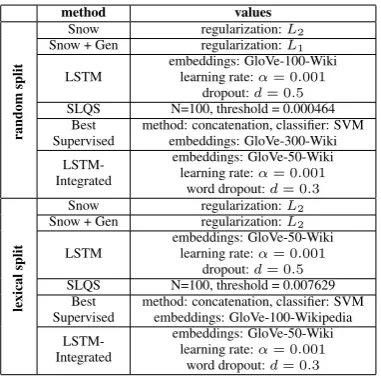
[image:10.595.322.513.545.734.2]Appendix A Best Hyper-parameters Table 8 displays the chosen hyper-parameters of each method, yielding the highestF1 score on the
validation set.
method values
random
split
Snow regularization:L2 Snow + Gen regularization:L1
LSTM embeddings: GloVe-100-Wikilearning rate:α= 0.001
dropout:d= 0.5
SLQS N=100, threshold = 0.000464 Best
Supervised method: concatenation, classifier: SVMembeddings: GloVe-300-Wiki
LSTM-Integrated
embeddings: GloVe-50-Wiki learning rate:α= 0.001
word dropout:d= 0.3
lexical
split
Snow regularization:L2 Snow + Gen regularization:L2
LSTM embeddings: GloVe-50-Wikilearning rate:α= 0.001
dropout:d= 0.5
SLQS N=100, threshold = 0.007629 Best
Supervised method: concatenation, classifier: SVMembeddings: GloVe-100-Wikipedia
LSTM-Integrated
embeddings: GloVe-50-Wiki learning rate:α= 0.001
word dropout:d= 0.3