J. Range Manage.
55:112-116 March 2002
Cull cow management and its implications for cow-calf profitability
RANDALL D. LITTLE, ALLEN R. WILLIAMS, R. CURT LACY, AND CHARLIE S. FORREST
Authors are Associate Professor, Department of Agricultural Economics, Associate Professor, Department of Animal and Dairy Sciences, Graduate Research Assistant and Extension Specialist, Department of Agricultural Economics, Mississippi State University, Mississippi State, Mississippi
39762. Dr. Little is the corresponding author. (662) 325-2884; fax: (662) 325-8777; email: [email protected]
Abstract
Selling culled breeding livestock is often viewed as "just anoth- er chore." Most cull sales are made in the fall, after calves are weaned and cows are pregnancy checked and open. Since cull cow sales comprise from 15 to 30% of a cow-calf enterprise's gross revenue, perhaps they should be viewed as a potential prof- it center.
This paper uses enterprise budgets and sensitivity analyses to illustrate cull cow management strategies that overcome certain physical and economic factors that limit the profitability of fall cow sales. The key limiting physical factor is often poor body condition, which results from the combined effect of lactation and deteriorating forage quality. The key economic factor is a seasonal price low, generated by a large beef supply in the fall.
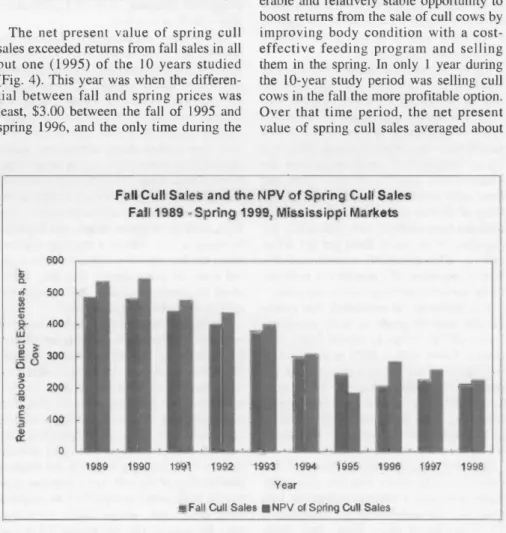
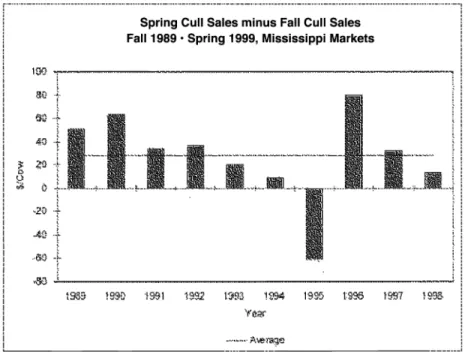
The results suggest potential, with adequate, low-cost feed- stuffs, to increase net returns by properly managing cull breed- ing stock. In only 1 year during the 10-year period, 1990-1999, was selling cull cows in the fall the more profitable option. Over that time period, the net present value of spring cull sales aver- aged about $30 per cow more than selling cull cows in the fall.
Key Words: seasonal price trends, net present value
Selling culled breeding livestock is often viewed as "just anoth- er chore." Most sales are made in the fall, after calves are weaned and cows are pregnancy checked and found to be open. Since cull cow sales comprise from 15 to 30 percent of a cow-calf enter- prise's gross revenue, the culling activity should, perhaps, be viewed and managed as a potential profit center.
The purpose of the research reported in this paper was to deter- mine if cull cow management strategies using cool season forages on improved pastures can overcome certain physical and eco- nomic factors limiting the profitability of fall cull sales. The key physical factor that frequently limits the profit potential of fall sales is poor body condition. Cows typically start the fall season in poor body condition because of the combined effect of the demands of lactation and the deteriorating quality of summer for- ages. The key economic effect is a seasonal price low, generated by large fall supplies (Fuez 1996, Spreen and Simpson 1992).
While the model used reflects a production situation typical throughout much of the Southeastern U.S., the theoretical frame-
Manuscript accepted 30 May 2001.
Resumen
La yenta de ganado para crianza que es de baja produccion (o no productivo), es una actividad que normalmente es considera- da como una "tarea rutinaria mas" en el manejo del ganado. La mayor parte de las ventas de este ganado se Ileva a cabo durante la epoca de Primavera, despues que las crias han sido destetadas y las vacas han sido revisadas y comprobadas que estan libres de prenez. La yenta de gando de baja producion abarca entre un 15
a 30 porciento del ingreso bruto de las operaciones de vaca para cria, por to que esta actividad deberia ser vista como una poten- cial fuente de ganancia.
Esta publicacion hace use de presupuesto de operaciones y analisis de sensibilidad para ilustrar estrategias en el manejo de ganado de baja producion, que ayudan a eliminar o reducir cier- tos factores fisicos y economicos que limitan la alta rentabilidad en las ventas de ganado durante la Primavera. El principal fac- tor fisico limitante, es a menudo una pobre condicion corporal del ganado, to cual es el resultado del efecto combinado de pobre lactacion y la deteriorada calidad del forrage. El principal factor economico es un bajo precio temporal durante la epoca de Primavera, generado por una alta oferta de reses durante la epoca de Otono.
Los resultados del analisis presentado indican un incremento potencial en el retorno neto, dado un manejo apropiado del ganado con una adecuada alimentacion, utilizando material ali- menticio de bajo costo. Solamente en un ano durante el periodo de 10 anos (1990-1999), la opcion de mayor ganacia fue vender el ganado de baja producion durante el Otono. Durante este mismo periodo el Valor Presente Neto (VPN) de las ventas de ganado de baja produccion durante la Primavera tuvo una ganacia prome- dio de $30.00 mas alto por cabeza, comparadas con las ventas en Otono.
work and methods are pertinent to any place quality cool season forages can be produced.
Cull Cow Grades
Cull cows are sold based on USDA slaughter grades, which can be related to body condition scores (BCS) (Table 1). The BCS is a system that uses visual appraisal to determine the degree of fat or muscle loss an animal exhibits. Body condition is scored from
1 to 9, with 9 being the fattest classification. An evaluation of fat
112 JOURNAL OF RANGE MANAGEMENT 55(2) March 2002
Table 1. Cull cow grades and characteristics.
Grade Dressing Percent Lean Content of Trimmings BCS
Canner 40-46 90-92
Cutter 45-49 88-90
Utility
Boning 50-52
Breaking 52-54 76-82
Commercial 55-60 70-80
Source: Gill (1998).
deposits at various locations of the body condition score of 5-6 and avoid market- (back, tail head, pins, hooks, ribs, and ing in the fall, particularly if cows are in brisket) is made to estimate the potential poor body condition.
carcass cutout quality. An animal with a score of 5 'should look average without being too thin or too fat. Animals with a score of 3 or below will have little or no fat and are scored on the degree of muscle loss.
The USDA Utility and Commercial cows usually command the best prices and have the highest dressing percentage (50 to 60 percent). They typically have body condition scores of 5 or higher. Cows that grade USDA Utility or Commercial usual- ly have enough intramuscular fat (mar- bling) and muscling for primals to be pulled from the carcass (particularly cuts from the rib and loin) and marketed out- side of the ground meat trade. This greatly enhances the value of a carcass, which, in turn, generates premiums paid for the higher quality animals.
Cow Prices - Historical and Trends
Materials and Methods
It may be profitable for producers to take advantage of favorable seasonal price trends and the premiums for animals in better body condition. The analysis report- ed in this paper used a partial budgeting approach in which the cull cow selling activity was treated as an independent livestock enterprise. An enterprise budget for the cull or stocker cow activity was developed (Table 2). Interest is charged on the purchase of the stocker cow over the 6-month period; the other expense items
Monthly Average Prices for Slaughter Cows Mississippi Auctions, 1981-1999
L
{¢ {f i. '
13,. {\5. r3 . 5`
1r 5r
Month/Year
Cr
,Figure 1 illustrates the volatility slaugh-
ter cow prices exhibit over time. For the Fig. 1. Monthly Average Utility Cow Prices in Mississippi, 1981 to 1999.
19-year period shown, average monthly cow prices (in nominal dollars) ranged from a high of $1.26 per kg to a low of about $0.64 per kg. Also evident in Figure
1 is the cyclical nature of cattle prices.
Not only is price variability an impor- tant factor, but seasonal price trends (Boyles, Spreen and Simpson 1992, Torell et al. 1998) and the price differentials between grades of cull cows (Gill 1998) are also critical to effective cull cow man- agement and marketing decisions. On average, the difference in price between USDA Utility and Cutter is about $0.09 per kg (Fig. 2). Figure 2 also shows the seasonal price patterns inherent in slaugh- ter cow prices. Prices normally peak in March and decline steadily through November. Torell et al. (1997) note that
"flesh adds weight and that weight adds value" (p. 955-2). Thus, if possible, it may be advantageous to target marketing of cull cows in the early spring at a body
Average of Monthly Prices for Slaughter Cows Mississippi Auctions, 1990-1999
ft 1.15
C
.Q0
0.95.
0.85 O.3t'
M 75 0.'70 0,65
5 1.5Y.;"r'Y,..5 5.
155r..`.y.5,.y..
-,.
Y1y1
'
_ 5
-5L 5''5''
fY
` L.
SL----..r. 1-,`L
5.
:. y`.
1'
J 'k5
5'15t"
.111
L
'tll._.'S
5' '-555-.-
,f.--f-
i
r
Jan. Feb. Mar Apr May June July Aug Sept Oct Nov Dec Month
.. S-r. biwinq Utilityh:.uttex5 1-2
11.WL W IWW W/V.IYiNN L. L111iV1W-H-.ifJ
Fig. 2. Seasonal Price Patterns for Cull Cows in Mississippi, 1990 to 1999.
l .i
1 1
5 I 5
1 4 i
1 SS
5 5 .
5
i
L55 !
5 : q1. i