Learning Salient Samples and Distributed Representations for
Topic-Based Chinese Message Polarity Classification
Xin Kang1,2∗ Yunong Wu3∗ Zhifei Zhang4∗ 1Department of Electronics and Information, Tongji University
2Faculty of Engineering, Tokushima University
3Department of Research and Development, Business Big Data Co., Ltd. 4Department of Computer Science and Operations Research, University of Montreal
1[email protected],2[email protected] 3[email protected],4[email protected]
Abstract
We describe our participation in the Topic-Based Chinese Message Polarity Classifi-cation Task, based on the restricted and unrestricted resources respectively. In the restricted resource based classification, we focus on the selection of parameters in a multi-class classification model with highly-biased training data. In the unre-stricted resource based classification, we explore the distributed representation of Chinese words through unsupervised fea-ture learning and the annotation of salient samples through active learning, with a raw corpus of over 90 million messages extracted from Chinese Weibo Platform. For two classification subtasks, our sub-mitted results ranked the 4th and the 2nd respectively.
1 Introduction
The ZWK team participates in the Topic-Based Chinese Message Polarity Classification Task, the purpose of which is to predict the message polar-ities in the Positive, Negative, and Neutral classes towards particular topics. Learning classification models on the training corpus with bag-of-words features is very challenging, given the fact that the class labels are highly-biased in the corpus and that the number of training samples is an order of magnitude lower than the number of observed word features. Therefore, our work focuses on the active learning and unsupervised feature learning algorithms, to avoid over-fitting the parameters of a linear classification model. To predict polarities with respect to specific topics, we re-evaluate the features with respect to their distances to topical words in a message.
∗
These authors contributed equally to this work.
Because the class labels are highly-biased in the training corpus, most of which are Neutral, we ex-plore an active learning algorithm to incrementally obtain the knowledge of different polarities from a large raw corpus. In the iterative procedure of active learning, salient samples are firstly selected from a large raw corpus, based on the amount of information in their polarity predictions, their rep-resentativeness within the raw corpus, and their distinctiveness in the selection. The selection pro-cedure ensures that samples of the minor classes are more probably selected than samples of the major class(es) and that the extension of training data with these samples has the most potential to improve the current classification model. Then, class labels are annotated to the salient samples by querying oracles, and all labeled samples are appended to the training corpus to update the clas-sification model before the next iteration in active learning. We select and append the salient samples in a batch-mode, to efficiently re-balance the train-ing corpus and incrementally improve the polarity classification model.
And because the number of training messages (around 5K) turns much smaller than the num-ber of unique words (17.5K), a linear classifica-tion model can be easily over-fitted with bag-of-word features. To avoid over-fitting, we project the 17.5K-dimensional word space to a 200-dimensional vector space through an unsupervised feature learning. We employ word2vec (Mikolov et al., 2013a; Mikolov et al., 2013b; Mikolov et al., 2013c) as the unsupervised feature learning al-gorithm, based on a raw corpus of over 90 million messages extracted from Chinese Weibo Platform. One of the most significant advantage of learn-ing with word2vec is that the vector representa-tions are additively composable, which means we can represent the semantic composition of multi-ple words by adding the respective vector repre-sentations. For the topic-based polarity
tion problem, we only compose words around the specific topics as features, with an exponentially decreasing weight along the word sequence.
The rest of this paper is arranged as follows: section 2 reviews the related work of polarity clas-sification, section 3 describes our active learning algorithm for retrieving salient samples, section 4 illustrates the unsupervised learning algorithm for reducing feature dimensions, section 5 shows our experiment results on polarity classification and discusses the over-fitting problem, and section 6 concludes our work.
2 Related Work
Polarity classification has been a popular field in natural language processing. In polarity classifi-cation, the main difficulty is to find effective lan-guage features for distinguishing positive, nega-tive, and neutral sentiments (Kiritchenko et al., 2014). Because overwhelming ambiguities exist in word polarity expressions, polarity prediction results based on lexicons (Taboada et al., 2011) could be unreliable.
To incorporate such ambiguity in sentiment modeling, a few studies resort to the hierarchi-cal Bayesian models, in which the ambiguity of sentiments in words has been transformed into the joint probability of words, word clusters (top-ics), and sentiments (Ren and Kang, 2013; Wu et al., 2014; Rao et al., 2014). Another solution of resolving such ambiguity in sentiment classifica-tion is to directly represent words in sentimental vectors (Maas et al., 2011; Socher et al., 2013; Tang et al., 2014; Kalchbrenner et al., 2014; Kim, 2014). Compared to the Bayesian models, vector-ized representation relates the semantic informa-tion directly to each entry of the word vector, and the results can be easily transformed in a simple classifier. We employ an unsupervised algorithm word2vec (Mikolov et al., 2013a; Mikolov et al., 2013b; Mikolov et al., 2013c) to learn such vector-ized word representation from a large raw corpus. In most of these sentiment classification re-searches, the class labels are not as skewed as the polarity labels in this task. To rebalance the train-ing data, we develop an novel active learntrain-ing (Set-tles, 2010) algorithm which automatically selects the salient samples from a large raw corpus and costs the minimum labor for annotation. Twitter-Hawk (Boag et al., 2015) notably places 1st in topic-based sentiment classification subtask of the
SemEval-2015 shared task on Sentiment Analysis in Twitter, which uses many hand-crafted features and a classic classifier. The overall solution of our work is basically consist with it.
3 Active Learning of Salient Samples Active learning (Settles, 2010) is a subfield of ma-chine learning. An active learning algorithm will automatically select salient samples from the unla-beled data set, and will incrementally improve ma-chine learning by obtaining knowledge from these samples and merge them to the training data.
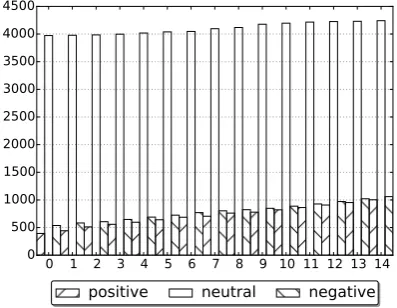
In the polarity classification problem, we de-veloped an active learning algorithm for obtain-ing the knowledge of different polarities from a large raw corpus of over 90 million messages. The algorithm begins with a restricted corpus L, in which the polarity labels are highly-biased i.e., 394 positive labels, 538 negative labels, and 3,973 neutral labels. By iterating through three sample selection steps, the algorithm incrementally adds salient messages to L after querying labels from oracles, and generates a less-biased corpus finally with 1,003 positive labels, 1,060 negative labels, and 4,242 neutral labels.
Before the first step of sample selection, a multi-label Logistic Regression classifier is trained on
L, and a batch of 1,000,000 messages is extracted from the raw corpus as an unlabeled poolU. We get probabilistic predictiony for each messagex
inU, and evaluate the amount of information in its probabilistic prediction by entropy
E(x) =−X
y
p(y|x) logp(y|x). (1)
The largest entropyE(x)is approached by those
x with the most evenly distributed predictions in
y. Because the classifier is trained on a biased cor-pus, its prediction would favor the major label of neutral. Therefore, the true labels for messages in
U with larger entropies are more probably posi-tive and negaposi-tive than neutral, since a truly neutral
xwill get odd probabilistic predictions and locates far from the large entropies. Our algorithm selects the top 10,000 messages forS1as the first step.
For the second step, the algorithm calculates Euclidean distances between every pair of mes-sagesxiandxj inS1by
by its average distance between all other messages inS1as
R(x) = |S 1
1| −1 X
xi∈S1
d(x, xi), (3)
and select the smallest 1,000 messages for S2.
This is because a representative x must be sur-rounded by many similar xi’s in the Euclidean space, andR(x)is usually smaller thanR(x0)for
x0in a very sparse region1. We select the represen-tative messages forS2because they are potentially
more general samples.
In the third step, the algorithm iteratively select the most distinctive messages fromS2 and move
them to an empty setS3. ForxinS2, its
distinc-tiveness is evaluated by the minimum Euclidean distance betweenxand everyxiinL∪S3
D(x) = min
xi∈L∪S3d(x, xi). (4)
Then the message with the largest distinctiveness
x∗ = arg max
x∈S2 D(x) (5)
is moved from S2 to S3. This procedure selects
100 most distinctivex∗forS
3, by ensuring the
di-versity in selected samples. The active learning al-gorithm then queries oracles (i.e., human experts) for polarity labels inS3, and merges the labeled S3toLat the end of this step.
4 Unsupervised Learning of Word Features
The bag-of-word feature is simple for usage in learning a polarity classification model. However, the feature dimension is an order of magnitude higher than the size of training data. In such case, the trained classifier is only sensible to messages in the training corpus, but not generalizable to new messages, which is an over-fitting problem. And a further problem in bag-of-word feature is that the semantic information in words is not fully repre-sented by single feature indexes.
We employ a dimension reduction method to solve this problem, which projects the large word space to a small vector space through unsuper-vised learning of distributed word representa-tions. The algorithm for unsupervised learning
1This is not always true in Euclidean space, but has been
employed in many active learning algorithms.
is word2vec2, and we employ its python imple-mentation3to learn a 200-dimensional vector rep-resentation for words with a 90-million-message corpus. The algorithm learns word representa-tions by constructing a recurrent neural network with each word and its context associated with as a layer (vector) of neurons respectively and fit-ting a 3-layer neural network to recurrently predict the next word given the current word and its con-text. More detailed implementations are described in (Mikolov et al., 2013a; Mikolov et al., 2013b; Mikolov et al., 2013c). The algorithm learned vec-tor representations for 1 million words.
An important property of the word2vec algo-rithm is that both the vector representation and the addition (subtraction) on vector representa-tions are semantically meaningful. This can be examined by the word pair relationships (Mikolov et al., 2013a) as follows. We calculate the se-mantic relation between words w1(“China”) and w2(“Beijing”) by subtracting their vector
repre-sentations, and use this to examine if a same relationship exists between w3(“American”) and w4(“Washington, D.C.”), by searching through the
learned words inV
w∗= arg max
w∈V cos(w1−w2+w4, w). (6)
w∗ equals w3 with the cosine similarity 0.6433, which ensures the additive compositionality exists in our learned model.
We assume words around the topical word have greater impact to the message polarity than the dis-tant words. To compose the semantic information in feature vector xfor polarity prediction, we at-tach exponentially decreasing weights around the topical word
x=X
i6=t
exp(−|i−t|/l)wi, (7)
where i and t are the word and topic locations in a message. l controls the decreasing speed in weights, which is set to5in our work.
5 Experiment and Discussion
The Topic-Based Chinese Message Polarity Clas-sification task provides 4,095 topic-message pairs from Chinese Weibo Platform for developing a basic polarity classifier over positive, negative,
2https://code.google.com/p/word2vec/
RUN0 RUN1 RUN2 RUN3 Prec. Recall F1 Prec. Recall F1 Prec. Recall F1 Prec. Recall F1 Neg 30.47 18.52 23.04 40.65 24.54 30.60 43.07 16.74 24.10 40.72 5.25 9.30 Neu 77.25 88.43 82.46 78.98 87.08 82.83 78.01 91.98 84.42 76.08 97.88 85.61
Pos 23.35 9.20 13.20 19.08 18.06 18.55 24.73 16.06 19.47 19.93 2.00 3.63 Mac 43.69 38.72 39.57 46.24 43.22 44.00 48.60 41.49 42.67 45.54 35.04 32.85
[image:4.595.78.521.62.160.2]Acc 70.68 71.30 73.42 74.89
Table 1: Polarity classification results.
and neutral sentiments, and 19,469 topic-message pairs for evaluating the classification results. In this task, further resources are required to improve the classifier.
We employ a raw corpus of 90 million mes-sages from Chinese Weibo Platform, for develop-ing salient samples with active learndevelop-ing and for learning distributed representation of words with unsupervised feature learning. All these messages are randomly collected from April to September in 2013.
Based on the One-vs-All Logistic Regression algorithm from scikit-learn4, we construct sev-eral polarity classifiersclfiwith different features.
For the basic classifier clf0, we explore the
bag-of-word feature by collecting words which oc-cur more than “min ococ-cur” times in the train-ing corpus and by removtrain-ing the most frequent “stop num” words in the collection. We select model parameters “C”, “penalty”, “class weight” and feature parameters “min occur”, “stop num” through grid search with 5-fold cross validation on the training corpus.
We employ an active learning algorithm to gen-erate a less-biased training corpus as shown in Fig-ure 2. Class labels have been significantly bal-anced after 14 loops of sample selection. Clas-sifierclf1 is trained on this corpus, with a similar
parameter selection procedure asclf0.
We employ the word2vec algorithm to project the large word space to a small vector space. The algorithm has learned a 200-dimensional distributed representation for 1 million different words in the raw corpus. Classifierclf2 is trained
on the basic corpus with composed word2vec fea-tures as in Eq. 7.
To evaluate the classification results, we calcu-late precision, recall, and F1 scores for each po-larity, the macro average of these scores, and the overall accuracy. Table 1 shows the evaluation of
4http://scikit-learn.org/dev/index.html
0 1 2 3 4 5 6 7 8 9 10 11 12 13 14 0
500 1000 1500 2000 2500 3000 3500 4000 4500
positive
neutral
negative
Figure 1: Label counts in active learning.
4 RUNs on the test corpus, with each RUN de-scribed below.
• RUN0 generates predictions fromclf0.
• RUN1 generates predictions fromclf1.
• RUN2 summarizes probabilistic predictions by
Y = arg max X i∈{0,1,2}
pclfi(X)
where pclfi generates the probabilistic
pre-dictions over (negative, neutral, positive) for clfi, and arg max generates the class label
with the largest accumulated probabilistic prediction.
• RUN3 combines probabilistic predictions by
Y = clf3([pclf0(X); pclf1(X); pclf2(X)])
where clf3 takes three probabilistic
predic-tions as features and generates polarity pre-dictions inY. clf3has been trained on the
[image:4.595.317.516.202.356.2]0 1000 2000 3000 4000 5000 6000 0.0
0.1 0.2 0.3 0.4 0.5 0.6 0.7 0.8
0.9
Neg
0 1000 2000 3000 4000 5000 6000 0.00
0.05 0.10 0.15 0.20 0.25
0.30
Neu
clf0(test)
clf0(train)
clf1(test)
clf1(train)
clf2(test)
0 1000 2000 3000 4000 5000 6000clf2(train)
0.00.2 0.4 0.6 0.8
[image:5.595.74.530.62.199.2]1.0
Pos
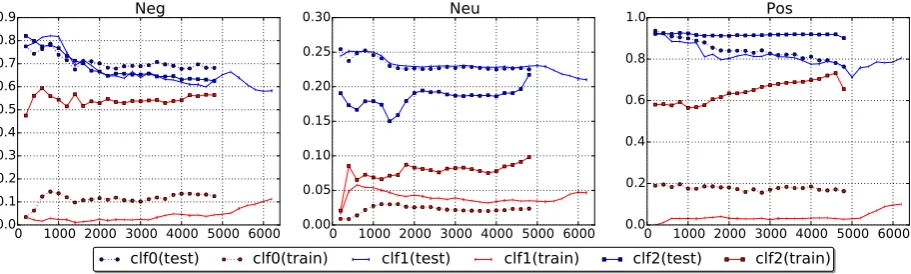
Figure 2: Learning curves.
RUN3 achieves the highest accuracy since its classifier is optimized over classification accuracy on training data. RUN1 yields the highest macro recall and F1 scores, which suggests that our ac-tive learning has effecac-tively selected salient sam-ples for training the polarity classifier. RUN2 yields the highest macro precision by summariz-ing the probabilistic predictions from three clas-sifiers. Among the results from all participants for the restricted and unrestricted source based classifications, our submitted results in RUN0 and RUN3 have been ranked the 4th and the 2nd, re-spectively.
To further examine the problems in learning procedure we plot learning curves for each class label. A learning curve represents the error rates of a classifier, trained with different sizes of data. Learning curves ofclf0 andclf1 suggest an
over-fitting problem since the models fit well on the training data but generalize poorly on the test data. Compard to clf0, clf1 is more
generaliz-able with extra samples selected by active learn-ing. The learning curves ofclf2 on negative and
positive labels suggest an under-fitting problem, which implies that the composed word2vec fea-tures have lost some important information for predicting these labels. Improvement is possi-ble to be achieved by increasing the dimension of word vectors in the word2vec algorithm.
6 Conclusion
We report our approach for solving the Topic-Based Chinese Message Polarity Classification problem. The basic polarity classifier is over-fitted with highly-biased labels in the training data. We employ an active learning algorithm to se-lect salient samples from a large raw corpus, and improve the learning procedure with less-biased
labels in a larger training data. We then sort to a dimension reduction technique, by re-ducing the feature dimension from 17.5K to 200 with the word2vec algorithm, to further relief the over-fitting problem. However, because the fea-ture reduction loses some important information, the model suffers an under-fitting problem. We believe developing the topic-based features in a properly low dimension and incrementally select-ing salient samples would help improvselect-ing the clas-sification results. Moreover, we want to analyze the function of sentence syntactics for topic-based polarity classification in the future, since the syn-tactic structures can better interpret the signifi-cance of a feature relevant to a specified topic. Last but not least, we hope to further improve the classification algorithm based on the distributed representations of words as features.
Acknowledgments
This work has been partially supported by the China Postdoctoral Science Foundation funded project, under Grant No. 2014M560351, and the Quebec-China Postdoctoral Scholarship (File No. 188040).
References
William Boag, Peter Potash, and Anna Rumshisky. 2015. TwitterHawk: A feature bucket based ap-proach to sentiment analysis. InProceedings of the 9th International Workshop on Semantic Evaluation, pages 640–646. ACL.
Yoon Kim. 2014. Convolutional neural networks for sentence classification. InProceedings of the 2014 Conference on Empirical Methods in Natural Lan-guage Processing, pages 1746–1751. ACL.
Svetlana Kiritchenko, Xiaodan Zhu, and Saif M Mo-hammad. 2014. Sentiment analysis of short in-formal texts. Journal of Artificial Intelligence Re-search, 50:723–762.
Andrew L Maas, Raymond E Daly, Peter T Pham, Dan Huang, Andrew Y Ng, and Christopher Potts. 2011. Learning word vectors for sentiment analysis. In
Proceedings of the 49th Annual Meeting of the Asso-ciation for Computational Linguistics: Human Lan-guage Technologies, pages 142–150. ACL.
Tomas Mikolov, Kai Chen, Greg Corrado, and Jef-frey Dean. 2013a. Efficient estimation of word representations in vector space. arXiv preprint arXiv:1301.3781.
Tomas Mikolov, Ilya Sutskever, Kai Chen, Greg S Cor-rado, and Jeff Dean. 2013b. Distributed representa-tions of words and phrases and their compositional-ity. InAdvances in Neural Information Processing Systems, pages 3111–3119.
Tomas Mikolov, Wen-tau Yih, and Geoffrey Zweig. 2013c. Linguistic regularities in continuous space word representations. In Proceedings of the 2013 Conference of the North American Chapter of the Association for Computational Linguistics: Human Language Technologies, pages 746–751. ACL. Yanghui Rao, Qing Li, Xudong Mao, and Wenyin Liu.
2014. Sentiment topic models for social emotion mining. Information Sciences, 266:90–100. Fuji Ren and Xin Kang. 2013. Employing
hierarchi-cal Bayesian networks in simple and complex emo-tion topic analysis. Computer Speech & Language, 27(4):943–968.
Burr Settles. 2010. Active learning literature survey.
University of Wisconsin, Madison, 52(55-66):11. Richard Socher, Alex Perelygin, Jean Y Wu, Jason
Chuang, Christopher D Manning, Andrew Y Ng, and Christopher Potts. 2013. Recursive deep mod-els for semantic compositionality over a sentiment treebank. InProceedings of the 2013 Conference on Empirical Methods in Natural Language Process-ing, pages 1631–1642. ACL.
Maite Taboada, Julian Brooke, Milan Tofiloski, Kim-berly Voll, and Manfred Stede. 2011. Lexicon-based methods for sentiment analysis. Computa-tional Linguistics, 37(2):267–307.
Duyu Tang, Furu Wei, Nan Yang, Ming Zhou, Ting Liu, and Bing Qin. 2014. Learning sentiment-specific word embedding for Twitter sentiment clas-sification. InProceedings of the 52nd Annual Meet-ing of the Association for Computational LMeet-inguis- Linguis-tics, pages 1555–1565. ACL.