EFFECT OF THE EXTERNAL CONCENTRATION OF CALCIUM
ON THE POSTMOULT UPTAKE OF CALCIUM IN BLUE CRABS
(CALLINECTES SAPIDUS)
DOUGLAS S. NEUFELD* ANDJAMES N. CAMERON
The University of Texas at Austin, Marine Science Institute, Port Aransas, TX 78373, USA
Accepted 29 October 1993
Summary
The rate of calcium uptake in blue crabs (Callinectes sapidus Rathbun) acclimated to 2 ‰ sea water with a calcium concentration of 1.4 mmol l21 was dependent on the
magnitude and direction of the electrochemical gradient for calcium. When transferred to water with a high calcium concentration (6 mmol l21), the electrochemical gradient for
calcium favoured diffusive influx, and calcium uptake and apparent H+ excretion
increased by approximately 50 %. When transferred to water with a low calcium concentration (0.10 mmol l21), where the electrochemical gradient for calcium strongly
favoured diffusive efflux, calcium uptake ceased but apparent H+excretion continued at a
reduced rate. Crabs regulated the free calcium concentration in their blood at approximately 8 mmol l21when the external concentration of calcium was 1.4 mmol l21
or higher, but the concentration of free calcium in the blood decreased to 5.6 and 4.6 mmol l21, respectively, at external concentrations of calcium of 0.25 and
0.10 mmol l21. Crabs transferred to water with 0.10 mmol l21calcium for the first 2 days
after moult accumulated only 2.5 g calcium kg21wet mass, about one-quarter of the mass
normally accumulated. Seawater-acclimated crabs transferred to 2 ‰ salinity at 1 day postmoult took up calcium at a reduced rate, indicating that a period of acclimation is necessary for a component of the active transport system to increase its capacity, for diffusive efflux to be reduced, or for both to occur.
Introduction
Salinity acclimation in crustaceans requires the hyperregulation of ions, probably by the use of enzyme transporters (Towle et al. 1976) and, in some cases, changes in the permeability of the external surface (Shaner et al. 1985). Calcium concentration is maintained against a smaller chemical gradient than sodium or chloride (Colvocoresses
et al. 1974) when blue crabs are acclimated to low salinity, but flux rates of calcium can
be greater than flux rates of sodium (Shaw, 1961; Greenaway, 1976), particularly after the
*Present address: Department of Physiology, College of Medicine, University of Arizona, Tucson, AZ 85724, USA.
moult, when large amounts of calcium are needed to mineralize the new exoskeleton. The electrochemical gradient favours passive influx during the postmoult period in crabs acclimated to sea water (Cameron, 1989), but the uptake of calcium after the moult occurs by active transport in crabs acclimated to very low salinities (Neufeld and Cameron, 1992). Changes in the transepithelial potential (Cameron, 1978) and the blood concentration of calcium (Greenaway, 1983; Cameron, 1985) both occur when crabs are transferred to different solutions, thus changing the overall electrochemical gradient. We were interested in determining whether changes in the transepithelial potential and/or the blood concentration of free calcium during short-term changes in the external calcium concentration or during long-term acclimation to low salinities produce a more favourable electrochemical gradient for calcium uptake. Blue crabs inhabit fresh water with relatively high concentrations of calcium (Cameron, 1978), but other crustaceans inhabit fresh water with much lower concentrations of calcium (Vincent, 1963; Chaisemartin, 1965). The measurement of calcium uptake at various external concentrations of calcium also provides a comparison between a euryhaline crustacean and other crustaceans that are limited to existence in fresh water.
Materials and methods
We collected crabs and acclimated them to a salinity of either 2 ‰ or 30 ‰ for at least 1.5 weeks as described by Neufeld and Cameron (1992). The calcium concentration varied from 1.12 to 1.60 mmol l21in 2 ‰ salinity and from 8.9 to 10.2 mmol l21in 30 ‰
salinity. Water temperature varied with room temperature, from 22 to 25 ˚C. The methods used for assessing ion concentrations and flux rates were also those described by Neufeld and Cameron (1992). Briefly, we used atomic absorption spectrophotometry to measure the total concentrations of divalent cations. We measured the calcium and apparent H+
fluxes in a crab by determining the changes in calcium concentration and pH over a period of time in a closed volume of water. The temperature of the bath water was regulated at 20 ˚C for all flux measurements. We determined the transepithelial potential using a catheter electrode inserted into the pericardial space. The equilibrium potential for calcium was calculated from the calcium activities of the bath and blood. Calcium activities were estimated from the concentration of free calcium using activity coefficients of 0.19 and 0.50, respectively, for bath and blood (Neufeld and Cameron, 1992). We measured the concentration of free calcium in blood using a calcium-selective electrode (Radiometer, Inc.), calibrated with standards of the same ionic strength as blood and with known concentrations of free calcium. The concentration of free calcium in the water was estimated as 85 % of the total concentration (Thompson and Ross, 1966).
We investigated the effect of an abrupt change in the calcium concentration of the bath on crabs that were at 1 day postmoult, the period when calcium uptake is at a maximum. For all trials, we used artificial 2 ‰ sea water made by adding the major salts to distilled deionized water at the approximate concentrations measured in the 2 ‰ water to which the crabs had been acclimated (in mmol l21: Na+, 29; K+, 0.8; Mg2+, 3.6; SO422, 2.6; and
HCO32, 3). The calcium concentration was adjusted by the addition of CaCl2, so the
calcium concentrations because of hydration of the CaCl2during weighing. At the onset
of the experiment, a catheter electrode was secured to the crab and the crab was placed into the measurement apparatus containing control medium. Once the rate of apparent H+
excretion had reached a plateau, usually within 1 h, we assumed that the crab had adjusted to the conditions and that pH and calcium were equilibrated throughout the system. We measured the pH and calcium concentrations at the beginning and end of a 45–60 min period to determine the rates of calcium and apparent H+ fluxes. The transepithelial
potential was monitored throughout the control period, and at the end a blood sample was taken from the pericardial cavity with minimal disturbance to the crab. We then replaced the control solution with a test solution and performed a trial in the manner described for the control period. On each postmoult crab, we performed two such sets of experiments with different test solutions at least 8 h apart. For each variable, comparisons between control and trial were analyzed with analysis of variance (ANOVA) using a randomized block design.
We held crabs in artificial 2 ‰ sea water with an extremely low calcium concentration (0.10 mmol l21) for 2 days to determine the total masses of calcium, magnesium and
strontium that are taken up over a longer period in water with very little calcium. We dried crabs to a constant mass (60 ˚C), extracted the dried material with 500 ml of 2 mol l21HCl and analyzed the liquid portion to determine the total mass of the divalent
ions.
The calcium and apparent H+fluxes in crabs abruptly transferred from 30 ‰ to 2 ‰
salinity were measured in the apparatus described previously. We first measured fluxes of calcium and apparent H+in crabs placed in water from the 30 ‰ holding tank, followed
by water from the 2 ‰ holding tank. The crabs were left in 2 ‰ salinity and the calcium and apparent H+fluxes were also measured 1 day after the transfer. The transepithelial
potential was measured in a separate group of seawater-acclimated crabs when in 30 ‰ salinity and immediately after transfer to 2 ‰ salinity.
All values are means ±1 S.E.M. Differences were tested with analysis of variance (ANOVA) or the appropriate nonparametric test.
Results
Effect of external calcium concentration
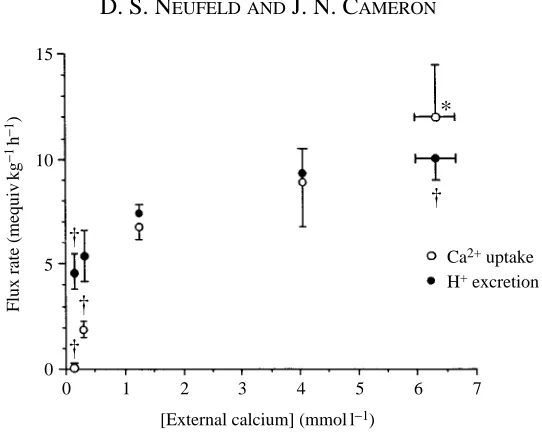
There was a significant increase in both calcium uptake and apparent H+ excretion
when the calcium concentration in the bath was increased from 1.4 to 6.4 mmol l21
(Fig. 1). The rate of calcium uptake decreased as the calcium concentration of the bath decreased, ceasing entirely at the lowest concentration (0.10 mmol l21), while apparent
H+ excretion continued at a rate lower than the control rate (Fig. 1). The average
concentration of bound calcium was different at the different external concentrations of calcium (Fig. 2; difference between total and free calcium), but no clear trend could be detected. The concentration of free calcium in the blood was unchanged when the calcium concentration of the bath was 1.4 mmol l21 and higher but decreased
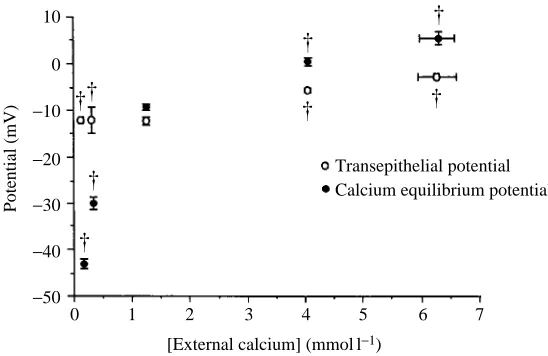
considerably below 1.4 mmol l21(Fig. 2). When the calcium concentration of the bath
significantly (ANOVA; P<0.05) more positive than the transepithelial potential (Fig. 3). Conversely, when the calcium concentration of the bath was at or below that of the acclimation water, the equilibrium potential became significantly more negative (ANOVA; P<0.05) than the transepithelial potential (Fig. 3). The external concentration of calcium and the concentration of magnesium in the blood varied inversely (Fig. 4).
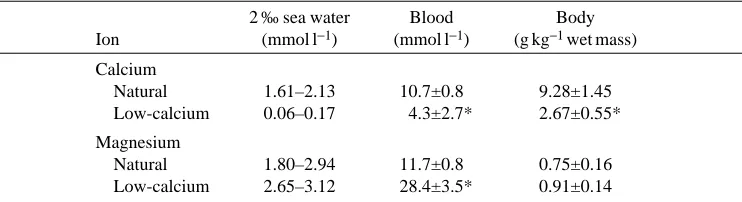
In crabs acclimated to 2 ‰ salinity and held at the lowest calcium concentration (0.10 mmol l21) for 2 days, the mass of calcium accumulated in the body was three times
the mass of magnesium accumulated (Table 1). After 2 days in water with a very low calcium concentration, the calcium concentration in the blood was much lower, and the concentration of magnesium in the blood was much higher, than the concentration of these ions in crabs in natural 2 ‰ salinity (Table 1). All crabs survived to 2 days when in water with a very low concentration of calcium, but they showed virtually no responses and were barely alive.
Postmoult transfer from high to low salinity
Crabs acclimated to 30 ‰ salinity that were transferred to 2 ‰ salinity at 1 day postmoult had a lower rate of apparent H+excretion than crabs remaining in 30 ‰ salinity
both immediately and 1 day after transfer (P<0.05; Friedman’s test, indicating a significant change in the rate of apparent H+ excretion between the three conditions)
(Table 2). Changes in the calcium concentration of the medium due to calcium uptake were small compared with the absolute concentration of calcium; consequently, there was
Ca2+uptake H+excretion 15
10
5
0
Flux rate (mequiv
kg
−
1h
−
1)
0 1 2 3 4 5 6 7
[External calcium] (mmol l−1)
*
†
†
†
[image:4.595.165.436.125.341.2]†
a high variability in the calculated mean rate of calcium uptake and the means were not significantly different (P>0.10; Friedman’s test). The transepithelial potential of crabs acclimated to high salinity was 22.2±1.2 mV (N=5) in 30 ‰ salinity at 1 day postmoult and became more negative, reaching 28.9±1.6 mV, when they were transferred to low salinity (P<0.05; Wilcoxon signed-ranks test). All six crabs that were transferred from 30 ‰ to 2 ‰ salinity survived to 1 day postmoult, but three died after several days at low salinity.
Total calcium
Free calcium 12
10
8
6
4
2
0
[Calcium] (mmol
l
−
1)
0 1 2 3 4 5 6 7
[External calcium] (mmol l−1)
†
†
††
[image:5.595.168.422.137.330.2]†
†
Fig. 2. Dependence of the blood concentrations of total and free calcium on the external concentration of calcium for crabs acclimated to 2 ‰ salinity. Statistics and sample sizes are as described in Fig. 1.
Transepithelial potential Calcium equilibrium potential 10
0
−10
−20
−30
−40
−50
Potential (mV)
0 1 2 3 4 5 6 7
[External calcium] (mmol l−1)
†
†
†
†
††
†
†
[image:5.595.151.425.389.567.2]Discussion
The euryhaline blue crab appears to be less able to accumulate calcium in water containing a low calcium concentration than are crustaceans that naturally live in fresh water. At an external calcium concentration of 0.1 mmol l21, calcium uptake ceased in
blue crabs but continues at around 0.75 mmol kg21h21 in the freshwater crayfish Austropotamobius pallipes (Greenaway, 1974). Austropotamobius can survive in a
reduced ambient concentration of calcium as low as 1.35mmol l21 at postmoult
(Greenaway, 1974) and Gammarus pulex, a freshwater amphipod, can survive in a 15
10
5
[image:6.595.181.420.129.327.2] [image:6.595.114.485.430.531.2]0
[Magnesium] (mmol
l
−
1)
0 1 2 3 4 5 6 7
[External calcium] (mmol l−1)
†
††
†
Fig. 4. Dependence of the total concentration of magnesium in the blood on the external concentration of calcium for crabs acclimated to 2 ‰ salinity. Statistics and sample sizes are as described in Fig. 1.
Table 1. The total mass of calcium and magnesium and the blood concentrations of
calcium and magnesium in postmoult crabs held in natural and low calcium 2 ‰ sea water for 2 days (N=3)
2 ‰ sea water Blood Body Ion (mmol l−1) (mmol l−1) (g kg−1wet mass)
Calcium
Natural 1.61–2.13 10.7±0.8 9.28±1.45 Low-calcium 0.06–0.17 4.3±2.7* 2.67±0.55*
Magnesium
Natural 1.80–2.94 11.7±0.8 0.75±0.16 Low-calcium 2.65–3.12 28.4±3.5* 0.91±0.14
Asterisks indicate that the blood concentration or body content in low-calcium water was significantly different from the corresponding value for crabs held in natural 2 ‰ sea water (P<0.05; Mann–Whitney U-test).
reduced ambient concentration of calcium of 12mmol l21at intermoult (Wright, 1979).
Postmoult blue crabs acclimated to 2 ‰ salinity, in contrast, were unsuccessful at regulating calcium over a 2 day period in water with a calcium concentration of 100mmol l21. An accurate comparison of regulatory capabilities requires that salinities
and temperatures in the acclimation and experimental media be equivalent, however, and we suspect that blue crabs acclimated naturally to lower salinities and/or ambient concentrations of calcium than we used may be able to take up calcium from lower concentrations than we observed.
Saturation kinetics describe calcium uptake in the blue crab and other crustaceans (Greenaway, 1974, 1983; Cameron, 1985) and are suggestive of an enzyme-catalyzed reaction, but it is inappropriate to assume that transport is based on active transport purely because of the presence of a rate-limited response. Changes in the external concentration of an ion often alter the electrical gradient in addition to the chemical gradient, such that the passive fluxes resulting from the change in electrochemical gradient may entirely explain the change in fluxes with external concentrations (Smith, 1969). When the external concentration of calcium is 1.4 mmol l21or lower, active transport is indicated in
blue crabs acclimated to low salinity by a transepithelial potential that is more positive than the equilibrium potential of calcium. When the external concentration of calcium is higher than 1.4 mmol l21, the electrochemical gradient is directed inward and it is
possible that calcium moves passively. Net uptake of calcium appeared to increase at the highest external concentration of calcium, but there was no increase in calcium concentration in the blood, indicating that there must be an increased deposition onto the shell. This is a somewhat surprising result, given that the rate of movement across the carapace epithelium into the shell would be expected to be dependent on changes in the calcium concentration of the blood. It is possible that bicarbonate uptake or apparent H+
excretion normally limit the rate of calcification and that a more positive transepithelial potential allows increased fluxes of these ions.
There was a clear correlation between the net uptake of calcium and the electrochemical gradient for calcium, as there is for net calcium uptake in
Austropotamobius at postmoult (Greenaway, 1974) and for unidirectional calcium influx
Table 2. Rates of calcium uptake and apparent H+excretion in postmoult crabs acclimated to 30 ‰ salinity and subsequently transferred to 2 ‰ salinity (N=6 crabs,
117±9 g)
Flux rate (mequiv kg−1h−1)
Immediately After after transfer 1 day Flux Sea water to 2 ‰ at 2 ‰
H+efflux* 6.60±0.48 4.94±0.62 2.94±1.06 Calcium influx 8.1±2.4 4.5±1.5 1.7±1.2
The asterisk indicates that the H+flux changed significantly over the course of the trial (P<0.05, Friedman’s test).
in Gammarus at intermoult (Wright, 1979). This suggests either that the specific mechanism of calcium transport is in some way dependent on the electrochemical gradient for calcium or that changes in the electrochemical gradient cause changes in passive fluxes that offset or augment active fluxes. An increased passive efflux at a low external concentration of calcium seems particularly likely, since, in fish, a decrease in the external calcium concentration generally produces an increased efflux of other ions that is not accounted for by any change in the transepithelial potential (Carrier and Evans, 1976; McWilliams, 1982). Alternatively, the change in the rate of calcium transport may itself cause the change in transepithelial potential, or there may be no direct cause and effect relationship between the two variables.
Apparent H+excretion does occur in seawater crabs transferred to 2 ‰ salinity, albeit
at a reduced rate, suggesting a similar change in the rate of calcium uptake. Given the negative transepithelial potential and assuming an external activity of calcium of 0.6 mmol l21, the internal activity would have to be 1.2 mmol l21(corresponding to a free
concentration of calcium of approximately 2.4 mmol l21) for net calcium uptake to occur
by passive mechanisms. It is doubtful that calcium decreases to this level since transfer of either seawater or freshwater crabs to water with low concentrations of calcium never caused a decrease to below approximately 5 mmol l21 in the total concentration of
calcium in the blood (Greenaway, 1983; Cameron, 1985; present study). We conclude that an active transport component can be rapidly elicited in seawater-acclimated crabs, but that it does not operate at maximal capacity even after 1 day at 2 ‰ salinity. Long-term acclimation of blue crabs to low salinity may involve an increase in calcium influx to offset losses, perhaps by a membrane transport enzyme. Acclimation to water with a low concentration of calcium does cause an increase in unidirectional influx in trout (Perry and Wood, 1985), but there are no measurements for crustaceans to indicate whether there is increased inward transport during acclimation to low salinity. A change in epithelial permeability is probably also involved in acclimation in blue crabs since permeability to water (Mantel and Farmer, 1983) and ions (Shaner et al. 1985) decreases during long-term acclimation to lower salinities in other crustaceans. In comparison with marine or euryhaline species, crustacean species that inhabit water with much lower calcium concentrations presumably also rely on either a greater ability to transport calcium inwards and/or a lower calcium permeability.
We expected that a decrease in the external concentration of calcium would inhibit calcium uptake in postmoult crabs, but the decrease in the level of free calcium in the blood and the negative shift in the transepithelial potential partially offset the inhibition. Although seawater blue crabs survived when transferred to low salinity at postmoult, a maximal rate of postmoult calcification apparently requires an acclimation period. We suggest that acclimation to low salinity with respect to calcium uptake requires an increased inward transport to offset the increased losses caused by an electrochemical gradient favouring diffusive efflux, a change in permeability to calcium, or both.
References
CAMERON, J. N. (1978). NaCl balance in blue crabs, Callinectes sapidus, in fresh water. J. comp. Physiol. 123, 127–135.
CAMERON, J. N. (1985). Post-moult calcification in the blue crab (Callinectes sapidus): relationships between apparent net H+excretion, calcium and bicarbonate. J. exp. Biol. 119, 275–285.
CAMERON, J. N. (1989). Post-moult calcification in the blue crab, Callinectes sapidus: timing and mechanism. J. exp. Biol. 143, 285–304.
CARRIER, J. C. ANDEVANS, D. H. (1976). The role of environmental calcium in freshwater survival of the marine teleost, Lagodon rhomboides. J. exp. Biol. 65, 529–538.
CHAISEMARTIN, C. (1965). La teneur en calcium de l’eau et l’équilibre calcique chez l’écrevisse Astacus pallipes Lereboullet en périod d’intermue. C. r. Séanc. Soc. Biol. 159, 1214–1217.
COLVOCORESSES, J. A., LYNCH, M. P. ANDWEBB, K. L. (1974). Variations in serum constituents of the blue crab, Callinectes sapidus: Major cations. Comp. Biochem. Physiol. 49A, 787–803.
GREENAWAY, P. (1974). Calcium balance at the postmoult stage of the freshwater crayfish Austropotamobius pallipes (Lereboullet). J. exp. Biol. 61, 35–45.
GREENAWAY, P. (1976). The regulation of the haemolymph calcium concentration of the crab Carcinus maenas (L.). J. exp. Biol. 64, 149–157.
GREENAWAY, P. (1983). Uptake of calcium at the postmoult stage by the marine crabs Callinectes sapidus and Carcinus maenas. Comp. Biochem. Physiol. 75A, 181–184.
MANTEL, L. H. ANDFARMER, L. L. (1983). Osmotic and ionic regulation. In The Biology of Crustacea, vol. 5 (ed. L. H. Mantel), pp. 54–162. New York: Academic Press.
MCWILLIAMS, P. G. (1982). The effects of calcium on sodium fluxes in the brown trout, Salmo trutta, in neutral and acid water. J. exp. Biol. 96, 439–442.
NEUFELD, D. S. ANDCAMERON, J. N. (1992). Postmoult uptake of calcium by the blue crab (Callinectes sapidus) in water of low salinity. J. exp. Biol. 171, 289–299.
PERRY, S. F. ANDWOOD, C. M. (1985). Kinetics of branchial calcium uptake in the rainbow trout: effects of acclimation to various external calcium levels. J. exp. Biol. 116, 411–433.
SHANER, S. W., CROWE, J. H. ANDKNIGHT, A. W. (1985). Long-term adaptation to low salinities in the euryhaline shrimp Crangon franciscorum (Stimpson). J. exp. Zool. 235, 315–323.
SHAW, J. (1961). Studies on ionic regulation in Carcinus maenas (L.). J. exp. Biol. 38, 135–152. SMITH, P. G. (1969). The ionic relations of Artemia salina (L.) II. Fluxes of sodium, chloride and water.
J. exp. Biol. 51, 739–757.
THOMPSON, M. E. ANDROSS, J. R. (1966). Calcium in sea water by electrode measurement. Science 154, 1643–1644.
TOWLE, D. W., PALMER, C. E. ANDHARRIS, D. L. (1976). Role of gill sodium ion and potassium ion dependent ATPase in acclimation of blue crabs Callinectes sapidus to low salinity. J. exp. Zool. 196, 315–321.
VINCENT, M. (1963). Le calcium total chez Gammarus pulex pulex (L.) et la teneur en calcium de l’eau. C. r. Séanc. Soc. Biol. 157, 1274–1277.