Zero Alignment of Verb Arguments in a Parallel Treebank
Jana Šindlerová Eva Fuˇcíková Zdeˇnka Urešová Charles University in Prague
Faculty of Mathematics and Physics Institute of Formal and Applied Linguistics
Czech Republic
{sindlerova,uresova,fucikova}@ufal.mff.cuni.cz
Abstract
This paper analyses several points of inter-lingual dependency mismatch on the ma-terial of a parallel Czech-English depen-dency treebank. Particularly, the points of alignment mismatch between the va-lency frame arguments of the correspond-ing verbs are observed and described. The attention is drawn to the question whether such mismatches stem from the inherent semantic properties of the individual lan-guages, or from the character of the used linguistic theory. Comments are made on the possible shifts in meaning. The authors use the findings to make predictions about possible machine translation implementa-tion of the data.
1 Introduction
In Machine translation tasks lately, paraphrases have been used and studied intensely. They ba-sically serve to improve the evaluation metrics of MT systems. The ability to generate valid para-phrases also plays an important role in informa-tion retrieval tasks, textual entailment etc. The so-called paraphrase tables can be automatically extracted from parallel corpora (Denkowski and Lavie, 2010; Ganitkevitch et al., 2013).
So far, only lexical paraphrases have been ex-plored for Czech (Baranˇcíková et al., 2014), with syntactic (structural) paraphrases intended for fu-ture enhancement of the systems. For English, experiments with both lexical and syntactic para-phrases are employed (Dorr et al., 2004).
This paper presents a preliminary linguistic analysis of structural paraphrases based on va-lency representations. It appears that certain types of paraphrases affect the valency structure of verbs, and possibly the semantic structure of
the sentence, in terms of foregrounding or back-grounding different arguments.1
We believe that the analysis of possible syntac-tic variation within paraphrases, especially such that involves a kind of “disproportion”, in the par-allel treebank data, would be beneficial for further MT experiments.
By a disproportion in dependencies, we mean such structural configurations that involve differ-ent number of dependencies in corresponding syn-tactic structures, i.e., an alignment of “something” on one side of the translation to “nothing” on the other side. For the purposes of this paper, we call it a “zero alignment”.
2 Related Work
The analysis in this paper goes in a similar direc-tion as that of (Sanguinetti et al., 2013), though our interest in what they call a “translation shift” is of a different kind. The authors claim that de-pendency structures are finely apt to account for the alignment of syntactically different treelets be-tween languages, because of the subtree structures constituting similar semantic units. We take their findings as our starting point and provide a lin-guistic analysis of some of the well-identified cat-egories of translation shift from their research, in order to get a better understanding of different lin-guistic grounds for different syntactic structures for a parallel semantic content. Also, our analy-sis is based on the deep syntactic layer (in con-trast to the surface structure alignments used in the paper mentioned above), therefore it does not have to deal with those structural phenomena that might not have important semantic consequences, but only serve for topic-focus hierarchization pur-poses (such as word order variation, simple pas-sivization etc.).
1Here, we use the label "argument" in a simplifying
man-ner. Any element which is included in the valency frame is referred to as an argument.
Our research is also inspired by (Bojar et al., 2013), an attempt to generate as many possible translation paraphrases as possible, in order to en-large the reference set of translations for MT eval-uation purposes. The experiment described in the paper used mostly a flat approach, and was car-ried out with substantial work provided by human annotators. We believe that our research might help establish rules for automatic extraction of true syntactic paraphrases (without unnecessary noise) from parallel corpora, based on the valency pat-terns of words, so that most of the work could be done automatically, with minimal human control.
3 Methodology and Data
In the research, we took the advantage of the ex-istence of Czech-English parallel data, namely the Prague Czech-English Dependency Treebank 2.5 (PCEDT 2.5) (Hajiˇc et al., 2012).2
It is a collection of about 50 000 sentences, taken from the Wall Street Journal part of Penn treebank (Marcus et al., 1993),3
trans-lated manually to Czech, transformed into de-pendency trees and annotated at the level of deep syntactic relations (called tectogrammatic layer). In short, the tectogrammatic layer con-tains mostly content words (with several defined exceptions) connected with oriented edges and la-belled with syntactico-semantic functors accord-ing to the Functional Generative Description ap-proach (FGD), see (Sgall et al., 1986). Ellipsis and anaphora resolution is also included, as well as automatic alignment of corresponding nodes. The PCEDT 2.5 is annotated according to the the FGD valency theory (FGDVT) and two valency lexicons (one for each language) are part of the release.
PDT-Vallex4(Hajiˇc et al., 2003; Urešová, 2011)
has been developed as a resource for annotating ar-gument relations in the Prague Dependency Tree-bank (Hajiˇc et al., 2006). The version used here contains 11,933 valency frames for 7,121 verbs. Each valency frame in the PDT-Vallex represents a distinct verb meaning. Valency frames consist of argument slots represented by tectogrammatic functors (slots). Each slot is marked as obligatory
2https://catalog.ldc.upenn.edu/
LDC2012T08
3https://catalog.ldc.upenn.edu/
LDC99T42
4http://lindat.mff.cuni.cz/services/
PDT-Vallex
or facultative and its typical morphological real-ization forms are listed. Frame entries are supple-mented with illustrative sentence examples.
EngVallex5 (Cinková, 2006) was created as an
adaptation of an already existing resource of En-glish verb argument structure characteristics, the Propbank (Palmer et al., 2005). The original Prop-bank argument structure frames have been adapted to the FGD scheme, so that it currently bears the structure of the PDT-Vallex, though some minor deflections from the original scheme have been al-lowed in order to save some important theoretical features of the original Propbank annotation. This lexicon includes 7,148 valency frames for 4,337 verbs.
PDT-Vallex and EngVallex have been inter-linked together into a new resource called CzEng-Vallex (Urešová et al., 2015a; Urešová et al., 2015). Beside the complete data of the two lexicons, the CzEngVallex contains a database of frame-to-frame, and subsequently, argument-to-argument pairs for the purposes of machine translation experiments (Urešová et al., 2015b). PCEDT and the CzEngVallex data have already been used successfully in several MT experiments aimed at valency frame detection and selection (Dušek et al., 2014) and also for word sense dis-ambiguation (Dušek et al., 2015).
The interlinking of CzEngVallex frames was carried out via an annotation over the PCEDT. First, an automatic alignment procedure was run over the data, which suggested translational links between nodes of the tectogrammatic layer. Cor-responding verb pairs6 and argument pairs were
highlighted. Then, manual revision and correction of the alignments by two annotators was carried out. Thus, as a by-product of building the lexicon, a collection of illustrative annotated tree pairs is available for each verb pair of the CzEngVallex.
4 Zero Alignment in the Data
In the following sections, we will describe the most important, consistent and frequent points of zero alignment found in the data. For each section, we will comment on the linguistic background of the phenomena described and the possible conse-quences for semantic interpretation in the individ-ual languages.
5http://lindat.mff.cuni.cz/services/
EngVallex
6As a basic stage of building the CzEngVallex, only
4.1 Catenative Verbs - Single vs. Double Object Interpretation
One of the prominent points of alignment dispro-portion in the data are sentences with catenative verbs. Catenative verbs are usually defined as those combining with non-finite verbal forms. Be-tween the finite catenative verb and the non-finite verb form, there might appear an intervening NP that might be interpreted as the subject of the de-pendent verbal form. In this section, we will be concerned with exactly those verbs allowing the sequence of a finite catenative verb – NP – a non-finite catenative verb.
4.1.1 ECM Constructions, Raising to Object
Most Czech linguistic approaches do not recog-nize the term Exceptional Case Marking (ECM) in the sense of “raising to object”, instead they generally address similar constructions under the label “accusative with infinitive”. The difference between ECM and control verbs is not being taken into account in most of Czech grammars. In short, raising and ECM are generally considered a marginal phenomenon in Czech and are not being treated conceptually (Panevová, 1996), except for several attempts to describe agreement issues, e.g., the morphological behaviour of predicative com-plements described in a phrase structure grammar formalism (Przepiórkowski and Rosen, 2005).
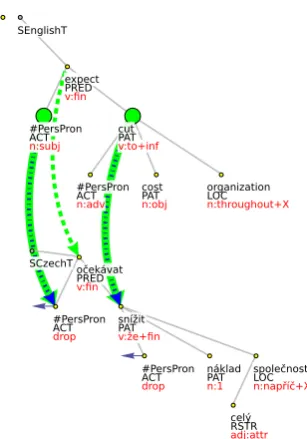
The reason for this negligent approach to ECM is probably rooted in the low frequency of ECM constructions in Czech. Czech sentences corre-sponding to English sentences with ECM mostly do not allow catenative constructions. They usu-ally involve a standard dependent clause with a fi-nite verb, see Fig.1,7or they include a
nominaliza-tion, thus keeping the structures strictly parallel. The only exception are verbs of perception (see, hear), which usually allow both ways of Czech translation – with an accusative NP followed by a non-finite verb form (1a), or with a dependent clause (1b), not speaking about the third possibil-ity involving an accusative NP followed by a de-pendent clause (1c).
(1) He saw Peter coming. a. Vidˇel
He sawPetraPeter.ACCpˇricházet.to come.
7In the examples displayed, the green dashed lines
con-nect the annotated verb pair, the dotted lines concon-nect verb dependents, the thick arrows mark collected verb arguments, the automatic node alignment is displayed in blue, the man-ually corrected alignment is marked in red. The images have been cropped or otherwise adjusted for the sake of clarity.
SEnglishT
SCzechT #PersPron ACT n:subj
#PersPron ACT drop
expect PRED v:fin
očekávat PRED v:fin #PersPron ACT n:adv
snížit PAT v:že+fin cut PAT v:to+inf
#PersPron ACT drop cost PAT n:obj
náklad PAT n:1 organization LOC n:throughout+X
celý RSTR adj:attr
společnost LOC n:napříč+X
[image:3.595.321.475.62.282.2]En: They expect him to cut costs... Cz: Oˇcekávají, že sníží náklady...
Figure 1: Alignment of the ECM construction
b. Vidˇel,
He sawžethatPetrPeter.ACCpˇrichází.is coming. c. Vidˇel
He sawPetra,Peter.ACC,jakhowpˇrichází.is coming.
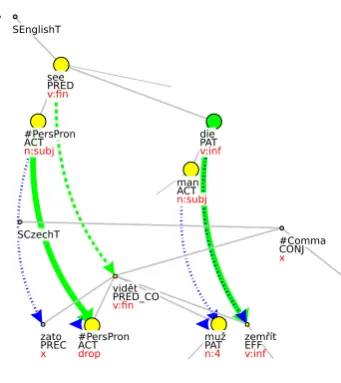
In this type of accusative-infinitive sequence, the accusative element is in FGDVT analysed con-sistently as the direct object of the matrix verb (the PATient argument) and the non-finite verb form then as the predicative complement of the verb (theEFFect argument).
The PCEDT annotation of verbs of perception is shown in Fig. 2, with frame arguments mapped in the following way:
ACT→ACT;PAT→EFF;---→PAT
The literature mentions two ways of ECM struc-tural analysis, a flat one, representing the NP as dependent on the matrix verb, and a layered one, representing the intervening NP as the subject of the dependent verb. This mirrors the opinion that verbs allowing ECM usually have three syntactic, but only two semantic arguments. It is then a mat-ter of decision between a syntactic and semantic approach to tree construction.
The English part of the PCEDT data was anno-tated in the layered manner,8thus most of the pairs
in the treebank appear as strictly parallel. The con-sistency of structures is one of the most
impor-8The annotation followed the original phrasal annotation
SEnglishT
see PRED
v:fin
man ACT
n:subj
die PAT
v:inf
#PersPron ACT
n:subj
SCzechT
zato PREC
x
#PersPron ACT
drop
vidět PRED_CO
v:fin
muž PAT
n:4
zemřít EFF
v:inf
#Comma CONJ
x
En: I have seen [one or two] men die...
[image:4.595.88.259.64.256.2]Cz: Zato jsem vidˇela [jednoho nebo dva] muže zemˇrít...
Figure 2: Alignment of the perception verbs’ ar-guments. The corresponding arguments man-muž are interpreted as belonging to verbs in different levels of the structure.
tant advantages of the layered approach; there is no need of having two distinct valency frames for the two syntactic constructions of the verb, there-fore, the semantic relatedness of the verb forms is kept. Also, there are other specific constructions supporting the layered analysis for English, like the there-constructions intervening instead of the NP, see (2).
(2) We expected there to be slow growth.
On the other hand, the Czech part of the PCEDT data uses flat annotation, partly because the cate-native construction with raising structure is fairly uncommon in Czech (cf. Sect. 4.1.1). The flat structure is easier to interpret, or translate in a morphologically correct way to the surface real-ization, but it requires multiple frames for seman-tically similar verb forms (the instances of the verb
to seeinsee the house fallandsee the houseare in the FGD valency approach considered two dis-tinct lexical units) and it also leaves alignment mismatches in the parallel data.
The treatment of ECM constructions in English and in Czech is different. It reflects both the dif-ferences internal to the languages and their conse-quences in theoretical thinking. Contrary to En-glish, Czech nouns carry strong indicators of mor-phology – case, number and gender. The rules for the subject-verb agreement block overt realiza-tion of subjects of the infinitives. The accusative
ending naturally leads to the interpretation of the presumed subject of the infinitive as the object of the matrix verb. The morphosyntactic repre-sentation is taken as a strong argument for us-ing a flat structure in the semantic representation, and a covert co-referential element for filling the “empty” ACTor position of the infinitive. In En-glish, in general, there is no such strong indication and therefore the layered structure is preferred in the semantic representation.
4.1.2 Object Control Verbs, Equi Verbs, Causatives
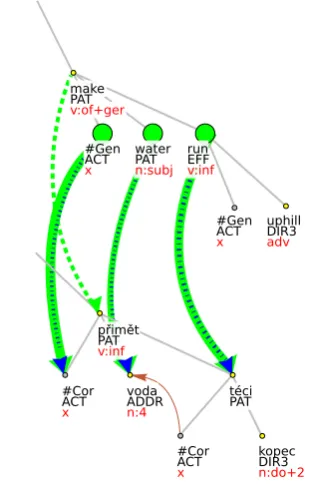
Contrary to the ECM constructions, object control verbs constructions (OCV), involving verbs such as make, cause, or get, are analyzed strictly as double-object in both languages, i.e., the interven-ing NP is dependent on the matrix verb (and li-censed by it) and there is usually a co-referential empty element of some kind in the valency struc-ture of the dependent verb form. OCV construc-tions are similarly frequent in Czech and English and their alignment in the PCEDT data is bal-anced, see Fig. 3.9
Interestingly, it is sometimes the case that En-glish control verbs in the treebank are trans-lated with non-control, non-catenative verbs on the Czech side, and the intervening NP is trans-formed to a dependent of the lower verb of the de-pendent clause (see Fig. 4), or even a more com-plex nominalization of the dependent structure is used.
The verb involved in this kind of translation shift may be either a more remote synonym, or a conversive verb.10
Such a translation shift brings about (at least a slight) semantic shift in the interpretation, usually in the sense of de-causativisation of the meaning (prompt→lead to).11Nevertheless, this type of
se-mantic shift does not prevent the use of the
struc-9In Fig. 3, EnglishACTofrundoes not show the
coref-erence link towatersince the annotation of coreferential re-lations has not yet been completed on the English side of the PCEDT, as opposed to the Czech side (cf. the coreference link fromACToftécitovoda).
10Semantic conversion in our understanding relates
differ-ent lexical units, or differdiffer-ent meanings of the same lexical unit, which share the same situational meaning. The valency frames of conversive verbs can differ in the number and type of valency complementations, their obligatoriness or mor-phemic forms. Prototypically, semantic conversion involves permutation of situational participants.
11Note that the de-causativisation process is possible
make PAT v:of+ger
#Gen ACT x
water PAT n:subj
run EFF v:inf
#Gen ACT x
uphill DIR3 adv
#Cor ACT x
přimět PAT v:inf
voda ADDR n:4
#Cor ACT x
téci PAT
kopec DIR3 n:do+2
[image:5.595.74.230.72.316.2]En: ...making water run... Cz: ...pˇrimˇet vodu téct...
Figure 3: Alignment of the control verbs’ argu-ments
ture as a sufficiently equivalent expression of the semantic content. We approach this as an inherent property of (any) language to suppress certain as-pects of meaning without losing the general sense of synonymity.
4.2 Complex Predication
By “complex predication” we mean a combination of two lexical units, usually a (semantically empty, or “light”) verb and a noun (carrying main lexi-cal meaning and marked withCPHRfunctor in the data), forming a predicate with a single semantic reference, e.g., to make an announcement, to un-dertake preparations, to get an order. There are some direct consequences for the syntactically an-notated parallel data.
First type of zero alignment is connected to the fact that a complex predication in one language can be easily translated with a one-word reference, and consequently aligned to a one-word predica-tion, in the other language. This is quite a triv-ial case. In the data, then, one component of the complex predication remains unaligned. There are basically two ways of resolving such cases: either one can align the light verb with the full verb in the other language, or one can align the full verb
fact ACT n:subj
also RHEM x
make PRED v:fin
profit PAT n:attr
picture PAT n:subj
look EFF v:inf
#Cor ACT x
better PAT adv
skutečnost ACT n:1
také RHEM x
způsobovat PRED v:fin
ziskový RSTR adj:attr
obraz ACT n:1
vypadat PAT v:že+fin
dobrý MANN adv
[image:5.595.312.512.73.249.2]En: The fact... ...will also make the profit picture look... Cz: Skuteˇcnost...zp˚usobuje, že ziskový obraz vypadá...
Figure 4: Alignment of English OCV with Czech non-OCV construction
with the dependent noun in the complex predica-tion, based on the similarity of semantic content. In the CzEngVallex, the decision was to align the verbs, reflecting the fact that the verb and the noun phrase form a single unit from the semantic point of view.
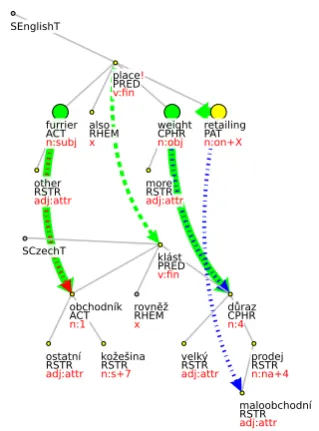
The second type of zero alignment is connected to the presence of a “third” valency argument within the complex predication structure, e.g., En:
placed weight on retailing - Cz: klást d˚uraz na
prodej, see Fig. 5.
Complex predicates have been annotated ac-cording to quite a complicated set of rules on the Czech side of the PCEDT data (for details, see (Mikulová et al., 2006)). Those rules include also the so-called dual function of a valency modifica-tion. There are two possible dependency positions for the “third” valency argument of the complex predicate: either it is modelled as the dependent of the semantically empty verb, or as a dependent of the nominal component. The decision between the two positions rely on multiple factors, such as valency structure of the semantically full use of the verb, valency structure of the noun in other contexts, behaviour of synonymous verbs etc. On the Czech side, the “third” valency argument was strongly preferred to be a dependent of the nomi-nal component.
SEnglishT
SCzechT other RSTR adj:attr
ostatní RSTR adj:attr furrier ACT n:subj
obchodník ACT n:1
also RHEM x
kožešina RSTR n:s+7
place! PRED v:fin
rovněž RHEM x
more RSTR adj:attr
klást PRED v:fin weight CPHR n:obj
velký RSTR adj:attr
retailing PAT n:on+X
důraz CPHR n:4
maloobchodní RSTR adj:attr
prodej RSTR n:na+4
[image:6.595.110.270.64.280.2]En: Other furriers have also placed more weight on retailing. Cz: Ostatní obchodníci s kožešinami rovnˇež kladou vˇetší d˚uraz na maloobchodní prodej.
Figure 5: Mismatch due to complex predication solution
(probably due to lower confidence of non-native speaker annotators in judging verb valency issues). There is probably no chance of dealing with the dependencies in one of the two above stated ways only. The class of complex predicates in the data is wide and heterogeneous with respect to semantic and morphosyntactic qualities. Nevertheless, the data suggest several points of interesting inconsis-tencies stemming from the imperfection or lack of reliability of the theoretical guidelines. For exam-ple, the dependency of the valency complementa-tion of the complex predicate klást d˚uraz ‘place emphasis’, as can be seen in Fig. 5, is solved as a dependency on the nominal component, whereas in the complex predicate klást požadavek ‘place claim’, the valency lexicon entry involves a direct dependency on the verb. Keeping in mind that the verbklást‘to place’ has three arguments in its se-mantically full occurrences, we would expect di-rect dependency on the verb in both cases.
4.3 Conversive Verbs
A considerable number of unaligned arguments in the data is caused by the translator’s choice of a verb in a conversive relation to the verb used in the original language. For some reason (e.g., fre-quency of the verbal lexical unit, topic-focus artic-ulation etc.), the translator decides not to use the
syntactically most similar lexical unit, but uses a conversive one (cf. also Sect. 4.1.2), thus caus-ing the arguments to relocate in the deep syntactic structure, see Fig. 6.
SEnglishT
SCzechT #PersPron APP
n:poss
#PersPron PAT
adj:poss
election ACT
n:subj
zvolení MEANS
n:7
increase PRED
v:fin
#Gen ACT
x
ryder APP
n:poss
počet ACT
n:1
board PAT
n:obj
člen RSTR
n:2
14 RSTR
adj:attr
member EFF
n:to+X
rada RSTR
n:2
zvýšit_se PRED
v:fin
14 PAT
n:na+4
[image:6.595.316.500.140.406.2]En: His election increases Ryder’s board to 14 members. Cz: Jeho zvolením se poˇcet ˇclen˚u správní rady spoleˇcnosti Ryder zvýšíl na 14.
Figure 6: Mismatch due to the the use of conver-sive verbs
The relocation of arguments frequently goes together with backgrounding of one of the ar-guments, which then either disappears from the translation, or is transformed into an adjunct, or into a dependent argument embedded even lower in the structure.
The first argument (actant)12 in the FGD
ap-proach is strongly underspecified. It is mostly de-limited by its position in the tectogrammatic anno-tation. Its prevalent morphosyntactic realization is nominative case, but certain exceptions are recog-nized (verbs of feeling etc.). Also, theACT posi-tion (first actant) is subject to the process called “shifting of cognitive roles” (Panevová, 1974), i.e., other semantic roles can take the nominative case and the corresponding place in the structure
12Under the term “actant”, FGDVT distinguishes five core
constituting valency complementations, ACT, PAT, ADDR,
in case there is no semantic agent in the structure. Thus we get semantically quite different elements (e.g., +anim vs. -anim) in theACTposition, even with formally identical verb instances, see the En-glish side of Figs. 7 and 8.
SEnglishT
SCzechT mr. RSTR
n:attr
Wertheimer ACT
n:1
wertheimer ACT
n:subj
Keating ACT
n:2
base!
PRED
v:fin
opírat_se PRED
v:fin
this PAT
n:obj
prohlášení PAT
n:o+4
statement ORIG_CO
n:on+X
mr. RSTR
n:attr
keating ACT
n:by+X
#Colon ORIG(APPS) x
En: Mr. Wertheimer based this on a statement by Mr. Keat-ing...
[image:7.595.329.491.70.262.2]Cz: Wertheimer se opírá o prohlášení Keatinga...
Figure 7: Conflict due to the underspecification of the ACT position
This formal feature of the FGDVT gives rise to a number of conflicts in the parallel structures considering structures that undergo semantic de-agentization or (milder) de-concretization of the agent.
Here the question arises, whether such verb in-stances correspond to different meanings of the verb (represented by different verb frames), or whether they correspond to a single meaning (rep-resented by a single valency frame). It is often the case, that the Czech data tend to overgeneralize the valency frames through considering the different instances as realizations of a single deep syntactic valency frame, when there is no other modification intervening in the frame. Therefore, this approach chosen for the Czech annotation sometimes shows a conflict, as in Fig. 7.
The valency structure for both instances ofbase
is identical, only in the first case, the verb is used in active voice, whereas in the second case, it takes passive morphology. There are three semantic
ar-SEnglishT
SCzechT report PAT
n:subj
zpráva ACT
n:1
base PRED
v:fin
opírat_se PRED
v:fin
#Gen ACT
x
výzkum PAT_CO
n:o+4
survey ORIG_CO
n:on+X
survey ORIG_CO
n:on+X
výzkum PAT_CO
n:o+4
and ORIG(CONJ)
x
interview ORIG_CO
n:on+X
a PAT(CONJ)
x
rozhovor PAT_CO
n:o+4
En: The report was based on a telephone survey... Cz: Zpráva se opírá o telefonický výzkum...
Figure 8: Original collect for the verbsbase and
opírat se
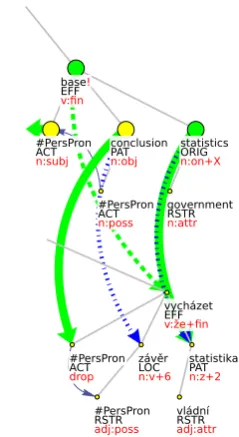
guments in the structure. We will call them the Person that expresses an opinion, the Expressed Opinion and the Resource for the opinion. The Person bases the Expressed Opinion on the Re-source. With the English verb, the Expressed Opinion always takes thePATposition and the Re-source the ORIGin position in the valency struc-ture. On the other hand, on the Czech side of the data, there is a conflict. In both cases, there are seemingly only two arguments. In the first case, the Expressed Opinion is sort of backgrounded from the semantic structure. If there were a need of overtizing it, it would probably appear with locative morphology, as an adjunct: Wertheimer
se v tomto opírá o prohlášení... ‘Wertheimer in
this relies on a statement’ (see also an authentic example from the data in Fig. 9). In the sec-ond case, on the other hand, the structure follows the passivized English structure in backgrounding the Person (note that thesemorpheme does NOT stand for a passive morphology here). If there were a need for expressing the Person, it would probably appear as a specifying dependent to the ACT position: Jejich zpráva se opírá o
telefon-ický výzkum. ‘Their report is based on a phone
[image:7.595.76.226.154.374.2]#PersPron ACT
n:subj
base!
EFF
v:fin
#PersPron ACT
n:poss
#PersPron ACT
drop
conclusion PAT
n:obj
#PersPron RSTR
adj:poss
government RSTR
n:attr
závěr LOC
n:v+6
statistics ORIG
n:on+X
vycházet EFF
v:že+fin
vládní RSTR
adj:attr
statistika PAT
n:z+2
[image:8.595.75.195.66.285.2]En: ...they based their conclusions on government statistics. Cz: ...vycházejí z vládních statistik.
Figure 9: Original collect for the verbs base and vycházet with LOC argument linked to PAT
in a corresponding manner to show the Expressed Opinion argument in theACTposition and the Per-son backgrounded from the structure, see (3):
(3) a. Wertheimer
WertheimerseREFLvein svémhis názoruopinionopíráleansoto prohlášení
the statementKeatinga.by Keating b. Wertheimer˚uv
Wertheimer’s názoropinionseREFLopíráleansoto prohlášení
the statementKeatinga.by Keating c. Wertheimer
Wertheimeropíráleanssv˚ujhis názoropinionoto prohlášení
the statementKeatinga.by Keating
The problem of the status of a Czech verbal-adjoiningse-morpheme is a complex one and there is no clear scientific consensus in this respect. The
se-morpheme in Czech has a variety of functions, e.g., a passivization morpheme for the so-called “reflexive passive” form, a “dispositional diathe-sis” morpheme, a reflexive morpheme for lexical derivation of impersonal verbal variants, or an ac-cusative reflexive pronoun.
These variants differ with respect to the way they are reflected in the data and in the lexicon. Some are treated as individual verb lemmas, some as surface variants of a common non-reflexive lemma.
The conflicts in annotation have a substantial reason – the ways in which English and Czech express backgrounding of the agent are multiple and they differ across the languages. Czech uses these-morphemization often, in order to preserve the topic focus articulation (information) struc-ture, whereas English does not have such a mor-pheme to work with, so it often uses simple pas-sivization, or middle construction.
Moreover, the first valency position in Czech is often overgeneralized, allowing a multitude of semantically different arguments, which is, due to “economy of description”, sometimes not re-flected in the linguistic theory.
4.4 Arguments Mapped to Adjuncts
In the previous section, we have described the bilingual treebank data manifestation of the fact that languages have different means of express-ing a content, and we have noted that these can also variate between argument and adjunct inter-pretation. This variation appears both within a single language (one language expresses a largely synonymous content with either argument or ad-junct means) and across languages (a direct con-sequence of the former case: an argument (actant) in one language can be translated into another lan-guage using an adjunct construction). Lanlan-guages may differ in the preference for either of the pos-sibilities.
Observing such mismatches in a parallel tree-bank occasionally leads us to hesitate whether our interpretation of a word (or phrase) as an argu-ment or an adjunct is proper or justifiable. There may be two possible consequences drawn from the observation of a mismatch – either there are some (rather subtle) semantic reasons for structur-ing a word as an argument/adjunct, or there might be some imperfection in our theoretical thinking about the internal system of a particular language. The theoretical distinction between arguments and adjuncts is subject to serious debates in the world of linguistics (Hwang, 2011; Tutunjian and Boland, 2008), and so far there is no approach known to us that would overcome this problem easily. Still, we can see that the real data indicate some remarkable points that stand at the roots of the argument/adjunct distinction problem. Most prominently - the nature of the relation between the form of the argument and its semantics.
others) such as alignment of an actor with a tem-poral adjunct (4) or an actor with a causal adjunct (5), etc.
(4) Americans haven’t forgiven China’s leaders for the military assault of June 3-4 thatkilled hundreds, and perhaps thousands, of demonstrators.
a. Ameriˇcané
Americansneodpustilihaven’t forgottenChineseˇcínskýmv˚udc˚umleaders vojenský
military útokassaultzfrom3.-4.3-4 June,ˇcervna, pˇri kterém
during whichzahynulydied stovky,hundreds,možnámaybeieven tisíce
thousandsdemonstrant˚u.demonstrators
(5) The purchase will make Quebecor the second-largest commercial printer in North America.
a. Díky
Thanks totétothiskoupipurchaseseREFLspoleˇcnostthe company Quebecor
Quebecorstanewill becomedruhousecondnejvˇetšílargest komerˇcní
commercialtiskárnouprinter vinSeverníNorth Americe.America The interpretation of the argument in the above stated examples is driven mainly by its morpho-logical form, which is a surprising finding consid-ering that we are dealing with deep syntax, or even semantics.
It is believed that the form of the expression more or less mirrors its function in the language. The width of the paraphrasing range though, both within and across languages, leads us to question-ing whether it is appropriate to lay much stress on the difference between arguments and adjuncts in the description of a language.
5 Conclusion
We have encountered several reasons for the pres-ence of a zero alignment in the data. Though these reasons have different grounds they tend to be in-terconnected in the language.
1. Language is flexible in paraphrasing linguis-tic content with different syntaclinguis-tic means. Even pairs of sentences which include se-mantic backgrounding or foregrounding of different arguments are easily interpreted as synonymous.
2. It is possible to use predicates that are in a conversive relation, or predicates of different complexity.
3. The backgrounding and foregrounding of ar-guments leads to syntactic relocation of other arguments in the structure, and consequently
to the shift in their morphosyntactic proper-ties, to the shift in their valency status, or even to their complete disappearance from the structure.
4. The FGD, having been built on a morpholog-ically rich Czech language, relies strongly on the morphosyntactic form of the individual arguments. Therefore, disproportions of the zero alignment or argument mismatch kind must appear when it is applied to other lan-guages with different typological properties.
Points 1, 2 and 3 belong among inherent deeply rooted properties of (perhaps any) natural lan-guage. Such differences are not to be overcome by means of possible theoretical unification of de-scription.
Point 4, on the other hand, belongs to the prop-erties of a certain linguistic theory. We will leave it open, whether it were appropriate to change the very roots of a linguistic theory in order to make it more flexible for use across different languages. Nevertheless, it appears that it is at least possible to change those aspects that cause individual and otherwise unjustifiable conflicts in the data.
Acknowledgements
This work has been supported by the grant GP13-03351P of the Grant Agency of the Czech Rep.
References
P. Baranˇcíková, R. Rosa, and A. Tamchyna. 2014. Im-proving Evaluation of English-Czech MT through Paraphrasing. In N. Calzolari, K. Choukri, T. De-clerck, H. Loftsson, B. Maegaard, and J. Mariani, editors,Proceedings of the 9th International Confer-ence on Language Resources and Evaluation (LREC 2014), pages 596–601, Reykjavík, Iceland. Euro-pean Language Resources Association.
O. Bojar, M. Macháˇcek, A. Tamchyna, and D. Zeman. 2013. Scratching the surface of possible
transla-tions. In Text, Speech, and Dialogue, pages 465–
474. Springer.
S. Cinková. 2006. From PropBank to EngValLex: adapting the PropBank-Lexicon to the valency the-ory of the functional generative description. In Proceedings of the fifth International conference on Language Resources and Evaluation (LREC 2006), Genova, Italy.
M. Denkowski and A. Lavie. 2010. Meteor-next and the meteor paraphrase tables: Improved evaluation
of the Joint Fifth Workshop on Statistical Machine Translation and MetricsMATR, pages 339–342. As-sociation for Computational Linguistics.
B. J. Dorr, R. Green, L. Levin, O. Rambow, D. Far-well, N. Habash, S. Helmreich, E. Hovy, K.J. Miller, T. Mitamura, et al. 2004. Semantic annotation and lexico-syntactic paraphrase. Proceedings of the 4th International Conference on Language Resources and Evaluation (LREC) Workshop on Building Lex-ical Resources from SemantLex-ically Annotated Cor-pora, pages 47 – 52.
O. Dušek, J. Hajiˇc, and Z. Urešová. 2014. Verbal va-lency frame detection and selection in Czech and
English. In The 2nd Workshop on EVENTS:
Defi-nition, Detection, Coreference, and Representation, pages 6–11, Stroudsburg, PA, USA. Association for Computational Linguistics.
O. Dušek, E. Fuˇcíková, J. Hajiˇc, M. Popel, J. Šindlerová, and Z. Urešová. 2015. Using Par-allel Texts and Lexicons for Verbal Word Sense
Disambiguation. In Proceedings of the Third
In-ternational Conference on Dependency Linguistics, Depling 2015, page this volume. Uppsala Univer-sity.
J. Ganitkevitch, B. Van Durme, and Ch. Callison-Burch. 2013. PPDB: The paraphrase database. In Proceedings of NAACL-HLT, pages 758–764, At-lanta, Georgia, June. Association for Computational Linguistics.
J. Hajiˇc, E. Hajiˇcová, J. Panevová, P. Sgall, O. Bo-jar, S. Cinková, E. Fuˇcíková, M. Mikulová, P. Pajas, J. Popelka, J. Semecký, J. Šindlerová, J. Štˇepánek, J. Toman, Z. Urešová, and Z. Žabokrtský. 2012. Announcing Prague Czech-English Dependency
Treebank 2.0. InProceedings of LREC, pages 3153–
3160.
J. Hajiˇc, J. Panevová, Z. Urešová, A. Bémová, V. Koláˇrová, and P. Pajas. 2003. PDT-Vallex: Creat-ing a Large-coverage Valency Lexicon for Treebank
Annotation. In Proceedings of The Second
Work-shop on Treebanks and Linguistic Theories, vol-ume 9, page 57–68.
J. Hajiˇc, J. Panevová, E. Hajiˇcová, P. Sgall, P. Pajas, J. Štˇepánek, J. Havelka, M. Mikulová, Z. Žabokrt-ský, M. Ševˇcíková Razímová, and Z. Urešová.
2006. Prague Dependency Treebank 2.0.
Num-ber LDC2006T01. Linguistic Data Consortium, Philadelphia, PA, USA.
J. D. Hwang. 2011. Making verb argument adjunct distinctions in English. Synthesis paper, University of Colorado, Boulder, Colorado.
M. P. Marcus, B. Santorini, and M. A. Marcinkiewicz. 1993. Building a Large Annotated Corpus of
En-glish: The Penn Treebank. COMPUTATIONAL
LINGUISTICS, 19(2):313–330.
M. Mikulová, A. Bémová, J. Hajiˇc, E. Hajiˇcová, J. Havelka, V. Koláˇrová, L. Kuˇcová, M. Lopatková, P. Pajas, J. Panevová, M. Razímová, P. Sgall, J. Štˇepánek, Z. Urešová, K. Veselá, and Z. Žabokrt-ský. 2006. Annotation on the tectogrammatical level in the Prague Dependency Treebank. Annota-tion manual. Technical Report 30, Prague, Czech Rep.
M. Palmer, D. Gildea, and P. Kingsbury. 2005. The proposition bank: An annotated corpus of semantic roles.Computational Linguistics, 31(1):71–106.
J. Panevová. 1974. On verbal Frames in Functional
Generative Description. Prague Bulletin of
Mathe-matical Linguistics, 22:3–40.
J. Panevová. 1996. More remarks on control. Prague
Linguistic Circle Papers, 2(1):101–120.
A. Przepiórkowski and A. Rosen. 2005. Czech and Polish raising/control with or without structure shar-ing. 3:33–66.
M. Sanguinetti, C. Bosco, and L. Lesmo. 2013. De-pendency and constituency in translation shift
anal-ysis. DepLing 2013, page 282.
P. Sgall, E.Hajiˇcová, and J. Panevová. 1986. The
Meaning of the Sentence in Its Semantic and
Prag-matic Aspects. Dordrecht, Reidel, and Prague,
Academia, Prague.
D. Tutunjian and J. E. Boland. 2008. Do we need a distinction between arguments and adjuncts? Evi-dence from psycholinguistic studies of
comprehen-sion.Language and Linguistics Compass, 2(4):631–
646.
Z. Urešová, E. Fuˇcíková, and J. Šindlerová. 2015. CzEngVallex: Mapping Valency between
Lan-guages. Technical Report TR-2015-58, Charles
University in Prague, Institute of Formal and
Ap-plied Lingustics, Prague. To appear at http://
ufal.mff.cuni.cz/techrep/tr58.pdf.
Z. Urešová, O. Dušek, E. Fuˇcíková, J. Hajiˇc, and J. Šindlerová. 2015b. Bilingual English-Czech
va-lency lexicon linked to a parallel corpus. In
Pro-ceedings of the The 9th Linguistic Annotation Work-shop (LAW IX 2015), Stroudsburg, PA, USA. Asso-ciation for Computational Linguistics.
Z. Urešová. 2011. Valenˇcní slovník Pražského
závis-lostního korpusu (PDT-Vallex). Studies in Compu-tational and Theoretical Linguistics. Ústav formální a aplikované lingvistiky, Praha, Czechia.
Z. Urešová, O. Dušek, E. Fuˇcíková, J. Hajiˇc, and J. Šindlerová. 2015a. Bilingual English-Czech
Va-lency Lexicon Linked to a Parallel Corpus. In