KenLM: Faster and Smaller Language Model Queries
Kenneth Heafield Carnegie Mellon University
5000 Forbes Ave Pittsburgh, PA 15213 USA [email protected]
Abstract
We present KenLM, a library that imple-ments two data structures for efficient lan-guage model queries, reducing both time and memory costs. The PROBING data structure uses linear probing hash tables and is de-signed for speed. Compared with the widely-used SRILM, our PROBING model is 2.4 times as fast while using 57% of the mem-ory. The TRIE data structure is a trie with bit-level packing, sorted records, interpola-tion search, and opinterpola-tional quantizainterpola-tion aimed at lower memory consumption. TRIE simul-taneously uses less memory than the small-est lossless baseline and less CPU than the fastest baseline. Our code is open-source1,
thread-safe, and integrated into the Moses, cdec, and Joshua translation systems. This paper describes the several performance tech-niques used and presents benchmarks against alternative implementations.
1 Introduction
Language models are widely applied in natural lan-guage processing, and applications such as machine translation make very frequent queries. This pa-per presents methods to query N-gram language models, minimizing time and space costs. Queries take the formp(wn|w1n−1)wherew1nis ann-gram.
Backoff-smoothed models estimate this probability based on the observed entry with longest matching
1http://kheafield.com/code/kenlm
historywfn, returning
p(wn|w1n−1) =p(wn|wfn−1) f−1
Y
i=1
b(win−1). (1)
where the probability p(wn|wfn−1) and backoff penaltiesb(wni−1)are given by an already-estimated model. The problem is to store these two values for a large and sparse set ofn-grams in a way that makes queries efficient.
Many packages perform language model queries. Throughout this paper we compare with several packages:
SRILM 1.5.12 (Stolcke, 2002) is a popular toolkit based on tries used in several decoders.
IRSTLM 5.60.02 (Federico et al., 2008) is a sorted trie implementation designed for lower mem-ory consumption.
MITLM 0.4 (Hsu and Glass, 2008) is mostly de-signed for accurate model estimation, but can also compute perplexity.
RandLM 0.2 (Talbot and Osborne, 2007) stores large-scale models in less memory using ran-domized data structures.
BerkeleyLM revision 152 (Pauls and Klein, 2011) implements tries based on hash tables and sorted arrays in Java with lossy quantization.
Sheffield Guthrie and Hepple (2010) explore sev-eral randomized compression techniques, but did not release code.
TPT Germann et al. (2009) describe tries with bet-ter locality properties, but did not release code.
These packages are further described in Section 3. We substantially outperform all of them on query
speed and offer lower memory consumption than lossless alternatives. Performance improvements transfer to the Moses (Koehn et al., 2007), cdec (Dyer et al., 2010), and Joshua (Li et al., 2009) translation systems where our code has been inte-grated. Our open-source (LGPL) implementation is also available for download as a standalone package with minimal (POSIX and g++) dependencies.
2 Data Structures
We implement two data structures: PROBING, de-signed for speed, and TRIE, optimized for mem-ory. The set of n-grams appearing in a model is sparse, and we want to efficiently find their associ-ated probabilities and backoff penalties. An impor-tant subproblem of language model storage is there-fore sparse mapping: storing values for sparse keys using little memory then retrieving values given keys using little time. We use two common techniques, hash tables and sorted arrays, describing each before the model that uses the technique.
2.1 Hash Tables and PROBING
Hash tables are a common sparse mapping technique used by SRILM’s default and BerkeleyLM’s hashed variant. Keys to the table are hashed, using for ex-ample Austin Appleby’s MurmurHash2, to integers evenly distributed over a large range. This range is collapsed to a number of buckets, typically by tak-ing the hash modulo the number of buckets. Entries landing in the same bucket are said to collide.
Several methods exist to handle collisions; we use linear probing because it has less memory overhead when entries are small. Linear probing places at most one entry in each bucket. When a collision oc-curs, linear probing places the entry to be inserted in the next (higher index) empty bucket, wrapping around as necessary. Therefore, a populated probing hash table consists of an array of buckets that contain either one entry or are empty. Non-empty buckets contain an entry belonging to them or to a preceding bucket where a conflict occurred. Searching a prob-ing hash table consists of hashprob-ing the key, indexprob-ing the corresponding bucket, and scanning buckets un-til a matching key is found or an empty bucket is
2http://sites.google.com/site/murmurhash/
encountered, in which case the key does not exist in the table.
Linear probing hash tables must have more buck-ets than entries, or else an empty bucket will never be found. The ratio of buckets to entries is controlled by space multiplier m > 1. As the name implies, space isO(m) and linear in the number of entries. The fraction of buckets that are empty ismm−1, so av-erage lookup time isOmm−1and, crucially, con-stant in the number of entries.
When keys are longer than 64 bits, we conserve space by replacing the keys with their 64-bit hashes. With a good hash function, collisions of the full 64-bit hash are exceedingly rare: one in 266 billion queries for our baseline model will falsely find a key not present. Collisions between two keys in the table can be identified at model building time. Further, the special hash 0 suffices to flag empty buckets.
The PROBING data structure is a rather straight-forward application of these hash tables to storeN -gram language models. Uni-gram lookup is dense so we use an array of probability and backoff values. For2≤n≤N, we use a hash table mapping from then-gram to the probability and backoff3. Vocab-ulary lookup is a hash table mapping from word to vocabulary index. In all cases, the key is collapsed to its 64-bit hash. Given countscn
1 where e.g. c1 is
the vocabulary size, total memory consumption, in bits, is
(96m+ 64)c1+ 128m
N−1
X
n=2
cn+ 96mcN.
Our PROBING data structure places all n-grams of the same order into a single giant hash table. This differs from other implementations (Stolcke, 2002; Pauls and Klein, 2011) that use hash tables as nodes in a trie, as explained in the next section. Our implementation permits jumping to anyn-gram of any length with a single lookup; this appears to be unique among language model implementations.
2.2 Sorted Arrays and TRIE
Sorted arrays store key-value pairs in an array sorted by key, incurring no space overhead. SRILM’s com-pact variant, IRSTLM, MITLM, and BerkeleyLM’s
sorted variant are all based on this technique. Given a sorted array A, these other packages use binary search to find keys in O(log|A|) time. We re-duce this toO(log log|A|)time by evenly distribut-ing keys over their range then usdistribut-ing interpolation search4(Perl et al., 1978). Interpolation search
for-malizes the notion that one opens a dictionary near the end to find the word “zebra.” Initially, the algo-rithm knows the array begins atb ← 0and ends at e← |A| −1. Given a keyk, it estimates the position
pivot← k−A[b]
A[e]−A[b](e−b).
If the estimate is exact (A[pivot] = k), then the al-gorithm terminates succesfully. If e < b then the key is not found. Otherwise, the scope of the search problem shrinks recursively: if A[pivot] < k then this becomes the new lower bound: l ← pivot; if A[pivot]> kthenu← pivot. Interpolation search is therefore a form of binary search with better esti-mates informed by the uniform key distribution.
If the key distribution’s range is also known (i.e. vocabulary identifiers range from 0 to the number of words), then interpolation search can use this in-formation instead of readingA[0]andA[|A| −1]to estimate pivots; this optimization alone led to a 24% speed improvement. The improvement is due to the cost of bit-level reads and avoiding reads that may fall in different virtual memory pages.
Vocabulary lookup is a sorted array of 64-bit word hashes. The index in this array is the vocabulary identifier. This has the effect of randomly permuting vocabulary identifiers, meeting the requirements of interpolation search when vocabulary identifiers are used as keys.
While sorted arrays could be used to implement the same data structure as PROBING, effectively makingm = 1, we abandoned this implementation because it is slower and larger than a trie implemen-tation. The trie data structure is commonly used for language modeling. Our TRIEimplements the pop-ular reverse trie, in which the last word of ann-gram is looked up first, as do SRILM, IRSTLM’s inverted variant, and BerkeleyLM except for the scrolling variant. Figure 1 shows an example. Nodes in the
4
Not to be confused with interpolating probabilities, which is outside the scope of this paper.
Australia <s> are
one
are
is Australia is Australia <s> <s>
of one
are
[image:3.612.356.500.56.179.2]is
Figure 1: Lookup of “is one of” in a reverse trie. Children of each node are sorted by vocabulary identifier so order is consistent but not alphabetical: “is” always appears be-fore “are”. Nodes are stored in column-major order. For example, nodes corresponding to these n-grams appear in this order: “are one”, “<s>Australia”, “is one of”, “are one of”, “<s>Australia is”, and “Australia is one”.
trie are based on arrays sorted by vocabulary identi-fier.
We maintain a separate array for each length n containing alln-gram entries sorted in suffix order. Therefore, for n-gram wn1, all leftward extensions wn0 are an adjacent block in then+ 1-gram array. The record forwn1 stores the offset at which its ex-tensions begin. Reading the following record’s off-set indicates where the block ends. This technique was introduced by Clarkson and Rosenfeld (1997) and is also implemented by IRSTLM and Berke-leyLM’s compressed option. SRILM inefficiently stores 64-bit pointers.
Unigram records store probability, backoff, and an index in the bigram table. Entries for2≤n < N store a vocabulary identifier, probability, backoff, and an index into then+ 1-gram table. The highest-order N-gram array omits backoff and the index, since these are not applicable. Values in the trie are minimally sized at the bit level, improving memory consumption over trie implementations in SRILM, IRSTLM, and BerkeleyLM. Given n-gram counts
{cn}Nn=1, we usedlog2c1ebits per vocabulary
iden-tifier and dlog2cne per index into the table of n -grams.
-gram suffix. This causes a problem for reverse trie implementations, including SRILM itself, because it leavesn+1-grams without ann-gram node pointing to them. We resolve this problem by inserting an en-try with probability set to an otherwise-invalid value (−∞). Queries detect the invalid probability, using the node only if it leads to a longer match. By con-trast, BerkeleyLM’s hash and compressed variants will return incorrect results based on ann−1-gram.
2.2.1 Quantization
Floating point values may be stored in the trie ex-actly, using 31 bits for non-positive log probability and 32 bits for backoff5. To conserve memory at the expense of accuracy, values may be quantized usingq bits per probability andr bits per backoff6. We allow any number of bits from2 to 25, unlike IRSTLM (8bits) and BerkeleyLM (17−20bits). To quantize, we use the binning method (Federico and Bertoldi, 2006) that sorts values, divides into equally sized bins, and averages within each bin. The cost of storing these averages, in bits, is
[32(N−1)2q+ 32(N −2)2r
Because there are comparatively few unigrams, we elected to store them byte-aligned and unquan-tized, making every query faster. Unigrams also have 64-bit overhead for vocabulary lookup. Using cn to denote the number ofn-grams, total memory consumption of TRIE, in bits, is
(32 + 32 + 64 + 64)c1+
N−1
X
n=2
(dlog2c1e+q+r+dlog2cn+1e)cn+
(dlog2c1e+q)cN
plus quantization tables, if used. The size of TRIE is particularly sensitive todlog2c1e, so vocabulary
filtering is quite effective at reducing model size.
3 Related Work
SRILM (Stolcke, 2002) is widely used within academia. It is generally considered to be fast (Pauls
5
Backoff “penalties” are occasionally positive in log space. 6One probability is reserved to mark entries that SRILM pruned. Two backoffs are reserved for Section 4.1. That leaves
2q−1probabilities and2r−2non-zero backoffs.
and Klein, 2011), with a default implementation based on hash tables within each trie node. Each trie node is individually allocated and full 64-bit point-ers are used to find them, wasting memory. The compact variant uses sorted arrays instead of hash tables within each node, saving some memory, but still stores full 64-bit pointers. With some minor API changes, namely returning the length of then-gram matched, it could also be faster—though this would be at the expense of an optimization we explain in Section 4.1. The PROBING model was designed to improve upon SRILM by using linear probing hash tables (though not arranged in a trie), allocat-ing memory all at once (eliminatallocat-ing the need for full pointers), and being easy to compile.
IRSTLM (Federico et al., 2008) is an open-source toolkit for building and querying language models. The developers aimed to reduce memory consump-tion at the expense of time. Their default variant im-plements a forward trie, in which words are looked up in their natural left-to-right order. However, their inverted variant implements a reverse trie using less CPU and the same amount of memory7. Each trie node contains a sorted array of entries and they use binary search. Compared with SRILM, IRSTLM adds several features: lower memory consumption, a binary file format with memory mapping, caching to increase speed, and quantization. Our TRIE im-plementation is designed to improve upon IRSTLM using a reverse trie with improved search, bit level packing, and stateful queries. IRSTLM’s quantized variant is the inspiration for our quantized variant. Unfortunately, we were unable to correctly run the IRSTLM quantized variant. The developers sug-gested some changes, such as building the model from scratch with IRSTLM, but these did not resolve the problem.
Our code has been publicly available and inter-grated into Moses since October 2010. Later, Berke-leyLM (Pauls and Klein, 2011) described ideas sim-ilar to ours. Most similar is scrolling queries, wherein left-to-right queries that add one word at a time are optimized. Both implementations em-ploy a state object, opaque to the application, that carries information from one query to the next; we
discuss both further in Section 4.2. State is imple-mented in their scrolling variant, which is a trie an-notated with forward and backward pointers. The hash variant is a reverse trie with hash tables, a more memory-efficient version of SRILM’s default. While the paper mentioned a sorted variant, code was never released. The compressed variant uses block compression and is rather slow as a result. A direct-mapped cache makes BerkeleyLM faster on repeated queries, but their fastest (scrolling) cached version is still slower than uncached PROBING, even on cache-friendly queries. For all variants, we found that BerkeleyLM always rounds the floating-point mantissa to 12 bits then stores indices to unique rounded floats. The 1-bit sign is almost always neg-ative and the 8-bit exponent is not fully used on the range of values, so in practice this corresponds to quantization ranging from 17 to 20 total bits.
Lossy compressed models RandLM (Talbot and Osborne, 2007) and Sheffield (Guthrie and Hepple, 2010) offer better memory consumption at the ex-pense of CPU and accuracy. These enable much larger models in memory, compensating for lost accuracy. Typical data structures are generalized Bloom filters that guarantee a customizable prob-ability of returning the correct answer. Minimal perfect hashing is used to find the index at which a quantized probability and possibly backoff are stored. These models generally outperform our memory consumption but are much slower, even when cached.
4 Optimizations
In addition to the optimizations specific to each data-structure described in Section 2, we implement sev-eral gensev-eral optimizations for language modeling.
4.1 Minimizing State
Applications such as machine translation use lan-guage model probability as a feature to assist in choosing between hypotheses. Dynamic program-ming efficiently scores many hypotheses by exploit-ing the fact that anN-gram language model condi-tions on at mostN −1 preceding words. We call these N −1 words state. When two partial hy-potheses have equal state (including that of other features), they can be recombined and thereafter
ef-ficiently handled as a single packed hypothesis. If there are too many distinct states, the decoder prunes low-scoring partial hypotheses, possibly leading to a search error. Therefore, we want state to encode the minimum amount of information necessary to prop-erly compute language model scores, so that the de-coder will be faster and make fewer search errors.
We offer a state function s(w1n) = wnm where substringwnm is guaranteed to extend (to the right) in the same way that w1n does for purposes of language modeling. The state function is inte-grated into the query process so that, in lieu of the queryp(wn|w1n−1), the application issues query
p(wn|s(wn1−1))which also returns s(w1n). The
re-turned state s(w1n) may then be used in a follow-on query p(wn+1|s(wn1))that extends the previous
query by one word. These make left-to-right query patterns convenient, as the application need only provide a state and the word to append, then use the returned state to append another word, etc. We have modified Moses (Koehn et al., 2007) to keep our state with hypotheses; to conserve memory, phrases do not keep state. Syntactic decoders, such as cdec (Dyer et al., 2010), build state from null context then store it in the hypergraph node for later extension.
Language models that containwk1 must also con-tain prefixesw1i for 1 ≤ i ≤ k. Therefore, when the model is queried forp(wn|w1n−1)but the longest
matching suffix iswfn, it may return states(wn1) = wnf since no longer context will be found. IRSTLM and BerkeleyLM use this state function (and a limit ofN−1words), but it is more strict than necessary, so decoders using these packages will miss some re-combination opportunities.
State will ultimately be used as context in a sub-sequent query. If the contextwnf will never extend to the right (i.e.wfnvis not present in the model for all wordsv) then no subsequent query will match the full context. If the log backoff of wnf is also zero (it may not be in filtered models), then wf should be omitted from the state. This logic applies recur-sively: if wfn+1 similarly does not extend and has zero log backoff, it too should be omitted, termi-nating with a possibly empty context. We indicate whether a context with zero log backoff will extend using the sign bit:+0.0 for contexts that extend and
SRILM performs a second lookup in its trie whereas our approach has minimal additional cost.
4.2 Storing Backoff in State
Section 4.1 explained that statesis stored by appli-cations with partial hypotheses to determine when they can be recombined. In this section, we ex-tend state to optimize left-to-right queries. All lan-guage model queries issued by machine translation decoders follow a left-to-right pattern, starting with either the begin of sentence token or null context for mid-sentence fragments. Storing state therefore be-comes a time-space tradeoff; for example, we store state with partial hypotheses in Moses but not with each phrase.
To optimize left-to-right queries, we extend state to store backoff information:
s(wn1−1) =wmn−1,
b(win−1) ni=−m1
where m is the minimal context from Section 4.1 andbis the backoff penalty. Becausebis a function, no additional hypothesis splitting happens.
As noted in Section 1, our code finds the longest matching entry wnf for query p(wn|s(wn1−1)) then
computes
p(wn|wn1−1) =p(wn|wfn−1) f−1
Y
i=1
b(wni−1).
The probability p(wn|wnf−1)is stored with wnf and the backoffs are immediately accessible in the pro-vided states(w1n−1).
When our code walks the data structure to find wnf, it visitswnn, wnn−1, . . . , wfn. Each visited entry wni stores backoff b(win). These are written to the states(w1n)and returned so that they can be used for the following query.
Saving state allows our code to walk the data structure exactly once per query. Other packages walk their respective data structures once to findwfn
and again to find {b(win−1)}fi=1−1 if necessary. In both cases, SRILM walks its trie an additional time to minimize context as mentioned in Section 4.1.
BerkeleyLM uses states to optimistically search for longer n-gram matches first and must perform twice as many random accesses to retrieve back-off information. Further, it needs extra pointers
in the trie, increasing model size by 40%. This makes memory usage comparable to our PROBING model. The PROBINGmodel can perform optimistic searches by jumping to anyn-gram without needing state and without any additional memory. However, this optimistic search would not visit the entries nec-essary to store backoff information in the outgoing state. Though we do not directly compare state im-plementations, performance metrics in Table 1 indi-cate our overall method is faster.
4.3 Threading
Only IRSTLM does not support threading. In our case multi-threading is trivial because our data struc-tures are read-only and uncached. Memory mapping also allows the same model to be shared across pro-cesses on the same machine.
4.4 Memory Mapping
Along with IRSTLM and TPT, our binary format is memory mapped, meaning the file and in-memory representation are the same. This is especially effec-tive at reducing load time, since raw bytes are read directly to memory—or, as happens with repeatedly used models, are already in the disk cache.
Lazy mapping reduces memory requirements by loading pages from disk only as necessary. How-ever, lazy mapping is generally slow because queries against uncached pages must wait for the disk. This is especially bad with PROBINGbecause it is based on hashing and performs random lookups, but it is not intended to be used in low-memory scenar-ios. TRIEuses less memory and has better locality. However, TRIEpartitions storage byn-gram length, so walking the trie reads N disjoint pages. TPT has theoretically better locality because it storesn -grams near their suffixes, thereby placing reads for a single query in the same or adjacent pages.
1 10 100
10 1000 100000 107
Lookups/
µ
s
[image:7.612.75.295.52.260.2]Entries probing hash set unordered interpolation binary search set
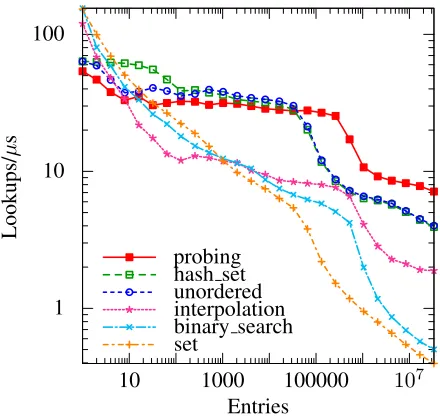
Figure 2: Speed in lookups per microsecond by data structure and number of 64-bit entries. Performance dips as each data structure outgrows the processor’s 12 MB L2 cache. Among hash tables, indicated by shapes, probing is initially slower but converges to 43% faster than un-ordered or hash set. Interpolation search has a more ex-pensive pivot function but does less reads and iterations, so it is initially slower than binary search and set, but be-comes faster above 4096 entries.
flag that is our default loading mechanism.
5 Benchmarks
This section measures performance on shared tasks in order of increasing complexity: sparse lookups, evaluating perplexity of a large file, and translation with Moses. Our test machine has two Intel Xeon E5410 processors totaling eight cores, 32 GB RAM, and four Seagate Barracuda disks in software RAID 0 running Linux 2.6.18.
5.1 Sparse Lookup
Sparse lookup is a key subproblem of language model queries. We compare three hash tables: our probing implementation, GCC’s hash set, and Boost’s8unordered. For sorted lookup, we compare
interpolation search, standard C++ binary search, and standard C++ set based on red-black trees. The data structure was populated with 64-bit inte-gers sampled uniformly without replacement. For queries, we uniformly sampled 10 million hits and
8http://boost.org
10 million misses. The same numbers were used for each data structure. Time includes all queries but ex-cludes random number generation and data structure population. Figure 2 shows timing results.
For the PROBING implementation, hash table sizes are in the millions, so the most relevant val-ues are on the right size of the graph, where linear probing wins. It also uses less memory, with 8 bytes of overhead per entry (we store 16-byte entries with m = 1.5); linked list implementations hash set and unordered require at least 8 bytes per entry for point-ers. Further, the probing hash table does only one random lookup per query, explaining why it is faster on large data.
Interpolation search has a more expensive pivot but performs less pivoting and reads, so it is slow on small data and faster on large data. This suggests a strategy: run interpolation search until the range narrows to 4096 or fewer entries, then switch to bi-nary search. However, reads in the TRIEdata struc-ture are more expensive due to bit-level packing, so we found that it is faster to use interpolation search the entire time. Memory usage is the same as with binary search and lower than with set.
5.2 Perplexity
For the perplexity and translation tasks, we used SRILM to build a 5-gram English language model on 834 million tokens from Europarl v6 (Koehn, 2005) and the 2011 Workshop on Machine Trans-lation News Crawl corpus with duplicate lines re-moved. The model was built with open vocabulary, modified Kneser-Ney smoothing, and default prun-ing settprun-ings that remove sprun-ingletons of order 3 and higher. Unlike Germann et al. (2009), we chose a model size so that all benchmarks fit comfortably in main memory. Benchmarks use the package’s bi-nary format; our code is also the fastest at building a binary file. As noted in Section 4.4, disk cache state is controlled by reading the entire binary file before each test begins. For RandLM, we used the settings in the documentation: 8 bits per value and false pos-itive probability 2561 .
from each query to the next. Table 1 shows results of the benchmark. Compared to decoding, this task is cache-unfriendly in that repeated queries happen only as they naturally occur in text. Therefore, per-formance is more closely tied to the underlying data structure than to the cache. In fact, we found that enabling IRSTLM’s cache made it slightly slower, so results in Table 1 use IRSTLM without caching. Moses sets the cache size parameter to 50 so we did as well; the resulting cache size is 2.82 GB.
The results in Table 1 show PROBING is 81% faster than TRIE, which is in turn 31% faster than the fastest baseline. Memory usage in PROBINGis high, though SRILM is even larger, so where memory is of concern we recommend using TRIE, if it fits in mem-ory. For even larger models, we recommend Ran-dLM; the memory consumption of the cache is not expected to grow with model size, and it has been reported to scale well. Another option is the closed-source data structures from Sheffield (Guthrie and Hepple, 2010). Though we are not able to calculate their memory usage on our model, results reported in their paper suggest lower memory consumption than TRIEon large-scale models, at the expense of CPU time.
5.3 Translation
This task measures how well each package performs in machine translation. We run the baseline Moses system for the French-English track of the 2011 Workshop on Machine Translation,9 translating the 3003-sentence test set. Based on revision 4041, we modified Moses to print process statistics before ter-minating. Process statistics are already collected by the kernel (and printing them has no meaning-ful impact on performance). SRILM’s compact vari-ant has an incredibly expensive destructor, dwarfing the time it takes to perform translation, and so we also modified Moses to avoiding the destructor by calling exit instead of returning normally. Since our destructor is an efficient call to munmap, by-passing the destructor favors only other packages. The binary language model from Section 5.2 and text phrase table were forced into disk cache before each run. Time starts when Moses is launched and therefore includes model loading time. These
con-9http://statmt.org/wmt11/baseline.html
Package Variant Queries/ms RAM (GB)
Ken
PROBING 1818 5.28
TRIE 1139 2.72
TRIE8 bitsa 1127 1.59
SRI Default 750 9.19
Compact 238 7.27
IRSTb Invert 426 2.91
Default 368 2.91
MIT Default 410 7.72+1.34c Rand Backoff 8 bitsa 56 1.30+2.82c
Berkeley
Hash+Scrolla 913 5.28+2.32d Hasha 767 3.71+1.72d Compresseda 126 1.73+0.71d
Estimates for unreleased packages
Sheffield C-MPHRa 607e
[image:8.612.313.547.82.304.2]TPT Default 357f
Table 1: Single-threaded speed and memory use on the perplexity task. The PROBINGmodel is fastest by a sub-stantial margin but generally uses more memory. TRIEis faster than competing packages and uses less memory than non-lossy competitors. The timing basis for Queries/ms in-cludes kernel and user time but exin-cludes loading time; we also subtracted time to run a program that just reads the query file. Peak virtual memory is reported; final resident memory is similar except for BerkeleyLM. We tried both aggressive reading and lazy memory mapping where appli-cable, but results were much the same.
a
Uses lossy compression.
bThe 8-bit quantized variant returned incorrect probabilities as
explained in Section 3. It did 402 queries/ms using 1.80 GB.
c
Memory use increased during scoring due to batch processing (MIT) or caching (Rand). The first value reports use immediately after loading while the second reports the increase during scoring.
dBerkeleyLM is written in Java which requires memory be
specified in advance. Timing is based on plentiful memory. Then we ran binary search to determine the least amount of memory with which it would run. The first value reports resident size af-ter loading; the second is the gap between post-loading resident memory and peak virtual memory. The developer explained that the loading process requires extra memory that it then frees.
e
Based on the ratio to SRI’s speed reported in Guthrie and Hepple (2010) under different conditions. Memory usage is likely much lower than ours.
fThe original paper (Germann et al., 2009) provided only 2s of
Time (m) RAM (GB)
Package Variant CPU Wall Res Virt
Ken
PROBING-L 72.3 72.4 7.83 7.92 PROBING-P 73.6 74.7 7.83 7.92 TRIE-L 80.4 80.6 4.95 5.24 TRIE-P 80.1 80.1 4.95 5.24 TRIE-L 8a 79.5 79.5 3.97 4.10 TRIE-P 8a 79.9 79.9 3.97 4.10
SRI Default 85.9 86.1 11.90 11.94 Compact 155.5 155.7 9.98 10.02
IRST
Cache-Invert-L 106.4 106.5 5.36 5.84 Cache-Invert-R 106.7 106.9 5.73 5.84 Invert-L 117.2 117.3 5.27 5.67 Invert-R 117.7 118.0 5.64 5.67 Default-L 126.3 126.4 5.26 5.67 Default-R 127.1 127.3 5.64 5.67
Rand Backoff
a 277.9 278.0 4.05 4.18
[image:9.612.318.532.53.200.2]Backoffb 247.6 247.8 4.06 4.18
Table 2: Single-threaded time and memory consumption of Moses translating 3003 sentences. Where applicable, models were loaded with lazy memory mapping (-L), prefaulting (-P), and normal reading (-R); results differ by at most than 0.6 minute.
aLossy compression with the same weights. b
Lossy compression with retuned weights.
ditions make the value appropriate for estimating re-peated run times, such as in parameter tuning. Table 2 shows single-threaded results, mostly for compar-ison to IRSTLM, and Table 3 shows multi-threaded results.
Part of the gap between resident and virtual mem-ory is due to the time at which data was collected. Statistics are printed before Moses exits and after parts of the decoder have been destroyed. Moses keeps language models and many other resources in static variables, so these are still resident in mem-ory. Further, we report current resident memory and peak virtual memory because these are the most ap-plicable statistics provided by the kernel.
Overall, language modeling significantly impacts decoder performance. In line with perplexity results from Table 1, the PROBINGmodel is the fastest fol-lowed by TRIE, and subsequently other packages. We incur some additional memory cost due to stor-ing state in each hypothesis, though this is minimal compared with the size of the model itself. The TRIE model continues to use the least memory of
Time (m) RAM (GB)
Package Variant CPU Wall Res Virt
Ken
PROBING-L 130.4 20.2 7.91 8.53 PROBING-P 132.6 21.7 7.91 8.41 TRIE-L 132.1 20.6 5.03 5.85 TRIE-P 132.2 20.5 5.02 5.84 TRIE-L 8a 137.1 21.2 4.03 4.60 TRIE-P 8a 134.6 20.8 4.03 4.72
SRI Default 153.2 26.0 11.97 12.56 Compact 243.3 36.9 10.05 10.55
Rand Backoff
a 346.8 49.4 5.41 6.78
[image:9.612.75.295.54.273.2]Backoffb 308.7 44.4 5.26 6.81
Table 3: Multi-threaded time and memory consumption of Moses translating 3003 sentences on eight cores. Our code supports lazy memory mapping (-L) and prefault-ing (-P) withMAP POPULATE, the default. IRST is not threadsafe. Time for Moses itself to load, including load-ing the language model and phrase table, is included. Along with locking and background kernel operations such as prefaulting, this explains why wall time is not one-eighth that of the single-threaded case.
a
Lossy compression with the same weights.
bLossy compression with retuned weights.
the non-lossy options. For RandLM and IRSTLM, the effect of caching can be seen on speed and mem-ory usage. This is most severe with RandLM in the multi-threaded case, where each thread keeps a separate cache, exceeding the original model size. As noted for the perplexity task, we do not ex-pect cache to grow substantially with model size, so RandLM remains a low-memory option. Caching for IRSTLM is smaller at 0.09 GB resident mem-ory, though it supports only a single thread. The BerkeleyLM direct-mapped cache is in principle faster than caches implemented by RandLM and by IRSTLM, so we may write a C++ equivalent imple-mentation as future work.
5.4 Comparison with RandLM
RAM (GB)
Pack Variant Time (m) Res Virt BLEU
Ken
TRIE 82.9 12.16 14.39 27.24 TRIE8 bits 82.7 8.41 9.41 27.22 TRIE4 bits 83.2 7.74 8.55 27.09
[image:10.612.73.299.55.140.2]Rand Stupid 8 bits 218.7 5.07 5.18 25.54 Backoff 8 bits 337.4 7.17 7.28 25.45
Table 4: CPU time, memory usage, and uncased BLEU (Papineni et al., 2002) score for single-threaded Moses translating the same test set. We ran each lossy model twice: once with specially-tuned weights and once with weights tuned using an exact model. The difference in BLEU was minor and we report the better result.
improved-kneser-neyoption and the default three pieces. Table 4 shows the results. We elected run Moses single-threaded to minimize the impact of RandLM’s cache on memory use. RandLM is the clear winner in RAM utilization, but is also slower and lower quality. However, the point of RandLM is to scale to even larger data, compensating for this loss in quality.
6 Future Work
There any many techniques for improving language model speed and reducing memory consumption. For speed, we plan to implement the direct-mapped cache from BerkeleyLM. Much could be done to fur-ther reduce memory consumption. Raj and Whit-taker (2003) show that integers in a trie implemen-tation can be compressed substantially. Quantiza-tion can be improved by jointly encoding probability and backoff. For even larger models, storing counts (Talbot and Osborne, 2007; Pauls and Klein, 2011; Guthrie and Hepple, 2010) is a possibility. Beyond optimizing the memory size of TRIE, there are alter-native data structures such as those in Guthrie and Hepple (2010). Finally, other packages implement language model estimation while we are currently dependent on them to generate an ARPA file.
While we have minimized forward-looking state in Section 4.1, machine translation systems could also benefit by minimizing backward-looking state. For example, syntactic decoders (Koehn et al., 2007; Dyer et al., 2010; Li et al., 2009) perform dynamic programming parametrized by both backward- and forward-looking state. If they knew that the first four words in a hypergraph node would never extend to
the left and form a 5-gram, then three or even fewer words could be kept in the backward state. This in-formation is readily available in TRIE where adja-cent records with equal pointers indicate no further extension of context is possible. Exposing this in-formation to the decoder will lead to better hypoth-esis recombination. Generalizing state minimiza-tion, the model could also provide explicit bounds on probability for both backward and forward ex-tension. This would result in better rest cost esti-mation and better pruning.10 In general, tighter, but well factored, integration between the decoder and language model should produce a significant speed improvement.
7 Conclusion
We have described two data structures for language modeling that achieve substantial reductions in time and memory cost. The PROBING model is 2.4 times as fast as the fastest alternative, SRILM, and uses less memory too. The TRIE model uses less memory than the smallest lossless alternative and is still faster than SRILM. These performance gains transfer to improved system runtime performance; though we focused on Moses, our code is the best lossless option with cdec and Joshua. We attain these results using several optimizations: hashing, custom lookup tables, bit-level packing, and state for left-to-right query patterns. The code is open-source, has minimal dependencies, and offers both C++ and Java interfaces for integration.
Acknowledgments
Alon Lavie advised on this work. Hieu Hoang named the code “KenLM” and assisted with Moses along with Barry Haddow. Adam Pauls provided a pre-release comparison to BerkeleyLM and an initial Java interface. Nicola Bertoldi and Marcello Fed-erico assisted with IRSTLM. Chris Dyer integrated the code into cdec. Juri Ganitkevitch answered ques-tions about Joshua. This material is based upon work supported by the National Science Founda-tion Graduate Research Fellowship under Grant No. 0750271 and by the DARPA GALE program.
References
Philip Clarkson and Ronald Rosenfeld. 1997. Statistical language modeling using the CMU-Cambridge toolkit. InProceedings of Eurospeech.
Chris Dyer, Adam Lopez, Juri Ganitkevitch, Johnathan Weese, Ferhan Ture, Phil Blunsom, Hendra Setiawan, Vladimir Eidelman, and Philip Resnik. 2010. cdec: A decoder, alignment, and learning framework for finite-state and context-free translation models. In Proceed-ings of the ACL 2010 System Demonstrations, pages 7–12.
Marcello Federico and Nicola Bertoldi. 2006. How many bits are needed to store probabilities for phrase-based translation? InProceedings of the Workshop on Statistical Machine Translation, pages 94–101, New York City, June.
Marcello Federico, Nicola Bertoldi, and Mauro Cettolo. 2008. IRSTLM: an open source toolkit for handling large scale language models. InProceedings of Inter-speech, Brisbane, Australia.
Ulrich Germann, Eric Joanis, and Samuel Larkin. 2009. Tightly packed tries: How to fit large models into memory, and make them load fast, too. InProceedings of the NAACL HLT Workshop on Software Engineer-ing, TestEngineer-ing, and Quality Assurance for Natural Lan-guage Processing, pages 31–39, Boulder, Colorado. David Guthrie and Mark Hepple. 2010. Storing the web
in memory: Space efficient language models with con-stant time retrieval. InProceedings of EMNLP 2010, Los Angeles, CA.
Bo-June Hsu and James Glass. 2008. Iterative lan-guage model estimation: Efficient data structure & al-gorithms. In Proceedings of Interspeech, Brisbane, Australia.
Philipp Koehn, Hieu Hoang, Alexandra Birch, Chris Callison-Burch, Marcello Federico, Nicola Bertoldi, Brooke Cowan, Wade Shen, Christine Moran, Richard Zens, Chris Dyer, Ondrej Bojar, Alexandra Con-stantin, and Evan Herbst. 2007. Moses: Open source toolkit for statistical machine translation. In Annual Meeting of the Association for Computational Linguis-tics (ACL), Prague, Czech Republic, June.
Philipp Koehn. 2005. Europarl: A parallel corpus for statistical machine translation. InProceedings of MT Summit.
Zhifei Li, Chris Callison-Burch, Chris Dyer, Sanjeev Khudanpur, Lane Schwartz, Wren Thornton, Jonathan Weese, and Omar Zaidan. 2009. Joshua: An open source toolkit for parsing-based machine translation. In Proceedings of the Fourth Workshop on Statistical Machine Translation, pages 135–139, Athens, Greece, March. Association for Computational Linguistics.
Kishore Papineni, Salim Roukos, Todd Ward, and Wei-Jing Zhu. 2002. BLEU: A method for automatic evalution of machine translation. InProceedings 40th Annual Meeting of the Association for Computational Linguistics, pages 311–318, Philadelphia, PA, July. Robert Parker, David Graff, Junbo Kong, Ke Chen, and
Kazuaki Maeda. 2009. English gigaword fourth edi-tion. LDC2009T13.
Adam Pauls and Dan Klein. 2011. Faster and smaller n-gram language models. InProceedings of ACL, Port-land, Oregon.
Yehoshua Perl, Alon Itai, and Haim Avni. 1978. Inter-polation search—a log log N search. Commun. ACM, 21:550–553, July.
Bhiksha Raj and Ed Whittaker. 2003. Lossless compres-sion of language model structure and word identifiers. In Proceedings of IEEE International Conference on Acoustics, Speech and Signal Processing, pages 388– 391.
Andreas Stolcke. 2002. SRILM - an extensible language modeling toolkit. InProceedings of the Seventh Inter-national Conference on Spoken Language Processing, pages 901–904.