Exploring the Effects of Redundancy within a Tutorial Dialogue System:
Restating Students’ Responses
Pamela Jordan Patricia Albacete
Learning Research and Development Center University of Pittsburgh
Sandra Katz
Abstract
Although restating part of a student’s cor-rect response correlates with learning and various types of restatements have been in-corporated into tutorial dialogue systems, this tactic has not been tested in isolation to determine if it causally contributes to learning. When we explored the effect of tutor restatements that support inference on student learning, it did not benefit all students equally. We found that students with lower incoming knowledge tend to benefit more from an increased level of these types of restatement while students with higher incoming knowledge tend to benefit more from a decreased level of such restatements. This finding has impli-cations for tutorial dialogue system design since an inappropriate use of restatements could dampen learning.
1 Introduction
A tutor restating part of a student’s dialogue con-tribution can be motivated by a range of commu-nicative intentions (e.g. a tutor intends to refor-mulate a response, so that it is correct) and at the surface level can range from exact repetitions, to using different words while keeping the con-tent semantically equivalent, to semantic reformu-lations which are often prefaced by markers such as “in other words” and “this means that” (Hyland, 2007). Some of the intentions associated with re-formulations in the context of classroom lectures (Murillo, 2008) that also appear in human tuto-rial dialogue (Jordan et al., 2012) include, among others, definition (reformulate a prior statement so terms are defined), correction (reformulate a prior statement so it is correct) and consequence (re-formulate so implications of a prior statement are clear).
But restatements also have intentions unique to the context of interactive discourse. We observed that human tutors, like classroom teachers who en-courage and support discussion, frequently imple-ment two types of restateimple-ment moves: revoicing and marking. Revoicing is characterized by a re-formulation of what the student said. Like class-room teachers who facilitate discussions using a technique called “Accountable Talk” (O’Connor and Michaels, 1993), tutors sometimes revoice in order to verify their understanding of what a stu-dent was trying to say and, in the case of a cor-rect student contribution, perhaps to model a better way of saying it. Marking, on the other hand, em-phasizes what the teacher or tutor considers most important in what the student said and attempts to direct the student to focus his/her continued dis-cussion on that.
Several recent studies of human tutorial dia-logue have looked at particular aspects of restate-ments, for example, (Chi and Roy, 2010; Becker et al., 2011; Dzikovska et al., 2008; Litman and Forbes-Riley, 2006). One study examines face-to-face naturalistic tutorial dialogue in which a tu-tor helps a student work through a physics prob-lem (Chi and Roy, 2010). The authors suggest that when the tutor repeats part of what the stu-dent said, it is often done with the intention of providing positive feedback for correct answers. Another of these recent studies collected a corpus using trained human tutors who filled in for a con-versational virtual tutor in a science education sys-tem (Becker et al., 2011) and noted that a restate-ment can help a student who is struggling with a particular concept by modeling a good answer and can mark an aspect of the student’s response to fo-cus on in the ongoing disfo-cussion. Below we show excerpts from our corpus of human-human typed dialogues that illustrate these uses of restatement.
T: How do we know if there is a net force on the bullet in this problem?
S:if m*a does not equal 0
T: Right,if the bullet is accelerating it must have a net force on it- [tutor restatement to mark and provide positive feedback]
T: how do we know it is accelerating? T: What is speed?
S:it is velocity without direction
T:Right, The (instantaneous) speed is the magni-tude of the (instantenous) velocity. [tutor restate-ment to model a good answer and provide positive feedback]
Because restatements of correct responses have been shown to correlate with learning (Dzikovska et al., 2008), this suggests the possibility that re-statements could causally contribute to learning. While restatements of various types have been incorporated into a number of tutorial dialogue systems, restatement has not been tested in iso-lation from other tactics to determine whether it has any causal connection to learning. Exam-ples of tutorial dialogue systems that have incor-porated restatement include: AutoTutor (Person et al., 2003) where elaborations and summaries often include restatements, CIRCSIM-Tutor (Freedman, 2000), which restates students’ answers that are nearly correct except for terminology, and Beetle II (Dzikovska et al., 2008), which restates the cor-rect parts of students’ nearly corcor-rect or partially correct answers.
Here, we explore the effects on student learning of a tutor’s restatement of the student’s correct re-sponse in the context of a consequence intention (Murillo, 2008)–that is, making an inference ex-plicit as shown in the excerpt below from our cor-pus.
T: How do we know that we have an acceleration in this problem?
S: because velocity starts at zero, and since the stone is falling, it doesn’t remain at zero, thus there isa change in the velocityof the stone
T: Ok so because there isa change in velocitythen there has to be an acc [sic] right? [tutor restatement of correct response while making its implications clear]
We test two alternative hypotheses about this type of restatement: 1) that it will benefit students and 2) that its effect varies according to students’ incoming knowledge.
Our discussion of the study that we conducted to test our hypotheses will proceed as follows. First we discuss the motivation for our hypothe-ses and then we describe the existing tutorial dia-logue system we used as a platform for conducting our experiments with three different populations
of students. We characterize the degree of restate-ment supported by the unaltered system and the modifications we made to produce a high restate-ment and a low restaterestate-ment version of the system. Next we describe the experimental design and dis-cuss our results in relation to two earlier experi-ments using different populations and test materi-als. We conclude by summarizing our results and plans for future work.
2 Background
From the perspective of memory encoding, stor-age and retrieval (McLeod, 2007), simply repeat-ing back a student’s correct answer may have an effect similar to maintenance rehearsal which would just maintain it in the student’s working memory but do little to aid transfer to long-term memory. However, connecting the correct answer to something else, which a consequence restate-ment would do, may have more of an elabora-tive rehearsal effect which is better for transfer to long-term memory (McLeod, 2007). But the ef-fect may not be applicable for very low incom-ing knowledge students who are not correct of-ten. Conversely, if the correct answer is already more strongly established in the student’s long-term memory–as may be the case for high incom-ing knowledge students–then restatincom-ing it could be detrimental, whether the tutor’s restatement only acknowledges the student’s correct answer or is in the context of a consequence. In this situation it may be better to focus on strengthening the con-nection between the correct knowledge and other knowledge by having the student recall the correct knowledge on his/her own when it is needed.
other hand, a student who may be having trouble getting started on a question (i.e. the processing load may be lower), may find the repetition bene-ficial because there is less chance of displacement. The former case may more often describe a high-knowledge student and the latter a low-high-knowledge student.
Two other strands of research in psychology that are related to our hypotheses examined the effect of text cohesiveness on comprehension for low-knowledge and high-knowledge readers. The first found that unpacking the inferences in text supports comprehension among low-knowledge readers, while less cohesive (higher inference-inducing) text is better suited for high-knowledge readers (McNamara et al., 1996). Forcing the stu-dent to figure out what led to a consequence when no premise is explicitly provided could make it similar to a higher inference-inducing text. Re-duced cognitive load is a proposed alternative ex-planation for the “cohesion reversal effect”, par-ticularly for high-knowledge readers, who must reconcile their existing schema about the topic discussed in the text with the background mate-rial provided in a “highly coherent” text (Kalyuga and Ayres, 2003). High-knowledge students might benefit more from less frequent consequence re-statements because these students can make more inferences on their own. Frequent consequence restatements might entail more frequent schema alignment, and therefore an increased cognitive load. However, both of these explanations of the cohesion reversal effect, with respect to high knowledge students (prompted inference-making, or increased cognitive load), may be less plausi-ble for consequence restatement during tutorial di-alogue than for reading, because the former in-volves a proposition that was recently explicitly covered in the dialogue.
3 Experimental Platform
We used an existing natural-language tutoring system, Rimac, to conduct our experiments. It is a web-based system that aims to improve students’ conceptual understanding of physics through typed reflective dialogues (Katz and Al-bacete, 2013). Rimac was built using the TuTalk natural language (NL) tutorial dialogue toolkit (Jordan et al., 2007). Thus its dialogue can be rep-resented as a finite state machine where each state represents a tutor turn. The arcs leaving a state
correspond to all classifications of a student’s re-sponse to the tutor’s turn. When a student turn is received, the system determines which arc it best represents and this in turn indicates what tu-tor state to transition to next. In the context of restatements, because the arc that is the best clas-sification of the student’s response leads to a par-ticular tutor state, the tutor state can include that arc in its representation and can easily restate that arc. Note that this simplified approach will pro-duce more reformulations than exact repetitions of student responses but both are acceptable for our experiment.
For this experiment we used Rimac’s dynamics content which covers three problems with two re-flection questions per problem. These problems and their associated reflective dialogues (two dia-logues per problem) were developed in consulta-tion with high school physics teachers. The reflec-tion quesreflec-tion dialogues are tutor-initiative only. The tutor primarily asks short answer questions, to keep accuracy of automatic recognition of stu-dent responses high. However, the dialogues in-clude some questions that prompt the student for explanations at key points and then presents a menu of responses to which students are directed to map their previously typed explanation. We ex-pect there to be a comparable frequency of mis-classification of student responses across the two versions of the system that we created for our ex-periments since we made no modifications to any student response arcs in the original system.
To create a high restatement system for this experiment, three dialogue content authors inde-pendently reviewed and cross-reviewed all of the tutor states in the dialogue specifications for the base system and added tutor restatements of stu-dent responses that occurred in two dialogue con-texts. Those contexts were: 1) an explicit if-then statement or question that draws the “if” or “then” part from the student’s immediately preceding re-sponse and 2) a statement or question at the end of a sub-dialogue that draws upon the student’s re-sponses during the sub-dialogue. An example for contexts 1 and 2 are shown below for the high re-statement condition:
Context 1:
T: Now let’s look at our case in which we have a flying arrow. While the arrow is flying is anything touching or in contact with it?
T: I agree. Hence sincethere is nothing touching the arrow during its flightthere is no contact force ap-plied to it.
Context 2:
T: What is the initial velocity of the faster arrow in the vertical direction as it leaves the bow?
S: [the initial velocity is] 0
T: I agree. Now does the faster arrow have an accelera-tion in the vertical direcaccelera-tion when it leaves the bow? S: yes, [it has a vertical acceleration of] 9.8 m/s2
T: Okay! Now that we knowthe initial vertical veloc-ity of the fast arrow is zero and that it has a vertical acceleration of 9.8 m/s2, what will the value of
verti-cal velocity of the arrow be a second after it leaves the bow?
To create the low restatement system, the same dialogue content authors reviewed the dialogue specifications for all instances of consequence restatements and either deleted or replaced the restatement of the student’s response with an anaphoric expression. But the content authors were further directed to not carry out any mod-ification that would disturb the coherency of the dialogue. The low restatement version of the first example above would be identical, except for the second tutor turn, which would read: “I agree. Hence there is no contact force applied to it.” The example for context 2 is shown below for the low restatement condition.
Context 2:
T: What is the initial velocity of the faster arrow in the vertical direction as it leaves the bow?
S: 0
T: I agree. Now does the faster arrow have an accelera-tion in the vertical direcaccelera-tion when it leaves the bow? S: yes, 9.8 m/s2
T: Okay! Now given what we know about the fast ar-row, what will the value of vertical velocity of the arrow be a second after it leaves the bow?
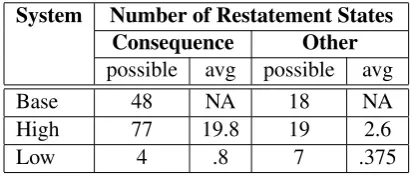
[image:4.595.313.520.128.218.2]After the experiments (described below) were completed, one of the authors of this paper re-viewed the tutor states in the base system and the high and low restatement systems to characterize the number of changes made to create the high and low restatement systems from the base system. These findings are shown in Table 1 in the columns “possible”. The “other” restatements, as shown in column 3 of Table 1, include restating the cor-rect part of a partially corcor-rect answer and restating a correct answer when it required deeper reason-ing to produce. These remain because they were deemed essential to tutoring. Ideally the number of “other” restatements should be equal for “high”
Table 1: Modifications to create the high and low restatement systems from the base system (labeled “possible”) and the average number of states stu-dents experienced (labeled “avg”)
System Number of Restatement States
Consequence Other
possible avg possible avg
Base 48 NA 18 NA
High 77 19.8 19 2.6
Low 4 .8 7 .375
and “low”. Content authors were instructed to re-move repetitions of fully correct answers to simple short answer questions but some were missed for “high”. In addition, some restatements that were added to increase consequence for “high” were instead simple repetitions. However, we do not expect simple repetitions to affect learning, espe-cially when their frequency is low, as reflected in the “avg” columns.
4 Methods
ParticipantsOur comparison of the high and low
restatement versions of Rimac was conducted dur-ing high school physics classes at three schools in the Pittsburgh PA area. The study followed the course unit on dynamics with a total of 168 stu-dents participating. Stustu-dents were randomly as-signed to one of two conditions: high restatement (N= 88; 30 females, 58 males) and low restatement (N= 80; 27 females, 53 males).
MaterialsStudents interacted with either a high
or low restatement version of Rimac, as described in the previous section, to discuss the physics con-ceptual knowledge associated with three quantita-tive dynamics problems.
We developed a 21 item pretest and isomorphic post-test (that is, each question was equivalent to a pretest question, but with a different cover story) to measure learning differences from interactions with the system. The test included nine multiple choice problems and twelve open response prob-lems and focused on testing students’ conceptual understanding of physics instead of their ability to solve quantitative problems.
Procedure On the first day, the teacher gave
Table 2: Learning from interacting with the systems, for both conditions combined and separately for the high and low restatement conditions
Problems Condition Pretest Posttest t(n),p
Mean (SD) Mean (SD)
All Combined 7.90 (2.40) 8.97 (2.88) t(167)=5.60, 0.376 (0.114) 0.427 (0.137) p<0.01 High 7.71 (2.36) 8.73 (2.73) t(87)=3.56,
0.367 (0.113) 0.416 (0.130) p<0.01 Low 8.11 (2.44) 9.23 (3.02) t(79)=4.49,
0.386 (0.116) 0.440 (0.144) p<0.01 Multiple- Combined 4.73 (1.40) 5.20 (1.50) t(167)=3.63, choice 0.525 (0.156) 0.578 (0.167) p<0.01
High 4.67 (1.37) 5.16 (1.46) t(87)=2.73, 0.519 (0.152) 0.573 (0.162) p=0.01 Low 4.79 (1.44) 5.25 (1.55) t(79)=2.39,
0.532 (0.160) 0.583 (0.173) p=0.02 Open- Combined 3.18 (1.48) 3.77 (1.78) t(167)=5.38, response 0.265 (0.124) 0.314 (0.148) p<0.01
High 3.04 (1.47) 3.57 (1.68) t(87)=3.13, 0.253 (0.123) 0.298 (0.140) p<0.01 Low 3.32 (1.49) 3.98 (1.87) t(79)=4.8,
0.277 (0.124) 0.332 (0.156) p<0.01
were approximately 45 min. or 80 min. long), students watched a video of a sample, worked-out solution to each homework problem in one of the two versions of Rimac and engaged in two “reflec-tive dialogues” after each problem-solving video. The videos demonstrated how to solve the prob-lem only and did not offer any conceptual expla-nations. Hence we do not believe that the videos contributed to learning gains. Finally, at the next class meeting, teachers gave the post-test.
5 Results
We evaluated the data to determine whether stu-dents who interacted with the tutoring system learned, as measured by gain from pretest to post-test, regardless of their treatment condition (i.e. which version of Rimac they were assigned to use), and if there was an aptitude-treatment inter-action; in particular, an interaction between stu-dents’ prior knowledge about physics (as mea-sured by pretest score) and how much students learned in each condition (as measured by gain score).
The data was first analyzed considering all problems together and then multiple-choice and open-response problems were considered sepa-rately. The rationale for this further division of test items is that open-response problems, unlike multiple-choice problems, would allow us to de-termine whether students are able to verbalize co-herent conceptual explanations of the physics
phe-nomena tested in these problems. Moreover, open-response problems do not allow for guessing of the correct answer to the extent that multiple-choice test items do.
Learning Performance & Time on Task To
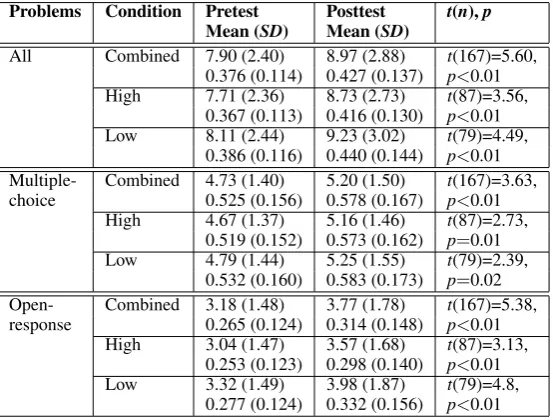
determine whether interaction with the system, re-gardless of condition, promoted learning, we com-pared pretest scores with post-test scores. To-wards this end, we performed paired samples t-tests. When all students were considered to-gether, we found a statistically significant dif-ference between pretest and post-test scores for all problems together, multiple-choice problems, and open-response problems as shown in Table 2. When students in each condition were considered separately, we again found a statistically signifi-cant difference between pretest and post-test for all problems together, multiple-choice problems, and open-response problems as shown in Table 2. These results suggest that students in both condi-tions learned from interacting with the system.
Prior to testing for differences between condi-tions, we tested for a difference in time on task between conditions. No statistically significant difference was found between conditions for the mean time on task.
High Restatement vs. Low RestatementFirst,
Figure 1: Prior knowledge-treatment interaction for All Problems
M(low)=.8; t(91)=29.3,p<.0001. Next, to test whether students who used the high restatement version of the system would perform differently from students who used the low restatement ver-sion, we compared students’ gains from pretest to post-test between conditions using independent samples t-tests. Gains were defined as (post-test - pretest) and their normalized versions as (post-test/#problems) - (pre(post-test/#problems).1
We found no significant differences in gains be-tween conditions for any subset of problems. This suggests that the presence or absence of a conse-quence restatement has the same effect on learning when students of all knowledge levels are consid-ered together.
Prior knowledge-treatment interaction To
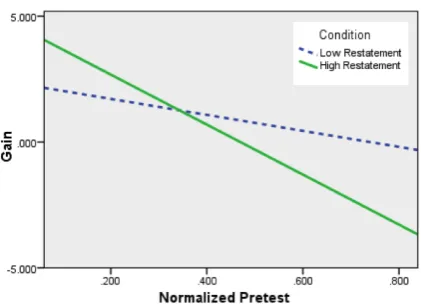
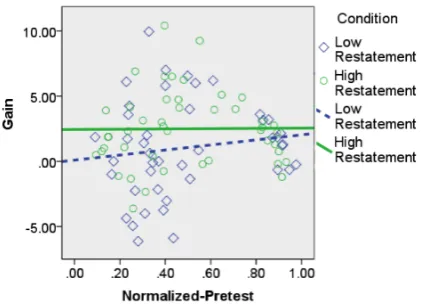
investigate whether there was a prior knowl-edge treatment interaction, we performed a mul-tiple regression analysis using condition, prior-knowledge (as measured by pretest) and condi-tion * prior-knowledge (interaccondi-tion) as explana-tory variables, and gain as the dependent variable. When all problems were considered together, we found a significant interaction between condition and prior knowledge in their effect on gains (t=-2.126,p=0.04). Likewise, we found a significant interaction when we considered only gains on open-response problems (t=-2.689,p=0.01). How-ever, for multiple-choice problems we did not find a significant interaction.
The graph of gain vs. prior knowledge in Fig-1The reason for using both measures is that each mea-sure relates the same information, but in a different way. The full test scores show means and standard deviations in terms of number of problems solved correctly (given that each test item has a score of 0-1) whereas the normalized values con-vey the same results in terms of percent of correct responses.
Figure 2: Prior knowledge-treatment interaction for Open-Response Problems
ure 1 shows the fitted lines for both conditions when considering all problems. It suggests that students with pretest scores that are 35% correct (7.5) or less benefit more from the high restate-ment version of the system than from the low re-statement version. However students with pretest scores above 35% correct benefit more from the low restatement version of the system. The graph of gain vs. prior knowledge for open-response problems is shown in Figure 2. It suggests that stu-dents with pretest scores of 23% or less on open-response items benefit more from higher restate-ment and students with pretest scores greater than 23% benefit more from lower restatement. Both findings offer evidence to support the hypothesis that the effect of consequence restatements varies according to students’ incoming knowledge. In particular, it suggests that lower knowledge stu-dents benefit more from high restatement in infer-ential contexts while higher knowledge students benefit more from low restatement.
6 Additional Support for a Prior Knowledge-Treatment Interaction from Earlier Experiments
Prior to the study that we described in Section 5, which we will refer to now as experiment E3, we conducted two field trials, E1 and E2, which dif-fered only by the versions of the tests that we ad-ministered and the populations recruited. We will refer to the test we previously described in Sec-tion 4 as T3, to distinguish it from the tests admin-istered during the prior experiments (T1 and T2).
Field Trial E1 with test T1The first field trial,
[image:6.595.310.521.63.191.2]years. The goal was to sample students whose knowledge of physics was similar to that of our target high school population. Test T1 was used in previous experiments with high school students for the dynamics domain.
Just as with E3, we confirmed that there was significantly more consequence restatement in the high restatement condition than in the low restate-ment condition using independent samples t-tests: M(high)=24.2, M(low)=1.2; t(36)=45.7,p<.0001. Similarly, we found that for the undergraduate population there were no significant differences in gains between conditions. However, for this population there were no significant interactions between conditions and prior knowledge. Since we had found a prior knowledge treatment in-teraction in experiment E3, we re-examined the pretest scores of the undergraduates, to investigate whether students’ incoming knowledge could have been a factor.
We found that the pretest mean for the under-graduates was 44% correct (SD=14%) while the pretest mean for the high school students who had taken test T1 was lower at 37% correct (SD=13%). Furthermore, the high school students who had taken T1 had a post-test mean of 40% correct (SD=16%) which was lower than thepretestmean of E1’s undergraduates. The undergraduates’ prior knowledge is clearly higher than that of the high school students. Given the higher prior knowledge of the undergraduates in E1 (compared with the high school students who had taken T1), we ex-pected that the mean gain for the low restatement condition in E1 (M=2.71, SD=2.18; normalized M=.12, SD=.10) would tend to be higher than for the high restatement condition (M=1.99, SD=2.24; normalized M=.09, SD=.10) and that was the case. Hence, this pattern is consistent with the sec-ond hypothesis that the effect of consequence re-statements varies according to incoming knowl-edge. While there was no significant difference between conditions for the undergraduate popula-tion, undergraduates had higher prior knowledge than high school students and for undergraduates the mean gain for the low restatement condition was higher than for the high restatement condition which is in the same direction as the findings for E3.
Field Trial E2 with test T2We decided to
re-fine test T1, which was used in E1, to create test T2. We used test T2 in field trial E2 with high
[image:7.595.311.523.115.268.2]school students (N=88) who were from two differ-ent local high schools from those who participated in experiment E3.
Figure 3: Prior knowledge-treatment interaction for All Problems for E2
As before with E3, we confirmed that there was significantly more consequence restatement in the high restatement condition than in the low restate-ment condition using independent samples t-tests: M(high)=20.3, M(low)=.64; t(56)=21.8,p<.0001. With this population, however, we found statisti-cally significant differences in learning gains be-tween conditions that favored the high restatement version of the system. Using independent sam-ples t-tests, we found significant differences for all test problems together: M(high)=2.49 SD=2.90, M(low)=1.04 SD=3.68;t(86)=2.07,p<.04 and for multiple-choice problems: M(high)=.66 SD=1.27, M(low)=-.-6 SD=1.4; t(86)=2.51,p<.01 but not for open-response problems. However, there were no statistically significant interactions between condition and prior knowledge for any subset of test problems.
t(86)=14.9,p=.000) and a larger sample size (N=65 vs. N=23). This suggests there were more lower incoming knowledge students in E2 than higher incoming knowledge students.
So there is a pattern that is consistent with the finding in E3 and the pattern in E1. The results suggested that the high restatement condition was significantly better than the low restatement one; however, more of the population seemed to have lower incoming knowledge which would favor the high restatement condition. However, more exper-imentation with populations similar to these two schools is needed. It is possible that the incom-ing knowledge in this one school is comparable to the ones in E3. This was the only high-school in which we had to move from the classroom to a computer lab. This added disruption to the usual classroom routine may have made it more difficult for students to “settle in” and concentrate. If the students had problems focusing, then the added repetitions may have been helpful.
Experiment E3 with test T3 After E2, we
shortened the test to create T3, which was used in experiment E3, the focus of this paper. While the tests differed across all three experiments, so we cannot directly compare the populations, the pat-terns in each case seem consistent with the prior knowledge treatment interactions that we found in study E3, as reported in Section 5. However, ex-periments that use the same test would be neces-sary to verify these patterns.
7 Conclusions and Future Work
We found that students learned from the tutoring system, across conditions, as measured by differ-ences in pre-test and post-test scores. In the main study reported here (E3), there was no difference in learning gains between conditions, which sug-gests that the presence or absence of consequence restatement in a system has a similar effect for all students considered together; that is, irrespec-tive of their prior knowledge. However, we did find a prior knowledge treatment interaction which supported the hypothesis that the effect of conse-quence restatement varies according to students’ prior knowledge. In particular, our results sug-gest that lower knowledge students would benefit more from a high restatement system while higher knowledge students would benefit more from a low restatement system.
Two earlier studies with different populations
and tests also support this finding. While there was no significant difference in learning gains be-tween conditions for the study with the undergrad-uate population (E1), undergradundergrad-uates had higher prior knowledge than high school students and for undergraduates the low restatement condition had a higher mean gain than the high restatement con-dition. For the earlier study with a different set of high schools (E2), there was a significant dif-ference in learning gains between the high and low restatement conditions that favored the high restatement condition but more of the population seemed to have lower incoming knowledge which would favor that condition. Moreover, the lower the student’s incoming knowledge, the larger the benefit of high restatement. However, these re-sults are preliminary and require further experi-mentation to better understand when and why con-sequence restatements can support learning.
The findings across the three experiments sug-gest that system designers may need to be care-ful in their use of restatement as it may dampen learning if there is a mismatch with students’ prior knowledge levels. Further it suggests that when building tutorial dialogue systems, care must be taken in the tactics and strategies that may be ap-plied to address system limitations. For exam-ple, spoken dialogue systems sometimes use an explicit confirmation strategy to address repeated speech recognition errors (Litman and Pan, 2000). Carrying such a strategy over to tutorial applica-tions could have an unintended impact on some students’ learning outcomes.
In future research, we plan to determine if the benefits of the high and low restatement versions of Rimac can be used advantageously in a system that adapts to students’ knowledge levels and to formulate and test additional hypotheses for other types of restatement.
Acknowledgements.
References
L. Becker, W. Ward, S. Van Vuuren, and M. Palmer. 2011. Discuss: A dialogue move taxonomy layered
over semantic representations. InIWCS 2011: The
9th International Conference on Computational Se-mantics, Oxford, England, January.
M. T. H. Chi and M. Roy. 2010. How adaptive is
an expert human tutor? In10th International
Con-ference on Intelligent Tutoring Systems (ITS), pages 401–412.
M. Dzikovska, G. Campbell, C. Callaway, N. Stein-hauser, E. Farrow, J. Moore, L. Butler, and C. Math-eson. 2008. Diagnosing natural language an-swers to support adaptive tutoring. InInternational FLAIRS Conference.
R. Freedman. 2000. Using a reactive planner as the basis for a dialogue agent. InInternational FLAIRS Conference.
Ken Hyland. 2007. Applying a gloss: Exemplifying
and reformulating in academic discourse. Applied
Linguistics, 28(2):266–285.
P. Jordan and M. A. Walker. 1996. Deciding to re-mind during collaborative problem solving: Empiri-cal evidence for agent strategies. InAAAI-96, pages 16–23, August.
P. Jordan, B. Hall, M. Ringenberg, Y. Cui, and C.P. Ros´e. 2007. Tools for authoring a dialogue agent that participates in learning studies. InAIED 2007. P. Jordan, S. Katz, P. Albacete, M. Ford, and C.
Wil-son. 2012. Reformulating student contributions in tutorial dialogue. In7th International Natural Lan-guage Generation Conference, pages 95–99. S. Kalyuga and P. Ayres. 2003. The expertise reversal
effect. Educational Psychology, 38:23–31.
S. Katz and P. Albacete. 2013. A tutoring system that simulates the highly interactive nature of human
tutoring. Educational Psychology (Special Issue
on Advanced Learning Technologies), 105(4):1126– 1141.
D. Litman and K. Forbes-Riley. 2006. Correlations between dialogue acts and learning in spoken
tu-toring dialogues. Natural Language Engineering,
12(2):161–176.
D. Litman and S. Pan. 2000. Predicting and adapt-ing to poor speech recognition in a spoken dialogue
system. InAAAI/IAAI, pages 722–728.
S. A. McLeod. 2007. Stages of memory
-encoding storage and retrieval. Retrieved from http://www.simplypsychology.org/memory.html. D.S. McNamara, E. Kintsch, N.B. Songer, and
W. Kintsch. 1996. Are good texts always better? text coherence, background knowledge, and levels
of understanding in learning from text. Cognition
and Instruction, 14:1–43.
S. Murillo. 2008. The role of reformulation markers in academic lectures. In A.M. Hornero, M.J. Luz´on, and S. Murillo, editors, Corpus Linguistics: Appli-cations for the Study of English, pages 353–364. Pe-ter Lang AG.
M.C. O’Connor and S. Michaels. 1993. Aligning aca-demic task and participation status through revoic-ing: Analysis of a classroom discourse strategy. An-thropology & Education Quarterly, 24(4):318–335. N. Person, A. Graesser, R. Kreuz, and V. Pomeroy.
2003. Simulating human tutor dialog moves in auto-tutor. International Journal of Artificial Intelligence in Education, 12(23-39).