Towards Enhanced Opinion Classification using NLP Techniques
Akshat BakliwalSIEL, IIIT-Hyderabad [email protected]
Ankit Patil SIEL, IIIT-Hyderabad [email protected]
Piyush Arora SIEL, IIIT-Hyderabad [email protected]
Vasudeva Varma SIEL, IIIT-Hyderabad
Abstract
Sentiment mining and classification plays an important role in predicting what peo-ple think about products, places, etc. In this piece of work, using basic NLP Tech-niques like NGram, POS-Tagged NGram we classify movie and product reviews broadly into two polarities: Positive and Negative. We propose a model to address the problem of determining whether a re-view is positive or negative, we experi-ment and use several machine learning al-gorithms Naive Bayes (NB), Multi-Layer Perceptron (MLP), Support Vector Ma-chine (SVM) to have a comparative study of the performance of the method we de-vised in this work. Along with this we also did negation handling and observed improvements in classification. The al-gorithm we proposed achieved an average accuracy of 78.32% on movie and 70.06% on multi-category dataset. In this paper we focus on the collective study of Ngram and POS tagged information available in the reviews .
1 Introduction
“What people think and feel” is the most impor-tant information for a business to promote and im-prove their product or for a production house to hit the blockbuster. Reviews are increasing with a rapid speed and are available over internet in nat-ural language. This proves to be of utmost use for consumers and also for the manufacturers to im-prove the performance of their product. Sentiment analysis tries to classify reviews on the basis of their polarity either positive or negative, which can be used in various ways and in many applications for example, marketing and contextual advertis-ing, suggestion systems based on the user likes and
ratings, recommendation systems etc. The ratings and the reviews of the products helps the user to have a better overview of the product and make a choice based on overall rating of multiple reviews of the same product. In this paper, we propose a method to classify reviews as positive or negative. We devised a new scoring function and test on two different approaches which are
• Simple NGram (N=1/2/3) matching:
Uni-grams, bigrams and trigrams of a review are been used to assign score to a review and thus classify it as positive or negative.
• Pos-Tagged NGram matching: NGrams in this case are formed using the POS-Tagged information of a review, Trigrams, Bigrams and Unigrams combination of only Adjec-tives (JJ) and Adverbs (RB) are used for scor-ing a review.
In another variant we used a combination of sim-ple Ngram and POS-Tagged Ngram approaches. Based on the final score of a review it is clas-sified as positive or negative. We also applied machine learning algorithms Naive Bayes(NB), Multi-Layer Perceptron (MLP) and Support Vec-tor Machine (SVM) to study the performance of our method. The method was applied on two datasets movie review and product review.
In section 2, we describe the related work done in the past. Section 3, describes the algorithm pro-posed by us in this work. Section 4, describes tools, techniques and data used here. Section 5, fo-cus on the experiments done and results of same. In section 6, small discussion over the results is done. Section 7, gives a conclusion of the present work.
2 Related Work
Identifying the sentiment polarity is a complex task, to address the problem of sentiment
fication various methodologies have been applied earlier. Following are Unsupervised approaches.
1. Syntactic approach towards sentiment classi-fication using Ngrams. This approach was used by Pang et al.(Pang et al., 2002) in their work.
2. Semantic approach using part of speech in-formation. Thumbs Up or Thumbs Down? Semantic Orientation Applied to Unsuper-vised Classification of Reviews (Turney, 2002) and Sentiment Analysis: Adjectives and Adverbs are better than Adjectives Alone (Benamara et al., 2007) used this approach for binary classification.
3. Extracting sentiment expressions using var-ious NLP techniques. Sentiment Analysis: Capturing Favorability Using Natural Lan-guage Processing (Nasukawa and Yi , 2003) and Extracting Appraisal expressions (Bloom et al., 2007) used techniques like word sense disambiguation, chunking, n-gram and others to perform binary polarity classification. Supervised approach uses machine learning su-pervised algorithms. Sentiment Classification for Chinese Reviews Using Machine Learning Meth-ods Based on String Kernel (Zhang et al., 2008), Pang et al.(Pang et al., 2002), Twitter Sentiment Classification using Distant Supervision (Go et al., 2009) deduced some features to perform super-vised machine learning.
Pang et al.(Pang et al., 2002) used the traditional n-gram approach along with POS information as a feature to perform machine learning for deter-mining the polarity. They used Naive Bayes Clas-sification, Maximum Entropy and Support Vector Machines on a three fold cross validation. In their experiment, they tried different variations of n-gram approach like unigams presence, unin-grams with frequency, unigrams+bigrams, bigrams, uni-grams + POS, adjectives, most frequent uniuni-grams, unigrams + positions. They concluded from their work that incorporating the frequency of matched n-gram might be a feature which could decay the accuracy. Maximum accuracy achieved by them among all the experiments they performed was 82.9% which was obtained in unigrams presence approach on SVM.
Turney (Turney, 2002) also worked on POS in-formation. He used some tag patterns with a win-dow of maximum three words (i.e) till trigrams.
In his experiments, he considered JJ, RB, NN, NNS POS-tags with some set of rules for classi-fication. His work is extension to the work done on adjectives alone (Hatzivassiloglou and McKe-own, 2004) because he considers RB, NN/NNS. Given a phrase he calculates the PMI (Point-wise Mutual Information) from the strong positive word “excellent” and also from the strong negative word “poor”, and the difference will give you the se-mantic orientation of the phrase.
Dave et al.(Dave et al., 2003) devised their own scoring function which was probability based. They performed some lexical substitutions to negation handling and used rainbow classifiers to decide the class of the review.
Our work is motivated from each of these works. Pang et al.(Pang et al., 2002) used POS information with unigram, we extended this work using POS information with bigrams and trigrams. Turney (Turney, 2002) also used POS1 intion with trigrams but he restricted trigram forma-tion with some rules. He used PMI to evaluate the classification and here in this research we pro-pose a new scoring function to classify. Dave et al.(Dave et al., 2003) devised some rules for nega-tion handling and thus motivated us to work on negation handling.
3 Algorithm
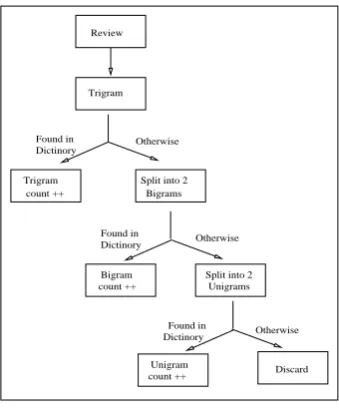
To perform polarity classification we devised our own algorithm. This algorithm was applied on all our approaches. In our experiments we per-formed 5-fold cross-validation and we divided the pre-annotated data into two parts namely training set and testing set to check the correctness. After dividing the data we form trigrams, bigrams and unigrams on the training data and store them in individual n-gram dictionary. We create two sep-arate models each for positive and negative polar-ity. For every testing review we create trigrams in the similar manner. Then we check if this tri-gram exists in our positive and negative tritri-gram dictionary. If it exist then, we increase the count of trigram matched else we break this trigram into two bigrams. These bigrams thus formed are cross checked in the bigram dictionary, If found then the bigram match count is increased otherwise each bigram is further split into two unigrams. These unigrams are then checked against the unigram
dictionary. Refer Figure 1for diagrammatic rep-resentation of algorithm.
Trigram count ++
Split into 2 Bigrams Otherwise
Otherwise
Bigram count ++
Split into 2 Unigrams
Dictinory Otherwise Found in
Discard Unigram
count ++ Trigram
Review
[image:3.595.96.266.98.304.2]Found in Dictinory Found in Dictinory
Figure 1: Algorithm Flow
We also propose a scoring function which gives priority to trigram matching followed by bigrams and unigrams.
Score= x∗Count T ri−gram+
y∗Count Bi−gram +
z∗Count U ni−gram
here x = 7/11, y = 3/11, z = 1/11, Count N-gram = Number of N-grams matched (N = Uni/Bi/Tri). The values 7,3,1 are chosen to ensure that (1) score for matching a trigram>score for matching 2 bi-grams. (2) score for matching a bigram >score
for matching 2 unigrams. In the scoring function we have given the least possible integer value to unigram, bigram and trigram keeping the above constraints in mind. The rationale behind having these constrains while deciding the values of x, y, z was that higher n-gram carries more weight then a lower gram and also matching of a higher n-gram should be weighed more than matching of two lower n-grams. Then we have normalized these values on a scale of 0 to 1. So the final x, y, z parameters are x=7/11, y=3/11 and z=1/11.
4 Framework
This section describes various tools, techniques and data used by us in this work. We are using two different datasets in this work. One is Prod-uct Review dataset (Refer Section 4.2.1) which has reviews on multiple products belonging to differ-ent categories like apparels, books, software, etc.
This dataset is a multi category dataset in contrast to the other dataset which has only one category i.e. movies. Movie review dataset (Refer Section 4.2.2) contains reviews on various movies by cri-tiques.
4.1 Tools and Algorithms
This section provides a brief details of the machine learning algorithms used in the experiments.
4.1.1 Naive Bayes (NB)
Naive Bayes Classifier uses Bayes Theorem, which finds the probability of an event given the probability of another event that has already oc-curred. Naive Bayes classifier performs extremely well for problems which are linearly separable and even for problems which are non-linearly separa-ble it performs reasonably well. We used the al-ready implemented Naive Bayes implementation in Weka2toolkit.
4.1.2 Multi-Layer Perceptron (MLP)
Multi Layer perceptron (MLP) is a feed-forward neural network with one or more layers between input and output layer. Feed-forward means that data flows in one direction from input to output layer (forward). We used the already implemented MLP in Weka toolkit.
4.1.3 Support Vector Machine (SVM)
This classifier constructs N-dimensional hyper-plane which separates data into two categories. SVM models are closely related to a Neural Net-work. SVM takes the input data and for each input data row it predicts the class to which this input row belongs. SVM works for two class problems and is a non probabilistic binary linear classifier. We used libSVM3 classifier which is available as a add on to Weka toolkit.
4.2 Datasets
This section provides a brief details of the datasets used by us in our experiments.
4.2.1 Product Review Dataset
Multi-Domain Sentiment Dataset (Version 2.0)4 (Blitzer et al., 2007) contains product reviews taken from Amazon.com belonging to different (total 25) categories like apparels, books, toys and
2http://www.cs.waikato.ac.nz/ml/weka/ 3http://weka.wikispaces.com/LibSVM
games, videos, etc. We considered 4000 posi-tive and 4000 negaposi-tive reviews randomly sampled from 5 domains. Domains were chosen with ut-most care so that they can represent non intersect-ing domains and 800 reviews of each polarity i.e. positive and negative are taken from each domain.
4.2.2 Movie Review Dataset
Polarity Dataset (Version 2.0)5 (Pang and Lee , 2004) contains 1000 positive and 1000 negative processed movie reviews on various movies. Re-views are pre-processed and divided into two cat-egories positive and negative.
5 Experiments
We performed various experiments on the review data which were based on NLP techniques like n-gram, POS-Tagged n-grams, etc. We divided our work in two approaches.
5.1 Simple NGram Approach
While classifying the review the lexical informa-tion plays a very important role. The lower order n-grams i.e. unigrams and bigrams does not carry much information as compared to the higher or-der n-grams like trigrams or beyond. For example consider the phrase “not good product”, here un-igrams formed are ’not’,’good’ and ’product’ but they does not carry sufficient information for po-larity classification. When we move to bi-grams “not-good” and “good product”, “good-product” has a sentiment towards positive polarity and “not-good” is negating the positivity of good but the trigram “not good product” gives enough informa-tion to classify the trigram in negative class.
We experimented with different N-grams varia-tion (unigram, bigram and trigrams) and its combi-nations (unigram + bigram and unigram + bigram + trigram ). The results (Refer Table 1) shows that the presence of trigrams with bigrams and un-igrams has a favourable effect on classification of the reviews as positive and negative.
5.2 POS-Tagged NGram Approach
In this approach we used the part of speech infor-mation to deduce the opinion and subjective in-formation in a given text. Adjective and Adverbs play an important role in deducing the subjective information since they reflect the qualitative judg-ment about a text. In this approach we create
5 http://www.cs.cornell.edu/People/pabo/movie-review-data/
Movie
Reviews ProductReviews
Unigram only 64.1 42.91
Bigram only 76.15 69.62
Trigram only 76.1 71.37
[image:4.595.312.522.61.161.2](Uni + Bi) gram 77.15 72.94 (Uni + Bi + Tri) gram 80.15 78.67
Table 1: Results of Simple NGram
Movie
Reviews ProductReviews
POS-(U + B + T)-JJ 75.00 50.425 POS-(U + B + T)-RB 65.50 36.76 POS-(U + B + T)-(JJ
+ RB) 76.50 62.06
Table 2: Results of POS-Tagged NGram. U = Un-igram, B = BUn-igram, T = Trigram
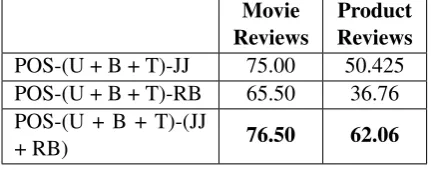
trigrams, bigrams, unigrams of only those words whose part-of-speech tag is either Adjective (JJ) or Adverb (RB). For trigram we have *-JJ/RB-*, Bigrams *-JJ/RB or JJ/RB-* and unigrams are JJ/RB. here * signifies any other pos-tag. Con-sider this review “This is a good product”, POS-tagged output of this review is “this DT is VBZ a DT good JJ product NN”. For this review we have 1 trigram good-product”, 2 bigrams “a-good” “good-product” and 1 unigram “good“.
Similarly we find possible n-grams for RB Tag. After forming these NGrams we apply our algo-rithm and based on the score we get from both the positive and negative model we deduce the nature of the opinion.Table 2reports the accuracy of our scoring function on the two datasets after consid-ering different variation of POS-tags such as only adjectives (JJ), only adverbs (RB) and both com-bined together.
[image:4.595.309.525.201.286.2]Movie
Reviews ProductReviews
POS-(U + B + T)-JJ 75.80 51.50 POS-(U + B + T)-RB 65.9 37.55 POS-(U + B + T)-(JJ
+ RB) 77.35 62.75
Table 3: Results of POS-Tagged NGram with Negation Handling. U = Unigram, B = Bigram, T = Trigram
output of this review is “this DT is VBZ not RB a DT good JJ product NN”. Now for this review if we make trigrams, bigrams and unigrams with-out negation handling, they will be 2 trigrams “is-not-a” “a-good-product”, 4 bigrams “is-not” “not-a” “a-good” “good-product” and 2 unigram “not” “good“.
None of these n-grams show the effect of not on good but if we do negation handling then the n-grams formed will be 2 trigrams “is-not-a” “a-#good-product”, 4 bigrams “is-not” “not-“is-not-a” “a-#good” “#good-product” and 2 unigram “not” “#good”.
After negation handling n-grams formed clearly indicates that the information of a negative word ”not“ preceded by good is incorporated. Table 3 reports the accuracy of our scoring function on the two datasets after applying negation handling.
To assert the performance of our scoring func-tion, we formed a feature vector with features very closely similar to our scoring function. In our scoring function we considered the count of n-grams matched and the feature vector is also formed with the same information. Features are selected in a way that they only differ in terms of weighted parameters(x, y, z) from the scoring function. Our feature vector composed of 6 fea-tures + class which are calculated from the an-notated data. Our features were <PUM, PBM,
PTM, NUM, NBM, NTM, class> where PUM
= Positive Unigram Matched, PBM = Positive Bi-gram Matched, PTM = Positive TriBi-gram Matched, NUM = Negative Unigram Matched, NBM = Neg-ative Bigram Matched, NTM = NegNeg-ative Trigram Matched and class = Actual class of the review. We formed this feature vector for both the above mentioned approaches.
5.3 Feature Vector Approach
In the above two approaches (N-gram and POS tagged approach) we devised our own scoring function and calculated the polarity of an opin-ion but it might be the case that the functopin-ion we used are biased, so in this approach we divided the dataset into training and testing set and extracted the features for the training set and formed fea-ture vector for each of the opinion, we used ma-chine learning algorithms for classification. We used WEKA toolkit for classification of the test-ing set (opinions). The feature vector was devised for both approaches.
For NGram and POS-tagged feature vector was the same as mentioned above. Table 4reports the accuracy of machine learning approach on Simple NGram and POS-Tagged NGram approaches.
We also combined Approach 1 (Simple NGram) and Approach 2 (POS-Tagged NGram) and the results were as shown in Table 5. Feature Vec-tor for the combined training was < PUM,
PBM, PTM, NUM, NBM, NTM, PUM, pt-PBM, pt-PTM, pt-NUM, pt-NBM, pt-NTM, class > where where PUM = Positive
Uni-gram Matched, PBM = Positive BiUni-gram Matched, PTM = Positive Trigram Matched, NUM = Negative Unigram Matched, NBM = Negative Bigram Matched, NTM = Negative Trigram Matched, pt-PUM = POS-Tagged Positive Uni-gram Matched, pt-PBM = POS-Tagged Positive Bigram Matched, pt-PTM = POS-Tagged Posi-tive Trigram Matched, pt-NUM = POS-Tagged Negative Unigram Matched, pt-NBM = POS-Tagged Negative Bigram Matched, pt-NTM = POS-Tagged Negative Trigram Matched and class = Actual class of the review
6 Result Analysis
[image:5.595.73.290.62.148.2]Movie Reviews Product Reviews
NB MLP SVM NB MLP SVM
NGram Feature 75.50 81.05 81.15 62.50 79.27 79.40
POS-Tagged Feature 72.35 76.35 75.45 68.81 70.87 67.88
POS-Taged Feature with Negation Handling 72.80 76.65 75.00 68.83 70.95 67.95
Table 4: Results of Approach 1 and Approach 2 on Machine Learning Algorithms
Movie Reviews Product Reviews
NB MLP SVM NB MLP SVM
Simple + POS-Tagged NGram Feature 78.05 81.60 78.45 69.25 79.47 78.86 Simple + POS-Tagged NGram with
[image:6.595.68.527.62.134.2]Nega-tion Handling Feature 79.35 81.60 78.50 69.17 79.39 79.03
Table 5: Results of Approach 1 Approach 2 Combined on Machine Learning Algorithms
while SVM reports 79.4 and MLP reports 79.27. This shows that our algorithm performs as good as supervised learning approach and the selection of the parameters x, y, z in our algorithm are close to accurate.
For approach 2 (POS-Tagged NGram), we ob-served a similar adjacency between our algorithm and machine learning. For movie review dataset our algorithm performed best for (JJ + RB + Nega-tion Handling) and accuracy attained was 77.35 which is higher than that achieved using SVM (75) and MLP (76.65). In case of product re-view dataset accuracy attained by our approach was 62.75 while the machine learning algorithms SVM (67.95) and MLP (70.95) dominated.
An observation we made while experimenting was that our model performs well when the re-views are domain specific (i.e. movie review) but when it comes to a larger or multiple domains (multi category product reviews) our performance drops down. Possible reason behind this could be that when we train on multiple categories together there may be cases that a specific category formes poorly and thus it pulls the over all per-formance down.
Main problem while dealing with sentiment analysis on reviews is that reviews span over multiple sentences. There are cases when a re-view contains multiple sentences and among them few sentences have opposite sentiment. For ex. “This movie was superb, good dialogs and ac-tion. The plot was awful”. In this review the first sentence shows positive polarity and the sec-ond sentence show negative polarity. It may be the case that though the review was rated
posi-tive by the reviewer but the negaposi-tive scored domi-nated and hence our system classified this as neg-ative. This problem sometimes also occur within the sentence. Consider this review ”This mobile phone has awesome features but the camera really sucks”. In this sentence, the part before ’but’ is positive and the part after but is negative. This review is neither positive nor negative and fails while classifying.
7 Conclusion
Based on these basic experiments which are sim-ple to understand and perform one can get a ap-proximate idea of the sentiments carried by re-views. We have presented simple techniques which are not restricted to review domain. With small simple modifications one can extend this work to various spheres like blogs, news (though we have not tested for the same and thus we make no claims). We obtained a general increment of 2-5% from the work done previously. This work will provide enough help to business industry to ana-lyze what consumers think about their company and products.
Acknowledgments
References
Farah Benamara, Carmine Cesarano, Antonio Pi-cariello, Diego Reforgiato, and V. S. Subrahmanian. Sentiment analysis: Adjectives and adverbs are bet-ter than adjectives alone. InProceedings of the In-ternational Conference on Weblogs and Social Me-dia (ICWSM), 2007. Short paper.
John Blitzer, Mark Dredze, and Fernando Pereira. Biographies, bollywood, boomboxes and blenders: Domain adaptation for sentiment classification. In
In ACL, pages 187–205, 2007.
Kenneth Bloom, Navendu Garg, and Shlomo Argamon. Extracting appraisal expressions. InProceedings of Human Language Technologies/North American As-sociation of Computational Linguists, 2007.
Kushal Dave, Steve Lawrence, and David M. Pennock. Mining the peanut gallery: Opinion extraction and semantic classification of product reviews. pages 519–528, 2003.
Alec Go, Richa Bhayani, and Lei Huang. Twitter senti-ment classification using distant supervision. pages 1–6, 2009.
Vasileios Hatzivassiloglou and Kathleen R. McKeown. Predicting the semantic orientation of adjectives. pages 174–181, 1997.
Tetsuya Nasukawa and Jeonghee Yi. Sentiment anal-ysis: capturing favorability using natural language
processing. In Proceedings of the 2nd
interna-tional conference on Knowledge capture, K-CAP ’03, pages 70–77, New York, NY, USA, 2003. ACM.
Bo Pang, Lillian Lee, and Shivakumar Vaithyanathan. Thumbs up? Sentiment classification using machine
learning techniques. In Proceedings of the 2002
Conference on Empirical Methods in Natural Lan-guage Processing (EMNLP), pages 79–86, 2002.
Bo Pang and Lillian Lee. A sentimental education: Sentiment analysis using subjectivity summarization
based on minimum cuts. InProceedings of the ACL,
pages 271–278, 2004.
Peter Turney. Thumbs up or thumbs down? semantic orientation applied to unsupervised classification of reviews. pages 417–424, 2002.
Changli Zhang, Wanli Zuo, Tao Peng, and Fengling He. Sentiment classification for chinese reviews using machine learning methods based on string kernel. In