4211
OPINION CLASSIFICATION OF ONLINE REVIEWS USING
THE PROBABILISTIC NEURAL NETWORK AND
PRINCIPAL COMPONENT ANALYSIS
1A. SHANTHINI, 2G. VINODHINI and3RM. CHANDRASEKARAN 1Assistant Professor, Department of Information Technology, SRM University, Chennai. 2Assistant Professor, Dept. of Computer Science and Engineering, Annamalai University, Chidambaram.3Professor, Dept. of Computer Science and Engineering, Annamalai University, Chidambaram.
E-mail: 1[email protected], 2[email protected], 3[email protected]
ABSTRACT
Sentiment analysis of product reviews is an attracting and increasing interest in the area of natural language processing and web text mining. Objective is to analyze the effect of ANN based method for opinion classification. In the research that has done so far on sentiment analysis, ANNs have been considered rarely. In this work, the probabilistic neural network (PNN) has been examined in sentiment classification. This work also examines neural network based sentiment classification methods for feature level sentiment classification on various levels of word granularity are used as features. Product reviews collected from the Amazon reviews website are used as dataset for evaluation. Our objective is to classify the product reviews into three classes: positive, negative and neutral. The results are empirically compared with SVM using various quality measures. The superiority of PNN with Principal Component Analysis (PCA) is also shown in terms of training time. PNN is found to perform better and yields higher accuracy in prediction. In general, statistical based approaches do not perform well as that of neural network based approaches. Compared with traditional techniques, the ANN based approach shows the performance improvement in quality measures and in training time. Through the experimental results it will be show that shortening of training time and increasing the classification accuracy can be achieved by hybrid combination of PNN with PCA.
Keywords: Opinion Mining, Classification, Principal Component Analysis, Neural Networks, Sentiment Analysis
1. INTRODUCTION
In general, buying habits of the customer in taking decision to buy a product is influenced by online reviews given by other customers. An automated online review mining system is required to provide decision support for the customer to help in decision making to buy a product. This automated system is an opinion mining system which extracts all the reviews of the product under consideration given by reviewers and mines out the information to provide decision support to the customer to take decision for buying the product. The automated mining system mines the attitude or judgment provided by the reviewers using NLP to extract features and classify them to provide decision support. The system could be developed as an application programming interface (API) and could be integrated to the ecommerce web portal to
help the customers in buying a product. The objective of the automated opinion mining system is to reduce the misclassification rate.
2. LITERATURE REVIEW
ISSN: 1992-8645 www.jatit.org E-ISSN: 1817-3195
4212 of NLP is the language term and each language term has various linguistic features, such as grammatical category, meaning, sense, co-occurrence similarity and contextual relationships that are employed for term classification and subjectivity analysis. The NLP tasks require a knowledge base for information extraction and analysis. While some techniques are necessary for building a knowledge base, other techniques use existing knowledge bases to analyze documents. Research has presented greater contributions in this area and diverse approaches have been employed to accomplish the subjective analysis [10,13,16]. The subjective texts are often vast for people to make effective decisions. An automatic sentiment classification model is required to categorize text messages into various sentiment types. Many machine learning problems involve analyzing whether a particular text is explicitly stated to be positive or negative sentiment. It is also important to identify what every comment on the specific product expresses. Sometimes it may not be stated clearly whether the review is purely positive or negative sentiment. Many of the product review comments give us only objective facts and do not explicitly express any sentiments in their review. At time, some review comments give us conflicting sentiments. Most of the researchers have worked on identifying the sentiments based on binary perception, i.e., identifying whether the review is a negative sentiment or a positive sentiment [19,5,17,2,29,28]. Thus, it is essential to have more information to classify the sentiments for better performance results.
In the existing literatures, it has been found that less work based on neural network for text sentiment classification has been done. In our proposed work, neural network based sentiment analysis is employed for predicting the sentiment of the product reviews. Further the text sentiment classification are extended to consider neutral reviews along with positive and negative reviews for better results. Here product attributes are used as features for predicting the sentiments. The results obtained are correlated with baseline method such as SVM by computing various attributes. Three different data models (models I, II and III) are developed in order to analyze the relationship amongst the reviews. By using unigram feature, data model I is constructed. Data model II has been constructed by using unigram and bigram features. Similarly by using unigram, bigram and trigram features data model III is constructed. The major contributions of our work are (i) use of PNN for sentiment classification, and also (ii) use of hybrid
combination of PCA and probabilistic neural networks. For evaluating the prediction methods, we have used multiclass classifications rather than binary classifications. To show the superiority of feature reduction with the neural network based approaches, training time is measured. In the subsections to follow, section 3 discusses the methodology used to construct the models. The data source used is reported in Section 4. The various techniques used to model the prediction system are introduced in Section 5. Section 6 summarizes the results.
3. METHODOLOGY
The following is the overview of the methodology that has been used for developing and validating the prediction models.
i.Preprocessing of data is done and the features are isolated.
ii.The word vector is developed for data model I using unigram attributes, similarly using product attributes as features, data model II is developed using unigram and bigram and data model III using unigram, bigram and trigram features.
iii.PCA is performed on the data model I, data model II and data model III to produce reduced feature sets.
iv.The prediction model is constructed using training data set that has dimension reduced feature set.
a.SVM model is constructed. b.Using PNN the neural network
model is designed.
v. Prediction of the class (positive, negative or neutral) for each review is done on the test data set.
vi. With actual values obtained, the prediction results are compared.
vii. The various quality parameters are evaluated and the prediction results are compared.
4. DATA SOURCE
4213
4.1 Data preparation
The sentiment data set used in this work contains a set of product review sentences which were categorized as positive, negative or neutral class. The neutral class is important because not all sentences have sentiments. The neutral class is not only considered as a state between positive and negative classes, but also as a class that denotes the lack of sentiment. Also in binary classes, we force the words to be classified as either positive class or negative class leaving no room for neutrality. This leads to over fitting and becomes vulnerable to situations where due to randomness, a particular neutral word occurs more times in positive or negative class examples. For constructing the dataset, we collected customer reviews of a particular product from publicly available website www.amazonreviews.com. Digital camera reviews have been chosen to perform our proposed research. In a total of 2420 reviews, sentences are crawled using Amazon reviews downloader and parser. For the customized dataset used, a sample review crawled from the Amazon website is as given below in Figure 1. Then product ID is given as input to the downloader. The data format after downloading is shown in Figure 2.
Figure 1: Sample review from Amazon
Figure 2: Data format of downloaded review
The text review contains written text to explain the star review. Since the reviews are provided by various individuals with ranging backgrounds, the meaning of a 5-star review changes from a person to person. Then the reviews are extracted and sentiment class is assigned based on the review score in the data format (sentiment class is positive if review score is >3, if review score is < 3 the class label is assigned negative or else the class label is assigned neutral). Amongst 2420 review sentences, 970 are positive reviews, 710 are negative reviews and 740 are neutral review sentences. Outliers analyses are also performed. When the outliers are implemented on the dataset, the results obtained are 950 positive reviews, 731 negative reviews and 680 neutral class review sentences. To overcome the skewed class distribution, we have chosen randomly 600 positive classes, 600 negative classes and 600 neutral classes as review sentences.
4.2. Feature Extraction
The product attributes in the review sentences are to be collected by part of speech (POS) tagging by considering each of positive, negative and neutral class reviews. The main aim is to extract the features about a particular product and to analyze the features which people like or dislike. It is also important to identify the product features that people are interested in discussing. These product features contribute to the crucial step. For example, consider a sentence from the reviews of a digital camera:
“The pictures are very clear.”
In the above sentence, it is clear that the user is convinced with the quality of the picture of the camera. Here the user talks about picture which is considered as a feature. In certain product review sentences, features are explicitly stated whereas in some reviews, it is very hard to find the feature as they are implicit. In our research, we have focused only on the explicitly stated features and are identified by noun or noun phrases. The identification of implicit features are left for future work. Usually nouns or noun phrases in review sentences are considered as product features. For this research, we extracted only noun phrases from a document based on the consideration that the feature terms are nouns. The NLP Stanford parser has been used to parse each review and to split text into sentences and for each word POS tag is produced. Figure 3 shows the POS tagging for the given sample review sentence.
product/productId: B003ZYF3LO review/userId: A1RSDE90N6RSZF review/profileName: Joseph M. Kotow review/helpfulness: 9/9
review/score: 5.0
review/time: 1042502400
ISSN: 1992-8645 www.jatit.org E-ISSN: 1817-3195
4214
(ROOT (S
(NP (PRP I))
(ADVP (RB recently)) (VP (VBD purchased) (SBAR
(S (NP
(NP (DT the) (NN canon)) (CC and)
(NP (FW I))) (VP (VBP am)
(ADJP (RB extremely) (JJ satisfied) (PP (IN with)
(NP (DT the) (NN purchase)))))))) (. .)))
“I recently purchased the Canon and I am
extremely satisfied with the purchase. In POS
[image:4.612.307.524.112.307.2]tagging, the words Canon and purchase are identified as nouns (NN).
Figure 3: POS tagging for a review sentence
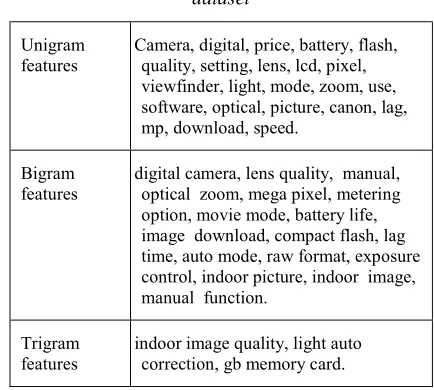
Each sentence considered for review processing along with the POS tag information of each word in the sentence is stored in review database. The next step is the generation of frequent features. A transaction file is created for this purpose. The transaction file contains only pre-processed nouns/noun phrases of the sentence. All the frequent pattern item sets are identified by association mining. An item set is nothing but a set of words that occurs together in a paragraph. The need for using association mining in this process is to identify the frequent item sets that are likely to be product features. The infrequent noun or noun phrases are expected to be non-product features. Apriori algorithm is applied on the transaction set of nouns/noun phrases. Each resulting frequent item set is a possible feature, if minimum support of the product review sentences are more than 1%. All the candidate frequent features generated association mining are not genuine features. Compactness pruning and redundancy pruning are used to discard the unlikely features. For redundancy pruning a p-support lower than the minimum p-p-support of three is used. The sample product features identified for the dataset is given in Table 1.
Table 1: Sample Product features identified for the dataset
Unigram
features Camera, digital, price, battery, flash, quality, setting, lens, lcd, pixel, viewfinder, light, mode, zoom, use, software, optical, picture, canon, lag, mp, download, speed.
Bigram
features digital camera, lens quality, manual, optical zoom, mega pixel, metering option, movie mode, battery life, image download, compact flash, lag time, auto mode, raw format, exposure control, indoor picture, indoor image, manual function.
Trigram
features indoor image quality, light auto correction, gb memory card.
4.3. Data Pre Processing
[image:4.612.99.297.150.401.2]4215
4.4 Feature Reduction
The statistical method widely used to reduce the dimension of feature set is PCA. The new principal component variables are referred to as new domain metrics. Assuming Z(a·b) matrix as the standardized word vector data with "a" reviews and "b" product attributes. The algorithm for carrying out PCA is :
i.Determine the covariance matrix R of Z. ii.Determine Eigenvalues k and Eigenvectors ek.
iii.The dimensionality of the data is scaled down. iv.Determine domain metrics for each product
review using tk
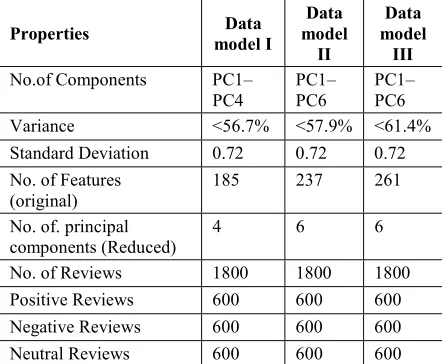
[image:5.612.84.305.545.727.2]The identification of PCA with its respective features (185, 237 and 261 in our case) for each model is identified by Weka tool. ‘Eigen value >1’ is the stopping rule used for this process. As stopping rule has been imposed, the number of principal components for data model I, II and III are reduced to 4, 6 and 6. The percentage of variance becomes less as stopping rule has been implied. With the reduced principal components as features, the word vector models (I, II and III) are reconstructed. The principle components obtained for models I, II and III are shown in Table 3.
Table 3: Description of models (feature reduced)
Properties model I Data model Data
II
Data model
III No.of Components PC1–
PC4 PC1–PC6 PC1– PC6 Variance <56.7% <57.9% <61.4% Standard Deviation 0.72 0.72 0.72 No. of Features
(original) 185 237 261 No. of. principal
components (Reduced) 4 6 6 No. of Reviews 1800 1800 1800 Positive Reviews 600 600 600 Negative Reviews 600 600 600 Neutral Reviews 600 600 600
5. METHODS
This section gives a brief discussion of the technique used for constructing the prediction system. For this research work, the statistical approach (SVM) is implemented using RapidMiner tool. We have also used neural network based PNN for constructing the prediction model. The neural network approach is employed using Neural Network Toolbox available in MATLAB package. The baseline methods are described in detail by the researchers Tao Li and Ziqiong Zhang [33,37]. Default values are used as parameters in the tools.
5.1 Probabilistic Neural Network (PNN)
A Probabilistic Neural Network is a technique which adopts on statistical Bayesian classification algorithm. In this technique, the functions are formulated into multilayered feed forward network with four layers. The input layer, pattern layer, summation layer and output layer are the four layers in multilayered feed forward network. The input layer has input nodes, which are the set of review measurements. The pattern layer for each pattern in training set is connected to the input layer. Depending on the class pattern the output from pattern layer is connected to summation units. PNN is a non linear classification technique based on Bayesian minimum risk criteria. From the previous studies, it is proved that SVM performs much better in sentiment classification but the disadvantage of SVM is its high computational cost for finding the best parameter combinations. The advantage of PNN is that it is simple and can be trained easily. PNN has only one parameter to be optimized and hence training is easy. For parameter optimization, PNN classifier is the best choice [3]. For a given unknown sample x, we can calculate its posterior probability to obtain which class label the sample x belongs to. According to Bayesian rule, is proportional to the multiplication of all prior probability by probability density function . That can be represented as: (x). Let m be the number of training samples, n the number of genes,
Camera
review Reviews No. of Feature features No. of Reviews Positive Negative Reviews Reviews Neutral Data model I 1800 Unigrams only 185 600 600 600
Data model II 1800 Unigrams + Bigrams 185 + 52 =237 600 600 600
Data model III 1800 Unigrams + Bigrams
ISSN: 1992-8645 www.jatit.org E-ISSN: 1817-3195
4216
xij the jth training sample for class i, and ki the
number of samples of class i. The Parzen estimate probability density function for class i can be written as (Eq. 1 )
(1) where σ is a smoothing parameter. The prior probability can be evaluated by the following formula (Eq . 2)
(2) where C denotes the number of subclasses in dataset. The datasets used in this work have only two sub classes positive and negative.
6. RESULTS AND DISCUSSIONS
The effectiveness of the prediction models varies greatly. Misclassification rate, correctness and compactness are used for evaluating the quality of the prediction models. The data models I, II and III are validated using 10-fold cross validation.
6.1 Misclassification Rate
[image:6.612.95.531.394.543.2]Misclassification rate is the ratio of number of wrongly classified reviews to the total number of reviews classified by the prediction method. The wrong classifications fall into three categories. C1 represents number of negative and neutral reviews classified as positive. C2 represents number of positive and neutral reviews classified as negative. C3 represents number of positive and negative reviews classified as neutral.
Table 4: Predicted Confusion Matrices for SVM for all the three Models
Data model I Data model II Data model III
Actual Positive Negative Neutral Positive Negative Neutral Positive Negative Neutral
Positive 458 78 64 464 75 61 471 68 61
Negative 87 439 74 82 460 58 73 465 62
Neutral 65 91 444 61 83 456 50 78 472
Type I Error
25.3%
Type II Error
28.2%
Type III Error
23.0%
Type I Error
23.8%
Type II Error
26.3%
Type III Error
19.8%
Type I Error
20.5%
Type II Error
24.3%
Type III Error
[image:6.612.98.530.571.732.2]20.5% Misclassification rate: 25.5% Misclassification rate: 23.3% Misclassification rate: 21.8 %
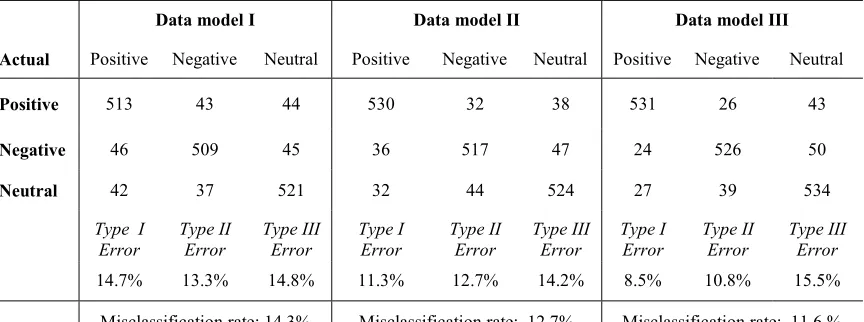
Table 5:Predicted Confusion Matrices for PNN for all three Model
Data model I Data model II Data model III
Actual Positive Negative Neutral Positive Negative Neutral Positive Negative Neutral
Positive 513 43 44 530 32 38 531 26 43
Negative 46 509 45 36 517 47 24 526 50
Neutral 42 37 521 32 44 524 27 39 534
Type I
Error Type II Error Type III Error Type I Error Type II Error Type III Error Type I Error Type II Error Type III Error
4217
Tables 4 and 5 summarize the misclassification results of all classification methods for the balanced dataset used. Table 4 gives the classification results in terms of error measures for SVM method. The type I, type II and type III errors are considerably higher. SVM method also predicts positive reviews more accurately (type II error is less than type I error) than negative and neutral reviews for data models I, II and III. It is evident from the results that, SVM performs much better for data model III than data models I and II.
PNN prediction results are presented in Table 6. The type I, II and III errors of the PNN models are lesser than the respective type of errors in SVM classification method. For PNN, the overall misclassification rate is less for data model III than the other two data models I and II. Thus the PNN method classifies considerably much better with unigrams, bigrams and trigrams combinations. The possible reason for better performance of PNN observed when compared to best individual classifier (SVM) could be due to the parametric model nature of PNN, while SVMs are non-parametric. The deep architectures of PNN with hidden layers represent intelligent behaviour more efficiently than shallow architectures like SVMs.
6.2 Correctness
Correctness is defined the number of reviews correctly classified as positive to the total number of reviews classified as positive.
The results from Table 6 show that the SVM based modes gives low correctness, which implies that a large number of sentences that are not positive would have been inspected. Data model III of PNN achieves 91.2% correctness in identifying positive review sentences, 89.0% correct in identifying negative review sentences and 85.2% correctness in identifying neutral review sentences. The prediction results of data model III are good when compared to data model I and data model II. The results suggest that the combined effect of unigram, bigram and trigram is the best option for review classification. Of all the prediction models, the reviews classified by PNN based models are more accurate.
6.3 Completeness
[image:7.612.93.525.512.594.2]Completeness is defined as the ratio of number of positive reviews classified as positive to the total number of reviews. Completeness of the prediction model is given in Table 7. The results observed are as follows : When compared with other data model the maximum positive, negative and neutral reviews are identified by data model III of PNN. All the methods predict positive reviews more completely than negative and neutral reviews.
Table 6: Correctness of classifiers based on prediction using various models
Methods Data model I (Predicted) Data model II (Predicted) Data model III (Predicted)
[image:7.612.92.524.633.714.2]Positive Negative Neutral Positive Negative Neutral Positive Negative Neutral SVM 75.1 72.2 76.3 76.4 74.4 79.3 79.3 76.1 79.3 PNN 85.4 86.4 85.4 88.6 87.2 86.0 91.2 89.0 85.2
Table 7: Completeness of classifiers based on prediction using various models
ISSN: 1992-8645 www.jatit.org E-ISSN: 1817-3195
4218 The results obtained clearly show that among the methods, PNN based prediction models perform well in all aspects. The high accuracy is achieved in data model III based prediction which concludes that including bigram, trigram in prediction provides better results when compared to results obtained using unigram only. From Table 8, we can observe the effect of feature reduction using PCA in terms of training time. Table 8 summarizes the average training time reduction using PCA prediction technique. From the analysis, it is predicted that huge data size and high dimensionality of text data will automatically reduce the performance of the classifier and hence leading to longer training time. From this table, it is proved that the neural network method reduces considerably the time taken for training.
7. CONCLUSION
This paper proposes opinion mining system for online reviews based on PNN and SVM to provide decision support for customers in taking a decision for a buying a product.. The System extractes unigram, bigram and trigram features from Amazon reviews on camera product and SVM and PNN methods are applied for prediction. From the results, it is observed that misclassification rate is lesser and correctness measure is higher for PNN when compared to SVM. This work, also identifies better performance in classification models based on the combination of unigram, bigram and trigram. It analyzes the effect of ANN based method for opinion classification. PNN performs better and yields higher accuracy in prediction. When compared to statistical approaches, neural network approach performs better than SVM approach. Compared with traditional techniques, the ANN based approach shows better performance both in quality measure and in training time.
In sentiment classification, the reduction of input attributes has now become an important issue for machine learning techniques. Our experimental results based on the hybrid combination of PNN and PCA could be a possible solution for increasing the performance of classification and shortening the training time. Future work can be an extension of this research using ensemble methods and various others feature selection methods. The general limitation of this work is that it cannot be implemented in other domains for example medical field. Since the results cannot be guaranteed as in case of product reviews.
REFERENCES
[1]. A. Ahmed, H. Chen, and A. Salem, "Sentiment analysis in multiple languages: feature selection for opinion classification in web forums", ACM Transactions on
Information Systems, Vol. 26(3), 2008.
[2]. A. Kennedy and D. Inkpen, "Sentiment classification of movie and product reviews using contextual valence shifters", In Workshop on the analysis of Informal and Formal Information Exchange during
negotiations. Language Processing, pp.129–
136, 2005.
[3]. A.V. Savchenko, "Probabilistic neural network with homogeneity testing in recognition of discrete patterns set", Neural
Networks, Vol. 46, pp. 227-241. October
2013.
[4]. C.H.Wu, Z.J. Chuang, and Y.C Lin, " Emotion recognition from text using semantic labels and separable mixture models". ACM Transactions on Asian
Language Information Processing, Vol. 5(2),
pp. 165–182, 2006.
[image:8.612.86.518.145.222.2][5]. G. Michael, "Sentiment classification on customer feedback data: noisy data, large feature vectors, and the role of linguistic analysis", In Proceedings the 20th
Table 8: Summary of the training time using PCA and without using PCA
Without PCA (in sec) With PCA (in sec)
Method model I Data model II Data model III Data model I Data model II Data model III Data
PNN 121.8 163.3 170.4 43.3 46.4 49.0
4219
international conference on computational
linguistics, 2004.
[6]. G. Salton, A. Singhal, M. Mitra, and C. Buckley, C. "Automatic text structuring and summarization", Information Processing and
Management, Vol. 33(2), pp. 193–207, 1997.
[7]. H.Tang, S. Tan, and X. Cheng, "A survey on sentiment detection of reviews", Expert
Systems with Applications, Vol. 36, pp.
10760–10773, 2009.
[8]. H.Yu and V. Hatzivassiloglou, " Towards answering opinion questions: Separating facts from opinions and identifying the polarity of opinion sentences". In Proceedings of the Conference on Empirical
Methods in Natural, 2003.
[9]. Hu, Minqing, and Bing Liu. “Mining and summarizing customer reviews”,
Proceedings of the tenth ACM SIGKDD international conference on Knowledge
discovery and data mining. ACM, 2004.
[10]. K. Dave, S. Lawrence and D.M. Pennock, "Mining the peanut gallery: Opinion extraction and semantic classification of product reviews", In The 12th www, 2003.
[11]. Kaiquan Xu , Stephen Shaoyi Liao , Jiexun Li and Yuxia Song, “Mining comparative opinions from customer reviews for Competitive Intelligence”, Decision Support
Systems, Vol. 50, pp. 743–754, 2011.
[12]. L. Briand and J. Wust, "Empirical studies of quality models in object-oriented systems, in: Marvin Zelkowitz (Ed.)", Advances in
Computers, vol. 56, Academic Press, pp. 1–
44, 2002.
[13]. M. Gamon, "Sentiment classification on customer feedback data: Noisy data, large feature vectors, and the role of linguistic analysis", In Proceedings of the 20th
International Conference on Computational
Linguistics p. 841, 2004.
[14]. M. Ghiassi, J. Skinner and D. Zimbra, "Twitter brand sentiment analysis: A hybrid system using n-gram analysis and dynamic artificial neural network", Expert systems
with applications, 2013.
[15]. M. Koppel, and J. Schler, "The importance of neutral examples for learning sentiment",
Computational Intelligence, Vol. 22(2), pp.
100-109, 2006.
[16]. Melville and Wojciech Gryc, "Sentiment Analysis of Blogs by Combining Lexical Knowledge with Text Classification",
KDD’09, Paris, France. Copyright 2009
ACM 978-1-60558-495-9/09/06, June 28– July 1, 2009,
[17]. P. Chaovalit, and L. Zhou, "Movie review mining: A comparison between supervised and unsupervised classification approaches",
In Proceedings of the 38th annual HICSS,
2005.
[18]. P. Subasic, and A. Huettner, "Affect analysis of text using fuzzy semantic typing", IEEE Transactions on Fuzzy
Systems, Vol. 9(4), pp. 483–496, 2001.
[19]. P.D. Turney, M.L. Littman, "Unsupervised Learning of Semantic Orientation from A Hundred-billion-word Corpus". Technical Report EGB-1094, National Research
Council Canada, 2002.
[20]. P.D.Turney, "Thumbs up or thumbs down? Semantic orientation applied to unsupervised classification of reviews". In Proceedings of
the 40th Annual Meetings of the Association
for Computational Linguistics, Philadelphia,
PA. pp. 417–424, 2002.
[21]. Patrick marques ciarelli and elias oliveira, "An enhanced probabilistic neural network approach applied to text classification ",Springer veerlag, LNCS 5856, pp 661-668, 2009.
[22]. Qiang Ye, Ziqiong Zhang, Rob Law, "Sentiment classification of online reviews to travel destinations by supervised machine learning approaches", Expert Systems with
Applications, Vol. 36, 6527–6535, 2009.
[23]. Qingliang Miao, Qiudan Li, Ruwei Dai, “AMAZING: A sentiment mining and retrieval system”, Expert Systems with
Applications, Vol. 36, pp. 7192–7198, 2009.
[24]. Rodrigo Moraes, João Francisco Valiati, Wilson P. Gavião Neto, "Document-level sentiment classification: An empirical comparison between SVM and ANN",
Expert Systems with Applications, Vol. 40,
Issue 2, pp. 621–633, 1 February 2013. [25]. Rudy Prabowo, Mike Thelwall, "Sentiment
analysis: A combined approach", Journal of
Informetrics Vo.3, pp. 143–157, 2009.
[26]. Rui Xia , Chengqing Zong, Shoushan Li, "Ensemble of feature sets and classification algorithms for sentiment classification",
Information Sciences, Vol. 181, pp. 1138–
1152, 2011.
ISSN: 1992-8645 www.jatit.org E-ISSN: 1817-3195
4220 [28]. S.B. Tan, and J. Zhang, "An Empirical study
of sentiment analysis for Chinese documents", Expert Systems with
Application, Vol. 34(4), pp. 2622–2629,
2008.
[29]. S.G. Wang, Y.J. Wei, W. Zhang, D.Y. Li, and W. Li, "A hybrid method of feature selection for chinese text sentiment classification". In Proceedings of the 4th
International Conference on Fuzzy Systems
and Knowledge Discovery, IEEE Computer
Society. pp. 435–439, 2007.
[30]. Songbo Tan , Jin Zhang, "An empirical study of sentiment analysis for Chinese documents", Expert Systems with
Applications, Vol. 34, pp. 2622–2629, 2008.
[31]. Suge Wang, Deyu Li, Xiaolei Song, Yingjie Wei, Hongxia Li, "A feature selection method based on improved fisher’s discriminant ratio for text sentiment classification", Expert Systems with
Applications, Vol. 38, pp. 8696–8702, 2011.
[32]. T. Wilson, J. Wiebe, and P. Hoffman," Recognizing contextual polarity in phrase level sentiment analysis". In Proceedings of
the Human Language Technology
Conference and Conference on Empirical
Methods in Natural Language Processing,
British Columbia, Canada. pp. 347–354, 2005.
[33]. Tao Li, Shenghuo Zhu, Mitsunori Ogihara, "Text categorization via generalized discriminant analysis", Information
Processing and Management, Vol. 44, pp.
1684–1697, 2008.
[34]. V. Hatzivassiloglou, and J. Wiebe, "Effects of adjective orientation and gradability on sentence subjectivity", In International Conference on Computational Linguistics
(COLING-2000), 2000.
[35]. Y. Yang, and C.G.Chute,"An example-based mapping method for text categorization and retrieval". ACM Transactions on Information
Systems, Vol. 12(3), pp. 252–277, 1994.
[36]. Zhu Jian, XU Chen, WANG Han-Shi, "Sentiment classification using the theory of ANNs ", The Journal of China Universities
of Posts and Telecommunications,
17(Suppl.): pp. 58–62, July 2010.