Proceedings of the Second International Conference on Dependency Linguistics (DepLing 2013), pages 147–156,
The Representation of Czech Light Verb Constructions
in a Valency Lexicon
V´aclava Kettnerov´a
and
Mark´eta Lopatkov´a
Charles University in Prague
Faculty of Mathematics and Physics
Institute of Formal and Applied Linguistics
Czech Republic
{
kettnerova,lopatkova
}
@ufal.mff.cuni.cz
Abstract
Light verb constructions (LVCs) pose a se-rious challenge for both theoretical and ap-plied linguistics as their syntactic struc-tures are not solely determined by verbs alone but also by predicative nouns. In this contribution, we introduce an initial step to a new formal lexicographic representation of LVCs for the valency lexicon of Czech verbs,VALLEX.
The main idea underlying our representa-tion is to decompose the informarepresenta-tion on an LVC between (i) the verbal valency frame and (ii) the nominal valency frame. Both deep and surface syntactic structures of LVCs can be easily derived from the in-formation given in the verbal and nomi-nal frames by application of formal rules as they are introduced in this contribution.
1 Introduction
Light verb constructions (LVCs) represent a type of complex predicate where two syntactic ele-ments serve as a single predicate – for exam-ple, in Czech, light verbs combine with predica-tive nouns, ex. (1), adjecpredica-tives, ex. (2), or adverbs, ex. (3) (LVCs are typed in bold). These combi-nations are characterized by ambivalent relations: from a syntactic point of view, a light verb is the governing component of the collocation; however, from a semantic point of view, it is the predicative noun that represents the governing component.
(1) Petrz´ıskal souhlasod sv´eho nadˇr´ızen´eho ke zmˇenˇe pr´avn´ıho z´astupce firmy. Eng. Peterwon approvalfrom his boss to change the legal representative of the com-pany.
(2) Janje podobn´ysv´emu otci. Eng. Johnis likehis father.
(3) V´ypovˇed’ kl´ıˇcov´eho svˇedka by mohlavn´est
do pˇr´ıpadujasno.
Eng. Key witness testimony could shed lighton the case.
Considering the wide range of issues, this study is limited to Czech LVCs based on the collocations of a light verb and a predicative noun, see ex. (1).
Despite being subject to many analyses, see esp. (Butt, 2010), a clear-cut definition of LVCs is still missing. In this paper, we follow both semantic and syntactic criteria for distinguishing LVCs. (i) The semantic operational criterion is based on the observation that a predicative noun (a predicative adjective or a predicative adverb) – as a semantic governing element – stands for the entire colloca-tion of the predicative noun and a light verb; i.e, a predicative noun shows the same semantic distri-bution as the entire collocation. (ii) According to the syntactic criterion, some valency complemen-tations of a light verb and a predicative noun have to be referentially identical, see esp. (Radimsk´y, 2010) and (Kol´aˇrov´a, 2010).
Like other types of multiword expressions, LVCs pose a serious challenge for both theoreti-cal and applied linguistics (Sag et al., 2002). As they require special treatment in NLP tasks, esp. in machine translation, their automatic recognition would bring a substantial benefit. Developing au-tomatic recognition tools can be greatly assisted by lexical resources providing formal description of LVCs, see e.g. PropBank (Hwang et al., 2010), and WordNet (Vincze et al., 2012).
In this paper, we propose a formal represen-tation of LVCs in the valency lexicon of Czech verbs, VALLEX.1 The VALLEX lexicon is a
col-lection of rich linguistically annotated data result-ing from an attempt at a formal description of the valency behavior of Czech verbs. It provides the information on the valency structure of Czech
1http://ufal.mff.cuni.cz/vallex
verbs in the form of valency frames, each valency frame corresponding to a single verbal lexical unit. For the description of valency, the valency theory formulated within the Functional Generative De-scription (FGD) – a dependency based framework – has been adopted (Sgall et al., 1986). Valency in FGD is related to the tectogrammatical layer – to a layer of linguistically structured meaning (roughly speaking, to a deep-syntactic layer). Five types of verbal actants – labeled by functors AC-Tor (ACT), PATient (PAT), ADDRessee (ADDR), ORIGin (ORIG), and EFFect (EFF) – have been determined. The first two – ACT and PAT – are distinguished on the syntactic basis. In assigning the remaining three actants – ADDR, ORIG and EFF – semantic criteria are taken into account as well, see esp. (Panevov´a, 1994).
The issue of LVCs (as well as other types of complex predicates) has remained underdeveloped in VALLLEX so far. The main motivation of this paper is to propose an adequate representa-tion of this phenomenon in order to fill such se-rious gap in the description of valency behav-ior of Czech verbs. When designing an LVCs representation for VALLEX, we draw inspiration esp. from the Explanatory Combinatorial Dictio-nary of the Contemporary Russian Language elab-orated within the Meaning-Text Theory, in which a strong emphasis is put on the systematic descrip-tion of combinatorial potentials of lexical units, see (Mel’ˇcuk and ˇZolkovskij, 1984). For the de-scription of LVCs, several lexical functions – al-lowing to identify verbonominal collocations – are used, see (Mel’ˇcuk, 1996).
We have carried out a detailed analysis of se-mantic and deep syntactic aspects (Section 2) as well as surface syntactic aspects (Section 3) of the given constructions. The analysis of the LVCs based on the combination of light verbs with pred-icative nouns can be conducted either (i) from the perspective of a light verb (Gross, 1981), or (ii) from the perspective of a predicative noun (Mel’ˇcuk, 1996). Each of these analyses poses different challenging problems. Moreover, they can lead to more or less different interpretations of forming complex syntactic structure of LVCs.
The representation of LVC proposed in this arti-cle combines these two perspectives: (i) From the semantic point of view, it is a predicative noun that provides the LVC with its semantic participants; thus semantic aspects of LVCs are described from
the perspective of a predicative noun here. (ii) On the other hand, deep syntactic aspects are de-scribed from the perspective of a (light) verb as it is a verb that provides its valency potential for se-mantic participants (evoked by the noun) and thus determines a core syntactic structure of a sentence. The results of this analysis have been re-flected in the representation of Czech LVCs in the VALLEX lexicon (Section 4). The proposed rep-resentation decomposes the information on LVCs between verbal and nominal lexicon entries, which are interlinked by a special attribute-lvc. More-over, a special attribute-mapattached to the ver-bal frame provides the information on the link-ing between verbal and nominal valency comple-mentations referring to the same entities in LVCs. Based on this linking, deep and surface syntactic structure of LVCs can be derived by application of formal rules, which capture ‘patterns’ common to individual types of LVCs.
2 Semantic and (Deep) Syntactic Aspects
In this section, semantic and (deep) syntactic as-pects of Czech LVCs are described in detail. When describing LVCs, it shows fruitful to distinguish:(i) semantic participants involved in the situa-tion expressed by a given LVC (related to semantic content),2 roughly corresponding
to semantic actants in MTT, see (Mel’ˇcuk, 2004a; Mel’ˇcuk, 2004b),
(ii) valency complementations (related to the deep syntactic layer), and
(iii) surface syntactic positions (related to the sur-face syntactic layer).
Here the relation between semantic participants (Subsection 2.1) and valency complementations in LVCs is discussed (Subsection 2.2).
2.1 Semantic Participants
Verbonominal collocations forming LVCs repre-sent a type of complex predicates where two syn-tactic elements – a light verb and a predicative noun – serve as a single predicate. In contrast to a single predicating verb, in LVCs, semantic fea-tures are decomposed between a light verb and a predicative noun.
2Generally, whereas the inventory of units of syntactic
As to the distribution of semantic properties, a light verb appears to be a semantically incomplete element expressing only general semantic prop-erties (esp. aspectual nuances). To be semanti-cally complete, it enters into the combination with a predicative noun which contributes individual lexical-semantic properties into the resulting com-plex predicate (Mach´aˇckov´a, 1979).
The following examples make evident that it is the noun (not the light verb) that determines the number of semantic participants (indicated by their semantic labels) expressed in LVCs, ex. (4)– (5), and their semantic features, ex. (6)–(7).
(4) PolicistaSpeakerpodal hl´aˇsen´ıo akciInform
sv´emu veliteliRecip.
‘The officerSpeaker – handed – a
re-port – on the actionInfo – to his
commanderRecip.’
Eng. The officerreportedon the action to his commander.
(5) SportovecAgent podal v z´avodu velk´y v´ykon.
‘The sportsmanAgent – handed – in the
race – a great performance.’
Eng. The sportsmangavea great perfor-mancein the race.
(6) Tento poˇc´ıtaˇc / ˇclovˇekin/animate dˇel´a
hodnˇepr´ace.
Eng. This computer/manin/animate does
muchwork.
(7) Tento *poˇc´ıtaˇc / ˇclovˇekin/animate dˇel´a
velkoukari´eru.
Eng. This *computer / manin/animate makesa greatcareer. (Radimsk´y, 2010) For instance, the light verbobdrˇzet‘to receive’ is depleted of individual semantic properties – in-cluding semantic participants, see ex. (9) – fore-grounding only the abstract semantic facets (i.e., ‘transferring’) of its full verb counterpart; the lat-ter expresses ‘transferring a physical object from an agent to a recipient’ characterized by three semantic participants, namely ‘Recipient’ (abbr. ‘Recip’), ‘Agent’, and ‘Theme’, see ex. (8).
(8) V´yherceRecip od n´asAgent obdrˇz´ı drobn´y
d´arekTheme.
Eng. ‘The winnerRecipwill receivea small
giftTheme from usAgent.’
(9) VelitelRecip obdrˇzel hl´aˇsen´ı od
policistySpeaker o akciInform.
Eng. The commanderRecip received the report on the actionInform from the
officerSpeaker.
To be semantically complete, the light verb combines with the predicative noun hl´aˇsen´ı ‘re-port’ that denotes the situation of ‘conveying a piece of information to a recipient by a speaker’. This situation involves three participants – ‘Speaker’, ‘Recip’, and ‘Information’ (abbr. ‘In-form’). As a result, the situation expressed by the collocationobdrˇzet hl´aˇsen´ı‘to receive report’ is the situation of reporting, characterized by the semantic participants provided by the predicative noun, see ex. (9).
2.2 Valency Complementations
From a (deep) syntactic point of view, both a pred-icative noun and a light verb in an LVC preserve their own valency potentials (represented in a form of valency frames), i.e., they are characterized each by own sets of valency complementations. In case of predicative nouns, valency frames rep-resent the usage of nouns in nominal structures. In case of light verbs, we observe that in Czech valency frames are prototypically identical with the frames of their full verb counterparts. Thus we assume that the valency frames of light verbs are inherited from the valency frames of the re-spective full verbs, see Subsection 2.3.2. As light verbs – entering into combination with predica-tive nouns – form multiword lexical units, their va-lency frames describe some kind of ‘proto lexical units’ (in contrast to valency frames of full verbs, where valency frames correspond to lexical units). For instance, both the verbobdrˇzet‘to receive’ and the noun hl´aˇsen´ı ‘report’ forming the LVC obdrˇzet hl´aˇsen´ı‘to receive report’ are character-ized by their own valency frames: (i) The valency frame of the verb is inherited from the valency frame of the full verb (10), see ex. (11). (ii) The valency frame of the noun (12) represents the us-age of the noun in a nominal structure, see ex. (13). (10) obdrˇzet‘to receive’ . . . ACT PAT ORIG
The valency complementations of the full verb are mapped onto the semantic partic-ipants ‘Recip’, ‘Theme’, and ‘Agent’, re-spectively; see ex. (11).
(11) V´yherceACT:Recip od n´asORIG:Agent obdrˇz´ıdrobn´y d´arekPAT:Theme.
Eng. ‘The winnerACT:Recipwill receivea
(12) hl´aˇsen´ı‘report’ . . . ACT ADDR PAT The nominal valency complementations are mapped onto the semantic participants ‘Speaker’, ‘Recip’, and ‘Inform’ respec-tively, see ex. (13).
(13) PolicistovoACT:Speaker hl´aˇsen´ı
veliteliADDR:Recip o akciPAT:Inform
bylo struˇcn´e.
Eng. The officer’sACT:Speaker re-port on the actionPAT:Inform to his
commanderADDR:Recipwas brief.
The correspondence between valency comple-mentations of a verb and those of a noun in LVCs is discussed in the following subsections.
2.3 Linking of Verbal and Nominal Valency Complementations
A predicative noun (as was shown above) con-tributes its semantic participants (linked with nom-inal valency complementations) to the LVC. On the other hand, the verbal complementations are not semantically saturated, see Subsection 2.1. To acquire semantic capacity, the verbal complemen-tations are interlinked with nominal ones (satu-rated by nominal semantic participants).
The linking of verbal complementations with the nominal ones is reflected in the notions of fu-sion or merger posited in connection with LVCs by authors from different theoretical backgrounds, see esp. (Alsina, 1997) and (Mohanan, 1997). In FGD, this fact is tentatively referred to as shar-ing valency complementations between a verbal and a nominal valency frame which is indicated by a specific type of grammatical coreference – quasi-control, see esp. (Mikulov´a et al., 2006), (Kol´aˇrov´a, 2010), and (Cinkov´a, 2009).
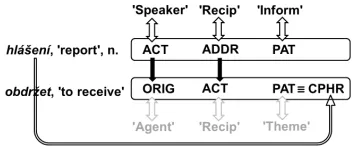
For instance, when the verbobdrˇzet‘to receive’ combines with the predicative noun hl´aˇsen´ı ‘re-port’ into the LVC, the nominal valency comple-mentations are still linked with nominal semantic participants (namely ‘Speaker’, ‘Recip’, and ‘In-form’, see (12) in Subsection 2.2). On the other hand, the verbal complementations do not corre-spond to any semantic participants. To acquire the semantic content, the verbal complementations are linked with the nominal complementations (and via them to the above given nominal semantic par-ticipants), see Fig. 1.
As to the mechanism of the linking: when the light verb obdrˇzet‘to receive’ combines with the
Figure 1: The linking of verbal valency com-plementations with nominal comcom-plementations (black arrows) and their saturation with the nom-inal semantic participants in the LVC obdrˇzet hl´aˇsen´ı‘to receive report’.
predicative noun hl´aˇsen´ı ‘report’, the noun oc-cupies the verbal valency ‘PATient’. In accor-dance with FGD, we re-assign this valency com-plementation with the functor ‘CPHR’ (‘Com-poundPHRaseme’) referring to a predicative com-ponent in complex predicates, see (Mikulov´a et al., 2006). The remaining valency complementa-tions, ‘ORIGin’ and ‘ACTor’ in the verbal frame (10), are linked with the nominal complementa-tions ‘ACTor’ and ‘ADDRessee’ in (12), respec-tively. As argued above, the linking allows the given verbal complementations to acquire seman-tic capacity from the nominal complementations. 2.3.1 Direction of Linking
With respect to the fact that a change of a light verb may trigger the changes in the linking of ver-bal and nominal valency complementations, we assume that it is the light verb that determines the linking of its complementation(s).
For instance, according to our suggestion, the arrangement of the links is evoked by the verb obdrˇzet‘to receive’ (not by the nounhl´aˇsen´ı ‘re-port’) in the LVCobdrˇzet hl´aˇsen´ı‘to receive re-port’, see Fig. 1. This hypothesis is supported by the following observation: when the nounhl´aˇsen´ı ‘report’ enters into combination with another light verb, e.g., with the verb podat ‘to hand’ (result-ing in the LVCpodat hl´aˇsen´ı‘to make report’), it leads to the rearrangement of the linking – in this case, the nominal ‘ACTor’ and ‘ADDRessee’ are linked with the ‘ACTor’ and ‘ADDRessee’ of the verbpodat‘to hand’, respectively, see ex. (14) and Fig. 2.
(14) PolicistaACT:Speaker podal hl´aˇsen´ı o
akciPAT:Infosv´emu veliteliADDR:Recip.
[image:4.612.330.508.48.121.2]commanderADDR:Recip.
Figure 2: The linking of verbal valency com-plementations with nominal comcom-plementations (black arrows) and their saturation with the nomi-nal semantic participants in the LVCpodat hl´aˇsen´ı ‘to make report’.
2.3.2 Verbal Valency Frame of a Light Verb Let us repeat that from our point of view, valency frames of light verbs are inherited from the lency frames of their full counterparts, i.e., the va-lency frames of light verbs are prototypically iden-tical with the frames of the respective full verbs (with the only difference that the complementa-tion referring to a predicative noun is marked with ‘CPHR’ functor), as was stated in Subsections 2.2 and 2.3.
There is only one additional exception. In com-parison with the valency frames of full verbs, the number of valency complementations in the frames of light verbs can be reduced. According to our proposal, only those verbal valency com-plementations from the valency frame that acquire semantic content from nominal ones are retained in the valency frame. Thus in case of light verbs, only those valency complementations (in addition to ‘CPHR’) that acquire semantic capacity via the linking with nominal complementations are em-ployed in the valency frame. Those verbal com-plementations that are depleted in any semantic content (i.e., those that remain unlinked with any nominal complementation) are removed from the valency frame.
These cases occur when the number of nom-inal complementations is lower than the number of verbal ones left in the verbal valency frame af-ter a predicative noun occupies some verbal com-plementation. Let us exemplify this case on the verb podat ‘to hand’ when it enters into combi-nation with the predicative noun v´ykon ‘perfor-mance’ (resulting in the LVCpodat v´ykon‘to give performance’), see ex. (5). This predicative noun
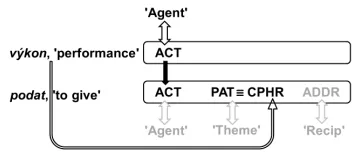
is characterized by a single valency complementa-tion – ‘ACTor’ corresponding to the semantic par-ticipant ‘Agent’. When this noun combines with the verb podat ‘to hand’, it fills the verbal ‘PA-Tient’ (assigned with ‘CPHR’). Then two verbal complementations – ‘ACTor’ and ‘ADDRessee’ – remain left in the verbal frame. The verbal ‘AC-Tor’ is linked with the nominal ‘AC‘AC-Tor’; however, the verbal ‘ADDRessee’ remains unlinked. As a result, the ‘ADDRessee’ is deleted from the re-spective verbal valency frame, see Fig. 3.
Figure 3: The linking of verbal valency com-plementations with nominal comcom-plementations (black arrows) and their saturation with the nomi-nal semantic participants in the LVCpodat v´ykon ‘to give performance’; see esp. the unlinked (and thus deleted) verbal ‘ADDRessee’ (in gray).
3 Syntactic Expressions and Morphemic
Forms of Valency Complementations
We have argued that both a light verb and a pred-icative noun retain their own valency potentials, i.e., they correspond to separate valency frames, see Subsection 2.2. These valency structures enter into interaction which results in a complex surface syntactic structure of a LVC.In general, the number of valency complemen-tations that can be expressed on the surface is de-termined by the number of semantic participants involved in the situation expressed by an LVC, plus one verbal complementation (‘CPHR’) that is reserved for a predicative noun.
[image:5.612.106.282.82.160.2] [image:5.612.329.506.199.275.2]We formulate the following hypothesis: It is a verb that, in general, determines the syntactic structure of a sentence. Thus in case that a par-ticular semantic participant is linked with both a nominal valency complementation (directly) and a verbal valency complementation (via the link to a nominal valency complementation), it is a verb (not a noun) that retains the complementa-tion in the resulted surface structure (and thus pre-scribe the morphemic form of the complementa-tion). As each semantic participant is prototypi-cally expressed only once, we consider the respec-tive nominal complementation as elliptic (i.e., as having zero morphemic realization).
Based on this hypothesis, the following rules can be formulated:
– From the verbal valency frame, those verbal valency complementations that are semanti-cally saturated via linking with some nominal valency complementations can be expressed on the surface.
– From the nominal frame, those nominal com-plementations that remain unlinked with any verbal ones are expressed on the surface. On the contrary, the nominal complementation affected by linking with verbal complemen-tation remains unexpressed on the surface.3
Let us exemplify the proposed rules on the ex-ample of the LVC obdrˇzet hl´aˇsen´ı‘to receive re-port’, which expresses the situation of reporting characterized by three situational participants – ‘Speaker’, ‘Recip’, and ‘Inform’ (as discussed in Section 2). Thus three valency complementa-tions can be surface syntactically structured in the LVC (in addition to the valency complementation occupied by the predicative noun), see ex. (19).
As to the valency behavior, the light verb obdrˇzet ‘to receive’ is characterized by the va-lency frame (16) inherited from the frame of its full counterpart (15). The valency frame of the predicative noun hl´aˇsen´ı ‘report’ (17) describes the usage of the noun in a nominal structure, as in ex. (18).
3In some cases, ‘ACTor’ can be expressed twice on the
surface, i.e., as both a nominal and a verbal complementa-tion, despite being interlinked, e.g.,Nemocnice sv˚ujboj proti ruˇsen´ı akutn´ıch l˚uˇzek nevzd´avaj´ı.‘Thehospitalsdo not give uptheirfight against eliminating acute beds.’ However, the possibility of expressing the ‘ACTor’ twice in a surface struc-ture is subject to strong stylistic constraints in Czech.
(15) obdrˇzet: ACTnom PATacc ORIGod+gen (16) obdrˇzet: ACTnom CPHRacc ORIGod+gen (17) hl´aˇsen´ı: ACTpos,gen ADDRdat PATo+loc (18) PolicistovoACT:pos hl´aˇsen´ı
veliteliADDR:dat o akciPAT:o+loc bylo
struˇcn´e.
Eng. The officer’sACT report on the
action to his commanderADDR was brief.
(19) VelitelACT:nomobdrˇzel hl´aˇsen´ıCPHR:acco
akciPAT:o+loc od policistyORIG:od+gen.
Eng. The commanderACT received re-portCPHR on the actionPAT from the
officerORIG.
1. When used in the LVC, one valency com-plementation of the verb obdrˇzet ‘to receive’ – ‘PATient’ expressed in accusative case – is filled with the predicative nounhl´aˇsen´ı‘report’; instead of ‘PATient’, this complementation is marked by the ‘CPHR’ functor distinguishing the light verb from the full verb, see above.
2.Five valency complementations – two from the verbal frame (‘ACTor’ and ‘ORIGin’) and three from the nominal one (‘ACTor’, ‘ADDRessee’, and ‘PATient’) – remain left in total for the expres-sion of three semantic participants – ‘Speaker’, ‘Recip’, and ‘Inform’. Two verbal valency com-plementations ‘ACTor’ and ‘ORIGin’ acquire se-mantic capacity from the nominal ‘ADDRessee’ and ‘ACTor’, respectively, see Subsection 2.2 and Fig. 1. Namely, the verbal ‘ACTor’ is linked with ‘Recip’ (via nominal ‘ADDRessee’) and the verbal ‘ORIGin’ is linked with ‘Speaker’ (via nominal ‘ACTor’). According to our hypothesis, the verb retains these two complementations in the surface structure and it determines their morphemic forms, nominative and prepositional group od+genitive, respectively; see valency frame (15).
As a result, nominal ‘ADDRessee’ and ‘ACTor’, remain unexpressed on the surface, see Fig. 4 displaying the (simplified) dependency tree representing ex. (19) – the linked valency com-plementations are related by coreferential arrows going from the complementations unexpressed on the surface to the expressed ones.
Figure 4: The (simplified) dependency tree for the LVCobdrˇzet hl´aˇsen´ı‘to receive report’ in ex. (19).
The proposed hypotheses on the surface syntac-tic formation of LVCs deserve further examination on the corpus data.
3.1 Basic Typology of Syntactic Structures with Light Verb Constructions
We have identified three types of complex surface syntactic structures of LVCs in Czech (according to the linking criteria). They are briefly exempli-fied in the following paragraphs.
Type 1. All verbal complementations (exclud-ing ‘CPHR’) are interlinked with the nominal ones and no nominal complementation remains unlinked. In this case, all the verbal complemen-tations are expressed on the surface whereas all nominal complementations remain unexpressed. Compare with ex. (20) where the verbal ‘ACTor’ and ‘ADDRessee’ (linked with the nominal ‘AC-Tor’ and ‘ADDResse’, respectively) are realized in the resulting surface structure, whereas the respec-tive nominal ones remain unexpressed (Fig. 5).
(20) JanoviADDR poskytovala podporuCPHR
rodinaACT.
Eng. John’s familyACT provided sup-portCPHRto himADDR.
[image:7.612.147.248.52.154.2]Type 2. All verbal valency complementations (excluding ‘CPHR’) are linked with the nomi-nal ones; however, some nominomi-nal complementa-tions remain unlinked. In this case, the linked verbal complementations are expressed whereas the corresponding nominal complementations are unexpressed in the resulted surface structure (as in Type 1). Further, the unlinked nominal com-plementations remain expressed as nominal ones. Compare with ex. (21) where the verbal ‘ACTor’ (linked with the nominal ‘ACTor’) is expressed in the resulted surface structure, whereas the nomi-nal ‘ADDRessee’ (being unlinked with any verbal
Figure 5: The (simplified) dependency tree for the LVCposkytovat podporu‘to provide support’ in ex. (20).
complementation) is realized as a nominal com-plementation (expressed by the morphemic form determined by the given noun, Fig. 6).
(21) Dceˇrin pˇr´ıtelACT na n´asADDR udˇelal dojemCPHR.
Eng. The daughter’s boyfriendACT made an impressionCPHRon usADDR.
Figure 6: The (simplified) dependency tree for the LVC udˇelat dojem ‘to make impression’ in ex. (21).
Type 3. Not all verbal valency complementations (besides ‘CPHR’) are linked with the nominal ones, see Fig. 3. The linked ones are expressed on the surface whereas the unlinked ones are deleted from the verbal valency frame, see ex. (22) where the verbal ‘ADDRessee’ is not structured (Fig. 7), see also Subsection 2.3.2, Fig. 3.
(22) SportovecACT podal v´ykonCPHR.
Eng. The sportsmanACT gavea great per-formanceCPHR.
4 Light Verb Constructions in
VALLEX
[image:7.612.374.456.343.453.2]Figure 7: The (simplified) dependency tree for for the LVCpodat v´ykon‘to give performance’ in ex. (22).
verbs, VALLEX. As every light verb and predica-tive noun creating an LVC are characterized by their own valency potentials, we represent them by separate valency frames: (i) for light verbs (Sub-section 4.1) and (ii) for predicative nouns (Subsec-tion 4.2). These frames are interlinked by refer-ences so that the whole collocations can be easily obtained. A special attention is paid to the repre-sentation of the mapping between valency comple-mentations of predicative nouns and light verbs.
In the current version VALLEX 2.5, there are roughly 2,730 verb lexeme entries containing to-gether around 6,460 verb lexical units; under the term lexical unit, we understand a form-meaning complex with (relatively) stable and discrete se-mantic properties. A lexeme then represents an abstract two-fold unit associating lexical form(s) with lexical unit(s). The verbs were selected ac-cording to their frequency in (the part of) the Czech National Corpus4 SYN2000 – the corpus
coverage is approximately 98%. In building the lexicon, the main emphasis was laid on both hu-man and machine readability – this is reflected in three formats of the lexicon: XML, HTML, and PDF formats.
The lexical entries of verbs in the VALLEX lexicon were exhaustively described in, e.g., ( ˇZabokrtsk´y and Lopatkov´a, 2007). Let us shortly recapitulate here the basic information relevant for our explanation. Each lexical unit – represented by a lemma (or set of lemmas) – is character-ized by obligatory attributes: gloss(es), a valency frame, and example(s). The valency frame, which provides the core information in the lexicon, is modeled as a sequence of valency slots. Each
4http://ucnk.ff.cuni.cz
slot stands for one valency complementation; it is characterized by a functor (indicating the type of the semantic relation of a valency complementa-tion to a verb), by obligatoriness (in superscript), and by a list of possible morphemic form(s) (in subscript). In addition, optional attributes may follow (providing the information on syntactico-semantic class, the information of applicable al-ternations, etc.).
4.1 Representation of Light Verbs
In this subsection, we describe the necessary mod-ification of verb lexical entries for the purpose of the representation of light verbs. Let us stress that light verbs in the VALLEX lexicon will be rep-resented by ‘proto lexical units’ (proto-LUs) (as light verbs form multiword lexical units only in combination with predicative nouns, see Subsec-tion 2.2). These proto-LUs are characterized by valency frames inherited from the frames of their full verb counterparts. Proto-LUs have to provide the following types of information:
I.In the inherited frame, the verbal valency com-plementation that is filled with a predicative noun is specified – its functor is changed to ‘CPHR’. In case that more verbal valency complementa-tions can be filled by (different) predicative nouns, more inherited valency frames are determined, with different valency slots identified as ‘CPHR’. This functor covers the similar information which is captured by lexical functions (namely Operi,
Funci, andLabori, j,(k)) in the Meaning-Text
Theory, see esp. (Mel’ˇcuk, 1996).
II.For each inherited valency frame, a list of pos-sible linking(s) between the valency complemen-tations of a light verb and those of a predicative noun is given in a special attribute -map, see Fig. 8.5 The following information can be drawn
from the linkings:
– which of the given valency complementation(s) is/are expressed in a surface structure as verbal modification(s) (those complementations that are linked (via nominal complementations) with se-mantic participants, see Section 3, Type 1, 2 and 3), and
– which verbal valency complementation(s) is/are deleted from the verbal frame (those that are not linked) and thus cannot be expressed on the sur-face (Section 3, Type 3).
5As it is a light verb that forms the syntactic structure of a
III. Moreover, each inherited valency frame of a light verb contains the references to possible pred-icative nouns that form LVCs with the given light verb. As the mapping may differ for different predicative nouns, these references are attached to individual types of linkings.
For instance, the verbpod´avatimpf, podatpf ‘to
hand’ as a full verb is characterized by the lexi-cal unit displayed on the top of Fig. 8. The va-lency frame representing the full verb is inherited by the proto-LU of the light verb; this proto-LU is characterized by the valency frame displayed be-low. In this valency frame, the ‘PATient’ is filled by predicative nouns (and thus replaced by the ‘CPHR’ functor). Moreover, two possible types of linking between verbal and nominal complemen-tations are specified. Both linkings are attributed with the list of predicative nouns forming respec-tive collocations.
Figure 8: The lexical unit of the full verb and the proto lexical unit of the light verbpodat, pod´avat ‘to hand’ inVALLEX.
4.2 Representation of Predicative Nouns The current version of theVALLEXlexicon covers only verbs, it does not comprise nouns. Thus for the purpose of the description of LVCs, it is neces-sary to enrich the lexicon with predicative nouns. The logical structure ofVALLEX is designed in a way allowing for its further enriching with another part-of-speech.
As in case of verbs, each lexical unit of a noun is provided with a set of obligatory attributes pro-viding the key information on the lexical unit – including a valency frame, gloss(es), and exam-ple(s). Again, the valency frame contains the core information on valency behavior of nouns. In case
of predicative nouns, each noun is assigned the valency frame corresponding to the usage of the noun outside LVC(s), see, e.g., the valency frame of the noun hl´aˇsen´ı ‘report’ given in (17), Sec-tion 3 describing the usage of the noun in ex. (18). In addition, a list of optional attributes that are applicable only to relevant lexical units may fol-low. Each predicative noun entering into combina-tion with a light verb is attached with the opcombina-tional attribute-lvc containing references to possible light verbs forming LVCs with the given predica-tive noun;6see, e.g., the proposedVALLEXlexical
[image:9.612.95.299.307.457.2]unit for the nounhl´aˇsen´ı‘report’ in Fig. 9.
Figure 9: The proposed lexical unit inVALLEX describing the nounpodat‘to hand’.
5 Conclusion
We have provided a detailed analysis of the seman-tic and deep syntacseman-tic aspects of light verb con-structions – we have explained the role of semantic participants with nominal and verbal valency com-plementations and their interlinking. We have also addressed the issue of surface syntactic expres-sions of LVCs by giving an explanation of changes in morphemic forms of the valency complementa-tions affected in these construccomplementa-tions.
Our hypotheses have been projected to the pro-posal of the representation of Czech LVCs in the VALLEX lexicon. We have proposed to decom-pose the information on LVCs between (i) ver-bal valency frames (corresponding to light verbs) and (ii) nominal valency frames (corresponding to predicative nouns). Both frames are interlinked by special attribute-lvc.
The proposed representation reflects the close interplay between two components of LVCs – a
6The list of relevant light verbs are obtained automatically
light verb and a predicative noun. The information provided by the-lvcattribute assigned to proto-lexical units representing light verbs together with valency frames (inherited from full verbs) make it easy to derive both deep syntactic structure as well as surface syntactic structure and morphemic expressions of verbal and nominal valency com-plementations of LVCs.
As the future work, the proposed hypotheses on surface syntactic formation of LVCs will be further examined on the corpus data. Moreover, esp. three issues should be addressed in connec-tion with LVCs: As for light verbs, a comprehen-sive inventory of their aspectual nuances should be compiled and included in their representation. As for predicative nouns, the restrictions imposed on the morphological category of number (e.g., upadnout do rozpak˚u‘to fall into embarrassment’ where the Czech predicative noun can be used only in plural) deserve further theoretical research whose results should be covered in the lexicon as well. Further, the possibility of expressing some of valency complementations twice in the surface structure deserves further investigation.
Acknowledgments
This work has been using language resources stored and/or distributed by the LINDAT-Clarin project of MˇSMT (project LM2010013). The re-search reported in this paper has been supported by GA ˇCR, grant No. GA P406/12/0557.
References
Alex Alsina. 1997. Causatives in bantu and romance. In Alex Alsina, Joan Bresnan, and Peter Sells, ed-itors, Complex Predicates, pages 203–246. CSLI Publications, Stanford, California.
Miriam Butt. 2010. The Light Verb Jungle: Still Hacking Away. In Brett Baker Mengistu Amber-ber and Mark Harvey, editors,Complex Predicates in Cross-Linguistic Perspective, pages 48–78. Cam-bridge University Press, CamCam-bridge.
Silvie Cinkov´a. 2009. Words that Matter: Towards a Swedish-Czech Colligational Dictionary of Basic Verbs, volume 2 of Studies in Computational and Theoretical Linguistics. UFAL, Prague.
Maurice Gross. 1981. Les bases empiriques de la no-tion de pr´edicat s´ematique.Languages, 63:7–53. Jena D. Hwang et al. 2010. Propbank annotation
of multilingual light verb constructions. In Pro-ceedings of LAW 4, pages 82–90, Uppsala, Sweden. ACL.
Veronika Kol´aˇrov´a. 2010. Valence deverbativn´ıch substantiv v ˇceˇstinˇe (na materi´alu substantiv s da-tivn´ı valenc´ı). Univerzita Karlova, Nakladateltsv´ı Karolinum, Praha.
Eva Mach´aˇckov´a. 1979. Analytick´a spojen´ı typu sloveso + abstraktn´ı substantivum (analytick´e vy-jadˇrov´an´ı predik´at˚u). ´Ustav pro jazyk ˇcesk´y ˇCSAV, Praha.
Igor A. Mel’ˇcuk. 1996. Lexical Functions: A Tool for the description of lexical relations in a lexicon. In Leo Wanner, editor, Lexical Functions in Lexi-cography and Natural Language Processing, pages 37–105. John Benjamins, Amsterdam/Philadelphia. Igor A. Mel’ˇcuk. 2004a. Actants in semantics and
syn-tax I: actants in semantics. Linguistics, 42(1):1–66.
Igor A. Mel’ˇcuk. 2004b. Actants in semantics and syn-tax II: actants in synsyn-tax. Linguistics, 42(2):247–291.
Igor A. Mel’ˇcuk and Alexander ˇZolkovskij. 1984. Tolkovo-kombinatornyj slovar’ sovremennovo russkovo jazyka. Wiener Slawistischer Almanach, Sonderband 14, Wien.
Marie Mikulov´a et al. 2006. Annotation on the tec-togrammatical level in the Prague Dependency Tree-bank. Annotation manual. Technical Report TR-2006-30, ´UFAL MFF UK, Prague.
Tara Mohanan. 1997. Multidimensionality of Repre-sentation: NV Complex Predicates in Hindi. In Alex Alsina et al., editor,Complex Predicates, pages 431– 471, Stanford, California. CSLI Publications. Jarmila Panevov´a. 1994. Valency Frames and the
Meaning of the Sentence. In Philip A. Luelsdorff, editor, The Prague School of Structural and Func-tional Linguistics, pages 223–243. John Benjamins Publishing Company, Amsterdam, Philadelphia. Jan Radimsk´y. 2010. Verbo-nomin´aln´ı predik´at s
kat-egori´aln´ım slovesem. Editio Universitatis Bohemiae Meridionalis, ˇCesk´e Budˇejovice.
Ivan A. Sag et al. 2002. Multiword Expressions: A Pain in the Neck for NLP. In Proceedings of CI-CLING 2002, pages 1–15, Mexico City, Mexico. Petr Sgall, Eva Hajiˇcov´a, and Jarmila Panevov´a. 1986.
The Meaning of the Sentence in Its Semantic and Pragmatic Aspects. Reidel, Dordrecht.
Veronika Vincze, Attila Alm´asi, and J´anos Csirik. 2012. Multiword verbs in wordnets. In Ch. Fell-baum and P. Vossen, editors,Proceedings of the 6th International Global WordNet Conference, pages 377–381, Brno. Tribun.