Proceedings of the NAACL HLT 2010 First International Workshop on Formalisms and Methodology for Learning by Reading, pages 24–33,
Large Scale Relation Detection
∗Chris Welty and James Fan and David Gondek and Andrew Schlaikjer
IBM Watson Research Center·19 Skyline Drive·Hawthorne, NY 10532, USA
{welty, fanj, dgondek, ahschlai}@us.ibm.com
Abstract
We present a technique for reading sentences and producing sets of hypothetical relations that the sentence may be expressing. The technique uses large amounts of instance-level background knowledge about the relations in order to gather statistics on the various ways the relation may be expressed in language, and was inspired by the observation that half of the linguistic forms used to express relations oc-cur very infrequently and are simply not con-sidered by systems that use too few seed ex-amples. Some very early experiments are pre-sented that show promising results.
1 Introduction
We are building a system that learns to read in a new domain by applying a novel combination of natural language processing, machine learning, knowledge representation and reasoning, information retrieval, data mining, etc. techniques in an integrated way. Central to our approach is the view that all parts of the system should be able to interact during any level of processing, rather than a pipeline view in which certain parts of the system only take as input the re-sults of other parts, and thus cannot influence those results. In this paper we discuss a particular case of that idea, using large knowledge bases hand in hand with natural language processing to improve the quality of relation detection. Ultimately we de-fine reading as representing natural language text in
∗Research supported in part by DARPA MRP Grant FA8750-09-C0172
a way that integrates background knowledge and in-ference, and thus are doing the relation detection to better integrate text with pre-existing knowledge, however that should not (and does not) prevent us from using what knowledge we have to influence that integration along the way.
2 Background
The most obvious points of interaction between NLP and KR systems are named entity tagging and other forms of type instance extraction. The second ma-jor point of interaction is relation extraction, and while there are many kinds of relations that may be detected (e.g. syntactic relations such as modi-fiers and verb subject/object, equivalence relations like coreference or nicknames, event frame relations such as participants, etc.), the kind of relations that reading systems need to extract to support domain-specific reasoning tasks are relations that are known to be expressed in supporting knowledge-bases. We call these relations semantic relations in this paper. Compared to entity and type detection, extraction of semantic relations is significantly harder. In our work on bridging the NLP-KR gap, we have ob-served several aspects of what makes this task dif-ficult, which we discuss below.
2.1 Keep reading
do not “populate databases” by reading; knowledge is not only a product of reading, it is anintegral part
of it. We require knowledge during reading in order to understand what we read.
One of the central tenets of our machine reading system is the notion that reading is not performed on sentences in isolation. Often, problems in NLP can be resolved by simply waiting for the next sentence, or remembering the results from the previous, and incorporating background or domain specific knowl-edge. This includes parse ambiguity, coreference, typing of named entities, etc. We call this theKeep Readingprinciple.
Keep reading applies to relation extraction as well. Most relation extraction systems are imple-mented such that a single interpretation is forced on a sentence, based only on features of the sen-tence itself. In fact, this has been a shortcoming of many NLP systems in the past. However, when you apply the Keep Reading principle, multiple hy-potheses from different parts of the NLP pipeline are maintained, and decisions are deferred until there is enough evidence to make a high confidence choice between competing hypotheses. Knowledge, such as those entities already known to participate in a relation and how that relation was expressed, can and should be part of that evidence. We will present many examples of the principle in subsequent sec-tions.
2.2 Expressing relations in language
Due to the flexibility and expressive power of nat-ural language, a specific type of semantic relation can usually be expressed in language in a myriad of ways. In addition, semantic relations are of-ten implied by the expression of other relations. For example, all of the following sentences more or less express the same relation between an actor and a movie: (1) “Elijah wood starred in Lord of the Rings: The Fellowship of the Ring”, (2) “Lord of the Rings: The Fellowship of the Ring’s Elijah Wood, ...”, and(3) “Elijah Wood’s coming of age was clearly his portrayal of the dedicated and noble hobbit that led the eponymous fellowship from the first episode of the Lord of the Rings trilogy.” No human reader would have any trouble recognizing the relation, but clearly this variability of expression presents a major problem for machine reading
sys-tems.
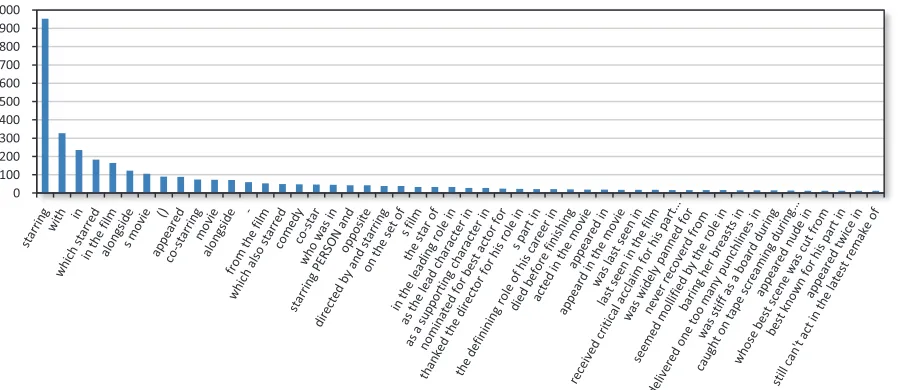
To get an empirical sense of the variability of nat-ural language used to express a relation, we stud-ied a few semantic relations and found sentences that expressed that relation, extracted simple pat-terns to account for how the relation is expressed between two arguments, mainly by removing the re-lation arguments (e.g. “Elijah Wood” and “Lord of the Rings: The Fellowship of the Ring” above) and replacing them with variables. We then counted the number of times each pattern was used to express the relation, producing a recognizablevery long tail
shown in Figure 1 for the top 50 patterns expressing the acted-in-movie relation in 17k sentences. More sophisticated pattern generalization (as discussed in later sections) would significantly fatten the head, bringing it closer to the traditional 50% of the area under the curve, but no amount of generalization will eliminate the tail. The patterns become increas-ingly esoteric, such as “The movie Death Becomes Her features a brief sequence in which Bruce Willis and Goldie Hawn’s characters plan Meryl Streep’s character’s death by sending her car off of a cliff on Mulholland Drive,” or “The best known Hawk-sian woman is probably Lauren Bacall, who iconi-cally played the type opposite Humphrey Bogart in To Have and Have Not and The Big Sleep.”
2.3 What relations matter
We do not consider relation extraction to be an end in and of itself, but rather as a component in larger systems that perform some task requiring interoper-ation between language- and knowledge-based com-ponents. Such larger tasks can include question answering, medical diagnosis, intelligence analysis, museum curation, etc. These tasks have evaluation criteria that go beyond measuring relation extraction results. The first step in applying relation detection to these larger tasks is analysis to determine what relations matter for the task and domain.
0 100 200 300 400 500 600 700 800 900 1000
Figure 1: Pattern frequency foracted-in-movierelation for 17k sentences.
[image:3.612.89.532.289.487.2]0 10 20 30 40 50 60 70 80
Figure 2: Relative frequency for top 50 relations in 20K question-answer pairs.
the relations in the KB connecting the entities. We kept a count for each relation of how often it con-nected a QNE to an answer. Of course we don’t ac-tually know for sure that the relation is the one being asked, but the intuition is that if the amount of data is big enough, you will have at least a ranked list of which relations are the most frequent.
Figure 2 shows the ranking for the top 50 rela-tions. Note that, even when restricted to the top 50 relations, the graph has no head, it is basically all tail; The top 50 relations cover about 15% of the do-main. In smaller, manual attempts to determine the most frequent relations in our domain, we had a sim-ilar result. What this means is that supporting even
the top 50 relations with perfect recall covers about 15% of the questions. It is possible, of course, to narrow the domain and restrict the relations that can be queried–this is what database systems do. For reading, however, the results are the same. A read-ing system requires the ability to recognize hundreds of relations to have any significant impact on under-standing.
2.4 Multi-relation learning on many seeds
question answering, building concept graphs from intelligence reports, semantic search, etc. Either by training machine learning algorithms on manually annotated data or by manually crafting finite-state transducers, relation detection is faced by this two-fold problem: the per-relation extraction hits a wall around 50% recall, and each relation itself occurs infrequently in the data.
This apparent futility of relation extraction led us to rethink our approach. First of all, the very long tail for relation patterns led us to consider how to pick up the tail. We concluded that to do so would require many more examples of the relation, but where can we get them? In the world of linked-data, huge instance-centered knowledge-bases are rapidly growing and spreading on the semantic web1. Re-sources like DBPedia, Freebase, IMDB, Geonames, the Gene Ontology, etc., are making available RDF-based data about a number of domains. These sources of structured knowledge can provide a large number of seed tuples for many different relations. This is discussed further below.
Furthermore, the all-tail nature of relation cover-age led us to consider performing relation extraction on multiple relations at once. Some promising sults on multi-relation learning have already been re-ported in (Carlson et al., 2009), and the data sources mentioned above give us many more than just the handful of seed instances used in those experiments. The idea of learning multiple relations at once also fits with our keep reading principle - multiple rela-tion hypotheses may be annotated between the same arguments, with further evidence helping to disam-biguate them.
3 Approach
One common approach to relation extraction is to start with seed tuples and find sentences that con-tain mentions of both elements of the tuple. From each such sentence a pattern is generated using at minimum universal generalization (replace the tuple elements with variables), though adding any form of generalization here can significantly improve recall. Finally, evaluate the patterns by applying them to text and evaluating the precision and recall of the tu-ples extracted by the patterns. Our approach, called
1http://linkeddata.org/
Large Scale Relation Detection(LSRD), differs in three important ways:
1. We start with a knowledge-base containing a large number (thousands to millions) of tuples encoding relation instances of various types. Our hypothesis is thatonly a large number of examples can possibly account for the long tail. 2. We do not learn one relation at a time, but rather, associate a pattern with a set of relations whose tuples appear in that pattern. Thus, when a pattern is matched to a sentence during read-ing, each relation in its set of associated rela-tions is posited as a hypothetical interpretation of the sentence, to be supported or refuted by further reading.
3. We use the knowledge-base as an oracle to de-termine negative examples of a relation. As a result the technique is semi-supervised; it requires no human intervention but does re-quire reliable knowledge-bases as input–these knowledge-bases are readily available today.
Many relation extraction techniques depend on a prior step of named entity recognition (NER) and typing, in order to identify potential arguments. However, this limits recall to the recall of the NER step. In our approach patterns can match on any noun phrase, and typing of these NPs is simply an-other form of evidence.
All this means our approach is not relation extrac-tion per se, it typically does not make conclusions about a relation in a sentence, but extracts hypothe-ses to be resolved by other parts of our reading sys-tem.
In the following sections, we elaborate on the technique and some details of the current implemen-tation.
3.1 Basic pipeline
The two principle inputs are a corpus and a knowledge-base (KB). For the experiments below, we used the English Gigaword corpus2 extended with Wikipedia and other news sources, and IMDB, DBPedia, and Freebase KBs, as shown. The intent is
2http://www.ldc.upenn.edu/Catalog/
to run against a web-scale corpus and larger linked-data sets.
Input documents are sentence delimited, tok-enized and parsed. The technique can benefit dra-matically from coreference resolution, however in the experiments shown, this was not present. For each pair ofproper names in a sentence, the names are looked up in the KB, and if they are related, a pattern is extracted from the sentence. At min-imum, pattern extraction should replace the names with variables. Depending on how patterns are ex-tracted, one pattern may be extracted per sentence, or one pattern may be extracted per pair of proper names in the sentence. Each pattern is associated withall the relationsknown in the KB between the two proper names. If the pattern has been extracted before, the two are merged by incrementing the as-sociated relation counts. This phase, calledpattern induction, is repeated for the entire corpus, resulting in a large set of patterns, each pattern associated with relations. For each ¡pattern, relation¿ pair, there is a count of the number of times that pattern appeared in the corpus with names that are in the relation ac-cording to the KB.
The pattern induction phase results in positive counts, i.e. the number of times a pattern appeared in the corpus with named entities known to be re-lated in the KB. However, the induction phase does not exhaustively count the number of times each pat-tern appears in the corpus, as a patpat-tern may appear with entities that are not known in the KB, or are not known to be related. The second phase, called pat-tern training, goes through the entire corpus again, trying to match induced patterns to sentences, bind-ing any noun phrase to the pattern variables. Some attempt is made to resolve the noun phrase to some-thing (most obviously, a name) that can be looked up in the KB, and for each relation associated with the pattern, if the two names arenotin the relation according to the KB, thenegative countfor that re-lation in the matched pattern is incremented. The result of the pattern training phase is an updated set of ¡pattern, relation¿ pairs withnegative counts.
The following example illustrates the basic pro-cessing. During induction, this sentence is encoun-tered:
Tom Cruise and co-star Nicole Kidman
appeared together at the premier.
The proper names “Tom Cruise” and “Nicole Kid-man” are recognized and looked up in the KB. We find instances in the KB with those names, and the following relations: coStar(Tom Cruise,
Nicole Kidman); marriedTo(Tom
Cruise, Nicole Kidman). We extract a
pattern p1: ?x and co-star ?y appeared
together at the premier in which all the
names have been replace by variables, and the associations <p1, costar, 1, 0> and <p1,
marriedTo, 1, 0> with positive counts and
zero negative counts. Over the entire corpus, we’d expect the pattern to appear a few times and end up with final positive counts like<p1, coStar,
14, 0> and <p1, marriedTo, 2, 0>,
in-dicating the pattern p1 appeared 14 times in the
corpus between names known to participate in the
coStar relation, and twice between names known to participate in the marriedTo relation. During training, the following sentence is encountered that matchesp1:
Tom Hanks and co-star Daryl Hannah ap-peared together at the premier.
The names “Tom Hanks” and “Daryl Hannah” are looked up in the KB and in this case only the relation coStar is found between them, so the
marriedTo association is updated with a negative count: <p1, marriedTo, 2, -1>. Over the
entire corpus, we’d expect the counts to be some-thing like <p1, costar, 14, -6> and <p1,
marriedTo, 2, -18>.
3.2 Candidate-instance matching
An obvious part of the process in both phases is taking strings from text and matching them against names or labels in the KB. We refer to the strings in the sentences ascandidate argumentsor simply can-didates, and refer toinstancesin the KB as entities with associated attributes. For simplicity of discus-sion we will assume all KBs are in RDF, and thus all KB instances are nodes in a graph with unique identifiers (URIs) and arcs connecting them to other instances or primitive values (strings, numbers, etc.). A set of specially designated arcs, calledlabels, con-nect instances to strings that are understood to name the instances. The reverse lookup of entity identi-fiers via names referred to in the previous section requires searching for the labels that match a string found in a sentence and returning the instance iden-tifier.
This step is so obvious it belies the difficultly of the matching process and is often overlooked, how-ever in our experiments we have found candidate-instance matching to be a significant source of error. Problems include having many instances with the same or lexically similar names, slight variations in spelling especially with non-English names, inflex-ibility or inefficiency in string matching in KB im-plementations, etc. In some of our sources, names are also encoded as URLs. In the case of movie and book titles-two of the domains we experimented with-the titles seem almost as if they were designed specifically to befuddle attempts to automatically recognize them. Just about every English word is a book or movie title, including “It”, “Them”, “And”, etc., many years are titles, and just about every num-ber under 1000. Longer titles are difficult as well, since simple lexical variations can prevent matching from succeeding, e.g. the Shakespeare play,A Mid-summer Night’s Dreamappears often asMidsummer Night’s Dream,A Midsummer Night Dream, and oc-casionally, in context, justDream. When titles are not distinguished or delimited somehow, they can confuse parsing which may fail to recognize them as noun phrases. We eventually had to build dictionar-ies of multi-word titles to help parsing, but of course that was imperfect as well.
The problems go beyond the analogous ones in coreference resolution as the sources and technology
themselves are different. The problems are severe enough that the candidate-instance matching prob-lem contributes the most, of all components in this pipeline, to precision and recall failures. We have observed recall drops of as much as 15% and preci-sion drops of 10% due to candidate-instance match-ing.
This problem has been studied somewhat in the literature, especially in the area of database record matching and coreference resolution (Michelson and Knoblock, 2007), but the experiments presented be-low use rudimentary solutions and would benefit significantly from improvements; it is important to acknowledge that the problem exists and is not as trivial as it appears at first glance.
3.3 Pattern representation
The basic approach accommodates any pattern rep-resentation, and in fact we can accommodate non pattern-based learning approaches, such as CRFs, as the primary hypothesis is principally concerned with the number of seed examples (scaling up initial set of examples is important). Thus far we have only experimented with two pattern representations: sim-ple lexical patterns in which the known arguments are replaced in the sentence by variables (as shown in the example above), and patterns based on the spanning tree between the two arguments in a de-pendency parse, again with the known arguments re-placed by variables. In our initial design we down-played the importance of the pattern representation and especially generalization, with the belief that very large scale would remove the need to general-ize. However, our initial experiments suggest that good pattern generalization would have a signifi-cant impact on recall, without negative impact on precision, which agrees with findings in the litera-ture (Pantel and Pennacchiotti, 2006). Thus, these early results only employ rudimentary pattern gen-eralization techniques, though this is an area we in-tend to improve. We discuss some more details of the lack of generalization below.
4 Experiment
Relation Prec Rec F1 Tuples Seeds
imdb:actedIn 46.3 45.8 0.46 9M 30K
frb:authorOf 23.4 27.5 0.25 2M 2M
imdb:directorOf 22.8 22.4 0.22 700K 700K
frb:parentOf 68.2 8.6 0.16 10K 10K
Table 1: Precision and recall vs. number of tuples used for 4 freebase relations.
using single-relation experiments, despite the cen-trality of multiple hypotheses to our reading system, in order to facilitate evaluation and understanding of the technique. Our main focus was to gather data to support (or refute) the hypothesis that more re-lation examples would matter during pattern induc-tion, and that using the KB as an oracle for training would work. Clearly, no KB is complete to begin with, and candidate-instance matching errors drop apparent coverage further, so we intended to explore the degree to which the KB’s coverage of the relation impacted performance. To accomplish this, we ex-amined four relations with different coverage char-acteristics in the KB.
4.1 Setup and results
The first relation we tried was the acted-in-show
relation from IMDB; for convenience we refer to it as imdb:actedIn. An IMDB show is a movie, TV episode, or series. This relation has over 9M
<actor, show> tuples, and its coverage was
complete as far as we were able to determine. How-ever, the version we used did not have a lot of name variations for actors. The second relation was the
author-of relation from Freebase (frb:authorOf), with roughly 2M <author, written-work> tuples. The third relation was the director-of-movierelation from IMDB (imdb:directorOf), with
700k <director,movie> tuples. The fourth
relation was the parent-of relation from Free-base (frb:parentOf), with roughly 10K<parent,
child>tuples (mostly biblical and entertainment).
Results are shown in Table 1.
The imdb:actedIn experiment was performed on the first version of the system that ran on 1 CPU and, due to resource constraints, was not able to use more than 30K seed tuples for the rule induction phase. However, the full KB (9M relation instances) was available for the training phase. With some
man-ual effort, we selected tuples (actor-movie pairs) of popular actors and movies that we expected to ap-pear most frequently in the corpus. In the other ex-periments, the full tuple set was available for both phases, but 2M tuples was the limit for the size of the KB in the implementation. With these promising preliminary results, we expect a full implementation to accommodate up to 1B tuples or more.
The evaluation was performed in decreasing de-grees of rigor. Theimdb:actedInexperiment was run against 20K sentences with roughly 1000 actor in movie relations and checked by hand. For the other three, the same sentences were used, but the ground truth was generated in a semi-automatic way by re-using the LSRD assumption that a sentence con-taining tuples in the relation expresses the relation, and then spot-checked manually. Thus the evalua-tion for these three experiments favors the LSRD ap-proach, though spot checking revealed it is the pre-cision and not the recall that benefits most from this, and all the recall problems in the ground truth (i.e. sentences that did express the relation but were not in the ground truth) were due to candidate-instance matching problems. An additional idiosyncrasy in the evaluation is that the sentences in the ground truth were actually questions, in which one of the arguments to the relation was the answer. Since the patterns were induced and trained on statements, there is a mismatch in style which also significantly impacts recall. Thus the precision and recall num-bers should not be taken as general performance, but are useful only relative to each other.
4.2 Discussion
war, trade, suspend relations, deport refugees, sup-port, oppose, etc. each other, so finding the two na-tions in a sentence together is not highly indicative of one relation or another. The director-of-movie re-lation was closer to acted-in-movie in this regard, and author-of a bit below that. The obvious next step to gather more data on the many examples hypoth-esis is to run the experiments with one relation, in-creasing the number of tuples with each experiment and observing the change in precision and recall.
The recall results do not seem particularly strik-ing, though these experiments do not include pat-tern generalization (other than what a dependency parse provides) or coreference, use a small corpus, and poor candidate-instance matching. Further, as noted above there were other idiosyncrasies in the evaluation that make them only useful for relative comparison, not as general results.
Many of the patterns induced, especially for the acted-in-movie relation, were highly lexical, using e.g. parenthesis or other punctuation to signal the relation. For example, a common pattern was actor-name (movie-name), or
movie-name: actor-name, e.g. “Leonardo
DiCaprio (Titanic) was considering accepting the role as Anakin Skywalker,” or “Titanic: Leonardo DiCaprio and Kate Blanchett steam up the silver screen against the backdrop of the infamous disas-ter.” Clearly patterns like this rely heavily on the context and typing to work. In general the pattern ?x (?y) is not reliable for the actor-in-movie
re-lation unless you know ?x is an actor and?y is a
movie. However, some patterns, like?x appears
in the screen epic ?y is highly indicative
of the relation without the types at all - in fact it is so high precision it could be used to infer the types of?x and?y if they were not known. This seems
to fit extremely well in our larger reading system, in which the pattern itself provides one form of evi-dence to be combined with others, but was not a part of our evaluation.
One of the most important things to general-ize in the patterns we observed was dates. If patterns like, actor-name appears in the
1994 screen epic movie-namecould have
been generalized toactor-name appears in
the date screen epic movie-name,
re-call would have been boosted significantly. As it
stood in these experiments, everything but the argu-ments had to match. Similarly, many relations often appear in lists, and our patterns were not able to gen-eralize that away. For example the sentence, “Mark Hamill appeared in Star Wars, Star Wars: The Em-pire Strikes Back, and Star Wars: The Return of the Jedi,” causes three patterns to be induced; in each, one of the movies is replaced by a variable in the pattern and the other two are required to be present. Then of course all this needs to be combined, so that the sentence, “Indiana Jones and the Last Crusade is a 1989 adventure film directed by Steven Spielberg and starring Harrison Ford, Sean Connery, Denholm Elliott and Julian Glover,” would generate a pattern that would get the right arguments out of “Titanic is a 1997 epic film directed by James Cameron and starring Leonardo DiCaprio, Kate Winslett, Kathy Bates and Bill Paxon.” At the moment the former sentence generates four patterns that require the di-rector and dates to be exactly the same.
Some articles in the corpus were biographies which were rich with relation content but also with pervasive anaphora, name abbreviations, and other coreference manifestations that severely hampered induction and evaluation.
5 Related work
of the pattern space for any given relation.
Another fundamental aspect of our approach lies in the fact that we attempt to learn many relations simultaneously. Previously, (Whitelaw et al., 2008) found that such a joint learning approach was use-ful for large-scale named entity detection, and we expect to see this result carry over to the relation ex-traction task. (Carlson et al., 2010) also describes relation learning in a multi-task learning framework, and attempts to optimize various constraints posited across all relation classes.
Examples of the use of negative evidence for learning the strength of associations between learned patterns and relation classes as proposed here has not been reported in prior work to our knowledge. A number of multi-class learning tech-niques require negative examples in order to prop-erly learn discriminative features of positive class instances. To address this requirement, a number of approaches have been suggested in the literature for selection or generation of negative class instances. For example, sampling from the positive instances of other classes, randomly perturbing known pos-itive instances, or breaking known semantic con-straints of the positive class (e.g. positing multiple state capitols for the same state). With this work, we treat our existing RDF store as an oracle, and as-sume it is sufficiently comprehensive that it allows estimation of negative evidence for all target relation classes simultaneously.
The first (induction) phase of LSRD is very simi-lar to PORE (Wang et al., 2007) (Dolby et al., 2009; Gabrilovich and Markovitch, 2007) and (Nguyen et al., 2007), in which positive examples were ex-tracted from Wikipedia infoboxes. These also bear striking similarity to (Agichtein and Gravano, 2000), and all suffer from a significantly smaller number of seed examples. Indeed, its not using a database of specific tuples that distinguishes LSRD, but that it uses so many; the scale of the induction in LSRD is designed to capture far less frequent patterns by using significantly more seeds
In (Ramakrishnan et al., 2006) the same intu-ition is captured that knowledge of the structure of a database should be employed when trying to inter-pret text, though again the three basic hypotheses of LSRD are not supported.
In (Huang et al., 2004), a similar phenomenon to
what we observed with theacted-in-movie relation was reported in which the chances of a protein in-teraction relation being expressed in a sentence are already quite high if two proteins are mentioned in that sentence.
6 Conclusion
We have presented an approach for Large Scale Re-lation Detection (LSRD) that is intended to be used within a machine reading system as a source of hy-pothetical interpretations of input sentences in natu-ral language. The interpretations produced are se-mantic relations between named arguments in the sentences, and they are produced by using a large knowledge source to generate many possible pat-terns for expressing the relations known by that source.
We have specifically targeted the technique at the problem that the frequency of patterns occurring in text that express a particular relation has avery long tail(see Figure 1), and without enough seed exam-ples the extremely infrequent expressions of the re-lation will never be found and learned. Further, we do not commit to any learning strategy at this stage of processing, rather we simply produce counts, for each relation, of how often a particular pattern pro-duces tuples that are in that relation, and how of-ten it doesn’t. These counts are simply used as ev-idence for different possible interpretations, which can be supported or refuted by other components in the reading system, such as type detection.
We presented some very early results which while promising are not conclusive. There were many idiosyncrasies in the evaluation that made the re-sults meaningful only with respect to other experi-ments that were evaluated the same way. In addi-tion, the evaluation was done at a component level, as if the technique were a traditional relation extrac-tion component, which ignores one of its primary differentiators–that it produces sets of hypothetical interpretations. Instead, the evaluation was done only on the top hypothesis independent of other evi-dence.
valid evidence to support or refute the hypotheses LSRD is based on:
1. A large number of examples can account for the long tail in relation expression;
2. Producing sets of hypothetical interpretations of the sentence, to be supported or refuted by further reading, works better than producing one;
3. Using existing, large, linked-data knowledge-bases as oracles can be effective in relation de-tection.
References
[Agichtein and Gravano2000] E. Agichtein and L. Gra-vano. 2000. Snowball: extracting relations from large plain-text collections. InProceedings of the 5th ACM Conference on Digital Libraries, pages 85–94, San Antonio, Texas, United States, June. ACM.
[Banko and Etzioni2008] Michele Banko and Oren Et-zioni. 2008. The tradeoffs between open and tradi-tional relation extraction. InProceedings of the 46th Annual Meeting of the Association for Computational Linguistics.
[Blum and Mitchell1998] A. Blum and T. Mitchell. 1998. Combining labeled and unlabeled data with co-training. In Proceedings of the 1998 Conference on Computational Learning Theory.
[Carlson et al.2009] A. Carlson, J. Betteridge, E. R. Hr-uschka Jr., and T. M. Mitchell. 2009. Coupling semi-supervised learning of categories and relations. In Proceedings of the NAACL HLT 2009 Workshop on Semi-supervised Learning for Natural Language Pro-cessing.
[Carlson et al.2010] A. Carlson, J. Betteridge, R. C. Wang, E. R. Hruschka Jr., and T. M. Mitchell. 2010. Coupled semi-supervised learning for information ex-traction. InProceedings of the 3rd ACM International Conference on Web Search and Data Mining.
[Craven et al.2000] Mark Craven, Dan DiPasquo, Dayne Freitag, Andrew McCallum, Tom Mitchell, Kamal Nigam, and Sean Slattery. 2000. Learning to construct knowledge bases from the World Wide Web. Artificial Intelligence, 118(1–2):69–113.
[Dolby et al.2009] Julian Dolby, Achille Fokoue, Aditya Kalyanpur, Edith Schonberg, and Kavitha Srinivas. 2009. Extracting enterprise vocabularies using linked open data. InProceedings of the 8th International Se-mantic Web Conference.
[Etzioni et al.2005] Oren Etzioni, Michael Cafarella, Doug Downey, Ana-Maria Popescu, Tal Shaked, Stephen Soderland, Daniel S. Weld, and Alexander Yates. 2005. Unsupervised named-entity extraction from the web: An experimental study. Artificial Intel-ligence, 165(1):91–134, June.
[Gabrilovich and Markovitch2007] Evgeniy Gabrilovich and Shaul Markovitch. 2007. Computing tic relatedness using wikipedia-based explicit seman-tic analysis. InIJCAI.
[Huang et al.2004] Minlie Huang, Xiaoyan Zhu, Yu Hao, Donald G. Payan, Kunbin Qu, and Ming Li. 2004. Discovering patterns to extract protein-protein interac-tions from full texts.Bioinformatics, 20(18).
[Michelson and Knoblock2007] Matthew Michelson and Craig A. Knoblock. 2007. Mining heterogeneous transformations for record linkage. InProceedings of the 6th International Workshop on Information Inte-gration on the Web, pages 68–73.
[Nguyen et al.2007] Dat P. Nguyen, Yutaka Matsuo, , and Mitsuru Ishizuka. 2007. Exploiting syntactic and semantic information for relation extraction from wikipedia. InIJCAI.
[Nigam et al.2006] K. Nigam, A. McCallum, , and T. Mitchell, 2006. Semi-Supervised Learning, chapter Semi-Supervised Text Classification Using EM. MIT Press.
[Pantel and Pennacchiotti2006] Patrick Pantel and Marco Pennacchiotti. 2006. Espresso: Leveraging generic patterns for automatically harvesting semantic rela-tions. InProceedings of the 21st international Confer-ence on Computational Linguistics and the 44th An-nual Meeting of the Association For Computational Linguistics, Sydney, Australia, July.
[Ramakrishnan et al.2006] Cartic Ramakrishnan, Krys J. Kochut, and Amit P. Sheth. 2006. A framework for schema-driven relationship discovery from unstruc-tured text. InISWC.
[Wang et al.2007] Gang Wang, Yong Yu, and Haiping Zhu. 2007. PORE: Positive-only relation extraction from wikipedia text. InISWC.
[Whitelaw et al.2008] C. Whitelaw, A. Kehlenbeck, N. Petrovic, , and L. Ungar. 2008. Web-scale named entity recognition. In Proceeding of the 17th ACM Conference on information and Knowledge Manage-ment, pages 123–132, Napa Valley, California, USA, October. ACM.