Aligning Predicate Argument Structures in Monolingual Comparable Texts:
A New Corpus for a New Task
Michael Roth
and
Anette Frank
Department of Computational Linguistics
Heidelberg University
Germany
{
mroth,frank
}
@cl.uni-heidelberg.de
Abstract
Discourse coherence is an important aspect of natural language that is still understudied in computational linguistics. Our aim is to learn factors that constitute coherent discourse from data, with a focus on how to realize predicate-argument structures (PAS) in a model that ex-ceeds the sentence level. In particular, we aim to study the case of non-realized arguments as a coherence inducing factor. This task can be broken down into two subtasks. The first aligns predicates across comparable texts, ad-mitting partial argument structure correspon-dence. The resulting alignments and their con-texts can then be used for developing a coher-ence model for argument realization.
This paper introduces a large corpus of com-parable monolingual texts as a prerequisite for approaching this task, including an evaluation set with manual predicate alignments. We il-lustrate the potential of this new resource for the empirical investigation of discourse coher-ence phenomena. Initial experiments on the task of predicting predicate alignments across text pairs show promising results. Our findings establish that manual and automatic predicate alignments across texts are feasible and that our data set holds potential for empirical re-search into a variety of discourse-related tasks.
1
Introduction
Research in the fields of discourse and pragmatics has led to a number of theories that try to explain and formalize the effect of discourse coherence induc-ing elements either locally or globally. For exam-ple,Centering Theory(Grosz et al., 1995) provides
a framework to model local coherence by relating the choice of referring expressions to the salience of an entity at certain stages of a discourse. An exam-ple for a global coherence model would be Rhetori-cal Structure Theory(Mann and Thompson, 1988), which addresses overall text structure by means of
coherence relationsbetween the parts of a text.
In addition to such theories, computational ap-proaches have been proposed to capture correspond-ing phenomena empirically. A prominent example is the entity-based model by Barzilay and Lapata (2008). In their approach, local coherence is mod-eled by the observation of sentence-to-sentence re-alization patterns of individual entities. The learned model reflects a key idea from Centering Theory, namely that adjacent sentences in a coherent dis-course are likely to involve the same entities.
One shortcoming of Barzilay and Lapata’s model (and extensions of it) is that it only investigates overt realization patterns in terms of grammatical func-tions. These functions reflect explicit realizations of predicate argument structures (PAS), but they do not capture the full range of salience factors. In partic-ular, the model does not reflect the importance of discourse entities that fill core roles of the predicate, but that remain implicit in the predicate’s local argu-ment structure. We develop a specific set-up that al-lows us to further investigate the factors that govern such a null-instantiations of argument positions (cf. Fillmore et al. (2003)), as a special form of coher-ence inducing element in discourse. We hcoher-enceforth refer to such cases asnon-realized arguments.
Our main hypothesis is that context specific re-alization patterns for PAS can be automatically
learned from a semantically parsed corpus of com-parable text pairs. This assumption builds on the success of previous research, where compara-ble and parallel texts have been exploited for a range of related learning tasks, e.g., unsupervised discourse segmentation (Barzilay and Lee, 2004) and bootstrapping semantic analyzers (Titov and Kozhevnikov, 2010).
For our purposes, we are interested in finding cor-responding PAS across comparable texts that are known to talk about the same events, and hence in-volve the same set of underlying event participants. By aligning predicates in such texts, we can investi-gate the factors that determine discourse coherence in the realization patterns for the involved partici-pants. As a first step towards this overall goal, we describe the construction of a resource that contains more than 160,000 document pairs that are known to talk about the same events and participants. Exam-ple (1), extracted from our corpus of aligned texts, illustrates this point: Both texts report on the same event, in particular the (aligned) event of locating victims in an avalanche. While (1.a) explicitly talks about the location of this event, the role remains im-plicit in the second sentence of (1.b), given that it can be recovered from the preceding sentence. In fact, realization of this argument would impede the fluency of discourse by being overly repetitive.
(1) a. . . . The official said that [no bodies]Arg1 had
been recovered [from the avalanches]Arg2which
occurred late Friday in the Central Asian coun-try near the Afghan border some 300 kilometers (185 miles) southeast of the capital Dushanbe. b. Three other victims were trapped in an
avalanche in the village of Khichikh. [None of the victims bodies]Arg1 have been found
[ ]Argm-loc.
Our aim is to identify comparable predications across pairs of texts, and to study the coherence factors that determine the realization patterns of ar-gument structures (including roles that remain im-plicit) in discourse. This can be achieved by consid-ering the full set of arguments that can be recovered from the aligned predications, including both core and non-core (i.e. adjunct) roles. However, in order to relate PAS across texts to one another, we first need to identify corresponding predicates.
In this paper, we construct a large data set to be used for the induction of a coherence model for ar-gument structure realization and related tasks. We discuss the prospects of this data set for the study of coherence factors in PAS realization. Finally, we present first results on the initial task of predicate alignmentacross comparable monolingual texts.
The remainder of this paper is structured as fol-lows: In Section 2, we discuss previous work in re-lated tasks. Section 3 introduces the new task to-gether with a description of how we prepared a suit-able data set. Section 4 discusses the potential bene-fits of the created resource in more detail. Section 5 presents experiments on predicate alignment using this new data set and outlines first results. Finally, we conclude in Section 6 and discuss future work.
2
Related Work
Data sets comprising parallel texts have been re-leased for various different tasks, including para-phrase extraction and statistical machine translation (SMT). While corpora for SMT are typically mul-tilingual (e.g. Europarl, Koehn (2005)), there also exist monolingual parallel corpora that consist of multiple translations of one text into the same lan-guage (Barzilay and McKeown, 2001; Huang et al., 2002, inter alia). Each translation can pro-vide alternative verbalizations of the same events but little variation can be observed in context, as the overall discourse remains the same. A higher degree of variation can be found in the Microsoft Research Paraphrase Corpus (e.g. MSRPC, Dolan and Brockett (2005)), which consists of paraphrases automatically extracted from different sources. In the MSRPC, however, original discourse contexts are not provided for each sentence. In contrast to truly parallel monolingual corpora, there also exist a range of comparable corpora that have been used for tasks such as (multi-document) summarization (McKeown and Radev, 1995, inter alia). Corpora for this task are collected manually and hence are rather small. Our work presents a method to automatically construct a large corpus of text pairs describing the same underlying events.
co-herent discourse. Different aspects related to this setting have been studied in previous work. For ex-ample, Filippova and Strube (2007) and Cahill and Riester (2009) examine factors that determine stituent order and Belz et al. (2009) study the con-ditions for the use of different types of referring ex-pressions. The specific set-up we examine allows us to further investigate the factors that govern the
non-realizationof an argument position, as a special form of coherence inducing element in discourse. As in the aforementioned work, we are specifically interested in the generation of coherent discourses (e.g. for summarization). Yet, our work also com-plements research in discourse analysis. A recent example for such work is the Semeval 2010 Task 10 (Ruppenhofer et al., 2010), which aims at linking events and their participants in discourse. The pro-vided data sets for this task, however, are critically small (438 train and 525 test sentences). Eventu-ally, the corpus we present in this paper could also be beneficial for data-driven approaches to role link-ing in discourse.
3
A Corpus for Aligning Predications
across Comparable Texts
Our aim is to construct a corpus of comparable texts that can be assumed to be about the same events, but include variation in textual presentation. This re-quirement fits well with the news domain, for which we can trace varying textual sources for the same underlying events.
The English Gigaword Fifth Edition (Parker et al., 2011) corpus (henceforth justGigaword) is one of the largest corpus collections for English. It com-prises a total of 9.8 million newswire articles from seven distinct sources. For construction of our cor-pus we make use of all combinations of agency pairs in Gigaword.
3.1 Corpus Creation
In order to extract pairs of articles describing the same news event, we implemented the pairwise sim-ilarity method presented by Wubben et al. (2009). The method is based on measuring word overlap in news headlines, weighting each word by its TF*IDF score to give a higher impact to words occurring with lower frequency. As our focus is to provide
a high-quality data set for predicate alignment and follow-up tasks, we impose an additional date con-straint to favor precision over recall. We apply this constraint by requiring a pair of articles to be pub-lished within a two-day time frame in order to be considered as pairs of comparable news items.
Following this two-step procedure, we extracted a total of 167,728 document pairs, an overall collec-tion of 50 million word tokens. We inspected about 100 randomly selected document pairs and found only two of them describing different events. This is in line with the results of Wubben et al. who re-ported a precision of 93% without explicitly impos-ing a date constraint. Overall, we found that most text pairs share a high degree of similarity and vary only in length (up to 7.564 words with a mean and median of 301 and 213 words, respectively) and de-tail. Closer examination of a development set of 10 document pairs (described below) revealed that we can indeed find multiple cases where roles are not locally filled in predicate argument structures. We show instances of this phenomenon, in which aligned PAS help to resolve implicit role references, in Section 4.
3.2 Gold Standard Annotation
We pre-processed all texts using MATE tools (Bohnet, 2010; Bj¨orkelund et al., 2010), a pipeline of natural language processing modules including a state-of-the-art semantic role labeler that computes Prop/NomBank annotations (Palmer et al., 2005; Meyers et al., 2008). The output was used to provide pre-labeled verbal and nominal predicates for anno-tation. We asked two students1 to tag alignments of corresponding predicates in 70 text pairs derived from the created corpus. All document pairs were randomly chosen from the AFP and APW sections of Gigaword with the constraint that each text con-sists of 100 to 300 words2. We chose this constraint as longer text pairs contain a high number of unre-lated predicates, making this task difficult to manage for the annotators.
Sure and possible links. Following standard prac-tice in word alignment tasks (cf. Cohn et al. (2008))
1Both annotators are students in Computational Linguistics,
one undergraduate (A) and one postgraduate (B) student.
the annotators were instructed to distinguish be-tweensure(S) andpossible(P) alignments, depend-ing on how certainly, in their opinion, two predi-cates (including their arguments) describe the same event. The following examples show cases of predi-cate pairings marked as sure (S link) (2) and as pos-sible (P link) alignments (3):
(2) a. The regulator ruled on September 27 that Nas-daq too was qualified to bid for OMX [. . . ]3
b. The authority [. . . ] had already approved a sim-ilar application by Nasdaq.4
(3) a. Myanmar’s military government said earlier this year it has released some 220 political prisoners [. . . ]5
b. The government has been regularly releasing members of Suu Kyi’s National League for Democracy party [. . . ]6
Replaceability. As a guideline for deciding whether two predicates are to be aligned, the annotators were given the following two criteria: 1) whether the predicates are replaceable in a given context and 2) whether they share (potentially implicit) arguments.
Missing context. In case one text does not provide enough context to decide whether two predicates in the paired documents refer to the same event, an alignment should not be marked as sure.
Similar predicates. Annotators were told explic-itly that sure links can be used even if two predicates are semantically different but have the same mean-ing in context. Example (4) illustrates such a case:
(4) a. The volcano roared back to life two weeks ago. b. It began erupting last month.
1-to-1 vs. n-to-m. We asked the annotators to find as many 1-to-1 correspondences as possible and to prefer 1-to-1 matches over n-to-m alignments. In case of multiple mentions (cf. Example (5)) of the same event, we further asked the annotators to pro-vide only one S link per predicate and mark remain-ing cases as P links. If possible, the S link should
3Source document ID: AFP ENG 20071112.0235 4Source document ID: APW ENG 20071112.0645 5Source document ID: AFP ENG 20020301.0041 6Source document ID: APW ENG 20020301.0132
be used for the pairing of PAS with the highest in-formation overlap (e.g. “performa3”–“performb2” in (5)). If there is no difference in information over-lap, the predicate pair that occurs first in both texts should be marked as a sure alignment (e.g. “singa1”– “performb1” in (5)). The intuition behind this guide-line is that the first mention introduces the actual event while later mentions just (co-)refer or add fur-ther information.
(5) a. Susan Boyle said she will singa1 in front of
Britain’s Prince Charles (. . . ) “It’s going to be a privilege to be performinga2before His Royal
Highness,” the singer said (. . . ) British copy-right laws will allow her to performa3the hit in
front of the prince and his wife.7
b. British singing sensation Susan Boyle is going to performb1for Prince Charles (. . . ) The show
star will performb2 her version of Perfect Day
for Charles and his wife Camilla.8
3.3 Development and Evaluation Data Sets
In total, the annotators (A/B) aligned 487/451 sure and 221/180 possible alignments with a Kappa score (Cohen, 1960) of 0.86. Following Brockett (2007), we computed agreement on labeled annotations, in-cluding unaligned predicate pairs as an additional
null category. For the construction of a gold stan-dard, we merged the alignments from both annota-tors by taking the union of all possible alignments and the intersection of all sure alignments. Cases which involved a sure alignment on which the anno-tators disagreed were resolved in a group discussion with the first author. We split the final corpus into a development set of 10 document pairs and a test set of 60 document pairs.
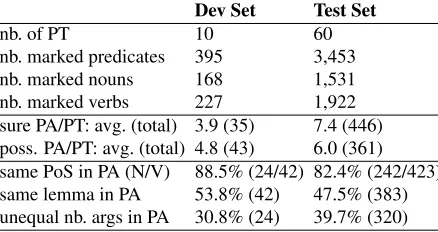
Table 1 summarizes information about the result-ing annotations in the development and test sets, respectively. It gives information about the paired texts (PT): number of predicates marked in prepro-cessing (nouns and verbs), the set of manual predi-cate alignments (PA): sure and possible, as well as information about whether they were annotated for predicates of the same PoS (N,V) or lemma.
Finally, as a rough indicator for diverging ar-gument structures captured in the annotated
Dev Set Test Set
nb. of PT 10 60
[image:5.612.84.303.71.187.2]nb. marked predicates 395 3,453 nb. marked nouns 168 1,531 nb. marked verbs 227 1,922 sure PA/PT: avg. (total) 3.9 (35) 7.4 (446) poss. PA/PT: avg. (total) 4.8 (43) 6.0 (361) same PoS in PA (N/V) 88.5% (24/42) 82.4% (242/423) same lemma in PA 53.8% (42) 47.5% (383) unequal nb. args in PA 30.8% (24) 39.7% (320)
Table 1: Information on Paired Texts (PT) and manual Predicate Alignments (PA) in development and test set
ments, we analyzed the number of PAs that involve a different number of arguments.
4
Potential of Aggregation
In this section, we analyze the predicate alignments in our manually annotated data set, to illustrate the potential of aggregating corresponding PAS across comparable texts.
We are particularly interested in cases of non-realization of arguments, and thus take a closer look at alignments involving roles that are not filled in their local PAS. We extract a subset of such cases by extracting pairs of aligned predicates that con-tain a different number of realized arguments. We deliberately focus on the more restricted core roles in this exposition, but will consider the full range of roles for developing a comprehensive coherence model for argument structure realization.9 Our se-lection of alignment examples is drawn from the de-velopment set.
The following excerpts are from a pair of com-parable texts describing a news report on Chadian refugees crossing into Nigeria:
(6) a. The Chadians said [they]Arg0had fled [ ]Arg1 in
fear of their lives.10
b. The United Nations says [some 20,000 refugees]Arg0 have fled
[into Cameroon]Arg1.11
In both examples, the Arg0 role of the predicate fled is filled, but Arg1 has not been realized in (6.a). Note
9Accordingly, the number of PAs involving diverging role
realizations in Table 1 is strongly underestimated.
10Source document ID: AFP ENG 20080205.0230 11Source document ID: APW ENG 20080206.0766
that the sentence is still part of a coherent discourse as fillers for the omitted role can be inferred from the preceding discourse context. Aggregating the aligned PAS presents an effective means to identify such appropriate fillers.
Example (7) presents another text pair, reporting on elections in Iraq, in which role realizations differ for the same hold event.
(7) a. He said (. . . ) [elections]Arg1will be held [ ]Arg0
to form a government.12
b. The president (. . . ) said Wednesday [his country]Arg0 will definitely hold
[elections]Arg1in 2004.13
Here, the changes in argument realization go along with a diathesis alternation, while the pair in (6) exemplifies a case of lexical licensing for omis-sion of a role.14
Example (8.b) illustrates a case in which the Arg1 of a decline event is involved in a preceding pred-ication (rise) and thus has already been overtly re-alized. The constructional properties of the subse-quent predicatesdeclineas a participle and noun, re-spectively, are more adverse to overt realization of the Arg1 role. Suppression of Arg1 in such cases yields a much more coherent discourse as compared to their realization. This is brought out by the con-structed examples in (a’/b’), which are both highly repetitive.
(8) a. The closely watched [index]Arg1 rose to 93.7
. . . after declining for . . . months.15
a’. ? . . . after the index declining for . . . months.
b. Consumer confidence rose . . . following three months of dramatic decline [ ]Arg1.16
b’. ? . . . following three months of dramatic decline [of consumer confidence]Arg1.
As showcased by the previous examples, the de-cision on whether to realize a role filler in a lo-cal PAS can be rather complex. Obviously, the
12Source document ID: AFP ENG 20031015.0353 13Source document ID: APW ENG 20031015.0236 14These different configurations are termed constructional
vs.lexical licensorsin the SemEval 2010 Task 10
(Ruppen-hofer et al., 2010).
Figure 1: The predicates of two sentences (white: “The company has said it plans to restate its earnings for 2000 through 2002.”; gray: “The company had announced in January that it would have to restate earnings (. . . )”) from the Microsoft Research Paragraph Corpus are aligned by computing clusters with minimum cuts.
above instances do not provide exhaustive informa-tion for grounding all such decisions. A comprehen-sive model of discourse coherence will need to esti-mate the argument realization potential of different predicates and roles from larger corpora. But as can be seen from the discussed examples, training a se-mantic model with suitable discourse features on all predicate argument structures in a large corpus such as ours will provide indicative range of realization decisions.
5
Experiments
This section presents an initial experiment using an unsupervised graph-based clustering method for the task of aligning predicates across comparable texts. We describe the alignment model, two baselines as well as the experimental setting and results.17
5.1 Clustering Model
Similarity Measures. We define a number of sim-ilarity measures between predicates, which make use of complementary lexical information. One source of information are token-based frequency counts, which we compute over all documents from the AFP and APW sections of Gigaword18. Given two lemmatized predicates and their respec-tive PAS, we employ the following four similarity
17The technicalities of this model, including detailed
def-initions of the similarity measures, are described elsewhere (manuscript, under submission).
18These sections make up 56.6% of documents in Gigaword.
measures: Similarity in WordNet (simWN) and
Verb-Net (simVN), distributional similarity (simDist) and
bag-of-word similarity of arguments (simArgs). The
first three measures are type-based, whereas the lat-ter is token-based.
Graph Representation. The input for graph clus-tering is a bi-partite graph representation for pairs of texts to be predicate-aligned. In this graph, each node represents a PAS that was assigned during pre-processing (cf. Section 3). Edges are inserted be-tween pairs of predicates that are from two distinct texts. A weight is assigned to each edge by a com-bination of the introduced similarity measures.
Clustering algorithm. The graph clustering method uses minimum cuts (or Mincuts) in order to partition the bipartite text graph into clusters of aligned predicates. Each Mincut operation divides a graph into two disjoint sub-graphs, such that the sum of weights of removed edges will be minimal. As the goal is to induce clusters consisting of pairs of similar predicates, a maximum number of two nodes per cluster is set as stopping criterion. We apply Mincut recursively to the input graph and resulting sub-graphs until we reach the stopping criterion. Figure 1 shows an example of a graph clustered by the Mincut approach.
5.2 Setting
task of inducing predicate alignments across com-parable monolingual texts. We evaluate on the man-ually annotated gold alignments in the test data set described in Section 3.2.
Parameter Tuning. As the graph representation becomes rather inefficient to handle using edges be-tween all predicate pairs, we use the development set of 10 text pairs to estimate a threshold for adding edges. We found the best similarity threshold to be an edge weight of 2.5. Note that the edge weights are calculated as a weighted linear combination of four different similarity measures. Subsequently, we also tune the weighting scheme for similarity measures on the development set. We found the best perform-ing combination of weights to be 0.09, 0.19, 0.48 and 0.24 forsimWN,simVN,simDistandsimArgs,
re-spectively.
Baselines. A simple baseline for this task is to align all predicates whose lemmas are identical (SameLemma). As a more sophisticated baseline, we make use of alignment tools commonly used in statistical machine translation (SMT). We train our own word alignment model using the state-of-the-art tool Berkeley Aligner (Liang et al., 2006). As word alignment tools require pairs of sentences as input, we first extract paraphrases for this baseline using a re-implementation of the paraphrase detection sys-tem by Wan et al. (2006). In the following sections, we abbreviate this model asWordAlign.
5.3 Results
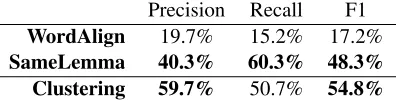
Following Cohn et al. (2008) we measure precision as the number of predicted alignments also anno-tated in the gold standard divided by the total ber of predictions. Recall is measured as the num-ber of correctly predictedsure alignments devided by the total number of sure alignments in the gold standard. We subsequently compute the F1-score as the harmonic mean between precision and recall.
Table 2 presents the results for our model and the two baselines. From all four approaches, WordAlignperforms worst. We identify two main reasons for this: On the one hand, the paraphrase detection does not perform perfectly. Hence, the extracted sentence pairs do not always contain gold alignments. On the other hand, even sentence pairs that contain gold alignments are generally less
paral-Precision Recall F1
WordAlign 19.7% 15.2% 17.2%
SameLemma 40.3% 60.3% 48.3%
[image:7.612.314.516.72.123.2]Clustering 59.7% 50.7% 54.8%
Table 2: Results for all models on our test set; significant improvements (p<0.005) over the results given in each previous line are marked in bold face.
lel compared to a typical SMT setting, which makes them harder to align.
We observe that the majority of all sure align-ments (60.3%) can be retrieved by applying the SameLemmamodel, yet at a low precision (40.3%). While the Clusteringmodel only recalls 50.7% of all cases, it clearly outperforms SameLemma in terms of precision (+19.4% points), an important factor for us as we plan to use the alignments in subsequent tasks. With 54.8%, Clustering also achieves the best overall F1-score. We computed statistical significance of result differences with a paired t-test (Cohen, 1995), yielding significance at the 99.5% level for precision and F1-score.
5.4 Analysis of Results
We perform an analysis of the output of the Clus-teringmodel on the development set to categorize correct and incorrect alignment decisions.19 In to-tal, the model missed 13 out of 35 sure alignments (Type I errors) and predicted 23 alignments not an-notated in the gold standard (Type II errors). Six Type I errors (46%) occurred when the lemma of an affected predicate occurred more than once in a text and the model missed the correct link. Vice versa, we find 18 Type II errors (78%) that were made be-cause of a high predicate similarity despite low ar-gument overlap. An example is given in (9).
(9) a. The US alert (. . . ) followed intelligence reports that . . .20
b. The Foreign Ministry announcement called on Japanese citizens to be cautious . . .21
While argument overlap itself can be low even for correct alignments, the results clearly indicate that
19We decided to leave the test set untouched for further
exper-iments. Due to parameter tuning, the results on the development set also provide us with an upper bound of the proposed model.
a better integration of context is necessary: Exam-ple (10.a) illustrates a case in which the agent of a warning event is not realized. Here, contextual in-formation is required to correctly align it to one of the warning events in (10.b). This involves inference beyond the local PAS.
(10) a. The US alert (. . . ) is one step down from a full [travel]Arg1warning [ ]Arg0.20
b. Japan has issued a travel alert . . . (which) follows similar warnings [from Ameri-can and British authorities]Arg0. (. . . ) An
offi-cial said it was highly unusual for [Tokyo]Arg0
to issue such a warning . . .21
On the positive side,Clusteringachieves a precision of 61.4% and a recall of 65.7% on the development set. Example (11) shows a correctly aligned PAS pair that involves non-realized arguments:
(11) a. . . . the Governing Council has established [a committee]Arg0to draft [a constitution]Arg1.22
b. A .. resolution calls on the Governing Council for elections and the drafting [ ]Arg0
[of a new constitution]Arg1.23
In (11.a), the follow-up sentences will refer back to the committee that will draft the new Iraqi constitu-tion, hence the institution has to be introduced in the discourse at this point. In contrast, excerpt (11.b) is the last sentence of a news report. Since it presents a summary, introducing new (omissible) entities at this point would not concord with general coherence principles.
6
Conclusion
In this paper, we presented a novel corpus of compa-rable texts that provides full discourse contexts for alternative verbalizations. The motivation for the construction of this corpus is to acquire empirical data for studying discourse coherence factors related to argument structure realization. A special phe-nomenon we are interested in are discourse-related factors that license the omission of argument roles.
Our data set satisfies two conditions that are es-sential for the purported task: the texts are about
22Source document ID: AFP ENG 20031015.0353 23Source document ID: APW ENG 20031015.0236.
the same events and constitute alternative verbaliza-tions. Selected from the Gigaword corpus, the doc-uments pertain to the news domain, and satisfy the further constraint that we have access to the full sur-rounding discourse context. The constructed corpus could thus be profitable for a range of other tasks that need to investigate factors for knowledge aggre-gation, such as summarization, or inference in dis-course, such as textual entailment.
In total, we derived more than 160,000 document pairs from all pairwise combinations of newswire sources in the English Gigaword Fifth Edition. Us-ing a subset of these pairs, we constructed a devel-opment and an evaluation data set with gold align-ments that relate predications with (possibly partial) PAS correspondence. We established that the anno-tation task, while difficult, can be performed with good inter-annotator agreement (κat 0.86).
We presented first experiments on the task of au-tomatically predicting predicate alignments. This step is essential to gather empirical evidence of dif-ferent PAS realizations for the same event, given varying discourse contexts. Analysis of the data shows that the aligned predications capture a wide variety of sources and variations of coherence ef-fects, including constructional, lexical and discourse phenomena.
In future work, we will enhance our model by in-corporating more refined semantic similarity mea-sures including discourse-based criteria for estab-lishing cross-document alignments. Given that our data set includes sets of aligned documents from several newswire sources, we will explore transitiv-ity constraints across multiple document pairs in or-der to further enhance the precision of the alignment model. We will then proceed to the ultimate aim of our work: the development of a coherence model for argument structure realization, including the design of an appropriate task and evaluation setting.
Acknowledgements
References
Regina Barzilay and Mirella Lapata. 2008. Modeling local coherence: An entity-based approach. Computa-tional Linguistics, 34(1):1–34.
Regina Barzilay and Lillian Lee. 2004. Catching the drift: Probabilistic content models, with applications to generation and summarization. InProceedings of the Human Language Technology Conference of the North American Chapter of the Association for Com-putational Linguistics,Boston, Mass., 2–7 May 2004, pages 113–120.
Regina Barzilay and Kathleen R. McKeown. 2001. Ex-tracting paraphrases from a parallel corpus. In Pro-ceedings of the 39th Annual Meeting of the Associ-ation for ComputAssoci-ational Linguistics,Toulouse, pages 50–57.
Anja Belz, Eric Kow, Jette Viethen, and Albert Gatt. 2009. The grec main subject reference generation challenge 2009: overview and evaluation results. In
Proceedings of the 2009 Workshop on Language Gen-eration and Summarisation, pages 79–87.
Anders Bj¨orkelund, Bernd Bohnet, Love Hafdell, and Pierre Nugues. 2010. A high-performance syntac-tic and semansyntac-tic dependency parser. InColing 2010: Demonstration Volume, pages 33–36, Beijing, China, August. Coling 2010 Organizing Committee.
Bernd Bohnet. 2010. Top accuracy and fast dependency parsing is not a contradiction. InProceedings of the 23rd International Conference on Computational Lin-guistics (Coling 2010), pages 89–97, Beijing, China, August. Coling 2010 Organizing Committee.
Chris Brockett. 2007. Aligning the RTE 2006 Corpus. Microsoft Research.
Aoife Cahill and Arndt Riester. 2009. Incorporating in-formation status into generation ranking. In Proceed-ings of the Joint Conference of the 47th Annual Meet-ing of the ACL and the 4th International Joint Confer-ence on Natural Language Processing of the AFNLP, pages 817–825, Suntec, Singapore, August. Associa-tion for ComputaAssocia-tional Linguistics.
Jacob Cohen. 1960. A coefficient of agreement for nom-inal scales. Educational and Psychological Measure-ment, 20:37–46.
Paul R. Cohen. 1995. Empirical methods for artificial intelligence. MIT Press, Cambridge, MA, USA. Trevor Cohn, Chris Callison-Burch, and Mirella
Lap-ata. 2008. Constructing Corpora for Development and Evaluation of Paraphrase Systems. 34(4).
William B. Dolan and Chris Brockett. 2005. Automat-ically constructing a corpus of sentential paraphrases. InProceedings of the Third International Workshop on Paraphrasing.
Katja Filippova and Michael Strube. 2007. Generat-ing constituent order in German clauses. In Proceed-ings of the 45th Annual Meeting of the Association for Computational Linguistics, Prague, Czech Republic, 23–30 June 2007, pages 320–327.
Charles J. Fillmore, Christopher R. Johnson, and Miriam R.L. Petruck. 2003. Background to FrameNet. International Journal of Lexicography, 16.3:235–250.
Barbara J. Grosz, Aravind K. Joshi, and Scott Weinstein. 1995. Centering: A framework for modeling the lo-cal coherence of discourse. Computational Linguis-tics, 21(2):203–225.
Shudong Huang, David Graff, and George Doddington. 2002.Multiple-Translation Chinese Corpus. Linguis-tic Data Consortium, Philadelphia.
Philipp Koehn, 2005. Europarl: A parallel corpus for statistical machine translation, volume 5, pages 79– 86.
Percy Liang, Benjamin Taskar, and Dan Klein. 2006. Alignment by agreement. InNorth American Associ-ation for ComputAssoci-ational Linguistics (NAACL), pages 104–111.
William C. Mann and Sandra A. Thompson. 1988. Rhetorical structure theory. Toward a functional the-ory of text organization.Text, 8(3):243–281.
Kathleen R. McKeown and Dragomir Radev. 1995. Gen-erating summaries of multiple news articles. In Pro-ceedings of the 18th Annual International ACM-SIGIR Conference on Research and Development in Informa-tion Retrieval,Seattle, Wash., 9–13 July 1995, pages 74–82. Reprinted inAdvances in Automatic Text Sum-marization, Mani, I. and Maybury, M.T. (Eds.), Cam-bridge, Mass.: MIT Press, 1999, pp.381-389.
Adam Meyers, Ruth Reeves, and Catherine Macleod. 2008. NomBank v1.0. Linguistic Data Consortium, Philadelphia.
Martha Palmer, Daniel Gildea, and Paul Kingsbury. 2005. The proposition bank: An annotated corpus of semantic roles. Computational Linguistics, 31(1):71– 105.
Robert Parker, David Graff, Jumbo Kong, Ke Chen, and Kazuaki Maeda. 2011. English Gigaword Fifth Edi-tion. Linguistic Data Consortium, Philadelphia. Josef Ruppenhofer, Caroline Sporleder, Roser Morante,
Collin Baker, and Martha Palmer. 2010. SemEval-2010 Task 10: Linking Events and Their Participants in Discourse. InProceedings of the 5th International Workshop on Semantic Evaluations, pages 45–50, Up-psala, Sweden, July.
InProceedings of the 48th Annual Meeting of the Asso-ciation for Computational Linguistics,Uppsala, Swe-den, 11–16 July 2010, pages 958–967.
Stephen Wan, Mark Dras, Robert Dale, and Cecile Paris. 2006. Using dependency-based features to take the ”Para-farce” out of paraphrase. InProceedings of the Australasian Language Technology Workshop, pages 131–138.
Sander Wubben, Antal van den Bosch, Emiel Krahmer, and Erwin Marsi. 2009. Clustering and matching headlines for automatic paraphrase acquisition. In