Aligning Predicates across Monolingual Comparable Texts
using Graph-based Clustering
Michael RothandAnette Frank Department of Computational Linguistics
Heidelberg University Germany
{mroth,frank}@cl.uni-heidelberg.de
Abstract
Generating coherent discourse is an important aspect in natural language generation. Our aim is to learn factors that constitute coherent discourse from data, with a focus on how to re-alize predicate-argument structures in a model that exceeds the sentence level. We present an important subtask for this overall goal, in which we align predicates across compara-ble texts, admitting partial argument struc-ture correspondence. The contribution of this work is two-fold: We first construct a large corpus resource of comparable texts, includ-ing an evaluation set with manual predicate alignments. Secondly, we present a novel ap-proach for aligning predicates across compa-rable texts using graph-based clustering with Mincuts. Our method significantly outper-forms other alignment techniques when ap-plied to this novel alignment task, by a margin of at least 6.5 percentage points in F1-score.
1 Introduction
Discourse coherence is an important aspect in natu-ral language generation (NLG) applications. A num-ber of theories have investigated coherence inducing factors. A prominent example isCentering Theory
(Grosz et al., 1995), which models local coherence by relating the choice of referring expressions to the importance of an entity at a certain stage of a dis-course. A data-driven model based on this theory is the entity-based approachby Barzilay and Lap-ata (2008), which models coherence phenomena by observing sentence-to-sentence transitions of entity occurrences.
Barzilay and Lapata show that their approach can discriminate between a coherent and a non-coherent set of ordered sentences. However, their model is not able to generate alternative entity realizations by itself. Furthermore, the entity-based approach only investigates realization patterns for individual enti-ties in discourse in terms of core grammatical func-tions. It does not investigate the interplay between entity transitions and realization patterns for full-fledged semantic structures. This interplay, how-ever, is an important factor for a semantics-based, generative model of discourse coherence.
The main hypothesis of our work is that we can automatically learn context-specific realization pat-terns for predicate argument structures (PAS) from a semantically parsed corpus of comparable text pairs. Our assumption builds on the success of previous research, where comparable and parallel texts have been exploited for a range of related learning tasks, e.g., unsupervised discourse segmentation (Barzilay and Lee, 2004) and bootstrapping semantic analyz-ers (Titov and Kozhevnikov, 2010).
For our purposes, we are interested in finding cor-responding PAS across comparable texts that are known to talk about the same events, and hence in-volve the same set of underlying event participants. By aligning predicates in such texts, we can inves-tigate the factors that determine discourse coher-ence in the realization patterns for the involved argu-ments. These include the specific forms of argument realization, as a pronoun or a specific type of refer-ential expression, as studied in prior work in NLG (Belz et al., 2009, inter alia). The specific set-up we examine, however, allows us to further
gate the factors that govern the non-realization of an argument position, as a special form of coher-ence inducing element in discourse. Example (1), extracted from our corpus of aligned texts,illustrates this point: Both texts report on the same event of locating victims in an avalanche. While (1.a) explic-itly talks about the location of this event, the role re-mains implicit in the second sentence of (1.b), given that it can be recovered from the preceding sentence. In fact, realization of this argument role would im-pede the fluency of discourse by being overly repet-itive.
(1) a. . . . The official said that [no bodies]Arg1 had been recovered [from the avalanches]Arg2which occurred late Friday in the Central Asian coun-try near the Afghan border some 300 kilometers (185 miles) southeast of the capital Dushanbe.
b. Three other victims were trapped in an avalanche in the village of Khichikh. [None of the victims bodies]Arg1 have been found [ ]Argm-loc.
This phenomenon clearly relates to the problem of discourse-linking of implicit roles, a very chal-lenging task in discourse processing.1 In our work, we consider this problem from a content-based gen-eration perspective, concentrating on the discourse factors that allow for the omission of a role.
Thus, our aim is to identify comparable predica-tions across aligned texts, and to study the discourse coherence factors that determine the realization pat-terns of arguments in the respective discourses. This can be achieved by considering the full set of argu-ments that can be recovered from the aligned pred-ications. This paper focuses on the first of these tasks, henceforth calledpredicate alignment.2
In line with data-driven approaches in NLP, we automatically align predicates in a suitable corpus of paired texts. The induced alignments will (i) serve to identify events described in both comparable texts, and (ii) provide information about the underlying ar-gument structures and how they are realized in each context to establish a coherent discourse. We in-vestigate a graph-based clustering method for
induc-1
See the recent SemEval 2010 task: Linking Events and their Participants in Discourse, (Ruppenhofer et al., 2010).
2
Note that we provide details regarding the construction of a suitable data set and further examples involving non-realized arguments in a complementary paper (Roth and Frank, 2012).
ing such alignments as clustering provides a suitable framework to implicitly relate alignment decisions to one another, by exploiting global information en-coded in a graph.
The remainder of this paper is structured as fol-lows: In Section 2, we discuss previous work in re-lated tasks. Section 3 describes our task and a suit-able data set. Section 4 introduces a graph-based clustering model using Mincuts for the alignment of predicates. Section 5 outlines the experiments and presents evaluation results. Finally, we conclude in Section 6 and discuss future work.
2 Related Work
The task of aligning words in general has been stud-ied extensively in previous work, for example as part of research in statistical machine translation (SMT). Typically, alignment models in SMT are trained by observing and (re-)estimating co-occurrence counts of word pairs in parallel sentences (Brown et al., 1993). The same methods have also been applied in monolingual settings, for example to align words in paraphrases (Cohn et al., 2008). In contrast to traditional word alignment tasks, our focus is not on pairs of isolated sentences but on aligning predicates within the discourse contexts in which they are sit-uated. Furthermore, text pairs for our task should not be strictly parallel as we are specifically inter-ested in the impact of different discourse contexts. In Section 5, we will show that this particular set-ting indeed constitutes a more challenging task com-pared to traditional word alignment in parallel or paraphrasing sentences.
Another set of related tasks is found in the area of textual inference. Since 2006, there have been reg-ular challenges on the task of Recognizing Textual Entailment (RTE). In the original task description, Dagan et al. (2006) define textual entailment“as a directional relationship between pairs of text expres-sions, denoted byT - the entailing ‘Text’ -, and H
As a matter of fact, the same holds true for the task of detecting paraphrases. In contrast to RTE, this lat-ter task requires bi-directional entailments, i.e., each of the two phrases must entail the other. Wan et al. (2006) show that a simple approach solely based on word (and lemmatized n-gram) overlap can already achieve an F1-score of up to 83% for detecting
para-phrases in the Microsoft Research Paraphrase Cor-pus (Dolan and Brockett, 2005, MSRPC). In fact, this is just 0.6% points below the state-of-the-art re-sults recently reported by Socher et al. (2011).
The MSRPC and data sets from the first RTE challenges only consisted of isolated pairs of sen-tences. The Fifth PASCAL Recognizing Textual En-tailment Challenge (Bentivogli et al., 2009) intro-duced a “Search Task”, where entailing sentences for a hypothesis have to be found in a set of full documents. This new task first opened the doors for assessing the role of discourse (Mirkin et al., 2010a; Mirkin et al., 2010b) in RTE. However, this setting is still limited as discourse contexts are only provided for the entailing part (T) of each text pair but not for the hypothesisH.
A further task related to ours is the detection of event coreference. The goal of this task is to identify all mentions of the same event within a document and, in some settings, also across docu-ments. However, the task setting is typically more restricted than ours in that its focus lies on iden-tical events/references (cf. Walker et al. (2006), Weischedel et al. (2011), inter alia). In particular, verbalizations of different aspects of an event (e.g., ‘buy’–‘sell’, ‘kill’–‘die’, ‘recover’–‘find’) are gen-erally not linked in this paradigm. In contrast to co-reference methods that identify chains of events, we are interested in pairs of corresponding predicates (and their argument structure), for which we can ob-serve alternative realizations in discourse.
3 Aligning Predicates Across Texts
This section summarizes how we built a large cor-pus of comparable texts, as a basis for thepredicate alignment task. We motivate the choice of the cor-pus and present a strategy for extracting comparable text pairs. Subsequently, we report on the prepara-tion of an evaluaprepara-tion data set with manual predicate alignments across the paired texts. We conclude this
section with an example that showcases the poten-tial of using aligned predicates for the study of co-herence phenomena. More detailed information re-garding corpus creation, annotation guidelines and additional examples illustrating the potential of this corpus can be found in Roth and Frank (2012).
3.1 Corpus Creation
The goal of our work is to investigate coherence fac-tors for argument structure realization, using com-parable texts that describe the same events, but that include variation in textual presentation. This re-quirement fits well with the news domain, for which we can trace varying textual sources that describe the same underlying events. The English Gigaword Fifth Edition (Parker et al., 2011) corpus (henceforth justGigaword) is one of the largest corpus collec-tions for English. It comprises a total of 9.8 million newswire articles from seven distinct sources.
In previous work (Roth and Frank, 2012), we in-troducedGigaPairs, a sub-corpus extracted from Gi-gaword that includes over 160,000 pairs of newswire articles from distinct sources. GigaPairs has been derived from Gigaword using the pairwise similar-ity method on headlines presented by Wubben et al. (2009). In addition to calculating the similarity of news titles, we impose an additional date constraint to further increase the precision of extracted pairs of texts. Random inspection of about 100 documents revealed only two texts describing different events. Overall, we extracted 167,728 document pairs con-taining a total of 50 million word tokens. Each doc-ument in this corpus consists of up to 7.564 words with a mean and median of 301 and 213 words, re-spectively. All texts have been pre-processed us-ing MATE tools (Bj¨orkelund et al., 2010; Bohnet, 2010), a pipeline of NLP modules including a state-of-the-art semantic role labeler that computes Prop-Bank/NomBank annotations (Palmer et al., 2005; Meyers et al., 2008).
3.2 Gold Standard Annotation
We selected 70 text pairs from the GigaPairs cor-pus for manual predicate alignment. All document pairs were randomly chosen with the constraint that each text consists of 100 to 300 words.3
cates identified by the semantic parser are provided as pre-labeled annotations for alignment. We asked two students4to tag corresponding predicates across each text pair. Following standard practice in word alignment tasks (cf. Cohn et al. (2008)) the annota-tors were instructed to distinguish betweensureand
possiblealignments, depending on how certainly, in their opinion, two predicates describe verbalizations of the same event. The following examples show predicate pairings marked as sure (2) and as possi-ble alignments (3).
(2) a. The regulator ruled on September 27 that Nas-daq too was qualified to bid for OMX [. . . ] b. The authority [. . . ] had already approved a
sim-ilar application by Nasdaq.
(3) a. Myanmar’s military government said earlier this year it has released some 220 political prisoners [. . . ]
b. The government has been regularly releasing members of Suu Kyi’s National League for Democracy party [. . . ]
In total, the annotators (A/B) aligned 487/451 sure and 221/180 possible alignments with a Kappa score (Cohen, 1960) of 0.86.5 For the construction of a gold standard, we merged the alignments from both annotators by taking the union of all possible align-ments and the intersection of all sure alignalign-ments. Cases which involved a sure alignment on which the annotators disagreed were resolved in a group dis-cussion with the first author.
We split the final corpus into a development set of 10 document pairs and a test set of 60 document pairs. The test set contains a total of 3,453 predicates (1,531 nouns and 1,922 verbs). Its gold standard an-notation consists of 446 sure and 361 possible align-ments, which corresponds to an average of 7.4 sure (6.0 possible) alignments per document pair. Most of the gold alignments (82.4%) are between predi-cates of the same part-of-speech (242 noun and 423 verb pairs). A total of 383 gold alignments (47.5%) have been annotated between predicates with iden-tical lemma form. Diverging numbers of realized arguments can be observed in 320 pairs (39.7%).
4
Both annotators are students in computational linguistics, one undergraduate (A) and one postgraduate (B) student.
5
Following Brockett (2007), we computed agreement on la-beled annotations, including unaligned predicate pairs as an ad-ditionalnullcategory.
3.3 Potential for Discourse Coherence
This section presents an example of an aligned predicate pair from our development set that il-lustrates the potential of aggregating corresponding PAS across comparable texts. The example repre-sents one of eleven cases involving unrealized argu-ments that can be found in our development set of only ten document pairs.
(4) a. The Chadians said theyArg0 had fled in fear of their lives.
b. The United Nations says some 20,000 refugeesArg0have fled into CameroonArg1.
In both sentences, the Arg0 role of the predicate flee is filled, but Arg1 (here: the goal) has not been real-ized in (4.a). However, sentence (4.a) is still part of a coherent discourse, as a role filler for the omitted ar-gument can be inferred from the preceding context. For the goal of our work, we are interested in factors that license such omissions of an argument. Poten-tial factors on the discourse level include the infor-mation status of the entity filling an argument posi-tion, and its salience at the corresponding point in discourse. Roth and Frank (2012) discuss additional examples that demonstrate the importance of fac-tors on further linguistic levels, e.g., lexical choice of predicates and their syntactic realization.
In the example above, the aggregation of aligned PAS presents an effective means to identify appro-priate fillers for unrealized roles. Hence, we can uti-lize each such pair as one positive and one negative training instance for a model of discourse coherence that controls the omissibility of arguments. In what follows, we introduce an alignment approach that can be used to automatically acquire more training data using the entire GigaPairs corpus.
4 Model
documents) in order to induce alignments between corresponding predicates.
4.1 Graph representation
We build a bipartite graph representation for each pair of texts, using as vertices the predicate argu-ment structures assigned in pre-processing (cf. Sec-tion 3.1). We represent each predicate as a node and integrate information about arguments only implic-itly. Given the sets of predicatesP1 andP2 of two
comparable texts T1 and T2, respectively, we
for-mally define an undirected graphGP1,P2 as follows:
GP1,P2 =hV, Ei where
V =P1∪P2
E =P1×P2 (1)
Edge weights. We specify the edge weight be-tween two nodes representing predicates p1 ∈ P1
and p2 ∈ P2 as a weighted linear combination of
four similarity measures described in the next sec-tion:WordNetandVerbNetsimilarity,Distributional
similarity andArgumentsimilarity.
wp1p2 = λ1∗simWN(p1, p2) + λ2∗simVN(p1, p2)
+ λ3∗simDist(p1, p2)
+ λ4∗simArg(p1, p2)
(2)
Initially we set all weighting parametersλ1. . . λ4to
have uniform weights by default. In Section 5, we define an optimized weighting setting for the indi-vidual similarity measures.
4.2 Similarity Measures
We employ a number of similarity measures that make use of complementary information that is type-based (simWN/VN/Dist) or token-based
(simArg).6 Given two lemmatized predicatesp1,p2
and their set of arguments A1 = args(p1), A2 =
args(p2), we define the following measures.
WordNet similarity. Given all pairs of synsetss1,
s2 that contain the predicates p1, p2, respectively,
we compute the maximal similarity using the infor-mation theoretic measure described in Lin (1998). Our implementation exploits the WordNet hierarchy
6
All token-based frequency counts (i.e.,f req()andidf()) are computed over all documents from the AFP and APW parts of the English Gigaword Fifth Edition.
(Fellbaum, 1998) to find the synset of the least com-mon subsumer (lcs) and uses the pre-computed In-formation Content (IC) files from Pedersen et al. (2004) to compute Lin’s measure:
simWN(p1, p2) =
IC(lcs(s1, s2))
IC(s1)∗IC(s2)
(3)
In order to compute similarities between verbal and nominal predicates, we further use derivation infor-mation from NomBank (Meyers et al., 2008): if a noun represents a nominalization of a verbal pred-icate, we resort to the corresponding verb synset. If no relation can be found between two predicates, we set a default value ofsimWN = 0. This applies in particular to all cases that involve a predicate not present in WordNet.
VerbNet similarity. To overcome systematic problems with the WordNet verb hierarchy (cf. Richens (2008)), we further compute similarity between verbal predicates using VerbNet (Kipper et al., 2008). Verbs in VerbNet are categorized into semantic classes according to their syntactic behav-ior. A class C can recursively embed sub-classes
Cs ∈ sub(C) that represent finer semantic and syntactic distinctions. We define a simple similarity function that defines fixed similarity scores between 0 and 1 for pairs of predicatesp1, p2 depending on
their relatedness within the VerbNet class hierarchy:
simVN(p1, p2) =
1.0 if∃C:p1, p2∈C
0.8 if∃C, Cs:Cs∈sub(C)
∧ p1, p2∈C∪Cs
0.0 else
(4)
Distributional similarity. As some predicates may not be covered by the WordNet and VerbNet hi-erarchies, we additionally calculate similarity based on distributional meaning in a semantic space (Lan-dauer and Dumais, 1997). Following the traditional bag-of-words approach that has been applied in re-lated tasks (Guo and Diab, 2011; Mitchell and La-pata, 2010), we consider the 2,000 most frequent context words c1, . . . , c2000 ∈ C as dimensions of
a vector space and define predicates as vectors using their Pointwise Mutual Information (PMI):
~
with PMI(x, y) = freq(x, y)
freq(x)∗freq(y)
Given the vector representations of two predicates, we calculate their similarity as the cosine of the an-gle between the two vectors:
simDist(p1, p2) =
~ p1·p~2
|p~1| ∗ |p~2|
(6)
Argument similarity. While the previous similar-ity measures are purely type-based,argument simi-larityintegrates token-based, i.e., discourse-specific, similarity information about predications by taking into account the similarity of their arguments. This measure calculates the association between the ar-gumentsA1of the first and the argumentsA2of the
second predicate by determining the ratio of over-lapping words in both argument sets.
simArg(p1, p2) =
P
w∈A1∩A2idf(w)
P
w∈A1idf(w) +
P
w∈A2idf(w) (7) In order to give higher weight to (rare) content words, we weight each word by its Inverse Docu-ment Frequency (IDF), which we calculate over all documentsdfrom the AFP and APW sections of the Gigaword corpus:
idf(w) =log |D|
|{d:w∈D|} (8)
Normalization. In order to make the outputs of all similarity measures comparable, we normalize their value ranges on the development set to have a mean and standard deviation of 1.0.
4.3 Mincut-based Clustering
Our graph clustering method uses minimum cuts (or
Mincut) in order to partition the bipartite text graph into clusters of aligned predicates. A Mincut op-eration divides a given graph into two disjoint sub-graphs. Each minimum cut is performed as a cut between some source node sand some target node
t, such that (i) each of the two nodes will be in a different sub-graph and (ii) the sum of weights of all removed edges will be as small as possible. Our sys-tem determines each Mincut using an implementa-tion of the method by Goldberg and Tarjan (1986).7
7Basic graph operations are performed using the freely available Java library JGraph, cf.http://jgrapht.org/.
functionCLUSTER(G)
clusters← ∅
E← GETEDGES(G) .Step 1
e←GETEDGEWITHLOWESTWEIGHT(E) s←GETSOURCENODE(e)
t←GETTARGETNODE(e)
G0 ← MINCUT(G, s, t) .Step 2
C ←GETCONNECTEDCOMPONENTS(G0)
for allGs ∈ Cdo .Step 3
ifSIZE(Gs)<= 2then
clusters←clusters∪Gs else
clusters←clusters∪CLUSTER(Gs) end if
end for
[image:6.612.315.544.62.291.2]returnclusters; end function
Figure 2: Pseudo code of our clustering algorithm
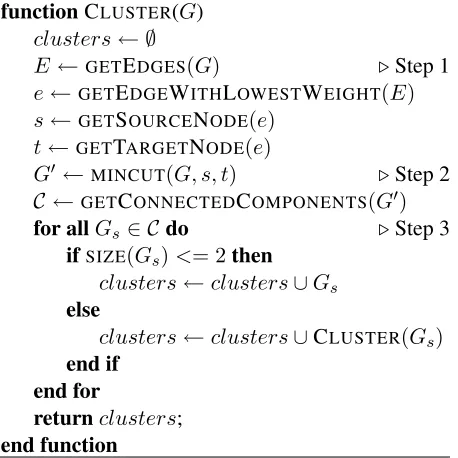
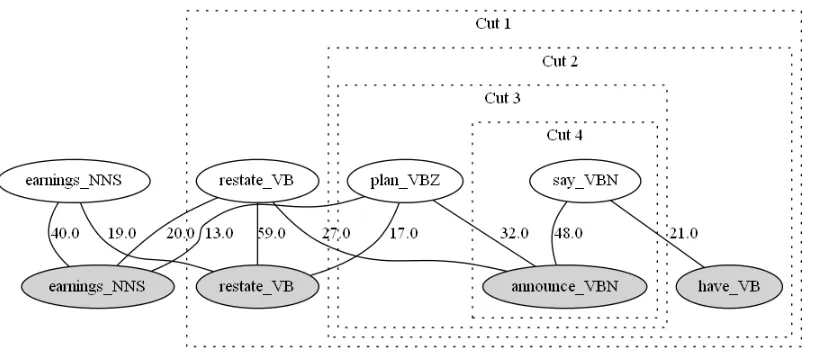
As our goal is to induce clusters that correspond to pairs of similar predicates, we set a maximum num-ber of two nodes per cluster as stopping criterion. Given an input graphG, our algorithm recursively applies Mincuts in three steps as described in Figure 2. Step 1 identifies the edgeewith lowest weight in the given graphG. Step 2 performs the actual Min-cut operation on G. Finally, the stopping criterion and recursion are applied in Step 3. An example of a clustered graph is illustrated in Figure 1.
The advantage of our method compared to off-the-shelf clustering techniques is two-fold: On the one hand, the clustering algorithm is free of any pa-rameters, such as the number of clusters or a clus-tering threshold, that require fine-tuning. On the other hand, the approach makes use of a termina-tion criterion that very well represents the nature of the goal of our task, namely to align pairs of predi-cates across comparable texts. The next section pro-vides empirical evidence for the advantage of this approach.
5 Experiments
vari-Figure 1: The predicates of two sentences (white: “The company has said it plans to restate its earnings for 2000 through 2002.”; grey: “The company had announced in January that it would have to restate earnings (. . . )”) from the Microsoft Research Paragraph Corpus are aligned by computing clusters with minimum cuts.
ous baselines, as well as results for these baselines and the model presented above.
5.1 Settings
In order to benchmark our model against tradi-tional methods for word alignment, we first apply our graph-based alignment model (Full) on three sentence-based paraphrase corpora. This model uses the similarity measures defined in Section 4.2 and the clustering algorithm introduced in Section 4.3.
In a second experiment, we evaluate Fullon our novel task of inducing predicate alignments across comparable monolingual texts, using theGigaPairs data set described in Section 3. We evaluate against the manually annotated gold alignments in the test data set described in Section 3.2. To gain more in-sight into the performance of the various similar-ity measures included in the Full model, we eval-uate simplified versions that omit individual similar-ity measures (Full–[measure name]).
The relative differences in performance against various baselines will help us quantify the differ-ences and difficulties between a traditional sentence-based word alignment setting and our novel align-ment task that operates on full texts.
5.1.1 Sentence-level Alignment Setting
For sentence-based predicate alignment we make use of the following three corpora that are word-aligned subsets of the paraphrase collections de-scribed in (Cohn et al., 2008):MTCconsists of 100
sentence pairs from the Multiple-Translation Chi-nese Corpus (Huang et al., 2002),Leaguescontains 100 sentential paraphrases from two translations of Jules Verne’s “Twenty Thousand Leagues Under the Sea”, and MSR is a sub-set of the Microsoft Research Paraphrase Corpus (Dolan and Brockett, 2005), consisting of 130 sentence pairs. All three paraphrase collections are in English.
Results for these experiments are reported in Sec-tion 5.3.1. Note that in order to determine alignment candidates, we apply the same pre-processing steps as used for the annotation of our corpus. The se-mantic parser identified an average number of 3.8, 5.1 and 4.7 predicates per text (i.e., per paraphrase sentence) inMTC,LeaguesandMSR, respectively. All models are evaluated against the subset of gold standard alignments (cf. Cohn et al. (2008)) between pairs of words marked as predicates.
5.1.2 Text-level Alignment Setting
[image:7.612.106.513.54.229.2]MTC Leagues MSR
Precision Recall F1 Precision Recall F1 Precision Recall F1
LemmaId 25.1** 74.9 37.6** 31.5** 67.2 42.9** 42.3** 90.8 57.7**
Greedy 74.8** 88.3** 81.0 75.0** 86.0** 80.1 80.7** 97.0** 88.1
WordAlign 99.3 86.6 92.5 98.7 78.5 87.4 99.5 96.0* 97.7*
[image:8.612.71.549.55.141.2]Full 92.3 72.2 81.1 92.7 69.4 79.4 94.5 88.3 91.3
Table 1: Results for sentence-based predicte alignment in the three benchmark settingsMTC,LeaguesandMSR(all numbers in %); results that significantly differ fromFullare marked with asterisks (* p<0.05; ** p<0.01).
a threshold on predicate similarity for adding edges. We tested all thresholds from 1.5 to 4.0 with a step-size of 0.25 and found 2.5 to perform best. This threshold is applied in the evaluation of all graph-based models.
5.2 Baselines
A simple baseline for both settings is to align all predicates whose lemmas are identical. This base-line, henceforth calledLemmaId, is computed as a lower bound for all settings. In order to assess the benefits of the clustering step, we propose a second baseline that uses the same similarity measures and thresholds as ourFullmodel, but omits the cluster-ing step described in Section 4.3. Instead, it greed-ily computes as many 1-to-1 alignments as possible, starting from the highest similarity to the learned threshold (Greedy).
As a more sophisticated baseline, we make use of alignment tools commonly used in sta-tistical machine translation (SMT). For the three sentence-based paraphrase settingsMTC,Leagues and MSR, Cohn et al. (2008) readily provide GIZA++ (Och and Ney, 2003) alignments as part of their word-aligned paraphrase corpus. For the experiments in theGigaPairs setting, we train our own word alignment model using the state-of-the-art word alignment tool Berkeley Aligner (Liang et al., 2006). As word alignment tools require pairs of sentences as input, we first extract paraphrases in the latter setting using a re-implementation of the para-phrase detection system by Wan et al. (2006).8 In the following section, we abbreviate both baselines using SMT alignment tools asWordAlign.
8Note that the performance of this system lies slightly be-low the state-of-the-art results reported by Socher et al. (2011) However, we were not able to reproduce the results of Socher et al. using the publicly available release of their software.
5.3 Results
We measure precision as the number of predicted alignments that are annotated in the gold standard divided by the total number of predictions. Recall is measured as the number of correctly predicted
surealignments divided by the total number ofsure
alignments in the gold standard. This conforms to evaluation measures used for word alignment mod-els in SMT (Och and Ney, 2003). Following Cohn et al. (2008), we subsequently compute the F1-score
as the harmonic mean between precision and recall. We compute statistical significance of result dif-ferences with a paired t-test (Cohen, 1995) over the affected test set documents and provide correspond-ing significance levels where appropriate.
5.3.1 Sentence-level Predicate Alignment
The results for MTC, Leagues and MSR are pre-sented in Table 1. The numbers indicate that WordAlignconsistently outperforms all other mod-els on the three data sets in terms of F1-score.
Sta-tistical significance of result differences between WordAlignandFullcan only be observed for recall andF1-score on theMSRdata set (p<0.05). Other
differences are not significant due to high variance of results compared to data set sizes.
model in terms of precision and F1-score. The
per-formance differences betweenGreedyandFullare statistically significant (p<0.01) regarding precision and recall.
5.3.2 Text-level Predicate Alignment
We now turn to the experiments on our own data set, GigaPairs, which comprises full documents of unequal lengths instead of pairs of single sen-tences. Table 2 presents the results for our full model and the three baselines. From all four approaches, WordAlignyields lowest performance. We observe two main reasons for this: On the one hand, sen-tence paraphrase detection does not perform per-fectly. Hence, the extracted sentence pairs do not always contain gold alignments. On the other hand, even sentence pairs that contain gold alignments are generally less parallel than in the previous settings, which make them harder to align. The increased dif-ficulty can also be seen in the results for theGreedy baseline, which only achieves an F1-score of 20.1%
in this setting. In contrast, we observe that the ma-jority of all sure alignments (60.3%) can be retrieved by applying theLemmaIdmodel.
The Full model achieves a recall of 46.6%, but it significantly outperforms LemmaId(p<0.01) in terms of precision (58.7%, +18.4 percentage points). This is an important factor for us, as we plan to use the alignments in subsequent tasks. With 52.0%, Fullachieves the best overall F1-score.
Ablating similarity measures. All aforemen-tioned results were conducted in experiments with a uniform weighting scheme of similarity measures as introduced in Section 4.3. Table 3 shows the per-formance impact of individual similarity measures by removing them completely (i.e., setting their weight to 0.0). The numbers indicate that not all measures contribute positively to the overall perfor-mance when using equal weights. However, a signif-icant difference can only be observed when remov-ing the argument similarity measure, which drasti-cally reduces the results. This clearly highlights the importance of incorporating the context of individ-ual predications in this task.
Tuning weights. Subsequently, we tested various combinations of weights on our development set in order to estimate a good overall weighting scheme.
Precision Recall F1 LemmaId 40.3** 60.3** 48.3
Greedy 19.6** 20.6** 20.1** WordAlign 19.7** 15.2** 17.2**
[image:9.612.316.514.57.126.2]Full 58.7 46.6 52.0
Table 2: Results forGigaPairs(all numbers in %); re-sults that significantly differ fromFullare marked with asterisks (* p<0.05; ** p<0.01).
Precision Recall F1
Full–WN 58.9 48.0 52.9
Full–VN 57.3 48.7 52.6
Full–Dist 54.3 42.8 47.9
Full–Args 40.1** 24.0** 30.0**
Full 58.7 46.6 52.0
Full+tuned 59.7** 50.7** 54.8**
Table 3: Impact of removing individual measures and us-ing a tuned weightus-ing scheme (all numbers in %); results that significantly differ fromFullare marked with aster-isks (* p<0.05; ** p<0.01).
This tuning procedure is implemented as a brute-force technique, in which we fix the weight of one similarity measure and allow all other measures to receive a weight assignment between 0.25 to 5.0 times the fixed weight. Finally, the resulting weights are normalized to sum to 1.0. We found the best per-forming weighting scheme to be 0.09, 0.48, 0.24 and 0.19 forλ1, . . . , λ4, respectively (cf. Eq. (2), Section
4). The performance gains of the resulting model (Full+tuned) can be seen in Table 3. Comput-ing statistical significance of the result differences between Full+tuned and all baseline models con-firmed significant improvements (p<0.01) for both precision and F1-score.
5.4 Error Analysis
We perform an error analysis on the output of Full+tuned on the development set of GigaPairs in order to determine re-occurring problems. In to-tal, the model missed 13 out of 35 sure alignments (Type I errors) and predicted 23 alignments not an-notated in the gold standard (Type II errors).
[image:9.612.313.515.184.278.2]been the source of 8 Type II errors (35%). We ob-serve that these errors are frequently related to pred-icates, such as “say” and “appear”, that often occur in news texts. Altogether, we find 15 Type II errors (65%) that are due to high predicate similarity de-spite low argument overlap (cf. Example (5)).
(5) a. The US alert (. . . ) followed intelligence reports that . . .
b. The Foreign Ministry announcement called on Japanese citizens to be cautious . . .
We observe that argument overlap itself can be low even for correct alignments. This clearly indicates that a better integration of context is needed. Ex-ample (6.a) illustrates a case in which the agent of a warning event is not realized. Here, contextual in-formation is required to correctly align it to the first warning event in (6.b). This involves inference be-yond the local PAS.
(6) a. The US alert (. . . ) is one step down from a full [travel]Arg1warning [ ]Arg0.
b. Japan has issued a travel alert . . . (which) follows similar warnings [from Ameri-can and British authorities]Arg0. (. . . ) An offi-cial said it was highly unusual for [Tokyo]Arg0 to issue such a warning . . .
6 Conclusion
We presented a novel task for predicate alignment
across comparable monolingual texts, which we ad-dress using graph-based clustering with Mincuts. The motivation for this task is to acquire empirical data for studying discourse coherence factors related to argument structure realization.
As a first step, we constructed a data set of com-parable texts that provide full discourse contexts for alternative verbalizations of the same underlying events. The data set is derived from all newswire pairs found in the English Gigaword Fifth Edition and contains a total of more than 160,000 paired documents.
A subset of these pairs forms an evaluation set, annotated with gold alignments that relate predica-tions, which exhibit a (possibly partial) correspond-ing argument structure. We established that the an-notation task, while difficult, can be performed with good inter-annotator agreement (κat 0.86).
Our main contribution is a novel clustering ap-proach using Mincuts for aligning predications across comparable texts. Our experiments estab-lished that recursive clustering improves on greedy selection methods by profiting from global infor-mation encoded in the graph representation. While the Mincut-based method is in itself unsupervised, a small amount of development data is needed to tune parameters for the construction of particularly suit-able input graphs.
We tested our full model against two additional baselines: simple heuristic alignment based on iden-tical lemma forms and a combination of techniques from SMT and paraphrase detection. The evalua-tion for our novel task was complemented by a tra-ditional word alignment task using established para-phrase data sets. We determined clear differences in performance for all models for the two types of task settings. While word alignment methods from SMT outperform the competing models in the sentence-based alignment tasks, they perform poorly in the discourse setting.
In future work, we will enhance our model by incorporating more refined similarity measures in-cluding discourse-based criteria. We will further ex-plore tuning techniques, e.g., a more suitable pre-selection method for edges in graph construction, in order to increase either precision or recall. The deci-sion of optimizing towards one measure or another is clearly task-dependent. In our case, high preci-sion is favorable as we plan to learn accurate dis-course model parameters from the computed align-ments. Even though such an optimization will result in an overall lower recall, application of the align-ment model on the entire GigaPairs corpus can still provide us with a large amount of precise predicate alignments. Using this set of alignments, we will then proceed to exploit contextual information in or-der to learn a semantic model for discourse coher-ence in argument structure realization.
Acknowledgements
References
Eneko Agirre, Daniel Cer, Mona Diab, and Aitor Gonzalez-Agirre. 2012. SemEval-2012 Task 6: A pi-lot on semantic textual similarity. InProceedings of the 6th International Workshop on Semantic Evalua-tions, Montreal, Canada, June. to appear.
Regina Barzilay and Mirella Lapata. 2008. Modeling local coherence: An entity-based approach. Computa-tional Linguistics, 34(1):1–34.
Regina Barzilay and Lillian Lee. 2004. Catching the drift: Probabilistic content models, with applications to generation and summarization. InProceedings of the Human Language Technology Conference of the North American Chapter of the Association for Com-putational Linguistics,Boston, Mass., 2–7 May 2004, pages 113–120.
Anja Belz, Eric Kow, Jette Viethen, and Albert Gatt. 2009. The grec main subject reference generation challenge 2009: overview and evaluation results. In
Proceedings of the 2009 Workshop on Language Gen-eration and Summarisation, pages 79–87.
Luisa Bentivogli, Ido Dagan, Hoa Trang Dang, Danilo Giampiccolo, and Bernardo Magnini. 2009. The fifth pascal recognizing textual entailment challenge. In
Proceedings of TAC.
Anders Bj¨orkelund, Bernd Bohnet, Love Hafdell, and Pierre Nugues. 2010. A high-performance syntac-tic and semansyntac-tic dependency parser. InColing 2010: Demonstration Volume, pages 33–36, Beijing, China, August. Coling 2010 Organizing Committee.
Bernd Bohnet. 2010. Top accuracy and fast dependency parsing is not a contradiction. InProceedings of the 23rd International Conference on Computational Lin-guistics (Coling 2010), pages 89–97, Beijing, China, August. Coling 2010 Organizing Committee.
Chris Brockett. 2007. Aligning the RTE 2006 Corpus. Microsoft Research.
Peter F. Brown, Vincent J. Della Pietra, Stephan A. Della Pietra, and Robert L. Mercer. 1993. The mathematics of statistical machine translation: Parameter estima-tion. Computational Linguistics, 19:263–311. Jacob Cohen. 1960. A coefficient of agreement for
nom-inal scales. Educational and Psychological Measure-ment, 20:37–46.
Paul R. Cohen. 1995. Empirical methods for artificial intelligence. MIT Press, Cambridge, MA, USA. Trevor Cohn, Chris Callison-Burch, and Mirella
Lap-ata. 2008. Constructing Corpora for Development and Evaluation of Paraphrase Systems. 34(4).
Ido Dagan, Oren Glickman, and Bernardo Magnini. 2006. The PASCAL recognising textual entailment challenge. In J. Qui˜nonero-Candela, I. Dagan, and
B. Magnini, editors, Machine Learning Challenges, pages 177–190. Springer, Heidelberg, Germany. William B. Dolan and Chris Brockett. 2005.
Automat-ically constructing a corpus of sentential paraphrases. InProceedings of the Third International Workshop on Paraphrasing.
Christiane Fellbaum, editor. 1998. WordNet: An Elec-tronic Lexical Database. MIT Press, Cambridge, Mass.
Adrew V. Goldberg and Robert E. Tarjan. 1986. A new approach to the maximum flow problem. In Pro-ceedings of the eighteenth annual ACM symposium on Theory of computing, pages 136–146, New York, NY, USA.
Barbara J. Grosz, Aravind K. Joshi, and Scott Weinstein. 1995. Centering: A framework for modeling the lo-cal coherence of discourse. Computational Linguis-tics, 21(2):203–225.
Weiwei Guo and Mona Diab. 2011. Semantic topic mod-els: Combining word distributional statistics and dic-tionary definitions. InProceedings of the 2011 Con-ference on Empirical Methods in Natural Language Processing, pages 552–561, July.
Shudong Huang, David Graff, and George Doddington. 2002. Multiple-Translation Chinese Corpus. Linguis-tic Data Consortium, Philadelphia.
Karin Kipper, Anna Korhonen, Neville Ryant, and Martha Palmer. 2008. A Large-scale Classification of English Verbs. 42(1):21–40.
Thomas K. Landauer and Susan T. Dumais. 1997. A so-lution to Plato’s problem: The Latent Semantic Anal-ysis theory of the acquisition, induction, and represen-tation of knowledge. Psychological Review, 104:211– 240.
Percy Liang, Benjamin Taskar, and Dan Klein. 2006. Alignment by agreement. InNorth American Associ-ation for ComputAssoci-ational Linguistics (NAACL), pages 104–111.
Dekang Lin. 1998. An information-theoretic defini-tion of similarity. In Proceedings of the 15th Inter-national Conference on Machine Learning,Madison, Wisc., 24–27 July 1998, pages 296–304.
Bill MacCartney, Michael Galley, and Christopher D. Manning. 2008. A phrase-based alignment model for natural language inference. InProceedings of the 2008 Conference on Empirical Methods in Natural Language Processing,Waikiki, Honolulu, Hawaii, 25-27 October 2008.
Adam Meyers, Ruth Reeves, and Catherine Macleod. 2008. NomBank v1.0. Linguistic Data Consortium, Philadelphia.
dis-course. InProceedings of the 23rd International Con-ference on Computational Linguistics (Coling 2010), Beijing, China, August. Coling 2010 Organizing Com-mittee.
Shachar Mirkin, Ido Dagan, and Sebastian Pad´o. 2010b. Assessing the role of discourse references in entail-ment inference. In Proceedings of the 48th Annual Meeting of the Association for Computational Linguis-tics,Uppsala, Sweden, 11–16 July 2010.
Jeff Mitchell and Mirella Lapata. 2010. Composition in Distributional Models of Semantics. 34(8):1388– 1429.
Franz Josef Och and Hermann Ney. 2003. A Systematic Comparison of Various Statistical Alignment Models. 29(1):19–51.
Martha Palmer, Daniel Gildea, and Paul Kingsbury. 2005. The proposition bank: An annotated corpus of semantic roles. Computational Linguistics, 31(1):71– 105.
Robert Parker, David Graff, Jumbo Kong, Ke Chen, and Kazuaki Maeda. 2011. English Gigaword Fifth Edi-tion. Linguistic Data Consortium, Philadelphia.
Ted Pedersen, Siddharth Patwardhan, and Jason Miche-lizzi. 2004. WordNet::Similarity – Measuring the re-latedness of concepts. In Companion Volume to the Proceedings of the Human Language Technology Con-ference of the North American Chapter of the Asso-ciation for Computational Linguistics,Boston, Mass., 2–7 May 2004, pages 267–270.
Tom Richens. 2008. Anomalies in the wordnet verb hier-archy. InProceedings of the 22nd International Con-ference on Computational Linguistics (Coling 2008), pages 729–736. Association for Computational Lin-guistics.
Michael Roth and Anette Frank. 2012. Aligning pred-icate argument structures in monolingual comparable texts: A new corpus for a new task. InProceedings of the First Joint Conference on Lexical and Computa-tional Semantics, Montreal, Canada, June.
Josef Ruppenhofer, Caroline Sporleder, Roser Morante, Collin Baker, and Martha Palmer. 2010. SemEval-2010 Task 10: Linking Events and Their Participants in Discourse. InProceedings of the 5th International Workshop on Semantic Evaluations, pages 45–50, Up-psala, Sweden, July.
Richard Socher, Eric H. Huang, Jeffrey Pennington, An-drew Y. Ng, and Christopher D. Manning. 2011. Dy-namic pooling and unfolding recursive autoencoders for paraphrase detection. InAdvances in Neural Infor-mation Processing Systems (NIPS 2011).
Ivan Titov and Mikhail Kozhevnikov. 2010. Bootstrap-ping semantic analyzers from non-contradictory texts.
InProceedings of the 48th Annual Meeting of the Asso-ciation for Computational Linguistics,Uppsala, Swe-den, 11–16 July 2010, pages 958–967.
Christopher Walker, Stephanie Strassel, Julie Medero, and Kazuaki Maeda. 2006. ACE 2005 Multilin-gual Training Corpus. Linguistic Data Consortium, Philadelphia.
Stephen Wan, Mark Dras, Robert Dale, and Cecile Paris. 2006. Using dependency-based features to take the ”Para-farce” out of paraphrase. InProceedings of the Australasian Language Technology Workshop, pages 131–138.
Ralph Weischedel, Martha Palmer, Mitchell Marcus, Ed-uard Hovy, Sameer Pradhan, Lance Ramshaw, Nian-wen Xue, Ann Taylor, Jeff Kaufman, Michelle Fran-chini, Mohammed El-Bachouti, Robert Belvin, and Ann Houston. 2011. OntoNotes Release 4.0. Lin-guistic Data Consortium, Philadelphia.
Sander Wubben, Antal van den Bosch, Emiel Krahmer, and Erwin Marsi. 2009. Clustering and matching headlines for automatic paraphrase acquisition. In